Brigham Young University Law School
BYU Law Digital Commons
Faculty Scholarship
2017
Patent Pacifism
Clark D. Asay
BYU Law, [email protected]
Follow this and additional works at:
https://digitalcommons.law.byu.edu/faculty_scholarship
Part of the
Intellectual Property Law Commons
This Article is brought to you for free and open access by BYU Law Digital Commons. It has been accepted for inclusion in Faculty Scholarship by an authorized administrator of BYU Law Digital Commons. For more information, please [email protected].
Recommended Citation
Patent Pacifism
Clark D. Asay*
ABSTRACT
Over the last decade, much of the patent law literature has focused on the problem of "patent trolls," or patent owners who don't make products, but sue others that do. The basic complaint against these types of entities is that they impose a tax on innovation without providing offsetting societal benefits. Fur-thermore, their patent assertions have been on the rise, with a significant per-centage of patent suits now attributable to them. In short, the troll phenomenon suggests a problem of excessive patent assertions.
But despite the importance of the troll phenomenon, the fact remains that most patents are never asserted, or are asserted less than they could be. Under-assertion of patents thus appears to be more prevalent than over-Under-assertion. Yet, beyond noting a set of generic economic considerations that may lead to this outcome, the literature fails to provide systematic, industry-specific assess-ments of why patent owners choose to forego asserting their rights in so many cases. And the generic nature of these assessments is particularly problematic given that patents play significantly different roles from one industry to the next, as scholars have noted for some time.
This Article addresses these issues by providing an industry-specific, in-formal model for theorizing why patent owners forego asserting their rights in so many cases (and why they may not in others). It briefly applies this model to four industries: software, pharmaceuticals, biotechnology, and semiconduc-tors. The Article then explores some potential implications of this industry-specific model. In particular, this Article suggests that high barriers to patent assertion in an industry may, ironically, result in increased patent trolling in the industry. Hence, this Article provides guidance to policymakers by helping explain the rise of patent assertions in some industries, such as software, as well as helping to identify other industries, such as biotechnology, that may be increasingly at risk of patent trolling.
* Associate Professor of Law, BYU Law School. M.Phil., University of Cambridge. J.D., Stanford Law School. For helpful comments on this Article, many thanks to Jonas Anderson, Stephanie Bair, Christopher Bradley, Chris Buccafusco, Dan Burk, Jorge Contreras, Brian Frye, Janet Freilich, Paul Gugliuzza, Tim Holbrook, Matt Jennejohn, Peter Karol, Irina Manta, Jan Osei-Tutu, Nicholson Price, Greg Reilly, Alex Roberts, Zvi Rosen, Rachel Sachs, Paul Stancil, and participants at the 2016 semiannual Junior IP Scholars Association Workshop, the 2016 IP Scholars Conference, the 2016 Rocky Mountain Junior Scholars Conference, a faculty workshop at the University of Kentucky School of Law, and Hofstra Law's Fall 2016 IP Colloquium. May 2017 Vol. 85 No. 3
646 THE GEORGE WASHINGTON LAW REVIEW
TABLE OF CONTENTS
INTRODUCTION ... 646
I. THE THEORIES BEHIND PATENTS ... 653
II. THE REASONS BEHIND PATENT NON-AsSERTION... 657
A. Theoretical Incompleteness ... ... 657
B. Economic Disincentives ... 659
III. INDUSTRY-SPECIFIC PATENT NON-ASSERTION... 667
A. The Special Case of Software ... 669
1. The Low Value of Software Patents ... 670
2. Search Costs ... 672 3. Negotiation Costs... 674 4. Litigation Costs... 675 5. Invalidity Costs ... 676 6. Reputational Costs ... 678 7. Dynamic Costs... 682
8. M itigating the Costs ... 683
B. The Special Case of Pharmaceuticals... 685
1. The High Value of Pharmaceutical Patents ... 685
2. Search Costs ... ... ... 689 3. Negotiation Costs... 690 4. Litigation Costs... 692 5. Invalidity Costs ... 694 6. Reputational Costs ... 695 7. Dynamic Costs... 696
C. The Biotechnology and Semiconductor Industries ... 697
1. Biotechnology ... 697
2. The Semiconductor Industry ... 702
IV. IMPLICATIONS ... 706
CONCLUSION ...
710
INTRODUCTION
On July 6, 2010, the United States Patent and Trademark Office
("USPTO") granted Amazon.com, Inc. a patent that, according to
multiple sources, appeared to cover Barnes & Noble's Nook e-Reader, Amazon's primary competition in the e-Reader market at the time.' If the patent did cover the Nook, it would provide Amazon with
1 Devin Coldewey, Amazon's Original Kindle Patent Could Spell Trouble for
Competi-tors, TECHCRUNCH (July 6, 2010), http://techcrunch.com/2010/07/06/amazons-original-kindle-pat ent-could-spell-trouble-for-competitors/; Ryan Fleming, Amazon Wins e-Reader Patent, How Will This Affect the Nook, DIGITAL TRENDS (July 7, 2010, 3:04 PM), http://www.digitaltrends.
comlcool-techlamazon-wins-e-reader-patent-how-will-this-affect-the-nook/; Nilay Patel, Amazon
PATENT PACIFISM
significant remedies against Barnes & Noble, including potential in-junctive relief, monetary damages, and attorney's fees.2 All Amazon
had to do was assert the patent against Barnes & Noble to find out. Yet Amazon never did formally assert its patent against Barnes & No-ble.3 Given the possible benefits of doing so, the question looms large: why not?
This question becomes even more interesting in context. Over the past decade, scholars have devoted most of their attention to the op-posite issue: excessive assertion of patent rights. For instance, the "non-practicing entity," "patent-assertion entity," or "patent troll" problem-where patent owners neither make nor provide goods and services to the public, instead asserting patents against others that do-has resulted in a voluminous literature.4 The basic complaint against patent trolls is that they abuse patent rights for their own mon-etary benefit, while providing no commensurate benefit to society.5
This trolling problem has become such a concern that it has attracted the attention of the President of the United States,6 Congress,7 the Kindle Dual-Screen e-Reader Patent Granted, Barnes & Noble Nook Potentially in Trouble,
EN-GADGET (July 6, 2010), http://www.engadget.com/2010/07/06/amazon-kindle-dual-screen-e-reader-patent-granted-barnes-and-nobl/.
2 See 35 U.S.C. §§ 283-285 (2012) (laying out the remedies available for infringement of a
patent, including injunctive relief, money damages, and attorney's fees).
3 It remains possible that the two parties entered into a license agreement with respect to
the patent, which, if true, represents a form of rights assertion that is simply difficult to account for because of the secret nature of many such transactions.
4 The "troll" literature would be difficult to capture in a single footnote. For some of the
more prominent studies, see James Bessen & Michael J. Meurer, The Direct Costs from NPE Disputes, 99 CORNELL L. REV. 387 (2014); Robin Feldman, The Pace of Change: Non-Practicing Entities and the Shifting Legal Landscape, 18 CHAP. L. REV. 635 (2015); John M. Golden, "Patent Trolls" and Patent Remedies, 85 TEX. L. REV. 2111 (2007); Mark A. Lemley & A. Douglas Melamed, Missing the Forest for the Trolls, 113 COLUM. L. REV. 2117 (2013); Gerard N. Mag-liocca, Blackberries and Barnyards: Patent Trolls and the Perils of Innovation, 82 NOTRE DAME
L. REV. 1809 (2007); Michael Risch, Patent Troll Myths, 42 SETON HALL L. REV. 457 (2012); James F. McDonough III, Comment, The Myth of the Patent Troll: An Alternative View of the Function of Patent Dealers in an Idea Economy, 56 EMORY L.J. 189 (2006).
5 Lemley & Melamed, supra note 4, at 2124 ("There is widespread belief that trolls
im-pose greater costs on technology users and society as a whole than do practicing entities, and that they provide little social benefit to offset those costs.").
6 Edward Wyatt, Obama Orders Regulators to Root Out 'Patent Trolls,' N.Y. TIMES (June 4, 2013), http://www.nytimes.com/2013/06/05/business/president-moves-to-curb-patent-suits.html?_r=0.
7 There have been numerous legislative proposals over the years aimed at addressing "troll" behavior. For one recent example, see Caroline Craig, Congress to Patent Trolls: You Shall Not Pass, INFOWORLD (Sept. 18, 2015), http://www.infoworld.com/article/2984696/govern ment/can-congress-stop-the-patent-trolls.html.
THE GEORGE WASHINGTON LAW REVIEW
Federal Trade Commission,8 numerous state legislatures,9 the popular press,0 and frequent academic conferences."
But despite the importance of these topics, the fact remains that the vast majority of patents are likely never asserted, either formally in litigation or informally as part of a demand letter, settlement, or licensing deal.12 Indeed, the USPTO has issued hundreds of thousands of patents each year for decades, but the number of patent lawsuits per year during the same time period-and the number of patents involved in those lawsuits-ranges in the thousands.13 And while it is difficult to calculate the number of other types of patent assertions such as demand letters, settlements, and licensing deals because of their non-public nature, there are good reasons to believe that their numbers are few relative to the overall number of issued patents.14 In other words, while this Article does not (and cannot's) define the total number of patents that are asserted, it nonetheless remains true that many-likely most-patents are never asserted in any manner. But if patent trolls have been able to game the patent system for great gain
8 Grant Gross, FTC Will Target Patent Trolls, Commissioner Says, PCWORLD (Dec. 10, 2014, 1:35 PM), http://www.pcworld.com/article/2858392/ftc-will-target-patent-trolls-commission er-says.html.
9 Jonathan Griffin, 2015 Patent Trolling Legislation, NAT'L CONF. OF ST. LEGISLATURES
(June 15, 2016), http://www.ncsl.org/research/financial-services-and-commerce/2015-patent-trol ling-legislation.aspx (indicating that twenty-seven states have enacted anti-patent troll legislation).
10 The number of popular press articles on trolls is too large to list here. For a sampling of such articles from just one popular technology news site, see Patent Trolls, WIRED, http:// www.wired.com/tag/patent-trolls/ (last visited May 31, 2017).
11 See, e.g., Patent Trolls and Patent Reform, STAN. L. SCH., https://law.stanford.edu/event/ patent-trolls-and-patent-reform/ (last visited May 31, 2017).
12 Mark A. Lemley, Rational Ignorance at the Patent Office, 95 Nw. U. L. REv. 1495, 1497, 1501-08 (2001) ("[Tlhe overwhelming majority of patents are never litigated or even licensed."); Kimberly A. Moore, Worthless Patents, 20 BERKELEY TECH. L.J. 1521, 1521-22 (2005) ("Each
year the United States Patent and Trademark Office (PTO) receives 350,000 patent applications and grants approximately 180,000 patents. Despite the large number of patent grants annually, patent holders file only 3,000 patent lawsuits involving approximately 4,500 patents each year to
enforce patents against infringers." (footnotes omitted)).
13 PRICEWATERHOUSECOOPERS, 2016 PATENT LITIGATION STUDY: ARE WE AT AN IN-FLECTION POINT? 1 (2016), http://www.pwc.com/us/en/forensic-services/publications/assets/
2
016-pwc-patent-litigation-study.pdf.
14 Lemley, supra note 12, at 1498, 1503.
15 To address this issue, some have called for a requirement that all license deals be regis-tered as part of a national database. See id. at 1503 n.38. This proposal has never been imple-mented, however. See U.S. PATENT & TRADEMARK OFFICE, MANUAL OF PATENT EXAMINING PROCEDURE ch. 313 (2015), https://www.uspto.gov/web/offices/pac/mpep/mpep-0
3 0 0.pdf
(indi-cating that license agreements "will generally be recorded," even though there is no recording requirement).
[Vol. 85:645 648
PATENT PACIFISM
by systematically asserting patents, as many claim,16 it may be surpris-ing to find that so many patents remain on the sidelines. What, then, accounts for this phenomenon of widespread patent non-assertion?
Previous scholarship has often assessed this question generally, noting that the high costs of litigation, coupled with the low expected value of recoverable damages, deters many parties from asserting their rights.17 Other scholars have zeroed in on patent non-assertion in particular, describing a related set of generic economic reasons for why parties forego asserting their patents.1 8 For instance, asserting a
patent can be time consuming and costly, and is fraught with uncer-tainty and risks.19 Furthermore, most patents may be of little actual commercial value, even losing whatever value they have over time.20 In sum, in many-perhaps most-cases, the likely costs of asserting a
16 See Jennifer H. Wu & Jenny C. Wu, Giving Teeth to 35 U.S.C. § 285 to Award Attorneys' Fees Against Vexatious Plaintiff Patentees, FED. LAw., Jan/Feb 2015, at 44, 46-47. See generally
EXEc. OFFICE OF THE PRESIDENT, PATENT ASSERTION AND U.S. INNOVATION (2013), https://
obamawhitehouse.archives.gov/sites/default/files/docs/patent-report.pdf.
17 See, e.g., Louis Kaplow, Private Versus Social Costs in Bringing Suit, 15 J. LEGAL STUD. 371, 371 (1986); Peter S. Menell, A Note on Private Versus Social Incentives to Sue in a Costly Legal System, 12 J. LEGAL STUD. 41, 41 (1983); Steven Shavell, The Fundamental Divergence Between the Private and the Social Motive to Use the Legal System, 26 J. LEGAL STUD. 575, 577-79 (1997) [hereinafter Shavell, Fundamental Divergence]; Steven Shavell, The Social Versus the Private Incentive to Bring Suit in a Costly Legal System, 11 J. LEGAL STUD. 333, 333-34
(1982); Tim Wu, Tolerated Use, 31 COLUM. J.L. & ARTS 617, 619 (2008).
18 See Lemley, supra note 12, at 1503 (showing that many issued patents are abandoned,
presumably because of their weak economic prospects); Robert P. Merges, As Many as Six Im-possible Patents Before Breakfast: Property Rights for Business Concepts and Patent System Re-form, 14 BERKELEY TECH. L.J. 577, 603 (1999) (concluding that most patented technologies fail commercially and present few economic advantages).
19 Damon C. Andrews, Why Patentees Litigate, 12 CoLUM. Sa. & TECH. L. REV. 219, 223-38 (2011) (reviewing a variety of disincentives for patentees to assert their rights, including the high costs of and "unpredictable results" of patent litigation); Jonathan M. Barnett, Property as Process: How Innovation Markets Select Innovation Regimes, 119 YALE L.J. 384, 397 (2009) (noting "that median patent discovery and litigation costs are $2.5 million and $4 million respec-tively"); Christopher R. Leslie, The Anticompetitive Effects of Unenforced Invalid Patents, 91 MINN. L. REV. 101, 134-35 (2006) ("Uncertainty increases the deterrent effect of invalid patents
... because courts routinely make mistakes in patent litigation."); Kimberly A. Moore, Forum Shopping in Patent Cases: Does Geographic Choice Affect Innovation?, 79 N.C. L. REV. 889, 908-09 (2001) (noting that the average length of patent litigation often exceeds a year).
20 Andrews, supra note 19, at 229-30; Edmund W. Kitch, Property Rights in Inventions, Writings, and Marks, 13 HARV. J.L. & PUB. POL'Y 119, 122-23 (1990) (concluding that most patents are so narrow that they are relatively worthless); Gideon Parchomovsky & R. Polk Wag-ner, Patent Portfolios, 154 U. PA. L. REV. 1, 5-6 (2005) ("The true value of patents inheres not in their individual worth, but in their aggregation into a collection of related patents-a patent portfolio.").
THE GEORGE WASHINGTON LAW REVIEW
patent outweigh the likely benefits, and patentees consequently forego asserting their rights.2 1
Yet while these economic considerations make a great deal of sense,2 2 they fail to account for patent non-assertion with the nuance it
deserves. Indeed, rational economic behavior in one context may be entirely irrational in another, particularly because different industries are subject to different economic influences.23 Furthermore, clumping together these disincentives to assert patents fails to account for how these factors may interact and affect one another. Previous scholar-ship explaining patent non-assertion is thus lacking in these several key respects.
This Article attempts to address these gaps by assessing patent non-assertion using an informal, industry-specific theoretical model. It analyzes patent non-assertion in an industry-specific manner for sev-eral reasons. First, though the requirements of patentability are more or less uniform across industries, scholars have long argued that, in
reality, patents and patent law are industry specific. 2 4 In other
words,
patents play different roles depending on the industry,25 and courts often apply the requirements of patent law differently depending on the implicated technology and industry.26 Second, some industries, in particular the pharmaceutical sector, include a regulatory overlay that may significantly affect whether a party chooses to forego asserting its patent rights.27
21 Andrews, supra note 19, at 248.
22 Paul Stancil, Balancing the Pleading Equation, 61 BAYLOR L. REV. 90, 93 (2009) ("U.S. civil litigation is in many ways an inherently economic enterprise .... ).
23 See, e.g., Jay Berman & Janet Pfleeger, Which Industries Are Sensitive to Business Cy-cles?, MONTHLY LAB. REV., Feb. 1997, at 19, 19 (discussing how different industries respond differently to swings in business cycles, thereby suggesting that different industries are subject to different economic models).
24 See DAN L. BURK & MARK A. LEMLEY, THE PATENT CRISIS AND How THE COURTS CAN SOLVE IT 62 (2009) (arguing that courts apply patent law differently depending on the industry and advocating that courts should increase such tailoring to better realize the purposes of patent law); Dan L. Burk & Mark A. Lemley, Is Patent Law Technology-Specific?, 17 BERKE-LEY TECH. L.J. 1155, 1205-06 (2002) (same); Dan L. Burk & Mark A. Lemley, Policy Levers in Patent Law, 89 VA. L. REV. 1575, 1581-95 (2003) [hereinafter Burk & Lemley, Policy Levers] (arguing that innovation is industry specific and that patent law should more readily adapt to that reality).
25 JAMES BESSEN & MICHAEL J. MEURER, PATENT FAILURE: How JUDGES,
BUREAU-CRATS, AND LAWYERS PUT INNOVATORS AT RISK 181-83 (2008) (arguing that the patent system
imposes more costs than benefits in most technology sectors).
26 See supra note 24.
27 See, e.g., Rebecca S. Eisenberg, The Role of the FDA in Innovation Policy, 13 MICH. TELECOMM. & TECH. L. REV. 345 (2007) (discussing the FDA's regulatory overlay and the role of patents in the development of biomedical research); Richard A. Merrill, The Architecture of
[Vol. 85:645
PATENT PACIFISM
As such, explaining patent non-assertion is almost certainly in-dustry specific as well. Different costs and risks arise depending on the industry, and those differences matter in terms of theorizing whether and why a particular patent owner will forego asserting its rights. This Article first charts out some of these different costs and how they may interact, thereby building a model for assessing patent non-assertion across different industries. It then applies this model to four specific industries: software, pharmaceuticals, biotechnology, and semiconduc-tors. Scholars often focus on these industries because of their overall importance to the economy,28 and this Article uses them as case
stud-ies for similar reasons.
Of course, it is important to stress at the outset that
industries-and patents industries-and parties within them-are also not monolithic.29 In the
information technology industry, for instance, Facebook likely faces different costs and benefits in asserting its patents than, say, a start-up or patent troll in the same sector. Furthermore, different parties within an industry may possess different types of patents in terms of quality and quantity that may also affect whether they choose to assert
their patents.3 0
Nonetheless, though no theory can capture all relevant nuances,3 1 an industry-specific theoretical model has several advantages. First, it allows for identification of broader trends within industries that previ-ous studies of patent non-assertion have failed to account for. And second, an industry-specific model provides a useful theoretical basis for further studies of specific industries and the different factors that affect how parties within those industries act, with respect to patents and otherwise.
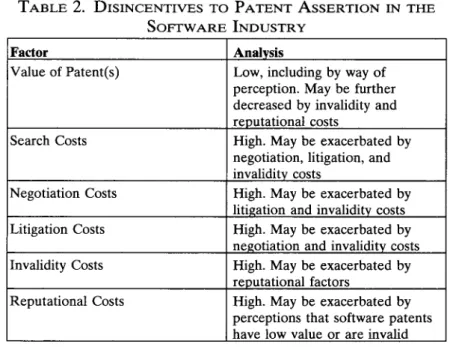
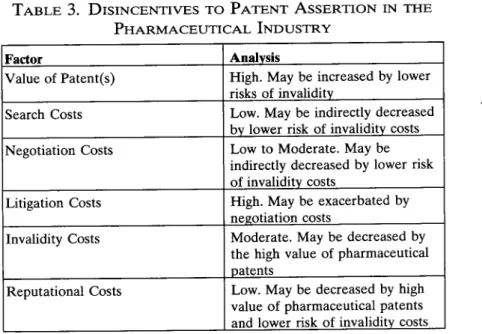
Overall, this Article's industry-specific theoretical model finds that disincentives to patent assertion are particularly high in the software industry. The semiconductor industry similarly exhibits strong disincentives to patent assertion, though typically not as high as
Government Regulation of Medical Products, 82 VA. L. REV. 1753 (1996) (providing an overview of how the FDA regulates medical products).
28 Benjamin M. Roin, The Case for Tailoring Patent Awards Based on Time-to-Market, 61 UCLA L. REV. 672, 687 (2014).
29 See, e.g., W. Nicholson Price II, Big Data, Patents, and the Future of Medicine, 37 CAR-DOzo L. REV. 1401, 1452-53 (2016) (stressing that the pharmaceutical industry is not uniform in terms of the role of patents).
30 See, e.g., Jonathan H. Ashtor, Michael J. Mazzeo & Samantha Zyontz, Patents at Issue: The Data Behind the Patent Troll Debate, 21 GEO. MASON L. REV. 957, 969 (2014) (assessing the quality of patents asserted by patent trolls vis-A-vis those of manufacturing companies).
31 See generally KENNETH N. WALTZ, THEORY OF INTERNATIONAL POLITIcs 7 (1979) (ar-guing that "[a] full description would be of least explanatory power" in modeling a theory).
THE GEORGE WASHINGTON LAW REVIEW
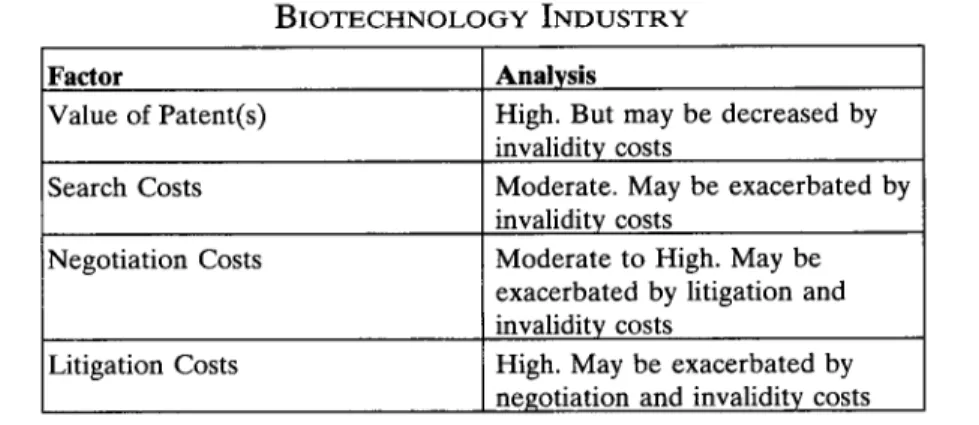
in the software industry. In the pharmaceutical industry, conversely, disincentives to patent assertion are relatively low; instead, incentives to assert pharmaceutical patents are typically high. The biotechnology industry similarly demonstrates relatively weak disincentives to patent assertion, though for a variety of reasons explored infra, incentives to assert patents in the biotechnology industry may not be as strong as they once were.
Importantly, these findings have implications for recent judicial and legislative patent law changes, many of which aim to curb exces-sive patent assertions by so-called patent trolls. Ironically, this Article finds that high barriers to patent assertion in an industry may actually increase patent assertions in the industry. This is so because those high barriers can make patent assertion too costly and risky for the patent holder, at which point many patent holders outsource those costs to patent trolls by selling or licensing to them some or all of their pat-ents. Or in other cases, the high costs may help push a company to become a patent assertion entity itself as it seeks economies of scale in patent litigation.32 And once either of these scenarios plays out, patent assertions are likely to rise, since the adopted business model de-mands it.
This, in fact, seems to be what has happened in the software in-dustry: while the industry generally exhibits high barriers to patent assertion, it has simultaneously seen an explosion in patent assertions over the last decade. And much of that explosion is attributable to patent trolling.33 This Article thus contends that high barriers to pat-ent assertion in the software industry help explain, in part, the rise in patent assertions in the industry. This industry-specific analysis, there-fore, may also help identify other industries that are increasingly at risk of increased patent trolling should barriers to patent assertion be-come too high. As this Article will explore, the biotechnology and semiconductor industries may be two such industries.
This Article has four parts. Part I provides a brief overview of the predominant theories behind patent law to highlight how these theo-ries predict how patent holders will act in the face of potential in-fringements of their rights. These theories suggest that, all else being equal, patent holders will assert their rights in the face of potential infringement. Part II then contrasts these theories with the reality that most patent rights are never asserted, even in cases where they could 32 See Kristen Osenga, Formerly Manufacturing Entities: Piercing the "Patent Troll" Rheto-ric, 47 CONN. L. REv. 435, 467-68 (2014).
33 See infra Section III.A.
[Vol. 85:645
PATENT PACIFISM
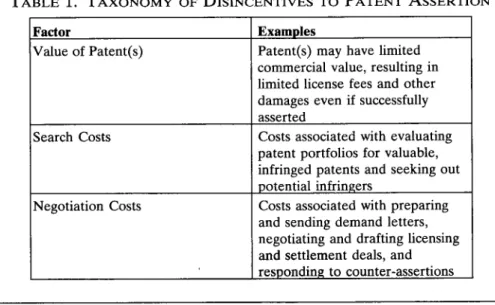
be. In reviewing some of the basic economic rationales that help ex-plain this phenomenon, this Part builds a taxonomy of different disin-centives to patent assertion. Part III applies this taxonomy to four specific industries: software, pharmaceuticals, biotechnology, and semiconductors. This application shows that the different disincentives to patent assertion play out differently depending on the industry. This Part also shows that these different categories of disincentives often have a dynamic relationship, meaning that the presence of one type of disincentive may increase or decrease the presence of another. Finally, Part IV assesses some potential implications of these industry-specific disincentives to patent assertion, including the claim that high barriers to patent assertion in an industry may ironically result in in-creased patent assertions in that industry.
I.
THE THEORIES BEHIND PATENTSThe U.S. Constitution authorizes Congress to grant inventors with exclusive rights in their discoveries in order to "promote the Pro-gress of Science and the useful Arts."34 On the basis of this provision, Congress has enacted patent laws.3 5 Patent laws grant exclusive rights
to qualifying inventors for their "discoveries."36 According to the
dominant theory behind patent rights, these exclusive rights are neces-sary because without them, inventors would have insufficient eco-nomic incentives to engage in socially beneficial inventive behavior.37 This is so, the story goes, because intellectual products such as inventive ideas have the features of public goods: they are non-rivalrous, meaning one party's use of the product does not prevent another from using the same, and they are non-excludable, meaning that it is difficult to prevent others from using such intellectual
prod-ucts.3 8 Consequently, absent rights of exclusion under patent law, third
parties could replicate the intellectual products of others without in-curring the same costs.39 Inventive parties would thus not create them
for fear of this happening. With rights of exclusion in hand,
con-34 U.S. CONST. art. I, § 8.
35 See Dotan Oliar, The (Constitutional) Convention on IP: A New Reading, 57 UCLA L. REV. 421, 463-64 (2009).
36 Id. at 458, 463.
37 Mark A. Lemley, Ex Ante Versus Ex Post Justifications for Intellectual Property, 71 U. CHI. L. REV. 129, 129-30 (2004) (articulating this rationale); Henry E. Smith, Intellectual Prop-erty as PropProp-erty: Delineating Entitlements in Information, 116 YALE L.J. 1742, 1744-45 (2007).
38 See ROBERT P. MERGES, PETER S. MENELL & MARK A. LEMLEY, INTELLECTUAL PROP-ERTY IN THE NEW TECHNOLOGICAL AGE 2 (6th ed. 2012).
39 Id. at 11-17.
THE GEORGE WASHINGTON LAW REVIEW
versely, inventive parties have the right economic incentives to invent because those rights allow them to exclude others from free-riding on their inventive ideas.4 0
To illustrate this theory in practice: a pharmaceutical company may not invest the millions of dollars it takes to develop life-saving drugs if it were true that another party could replicate the drug with-out incurring the same costs as-or any liability to-the pharmaceuti-cal company.41 And when third parties attempt to use the products of pharmaceutical companies without permission, we have plenty of evi-dence of pharmaceutical companies protecting their investments by asserting their patent rights in pharmaceutical products.42
Hence, an important part of this economic incentives story is that we would expect rights holders to assert their rights in cases where doing so helps protect their investments in creating the intellectual products. And we might expect this to be so in most cases because, all else being equal, third parties would otherwise free-ride on the efforts of the rights holders. That free-riding problem, after all, is precisely the problem patents are meant to solve.4 3
Of course, a variety of other economic considerations may affect
whether a party ultimately chooses to assert its rights; Part II will ex-amine those considerations in detail.4 4 For now, suffice it to say that
the basic economic reasoning of the dominant theory behind patent rights would appear to predict some form of patent assertion when infringement occurs.
Aside from this dominant "utilitarian" model, other important in-tellectual property law theories also appear to predict that patent owners will assert their rights when third parties infringe those rights. For instance, "prospect" and "commercialization" theories of patent
40 Id.
41 Indeed, the pharmaceutical industry is often pointed to as one of the areas where this theory applies well. See, e.g., Price, supra note 29, at 1452 (noting that "[t]he pharmaceutical and biomedical industries are typically characterized as areas where patents work fairly well" be-cause these industries require substantial upfront investment, and patent rights help recoup those investments).
42 Indeed, because pharmaceutical companies "protect the intellectual property (IP) that drugs represent and sue those who try to manufacture and sell patented drugs cheaply," some regard pharmaceutical companies as "vampires who exploit the sick and ignore the sufferings of the poor." The New Drugs War, ECoNOMIsT (Jan. 4, 2014), http://www.economist.com/news/ leaders/21592619-patents-drugs-are-interests-sick-well-industry-protection-should-not.
43 See Joseph Scott Miller, Building a Better Bounty: Litigation-Stage Rewards for Defeat-ing Patents, 19 BERKELEY TECH. L.J. 667, 680-85 (2004) (describing this theory in the patent context).
44 See infra Part II.
PATENT PACIFISM
law argue that we grant patent rights in order to incentivize inventors to further develop and commercialize their inventions.45 These types of "ex-post" theories thus focus on the post-invention incentives of parties, and theorize that granting parties rights in their inventions, if done correctly, will incentivize those parties to cultivate their inven-tions for the benefit of society.46 Another group of theories, what some call "disclosure" or "coordination" theories, similarly focuses on the post-invention incentives of creators, positing that parties will be averse to sharing their technological accomplishments with others without rights of exclusion in hand.47 This is so because, without exclu-sive rights, inventors fear they will lose the economic value of their inventions, while others will capture that value.48
Hence, if these theories hold true, we would also expect rights holders to assert their patent rights against infringers. Otherwise, such infringements would significantly undermine the incentives of patent owners to further develop their inventions, or to disclose their inven-tions to third parties or the public in general. For instance, a third party using some patented technology without a license from the rele-vant patent owner would harm that patent owner's economic pros-pects in several ways. First, the patent owner loses an economic opportunity vis-A-vis that third party. Second, the patent owner may lose economic opportunities more broadly, either because other par-45 See, e.g., Edmund W. Kitch, The Nature and Function of the Patent System, 20 J.L. &
ECON. 265 (1977) (articulating "prospect" theory). For "commercialization" theory accounts, see Michael Abramowicz, The Danger of Underdeveloped Patent Prospects, 92 CORNELL L. REV. 1065 (2007); Michael Abramowicz & John F. Duffy, Intellectual Property for Market Experimen-tation, 83 N.Y.U. L. REV. 337 (2008); F. Scott Kieff, Property Rights and Property Rules for Commercializing Inventions, 85 MINN. L. REV. 697 (2001); Ted Sichelman, Commercializing Pat-ents, 62 STAN. L. REV. 341 (2010).
46 See Lemley, supra note 37, at 130; supra note 45.
47 See WILLIAM M. LANDES & RICHARD A. POSNER, THE ECONOMIC STRUCTURE OF IN-TELLECTUAL PROPERTY LAw 326-30 (2003) (elaborating on the coordination function and value of patents); Paul J. Heald, A Transaction Costs Theory of Patent Law, 66 OHIO ST. L.J. 473, 488-89, 497 (2005) (arguing that patents help address concerns about information misappropria-tion and thus encourage informamisappropria-tion sharing); Roberto Mazzoleni & Richard R. Nelson, Eco-nomic Theories About the Benefits and Costs of Patents, 32 J. ECON. ISSUES 1031, 1039-40 (1998) (describing different strands of disclosure theory generally); Stephen Yelderman, Coordination-Focused Patent Policy, 96 B.U. L. REV. 1565 (2016).
48 See, e.g., Nancy T. Gallini, The Economics of Patents: Lessons from Recent U.S. Patent
Reform, 16 J. ECON. PERSP. 131, 132 (2002) (suggesting that patents may induce parties to dis-close information that they may otherwise withhold); Robert P. Merges, A Transactional View of Property Rights, 20 BERKELEY TECH. L.J. 1477, 1487-90 (2005) (describing how property rights, including patent rights, may induce parties to disclose information before, during, and after con-tract formation that they otherwise may withhold for fear that the value of their property will be lost).
THE GEORGE WASHINGTON LAW REVIEW
ties choose to obtain the patented technology from the original in-fringer rather than the patent owner, or these other parties may simply develop the technology themselves. Of course, the patent owner may at that point choose to assert its patent rights against any and all of these parties. But if they did so, that would simply confirm the expectation that, in accordance with these theories, patent owners will assert their rights against infringers in order to vindicate their eco-nomic interests in developing or sharing the patented technologies more broadly.
In contrast to these economic-centric theories, "natural rights" theories may, at first glance, seem less straightforward in terms of pre-dicting that rights holders will assert their rights against potential in-fringers of those rights. Natural rights theories posit that we grant patents for a variety of reasons that are not strictly economic in na-ture.49 For instance, we might grant parties rights in what they have created on the basis of their efforts, or the "labor" that they exerted in creating the intellectual product.5 0 We might also grant rights to
par-ties in their inventions because those inventions are bound up in the personality or "personhood" of the creator.5 1
Hence, if patent rights arise because of a creator's personhood or labor, the economic incentives to sue infringers may not exist because the intellectual activity was never entirely about economics in the first place. But in reality, these types of theories, when and if they apply, may in some cases actually predict greater rights assertions than their economic counterparts discussed above. This is so because, if rights accrue due to the inventor's effort or "personhood," use of that crea-tion without permission may represent in some sense a personal viola-tion. And in many cases, a personal affront of this nature may be more likely to trigger an attempt by rights holders to vindicate their inter-ests than if the right is simply economic in nature.52
49 Wendy J. Gordon, A Property Right in Self-Expression: Equality and Individualism in the Natural Law of Intellectual Property, 102 YALE L.J. 1533, 1535, 1560 (1993).
50 See, e.g., id.; Justin Hughes, The Philosophy of Intellectual Property, 77 GEO. L.J. 287, 296-330 (1988) (discussing different interpretations of Lockean property theory and how reward schemes interact with labor output).
51 See, e.g., Neil Netanel, Copyright Alienability Restrictions and the Enhancement of Au-thor Autonomy: A Normative Evaluation, 24 RUTGERs L.J. 347, 423 (1993); Margaret Jane Ra-din, Property and Personhood, 34 STAN. L. REV. 957, 957 (1982).
52 Christopher Buccafusco & David Fagundes, The Moral Psychology of Copyright In-fringement, 100 MINN. L. REV. 2433, 2483-84 (2016) (reviewing a number of psychological rea-sons why parties may assert copyright rights, even when it may not make economic sense to do so).
PATENT PACIFISM
In sum, the predominant theories behind patent rights appear to suggest that patent holders will typically assert their rights when third parties violate them. And of course, plenty of examples exist where rights holders do exactly that. Indeed, as discussed in the Introduction, there is growing concern that many rights holders actually assert their rights in excess, in ways that harm society and sully intellectual prop-erty laws more generally.53
Yet the reality is that most patents are never asserted, or at least are asserted less than they could be.54
In light of the predominant the-ories behind patent law, this is a curious result, because many of these theories argue that patent rights are necessary incentives to inventive and other socially beneficial behavior. Hence, implicit in such theories is that rights holders will vindicate those interests when parties, such as infringers, act to undermine them. The next Part explores reasons why these theories may often not match reality.
II.
THE REASONS BEHIND PATENT NON-ASSERTIONThis Part examines various reasons why patent holders may choose to forego asserting their rights, even in cases where they clearly could assert those rights, and where dominant patent theories suggest that they would. Section II.A argues one reason is that the theories reviewed above may simply be incomplete in many cases. Section II.B momentarily sets aside that possibility and takes the pre-dominant theories at face value, instead exploring a variety of reasons why patent holders don't assert their rights more than they do. A. Theoretical Incompleteness
One reason why parties may not assert their patents in situations where dominant theories predict that they would is, quite simply, that the theories may not always accurately explain the role of patents. In other words, the widespread phenomenon of patent non-assertion may simply be evidence of the incompleteness, in many cases, of pre-dominant patent law theories.
Indeed, a substantial body of scholarship has grown over the years challenging the traditional premises of many of these theories. One line of critique is that intellectual property rights are not the only,
53 See, e.g., Jeanne C. Fromer, Should the Law Care Why Intellectual Property Rights Have Been Asserted?, 53 Hous. L. REV. 549, 587-92 (2015) (arguing that assertions of intellectual property rights that do not align with the purposes behind those laws can cause greater societal losses than the laws intended).
54 See supra note 12 and accompanying text.
THE GEORGE WASHINGTON LAW REVIEW
or even the most important, incentives that promote inventive
behav-ior.5 5
Tax incentives, government grants and prizes, and other
regula-tory measures also provide incentives for such behavior.5 6 And in some cases, they may be better mechanisms than patent rights for pro-moting creativity and invention.57 Hence, non-assertion of rights may result in some cases because these other incentives are the real drivers behind many inventive activities, and vindication of patent rights is, consequently, simply less important than imagined.
Second, in a growing literature often referred to as "IP without IP," scholars point to a number of areas where creativity and innova-tion have flourished absent any intellectual property protecinnova-tions at all.58 Other factors, such as social norms, competition, or the love of creativity itself, appear to motivate parties to innovate even absent formal intellectual property protections.59 Hence, this evidence may suggest that intellectual property rights are less needed than imagined, or in some cases not needed at all, even in areas of intellectual activity where intellectual property rights apply.60 And if intellectual property rights such as patents sometimes do not act as incentives in the ways that traditional intellectual property law theories posit, then it may be less surprising that violation of those rights does not result in more frequent rights assertions.
Third and relatedly, although patents may have an important role to play, in many cases the roles may be different than those that tradi-tional theories ascribe to them. For instance, some scholarship argues that parties sometimes obtain patents in order to signal information to 55 See, e.g., Daniel J. Hemel & Lisa Larrimore Ouellette, Beyond the Patents-Prizes De-bate, 92 TEX. L. REV. 303 (2013) (arguing for a "pluralistic approach" to innovation policy be-cause tax incentives and government grants can stimulate innovative behavior with greater effect than patents in certain areas); Lisa Larrimore Ouellette, Patentable Subject Matter and Nonpat-ent Innovation IncNonpat-entives, 5 U.C. IRVINE L. REV. 1115 (2015).
56 Ouellette, supra note 55, at 1130.
57 See Hemel & Ouellette, supra note 55, at 303.
58 See, e.g., KAL RAUSTIALA & CHRISTOPHER SPRIGMAN, THE KNOCKOFF ECONOMY:
How IMITATION SPARKS INNOVATION 5 (2012); Rochelle Cooper Dreyfuss, Does IP Need IP? Accommodating Intellectual Production Outside the Intellectual Property Paradigm, 31 CARDOZO
L. REv. 1437, 1437, 1446 (2010); Kal Raustiala & Christopher Sprigman, The Piracy Paradox: Innovation and Intellectual Property in Fashion Design, 92 VA. L. REv. 1687, 1689-91 (2006); Elizabeth L. Rosenblatt, A Theory of IP's Negative Space, 34 COLUM. J.L. & ARTS 317, 319-21 (2011).
59 See supra note 58.
60 See, e.g., Anthony J. Casey & Andres Sawicki, The Problem of Creative Collaboration, 58 Wm. & MARY L. REV. (forthcoming 2017) (manuscript at 3-4), http://papers.ssrn.com/sol3/ papers.cfm?abstract id=2772710 (arguing that informal rules are often more effective and im-portant in facilitating creative collaboration than formal copyright law).
[Vol. 85:645
PATENT PACIFISM
capital, product, and labor markets about the patent holder.61 Hence,
rather than using patents as means by which to directly recoup their costs, parties may use patents to attract venture financing, recruit tal-ented employees, and facilitate collaboration more generally.62 As such, patent holders using patents in these ways may lack good rea-sons to assert some or all of their patents. In fact, in some cases they may even have very good reasons to formally forego asserting their rights.63
These pushbacks to traditional intellectual property law theories are certainly plausible in many cases, and may explain in some settings why parties forego asserting their rights in the face of infringement. In other words, patent rights simply may not be important to many pat-ent holders-at least in the ways that traditional patpat-ent law theories posit.64 Widespread patent non-assertion may thus provide additional evidence that traditional patent law theories are often incomplete ex-planations of the roles that patents play.
But other economic factors may help explain such non-assertion as well. Indeed, parties may choose to forego asserting their rights against infringers because of such factors, even in cases where the premises of traditional patent law theories accurately explain the role of patents in incentivizing patent holders. The following Sections mo-mentarily take predominant patent law theories at face value and seek to explain, on the basis of certain economic factors, why parties may forego asserting their rights in the face of infringement.
B. Economic Disincentives
Part I painted a fairly basic economic picture in suggesting that, under the predominant economic theories behind patent rights, rights holders would be expected to assert their rights in the face of infringe-ment, all else being equal. But it is clear that in many cases, all else is not equal.
61 See Clark D. Asay, The Informational Value of Patents, 31 BERKELEY TECH. L.J. 259, 265 (2016) (arguing that patent holders that pledge their patents to the public do so in many cases in order to credibly signal information about themselves to capital, labor, and product markets); Clarisa Long, Patent Signals, 69 U. CH. L. REV. 625, 636-37 (2002).
62 See supra note 61.
63 Asay, supra note 61, at 300, 304 (discussing a variety of patent pledges made by patent
owners where such parties formally and publicly pledge to forego asserting their rights against third parties).
64 Cf Lisa Larrimore Ouellette, Patent Experimentalism, 101 VA. L. REV. 65, 69 (2015) (arguing for policy diversity with respect to innovation policy more generally).
THE GEORGE WASHINGTON LAW REVIEW
Indeed, scholars have long noted a number of general economic considerations that may lead any given party with a colorable legal claim to forego making that claim.65
For instance, in many cases the private benefits of bringing a suit are simply too few, particularly since the legal system "is a very costly social institution" and potential liti-gants may not realize many of the benefits of their suits (e.g., such as deterring future wrongs from others).6 6 Indeed, the high costs of
litiga-tion, coupled with the low expected value of recoverable damages, may deter many parties from pursuing lawsuits.67 The result in many cases may be too few incentives for parties to assert claims that may otherwise benefit society.68 Or as one scholar put it, such factors often lead to "systematic underenforcement of otherwise actionable claims" in legal regimes, such as the patent system, that rely on private
enforcement.6 9
Patents may be particularly prone to underenforcement for a number of additional reasons. First, many-perhaps most-patents may simply lack significant commercial worth, even losing whatever value they have over time.70 Indeed, several scholars suggest that most patents, in isolation, are of extremely limited value.7 1 Hence, even if a patentee wins a patent infringement suit or otherwise successfully as-serts its patents against a third party, any damages or licensing fees that the party obtains may be relatively small, particularly in light of
65 See supra note 17 and accompanying text.
66 Shavell, Fundamental Divergence, supra note 17, at 575-78. 67 Menell, supra note 17, at 41.
68 Shavell, Fundamental Divergence, supra note 17, at 578; see also Mark A. Lemley, The Surprising Resilience of the Patent System, 95 TEX. L. REV. 1, 2 (2016) (discussing the possibility of a "crisis of underprotection" because of patent law reforms that have weakened patent rights).
69 Shyamkrishna Balganesh, The Uneasy Case Against Copyright Trolls, 86 S. CAL. L. REV. 723, 729 (2013).
70 Andrews, supra note 19, at 229-30; Kitch, supra note 20, at 122-23 (concluding that most patents are so narrow that they are relatively worthless); Lemley, supra note 12, at 1503-06 (showing that many issued patents are abandoned, presumably because of their weak economic prospects); Merges, supra note 18, at 603 (concluding that most patented technologies fail com-mercially and present few economic advantages).
71 See F.M. Scherer, The Innovation Lottery, in EXPANDING THE BOUNDARIES OF
INTEL-LECTUAL PROPERTY: INNOVATION POLICY FOR THE KNOwLEDGE SOCIETY 3, 3-21 (Rochelle
Cooper Dreyfuss et al. eds., 2001) (arguing that the hope of winning a patent "lottery" encour-ages many parties to obtain patents that do not end up proving valuable, and which are thus never enforced); John R. Allison et al., Valuable Patents, 92 GEO. L.J. 435, 436-37 (2004) ("The best explanation for why some patents are used and others are not is simple: Some patents are intrinsically more valuable than others."); Parchomovsky & Wagner, supra note 20, at 5-6 ("The true value of patents inheres not in their individual worth, but in their aggregation into a collec-tion of related patents-a patent portfolio."); see also supra note 70.
[Vol. 85:645
PATENT PACIFISM
the high costs of making the assertion in the first place.72 Thus, the lack of significant value associated with any given patent may be enough, on its own, to deter many patent assertions.
Second, even if a given patent has some value, asserting it may be unappealing because the initial costs of making that determination are so high. That is, in order to assert their patents against third parties, patent holders must first do several things. For starters, they must in-cur the (often significant) costs associated with evaluating their own patent portfolios to identify patents that have more than marginal value and that are likely infringed.73 Conducting such evaluations may include enlisting both internal resources-such as engineers, in-house counsel, and business personnel-as well as outside counsel and other analytics expertise.7 4
Once a patent holder evaluates its patent portfolio, the patent holder must then identify and assess actual instances of potential in-fringement.75 Doing so can be time consuming and difficult as well,
since not all instances of patent infringement are readily observable.76
Furthermore, even once a party has identified a potential target, it may incur additional search costs in evaluating the strength of poten-tial counterclaims.7 7 Indeed, this phase will also likely require using
72 See infra Part III.
73 See, e.g., Michael Gulliford, Sound Patent Portfolio Management Is the Key to Innova-tion Success, IPWATCHDOG (Nov. 1, 2015), http://www.ipwatchdog.com/2015/11/01/sound-pat-ent-portfolio-management-key-innovation-successid=62674/ ("[M]any innovative companies have no idea what is actually in their patent portfolio.").
74 It may seem surprising that parties spend so many resources acquiring patents, only to lose track of them internally. Indeed, the costs of patent acquisition can be significant, and only increase in absolute terms the more patents a party acquires. See Gene Quinn, The Cost of Obtaining a Patent in the US, IPWATCHDOG (Apr. 4, 2015), http://www.ipwatchdog.com/2015/04/ 04/the-cost-of-obtaining-a-patent-in-the-usid=56485/ (detailing ballpark figures for obtaining different types of patents, which in the cumulative typically cost at least $10,000 per patent). Be that as it may, it is common for parties to lack rigorous patent portfolio management. See Gul-liford, supra note 73. Consequently, the costs of assessing one's patents can be high, and those costs may deter many patent assertions that would otherwise make commercial sense.
75 Tun-Jen Chiang, The Reciprocity of Search, 66 VAND. L. REv. 1, 2-4, 39-40 (2013) (ar-guing that patent law currently imposes too few obligations on patentees to search for potential infringers); Jonathan S. Masur, Patent Liability Rules as Search Rules, 78 U. CHI. L. REV. 187, 187-88 (2011) (discussing the search costs that patentees may face when seeking out potential infringers).
76 See, e.g., Julia Elvidge, Using Reverse Engineering to Discover Patent Infringement, PHOTONICS MEDIA (Sept. 2010), http://www.photonics.com/Article.aspx?AID=44063 (discussing the need in many cases to use reverse engineering to discover patent infringement, since many instances of patent infringement may not be otherwise readily observable).
77 Kayla Fossen, Note, The Post-Grant Problem: America Invents Falling Short, 14 MINN. J.L. Sci. & TECH. 573, 593 (2013) ("[T]here is an institutional bias in the United States for counterclaims.").
662 THE GEORGE WASHINGTON LAW REVIEW
both internal and external resources to identify and evaluate potential targets, all of which can be costly.78 In the cumulative, these types of search costs may thus be significant enough to deter many patent as-sertions, even in cases where the patents otherwise have more than marginal value.
Third, even if a party overcomes these search costs, moving ahead with a patent assertion entails additional, potentially significant nego-tiation costs. For starters, even if a party does not formally file a pat-ent suit, asserting a patpat-ent against a third party involves costs associated with making the assertion, such as initially approaching the party and negotiating with them thereafter. And these negotiation costs can quickly grow, especially if negotiations become protracted and ultimately result in the need to prepare complex legal documents
relating to a settlement or licensing deal.79
Indeed, these negotiations may become particularly complex, time consuming, and costly in cases where the original asserter wakes a sleeping dragon. In other words, the asserted-against party may own patents of its own that it can bring to bear against the original asserter. Hence, patent owners that practice a variety of inventive ideas in their day-to-day commercial operations may be more loathe to assert pat-ents against others, simply for fear that those parties will strike back with patent claims of their own and thereby increase the costs of nego-tiating an end to the original assertion.80
Fourth, a patent asserter may incur significant litigation costs re-lated to formally asserting a patent in court. A party may ultimately file a patent infringement suit against a third-party infringer for sev-eral reasons. First, they may do so to increase their leverage vis-a-vis the other party in licensing and settlement negotiations." Second, they may file a patent infringement suit because licensing and settle-ment negotiations have broken down, and litigation is their final
re-sort.82
Finally, the patent owner may file a patent infringement suit
78 See Gulliford, supra note 73.
79 See, e.g., Gene Quinn, Drafting a Licensing Agreement, a Patentee Perspective, IPWATCHDOG (Apr. 30, 2016), http://www.ipwatchdog.com/2016/04/30/drafting-licensing-agree ment/id=68723/ (discussing some of the complexities of negotiating a patent license, which leads to many of these negotiation costs).
80 Bessen & Meurer, supra note 4, at 413 (noting that non-practicing entities ("NPEs"), also known as patent trolls, "have a bargaining advantage over practicing-entity patent plaintiffs because NPEs are invulnerable to patent counterclaims and have lower litigation costs, espe-cially discovery costs").
81 Andrews, supra note 19, at 240.
82 Id. at 248-49.
PATENT PACIFISM
because they prefer patent law remedies, such as potential injunctive relief, to those they are able to privately negotiate.83
But patent litigation is notoriously expensive.8
4 Indeed, average costs for litigating a patent range in the millions of dollars.8 5 These
high costs also mean that patent litigation can last a long time, thereby consuming time and resources that the patent owner might otherwise devote to other important interests.86 Furthermore, many of the nego-tiation costs discussed above also typically become part of the litiga-tion, as parties often spend significant resources during litigation attempting to settle their dispute, not to mention also responding to counterclaims.7 Hence, the high costs of litigation, too, can often act as a deterrent to many parties asserting their patents,8 since a party
considering patent assertion must be prepared for the possibility that it may need to ultimately resort to the courts to settle its dispute.
Fifth, asserting a patent can also entail what this Article refers to as invalidity costs. That is, if a patent holder asserts its patents against a third party, the asserted patents may ultimately be invalidated, and the patent holder thereby forfeits patent assets against the world.89
This can happen on the basis of a number of substantive patent law doctrines, including a failure to satisfy patent law's novelty, non-obvi-ousness, patentable-subject matter, utility, or disclosure requirements.90
It can also happen in a number of different settings. For instance, if a patent holder asserts its patents against a party outside of court, the asserted-against party can appeal to a court seeking a declaratory
83 See 35 U.S.C. §§ 283-284 (2012) (providing remedies such as injunctive relief and mone-tary damages).
84 See Andrews, supra note 19, at 226-38 (reviewing a variety of disincentives for
paten-tees to assert their rights, including the high costs of such litigation); Barnett, supra note 19, at 398.
85 See AM. INTELLECTUAL PROP. LAw Ass'N, REPORT OF THE ECONOMIC SURVEY 2005 22
(2005) (indicating that the median expense for a patent litigation with more than $25 million at risk was $4.5 million); Aaron S. Kesselheim & Jonathan J. Darrow, Hatch-Waxman Turns 30: Do
We Need a Re-Designed Approach for the Modern Era?, 15 YALE J. HEALTH POL'Y L. & ETHICS 293, 324 (2015); Chris Neumeyer, Managing Costs of Patent Litigation, IPWATCHDOG (Feb. 5, 2013), http://www.ipwatchdog.com/2013/02/05/managing-costs-of-patent-litigation/id=34808.
86 Moore, supra note 19, at 908 (noting that the average length of patent litigation often
exceeds a year).
87 See supra note 80 and accompanying text. 88 Barnett, supra note 19, at 398.
89 See Roger Allan Ford, Patent Invalidity Versus Noninfringement, 99 CORNELL L. REV. 71, 77-78, 78 n.21 (2013).
90 Id.
664 THE GEORGE WASHINGTON LAW REVIEW
judgment that the patent is invalid.91 Furthermore, if a patent holder asserts its patents against a party in court, that party is likely to defend against the assertion, in part, by claiming that the patent is invalid.92 In either case, if a court finds that the patents are invalid, that invalidity affects not only the instant dispute, but also means that the patent owner loses rights against the rest of the world, including potential licensing opportunities.93 Moreover, if a court finds that the patent
owner engaged in "inequitable conduct" in procuring the patent, such a finding could mean that other, related patents are also no longer enforceable.94
In addition to these traditional court options, the 2011 America Invents Act95 (said to be the most important patent law reform in
some sixty years) also instituted a number of patent validity review procedures that third parties can use to invalidate patents, even absent any sort of patent controversy between the parties.96 Nonetheless, a patent assertion, in or outside of court, may make it more likely that defendants resort to these expedited review mechanisms as well.97
In all of these settings, the risk that a patent asserter will incur invalidity costs is relatively high for several reasons. First, it may be true that many, and perhaps most, patents are actually invalid.98 In-deed, scholars have long complained that the USPTO harms society
by flooding the marketplace with significant numbers of invalid
pat-ents.99 If this is true, then there's simply a good chance that the as-91 See, e.g., Jennifer R. Saionz, Declaratory Judgment Actions in Patent Cases: The Federal Circuit's Response to MedImmune v. Genetech, 23 BERKELEY TECH. L.J. 161, 168-69 (2008)
(discussing several cases involving a finding of invalidity based on an action for declaratory judgment).
92 But for reasons why a defendant may rely on non-infringement as a defense over inva-lidity, see Ford, supra note 89, at 85.
93 See Andrews, supra note 19, at 233.
94 Lee Petherbridge, Jason Rantanen & R. Polk Wagner, Unenforceability, 70 WASH. & LEE L. REV. 1751, 1752-54 (2013).
95 Leahy-Smith America Invents Act, Pub. L. No. 112-29, § 19, 125 Stat. 284 (2011) (codi-fied as amended in scattered sections of 35 U.S.C.).
96 See generally Eric C. Cohen, A Primer on Inter Partes Review, Covered Business Method Review, and Post-Grant Review Before the Patent Trial and Appeal Board, 24 FED. CIR. B.J. 1
(2014) (discussing three "fast-track proceedings for challenging issued patents" under the America Invents Act).
97 See, e.g., Brian J. Love & Shawn Ambwani, Inter Partes Review: An Early Look at the Numbers, 81 U. CHI. L. REV. DIALOGUE 93, 94 (2014) (providing statistics relating to inter
partes review, a new mechanism within patent law for reviewing the validity of patents). 98 Alan Devlin, Antitrust Limits on Targeted Patent Aggregation, 67 FLA. L. REV. 775, 779 (2015).
99 Michael D. Frakes & Melissa F. Wasserman, Does the U.S. Patent and Trademark Office Grant Too Many Bad Patents?: Evidence from a Quasi-Experiment, 67 STAN. L. REV. 613, 615