Open Research Online
The Open University’s repository of research publications
and other research outputs
Structural adjustment
Book Section
How to cite:
Mohan, G. (2009). Structural adjustment. In: Kitchin, R. and Thrift, N. eds. International Encyclopedia of Human Geography, Volume 11. Oxford, UK: Elsevier, pp. 1–9.
For guidance on citations see FAQs.
c
2009 Elsevier
Version: Accepted Manuscript
Link(s) to article on publisher’s website:
http://www.elsevier.com/wps/find/bookdescription.cws home/722034/description#description
Copyright and Moral Rights for the articles on this site are retained by the individual authors and/or other copyright owners. For more information on Open Research Online’s data policy on reuse of materials please consult the policies page.
INTERNATIONAL ENCYCLOPEDIA
OF HUMAN GEOGRAPHY
Structural adjustment
Dr. Giles Mohan
Senior Lecturer in Development Studies
Development Policy and Practice Department, The
Open University, Walton Hall, Milton Keynes, MK7
6AA, UK.
Email:
[email protected]
Keywords
Africa, Conditionality, Developing Countries, Governance, International Monetary Fund, Neo-liberalism, Poverty Reduction, Privatization, Sovereignty, Structural Adjustment, Transition, Uneven Development, World Bank
Glossary
Balance of payments: the difference between total payments to foreign nations arising from imports of finance, goods etc and total receipts from foreign nations from exports of finance, goods, etc
Civil society: those organizations that form part of the political sphere, but which lie outside the state and market (cross refer to other entries)
Cold War: the period between the end of World War II and the late 1980s when the world was divided between the two Superpowers of the US and USSR (cross refer to other entries)
Conditionality: the practice by the major international lenders of attaching policy conditions to loans
Governance: a way of organizing policy making and rule through networks of actors rather than simply by the institutions of state (cross refer to other entries)
Informal sector: the area of economic activity which lies outside of the state regulated system and is characterized by self-employment and small scale (cross refer to other entries)
Keynesian(ism): economic policy named after the economist John Maynard Keynes, which favors state intervention in correcting market failures and was practiced in the immediate post-World War II period.
Neo-colonialism: the persistence of external control in the formerly colonized world by foreign governments and transnational corporations (cross refer to other entries)
Privatization: the sale of once state owned enterprises to capitalist firms (cross refer to other entries)
Synopsis
Structural adjustment may sound technical, but refers to the comprehensive economic programs that the major international lenders require of developing countries when they are granted a loan. These structural adjustment programs – called SAPs - require liberalization of the economy so that markets can function more easily and the recipient countries are more open to foreign investment. The impacts of these programs have been limited with a few success stories, and in the main produced negligible or negative impacts. Worst hit are the poor and vulnerable, who suffer unemployment, job insecurity, rising prices, reduced services, and ecological marginalization. Politically, SAPs signal a further erosion of sovereignty for developing countries and they create parallel governments run by unaccountable technical experts. This centralization is set against claims to decentralize control and decision-making to the localities. SAPs have changed name in the last decade, but are set to stay a key part of the international development scene.
Introduction
Structural adjustment sounds like a highly technical idea, which appears benign, even boring. But it is a generic term that refers to a set of programmes that seek to restructure the economies of countries in the developing world or in transition; literally
adjusting the structure of national economic life. These programmes are comprehensive and affect everything from government economic policy to ownership of firms and the price of essential services. They are based on a set of neo-liberal economic principles that were first practised from the 1970s and 1980s in a number of ‘developed’ economies before being exported to the developing world. For these reasons, this apparently unassuming concept affects us all, but has its greatest impact on the poorer sections of society across the world. Structural adjustment programs, or SAPs, are orchestrated by the major international lenders – the International Monetary Fund and World Bank – in which policy conditions are attached to loans to indebted and impoverished countries. In this way the financial power of these institutions is central to policy-making in developing countries and continues a long history of external interventions in the developing world, which raises vital questions about sovereignty in a globalising world.
Understanding the dynamics of structural adjustment reveals two important geographical themes. The first concerns long-standing interdependencies across space. A persistent feature of the international system has been the way in which capitalist expansion and political intervention has generated uneven development. Within this system, through both formal colonisation and less obvious neo-colonialism (glossary), countries in the global South have been subject to unequal terms of trade and political interference in their affairs of state. While not exonerating these countries’ leaders they have in effect been ‘hemmed in’ within the global economy, leaving little space for manoeuvre. Structural adjustment, therefore, reflects the latest phase in this unequal relationship.
The second issue concerns the uneven geographical expression of neo-liberalism. Although, neo-liberalism is based on a set of universal principles and is a term bandied around as if the liberal condition were uniform, the realisation of neo-liberalism is shaped by differences within and between states and societies. So, while we discuss general trends, the real world geography of neo-liberalisation is uneven and deeply political. The key, and crudely stated, difference between the neo-liberalisation occurring in the global North and that in the South is that in the former it has been driven by domestic political elites within nominally democratic systems whereas in the latter it has been forced on impoverished populations by the same political elites acting through multilateral organisations alongside their cronies in these developing countries.
I start by tracing the emergence of structural adjustment before outlining what makes up a typical SAP. We then look at the major effects of SAPs and then at how the politics of the policies operates and is contested.
The neo-liberal turn and the underlying principles of SAPs
Structural adjustment programs are based on a neo-liberal set of assumptions. Here we examine the genesis of SAPs from the 1970s right up to the current period, where, despite changes in name and emphasis, SAPs are still very much in evidence.
SAPs are based on a belief that free markets can deliver the best route to prosperity and development. In terms of economic policy the post-War period up to the early 1970s was broadly characterised as one of Keynesianism (glossary, which saw a role for state to balance out economic cycles and protect the marginalised. By
contrast, neo-liberalism believes in a minimalist state and a faith that open and unfettered economies can generate growth, which will eventually trickle down to the poorest.
While Keynesian policy was focused on national economies, international economic regulation in the post-War period was through a system called the Gold Standard, which pegged currencies to the value of gold and prevented wild speculation. Additionally, a system of international economic institutions was created to avoid volatility. The architecture of this was laid down at a conference at the Bretton Woods ski resort in the USA, so that this complex of regulatory bodies became known as the Bretton Woods Institutions and included the International Monetary Fund (IMF), The International Bank for Reconstruction and Development (more usually called The World Bank), and the General Agreement on Tariffs and Trade (GATT), which later became the World Trade Organisation (WTO). In different ways these institutions sought to regulate international economic flows and were governed by representatives of the countries that contributed finances.
By the early 1970s pressures had mounted which saw a gradual dismantling of the Keynesian regulatory system. The Gold Standard was abandoned and currency movement became easier, in many developed economies inflation and labour unrest was distressing governments, and an oil crisis forced an international recession. This was set against Cold War (glossary) polarities, which saw aid and (often covert) military support for regimes that professed support for one of the Superpowers. In September 1973, a US-backed coup d’etat in Chile ousted the left-leaning Salvador Allende and replaced him with General Pinochet. Pinochet and his allies in the US put in place an economic model that removed labour regulations and brutally suppressed dissent. The intellectual support came from a group of economists based in the University of Chicago and led by Milton Friedman. These ‘Chicago Boys’ were the architects of the neo-liberal policies in Chile, which acted as a test-bed for ideas that would soon come to dominate policy.
Internationally the oil crisis of the early 1970s generated a recession but also huge profits for oil producers. With lots of money in the bank, but fewer productive outlets in the capitalist core, bankers looked for other avenues for profitable investment. These so-called petrodollars were leant to developing countries at relatively low interest rates. In the late 1970s, as one of the earliest neo-liberal attacks on inflation in the core economies, interest rates were raised rapidly. For those developing countries with loans from Northern banks this created a massive and unsustainable debt problem with Mexico famously declaring itself bankrupt and unable to repay in 1982. For the banks this was a huge (and embarrassing) issue that could threaten the legitimacy of the international financial system and the privileges of wealth it secured. Hence, a mechanism was needed to repay the debt, which ensured that these economies did not decline further so that funds were available for debt servicing. It is here that structural adjustment arrives.
Given that state financing was available commercially, the Bretton Woods Institutions had to ‘reinvent’ themselves as development agencies whose main work was in the developing world, and from the late 1980s the former Soviet Bloc as well. Their role became that of ensuring the steady repayment of debt and the inculcation of neo-liberal economic ‘openness’, which they did by attaching policy conditions to the concessional loans they granted to developing countries. It was following the neo-liberal turns in the USA, UK and Germany that the Bretton Woods Institutions formally introduced structural adjustment programmes in the early 1980s.
Although set up in Bretton Woods, these institutions are all based in Washington DC. The orthodoxy that came to dominate their relationships with the developing world became known as the Washington Consensus and enforced a dogmatic reading of neo-liberal policy as part of their conditions. This started in the early 1980s and was in full flow by the middle of that decade. We will look at the content and impacts of SAPs below, but suffice to say that they created controversy and hardship for many. As a result of limited impacts, theoretical critique and active resistance, the 1990s saw a softening on the hard neo-liberal line. The discourse shifted away from growth-at-any-costs liberalization to poverty eradication by a more diverse set of means, although never displacing the centrality of the market mechanism. This saw structural adjustment programs falling out of circulation as a term to describe neo-liberal policies and being replaced by a new, but very similar, initiative called Poverty Reduction Strategies (PRSs). In order to fully appreciate how structural adjustment operates and the difference that geographical context makes we need to understand what a SAP actually looks like.
What is structural adjustment?
At the heart of SAPs is liberalization of the economy. It is based on the persuasive discourse of freedom and self-sufficiency, that human beings are by nature driven by self-interest and that anything which prevents the realisation of this potential is wrong. For the neo-liberals the main target was the state, which they believed impeded national and international markets and created dependency among the poor on state welfare.
The 1970s saw the intellectual refinement of this attack on the state with full-blown SAPs emerging in the early 1980s. A typical SAP contains the following elements:
• Tariff barriers, which had been set high to protect local production, are
removed to promote competition from imports with a view to kick-starting local producers into efficient production.
• Export promotion is also encouraged by pushing for key commodities,
especially agricultural goods, to be produced, which diverts efforts away from production for local consumption.
• Devaluation of the national currency, which is often overvalued, to make
exports cheaper on the global market and imports more expensive, which encourages exports over imports to correct the balance of payments deficit.
• Financial liberalization to allow freer inward and outward flows of international
capital as well as a removal of restrictions on what foreign businesses and banks can own or operate.
• Subsidies are removed in order to remove market distortions and overcome
the dependency of the poor on state welfare.
• User fees are levied on key services as a way of ‘recovering’ the costs and
reducing the burden on tax revenue. On the other side of the fiscal equation services are cut back to reduce government spending.
• Bureaucracies are trimmed down and other state workers laid off to reduce
the government’s wage bill. Bureaucracies are also to be made more efficient and less corrupt under the ‘good governance’ (glossary) initiatives that followed SAPs.
• Privatization (glossary) is introduced as a way of enhancing competitiveness
and efficiency, and reducing the burden on the state of sapping and corrupt state-owned industries (SOIs). With liberalization, heavily defended national economies are now open to possible inward investment to buy up these SOIs.
Ideally, the upshot of stabilization and liberalization is that the economy opens up and the state reduces spending, which provides a conducive environment for foreign firms and releases finances for debt repayment.
In terms of implementing a SAP there was a division of labour between the IMF and World Bank, with the former following its historical remit of macro-economic stabilization and adjustment and the latter focusing more on sectoral problems, such as industrial strategy, and supply-side bottlenecks, like poor infrastructure. In practice the two institutions worked closely together. What is crucial about IMF agreements is that they signalled to other lenders that a particular country was loan worthy. While total IMF lending to a country may not have been huge, it was necessary in order to access other concessional lending.
The high-point of SAPs was the mid-late 1980s whereby 64 countries had a SAP in place. On-going resistance within recipient governments to SAPs saw the addition of a political dimension to these economic programs in the shape of ‘good governance’ initiatives. As corruption and mismanagement were seen to be impeding SAPs, attention turned in the early-1990s to reforming the bureaucracy and giving greater voice to potentially pro-market elements within ‘civil society’ (glossary). At the same time, changes in government in the UK and USA ushered in a social democratic model, which was still very much pro-market but conceded that for those excluded from the benefits of markets some form of market-based supports were needed to protect them.
A further development was around debt. After over a decade of SAPs it became apparent that most countries were still mired in debt and barely keeping up with repayments. Concerted international lobbying forced a move towards debt reduction and further concessions to indebted countries, which became tied into the adjustment agenda. The Heavily Indebted Poor Countries (HIPC) initiative started in the mid-1990s and was aimed at those countries in severe debt, but who also showed the necessary commitment to neo-liberal reforms. Once these countries demonstrated a ‘rational’ plan for implementing neo-liberal policies and made the necessary moves towards ‘good governance’, they passed the HIPC ‘decision point’ when further concessions would be made.
In terms of international policy all this produced the ‘post-Washington Consensus’ with a shift away from hardline conditionality (glossary) and an exclusive growth-orientation towards greater ‘participation’ in policy-making by both recipient governments and their people. The response was Poverty Reduction Strategies (PRSs) that were introduced in the late 1990s. According to their initiators in the Bretton Woods Institutions PRSs are country-driven, results-oriented, comprehensive, partnership-oriented and long-term. They are seen to reverse the draconian conditionality of SAPs, which made a set of policies conditional on taking a loan. By contrast, PRSs favour ‘smart’ conditionality, which assesses each country’s institutional and financial worthiness and then awards a loan accordingly. One important change is that rather than giving funds for specific projects, such as the revamping of a port facility, they are given directly to the national treasury to be spent in accordance with the home-grown adjustment program set out in the Poverty Reduction Strategy Paper (PRSP). This so-called ‘direct budget support’ appears to give greater control to recipient governments, but despite this rhetoric of ownership all PRSs contain the same elements as SAPs in terms of liberalization and cost recovery.
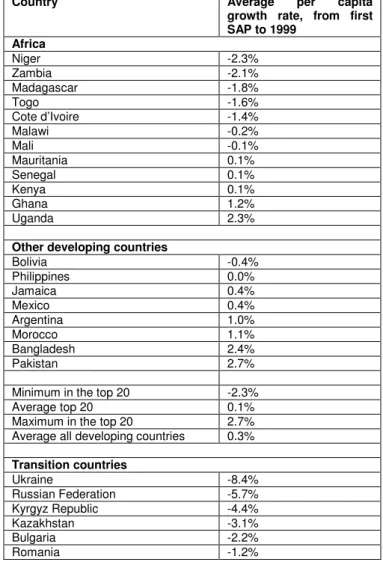
Although neo-liberalism is usually talked about in universal terms, its elaboration and effects are locally specific. Here we review some of the key impacts of SAPs, while trying to capture these complex patterns. Analysis is difficult for various reasons. First, is the counterfactual problem, because we can never know what would have happened to the economy had SAPs never been implemented. The usual approach is simply to take ‘before’ and ‘after’ snapshots of key indicators to try and capture what impacts SAPs have had. Second, SAPs focused on domestic conditions and constraints, whereas economic performance is also affected by global conditions so it is hard to separate out which effects were produced by what factors. Third, data for many developing countries are poor so calculating impacts is always difficult. However, qualitative data is often used to get behind the aggregate trends. We begin with aggregate trends before disaggregating the impacts of major reform areas. Table 1 shows the performance of countries classified as ‘strong adjustors’ meaning a commitment to SAPs and receiving many loans. It shows that contrary to the objective of ‘adjustment with growth’, the recipients of adjustment loans had the same near-zero per capita growth rates as the overall developing country sample. In the worst cases, there were very poor macroeconomic outcomes although the best cases showed that growth was possible. However, there were no cases where growth was reasonable and all macroeconomic imbalances were under control for the adjustment lending period. For example, by 1992 Uganda had shown good growth, but erratic and high inflation, despite having received 14 adjustment loans.
Table 1: Performance indicators for a sample of adjusting countries
Country Average per capita growth rate, from first SAP to 1999 Africa Niger -2.3% Zambia -2.1% Madagascar -1.8% Togo -1.6% Cote d’Ivoire -1.4% Malawi -0.2% Mali -0.1% Mauritania 0.1% Senegal 0.1% Kenya 0.1% Ghana 1.2% Uganda 2.3%
Other developing countries
Bolivia -0.4% Philippines 0.0% Jamaica 0.4% Mexico 0.4% Argentina 1.0% Morocco 1.1% Bangladesh 2.4% Pakistan 2.7% Minimum in the top 20 -2.3% Average top 20 0.1% Maximum in the top 20 2.7% Average all developing countries 0.3%
Transition countries Ukraine -8.4% Russian Federation -5.7% Kyrgyz Republic -4.4% Kazakhstan -3.1% Bulgaria -2.2% Romania -1.2%
Hungary 1.0% Poland 3.4% Albania 4.4% Georgia 6.4% Minimum -8.4% Median -1.7% Maximum 6.4%
Source: William Easterly (2002) What did structural adjustment adjust? The association of policies and growth with repeated IMF and World Bank adjustment loans, Center for Global Development, Institute for International Economics, August 2002, www.cgdev.org/content/publicatons/detail/2779
This strong adjustment lending group includes some notable disasters. Zambia received 18 adjustment loans but had sharp negative growth, large current account and budget deficits, high inflation, massive overvaluation of the currency, and a negative real interest rate. In other regions, there were also problem cases. After the initiation of adjustment lending, Bolivia had hyperinflation, negative real interest rates, and overvaluation. Even when Bolivia stabilized inflation in 1987, growth was poor, interest rates swung from excessively negative to excessively positive, and overvaluation remained.
The ex-Communist ‘transition’ countries only received adjustment loans in the 1990s after the fall of the Berlin Wall and the break-up of the USSR. Their average growth was –1.7 percent per annum, showing an overall decline. Six of the countries had negative per capita growth and four had positive growth after the initiation of SAP lending. Only Poland and Hungary are clear success stories.
At one level SAPs have been successful in ensuring debts are repaid. This net transfer of finance from the poor to rich countries can be viewed as a form of tribute, not dissimilar to the actions of colonial governments in the 19th and 20th Centuries. In development speak adjusting countries service their debt, which when measured against economic activity (GDP) gives a ‘debt service ratio’. The higher the ratio, the greater percentage of a country’s income goes on paying off loans. An example of the typical impacts of SAPs is Ghana. In 1983, at the start of the first SAP, its debt service ratio was 0.81% but jumped to 10.82% in 1987 meaning that one dollar in nine went on repayments to the lenders. It was the recognition of this crippling debt servicing that forced HIPC and related moves.
Trade liberalization aims to enhance exports and encourage competition from imports to promote domestic industries. All countries with a SAP put such provisions in place and, in general, their exports did rise. In keeping with theories of comparative advantage countries were encouraged to produce in sectors where they had an advantage, which often meant relying on a narrow range of products, such as one or two commodity crops. So, adjusting economies rarely diversified to develop inter-sectoral linkages or a more robust portfolio of different activities. The rise in exports was set against a rise in imports, which meant that the overall balance of payments (glossary) position did not improve. Many of these imports are finished consumer goods rather than intermediate capital goods that would be used in domestic manufacturing, which means they usually displaced comparable local products that may be more expensive or poorer quality. The net effect of this is deindustrialization where the number of firms declines, production falls away even more, unemployment rises, and purchasing power in the local economy is reduced. Sectorally there has been a shift away from manufacturing to services, but local firms often lack the expertise, which opens the market up to foreign firms. And as larger
and more formal firms close this releases labour, which cannot be absorbed and is forced to enter the informal sector and rely on a range of risky survival strategies. So, those worse affected by trade liberalization are smallholder farmers who cannot produce for export, very small manufacturing enterprises, and semi-skilled labour. In terms of financial liberalization the SAPs aimed to reform interest rates, ease the flow of funds in and out of countries, and make credit easier to access. These are basically about deregulating the financial sector. A key outcome is that while these regulations have been relaxed, only those people and businesses with a sound financial footing have been able to capitalise on these opportunities, leading to concentration of ownership and the further enrichment of the already rich at the expense of the poorer section of society. Particularly badly hit have been small and medium sized enterprises that lacked sufficient collateral for loans. Many of these are women-run, so the effects of financial liberalization were felt worse by them. The wealthiest who could gain credit often used a portion of this on non-productive consumption, which raised demand for foreign imports over local goods, thereby exacerbating the effects of trade liberalization.
We have seen how competition from imports, amongst other things, undermined local producers. But other changes such as privatization and labour market reforms have also impacted on the poorest in adjusting countries. In countries with a well established manufacturing base jobs that were created were often in ‘flexible’ and semi-skilled industries, which meant that labor has low pay, few rights, and little job security. Again, this changed labor market was gendered with women usually taking the jobs in manufacturing and subject to harsh labor conditions. The export drive of SAPs also pushes the economy into specialisation, which renders some sectors unviable. For example, where agricultural production is not for export, it becomes obsolete and generates rural unemployment and a concomitant rise in rural-urban migration, which undermines rural communities. And as unemployment rises, households are forced into securing income and resources from wherever they can, which can mean forcing children into informal and risky jobs.
Privatization was intended to enhance the competitiveness of the economy and reduce the liability on the state of inefficient enterprises. SAP countries tended to produce an audit of their state-owned industries (SOIs), get them into reasonable financial shape, and then offer them for sale on international markets. Typically these included hotels, heavy industry and commodity processing plants, and infrastructures like telecommunications, water and electricity. Privatization has had mixed results, with efficiency rising in some and a reduction in the state’s obligations
coupled with a rise in taxable income. In general, the best SOIs were cherry picked by foreign investors which meant that profits leave the country. Socially, the move towards efficiency resulted in streamlining practices and getting rid of unwanted labor, which adds to unemployment levels. Additionally, in most cases, the prices for privatized services like phones rose after privatization pushing them further out of reach of the poor. In this respect, water has been the most difficult and contested as it is obviously vital to life and costing it out of reach of the poor makes humane living near impossible.
Cut-backs in social spending and the re-pricing of government services are designed to balance the government’s books and free up funds for debt repayment. In practice, this means reduced funding for education and health in particular, which clearly has major knock-on effects for society and economy. The introduction of user fees for these basic services puts them out of reach of the poorest in society, which further deepens their exclusion and poverty. These effects were so visible in the early days of adjustment that a landmark publication called ‘Adjustment with a human face’ was published in 1987, which highlighted the impacts on the poor and vulnerable and called for the introduction of social safety nets to protect people during the supposedly harsh, but temporary, adjustment process. The social protection schemes were rolled out with much fanfare, but donor funding was quite limited and by making access conditional upon certain workfare practices they also served to reinforce a pro-market logic.
Agricultural promotion was also geared to exporting cash crops at the expense of locally consumed food crops. Additionally, to enhance the market competitiveness of the sector subsidies on key inputs such as fertilizer were cut. This has major livelihood and environmental consequences. Poorer farmers who could no longer afford inputs saw yields decline, which reduced income and food security. It also meant that larger farmers who had the initial capital or could access credit were able to consolidate their position and expand at the expense of smaller farmers. This often meant taking over the best land and forcing the poorest onto even more marginal land, which was more prone to environmental degradation, thereby fuelling a vicious cycle of poverty and degradation. The focus on cash crops also encouraged mono-cropping, that reduced biodiversity and with it an increase in the susceptibility of crops to disease. Similar trends were seen in mineral extraction as mining enterprises expanded operations at the expense of agricultural land, not to mention the pollution problems associated with under-regulated heavy industry. Overall, food production for local consumption was negatively affected by these reforms, which saw a consolidation and specialization of production.
While it is difficult to generalise about the aggregate impacts of SAPs, compared to their stated aims there was limited or negative economic growth, increased social polarisation, and enhanced foreign ownership. However, debt has been serviced.
Within these general impacts women and children were the worst affected. So the economic pie did not increase much in size, but the richest peoples’ share of the pie got bigger.
As we have seen the PRSs promise a big change from the SAPs of the 1980s and 1990s. While it is a little early to say with any precision what the effects have been, there is a lack of clarity over how they will contribute to poverty reduction as opposed simply to stabilization and growth. By and large the strategies still focus on economic growth without really addressing how any growth is to be redistributed to the poor. At their heart are the same macro-economic prescriptions of the old structural adjustment programs with a continued emphasis on privatization, liberalization and a reduced role for the state.
‘It’s not right for a bank to run the whole world’1: The politics of sovereignty and accountability
So far we have looked at the economic effects of SAPs, but as is clear they are so far-reaching that their formulation and implementation is also highly political. Here we will focus on the politics of SAP intervention, which affects national sovereignty and promotes accountability to the donors despite a countervailing rhetoric of democratisation and self-determination.
A key paradox of structural adjustment is that the creation of ‘free’ markets unencumbered by state regulation requires a great deal of state-based politicking, encompassing both the use of raw power and the less obvious deployment of theoretical discourses. The Bretton Woods Institutions are bound, in theory, to non-interference in the politics of sovereign countries, yet conditionality shows that they are central to the decision-making of many countries. At the national level we see the state heavily involved in the withdrawal of the state from regulation and service delivery. Rather than disappearing, the state is restructured to form a parallel government run by insulated and unaccountable technocrats, most often located in the finance ministries. On the other hand much is made in the neo-liberal armoury of devolution to enhance ‘choice’ at the local level which runs counter to the massive centralisation of power that the implementation of SAPs require.
This polemic of devolution within SAPs suggests that local governance is to be a key arena for enhancing political choice. This localism has seen a whole host of political experiments centred on ‘civil society’, ‘participation’ and ‘empowerment’. These positive and radical sounding concepts promise local self-determination, but prove to be about marketizing services such as education, by-passing the central state which has in many cases proven obstructive to liberalization, and as a vehicle for promoting certain civil society organisations that are known to be pro-market. As a result ‘choice’ through devolution is part of the wider move to create markets and weaken opposition to SAPs, while all the time couching it in a language of empowerment. This localism has proven to be one of the mainstays of the ‘good governance’ programs already mentioned. After nearly a decade of SAPs it was realised that key elements within the recipient states were blocking the reform agenda, which meant the donors needed to also focus on reforming the political and bureaucratic process. These factions needed to be removed or bypassed, which led to a whole raft of political reforms such as downsizing bureaucracies, removing key individuals, insulating decision-making, and using external consultants to provide ‘objective’ analysis of what needed to be changed. These programs were always couched in
1Fred M’membe, editor of the Zambia Post, quoted in Structural Adjustment – a Major Cause
terms of accountability and transparency, and were tied to democratisation agendas that also promised accountability. Again, what is ironic is that these moves were forced as part of the loan conditionality, which runs against any definition of democratic politics, and can only ever be justified through an assertion of the moral superiority of western political models and a concomitant demonization of developing countries as irrational and corrupt.
With the PRSs this upward accountability to donors is supposedly reversed, as recipient countries now ‘own’ their own adjustment programs. As we have seen, despite the promise of local input to program design, which should produce different policy mixes, all PRSs look stunningly similar. The shift to supposedly smart conditionality and direct budget support has not reversed the accountability to donors who still pull the strings and undermine the domestic democratisation they work so hard to champion. Rather than brutal conditionality the language has shifted to compliance, yet a whole system of checks are in place – most notably Country Policy Institutional Assessments - to ensure that recipient countries are trustworthy before loans are approved and that annual approvals are made in order for funds to be released.
However, these harsh economic conditions and political meddling have not gone unopposed. As the neo-liberal model creates authoritarian, centralised, and unaccountable politics ordinary people are often forced into direct action. Dubbed ‘IMF riots’ these protests combine genuine anxiety over austerity-driven economic hardships with a frustration at the way in which national sovereignty has been usurped by the Bretton Woods Institutions and their cabal of donors. These have been occurring since the start of the SAP era, and more recently fed into the worldwide ‘anti-globalisation’ movements.
Figure **: An anti-IMF protest in the USA
http://www.cbsnews.com/stories/2005/04/12/world/main687657.shtml
Conclusion
Structural adjustment is a critical issue for the lives of many in the developing world. It is a process linked to older trajectories within the international political economy, which are about uneven interdependencies across space. The developing world is further hemmed in by SAPs and complex multi-levelled governance sees national sovereignty being usurped by international organisations acting in the name of the poor. They also espouse localism as a way of enhancing choice and freedom, but this proves to be a smokescreen for destatization. By understanding this complex economic and political geography we get an insight into how neo-liberalization operates so that it appears everywhere and nowhere at the same time. Think back
across this short paper and list the places and countries that are implicated in the story of structural adjustment.
Since the so-called ‘war on terror’ began, the economic well-being of the global poor has taken on a new significance since poverty is believed to breed grievances, as the poor in the South witness with growing envy the lifestyle of the North. Hence, the poverty focus of adjustment programs is now also about maintaining the security of the North by preventing these grievances building up. Under this war footing the neo-liberal governance prerequisites become even more important, because they signal a commitment to like-minded (read US) values. Muddying the waters further is China’s rise in global economics and politics, which potentially provides an alternative to structural adjustment. The Chinese government is ready to lend to developing countries and enter partnerships and joint ventures unencumbered by the same ideological baggage and the burden of debt repayment. All this means that structural adjustment is set to continue, but is likely to change yet further.
Further reading
Bracking, S. (1999) ‘Structural Adjustment: Why it wasn’t necessary and why it did work’, Review of African Political Economy, 80, 207-226.
Chossudovsky, M. (1997) The Globalisation of Poverty: impacts of IMF and World Bank Reforms, London: Zed Books.
Cornia, G., Jolly, R. and Stewart, F. (1987) Adjustment with a Human Face, Volumes 1 and 2, Protecting the vulnerable and promoting growth, Oxford: Clarendon Press. Craig, D. and Porter, D. (2003) 'Poverty Reduction Strategy Papers: a new convergence', World Development, 31(1): 53-69.
Elson, D. (1995) ‘Male bias in macro-economics: the case of structural adjustment’, in D. Elson (ed.) Male Bias in the Development Process (2nd edition), Manchester: Manchester University Press, 164-190.
Green, D. (1995) Silent Revolution: the rise of market economics in Latin America,
London: Cassell.
Harvey, D. (2005) A Brief History of Neoliberalism, Oxford: Oxford University Press Mohan, G., Brown, E., Milward, B. and Zack-Williams, A. (2000) Structural Adjustment: theory, practice and impacts, London: Routledge.
Schuurman, F. (1997). The Decentralisation Discourse: Post-Fordist Paradigm or Neo-liberal Cul-de-Sac? European Journal of Development Research, 9(1) 150-66. Stewart, F. and M. Wang (2003) ‘Do PRSPs empower poor countries and disempower the World Bank, or is it the other way around?’, Queen Elizabeth House WP 108. www2.qeh.ox.ac.uk/research/wp.html
Williams, G. (1994) ‘Why structural adjustment is necessary and why it doesn’t work?’, Review of African Political Economy, 60, 214-225.
World Bank (1994) Adjustment in Africa: Reforms, Results and the Road Ahead, New York: Oxford University Press for the World Bank.
Websites
These two Bretton Woods Institutions are the architects of SAPs, and have much information in the form of factsheets, as we well as their own policy analysis.
http://www.worldbank.org http://www.imf.org
These two organizations have done more independent evaluation work on SAPs and PRSs.
http://www.saprin.org http://www.odi.org.uk
The following are campaigning and advocacy NGOs, who are either very critical of SAPs/PRSs or call for more piecemeal reform.
http://www.essentialaction.org http://www.globalissues.org
http://www.50years.org
http://www.jubileedebtcampaign.org.uk
http://www.tjm.org.uk (trade justice movement)
http://www.wdm.org.uk (world development movement)
Suggestions for cross-references
In the order they appear on the spreadsheet
• Civil society • Cold War • Debt • Dependency • Good governance • Informal sector
• Neo-liberalism and development • Neocolonialism
• Third World
• FDI and industrial restructuring • International organisations • Privatization
• TNCs and developing countries • Uneven development
• Africa
• Communist and post-Communist geographies • Governance
• Neo-liberalism • Sovereignty