Blockchain within Logistics: a SWOT analysis
Belén Martínez Laosa
Dissertation to obtain the Master of Science Degree in
Industrial Engineering and Management
Supervisor: Prof. Susana Isabel Carvalho Relvas
Acknowledgements
I would like to express my gratitude to Prof. Susana Relvas for giving me her advice and for being always available when I needed her. I am so grateful for her patience and dedication and I really appreciate her support.
My completion of this project could not have been accomplished without the support of my family. To my parents and my sister for instilling me the most important values and never let me fall and to Jorge, to accompany throughout my journey and always supports me.
I have no valuable words to express my thanks, but my heart is still full of the favours received from every person.
Abstract
The industry 4.0 is already developed in many sectors and business. In recent years, some technologies of this trend have appeared in our society providing new business models and improving the effectiveness and efficiency for processes.
One of these technologies is Blockchain, a distributed database of records among participants. It is believed that this technology could revolutionize business and redefine logistics. However, Blockchain is an emerging technology and it is still at an early state of development.
The objetive of this Master Dissertation is to understand what Blockchain is and to measure the impact of this technology in logistics, analyzing the possible limitations and applications and considering professional judgement. Moreover, this work provide a framework to identify the Blockchain opportunities in the logistics industry and helping managers to know where they can implement it in their processes.
The methodology of this work involved three stages: (1) analysis of the literature review to establish the technology basis and the current applications in logistics; (2) The implementation of a SWOT analysis according to recent studies; (3) testing the SWOT analysis using an online interview aimed at experienced business in logistics and cibersecurity. Finally it will be explained the main result of this work.
Contents
Contents ... 4 List of Tables ... 6 List of Figures ... 7 CHAPTER 1 - INTRODUCTION ... 1 1.1 Problem Motivation ... 1 1.2 Objectives ... 2 1.3 Overview of Methodology ... 2 1.4 Structure ... 4CHAPTER 2 - LITERATURE REVIEW ... 6
The second chaper is dedicated to present the pillars of this work – Logistics (section 2.1) and Industry 4.0 (section 2.2). Thereafter, we present Blockchain and a structured discussion on the findings from the literature that provide the basis for the methodology herein presented and implemented. ... 6
2.1 Logistics ... 6
2.1.1 Introduction to Logistics ... 6
2.1.2 Supply Chain Management ... 7
2.2 Industry 4.0 ... 8
2.2.1 History ... 9
2.2.2 Definition and drivers of Industrial digitalization ... 11
2.2.3 Components of Industry 4.0 ... 11
2.2.4 Key technology in the industry 4.0 ... 12
2.2.5 Potential improvement areas ... 14
2.2.6 Challenges ... 15
2.2.7 Impact in logistics and supply chain management ... 17
2.2.8 Innovation trends and proposed systems ... 18
2.3 Blockchain ... 19
2.3.1 Definition ... 20
2.3.2 The architecture behind Blockchain ... 22
2.3.3 Types of Blockchain networks ... 25
2.3.4 Applications ... 27
2.3.5 Blockchain advantages in logistics ... 32
2.3.6 Blockchain study in today's businesses ... 36
2.3.7 Current status in the logistics sector ... 37
2.3.8 Supply chain perfomance ... 39
2.3.9 Challenges ... 42
CHAPTER 3 - SWOT ANALYSIS ... 44
3.1 Introduction ... 45
3.3 Review of published SWOT papers ... 46
3.3.1 Approaches in SWOT studies ... 47
3.3.2 Application areas of SWOT papers ... 49
3.4 SWOT analysis ... 50 3.4.1 Strenghts ... 50 3.4.2 Weaknesses ... 52 3.4.3 Opportunities ... 54 3.4.4 Threats ... 56 3.4.5 Conclusion ... 58 CHAPTER 4 - INTERVIEW ... 62 4.1 Introduction ... 62 4.2 Definition ... 62 4.3 Structure ... 63 Appendix 1. Interview ... 65 4.4 Selection of participants ... 72 4.5 Results ... 72 4.6 Limitations ... 74 CHAPTER 5 - CONCLUSION ... 76 References ... 78
List of Tables
Table 1. "Industry 4.0: what makes it a revolution,2017...10
Table 2. "Blockchain Principles". Source: Adapted from What to adopt and Where to Start, 2018...22
Table 3. "Classification and main characteristics of networks". Source: A systematic literature review of blockchain-based applications: Current status, classification and open issues, 2018... 26
Table 4. "Specific areas of Blockchain Applications by sectors". Source: A systematic literature review of blockchain-based applications: Current status, classification and open issues, 2018... 31
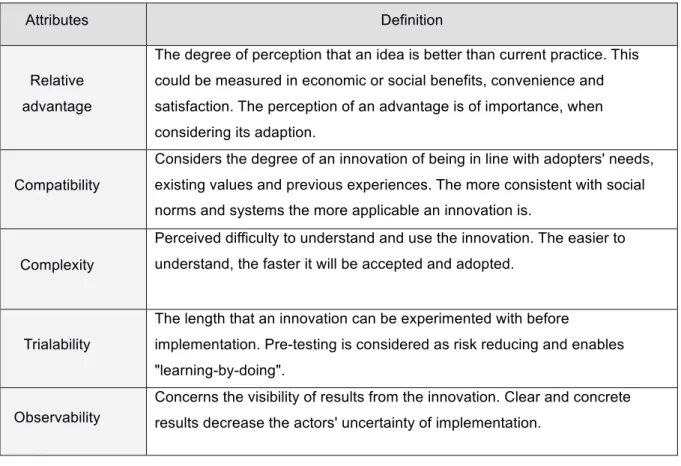
Table 5. "Attributes of innovation". Source: Adapted from Blockchain for and in Logistics: What to Adopt and Where to Start, 2018 ... 35
Table 6. "Transformation phases in Logistics". Source: Adapted from Blockchain for and in Logistics: What to Adopt and Where to Start, 2018 ... 41
Table 7. "Blockchain prerequisites". Source: A systematic literature review of blockchain- based applications: Current status, classification and open issues,2018 ... 43
Table 8. Areas in case studies... 49
Table 9. Strenghts by authors ... 50
Table 10. Weakness by authors ... 52
Table 11. Opportunities by authors ... 54
Table 12. Threats by authors ... 56
List of Figures
Figure 1. "Basic Supply Chain" Source: Basic Manual of integrated logistics, 2014"... 8 Figure 2. Figure 2. Information Flow in Suppy Chain. Source: Adapted from Mapping the Sea of Opportunities: Blockchain in Supply Chain and Logistics, 2018 ...20 Figure 3. Figure 3. A basic architecture of Blockchain Technology. Source: Adapted from Blockchain technology for enhancing supply chain resilience, 2018... 24 Figure 4. Figure 4. Basic inner of Blockchain. Source: Adapted from Blockchain technology for enhancing supply chain resilience, 2018... 25 Figure 5. Figure 5. Different types of Blockchain Applications. Source: Adapted from A systematic literature review of blockchain-based applications: Current status, classification and open issues, 2018... 27 Figure 6. Figure 6. Blockchain advantages in Logistics. Adapted from Blockchain technology for enhancing supply chain resilience, 2018... 32 Figure 7. The position taken by companies toward Blockchain. Source: Adapted from Mapping the Sea of Opportunities: Blockchain in Supply Chain and Logistics, 2018... 36 Figure 8. Barriers toward Blockchain. Source: Adapted from Mapping the Sea of Opportunities: Blockchain... 37 Figure 9. Part of order fulfillment steps where Blockchain can fit in. Source: Blockchain technology for enhancing supply chain resilience,2018... 38
CHAPTER 1 - INTRODUCTION
Industry 4.0 or the 4th industrial revolution is a seen in the literature as the framework of appearence of several new trends and technologies, such as Blockchain technology. This is the technology under study in this master dissertation.
The main reason to choose this technology is because it is considered to be useful for many companies in their daily operations but most of them do not have a clear knowledge about it and, nowadays, it is not yet fully or partially implemented in their processes.
The introduction is used to contextualize the problem being analysed in this thesis and set the objective of this dissertation. Thereafter, we present an overview of the methodology used and the reasoning behind the structure of the thesis.
1.1 Problem Motivation
In recent years, the logistics sector is experiencing great advances with the introduction of new ways of working and optimizing processes (Pinheiro de Lima et al., 2016) .
Blockchain is a new technology which is transforming current models into distributed platforms characterized by a common consensus among different parties. This technology has shown great potential in some areas where it has been implemented, such as finance, banking and healthcare. However, several studies have been carried out to investigate the applications and uses of this technology, but it is not yet known exactly if it will bring long-term benefits.
In this work we try to study the technology and its possible beneficial used in the logistics field. It is intended to inform about its benefits but also to alert about its risks and threats, providing a broad spectrum and being as objective as possible. Thus, we want to evaluate the potential of implementation within logistics.
Moreover, the scope of the research is not limited to the recent studies analysis. It is aimed to provide a realistic vision about Blockchain and try to study in depth this technology, therefore not only analyzing the knowledge provided by other authors but also doing a SWOT analysis and an interview for putting up our own investigation.
1.2 Objectives
Nowadays, technology is present in many aspects of our life. Especially, the processes and activities have undergone great changes since the manpower was changed by the use of machinery.
With this situation, it is necessary to study the possibilities that we could achieve with the appearance of new technologies.
Moreover, while I was finishing my master, one of the subjects I was very interested was "Technologies and information systems". In this subject I could learn about new ways of doing activities, organizing processes and communication between the several actors in the supply chain or just recording data. Blockchain was one of the most important topic in the subject but we don't know what is going to happen with this technology as it was not totally developed. Therefore I thought that it would be a good idea to make a study about this technology focusing on the logistic sector and the benefits that Blockchain could bring to this area.
Therefore the objetive of this dissertation is to study and analize if this technology would provide real benefits or just the same properties as other similar technologies already implemented in business. With this purpose, it is required to study in deepth the main characteristics of Blockchain, current utilities and uses.
Moreover, it will be done a SWOT analysis trying to obtain a general approach of the main strengths, weakness, opportunities and threats. Getting this information we are able to know the current situation of the technology and how business have to use it to apply in their processes. In addition, we will realize about the lack of information. Therefore, the main goal is to provide researchers in what they have to lead the future investigations.
Finally, an interview will be conducted to verify the information of SWOT analysis by different
companies. In addition, another purpose is to be conscious of the knowledge and possition about Blockchain.
In the end, with all the obtained information, the conclusions will be drawn up.
1.3 Overview of Methodology
During this work, a methodology to measure the impact of Blockchain's implementation in technology companies, particularly in the logistics field, will be created. Therefore, in this section the methodology used in the elaboration of this Master dissertation to achieve the final conclusions will be described.
the activities included in it, delving into new business models which have emerged in recent years applications.
Two different databases have been used: Google Scholar and Web of Science. The goal was to find papers from different years and authors to display the progress in the logistics sector and to give a truthful vision. The keywords used were logistics, logistics-business and logistics- management.
Moreover, to analyze the impact of Blockchain in logistics, it was necessary to carry out a literary study on the current trend of the industry towards Industry 4.0, being Blockchain a part of it, as well as understanding and defining essential terms such as logistics and the supply chain. A review fof logistics and Industry 4.0 was made, trying to address the main characteristics of both and making a general investigation of these two concepts.
Therefore, it will be explained what is the Industry 4.0 and the main trends and technology which compose it. In this case, it has been selected a wide number of papers related to the topic, but it has been filtered and analyzed the most relevant depending on the content or the used language being more than 50 papers analyzed. The keywords which have been used for the filtering were: Industry 4.0, Industry 4.0 applications, Industry 4.0 logistics, Industry 4.0 challenges.
Once these concepts were understood and settled, Blockchain analysis was carried out specifically. The objective was to systematize and understand this technology, obtaining information of the essential characteristics and principles as well as the main challenges. It has been tried to mention some applications referring to different areas but it has deepened in the area of logistics to be the object of this study. In addition, it will be realized a study of Blockchain, analyzing its main applications and benefits as well as its challenges and disadvantages. With all that, it will be formed an overview on the current state of technology. In this case the keywords used have been Blockchain, Blockchain-Logistics and Blockchain applications.
In the next phase, a SWOT analysis has been accomplished, selecting articles of different themes and authors to obtain the greatest possible number of point views and a broad spectrum of contextualization. In this way it has been tried to observe the strengths, weaknesses, opportunities and threats that Blockchain currently presents accordint to different sources and authors. With this information it will be easier to know how could be the impact of Blockchain in logistics. The keywords used were Blockchain principles, Blockchain and supply chain, Blockchain strenghts, Blockchain opportunities, Blockchain weakness, Blockchain threats and Blockchain SWOT.
factors are explained with too much generality, sometimes not being clear the real application in a specific field. Therefore, it has been tried to be as exhaustive as possible in terms of determining the factors.
On the other hand, due to the immaturity of this technology, it has been complicated to determine the strengths that are currently demonstrated than the weaknesses. However, it has been tried to examine the main strengths and weaknesses in relation to each key problem in the external environment, trying to provide organizations with information and knowledge about this technology.
We have also noticed that some articles treat factors in different ways. Ones are considering some factors as strengths and others as weaknesses as well, depending on the context and the situation. For example, in the case of participation, some articles are regarding as a strength since all members must verify and validate the recorded information. However, it is also acounting as a weakness in other articles as it can not obtain the wished individual privacy. It is of the utmost importance to mention that personal opinions that were not previously contrasted by other studies have not been taken into account, with the aim of being as rigorous as possible. In addition, no factor has been prioritised according to the articles area.
Moreover, an interview with professionals has been carried out in order to verify the conclusions drawn from the SWOT analysis and the impact of Blockchain in logistics.
Finally it willl be discussed the overall thesis, the main limitations of the work and what is the future works to be developed.
1.4 Structure
The dissertation is divided in six chapters. In this first chaper it is presented an introduction about the thesis which motivated the question being studied in this work and the methodology to be used.
In chapter 2 the differents terms discussed during this work will be explained according to the analyzed literature review.
First of all, it will be made an introduction about logistics, taking into account the activities and processes which form the logistic management. In addition, it will be defined the supply chain management focusing on efficiency and effectiveness as one the most important factors to measure the right functioning of a process.
Moreover, another crucial topic to understand the relevance of Blockchain in logistics is the Industry 4.0 as it is the current industry trend which encompasses several technologies such as Blockchain, Internet of things, et cetera. Therefore, it will be made a contextualization of Industry 4.0 describing the history, key components, challenges and the relation with logistics. It is also necessary to build a section dedicated to Blockchain as we have to understand what is Blockchain, how works and what are its main applications nowadays. Then is explored the definition, architecture, types of Blockchain networks, challenges and applications in logistics management and suppy chain performance.
In chapter 3 it is developed a SWOT analysis. The main strengths, threats, opportunities and weaknesses of Blockchain must be under carried to know what the pros and cons of this technology are, as well as the current state of development.
In chapter 4 it will be evaluated the SWOT analysis thorught an interview built for getting the opinion of professionals in some sectors. This interview consists of questions with open answer with the purpose letting participants to express their own opinion related with the the asked topics. In addition, participants will have to divide the critical factors about Blockchain into strengths, weakness, threats and opportunities. Finally, the surveyed can express their own considerations about Blockchain and its impact in logistics.
CHAPTER 2 - LITERATURE REVIEW
The second chaper is dedicated to present the pillars of this work – Logistics (section 2.1) and Industry 4.0 (section 2.2). Thereafter, we present Blockchain and a structured discussion on the findings from the literature that provide the basis for the methodology herein presented and implemented.
2.1 Logistics
2.1.1 Introduction to Logistics
During the first section it is intended to provide a thorough understanding of the logistics definition and the role it plays in the supply chain. Therefore it will be explained the term of "Logistics" and "Supply chain" to understand what they are composed and what they are also representing.
Different definitions for Logistics have been published throughout the years but it is considered that the one definition could be "Logistics is one of the parts encompassed in the management of the supply chain and it interacts with the flow and product information along it. Also, it aims to achieve the optimization in all the processes with a minimal cost" (Inda, 2014).
Moreover, the Council of Supply Chain Management Practitioners, which is the main organization formed by professionals in the supply chain, provides the definition of logistics as "Logistics is the activity which have the function of planning, implementing and controlling the efficient and effective flow of services, information and goods between the point of origin and consumption" (Gibson et al., 2005).
That is why there is not only one definition for contextualizing and understanding what is logistics. However, businesses and professionals need to understand the fundamentals and common goal pursued to implement some of the industry 4.0 trends (Bowersox, 2013).
Furthermore, the logistics can be divided into two complementary dimensions: internal logistics and external logistics. The first one consists of planning, managing and coordinating the flow of materials and information that occurs within the company. External logistics tries to perform the same functions but interacting with the several external players involved in the activities and processes, such as suppliers, transporters and even customers.
Nowadays, logistics is not analyzed taking into account separate activities or processes. It is trying to integrate all the activities into a whole process. This way of managing logistics is called integrated logistics (Inda, 2014).
Here, we will identify the main activities in logistics management: • Supplier Management
• Transportation Management • Fleet management and equipment
• Materials and inventory management (stock) • Orders management
• Planning supply and demand
It is found that integrated logistics management (considering all processes related to the supply chain and creating global strategies) increases the overall efficiency and lowers the overall cost, improving lack of information and damage (Pau i Cos et al., 2001). Some of the main advantages are the following (Pinheiro et al ., 2016):
• Reach and meet the needs of customers • Maintain an overview of the company
• Jointly address all processes and activities related to logistics • Optimization and reduction of time and costs
• Customer bonding through information technology
Logistics management is considered one of the main factors to think when a company wants to establish and implement corporate strategies. Companies should focus on enhancing their own skills, processes and technologies enabling them to create a competitive advantage (Hollenbeck, 2014).
For this purpose, information systems and industry trends 4.0 are a great ally, providing faster exchanges of information between the different parties involved and improving the properties of transactions (Sandberg, 2013).
2.1.2 Supply Chain Management
The definition of "Supply Chain" could be the proposed by La Londe and Masters. They said that supply chain management includes a set of firms that pass materials forward. Several independent companies are involved in manufacturing a product and placing it in the hands of the end user. This process implies the coordination of raw material and component producers, product assemblers, wholesalers, retailer merchants and transportation companies (La Londe and Masters, 1994).
Moreover, it could also be defined as "the network of organizations that are involved, through upstream and downstream linkages, in the different processes and activities that produce value in the form of products and services delivered to the ultimate consumer. In other words, a supply chain consists of multiple firms, both upstream (i.e., supply) and downstream (i.e., distribution), and the ultimate consumer" (Martin L, 1992).
joint management of all the encompassed processes in the supply chain as well as the main involved players and undertaken activities.
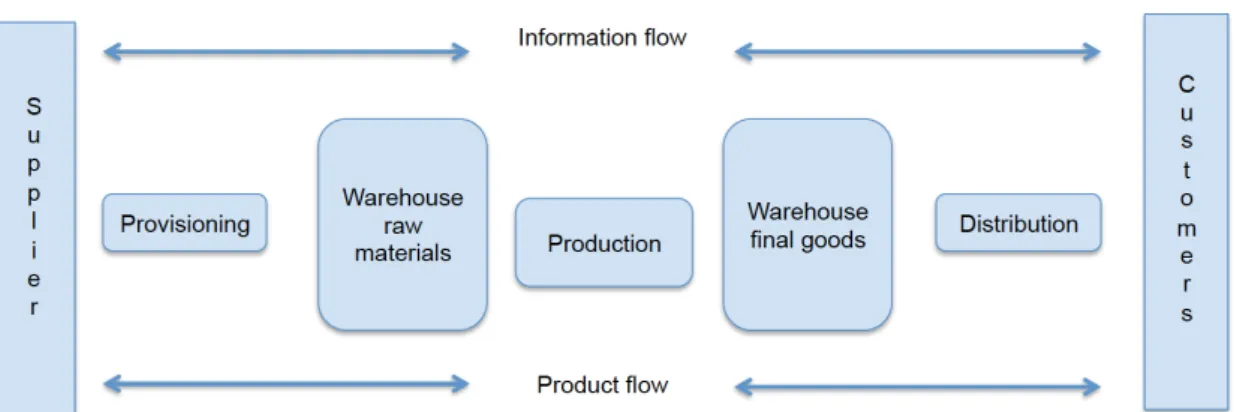
In the Figure 1 it can be observed a basic outline of a supply chain, with the main information flow.
Figure 1. Basic Supply Chain. Source: Basic Manual of integrated logistics, 2014 As it can be observed, an exchange of materials and information is produced from suppliers to customers. Moreover, not only the activities related to logistics management, but it also includes other activities such as production, customer service and performance monitoring. efficiency and effectiveness. These two last factors must be taken into account. Efficiency relates to the optimal use of available resources (Öjmertz, 1998) while efficiency is related to the fulfillment of the main objectives offering and meeting customer needs (Kao and Hwang, 2014).
However, there are several issues and trade-offs regarding how to perform supply chain management. For example, the responsible area for carrying out the production of goods will try to occur in droves, taking advantage of a single process to manufacture many products and minimizing manufacturing unit costs. However, this is a problem for those responsible for managing the stock or inventory level, since manufacturing in large batches produces an increase in inventory, causing a high cost of stock. This is just one example of the trade-offs that can arise along the supply chain (Inda, 2014).
2.2 Industry 4.0
The remainder of this chapter is structured as follows: first, the approach used in the research is to explain the history, definition and components of the industry 4.0. The second part is focused on the key technology which is used, its advantages and challenges, and its application. The third part will the term productivity optimization which is related to productivy improvements. However in the fourth part it is also included the big challenges for Blockchain. In addition, it will be explained how Blockchain could impact in logistics and supply chain. The last part of the chapter will try to give a general approach about all these concepts and innovate trends, this
includes how can they work together and what kind of activities can be developed with them. The work presented may be issued from case-studies and theoretical research with a potential to be applied in industrial aplications.
2
.2.1 History
Industry is one of the most fundamental elements of the economy, through which the material goods for society are produced (Schwab, 2016).
To understand the Industry 4.0 an analysis has to be made on the main “Industrial revolutions” popularized as periods of technological discoveries. These revolutions have had a high impact on society.
It is not easy to divide the history in exact periods of time because each revolution has no evident beggining and end. However, many historians agree that it’s undeniable the existence of four revolutions in the field of industry (Klingenberg, 2017).
In this process, the world has experienced three industrial and technological revolutions - currently brewing the fourth- over the last two centuries. Basic enery sources, dynamism and communication have changed in each of them (Freeman et al., 1997).
Following there’s a brief summary of the three industrial revolutions and the factors which have had the greatest influence on each one.
• First industrial revolution (1784-1870). It took place at the end of the 18th century in Britain. The most significant characteristic was the substitution of water, coal and steam power for human labor. This fact helped increasing the production in several sectors starting with the textile industry. Moreover, this revolution yielded the separation of work and personal life, the growth of urban center and the emergence of a proletarian class, as one of their top priorities (Hobsbawm,2016).
• Second industrial revolution (1870- 1969). The United States were its precursors, with the appearance of electricity. Goods became accessible to a large part of the population, which lead to the increase of the living standards. As a results of the advantages, some companies were able to improve their activities and reduce their operating costs (Jensen,1993).
• Third industrial revolution (1969- Today). In this case it’s not about an enery source change. Electronics and information technology had the fundamental paper in this period. Industries started to automate their processes as the technology replaced current activities formerly made by human (Jensen, 1993) (Freeman et al., 1997)
After the first step, which defines and identifies each revolution, the new step is analysing the technical advances, economic situation and demography. The Table 1 defines these factors in each period of time.
Table 1. Cristina Klingenberg (2017) "Industry 4.0: what makes it a revolution?" Revolution Technical advances Economic situation Demography First industrial
revolution
- Watt steam engine - More autonomy to manufacturing - New machines in textile industry - Mechanization of the tools in agriculture - Rural manufacturing network - Intense ultramarine trade - Coal availability - Population start to grow fast - Creation of demand - Amplification of the labor supply
Second industrial revolution
- Effects in
railroads, steels and chemical - Development of mass production system - Specialized machines - Diffusion of industrialization through Europe and United States - Verticalization of the automobile industry - Creation of R&D departments - Migration of labor - Fast growth of population - Growing demand Third industrial revolution - Advanced Manufacturing Technologies (computers, chips, internet..). - Automation of activities in manufacturing and electronics -More customized products - Shorter production cycles - Investments in R&D by governments and universities - Oil crisis in 1970 - New operation strategies - Manufacturing activities were moving to underdeveloped countries -Globalization intensified the IT application - Demography changed a lot - Availability of labor - Low wages
2.2.2 Definition and drivers of Industrial digitalization
Nowadays, activities are developed with the presence of technology as a main tool to make them possible. Thus, it is a new way to organize, execute and implement processes in daily life. The largest applications of information technology have changed the organization of business and those changes are known as “the Fourth Industrial Revolution”. This term has become a new paradigm around the world and many people discuss the impacts that it would have in the future (Freeman ans Soete, 2008).
Industry 4.0 emerged as a long-term project driven by the German government as part of the 2020 high-tech strategy action plan. Between the main trends, the evolution of current systems in a productivity approach, the access to information and the use of innovative software programs are involved.
This revolution is based on some characteristics. The first one, is the need of an individualized production that takes into consideration the customer behaviour. The second one, is the horizontal integration in collaborative networks represented by all the organization. Finally, the last one, is the digital integration of the supply chain. These technological advances result in a relevant impact on production and distribution (Brettel et al.,2014).
2.2.3 Components of Industry 4.0
Industry 4.0 is known as "The digital transformation of manufacturing" and involves the use of technologies that can increase the efficiency, quality, safety and ergonomics of industrial processes and infrastructures (Lasi et al., 2014).
In order to explain the application of some trends in the industry 4.0, it is important to characterize the several components included in this project as well as the changes that have occurred and originated its appearance must be first addressed. Therefore, the first step is to define the components of Industry 4.0.
In this study, we will identify and define the main areas that we have take in consideration: • Digital information: the data collected, processed and analysed from digital
information, allows making better decisions and forecasts. This information is manipulated and displayed by computational tools.. In addition, digital information is stored using a series of ones and zeros.
• Automation: In recent years, the automation of processes is managed by machines. Besides, is important to note that it will seek to diminish the costs of possible human mistakes. Automation is being used in several applications of areas such as manufacturing, defense, transport, utilities and operations. • Intelligent manufacturing: it is a fully integrated flow that synchronizes the
sustainability. Moreover, it has the purpose to optimize manufacturing resources and improve business value.
• Connectivity: the customer is informed and connected all the time, knowing the information required by the product, presenting challenges to suppliers and generating new business opportunities. This conection allows the ability to link and communicate with other computer systems and enabled all employees to discuss team issues in real time.
However, not only technology plays a fundamental role in industry 4.0. The changes have also shaken cultural and organizational factors in the industry based on digitization and connectivity. The effective analysis of data, the use of information systems that allow constant communication between departments of the same company -and even in different companies- and the use of a database capable of storing information, have an impact on the efficiency of the entire value chain. In addition, it has been created a large number of new business models in different sectors in an effort to cover the most demanding needs.
It is expected that in the near future modular manufacturing systems and processes will be created controlling the execution and revising their own activity. Digitization in processes will require a change in the value chain, starting with the acquisition of raw materials until their final use.
This high-tech strategy has implications for the production system, using cybernetic systems, connecting machines, objects and people in real time and offering storage solutions (Bahrin et al., 2016).
2.2.4 Key technology in the industry 4.0
Industry 4.0 offers a new vision based on technology. It will transform the business models, connecting the product to an integrated and transparent supply chain. It can be decomposed in sub-fields of technology as presented below.
• Internet of Things (IoT): It's a system with devices and other everyday objects which offers us relevant information and data for further analysis. Moreover, these devices work with other related devices and exchange the information they get from one to another. Increasingly, organizations in the whole world are using this tool to operate more efficiently.
• Advanced robotics and artificial intelligence: To automate industrial activities, decision making and even learning emulating human logical thinking.
• Systems for vertical and horizontal integration: vertical is understood as the internal implementation of a process or service in a company. On the other hand, outsourcing is called horizontal.
• Communication (Machine to Machine): Known by the name of M2M communication, machines communicate by exchanging information and they can perform efficient actions without the need of human intervention.
• Cyber-physical systems: Are those devices that have computational, storage and communication skills with the aim of directing and interacting with a physical process.
• Big Data: It is the massive analysis of data, which can be processed and stored for issues that previously would not have been possible to solve in the company.
• Hyper-connectivity: Defines the model of society permanently connected to information through different devices.
• Cloud Computing: Consists of a new model of implementation of ICT services (Information and Communication Technologies) connected through the Internet. • Cybersecurity: It is the practice of protecting the computer systems of the
companies from attacks that could put at risk the activity of these systems. • Digital manufacturing (3D printing / 4D: Printing (height, width and depth)
becomes intelligent objects capable of adapting and interacting with the environment or demand.
• Virtual and augmented reality: is the technology that allows us to replace the environment and move to a digital world. In augmented reality sight it is not obstructed, but information is increased by adding relevant knowledge and receiving it in real time.
It is worth mentioning that the incorporation of any of these elements in the company's value chain facilitates the flow of information from the physical world to business decisions in real time (Hermann et al., 2016).
The high capacity for innovation represents one of the greatest success factors in the business world. Another key factor is achieving a flexible production in which non-centralized decision making occurs. For this, it is necessary that the business organization is not highly hierarchical. Currently, Germany leads the digital transformation and the introduction of smart tools. In recent years, it has been possible to integrate predictive technologies for making decisions, related to the software transformation and the creation of an interconnected cybernetic system. These changes have allowed the use of information on salaries, demographic changes, resource management, efficiency and production (Santos, 2016).
Therefore, data transformation related to Big data must be integrated to achieve an increase in the productivity and transparency of the company. This implementation is made up of several
components combined with the construction of an online platform, built according to different criteria based on the speed of calculation and the complexity of the organization.
This platform is composed by algorithms created from laboratory experiments performed with real data. However, these experiments cannot address a large number of data so they limit the operation of the machine to certain conditions. Therefore, one of the main current challenges is the creation of an algorithm capable of extending the use of the data for which it has been programmed in a wider spectrum. Thus, it will be able to deal with previously unknown situations and achieve a very high flexibility in the operations (Hermann et al., 2016).
2.2.5 Potential improvement areas
The productivity optimization has been achieved by the implementation of the key technologies, previously mentioned. Some examples of productivity improvement that have been generated in the industry 4.0 are included in these areas:
• Integration Systems: Operational technologies have been integrated with information and communication technologies. In this way, progress has been made as the connection of the different areas of the productive unit and the company with all the key players in the value chain as suppliers, logistics personnel and transport and even with customers.
• Additive manufacturing: It allows the design and manufacture of products virtually. It is no longer necessary to make previous molds or prototypes, spending resources and time that can be used in other processes.
• Cybersecurity: It is a fundamental aspect in Industry 4.0. Most processes are performed in the cloud, and therefore, security is a priority. A significant part of data could be sensitive information therefore this system protect it from network attacks.
In Industry 4.0, the machines exchange data and processes automatically. Furthermore, data processing mechanisms must be used in order to make right decisions and to work properly (Bitkom et al., 2016).
Besides, it's important to note that it proposes predictive information as logistics base. This information requires the use of tools that allow us to obtain decisions based on rigorous and truthful data. The implementation of the main trends of the industry 4.0 in logistics helps achieving added value for organizations and society.
Processes based on mechanical systems, need to be transformed to highly automated production lines. Prediction will reduce the time of inactivity and defects correction. Moreover, it will increase the security and it will optimize the management of the different departments,
speeding up the final process. The costs related to energy expenditure will be also reduced (Frieden, 2018).
The new technology can be used to determine the product's performance and its needs, among other fundamental purposes. The influence of Industry 4.0 is reflected by three main points: digitization of production, automation and integration of the entire supply chain (Vešić and Bosch, 2016).
It is important to notice that consumer behaviour has also varied. The currently growth with the adoption of information systems and the massive expansion of information through social networks have been the factors that have transformed the way the consumer behaves (Brettel et al.,2014). More specifically focusing on the quality, the variety and the personalization of the product.
2.2.6 Challenges
Industry 4.0 not only will bring benefits for companies, but it will also have to face some challenges before the revolution become a reality. It requires the collaboration of all the members in the value chain. Moreover, it will not have benefits if the company doesn’t believe and invests on it (Lee et al., 2015).
However, many systems are not ready to address the introduction of smart tools. For this reason it is going to be carried out an in-depth study on one of the main trend that are integrated in industry 4.0, blockchain and its impact in logistics.
Nevertheless there are other issues that need to be solved for the development of the industry 4.0 in logistics. Autonomous computing methodologies have been implemented, obtaining benefits in time and cost. However, self-learning machines are still a task to be solved in the industry. In order to be able to implement them in current systems, a huge study should be made in the current logistics. The main problems to be addressed according to their origin and implementation are the following.
Interaction and communication among the different employees who operate a machine must be facilitated. On the one hand, administrators design and integrate mathematical programs, and on the other hand, operators are responsible for controlling the operation of the machine once these programs are applied. In this way, the machine only is assigned by one function, without any notice of failure or incapacity in any component.
The same type of machine is used to make completely different tasks. This fact causes problems in the systems of prediction as they are programmed and designed for specific operating conditions. To solve this problem and decrease the number defaults in a production
chain, different and specific controls should be stablished. As a result, the implementation cost would be increased but the information cost would be significantly reduced (Kagermann et al., 2013).
In addition, another way to determine the correct operation of the machines is to collect information about the quality of the final product. If there are deficiencies in the quality of the final good, there must be control points and methods that verify where the fault is produced. These control points and methods would be integrated by sensors as well as other control devices.
As mentioned above, the use of big data and the cloud is being one of the main applications in current business. It is the main tool to create machines capable of correcting, with self-determination and high efficiency. Nevertheless, a complete integration between the operator and the machine must be developed. The ordinary machines are only dedicated to fulfil the original programmed orders. It is expected that in a few years the machines will be able to react when the assigned task is not going to be satisfactorily fulfilled or the required conditions are not correct.
The real efficiency of the system can be affected by the reduction in operational output or the constant stoppages due to system failures (Khan and Turowski et al., 2016). It will be necessary to carry out an analysis of the main resources to visualize where is the bottleneck and how affects the entire production. The bottleneck can be caused by several factors, including excessive workload for a single machine or the inability to achieve its function.
However, not only the machine is responsible for obstructing the correct operation process, but also is the lack of knowledge or ability of the employees to adapt to the Industry 4.0 in the area of logistics. These employees must be trained to obtain the necessary knowledge to develop a thought based on digitization, autonomous decision-making and problem-solving capacity. In this way, the application of industry 4.0 to the current logistics cannot be summarized only by digitalization and automation of processes. It is also necessary that the organization and the supply chain work together. The professionals will have to adapt to the new requirements and be able to deal with the new emerged problems (Kagermann et al., 2013).
Another crucial aspect is the security in privacy data, given that cyber theft is one of the main problems of using internet. We must create reliable systems Reliable systems must be created
so they can't be invaded by these information thieves.
It should not be less important to take into account the number of devices connected to the cloud and the interaction between them. The protection of data requires the creation of specific
mechanisms to safeguard the privacy of the global environment. Therefore, it will be necessary to collect data with total transparency between the company and the client.
In addition, the implementation of information technologies requires an initial investment that could be a huge amount of capital (Kagermann et al.,2013). Each company will have to analyse if introducing the logistics mechanism related to the 4.0 industry will be profitable in the final result. Therefore, each specific case will require different conditions and investment according to its characteristics.
Finally, the standardization is another change for the industry 4.0. The system must generalise its features for the various industries and markets. The aim is to create a system capable of taking advantage of the economies of scale and generating data in different formats (Lee et al., 2015).
2
.2.7 Impact in logistics and supply chain management
Logistic management is made up of all the mechanisms that meet the needs of customers through the organization and coordination of all the activities and processes that make up the supply chain. In addition, it also implies activities related to the processes of production and distribution of goods (Lee et al., 2017).
With the aim of improving current logistics there has been a high development in technology based on three fundamental pillars: information, communication and automatic identification.
These pillars are advances in innovation, speed and ease of processes (Porter and Heppelmann, 2014).
The automatic identification consists of the introduction of data directly into the computer system with the use of logistic controllers or microprocessors. The three most common forms of identification are radio-frequency identification, bar coding and speech recognition. This technology is used in the field of logistics in many applications, such as data storage and processing or in the tracking of goods during distribution. In addition, automatic identification is also used during the production process.
The products are identified in each of the phases, knowing their degree of development by assigning a bar code, elseway and once the productive process is finished, the product is transported to the warehouse. During this transport, it passes through a conveyor that scans the product information and registers it I the data center.
Likewise, these technologies improve the ability of manufacturers to estimate the volume of inventory (Kagermann et al, 2013).
Another technology used for transfering information between organizations is EDI technology, based on the transfer of documents or transactions from one software to another software, that is, from one computer to another. In this way a higher volume of transactions can be achieved in a reduced time, and the transaction cost is reduced by being an online service, which improves the commercial relations between the different organisms of the supply chain.
Finally, recently, the use of web services by companies has been extended to a service called "Web based Tracking". Through this, customers are able to visualize the trajectory of their order, from the warehouse to the moment of delivery (Raghuram and Nahgaraj, 2001)
.
2.2.8 Innovation trends and proposed systems
To provide a high quality and speed in the delivery of the products it is necessary that the logistics systems of distribution has specific characteristics based on the capacity of prediction, comparison, reconfiguration and maintenance (Roblek et al., 2016).
Another of the identifying and differentiated features of logistics in Industry 4.0 is the intention to improve and optimize the service for the customer. The aim is to combine production, distribution and customer service in order to improve product competencies. For this, changes have been made in the way of "offering value" and integrating value to the product. One of the key tools is the creation of a cloud-based platform that contains an infrastructure designed to offer solutions to different consumer problems. The companies not only focus on the sale of the product, but also on satisfying the needs of the client.
In addition, there has been the creation of a unified information network that connects the system with customers instantaneously. This strategy uses recent and past information to provide adaptability to the new future situation.
In this way, the relationship between the consumer and the producer becomes closer. Sellers get feedback from consumers who evaluate and value the service received, but at the same time, consumers value fundamental aspects such as the quality and reliability of the information received. Additionally, it is clear that this trend leads to greater individualization of the products.
With all this, there will be an improvement in logistics with a common goal: to collect data that allows analysing the environment by integrating it in a circular economy that allows to reduce expenses and increase revenues.
Thus, one of the main tools used by Industry 4.0 is called the "Internet of things", that represents the integration of all the intelligent devices that are part of the main platforms. Through this tool, market business models have been transformed by increasing the supply of goods. In addition, the supply chain strenghtens its efficiency by obtaining more detailed and updated information.
Artificial intelligence and augmented reality are also trends which are transforming the way of doing. Thanks to the great degree of automation and the capaciity of predict operations logistics can remove tradicional models and create opportunities for new services.
Moreover, cloud computing is another tool used by companies to create a platform where internal data would be available and easily managed. Most importantly, it can also minimize the associated problems with descoordination or lack of knowledge. Therefore, many business have noticed the growing need for creating their own digital platforms providing visibility and dynamic communication.
However, it will be analyzed one trend which is called "Blockchain". The main reason is because this technology is not completely mature and there are many ssumptions about it but without any verification. Thus, it is necessary to understand what it is about and how could improve logistics (Lee et al.,2015)
The new business models must adapt to the constantly changing human needs, always respecting the rules related to privacy. Therefore, designing business models that include internet and connectivity in processes is one of the bases of current logistics. In addition, digitalized environments that have virtual simulation and response as an engine will provide solution scenarios to the various problems that have arisen (Heutger, 2018).
2.3 Blockchain
During this section it is conducted a study on the Blockchain as an emerging technology and thereafter how it can impact on the logistics sector.
First, in the definition and the architecture of Blockchain, it will be analyzed the evolution over time of blockchain, specifying its characteristics and similarities with other technologies. In addition, it will be explained the main types of networks and the applications of this technology, in general and in logistics, as well.
Subsequently it will be discussed the current state of this technology and the presented opportunities, namely by analysing if it is experienced enough to be applied in different sectors with low risk on the outcomes.
In addition, it has to take into account the claims of its limitations and adaptation to the different processes of its principle applications. Therefore it will be analyzed all this information in the paragraph dedicated to challenges.
Given the relative newness of the concepts, it will be intended to provide an overview of the topic and its main features and applications in the area of logistics.
Finally, giving an overview of the results, providing an overview of this technology and comprehensive knowledge of its details.
However, future research should examine other factors such as industry trends, the pressure from governments or degree of management support and factors that influence the implementation and impact of technology.
2.3.1 Definition
Blockchain is referred to as the system that enables decentralized data storage and transfers it without any other intermediary system. This is an emerging technology developed for use in a wide range of applications and industries.
It consists of a record of digital transactions using ledgers distributed beyond the control of centralized organizations. It aims to eliminate the risk associated with intermediaries, instability and even interruptions of privacy. It also seeks to end piracy as it is able to track all transactions (IBM, 2017).
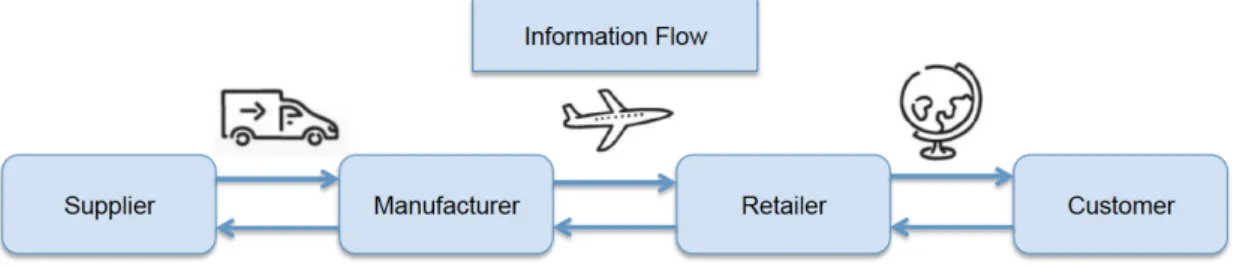
Thus, it is unlike the traditional databases because it does not rely on intermediaries to verify control operations and it is able to operate between various stakeholders. In fugure 2 it can be observed the information flow in a general supply chain.
Figure 2. Information Flow in Suppy Chain. Source: Adapted from Mapping the Sea of Opportunities: Blockchain in Supply Chain and Logistics, 2018
Since the advent of Bitcoin in 2008 and its rise on different platforms, the Blockchain technology has generated interest in many social groups (Nakamoto, 2008). In fact, in 2016 technology companies and service providers invested more than one billion dollars in their business to introduce Blockchain in various processes, an amount expected to increase in the coming years (Harty, 2018).
Before performing an analysis on Blockchain it is required to find a suitable research protocol. During this process, it will be gathered research from papers and authors, focusing our search on the Web of Science database. The papers have been filtered using some keywords: blockchain, blockchain and logistics, Blockchain and supply chain and blockchain and applications. In addition, the papers have been selected with the aim of not only analyzing the
development of this technology over time, but analyzing the current situation. Therefore, several papers have been extracted from previous years until now (from 2014 to 2019).
The Blockchain technology triggered the evolution of Bitcoin cryptocurrency. A dramatic increase in the price of Bitcoin for a short period of time generated interest from many investors and entrepreneurs. Bitcoin can be defined as a public, open, decentralized and anonymous network. The transactions do not require personal information because the system is able to trace the activity associated with each of the accounts (Hackett, 2017).
It was in 2015 when Blockchain became known in the financial sphere, and later began to expand into other areas, including logistics. The change involved adopting this concept in the industry was not easy to assimilate, however, instead of it being a gradual change a more instantaneous introduction into the various areas of application was more applicable (Pilkington, 2016).
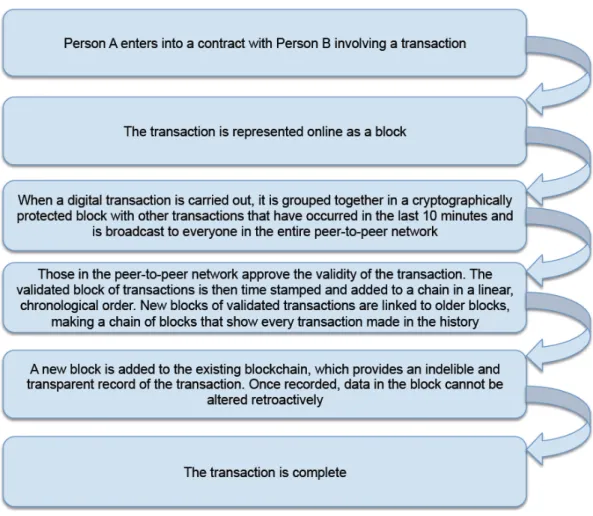
Furthermore, Blockchain is considered as a database organized as a list of blocks connected to each other. There are three generations of Blockchain: the first one was used to launch the digital cryptocurrency transactions. The second generation was based on the usefulness of this technology by addressing other related supply chain fields. Currently the third generation, has various applications in different areas using smart contracts, accelerating transactions by optimizing consumed resources and improving security (Zhao et al., 2016).
However, according to recent studies, one can conclude that this system is not yet efficiently
integrated into companies, mainly due to ignorance in some sectors. Its applications in sectors such as logistics, still generate controversy and uncertainty. Many companies are not familiar with this technology and are not aware of its potential (Kersten et al.,2017).
On the other hand, one of its main objectives is transparency in data. All members belonging to the same network have the right to display the content that has been introduced into the network, without any distinction. This way, it creates reliable and verifiable systems within an organization or for sharing data between different organizations.
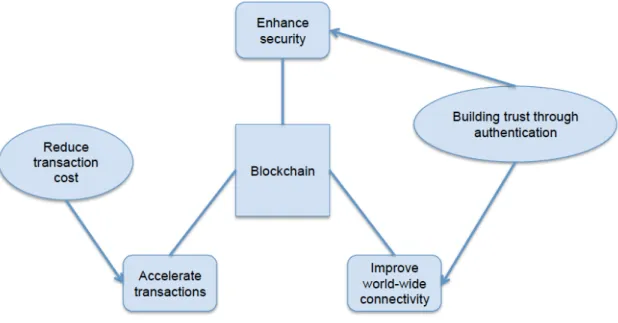
Another main benefit of blockchain is to reduce transaction time (by not using intermediaries), improving visibility at all stages of the supply chain, through increased transparency of the process, and improving communication between members responsible for activities to be updated and instant information at all times. It is true that the benefits of this technology will not be fully ascertained until it reaches maturity and consolidates companies to invest in this technology for their processes (Min,2018).
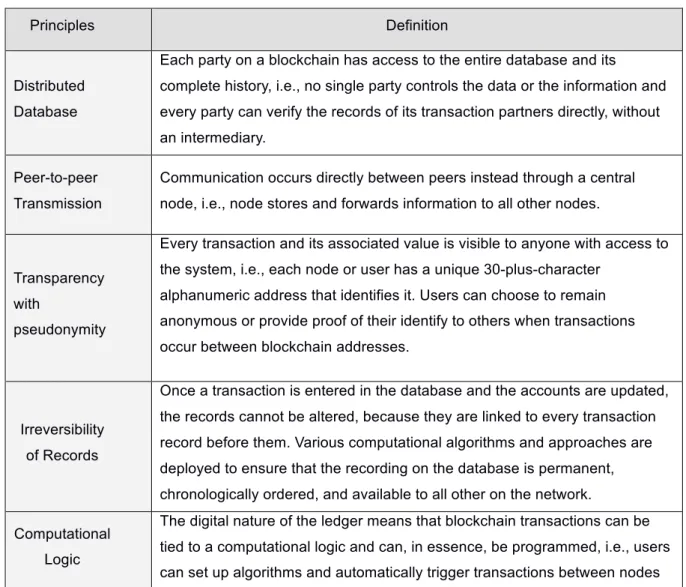
In table 2 is shown the main principles of Blockchain.
Table 2. Blockchain Principles Source: Adapted from What to adopt and Where to Start,2018
Despite the benefits presented by the technology, there is disagreement on what should get implemented globally in the industry. Therefore, during this work it will be aimed to do a thorough analysis of the characteristics of this trend, application and potential impact, generating an overall framework for logistics management linked to the possibilities presented by Blockchain (Banker, 2017).
2.3.2 The architecture behind Blockchain
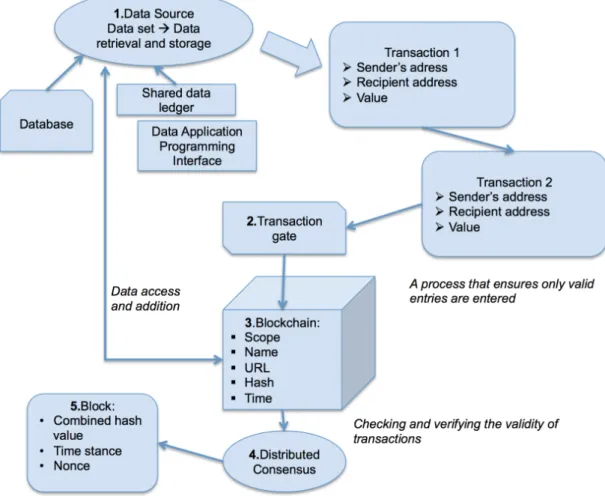
Blockchain is composed by chain block which consists of different modules that govern the operations and mark patterns of system behaviour. Below we explain each chain block and its typical architecture displayed on a general level, which is represented in Figure 3.
First, the data source module (1) is responsible for creating and coordinating shared databases, thus creating a decentralized network able to operate together. Within this module you can only read and review data but not update or delete it.
Principles Definition
Distributed Database
Each party on a blockchain has access to the entire database and its
complete history, i.e., no single party controls the data or the information and every party can verify the records of its transaction partners directly, without an intermediary.
Peer-to-peer Transmission
Communication occurs directly between peers instead through a central node, i.e., node stores and forwards information to all other nodes.
Transparency with
pseudonymity
Every transaction and its associated value is visible to anyone with access to the system, i.e., each node or user has a unique 30-plus-character
alphanumeric address that identifies it. Users can choose to remain anonymous or provide proof of their identify to others when transactions occur between blockchain addresses.
Irreversibility of Records
Once a transaction is entered in the database and the accounts are updated, the records cannot be altered, because they are linked to every transaction record before them. Various computational algorithms and approaches are deployed to ensure that the recording on the database is permanent, chronologically ordered, and available to all other on the network. Computational
Logic
The digital nature of the ledger means that blockchain transactions can be tied to a computational logic and can, in essence, be programmed, i.e., users can set up algorithms and automatically trigger transactions between nodes
It also creates access to databases without permission from any authority other than the user provided obligating all participants to check new additions, thus decreasing the risk of altering the original content.
The second module is the module or value exchange transaction (2) between buyer and seller. During this module, transactions are verified and new ones are created. For this to happen it is necessary for an agreement between buyer and seller to later verify and transfer it to the network. Often different multiple entries are included in the same transaction (Ray, 2017). On the other hand, the data recording is done permanently in the module creation through files called blocks (3). It may be that a block has to be linked directly to other blocks, in this case a chain block originates a new transaction by mathematical puzzles by adding the log of past transactions. In addition, to ensure the elimination of corruption, Blockchain has created a mechanism called module consensus (4). This complex test work or consensus algorithm tolerance is used to validate each transaction.
Finally, the connection module and interface provides real-time information on the status of transactions, the origin and recipient. Thus, Blockchain coordinates the web interfaces between different users by integrating all applications with their corresponding algorithms. That is why it represents the ideal tool to share data across different organizations or different departments within the same organization, increasing the capacity of association and communication (Min,
Figure 3. A basic architecture of Blockchain Technology. Source: Adapted from Blockchain technology for enhancing supply chain resilience, 2018
Blockchain enhances interoperability between the various systems and provides a single source of truth and trust. These features make Blockchain to possess a high processing capacity in different scenarios and operations. It also represents a fundamental change in relation to traditional systems, as participants no longer need a central authority for regulation and control.
Lastly, it is a tool that may change business models, diversifying traditional forms used in
In figure 4 is represented the basic inner of Blockchain technology.
Figure 4. Basic inner of Blockchain. Source: Adapted from Blockchain technology for enhancing supply chain resilience, 2018
2.3.3 Types of Blockchain networks
There are different mechanisms of consensus and exchange of information (Buterin, 2015), which originate three types of networks: public, private and federated.
Blockchain as a public network allows anyone at any time, as well as access to the information platform. Thus, the platform itself is self-managed reducing costs and maintenance administration. The public network is open to any participant space while the private network requires approval to enrol. Bitcoin and Eyherum are types of public networks. They have a lower speed, because they distribute information in countless open and public users books, contrasting to speed of the private network which is faster as it is limited to a number of members (Haferkon et al.,2015).
Furthermore, private Blockchains are only available to the number of participants that interact with the system and create changes within. They are used to further enhance security by
restricting access to certain participants. The main applications offer data management and auditing. This approach seems the most appropriate in the business world, where they have to constantly deal with confidential data. However, an analysis of the specific case which ensures the ideal interface must be conducted.
The basic difference between these two types of networks is the restricting access to the network and sharing data with other participants (Sadouskaya, 2017).
In addition, there is also a federated network, which is a combination of public and private networks. In this case, the level of privacy protection is very similar to the private network, but a set of nodes are responsible for verifying the transaction processes. This way not just a set of users can enter or change data, but they can also give permissions to other external users to perform these functions well. An example of this use is found in the banking and industrial sectors (Zheng et al., 2016). Table 3 summarizes the main properties of each network.
Table 3. Classification and main characteristics of networks. Source: A systematic
literature review of blockchain-based applications: Current status, classification and open issues, 2018
To achieve the integration of this technology in everyday life mechanisms by identifying users
Property Public Private Federated
Consensus Mechanism • Costly PoW • All miners • Light PoW • Centralised organization • Light PoW • Leader node set
Identity Anonymity
• Anonymous • Identified users • Trusted • Identified users • Trusted Protocol Efficiency & Consumption • Low efficiency • High energy • High efficiency • Low energy • High efficiency • Low energy Immutability • Almost impossible
• Collusion attacks • Collusion attacks
Ownership & Management • Public • Permissionless • Centralised • Permissioned whitelist • Semi-Centralised • Permissioned nodes Transaction Approval
• Order of minutes • Order of milliseconds
• Order of milliseconds
and verifying the correct ones which are needed, it is necessary to create platforms certifying basic features, as well as names, age or other relevant personal information (Lemieux, 2016). The main objective is to provide the exchange of secure and auditable data in different contexts, situations or processes using intelligent devices connected to exchange information simultaneously. In addition, the technology has been recognized to be in Blockchain favour by giving visibility, optimization and forecasting in logistics chains (Zhang et al.,2017).
2.3.4 Applications
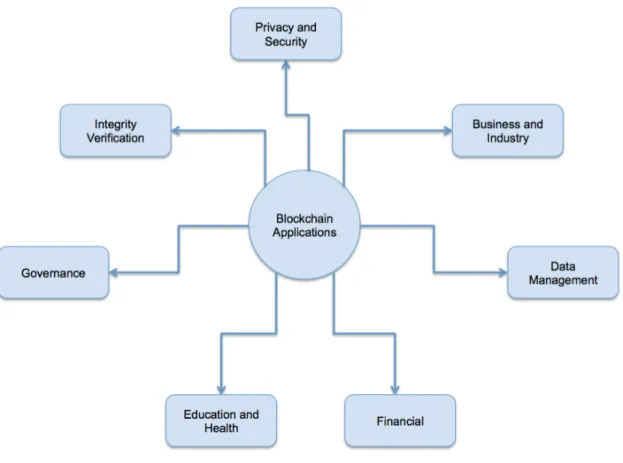
Blockchain has various applications depending on the scope and specific use in that matter, as it can be seen in figure 5. For example, this technology owns a verification system which could improve privacy and security.
Figure 5. Different types of Blockchain Applications. Source: Adapted from A systematic literature review of blockchain-based applications: Current status, classification and
open issues, 2018
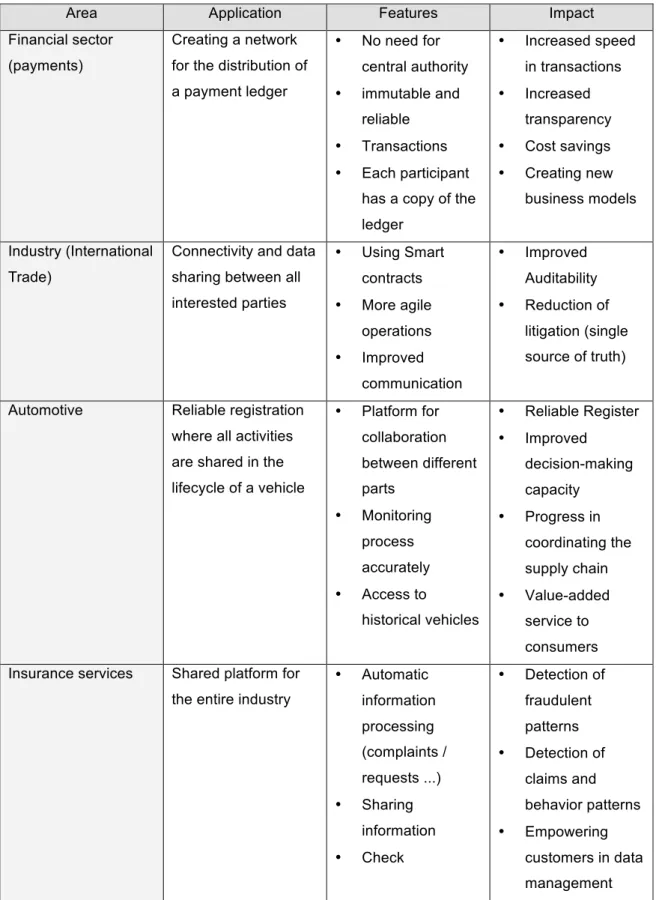
Moreover, financial services could undergo innovations with the implementation of new model business. Therefore the data management would become easier to manage and transactions