Cahier de recherche
2006-06
WEB SITE CONTENT MANAGEMENT AND ANALYSIS: A STAKEHOLDER AND
CONTINGENCY PERSPECTIVE Working Paper July 13, 2006 Sylvie Héroux Professor Accounting department École des sciences de la gestion
Université du Québec à Montréal (ESG-UQAM) C.P. 8888, succursale Centre-ville
Montréal, QC, Canada H3C 3P8 [email protected] telephone: 514-987-3000, 0274#
2 WEB SITE CONTENT MANAGEMENT AND ANALYSIS: A STAKEHOLDER AND CONTINGENCY
PERSPECTIVE
Abstract: The Internet contributes to financial market transparency by allowing a vast group of stakeholders to be reached quickly. Organizations can use the Internet as a strategic tool to set themselves apart from their competitors. They can use it as a way to maintain relations with their stakeholders. Prior accounting research had mainly focused on web site content analysis, on the content determinants, and, to a lesser extent, on certain aspects of the Internet communication process. Based on the stakeholder and contingency perspectives, this study examines how different stakeholders and contextual factors influence structures related to web site content management. It also analyses the relationship between this and the web site content. A mail survey sent to the web site managers of 551 Canadian organizations resulted in a 32.7% response rate. The web sites of the 180 companies taking part in the study were analysed based on a list of 161 items. Results suggest that stakeholder orientation, structures related to web site management, the size of the organization and business sector influence the web site content. Top management support, the resources allocated to web sites and the size of the organization determine to what extent structures are developed. There are gaps between stakeholder orientation, site objectives and site content. Boards of directors and auditors are not very involved in the Internet communication process. Overall, research avenues are evolving in the area of corporate governance, auditing and strategy.
Keywords: content management; web site analysis; Internet reporting; stakeholders; contingency.
1 Introduction
Technological changes and globalization put pressure on organizations and stress the importance of relationships between an organization and the stakeholders (Sillanpaa, 1998). The growing social expectations with respect to the reporting of organizational activities with important social impacts motivate accountability (Logsdon and Lewellyn, 2000) and corporate governance where stakeholder interests are considered (Waterhouse and Svendsen, 1998). "Every business is an information business" (Evans and Wurster, 1997). The organization that discloses "good information" over the Internet by taking the "right technological, technical and human means" could be very successful with stakeholders. Moreover, maintaining good relations with them can create value (Svendsen et al., 2003). Information transforms the nature and the structure of the competitive environment (Porter, 2001). The Internet has the potential to reach more stakeholders, to increase the amount of information exchanged with them and to enhance information by increasing the amount in circulation between them, by personalizing it and offering an interactive framework (Evans and Wurster, 2000; Brown and Duguid, 2000). To be more competitive, firms should facilitate stakeholders’ access to information (Trites, 2004).
In this context, accounting standard-setters are concerned about Internet reporting (AICPA, 1993; CICA / Trites, 1999; IASC, 1999; FASB, 2000;
IFAC, 2002)1. Given that the Internet can improve the organization’s transparency and reduce information asymmetry, it is of interest to regulators (TSX, 1999, 2003; CSA, 2001; SEC, 1999; DTI, 2001)2. Managers are concerned about costs and benefits; web sites that consider stakeholders’ information needs could provide organizations with economic advantages (Ashbaugh et al., 1999; Beattie and Pratt, 2001, 2003).
Accounting standard-setters and regulators encourage the adoption of an Internet disclosure policy (IFAC, 2002; TSX, 2003). After the enforcement of the FD ("fair disclosure") SEC rule in 1999 favouring communication to all stakeholders, firms had used the web to open previously private conference call minutes to the public (Trites, 2004). The Sarbanes-Oxley Act (2002) requires that companies disclose their annual 10-K Form3 "as soon as reasonably practicable" on their web site. The Company Law Review Steering Committee (DTI, _______________________
1
AICPA: American Institute of Chartered Public Accountants; CICA: Canadian Institute of Chartered Accountants; IASC: International Accounting Standards Committee; FASB: Financial Accounting Standards Board; IFAC: International Federation of Accountants.
2
TSX: Toronto Stock Exchange; CSA: Canadian Securities Administrator; SEC: Securities and Exchange Commission; DTI: Department of Trade and Industry, London.
3
10-K Form: annual report to be completed according to articles 13 or 15d) of the "Securities Act of 1934" and submitted to the SEC.
3 2001) recommends that they disclose the preliminary
results on their site, immediately after the official announcement. To meet these requirements, accountants should know how electronic reporting systems work (Trites, 2004).
Prior research in accounting had mainly focused on web site content analysis, on the content determinants (based on signalling theory, agency theory, cost / benefit approach) and, to a lesser extent, on a description of certain aspects of the Internet communication process. However, there is a limited number of studies that describe the influence of certain parties, their actions and the means they use to manage the web site content.
Internet reporting choices seem to depend upon stakeholder orientation (Flynn and Gowthorpe, 1997). Stakeholders’ information needs are intuitively identified, focusing on shareholders / investors (Gowthorpe and Flynn, 2002; Gowthorpe, 2005). Financial information disclosed over the Internet is a reproduction of PDF documents filed with regulators (Ettredge et al., 2002a; Smith and Pierce, 2005). The time to put 10-K Form information on-line differs from one firm to another (Ettredge et al., 2002b). Firms do not purge their web site content and they do not make sure that hyperlinks are functional when they add new content (Ettredge and Gerdes, 2005). The incorporation of the Internet communication strategy of listed firms into their overall communication strategy has some weaknesses (Lybaert, 2002). It is difficult to know if financial information disclosed on web sites is audited or not (Fisher et al., 2004). Managers are concerned about the security, integrity and credibility of information (Ashbaugh et al., 1999). Paradoxically, there is no indication of their pro-active attitude to ensure integrity; they have little knowledge of the work performed by external auditors to add credibility to information disclosed on web sites; they do not have the same opinion about auditors’ responsibilities (Smith and Pierce, 2005). The lack of consensus between information preparers, users and auditors suggests that conflicts exist, based on their evaluation of costs and benefits (Beattie and Pratt, 2001, 2003).
Overall, the previous studies contribute to developing some knowledge of items surrounding web site content management. To further this knowledge, this paper examines: i) How organizations manage their web site content, in particular, how different stakeholders and contextual factors influence the web site’s content management ? ii) The relationship that exists between the content management and the web site content. In other words, to what extent the combination of contextual factors
and structural factors (including those related to stakeholders) influence web site content.
In a more qualitative way, the aim of this study is describe content management profiles and the corresponding web site content. In order to generalize the results, its purpose is to examine the influence of contextual factors (both directly and indirectly due to structural factors) on web site content.
The theoretical discussion is based on stakeholder and contingency perspectives. Under the Configuration contingency approach, results are analysed with a cluster analysis. Under the Cartesian contingency approach, path analyses are used to discuss the results.
A mail survey sent to web site managers of 551 Canadian organizations with annual revenues greater than $50 million resulted in a 32.7% response rate. The web sites of the 180 organizations taking part in the study were analysed based on a list of 161 items.
Results indicate that stakeholder orientation, structures related to web site content, the size of the organization and the business sector influence the web site content. Top management support, the resources allocated to web sites and the size of the organization determine to what extent structures related to web site content are developed. There are gaps between stakeholder orientation, site objectives and site content. Boards of directors and auditors are not very involved in the process under study.
The remainder of this paper is organized as follows. The theoretical framework (Section 2) and the methodology (Section 3) are presented. Descriptive statistics (Section 4) precede the results analyses under the Configuration and Cartesian approaches (Sections 5 and 6). The conclusion of the study is then presented.
2 Theoretical Framework
2.1 Stakeholder and Contingency Perspectives The contingency perspective assumes that "there is no best way" to organize and that all depends upon the organization and its "fit" with the environment (Galbraith, 1973). Managers adapt the organization to environmental changes to improve performance (Chenhall, 2003). Success (a good performance) results from a proper fit between the firm and its environment, between its structures and the context.
4
Table 1
List of variables Contextual factors: Stakeholder orientation (a) Top management support Resources allocated to web site Web site development stage Environmental uncertainty
Other contextual factors :
Size of organization, financial results, indebtedness, foreign revenues, age of organization and business sector
Structural factors related to content management: Decentralization
Formalization / standardization Strategic planning (a)
Control system (a)
Web sites content:
Total content index (split in sub-indexes according to the type of content)
(a) The variables "stakeholder orientation" and "strategic planning" could be pooled under a "strategic factors" block (in a manner similar to
Miller and Friesen, 1977) and the variable "control system" could be distinguished from structural factors (in a way similar to Smith and Langfield-Smith, 2004). To simplify the model, the first variable was included as a contextual factor and the two others as structural factors.
In this study, the concept of "performance" is strictly defined. Under the stakeholder perspective, it is exclusively associated to the quantity of information disclosed on web sites. From a transparency point of view, the information targets multiple stakeholders; in that sense, a "well-performing" web site is based on the assumption that more information is disclosed. From a general point of view, by combining stakeholder and contingency perspectives, there could be more than one "best way" to align context and structures with a multiple stakeholder orientation. In particular, there could be more than one type of multiple stakeholder orientation (Greenley and Foxall, 1997). When properly aligned with particular factors, multiple stakeholder orientations could lead to higher content sub-indexes.
Table 1 presents the list of variables selected in this study, according to Internet reporting studies, consulting interviews4, stakeholder literature and accounting studies based on contingency literature5. 2.2 Configuration and Cartesian Contingency
Approaches
_______________________
4
In order to provide support to the development of the theoretical framework and guide the data collection, four web site managers in large organizations, one consultant in numerical relations whose major clients are large private firms and one top manager of a fund management company were met. Six consulting interviews were conducted in five organizations (two public; four of large size; representing three business sectors), for a duration of 90 to 120 minutes each, totalling almost 11 hours of recording.
5
See Thomas (1986); Mak (1989); Xiao et al. (1996); Greenley and Foxall (1997); Husted (2000); Chenhall (2003).
The following discussion (Subsections 2.2.1 and 2.2.2) is mainly based on Gerdin and Greve (2004)6. Web site content management is included in a comprehensive set of management systems. Its structures can be affected by particular contextual factors (web site development stage, top management support, resources allocated to web site). Given that there is no literature specific to the topic, it is difficult to predict the direction of the relationships under study. Propositions are thus made.
2.2.1 Configuration Model
The Configuration approach relies on a systemic view of the relationships between contextual and structural factors. The structures are relatively stable over time but are not static. Changes made to them are major, radical (quantum jumps), done on more than one component at a time, when the organization estimates that the costs of misfit between context and structures are greater than the costs of changes. According to the "congruence" view of the Configuration approach, most of the organizations can be classified in a limited number of groups characterized by similar structures and environment (Miller and Friesen, 1984). In this study, the relationship between contextual factors and structural factors is explored, in order to describe content management profiles; web site content and some other contextual factors corresponding to the profiles are examined (Figure 1).
_______________________
6
Gerdin and Greve (2004) review the forms of contingency fit in management accounting literature, notably considering the work done by Miller and Friesen (1984), Drazin and Van de Ven (1985), Venkatraman (1989), Meyer et al. (1993) and Donaldson (1996).
5
Figure 1
Configuration model
Content management profiles Web sites content
General proposition:
A higher content index results from a proper fit between contextual and structural factors and from a multiple stakeholder orientation. There are a few "well-performing" (proper) fits.
2.2.2 Cartesian Model
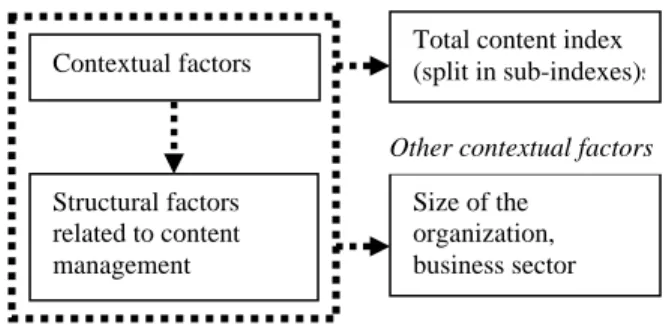
The Cartesian approach relies on a reductionist view of the relationships between contextual and structural factors. Changes on structures are made gradually (incremental changes) on a few components at a time. In the spirit of the "contingency" view of the Cartesian approach, variations in web site content (in the "performance") are explained in terms of the relationship between contextual and structural factors. Multiple fits for "context-structures" could give rise to a variation in "performance". Contextual factors (including stakeholder orientation) could influence web site content both directly and indirectly due to structural factors (Figure 2).
Figure 2 Cartesian model Contextual factors Structural factors related to content management Total content index (split in sub-indexes) Other contextual factors Stakeholder Orientation
The principal groups of stakeholders are represented by shareholders / investors, employees, suppliers, governments / political groups, and the public at large (Clarkson, 1995; Donaldson and Preston, 1995). The management of stakeholder relations (Husted, 1998) requires paying simultaneous
attention to their interests in establishing organizational structures as well as in the general policies (Donaldson and Preston, 1995). Scarcity of resources can prevent an organization from paying the same attention to multiple stakeholder interests (Greenley and Foxall, 1997). Corporate governance from a stakeholder point of view (Freeman and Reed, 1983; Charreaux and Desbrières, 1998; Waterhouse and Svendsen, 1998) implies the establishment of an order of priority that considers potentially conflicting interests; those interests can be considered by the board of directors and in the management structures (Preston, 1998). The perception of stakeholders’ attributes (legitimacy, urgency, power) by top managers can influence the order of priority (Agle et al., 1999). Internet reporting choices seem to depend upon stakeholder orientation (Flynn et Gowthorpe, 1997).
Proposition #1:
It can be expected that stakeholder orientation: a) influences web site content; b) influences structures related to content management, and, consequently, web site content.
Decentralization of Activities Related to Content Management
Members of the board of directors can be involved in the approval of web site content (Gowthorpe and Flynn, 2002; Gowthorpe, 2005).
According to consulting interviews (Section 2.1), organizations benefit from interactivity (email comments) or ask for information users’ participation (focus group discussions, tests using the company’s web site) to involve clients and community representants in improving their site. Different groups of employees (notably in communications, marketing, IT departments) are involved in content management; given that their concerns are often diverging, it is not easy to develop a consistent and global vision for the web site. This can influence content.
Under a value-added perspective, by creating stakeholder networks, by calling them out to get an idea of their expectations, an organization develops good relationships with stakeholders (Svendsen et al., 2003). In that sense, the involvement of external groups (distributors, clients, community members, regulating agencies) in a process to obtain ISO 14001 certification (Environmental Management Standard) generates a competitive advantage (Delmas, 2001).
External consultants can be perceived as change agents ("technological innovators") in a highly uncertain environment, where organizations try to imitate their practices (Crucini and Kipping, 2001). Contextual factors
Structural factors related to content management
Total content index (split in sub-indexes)s
Size of the organization, business sector Other contextual factors
6
Proposition #2:
It can be expected that decentralization of activities related to content management influences web site content.
Top Management Support
Top management support influences the activity-based costing systems implementation process (Anderson and Young, 1999). It is plausible to expect that this support could influence the structures related to content management.
According to consulting interviews (Section 2.1), top management provides support by appointing a top manager in charge of the site, by developing an overall vision for the site and by formulating the site’s mission. This can affect how parties involved face up to their responsibilities (formalization / standardization of mechanisms) and, consequently, can affect web site content.
Proposition #3:
It can be expected that top management support influences structures related to content management and, consequently, web site content.
Resources Allocated to Web Site
According to consulting interviews (Section 2.1), structures related to content management can help to maintain and improve web site content; the availability of human, financial and material resources can influence these structures and the web sites content.
Proposition #4:
It can be expected that resources allocated to web sites: a) influence web site content; b) influence structures related to content management and, consequently, web site content.
Web Site Development Stage
Under stakeholder perspectives, "at any organizational life cycle stage, certain stakeholders, because of their potential to satisfy critical organizational needs, will be more important than others." (Jawahar and McLaughlin, 2001, p. 405). In that sense, web site development stages (characterized by different objectives and strategies) could influence their content as well as the structures put in place to manage it.
The maturity of information systems can influence the degree of user participation (Sabherwal and King, 1992). The web site development stage could thus affect the degree of involvement of stakeholders. According to consulting interviews (Section 2.1), content management could be
centralized at first while it could be decentralized after a period of four to five years.
Proposition #5:
It can be can expected that web site development stage: a) influences web site content; b) influences structures related to content management and, consequently, web site content.
Environmental Uncertainty
According to Lawrence and Lorsch (1967), the degree of environmental uncertainty affects organizational structures (Chapman, 1997). Organizations adapt their structures and processes to the environment (Miles and Snow, 1978). Firms confronted with greater environmental uncertainty use more sophisticated operational controls (Mak, 1989). The relationship between a multiple stakeholder orientation and organizational performance is moderated by competitive hostility (Greenley and Foxall, 1997). Small business unit strategy and environmental uncertainty influence the design of management accounting systems; the fit between systems and strategy - environment is a significant determinant of the business unit’s performance (Chong and Chong, 1997).
In this study, a firm confronted with a heterogeneous environment could be accountable to a greater diversity of stakeholders, influencing the quantity (and the type) of information disclosed on web sites. A dynamic / stable environment could affect structures related to content management.
Proposition #6:
It can be expected that environmental uncertainty: a) influences web site content; b) influences structures related to content management and, consequently, web site content.
Other Contextual Factors
The size of the organization can influence how it is managed (Chenhall and Langfield-Smith, 1998); it can influence its structures (Miles and Snow, 1978; Miller and Friesen, 1984). In the context of this study, small listed companies intuitively identify stakeholders’ needs concerning Internet reporting; their board of directors is involved in approving web site content (Gowthorpe and Flynn, 2002; Gowthorpe, 2005).
The age of the organization influences its
structures (Miller and Friesen, 1984). Experience acquired over the course of time could be materialized in the form of more sophisticated structures related to content management, and,
7 consequently, could influence web site content. Some
studies suggest that business sector differences influence organizational structures more than the direct influence of technology (Miles and Snow, 1978). According to consulting interviews (Section 2.1), organizations with good financial results benefit from consultants’ expertise by involving them in content management; web site content seems to depend upon the size of the organization and the financial results. According to Internet reporting literature, size of organization, business sector, international dimension / foreign revenues, financial
results and indebtedness could influence web site
content (in some studies they do; in others, they do not).
Proposition #7:
It can be expected a) that the size and age of the organization, financial results and business sector influence structures related to content management; and b) that the size and age of the organization, financial results and business sector, foreign revenues and indebtedness influence web site content. 3 Research Methodology
3.1 Data Collection and Sample
Data was collected in three steps: a mail survey7 (summary, Section 3.2) was sent to the web site managers of 551 organizations8; the web sites of 180 firms were analysed based on a list of 161 items (appendix); data related to other contextual factors was mainly collected in the Financial Post database. _______________________
7
The English and French versions of the questionnaire were developed and tested. Six research colleagues and two external experts (proof reader and translator) revised it and 12 web site managers (who were not taking part in the study) tested it. The questionnaire takes approximately 25 minutes to complete.
8
The Financial Post electronic database is updated daily and contains information about over 5,600 Canadian organizations. On June 17, 2004, all the organizations having annual revenues greater than $50 million were selected from this database. The organizations that did not have a web site, whose web site is not distinct from that of their foreign parent company or is not managed in Canada; that were engaged in a dissolution process; that have a web site incorporated in a parent company already included in the target population; or that are not incorporated in Canada, were removed. The target population is represented by 551 organizations.
3.1.1 Survey Implementation
Considering the size of the target population, the need to maintain the cost of this study at a reasonable level and the fact that the questionnaire should ideally be completed by the web site manager or by a person who has an overview or a sufficient knowledge of the management of information content from all points of view, one respondent per organization is identified.
The identification of web site managers is crucial because the survey is organized around specific themes. This step is spread out over a period of four weeks before mailing the survey. For each of the 551 organizations in the target population, i) attempt is made to find the name, address and telephone number of "potential" web site managers by scrutinizing information about directors in the Financial Post database or on an organization’s web site; ii) as a pre-notice procedure, this information is validated by email or by telephone9, once, and twice if necessary. The survey is mailed on September 30, 2004, including a cover letter and a postage-paid envelope. The follow-up procedures are done in four steps: 1) mailing of a thank you / reminder post card about three weeks after the questionnaire mailing; 2) a few days before mailing a replacement questionnaire, emailing respondents who had previously agreed to participate but did not return the survey yet; 3) mailing of a replacement questionnaire to all the non-respondents about five weeks after the first questionnaire mailing; 4) making a final contact with organizations that had positively answered any of our previous contacts, spread out between the second and the third month after the first questionnaire mailing. 3.1.2 Sample Description
A total of 180 managers had completed the survey (response rate 32.7%)10. This manager rate of _______________________
9
Email is more effective and efficient. It makes it possible to indicate in writing the aim of this study, the main themes of the questionnaire and the time required to complete it. In spite of the risk of being deleted without being read by the recipient, it is fast and makes it possible to create a list of contacts facilitating the optimization of the follow-up procedures.
10
It should be noted that 72 firms (including 47 at the pre-notice stage) indicated that the organizational policies do not allow for participation in any study (17) or that they cannot participate because of an important event such as a reorganization (12), because of their lack of interest in the topic (3), of time or resources (20), for confidentiality reasons (1), or without providing any raison (19).
8 participation is greater than or similar to studies on
their perception of Internet reporting practices (27% to 33%)11 or research based on contingency perspectives (11% to 25%)12. According to studies based on a theoretical framework comparable to our own, the Configuration approach seems to be applied on a sample (16 to 110)13 smaller than the Cartesian approach (34 to 265)14. The sample size (n=180) is therefore acceptable for the analyses based on both approaches.
The average revenues, assets and employees of the sample are not significantly different from the target population (according to one sample T-tests), nor are they from those of the 371 non-respondent firms (according to independent sample T-tests); this suggests that the sample is representative of the target population. It is made up of 165 firms listed on the Toronto Stock Exchange, three companies listed on TSX Venture Exchange, seven crown corporations and five major subsidiaries of large parent companies. These organizations are split into seven business sectors.
3.1.3 Web Site Analysis
Web site content was analysed over a period of three months coinciding with the beginning and the end of receipt of the questionnaires (October 2004 to January 2005). The list of 161 items (Appendix A) had initially been tested with the web sites of the 12 first respondent organizations. To get a reliable interpretation of these items, a research assistant and I analysed 16 web sites (one to two sites per business sector). I completed the analysis of the content of the 164 other web sites.
3.2 Definition and Measurement of Constructs To measure contextual and structural factors, a questionnaire was developed based on Dillman _______________________
11
Respectively 27%, 33%, 31%, 22%, for Ashbaugh et al. (1999), Beattie and Pratt (2001; 2003), Joshi and Modhahki (2003), Smith and Pierce (2005).
12
Respectively 18%, 23%, 25% and 11% for Sabherwal and King (1992), Greenley and Foxall (1997), Chong and Chong (1997), Bergeron et al. (2001).
13
See Miller and Friesen (1977), Miles and Snow (1978), Bergeron et al. (2001).
14
See Gordon and Narayanan (1984), Mak (1989), Sabherwal and King (1992), Greenley and Foxall (1997), Chong and Chong (1997), Chenhall and Langfield-Smith (1998), Anderson and Young (1999).
(2000), consulting interviews (Section 2.1) and questions adapted from previous studies (Appendix B). Seven-point Likert scales were mostly used, complemented by a few questions with response categories.
Questionnaire Summary – Contextual factors
Stakeholder orientation is reflected in the corporate mission (Greenley and Foxall, 1997; Waterhouse and Svendsen, 1998), in the degree of time and attention given by the management team to each group of stakeholders as well as in the importance acknowledged to satisfy their needs (Agle et al., 1999).
Top management support to maintain and improve a web site is provided by appointing a top manager in charge of the site, formulating the site’s mission, supporting the allocation of resources, encouraging all the spheres of the organization to help maintain and improve the site (adapted from Anderson and Young, 1999; inspired by Miller and Friesen, 1984; Clarkson, 1995; and Agle et al., 1999). Financial, human and material resources allocated to web sites can be perceived to be sufficient (adapted from Anderson and Young, 1999). The number of employees involved and the annual amount of the budget allocated to web sites can also be used as measures for the resources allocated to web sites (inspired by consulting interviews).
Web site development stages are inspired by Jawahar and McLaughlin (2001). Web site is at the initial stage. It is continually being adjusted or currently undergoing improvements. It represents a model for competitors and companies in general. It is stagnating (activities to maintain and improve the site are suspended).
Environmental uncertainty has three dimensions. Environmental dynamism refers to the unpredictability of competitors’ actions, client demand and regulation (Miles and Snow, 1978). Environment hostility is characterized by competition for prices for products / services and by regulation intensity (Gordon and Narayanan, 1984; Miller and Friesen, 1984). Environmental heterogeneity is measured by the diversity of competitive tactics and client tastes (Miller and Friesen, 1984).
Questionnaire Summary – Structural factors
Decentralization is made up four parts: A) the degree of parties’ involvement in writing the information content, delivering it on-line and improving the web sites (inspired by Delmas, 2001); B) the degree of consultation (in respect of the writing and the on-line delivery of information) of the
9 decision process (inspired by Sabherwal and King,
1992); C) the sharing of web site and content responsibilities between the parties and D) the utilization of content management software (C and D are inspired by consulting interviews).
Consulting interviews (Section 2.1) suggest that the definition of internal parties’ roles and responsibilities, a shared common vision of how information content is managed and the existence of procedures to facilitate the settlement of conflicts between groups involved in the process contribute to the formalization / standardization of mechanisms put in place. Written procedures, informal agreements reached to handle situations, informal steps (ad hoc committee seminars, etc.) and the existence of procedures for all situations dealing with management also contribute to it (adapted from Sabherwal and King, 1992).
Strategic planning related to content management refers to the identification of risks inherent to Internet reporting, anticipation of actions to manage those risks, anticipation on a long-term basis of the information needs of Internet users and of the resources requested to do so (adapted from Mak, 1989). It also refers to the incorporation of strategic decisions about Internet reporting into the company’s overall communication strategy and the coordination of strategic actions (adapted from Miller and Friesen, 1984).
Based on Miller and Friesen (1984), Mak (1989), Chenhall and Langfield-Smith (1998) and on consulting interviews (Section 2.1), items that can be representative of the system put in place to follow up on web site content are identified (comparison with other web sites, surveys on user satisfaction, focus group discussions, etc.). Web site managers’ perceptions of the quality of different types of content compared to the competitors could give rise to changes in content; they are thus also a part of the control system related to content management. Other Contextual Factors
The size of the organization is measured by the log of total assets, total revenues, number of employees or, if applicable, market capitalization. The age of the organization corresponds to the number of years since the incorporation date. Financial results are taken into consideration by the return on (average) equity ratio. Indebtedness is measured by the long term debt to equity ratio. The proportion of foreign revenues is equal to foreign revenues divided by total revenues.
Data are collected from different financial data bases (mainly the Financial Post). Business sectors
are defined by the "Global Industry Classification Standard".
Content Index
The total content index is defined by the quantity of information disclosed on a web site. It is split into sub-indexes according to the type of content. Financial content can refer to accounting information (ex.: results disclosed in the annual report) or not (ex.: quoted market price). Non-financial content is split into six parts: general information (ex.: mission, profile, history, contact, updating date, legal notice), corporate governance, operations / development, human capital, social responsibility and products / services / clients. Promotional information includes details on products / services, pre- and after-sales services. Transactional information principally refers to Internet sales conditions. The content that facilitates accessibility includes hyperlinks with other web sites and navigation aids. The content index measurement is based on a list of 28 financial, 97 non-financial, 5 promotional, 8 transactional, and 23 accessibility items (Appendix A).
This list had been developed by crosschecking indexes from previous studies15 and judging criteria used for the CICA (2003 / 2004) "Corporate Reporting Awards", "Excellence in Electronic Disclosure" category16.
The objective of this study is generally close to Xiao et al. (2004), Marston and Polei (2004) and Héroux and Cormier (2002): is an item disclosed or not on the web site? (yes = 1; no = 0). It does not say if information disclosed on web sites corresponds more to stakeholder needs than the information disclosed in a more traditional way, as there is no comparison between the two communication strategies. The web site content analysis is concentrated on "web pages" only, excluding the PDF document content.
_______________________
15
Xiao et al. (2004), Marston and Polei (2004), Héroux and Cormier (2002), Debreceny et al. (2001, 2002); Ettredge et al., 2002a), Deller et al. (1999), Pirchegger and Wagenhofer (1999), Williams and Ho Wern Pei (1999), Cormier and Magnan (1999, 2003) and Flynn and Gowthorpe (1997).
16
Judges are volunteers from the CICA, from the "Canadian Investor Relations Institute" and from the "Toronto Society of Financial Analysts".
10 Table 2
Descriptive statistics – contextual and structural factors (n=180)
Variables (a) # of items Cronbach Alpha Mean S.D. Min. Max.
Contextual factors: Stakeholder orientation - shareholders / investors - clients - employees - suppliers
- governments / political groups - public at large 3 3 3 3 3 3 0.80 0.90 0.79 0.79 0.83 0.87 5.87 5.41 5.11 3.59 3.16 3.83 1.56 2.07 1.62 1.60 1.75 1.95 0 0 0 0 0 0 7 7 7 7 7 7
Top management support 3 0.77 4.45 1.52 1 7
Resources allocated to web site 3 0.85 4.59 1.55 1 7
Web site development stage - initial stage
- continual adjustments - current major changes - model for other firms - period of stagnation 1 1 1 1 1 n.a. 2.08 5.34 4.26 4.01 1.87 1.89 1.85 2.25 1.76 1.36 0 0 0 0 0 7 7 7 7 7 Environmental uncertainty 8 0.80 4.05 1.16 0 6.75
Structural factors related to content management:
Decentralization 37 0.80 3.09 0.80 1.43 5.24
Formalization / standardization 7 0.81 3.95 1.38 0 7
Strategic planning 6 0.89 4.71 1.58 0.67 7
Control system 18 0.82 3.89 0.90 1.94 6.61
(a) Variables measured on a seven-point Likert scale (0 if not applicable). 4 Descriptive Statistics
Table 2 presents sample descriptive statistics for
contextual and structural factors17. The more the
means tend to 7, the more the firms tend to have a stakeholder orientation; the more the top management supports web site management; the more the resources allocated to the web site are perceived to be sufficient; the more the environment is uncertain, the more the activities and mechanisms surrounding web site management are respectively decentralized and formalized, and the more the strategic planning and the system control have a place in content management.
It should be noted that 70% of the organizations have had a web site for more than five years and that resources allocated to web sites are limited for 70% to 80% of organizations (less than five employees; annual budget less than $300,000).
Concerning the other contextual factors (descriptive statistics not tabulated), on average, large
_______________________
17
There is no multicollinearity problem between contextual and structural factors related to content management.
organizations18, incorporated 30 years ago, had in general made profits during their most recent year-end; 51% of the respondents perceived that the financial results correspond to top management expectations; 22% and 27% think they are respectively below and over these expectations. On average, organizations earn 28% of their total income abroad. Their respective indebtedness is very disparate. A correlation analysis (not tabulated) indicates that the size of the organization seems to have an effect on contextual and structural factors and on web site content. Comparisons between the mean of each variable for every business sector suggest that business sector also seems to have an effect in this area.
Table 3 shows that, on average, firms disclose relatively little information versus the maximum number of items. Contextual factors could prevent them from doing so (ex.: limited resources, poor financial results) or they can motivate this practice (ex.: strategic orientation benefits a particular group of stakeholders). The "products / services / clients" _______________________
18
On average, total assets, revenues and market capitalization are respectively about $7.5; $2 and $3.3 billion while the average number of employees is about 6,000.
11 and promotional and transactional contents are
brought together under what is referred to as the "marketing content" (*19 items, α=0.84).
The relevance of this grouping had been confirmed by a factor analysis done with the 10 content sub-indexes (not tabulated).
Table 3
Descriptive statistics – web sites content indexes (n=180)
Indexes # of items Cronbach Alpha Mean S.D. Min. Max.
Total content Financial content Non-financial content - general (a) - governance - operations/development (a) - human capital - social responsibility - products/services/clients* Promotional content* Transactional content* Accessibility (a) 161 28 97 17 27 23 13 11 6 5 8 23 0.93 0.84 0.91 0.54 0.87 0.70 0.84 0.86 0.65 0.61 0.87 0.69 58.01 9.12 33.63 9.58 7.10 6.46 4.23 3.16 3.11 2.54 1.20 11.53 19.66 4.69 13.00 2.55 4.95 3.51 3.28 3.17 1.49 1.35 2.04 3.74 17 0 10 3 1 0 0 0 0 0 0 2 111 22 72 17 22 16 12 11 6 5 7 22 *Marketing content 19 0.84 6.84 3.77 0 16
(a) The general content’s Cronbach Alpha coefficient is below the acceptable lower limit (α=0.54; Table 3). According to correlation analyses (not
tabulated), there is no structural factor correlated with operations / development content (α=0.70, Table 3). Correlations between contextual / structural factors and accessibility content (α=0.69; Table 3) are similar to those observed for the total content. It is then less relevant to deepening the analysis of the relation between those three sub-indexes and these factors.
Cronbach’s Alpha reliability coefficient " […] is a measure of internal consistency that uses repeated measurements […] to assess the degree to which correlation among the measurements is attenuated due to random error. " (Botosan, 1997, p. 335). It measures the internal consistency of a multi-item scale. A coefficient α of 0.70 deems to be the lower acceptability limit (0.60 in an exploratory study) (Hair et al., 1998). According to coefficients α, all exceeding 0.70 (Table 2), the responses collected by questionnaire are consistent. According to the coefficient α=0.93 (Table 3), the correlation between the 161 items is not much attenuated due to random error; overall, the total content index seems to be valid.
5 Results – Configuration Approach
In order to describe content management profiles, the cluster analysis technique is used. Homogeneous groups were formed using contextual and structural factors as clustering variables19. The corresponding _______________________
19
A factor analysis on contextual and structural factors (not tabulated) indicates that two principal components are crosschecking as for a variable. In addition, " […] there is a debate over the use of factor scores in cluster analysis, as some research has shown that the variables that truly
size of organizations, business sectors and web site content is examined. The k-means clustering method is relevant because the amount of available data is large (n=180) (close to the 200 limit given in SPSS Application Guide).
5.1 Determination of the Number of Clusters
The determination of the optimal number of clusters is a crucial step in a cluster analysis; there is no formal method to do so; a heuristic approach progressively guides the researcher (Chenhall and Langfield-Smith, 1998).
According to a visual examination of the dendrograms resulting from a Ward’s hierarchical procedure, four or ten clusters could be appropriate while four- or seven-cluster solutions could be relevant according to the average linkage method. Common to the two methods, the four-cluster solution keeps our attention a priori.
An analysis of agglomeration schedules supports this observation. According to Ward’s method, two-, three- or four-cluster solutions lead to a large percentage change in agglomeration coefficients
discriminate among the underlying groups are not well represented in most factor solutions. " (Hair et al., 1998, p. 491). In this study, every measure of the contextual and structural factors (of the questionnaire’s statements) are used as clustering variables.
12 compared to four or five clusters, according to the
average linkage method. Again, common to the two methods, the four-cluster solution seems to be appropriate.
A four-cluster solution should give rise to a sufficient number of details to distinguish content management profiles. A cluster analysis using more than four groups can make the descriptive process cumbersome and can lead to the formation of clusters with a few observations (which is the case with the five-cluster solution: one cluster has only 15 observations). Thus, the correspondence between the observations of the four- and the three-cluster solutions is finally examined.
Overall, the formation of a fourth cluster makes it possible to isolate 24 observations (of which 21 come from one group for the three-cluster solution). The attribute analysis of this fourth group could enhance the results of this study.
5.2 Differences in Content Management Profiles The analysis of variance (one-way ANOVA) technique was used to indicate if there are significant differences between the means of the variables for each cluster. Table 4 illustrates the results of ANOVAs on the contextual and structural factors. The results from ANOVAs (not tabulated) on each measure of these variables (on each questionnaire’s statements) are added in italics in Section 5.2.
Table 4
Tests on mean differences between clusters – contextual and structural factors
Means Statistics Variables (a)
(# of questionnaire’s statements; see Table 2) cl1 n=44 cl2 n=24 cl3 n=53 cl4 n=59 F or Welch (b) *** Pairs of means that are significantly
different (c) Contextual factors: Stakeholder orientation - shareholders / investors (3) - clients (3) - employees (3) - suppliers (3)
- governments / political groups (3) - public at large (3) 6.48 4.33 5.61 3.56 3.86 4.14 4.42 3.18 2.93 2.32 1.42 2.19 6.18 6.55 5.92 4.32 3.84 5.09 5.72 6.09 4.90 3.46 2.75 3.14 10.234 21.394 7.743 23.306 20.439 28.096 gr1-2; gr1-4; gr2-3 gr1-3; gr1-4; gr2-3; gr2-4; gr3-4 gr1-2; gr1-4; gr2-3; gr2-4; gr3-4 gr1-2; gr2-3; gr2-4; gr3-4 gr1-2; gr1-4; gr2-3; gr2-4; gr3-4 gr1-2; gr1-3; gr1-4; gr2-3; gr3-4
Top management support (3) 4.80 2.79 5.58 3.85 37.384 gr1-2; gr1-3; gr1-4; gr2-3; gr2-4; gr3-4 Resources allocated to web site (3) 5.21 3.63 5.28 3.90 16.141 gr1-2; gr1-4; gr2-3; gr3-4 Web site development stage (d)
- continual adjustments (1) - undergoing major changes (1) - model for other firms (1) - period of stagnation (1) 5.25 3.27 3.73 1.45 3.71 3.50 2.21 2.17 6.38 4.96 5.19 1.64 5.14 4.66 3.90 2.27 6.642 22.838 16.932 4.111 gr1-2; gr1-3; gr2-3; gr2-4; gr3-4 gr1-3; gr1-4; gr2-3 gr1-2; gr1-3; gr2-3; gr2-4; gr3-4 gr1-4 Environmental uncertainty (8) 3.56 3.27 4.75 4.12 14.988 gr1-3; gr2-3; gr2-4; gr3-4 Structural factors related to content management:
Decentralization (37) 2.88 2.28 3.97 2.80 71.056 gr1-2; gr1-3; gr2-3; gr2-4; gr3-4 Formalization / standardization (7) 3.96 2.73 4.91 3.57 22.018 gr1-2; gr1-3; gr2-3; gr2-4; gr3-4 Strategic planning (6) 5.60 2.62 5.51 4.18 35.636 gr1-2; gr1-4; gr2-3; gr2-4; gr3-4 Control system (18) 3.97 2.92 4.69 3.50 49.982 gr1-2; gr1-3; gr1-4; gr2-3; gr2-4; gr3-4 (a) Variables measured on a 7-point Likert scale. (b) According to Levene test, if homogeneity of variances between clusters is assumed, F statistic
is examined; otherwise, Welch statistic (*** p value p=0,00 for all F or Welch statistics). (c) If homogeneity of variances between clusters is
assumed, multiple comparisons between clusters are done according to Tuckey HSD ("honestly significant difference"); otherwise, according to Dunnett C test. (d) Variable "initial stage of development" not tabulated: means < 3/7; Welch statistic = 2,494, not significant.
13 In general, according to the weak F / Welch
statistics (respectively 7.743; 10.234; 6.642; 4.111; 2.494; Table 4), shareholder / investor or supplier orientations, the fact that a web site is undergoing major changes, is stagnating or is at the initial stage do not contribute to make a clear distinction between clusters.
Overall, organizations comprising cluster 3 are significantly different from other clusters with respect to many variables. They have a greater multiple stakeholder orientation (mean greater than 5/7 for 4 out of 6 orientations, Table 4). They have a greater top management support. Their web sites are continually adjusted and seem to be perceived as a model for other firms. They are facing a more uncertain environment. The unpredictability and intensity of regulations are, however, comparable to clusters 1 and 4 while the intensity of competition is similar to cluster 4’s intensity. Structures related to content management are in general more developed than those of other clusters.
Organizations comprising cluster 3 involve more groups of stakeholders (decentralization); they have the greatest tendency to involve clients and community representants to improve the web site; this can explain the involvement of a multidisciplinary Internet team to coordinate the activities. They define the roles and responsibilities of the internal parties involved and procedures to settle conflicts exist (formalization / standardization). Surveys on web site satisfaction, tests using web site, focus group discussion results, the number of visitors per web site section, fall out reports (specifying where on a web page the Internet user has given up visiting the site or completing an application on line), reflect a certain level of sophistication of the control system.
The contextual and structural factors characterizing cluster 2 differ in many respects from the three other clusters. Firms tend to adopt a shareholder / investor orientation (the only orientation with a mean greater than 4/7, Table 4). Top management does not seem to provide support to maintain and improve the web site, which is not continually adjusted. Structures related to content management are less developed. Comparison with the web sites’ competitors or leaders in Internet reporting are examples of basic tools used to follow up on web site content. Overall, cluster 2 uses control mechanisms to a lesser extent than clusters 1, 3 and 4.
Cluster 1 is distinguishable from others by a multiple stakeholder orientation (mean greater than 4/7 for 4 out of 6 orientations, Table 4) marked by a
"financial and political dimension". On average, the finance / administration department, top management and the board of directors are involved in content management to a greater extent than in the other clusters (decentralization). It should be noted that the unpredictability and intensity of regulation are comparable to those of cluster 3 (environmental
uncertainty). Resources allocated to web sites are
perceived to be sufficient by cluster 1 and 3 representants (respective means of 5.21 and 5.28/7; Table 4). The strategic planning measures for clusters 1 and 3 related to content management are comparable.
Cluster 4 is also characterized by a multiple stakeholder orientation (mean greater than 4/7 for 3 out of 6 orientations, Table 4). It is marked by a "promotional" dimension from a client orientation (comparable to cluster 3), by competition intensity (similar to cluster 3) and by a web site that aims at promoting products / services.
The four clusters lean towards decentralization as managers’ decisions concerning the writing of the content and its delivery on-line are made with a maximum of consultation (differences generally not significant between clusters) and towards centralization of responsibilities for the web site and for the information content around a few parties involved. Their different levels of use of content management software suggest that firms are not all at the same stage of decentralization of activities related to writing and delivering the content on-line. Clusters 1 and 3 tend to use content management software while clusters 2 and 4 do not do so very much. The degree of parties’ involvement differs from one cluster to another. The four clusters do not tend to involve community representants, auditors, or members of the board of directors (means lesser than 3/7).
On the whole, one content management profile with a multiple stakeholder orientation at large (cluster 3), two profiles with a selective multiple stakeholder orientation ("financial / political" – cluster 1 and "promotional" – cluster 4) and one profile without a multiple stakeholder orientation ("shareholders / investors") (cluster 2) are distinguished.
5.3 Content Management Profiles and Web Sites Content
Table 5 presents the results of ANOVAs on the content indexes and on the size of organizations. The size of organizations of clusters 1, 2 and 4 are
14 comparable (differences not significant) and smaller
than cluster 3 firms.
It should be noted that there is a certain concentration of business sectors in each cluster (frequencies not tabulated). Cluster 1 is mainly composed of enterprises from the Energy (34.1%) and Materials (29.5%) sectors. A third of the organizations in cluster 2 operate in the Consumer sector (33.4%). Cluster 3 has half of the Technology and telecommunications firms (11/22) and more than one third of the ones in the Consumer sector (13/36). Cluster 4 is more concentrated in the Industrials, Consumer and Financial services sectors.
5.3.1 Higher Content Indexes Total Content
Organizations with a multiple stakeholder orientation at large (cluster 3) are significantly larger than others (Table 5). The total content index associated with this content management profile is significantly higher than those of the three other profiles (Table 5), suggesting a proper fit of structures to a multiple stakeholder orientation and to contextual factors.
Overall, the description of this profile is in accordance with the general proposition (Subsection 2.2.1).
Financial and Governance Content
Financial and governance content indexes of the multiple stakeholder orientation at large (cluster 3) and of the financial / political multiple stakeholder orientation (cluster 1) are generally higher than those associated with the two other profiles but they are not significantly different from each other (Table 5). Overall, clusters 1 and 3 content management profiles are different, but factors common to both influence those types of content in particular.
Shareholder / investor orientation, intensive regulation (environmental uncertainty) and resources perceived as being sufficient by web site managers are contextual factors that, combined with well-developed strategic planning, influence financial and governance content. By incorporating Internet reporting policies to overall existing communication policies (strategic planning), organizations from clusters 1 and 3 take into consideration those of the Toronto Stock Exchange (2003).
Table 5
Tests on mean differences between clusters – content indexes and size of organization
Means Statistics Variables cl1 n=44 cl2 n=24 cl3 n=53 cl4 n=59 F or Welch (a) *** Pairs of means that are significantly
different (b) Content indexes (# of items, see Table 3):
Total content (161) 57.84 48.54 68.50 52.56 76.134 gr1-3; gr2-3; gr3-4 Financial content (28) 11.59 8.21 9.60 7.20 8.886 gr1-2; gr1-4; gr3-4 Non-financial content - governance (27) - human capital (13) - social responsibility (11) 9.40 2.41 2.72 5.96 3.50 2.42 8.04 6.34 4.55 5.00 4.00 2.54 15.237 5.201 75.110 gr1-4; gr3-4 gr1-3; gr1-4; gr2-3; gr3-4 gr1-3; gr2-3; gr3-4 Marketing content (19) 3.46 4.79 9.38 7.92 79.634 gr1-3; gr1-4; gr2-3; gr2-4 Other contextual factor:
Size of organization(c) - ln total assets - ln revenues - ln number of employees - ln market capitalization (d) 13.38 12.62 5.96 13.58 12.99 12.76 6.62 12.62 14.55 13.94 8.12 14.35 13.27 12.89 7.15 12.79 6.215 6.294 7.656 9.954 gr1-3; gr2-3; gr3-4 gr1-3; gr2-3; gr3-4 gr1-3; gr1-4; gr3-4 gr2-3; gr3-4 Note :
- total assets (millions $) - revenues (millions $) - number of employees
market capitalization (millions $)
2.649 1.330 3.075 2.661 4.845 1.588 4.544 3.259 17.765 3.883 11.769 6.141 2.699 928 3.171 1.331 (a)
According to Levene test, if homogeneity of variances between clusters is assumed, F statistic is examined; otherwise, Welch statistic (*** p value p<0,01 for all F or Welch statistics). (b) If homogeneity of variances between clusters is assumed, multiple comparisons between clusters
are done according to Tuckey HSD ("honestly significant difference"); otherwise, according to Dunnett C test. (c) ANOVA is affected by
variances differences and by the difference between the size of the clusters. Even if the Welch test permits a correction, when the variances are too different (it could be the case for the "size of organization" variable), means difference cannot be statistically underlined. Therefore, tests on mean differences for log of assets, revenues, number of employees and market capitalization are presented. (d) n=165 firms listed on Toronto Stock
15 Marketing Content
In spite of resources perceived as being insufficient, less top management support and fewer developed structures (than cluster 3), the marketing content of the organizations having the promotional multitude stakeholder orientation (cluster 4) is comparable to the one having the multiple stakeholder orientation at large (cluster 3); it is higher than the shareholder / investor profile (cluster 2) and the financial / political multitude stakeholder orientation (cluster 1) (Table 5). The strong strategic client orientation, which is clearly apparent in the web site aims, seems to particularly influence marketing content in an environment where the site is continually being adjusted. Two different content management profiles (including a comparable stakeholder orientation) can therefore lead to a similar and higher marketing content index.
Overall, in the spirit of the general proposition (Subsection 2.2.1), the results indicate that a few content management profiles give rise to higher particular content indexes, suggesting that there is no best structure and no best way to manage the different types of web site content.
5.3.2 Lower Content Indexes
Some content management profiles have components that do not seem consistent with the web site content.
The shareholder / investor profile (cluster 2) is associated with total and corporate responsibility content indexes lower than those of the "well-performing" profile (cluster 3). In spite of an orientation which is not directed toward multiple stakeholders and with generally more limited means (top management support, structures, etc.), these indexes are, however, similar to those of the financial / political (cluster 1) or promotional (cluster 4) multiple stakeholder profiles, whose size of organizations is comparable (Table 5). The shareholders / investors profile seems to be as effective as others but it looks more efficient. Other factors not considered in the model could influence the web site content.
As an example, a firm could be more efficient and can successfully "raise" its web site content by imitating its competitors’ Internet reporting practices. Therefore, the content is not the incarnation of the fit between the contextual and the structural factors of the firm but it could reflect what the web site manager (or team) retains from its comparison with the site of organizations’ leaders in Internet reporting.
In accordance with the Configuration approach (Subsection 2.2.1), the organizations to which the firm having a shareholders / investors profile is compared could temporarily align the structures to the context in an inappropriate manner, resulting in a certain inconsistency (a temporary imbalance) between contextual and structural factors and web site content. They could also perceive the Internet as a mean among others to communicate with stakeholders (as opposed to an end, a strategic tool to set themselves apart from their competitors), and therefore presenting less information on their web site. In that sense, the results indicate for the financial / political profile (cluster 1) a social responsibility content which is comparable to shareholders / investors (cluster 2) and promotional (cluster 4) profiles (Table 5) even if it has greater government / political group or public at large orientations. Pushing up the incorporation of the strategic dimension into the Configuration model could be an interesting research avenue.
6 Results – Cartesian Approach
6.1 Evaluation of the Cartesian Model
The comprehensive model comprises 25 variables including six dichotomous variables representing seven business sectors. Some rules of thumb propose a minimal number of 10 to 15 observations per independent variable; others suggest a range of 4 to 5 (Hair et al., 1998). In order to make the model more robust, six influential observations and one outlier20 were eliminated (n=173). The ratio is then seven observations per variable (nine if the "business sectors" variables are excluded) (Table 6).
The explanatory power of the model tends to be high (adjusted R2 going as far 67.5% for total content). Overall, a larger organization gives less attention to suppliers’ interests, continually adjusts its web site, has more formalized / standardized _______________________
20
Six observations whose standardized measure of the DFFIT statistic (SDFFIT) exceeds the limit +/- 0,8218* for at least two out of six contents were withdrawn. The outlier (by more than three standard deviations) results from a multiple regression on total content (with n=180, not tabulated).
*0,8218 = 2 x square root of [(25 independent variable +1) / (n=180-25 independent variable-1)] (according to Hair et al., 1998).
16 mechanisms put in place to manage the web site
content, and discloses more information on its site.
Table 6
Multiple regressions: independent variables on content indexes (n=173)
Content indexes Independent variables
total financial governance social resp. human capital marketing Contextual factors: Stakeholder orientation - shareholders / investors - clients - employees - suppliers
- gov. / political groups - public at large (a) 0.05 -0.01 -0.05 *-0.10 0.09 -0.04 ***0.23 ***-0.15 -0.13 -0.02 0.10 -0.04 **0.18 -0.14 -0.05 -0.05 0.11 -0.13 ***-0.17 0.07 0.01 -0.09 0.10 0.09 -0.09 *0.17 0.11 -0.13 -0.03 -0.05 -0.06 ***0.27 0.01 *-0.13 -0.09 -0.04
Top management support -0.09 *-0.17 -0.06 -0.04 -0.07 0.09
Resources allocated to web site 0.02 **0.22 0.05 0.01 -0.03 ***-0.26
Web site development stage **0.12 -0.01 0.01 *0.10 0.08 **0.15
Environmental uncertainty -0.09 -0.06 -0.07 -0.07 -0.12 -0.04
Other contextual factors(b):
Size of organization ***0.70 ***0.60 ***0.45 ***0.60 ***0.46 **0.18
Accounting rate of return 0.01 0.08 -0.01 -0.05 -0.02 -0.08
Long term debt / net assets 0.08 *-0.12 0.02 0.06 *0.13 0.07
Foreign revenues / total revenues -0.03 0.03 0.09 -0.08 -0.09 **-0.16
Age of organization 0.04 -0.08 0.03 **0.13 0.09 **0.16
Structural factors related to content management: Decentralization 0.05 0.06 0.07 0.09 0.05 -0.01 Formalization / standardization ***0.16 -0.03 0.13 **0.16 ***0.24 *0.14 Strategic planning 0.07 *0.15 *0.16 -0.04 -0.01 -0.12 Control system 0.05 -0.05 -0.01 -0.11 -0.01 ***0.28 Adjusted R2 F statistic 67.5% ***15.308 43.6% ***6.313 41.8% ***5.940 62.8% ***12.601 37.5% ***5.133 45.1% ***6.643 F Change
- other contextual factors o size, business sectors o others - contextual factors - structural factors ***42.649 0.866 **1.918 ***4.195 ***13.920 **2.591 ***2.880 1.053 ***14.699 0.952 **1.987 **2.532 ***32.216 ***5.032 1.478 **2.764 ***13.037 1.859 1.072 **2.803 ***11.891 1.069 ***2.637 ***4.597
(a) Standardized beta coefficient.
(b) Statistics related to business sectors not tabulated.
*** p value < 0.01; ** p value < 0.05; * p value < 0.10; bilateral test. Variables: Measures:
Stakeholder orientation = for each group of stakeholders, mean of 3 statements of the questionnaire, scale 0-7
Top management support = mean of 3 statements of the questionnaire, scale 0-7
Resources allocated to web site = mean of 3 statements of the questionnaire, scale 0-7
Web site development stage = web site is continually adjusted, 1 statement of the questionnaire, scale 0-7 Environmental uncertainty = mean of 8 statements of the questionnaire, scale 0-7
Size of organization = natural log of total assets at the end of the last completed fiscal year at the collecting data period Financial results / accounting rate of return = net results from the last completed fiscal year at the collecting data period / average net assets
Indebtedness = long term debt / net assets of the last completed fiscal year at the collecting data period
Foreign revenues = foreign revenues / total revenues from the last completed fiscal year at the collecting data period
Age of organization = number of years since the date of constitution
Decentralization of activities = mean of 37 statements of the questionnaire, scale 0-7 Formalization / standard. of mechanisms = mean of 7 statements of the questionnaire, scale 0-7
Strategic planning = mean of 6 statements of the questionnaire, scale 0-7
Control system = mean of 18 statements of the questionnaire, scale 0-7
17 Table 7
Other measures of independent variables – multiple regressions (n=173)
Variables: Other measures:
Stakeholder orientation = - for each group of stakeholders, mean of statements of the questionnaire related to the web site’s aim, scale 0-7
Resources allocated to web site = - quantity or human (number of employees) and financial (annual budget) resources allocated, two statements of the questionnaire, categories 0-4
Web site development stage = - is at the initial stage (1 statement of the questionnaire, scale 0-7) - is undergoing major changes (1 statement of the questionnaire, scale 0-7) - is a model for other firms (1 statement of the questionnaire, scale 0-7) - is stagnating (1 statement of the questionnaire, scale 0-7)
Environmental uncertainty = - beta risk (collected in the Financial Post database) (for 159 listed firms) Size of organization = - natural log of revenues
- natural log of number of employees
- natural log of market capitalization (for 159 listed firms) Financial results - return on assets
- dividend yield (for 159 out of the 173 firms)
Decentralization of activities = - involvement of different groups of stakeholders (31 statements of the questionnaire, scale 0-7)
- utilization of a content management software (2 statements of the questionnaire, scale 0-7) - responsibility in respect to the content and to the site at large (2 statements of the questionnaire, scale 0-7)
Control system = - follow-up mechanisms (10 statements of the questionnaire, scale 0-7)
- quality of different web site contents as perceived by web site (8 statements of the questionnaire, scale 0-7)
F change is significant (p values < 0.01) for each of the content indexes, confirming the influence of the size of organization and business sector. The other contextual factors (accounting rate of return, indebtedness, etc.) have, for their part, a significant effect only on financial and social responsibility content. The contextual factors (stakeholder orientation, top management support, etc.) and the structural factors improve the Cartesian model in general (F changes respectively significant for four and five out of six indexes).
The orientations toward employees, governments / political groups or the public at large, environmental uncertainty, accounting rate of return and decentralization of activities do not have a significant influence on any content indexes.
The management of a transactional web site requires more human, material and financial resources compared to a web site that is not transactional. Web site managers from organizations that disclose more marketing content perceive the resources put in place as being insufficient (significant negative relationship, Table 6), while those from firms that disclose more financial content perceive them as being sufficient (significant positive relationship, Table 6). The control system positively and significantly influences the marketing content (Table 6). On the one hand, financial and non-financial information can be a reproduction of PDF documents or documents filed for the securities
administrators, requiring less control before being put on-line on web sites (Ettredge et al., 2002a ; Smith et Pierce, 2005). On the other hand, promotional and transactional content could be more "dynamic", and could require a more sophisticated control system. 6.2 Sensitivity Analyses
Other measures of independent variables (Table 7) were used in new regressions on the different content (results not tabulated). The analyses had been done independently for each variable and positioned in relation with the results presented in Table 6. Overall, the Cartesian model is not improved by using these different measures.
To a certain extent, ordinal logistic regression makes it possible to examine the effect of the subjectivity related to the measurement of the content indexes on the results. These indexes are thus recoded as 0, 1 or 2 if they are respectively in the lowest, central or highest third of their distribution. Overall, the results (not tabulated) corroborate those of multiple regressions (Table 6). The Pseudo R2 are similar to the adjusted R2. The size of the organization and business sector influence web site content. Excluding employee orientation, stakeholder orientations have an effect on some content. Three out of four structural factors significantly influence various content.