Volume 21 | Number 9 Article 8
9-19-2016
Exploring the Influence of Teacher Language on
Fourth Grade Students’ Mindsets: A Multi-Case
Study
Abby Rau
University of Sioux Falls, [email protected]
Follow this and additional works at:http://nsuworks.nova.edu/tqr
Part of theElementary Education and Teaching Commons,Quantitative, Qualitative, Comparative, and Historical Methodologies Commons, and theSocial Statistics Commons This Article has supplementary content. View the full record on NSUWorks here:
http://nsuworks.nova.edu/tqr/vol21/iss9/8
This Article is brought to you for free and open access by the The Qualitative Report at NSUWorks. It has been accepted for inclusion in The Qualitative Report by an authorized administrator of NSUWorks. For more information, please [email protected].
Recommended APA Citation
Rau, A. (2016). Exploring the Influence of Teacher Language on Fourth Grade Students’ Mindsets: A Multi-Case Study.The Qualitative Report,21(9), 1684-1707. Retrieved fromhttp://nsuworks.nova.edu/tqr/vol21/iss9/8
Mindsets: A Multi-Case Study
Abstract
With a shift in education today toward increased student talk, collaboration, and ownership of learning, the words that teachers choose to weave throughout their instruction and interactions with students are even more crucial. The purpose of this qualitative multi-case study was to explore the shift in students’ mindsets within an environment thick with process-oriented language with a focus on the inevitability of problems while learning. Research questions focused on the impact of specific teacher language, student reactions to challenging situations, and shifts in student language and perceptions of themselves as learners (mindset). The participants, two male and one female, attended 4th grade in a public elementary school in a rural Midwestern community in the US. Student written response to scenarios, interviews, student mindset survey responses, videotaped classroom instruction, and student daily written reflection served as data sources. Using a constant comparative method of analysis, the author analyzed these data sources throughout the study in an open-coding process. As students learned in this process-oriented language rich environment, their mindsets shifted as their focus gradually moved from speed to content to process. Students incorporated language focused on growth and problem-solving strategies into their written reflections and interactions in the classroom. Suggestions for further research include exploring teacher language with regard to both students’ mindsets and academic achievement, as well as the implications of parent involvement.
Keywords
Teacher Language, Feedback, Process, Mindset, Elementary School Students, Case Study, Qualitative Research
Creative Commons License
This work is licensed under aCreative Commons Attribution-Noncommercial-Share Alike 4.0 License.
Exploring the Influence of Teacher Language on Fourth Grade
Students’ Mindsets: A Multi-Case Study
Abby Rau
University of Sioux Falls, Sioux Falls, South Dakota, USA
With a shift in education today toward increased student talk, collaboration, and ownership of learning, the words that teachers choose to weave throughout their instruction and interactions with students are even more crucial. The purpose of this qualitative multi-case study was to explore the shift in students’ mindsets within an environment thick with process-oriented language with a focus on the inevitability of problems while learning. Research questions focused on the impact of specific teacher language, student reactions to challenging situations, and shifts in student language and perceptions of themselves as learners (mindset). The participants, two male and one female, attended 4th grade in a public elementary school in a rural Midwestern community in the US. Student written response to scenarios, interviews, student mindset survey responses, videotaped classroom instruction, and student daily written reflection served as data sources. Using a constant comparative method of analysis, the author analyzed these data sources throughout the study in an open-coding process. As students learned in this process-oriented language rich environment, their mindsets shifted as their focus gradually moved from speed to content to process. Students incorporated language focused on growth and problem-solving strategies into their written reflections and interactions in the classroom. Suggestions for further research include exploring teacher language with regard to both students’ mindsets and academic achievement, as well as the implications of parent involvement. Keywords: Teacher Language, Feedback, Process, Mindset, Elementary School Students, Case Study, Qualitative Research
Every day in classrooms across the world, teachers’ words fill the rooms and the minds of the students they have in their care. Frequent interactions occur between teacher and student on a daily basis. Over the years in my classroom, I have become acutely aware of the impact my words have on my students’ beliefs. During a goal-setting conversation toward the beginning of his 4th-grade year, a student of mine, Diego, explained his hopes for the upcoming year. Rather than reaching for a goal in a specific skill, the process of learning, or exploration, he explained that he was primarily interested in being fast at each task he encountered. Diego thought it would be best if he were able to hurry up and learn to be faster in completing his work.
As I reflected on this conversation, I realized that Diego was not alone in this goal. In schools today, students’ focus is often on immediate gratification and a need to reach a result quickly and easily. Students frequently shy away from challenges and become defeated in the face of adversity. Upon further reflection, I developed an awareness that perhaps the words I used with my students had a direct impact on the development of this immediate gratification ideology that I so often saw. How many times each day did I encourage my students to transition quickly? What words did I use as I rushed my students from one content area to the next or one unit of study to the next? As an educator, I began to wonder how I could better prepare children to approach the increasing rigor in school with perseverance and resiliency.
Among the key factors in the success of students in both the school environment and later in life is a mindset focused on growth and the process of learning (Blackwell, Trzesniewski, & Dweck, 2007; Dweck, 2006; Grant & Dweck, 2003; Johnston, 2004; Mangels, Butterfield, Lamb, Good, & Dweck, 2006). With this knowledge, certain questions then began to formulate in my mind. How do these particular children develop these beliefs and mindsets? Who or what influences students to place their focus on growth and learning rather than grades and a product? Johnston (2012) notes that the words educators utilize each day reveal to students what we choose to notice as well as what we value. I arrived at the realization that I often sent a clear message to students that I value quickness and completion over learning. It became apparent to me that I needed to become aware of and analyze the language I chose to use in the classroom to ensure it aligned with the beliefs I hoped my students would develop. The type of language I elected to use was of great importance.
The purpose of the present study was to explore the impact of intentional teacher language focused on process-oriented questions and feedback on students’ mindsets, language, and reaction to challenging situations. The study examined the following questions: How will intentional teacher language influence students’ language? How will intentional teacher language influence students’ responses to challenging situations? How will intentional teacher language influence students’ mindsets? Prior to the study, I held the belief that implementing intentional language focusing on process-oriented questions and feedback would promote in 4th graders the belief and mindset that the process of learning is of more value than solely the product created. I also believed that this shift in beliefs would enhance students’ abilities to respond in positive ways to challenging situations. Instead of shutting down, I believed students would begin to develop strategies to persevere through the challenges.
Teachers across grade levels can apply what they learn from this study in their classrooms. As a result, many students may benefit from immersion in environments thick with language focused on the process of learning. As students hear this language throughout their day, their mindsets may begin to shift to growth mindsets. Students may begin to apply these beliefs in challenging situations by implementing problem-solving strategies.
Review of Literature
Students, like all humans, tend to hold two theories about their intelligence. They may believe that they are intelligent or unintelligent, a quality they do not have control over. Students may also believe that they are able to change their level of intelligence through the process of learning or problem-solving. Dweck (2006) focused her research on two mindset categories: growth mindset and fixed mindset. The growth mindset is a belief that intelligence is malleable and ever-changing as one encounters new information and experiences. A person with a fixed mindset believes that intelligence is unchanging, or fixed. The terms growth mindset and fixed mindset find their origins in implicit theories, or theories of intelligence, including the entity theory and incremental theory. Entity theorists believe that intelligence is fixed. Incremental theorists believe that intelligence is a flexible quality that can be developed (Dweck & Leggett, 1988). For my purpose in the present research, I will utilize the terms growth mindset and fixed mindset, with the foundation coming from incremental theory and entity theory as I discuss the beliefs that my students held.
A body of evidence reinforces the importance of the theory or mindset held by students. Blackwell, Trzesniewski, and Dweck’s (2007) research supported the relationship between an incremental theory and a discontinued decline in achievement, which persisted for years following the research. In their research, they conducted a longitudinal field study of students in their junior high years, seeking evidence about a connection between students’
intelligence theories and their academic trajectories. During the second part of the study, they conducted an intervention at the classroom level of junior high students, seeking evidence about a positive impact of teaching an incremental theory to students over an academic intervention. During the first part of the study, the researchers tracked math grades of 373 junior high students over the course of 2 years. After comparing the trajectories of students holding an incremental theory over an entity theory, they found that there was a significant effect of theory of intelligence on change in grades. Students who held an incremental theory of intelligence saw an incline in grades over a 2-year period, while the grade trajectory of students who held an entity theory showed a decline (Blackwell, Trzesniewski, & Dweck, 2007).
The second part of the study focused on a classroom intervention with 95 students in a 7th grade classroom. Researchers conducted an intervention focused on teaching half of the students in the study an incremental theory. These students learned about the brain and the ability to grow intelligence. After comparing the trajectories of students in the experimental group with those in the control group, they found that the declining grade trajectories of students who held an entity view in the experimental group reversed, while the trajectories of students who held an entity view in the control group continued to decline. Both parts of this study point to an importance in facilitating the development of an incremental, or growth, mindset in students.
Also of interest to me was the ability of students to persevere in the face of challenges, and the connection between the ability to persevere and the mindset or intelligence theory held by students. Learners need this incremental prospective in order to motivate themselves to progress through a learning process, or extended period of learning (Ziegler, Fidelman, Reutlinger, Vialle, & Stoeger, 2010). Cury, Da Fonseca, Zahn, and Elliot (2008) sought to understand the influence of implicit theories on test performance. In this two-part study, they first examined the relationship between assessed implicit theories, or those theories already held by the children, and test performance. Results showed lower test performances with children endorsing an entity theory. Of more interest to me was the second part of their study, which examined the relationship between implicit theories manipulated by the experimenters and test performance. Between tests, experimenters provided specific statements to the children. Experimenters in one group gave statements like, “In sum, today we want to test you on a type of ability that is part of the intelligence of teenagers. This ability is relatively stable, so it is very difficult to change it” (p. 787) while children in a second group received statements like, “In sum, today we want to test you on a type of ability that is part of the intelligence of teenagers. This ability is relatively unstable, so it is very possible to change it” (p. 787). Results of this part of the study revealed that children in the group receiving statements that aligned with an entity theory (fixed intelligence) performed worse on the tests. The possible negative impact of endorsing an entity theory does not end there. Entity theorists also demonstrated an increased sense of worry, which led to decreased practice and decreased test performance (Cury et al., 2008) and an inability to integrate situational influences on behavior into their inferences about a person’s traits (Molden, Plaks, & Dweck, 2006; Yeager & Dweck, 2012). These studies point once more to the benefits of holding an incremental theory of intelligence, while also leading to a discussion of the influence of feedback provided throughout the learning process.
Perhaps crucial to the endorsement of a growth mindset is a belief in the ability of the brain to change as one encounters new learning and experiences. Research in the neuroscience field revealed that neurogenesis, or the creation of new neurons, takes place in the brain after infancy. Neuroscientists refer to this ability to generate new neurons as neuroplasticity (Doidge, 2007; Eriksson, Perfilieva, Björk-Eriksson, Alborn, Nordborg, Peterson, & Gage, 1998; Kempermann, Kuhn, & Gage, 1998). Further research discovered
that we can have an impact on the rate of brain cell growth (van Praag, Kempermann, & Gage, 1999). Jensen (2005) discussed the implications of this research in the field of education. Educators must teach students that the brain is adaptable and malleable, and more importantly, humans are able to change their own brain.
Of importance to the present study is the influence of feedback and language on students’ mindsets. Evidence showed that people who hold an entity theory, or fixed mindset, do not process feedback in the same manner as those who hold an incremental, or growth, mindset (Mangels et al., 2006). Mangels et al. (2006) found that deep-level processing in the brain does not occur when the learner is operating from an entity framework. In their study, they sought to understand how factors other than ability could affect the success of undergraduate-level learners when challenged. Prior to the study, researchers assessed participants’ theory of intelligence (incremental or entity). At the beginning of the study, participants took a general knowledge test on the computer, which then presented feedback about which answers they got right or wrong, as well as an indication about which answer was correct. Subsequently, participants took a retest that focused solely on questions they incorrectly answered on the first test. They were not aware that this retest was going to take place. Results indicated that participants who held an incremental belief prior to the study showed a greater inclination to correct their responses on the retest, and presented higher scores overall on the retest. This study showed that feedback focusing on right and wrong answers and an indication of the correct answer did not positively influence participants with an entity view. Participants with an entity view were not able to process the feedback in a meaningful way. This study exposed the notion that not all feedback has the ability to influence learners in a meaningful way, which leads to a discussion of various types of feedback, and the possible positive impact of certain types of feedback on students’ reaction to mistakes, challenges, or failures.
The question, then, is what can educators do to facilitate this incremental, or growth, mindset through their language or feedback? Numerous factors play a part in facilitating this type of mindset; however, evidence shows that this can be taught (Blackwell et al., 2007; Dweck, 2006). Investigating the factors needed to create an environment where persistence permeates the culture is crucial. Evidence points to the power of educators’ language in the classroom environment. Words uttered, questions asked, and feedback given all play an essential role in the mindset students develop (Dweck, 2007; Gunderson, Gripshover, Romero, Dweck, Goldin-Meadow, & Levine, 2013; Johnston, 2004; Johnston, Ivey, & Faulkner, 2012; Kamins & Dweck, 1999; Rattan, Good, & Dweck, 2012). In their longitudinal study, Gunderson et al. (2013) examined the language, specifically the praise, utilized by parents of 1 to 3-year old children in the home environment. The praise that parents provided was categorized into process praise (focused on the process of learning), person praise (focused on the child), and other praise. Several years later, when the children in the study were 7 or 8 years old, they were given two questionnaires to measure their beliefs in regard to the stability of traits, preference toward learning or performance goals, and ability to develop strategies to improve. Results showed that children whose parents provided feedback in the form of process praise significantly predicted the development of an incremental belief years later. This study supports my belief that certain language and feedback does have the ability to change students’ mindsets or beliefs.
Rubie-Davies, Hattie, and Hamilton (2006) revealed that expectations set and carried out through educators’ language and actions affected the achievement levels of students. Low expectations for a particular group of students resulted in lower academic achievement at the end of the year, even though the achievement did not differ among groups at the beginning of the year.
Language spoken in the classroom emphasizing the process of learning over the product and students’ effort and strategies over ability has shown to affect students’ perspectives, motivation, and engagement levels in positive ways (Blackwell et al., 2007; Grant & Dweck, 2003; Johnston, 2004; Johnston et al., 2012; Kamins & Dweck; 1999; Rattan et al., 2012; Wormeli, 2006). Current research also stressed the importance of communicating to students the absolute certainty of mistakes, challenges, and failures (Dweck, 2006; Johnston et al., 2012). It is how we react in the face of a challenge that is of particular interest, further accentuating the importance of equipping children with the tools and strategies to do so.
Previous research greatly expands on the understanding of theories of intelligence or mindsets. The current literature offers valuable insight into the impact that these theories of intelligence can have on students’ academic achievement, not just in the short-term, but also over an extended period. Previous research also establishes the power of language and feedback, both at home and in the classroom. Literature shows that specific types of feedback in young children in the home environment can lead to the development of an incremental, or growth, belief.
I wonder if this type of impact is possible in the classroom environment, as well. Can educators across the world influence the intelligence theories of their students with the words they carefully choose in their classrooms each day? Examining the language and feedback used by educators on a daily basis may provide insight into how our students’ mindsets and problem-solving skills develop.
As an educator who has worked in an elementary setting for the past 6 years, I have noticed patterns among the students with whom I have worked. Through various action research projects as a part of a university master’s program, I began to notice distinct differences in the language that students used in response to their learning and challenges. When presented with new information, some students tackled it with force, armed with a variety of tools and strategies. These learners spoke about what they would try first in a new situation, followed by back-up plans if they first did not succeed. In contrast, many students froze when presented with a new or challenging situation. They often had a lack of language altogether.
Through reflection and exposure to a variety of literature on the topic of language, I began to wonder about my role in the development of certain language utilized by my students. The authors of the books I read discussed the impact of language on students’ beliefs and the effort they exuded each day (Johnston, 2004; Johnston, 2012; Dweck, 2006). The conclusion that specific teacher language can have an impact on students’ beliefs served, in part, as this study’s theoretical framework. Implicit theories of intelligence, in which students believe in either the incremental (malleable) or entity (fixed) theory of learning, also served as a theoretical framework of this study (Dweck & Leggett, 1988). Through both of these frameworks, I began to wonder if intentionally changing my language would influence the mindsets (theories of intelligence) that my students developed while in my 4th grade classroom environment.
Method
According to Yin (2014), a case study approach is preferred when the researcher desires to maintain a real world prospective. Researchers utilize this approach when interested in “how” or “why” questions which are focused on explanation or exploration. Further, a benefit of a case study approach is the ability to collect information in the form of observations and interviews. More specifically, in a multi-case study, the researcher explores more than one case within the study (Yin, 2014). In this study, I chose to use a multi-case
approach, studying three 4th-grade students, to explore how immersion in an environment with teacher language focused on process-oriented questions and feedback would influence their mindsets, language, and responses to challenging situations. I also intended to consistently monitor and reflect on my own questioning and feedback language as an educator.
Prior to the start of this study, I gained approval from The University of Sioux Falls Institutional Review Board and the school district in which the study took place. This study took place in a K-4 Midwestern rural elementary school with high ethnic and socio-economic diversity. At the time of the study, the school served approximately 1,200 students with 225 students enrolled in 4th grade. To be eligible for participation in the study, students scored at least a three on the WIDA ACCESS for English Language Learners Summative Assessment (WIDA Consortium, 2012). The WIDA ACCESS test measures students’ English language proficiency in reading, writing, speaking, and listening. A score of a one on this test demonstrates an “entering” level of overall English proficiency. A score of a two on this test demonstrates a “beginning” level of overall English proficiency. Students with a score of one or two on the WIDA were not included in the study because they were not present in the regular education classroom for much of the whole group instruction, therefore missing significant parts of the implementation of specific teacher questioning and feedback.
I also used a pre-study survey that measured students’ mindset with regard to learning and reading to determine eligibility. Eligible students displayed a fixed mindset, as one focus of this study was to explore a possible change in mindset. I desired to see if the fixed mindsets of students shifted over time. Students who displayed a growth mindset toward learning and reading were not eligible for participation. To determine the mindset of each student prior to the study, I gave a student mindset survey (adapted from Mindset Works, Inc., 2013), to all students in my 4th grade class. The complete survey can be found in Appendix A. This survey utilized a 6-point Likert scale in which students agreed or disagreed with specific statements such as “I can learn new things, but I can’t really change how intelligent I am.” Results from the survey helped to determine participants for the study. The three students chosen for the study scored the lowest on this mindset survey. A low score on the mindset survey reflected a fixed mindset, or the belief that intelligence is fixed or stable.
The participants included three 4th-grade students, two male and one female. Of these three students, two are identified as Asian-Pacific Islander and one is identified as Hispanic. The three participants in this study were Diego, Eli, and Cora. Pseudonyms are used in place of the participants’ names.
Diego was the first-born of two children in his family. He was 9 years old at the beginning of the study and turned 10 years old while the study was in process. Diego lived with his parents and brother throughout the duration of the study. He spoke both English and Spanish at home. Diego enjoyed interacting with his peers and was an outspoken student.
Eli was an only child in his family. He was 10 years old at the time of the study. Eli lived with his mother throughout the duration of the study. He spoke Vietnamese at home and English at school. Eli was deeply thoughtful and enjoyed working independently and reading non-fiction books.
Cora was the first-born of two children in her family. She was 9 years old at the time of the study. Cora lived with her sister and mother throughout the duration of the study. Her family spoke English at home. Cora was an extremely social person who enjoyed working with peers.
This multi-case study was conducted during a 3-month time period during whole group instruction and independent practice times in my 4th grade classroom. Data collection also occurred at the beginning of the school day. Gathering data from multiple sources is essential to a research study, as it allows the researcher to gain multiple perspectives
throughout the study, as well as to establish validity (Creswell, 2009; Yin, 2014). The data collection methods for this study included a student mindset survey, recordings of classroom instruction, daily written reflection by the participants, participant responses to specific scenarios, and formal interviews.
Student Mindset Survey
In order to gain an understanding of students’ mindsets, I surveyed students using a student mindset survey (adapted from Mindset Works, Inc., 2013) prior to the beginning of the study, as well as at the conclusion of the study. As mentioned above, this survey utilized a 6-point Likert scale in which students agreed or disagreed with specific statements. This survey can be found in Appendix A. Students read and completed the survey independently. The time it took students to complete the survey ranged from 5-10 minutes. Students who displayed a fixed mindset at the beginning of the study were eligible for participation in the study. At the conclusion of the study, I administered the same survey a second time. The purpose of the second administration was to observe students’ thinking and mindsets after an immersion in an environment thick with process-oriented questioning and feedback language.
Recording and Transcription of Classroom Instruction
Observations of myself as the teacher/researcher were essential to the study. Throughout the course of the study, I implemented specific, process-oriented questions and feedback in my instruction and interactions with students. Process-oriented language focuses on the process of learning, in contrast to a focus on the product (Gunderson et al., 2013).Four times over the course of the study, I recorded whole group classroom instruction to monitor and reflect on the language I utilized. These recordings were each approximately 20 minutes. Transcribing these recordings gave me concrete evidence concerning which types of questions and feedback language I used on a consistent basis. Examples of specific feedback language and questions incorporated into daily classroom instruction and interactions are listed below:
• How did you figure that out?
• What problems did you come across today?
• How could you figure that out?
• What will you do differently next time? Let us make a plan for learning.
• Your hard work is evident in this task/project/assignment.
These statements and questions were gathered and adapted from research on process-oriented language (Johnston, 2004). Though scripting of all teacher language did not occur, I made a conscious effort to weave process-oriented language throughout my instruction on a daily basis.
Written Reflection
Every morning throughout the study, students responded to two questions via a Google Form. The two questions were “What opportunities for learning do you think you will have this morning?” and “How can you grow as a learner this morning?” I developed these questions to monitor participants’ language with regard to learning over time. Frequent collection of participants’ language was essential to the process as it allowed me to observe
participants’ language over the course of the study. Participants were responsible for answering both questions, and spent approximately 5-15 minutes on this task each day.
Scenarios and Interviews
In addition to daily reflection, participants responded to specific scenarios to explore their reactions to challenging situations. The presentation of these scenarios occurred four times over the course of the study, approximately every 3 weeks. The purpose of presenting scenarios to participants was to understand each participant’s response to challenging situations over time. Descriptions of all scenarios can be read in Appendix B. I wrote the four scenarios to reflect common challenging classroom and school related situations. In developing the scenarios, I wished to focus on various subject areas and issues – reading, math, content-area tests/assessments, and friendship. Gathering written documents during the research process allows the researcher to support and confirm the participants’ responses in interviews, creating more trustworthy data (Creswell, 2009; Yin, 2014). Participants read each short scenario and responded in writing with how they would feel about and react to the given situation through a Google Form. Students were given as much time as they needed to complete each response. Response times ranged from 5-15 minutes. Prior to reading the scenario, I prompted participants with three questions to assist them in formulating a response. The three questions posed were:
1. How would you feel? 2. What would you think?
3. What, if anything, would you do?
Knowing that some students are able to express their thoughts more effectively through oral communication, I interviewed the participants about each of their scenario responses. I conducted the interviews with each participant the same day of the written response. The structure of the interview was as follows:
1. Teacher paraphrased participant’s written response to the scenario. 2. Did I understand this in the same way you meant it?
3. Is there anything you want to change or add to your original answer?
Though I presented the interview in this same format to each participant, it is important to note that the nature of interviews in case studies is that each respondent has a unique story to tell, which may lead the interview in a different direction than with a different respondent (Stake, 1995). Because of each participant’s unique experience, interview times ranged from 1-2 minutes to 10-15 minutes. Checking back with participants allowed them to verify accuracy, while concurrently giving them the opportunity to expand on their initial thoughts. This resulted in an understanding of each participant’s perspective in its entirety. One purpose of interviews is to gain a deeper understanding through an explanation given by the participant (Stake, 1995). Giving participants the opportunity to explain their rationale and thinking allowed me to better understand their thought processes.
Parent and student permission to participate in the study were obtained for all participants. In order to protect confidentiality of the participants, I assigned random numbers
to the participants and utilized these numbers for the duration of the study. I utilized these numbers as the only identifier on all data collected. In addition, I further protected the confidentiality of the participants by requiring that all students in my classroom, participants and non-participants, complete the written reflection each morning and the scenario responses throughout the study. The individual interviews with participants took place at a table in the classroom regularly used for one-on-one conferences with all students across content areas.
In a study in which I was both the teacher and the researcher, it is important to note the position of power a teacher may hold over students in a classroom. In my classroom, I strive to facilitate a culture in which I establish a community of learners, including myself. As an educator, I encourage students to approach information and resources critically. By this, I mean that students in my classroom regularly question the information given and agree/disagree based on their own evidence. My role in this research was to implement process-oriented questions and feedback, observe the language my students were utilizing, and analyze the data I collected. I assured my students that any information they presented was protected and confidential, and that they may withdraw from the study at any point.
Data Analysis
Qualitative data collection, data analysis, and interpretation of the data occur in concert as an ongoing, reflective process (Creswell, 2009). I employed a constant comparative method in which data collection, analysis, and coding occurred simultaneously throughout the study. An initial step in the analysis process is to read the data in order to get an idea of the overall meaning of the data, followed by developing categories and codes (Creswell, 2009). In order to gain a comprehensive understanding of the data, I transcribed video recordings of whole class instruction verbatim. I also sorted participants’ daily responses, scenario responses, and interview transcripts by date.
I reread and reviewed the documents, interview transcripts, and transcripts of classroom instruction in order to develop possible themes through an open coding process. After reading through the data, I followed Creswell’s (2009) suggestion of thinking about and writing notes about the general meaning of the data. Throughout the study, I recorded memos related to observations of each participant as well as emerging codes and their definitions. At this point, I recorded each participant’s data in a separate document. In order to develop codes, I analyzed the data per participant. For example, after rereading a week of participants’ daily reflections, I wrote about one participant in particular, “He used the word, faster, 3 out of 5 days this week in his responses. One day he wrote, I learned to be faster at getting my stuff.” I noted that a code might be speed, or completing work quickly. As the study progressed and my analysis continued, I noticed that another code might be language related to content. I began to observe a pattern in participants’ daily reflections in which they referenced specific standards or content they were to learn that day. Examples include, “determining importance,” “doing adverbs,” “sequencing in reading,” and “doing a multiplication sheet.” Toward the end of the study, my notes and reflections displayed a third main code—process. In the participants’ language, I noticed the frequent inclusion of the phrase, “learning about” as they expressed their learning opportunities and goals. Instead of focusing solely on the content or skill, participants’ focus was on learning about something, which I coded as process.
Throughout the study, I examined the relationships among codes to develop themes about the data, and remained open to the development of new themes. As I began to analyze the data in its entirety, looking at the data collected from all participants in one set, I noticed that all participants progressed through the codes in a similar sequence. A major theme I noticed emerging from coding the data was the shift that students made from one code to
another. It seemed to occur almost on a continuum from a focus on speed to content to process. For example, one participant focused on speed at the beginning of the study. As the study progressed, his language associated with learning goals changed from “I learned to be faster getting my stuff” to “getting better at division” to “work hard.” The sequence of this shift was present in the language of each of the participants. A second participant began the study with a focus on content responding with “historical fiction” and “adverbs.” This participant’s language at the end of study changed to “learning about long division” and “to help someone do long division.” These patterns show a focus on the process of learning rather than the content. Though the participants did not progress through the phases of speed to content to process in an identical manner, this theme was present for each of them. After developing codes and themes, I used thick, rich descriptions to provide a thorough picture of each student’s mindset over the course of the study (Creswell, 2009).
To check for consistency, I checked all transcripts for any mistakes made throughout the transcription process. To establish trustworthiness, I triangulated the data, analyzing several data sources, and establishing themes by synthesizing the data from all sources (Creswell, 2009). The use of a peer to review and inquire about the study gives an exploration outside of the researcher directly involved in the study, further ensuring accuracy (Creswell, 2009; Yin, 2014). Peer debriefing took place throughout the data collection and analysis processes of this study. A peer assisted in reviewing and analyzing data, asking questions, and developing codes.
Findings
The findings of this study are reported through the language patterns of my three 4th grade students and myself as the teacher/researcher.
Teacher Language
Over the course of the study, I closely monitored the language used across all subject areas in instruction and interactions with students through recording and later transcriptions of these recordings. As I analyzed the transcripts, I noticed that process-oriented language began to weave its way through each school day. During a whole-group math lesson in the beginning of October, we concentrated on applying various mathematical strategies to solve multiplication word problems. An excerpt from the transcript follows:
Students (reading objectives of the lesson): Students will be able to solve word problems using the strategies drawing a picture and writing an equation. My learning job is to read each word problem, discuss my strategy with my group, and record any work.
Teacher (T): Identify what strategy you will use. Use the problem solving recording sheet to break down the strategies we are going to use. Let’s read… starting with Fran.
Students (reading together): Fran has eight football cards. She has five times as many baseball cards as she has football cards. How many baseball cards does Fran have?
T: Let's sit down and solve it. Remember, these are the steps. What is it asking us to find?
S: How many baseball cards.
T: So, she has five times as many baseball cards as football cards. What would our number sentence be? Think about what we did in our example.
Teacher models strategy by drawing boxes to scaffold student understanding.
T: What number did we have in each box? S: Eight
T: How many boxes do we have? S: Five
This interaction is worth noting for various reasons. Mathematical environments lend themselves to a discussion on using strategies in the face of challenges, while also serving as a model for problem solving. Orienting students toward the process of solving the problem was the aim of this lesson. Evidence from this transcript also shows, though, that the development and implementation of process-oriented questions and feedback was a journey for me. As I reflected and analyzed the language I used in this discussion, I noticed and wrote memos about several points in which I might have provided even more strategy talk. Instead of simply accepting each answer the student gave, I might have deepened her thinking more by asking about the process in which she arrived at each answer. For example, “How did you decide that there should be eight in each box? How did you figure that out?”
During a whole-group reading lesson in mid-November in which my goal was to introduce book clubs to the class, I included specific language about the benefits of engaging in the process of book clubs. An excerpt from this transcription follows:
Teacher (T): So at the end of today or at the end of this week, we want to know why we would have book clubs. What is their purpose? Hopefully through the process of doing book clubs, you will discover even more about what their purpose is or why they are important. But today we are going to try to come up with a few reasons why we might do book clubs. Thumbs up if you have ever done book clubs…book clubs, literature circles…in the past. What can you share with us about your experiences?
Student 1 (S1): Um, well when. . .when I was with my friends. The way we usually have book clubs is we would read Diary of a Wimpy Kid, and we would say what we liked about the book and some improvements the author might make about the book.
T: Were you outside of school? S1: Yea
S2: I want to build on what he said. We read like a chapter or two of the book at a time and then we talked about it. And we wrote about it.
T: So what were some of the things that you wrote about or talked about? S2: I don’t remember.
T: Anyone else have experiences with book clubs?
S3: We talked about them and if they were like a movie we had seen. T: So, you’re kind of comparing and contrasting the book with the movie? Alright, so it sounds like a few of us have experiences, but for a lot of us this will be a new experience. There are going to be areas where we have to figure things out and problem-solve to figure out how to work together.
As I analyzed this brief interaction, I noted that I attempted to emphasize the concept that book clubs are about a process of learning. While introducing new projects or tasks, like the book clubs in this example, I noticed that I often used the word process. The desire was to facilitate the discovery of the purposes of book clubs over any end the students may arrive at. As a whole-group reading lesson progressed in early November, I focused my students on questions that encouraged them to think about how they were figuring out particular parts of our reading passage. An excerpt from the transcript is below:
Teacher (T): So last week when we were working on summarizing, we were also working on a strategy called fix-up monitoring. Remember, that means as a reader, I am making sure I’m understanding what’s going on while I am reading. And if I don’t understand what’s going on while I’m reading, then I need to make sure to stop as a reader and go back and think about…hmmm…what was the problem there? Why didn’t I understand, and then think about how I might be able to fix it. So as I’m reading through this, if there’s something in my head that I don’t understand, I’m going to stop and think…how could I figure that out? What could I do as a reader? The title of this passage is “Bike Tour to Comanche.”
Student (S): What does that mean?
T: I already hear questions, and I thought the same thing the first time I read this. I thought…hmmm…I wonder what that means. That’s not a word that’s familiar to me, so I’m going to read on. That’s one of the strategies we might do. I’m going to read on, and I’m going to see if I can figure out what the word means.
Teacher reads first paragraph.
T: My strategy of reading on worked. I was able to figure out what this word probably means. Did anyone else figure out what this word probably means? Or what you think it might be?
S1: It says something about a place to bike.
T: Hmmmm… does anyone agree or disagree with what he said?
S2: I disagree with you because I think Comanche is a place where people go to have fun...to relax.
T: What helped you figure that out, in that paragraph, that that was a place? S2: It said “for all you…” “the state of Montana”
T: So what do you know if it says the state of Montana? S2: That it might be a town in the state of Montana.
It was during direct-teaching lessons like this one that I embedded think-alouds that explicitly demonstrated what was going on in my mind as I processed through a particular skill or content area. Through analysis of each of the transcripts, I observed a pattern in the questions I chose to implement in my instruction and interactions. Though my initial goal was to implement several different questions, I found myself focusing on, and implementing, one question in particular. This question was “What helped you figure that out?” Through analysis of the transcripts, I found that this question in particular helped me to focus students on the process of arriving at an answer, or the journey they went on in their learning to figure out something new.
Intentionality was the key during the implementation of this language into daily instruction and interactions. Before becoming a habit, this specific language took a conscious effort to utilize. As the study progressed, I noticed that I not only needed to focus on my language during academic times, but also during transitions and informal interactions with students. Focusing on “quick transitions” gradually evolved into “moving efficiently” to the next part of the students’ day, as I noticed through transcript analysis that getting to the next activity or subject was, at times, a major focal point of our time together. Language could not be focused on during just one area or one type of interaction, but needed to be at the forefront of consciousness at all times. As the study progressed, the frequency of product-oriented language decreased, as my language habits took on the form of process-oriented language and problem solving strategies.
Theoretical Continuum
In order to frame the findings of each of the participants that follow in this section, it is important to note that as I analyzed the data, a new theoretical continuum emerged (Figure 1). Through this journey, students progressed through stages, just as readers and writers progress through stages on a continuum. As I analyzed the data as a set, focusing on all participants, I noticed the pattern, or theme, that each participant seemed to progress through the codes in the same sequence. Data gathered at the beginning of this study showed the students’ focus on speed. Students desired to finish their tasks quickly. Completing the task was the goal, while finishing it swiftly made it even more successful in their eyes. An immersion in an environment thick with process-oriented questioning and feedback language resulted in a move along the continuum to arrive at a place where their attention concentrated on the content under study. In this stage, students wanted to learn about or master specific topics or skills.
The shift continued as students’ language and actions began to take the form of words and phrases such as working hard, putting in effort, listening, and thinking. What resulted from this study for the students was movement from speed to content to process. Like all other continuums, students progressed through these stages and along the continuum at their own pace. The gradual shift made by students was as individual and unique as each student was; however, what remained the same was the sequence.
Diego’s Story
Diego displayed a fixed mindset at the beginning of the study. In response to statements such as “no matter how much intelligence I have now, I can always change it” and “I like school work a lot when it challenges me” on the pre-study Student Mindset Survey, Diego chose “disagree a lot.” As I analyzed notes about classroom observations, I noticed that his reactions to daily challenges further supported a fixed mindset. After receiving a math test in which he incorrectly answered all questions in a particular section, I noted in my observations that Diego sighed and put his head down on his table. When I followed up with Diego to inquire about his math test, he explained that he “got them all wrong and wanted to quit.”
At the conclusion of the study, I asked all participants to complete the Student Mindset Survey a second time, providing detailed explanation for each of their answers. Through a close analysis of his answers on both of the surveys, I noticed a change in statements he agreed or disagreed with. This survey revealed a change in Diego’s mindset as he then agreed with the statement, “No matter how much intelligence I now have, I can always change it,” and strongly agreed with the statement, “I like school work best when it challenges me.” During a post-survey conversation, I noticed that Diego’s explanations further highlighted his mindset shift. Like with the scenarios, I asked him to expand on his answers. Diego explained that, “You can change as a person. You can learn more.” His final statement during this discussion was, “If you give up, you’ll never learn about it.” These statements supported his shift toward the process of learning on the continuum (see Figure 1).
Diego’s shift in thinking and mindset was further highlighted in the progression of the language he used each morning in response to two reflection questions. Throughout the study, participants began each morning reflecting first on the question, “What do you think
your opportunities for learning will be today?” followed by the question, “What are your goals for learning today?” The third day of the study, Diego’s response to the first question was, “Learn to be faster.” This began a pattern in his data in which he fixated on “being fast” over the course of the following 2 weeks in both his learning opportunities and his goals for the day.
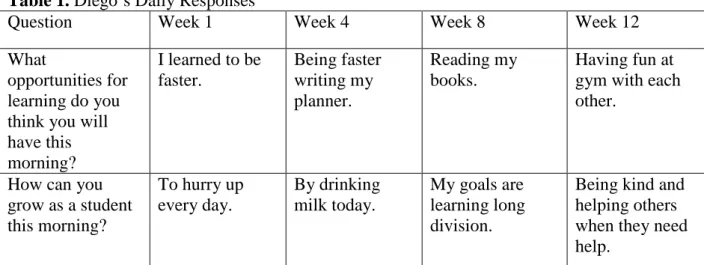
Table 1. Diego’s Daily Responses
Question Week 1 Week 4 Week 8 Week 12
What
opportunities for learning do you think you will have this morning? I learned to be faster. Being faster writing my planner. Reading my books. Having fun at gym with each other.
How can you grow as a student this morning? To hurry up every day. By drinking milk today. My goals are learning long division.
Being kind and helping others when they need help.
Over the next month of the study, analysis of Diego’s language began to reveal a slow change in his focus from the pace of what he was doing to the content he was currently learning. This change fit the theme that students shift from speed to content on a continuum (see Figure 1). The words he used to articulate his goals included specific skills. For example, 5 weeks into the study, Diego wrote, “I want to learn about division” accompanied by his goals of “getting better at division” and “learning all of my facts.” This shift continued throughout the course of the study, as his final reflections began to focus on the process and aesthetic side of learning, as noted in Table 1 above.
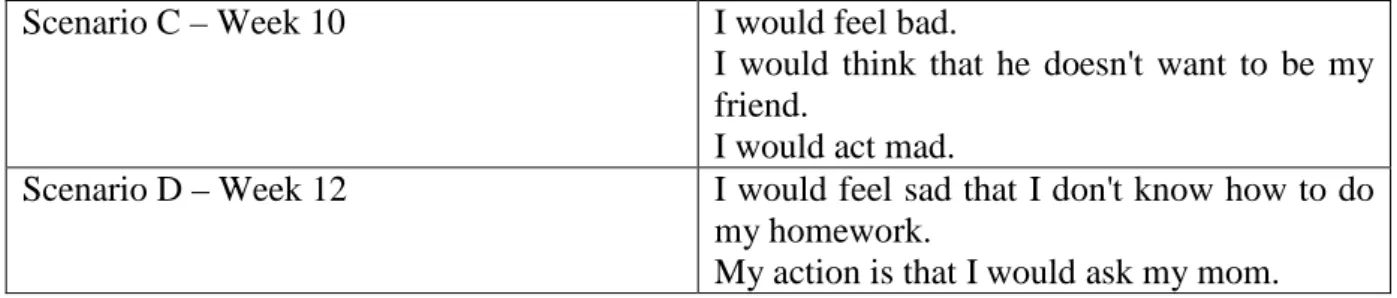
Careful observation and analysis of each scenario response and subsequent interview with Diego exposed a raw emotional and physical reaction to even hypothetical challenges. The way in which he sat as he wrote a response to the difficult situations provided a window into the deep emotional connection he associated with assumed “failure.” As he wove the words mad, sad, and bad into each one of his scenario responses, he slumped deeper and deeper into his chair. During the interviews, it took prompting to lift his head and explain what had brought him to his strong feelings. It was only in response to the final case scenario that Diego began to turn his attention slightly to an action he might take to problem solve his situation. Though the action he identified focused outside of himself in asking an adult for help, this was a vital shift in how he reacted to the challenges given.
Table 2. Diego’s Scenario Responses
Scenario Response
Scenario A – Week 1 I would feel mad.
I would be sad.
I would be unhappy. I would not be happy. I would not understand what the book is about.
Scenario B – Week 6 I would be happy because it is a good grade.
I would think this is the best grade. I would feel smart and great about myself.
Scenario C – Week 10 I would feel bad.
I would think that he doesn't want to be my friend.
I would act mad.
Scenario D – Week 12 I would feel sad that I don't know how to do
my homework.
My action is that I would ask my mom. Language observed in the final interview revealed the beginnings of a turning point in his thinking as he confidently explained, “I can change whenever I want” and “The more you read, the more you get smarter.” Once again, this language followed the patterns associated with the shift from content to process on the continuum (see Figure 1). Though I believe that Diego was just beginning his journey in shifting his mindset, the examples I have highlighted in his story show that he was making steps toward a growth mindset.
Eli’s Story
Eli showed an inconsistent mindset at the beginning of the study. Through analysis of his responses on the Student Mindset Survey, I noticed that with regard to learning in general, Eli was unsure whether a person could change his/her level of intelligence. When speaking specifically to schoolwork, he was adamant that he did not like work that was challenging or difficult. He preferred schoolwork that did not require added effort on his part. He also communicated that he did not want to put in extra effort while reading challenging books. At the same time, however, he somewhat agreed that a person could always change his/her ability to read. Through these varied responses, I noted that Eli seemed to demonstrate a different mindset for different subject areas or activities.
A shift in Eli’s mindset occurred throughout the study. His responses during the post-survey interview revolved around the premise that learning more, challenging oneself, and putting in additional effort all resulted in increased intelligence. I coded his statements about effort as process, and noted that they showed Eli’s move toward the process stage of the continuum (see Figure 1). When thinking in global terms, Eli was sure that extra effort would lead to “getting smarter;” however, he continued to display uncertainty with the extent to which this applied to him personally. His responses in this manner were interesting and surprising to me. I noted the possibility of the continuum applying differently to beliefs about oneself versus beliefs about others or the belief/mindset in theory versus the belief/mindset in action.
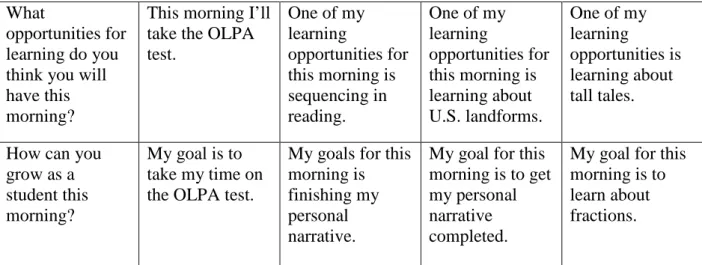
Eli’s written responses to the two daily questions were very succinct. Each day, he tied his learning opportunities and goals to the content and notes written on the classroom homework board. Due to this fact, for the first month of the study, I coded Eli’s goals, which focused on mastering the content that I presented each day, as content. For example, during October, Eli wrote that his learning opportunities were to “take the OLPA test,” “sequence in reading,” and “summarizing.” Eli’s focus was also on the completion of various tasks. In response to his opportunities for growth during the first week of November, he wrote, “finishing my pen pal letter,” “finishing my Veterans Day letter,” and “finishing my personal narrative.” Statements such as these also fell into the content code during analysis.
Table 3. Eli’s Daily Responses
What
opportunities for learning do you think you will have this morning?
This morning I’ll take the OLPA test. One of my learning opportunities for this morning is sequencing in reading. One of my learning opportunities for this morning is learning about U.S. landforms. One of my learning opportunities is learning about tall tales.
How can you grow as a student this morning?
My goal is to take my time on the OLPA test.
My goals for this morning is finishing my personal narrative.
My goal for this morning is to get my personal narrative completed.
My goal for this morning is to learn about fractions.
Throughout the remainder of the study, a pattern began to emerge in Eli’s language. He consistently used the words, “learning about,” in his learning opportunity responses, indicating an increased stress on the process of learning. This process language is what I had focused on in my instruction and interactions throughout the study. For example, around mid-November, in response to the question about learning opportunities, he wrote, “learning about World War 2,” “learning about U.S. landforms,” and “learning about the history of Thanksgiving.” Statements such as these exemplified the process code and I labeled them as such during analysis.
Eli’s language in his responses to the scenarios did not change drastically over the course of the study. His responses to the first scenario and the last scenario were nearly identical, “I would ask for help.” Daily classroom life was up and down for Eli; relationships with peers were a struggle for him. Accordingly, deep pondering and silence in both oral and written language followed the scenario that focused on difficulties with friendship (Scenario C).
Table 4. Eli’s Scenario Responses
Scenario Response
Scenario A – Week 1 Ask for help. Get a dictionary. Sound out the
words.
Scenario B – Week 6 I would feel shocked.
I would think how did I get a c+. I would think how did I fail.
Scenario C – Week 10 No response
Scenario D – Week 12 I would ask for help. I would feel I needed
help.
In our follow-up interview about this particular scenario, in which he choose not to write anything, he struggled to formulate words to express how he would feel or what he might think. In the comfortable realm of reading, he matter-of-factly and concisely listed the fact that he would ask others for help.
Evidence from Eli’s data showed that he was moving across the continuum. At the conclusion of the study, his attention was beginning to center on the process of learning. During the final interview, Eli mentioned that, “If it’s a challenge, it will challenge my brain and make me think more.” As a learner, it seemed as though Eli understood this concept; however, he had yet to transfer this understanding to specific action steps in his scenario responses. His journey had just begun.
Cora’s Story
Initial responses and attitudes from Cora reflected a fixed mindset. She demonstrated mixed feelings about whether a person could change his/her level of intelligence on the pre-study Student Mindset Survey. With specific regard to reading, she was adamant about not wanting to put in additional effort with books that were challenging, rating the statement, “Reading challenging books makes me want to put in more effort,” as a strongly disagree. Through classroom observations, I noticed a consistent frustration in the face of difficulties and an abandonment of challenging tasks. I noted that this behavior seemed to fall in the category of speed as she displayed frustration when she was not able to complete a task in a quick manner. In my observations of her, I noted that when she did not understand a skill in math right away, she rolled her eyes, sighed, and stopped working.
As the study progressed, the most dramatic shift occurred in Cora’s daily mannerisms. In place of the eye rolls and sighs were smiles and comments such as, “I love reading. I love math. I just love school!” The following interaction in mid-November showed a willingness on Cora’s part to explain how she figured out a word while reading.
Teacher - How did you figure that out?
Cora - I read and it didn’t sound right and I know in my schema that my mom said, “take your place at the table,” so I changed it from talk to take. I just had to try it another time and it worked.
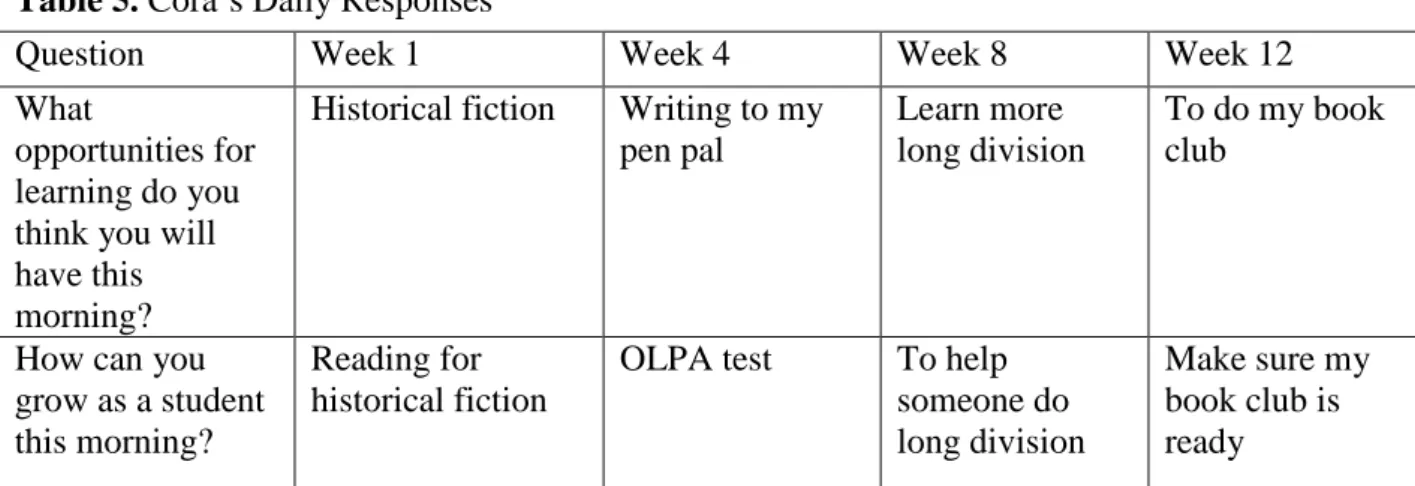
Data collected through Cora’s written reflection showed an interesting transformation in the emphasis she placed on herself versus those around her in the classroom. Her language in the first few weeks of the study focused on the content that she expected to learn each day. Cora’s goals were short, concise phrases that focused on one particular area of study. For example, the first day she wrote “historical fiction” in response to the question about learning opportunities for the morning. A few weeks later, her opportunity was “Louisiana perchase” (student’s spelling of the phrase). When analyzing her language to these daily responses, I coded this type of language, shown in week 1 of Table 5 below, as content.
Table 5. Cora’s Daily Responses
Question Week 1 Week 4 Week 8 Week 12
What
opportunities for learning do you think you will have this morning?
Historical fiction Writing to my pen pal
Learn more long division
To do my book club
How can you grow as a student this morning?
Reading for historical fiction
OLPA test To help
someone do long division
Make sure my book club is ready
As the study progressed, and I immersed the classroom environment with process-oriented language, Cora’s own language began to change. In her reflection each morning arose the phrases, “learning about” and “how to.” Table 5 above shows the shift that Cora made, with language in week 8 specifically showing a shift from content to process. Cora now focused on the process of her learning rather than the product or concept itself. For
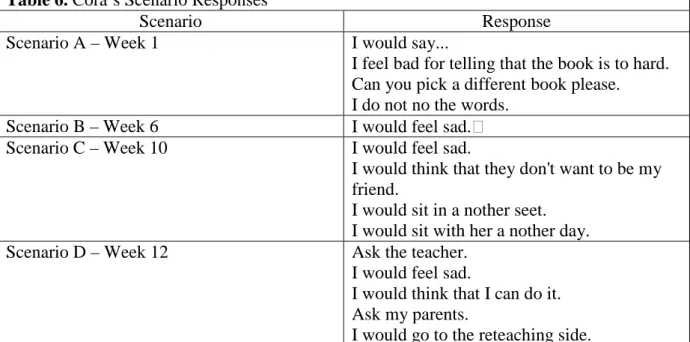
example, her responses included “how to do book clubs,’ “learn more about author’s purpose,” and “learn about PIE.” At the same time in the study, examination of her language revealed her concern for helping peers. Eight weeks into the study, Cora noted that in order to grow as a student that day, she desired “to help someone to do long division.” A few days later, her goal was “to make sure her book club was ready.” This type of language and behavior was unexpected and surprising to me. Through further reflection and analysis of the pattern, I coded it as a part of the process of learning.
Table 6. Cora’s Scenario Responses
Scenario Response
Scenario A – Week 1 I would say...
I feel bad for telling that the book is to hard. Can you pick a different book please. I do not no the words.
Scenario B – Week 6 I would feel sad.𑠀
Scenario C – Week 10 I would feel sad.
I would think that they don't want to be my friend.
I would sit in a nother seet. I would sit with her a nother day.
Scenario D – Week 12 Ask the teacher.
I would feel sad.
I would think that I can do it. Ask my parents.
I would go to the reteaching side.
Data collected and examined through scenarios and interviews revealed a growth in Cora’s self-efficacy. As she wrote about and explained her reactions to the four scenarios, I observed a pattern of emotional responses. In each scenario that involved a challenge or difficulty, she expressed an initial feeling of sadness. As the study continued, Cora began to expand her responses. Though she continued to touch on her emotional side first, she began to build her toolbox of strategies in the face of challenges. At the end of the study, her parting comments in response to a scenario about difficult math problems were “I would think that I can do it” and “I would go to the reteaching side.” This language paired an increase in self-efficacy with an action step to problem-solve the situation and independently improve her understanding.
Discussion
Results of this study have implications for shifting students’ mindsets toward a growth mindset. Immersion in an environment thick with process-oriented language influenced students’ language, overall mindsets, and response to challenging situations in a variety of ways. Researchers in the educational field emphasized this impact of teacher language. Johnston (2012) points to the expansive repercussions teacher language can have on students and their learning, specifically questioning strategies, which focus on the process of learning. Though a limitation of this study was the short duration, the results show that teacher language can not only affect student learning, as Johnston discussed, but it can reach further to affect the mindsets that students are developing. The potential implications of shifting student mindsets from a fixed to a growth mindset are long lasting.
Frequent inquiries through daily reflections revealed what students were thinking as they maneuvered through various tasks, assignments, and projects. What I noticed was a shift in student language and behavior as they began to focus on the process of learning as opposed to the product. The goal was no longer a concrete object, but rather the road that led there. As students’ language began to change, their mindsets began to change as well. Their thinking started to align more with a growth mindset, evidenced by their emphasis on “effort” and “getting smarter” in daily reflections and interviews.
As noted in the findings section, a new theoretical continuum emerged as I analyzed the data. This continuum puts in concrete form the shifts the participants made throughout the study. Due to the unique nature of each student, an unexpected finding for me was the emergence of this common progression. Students began with a focus on speed, or finishing their work quickly. At various points in the study, students began to hold a greater focus on the content. They desired to master a specific skill. In this stage, like in the speed stage, students desired to arrive at a product. The third stage on the continuum leads to a focus on the process of learning. In this stage, students focused more of their attention on the process of learning, and navigating through problems with strategies in mind.
Limitations included the length of the study and an inability to completely isolate students’ shift in mindset as an effect of the teacher’s language. The themes may have become stronger with an extended period of immersion in a learning environment laden with process oriented feedback and questioning, and a focus on problem-solving strategies. Inferences can be made about the impact of the teacher’s language on the students’ mindsets during this study.
More research is needed on the full impact of teacher language on students’ mindsets. A consideration for further studies may be to explore the impact of teacher language on both students’ mindsets and academic achievement within one comprehensive study. Additionally, an exploration of the effect of educating parents in these same language strategies may be another consideration for a future study. Immersion in language focusing on process-oriented feedback, questions, and the inevitability of problems in both learning and life in both the home and school environments would perhaps provide interesting results.
The implications of this for educators and schools worldwide are immense. Teachers must focus on the language they are using in their classrooms. Numerous researchers have shown the importance of language for an assortment of different purposes (Gunderson et al., 2013; Johnston, 2004; Rattan, Good, & Dweck, 2012). Teachers must be cognizant of the questions they are asking, or not asking, and the feedback they are providing, or not providing, for all of the reasons that have come before this study, but also for the desire to facilitate growth mindsets. A growth mindset has a positive impact on a student’s learning and achievement (Blackwell et al., 2007). In order to guide them there, we must monitor and be intentional with our own powerful language.
References
Blackwell, L. S., Trzesniewski, K. H., & Dweck, C. S. (2007). Implicit theories of intelligence predict achievement across an adolescent transition: A longitudinal study and an intervention. Child Development, 78, 246-263.
Creswell, J. W. (2009). Research design: Qualitative, quantitative, and mixed methods approaches (3rd ed.). Los Angeles, CA: Sage.
Cury, F., Da Fonseca, D., Zahn, I., & Elliot, A. (2008). Implicit theories and IQ test performance: A sequential mediational analysis. Journal of Experimental Social Psychology, 44, 783-791.