© 2017, IRJET | Impact Factor value: 5.181 | ISO 9001:2008 Certified Journal | Page 3095
A Review on Reuse Partitioning in Cellular System with Mobile Users
Harmandeep Kaur
1, Dr. Manjit Singh Bhamrah
21
M.Tech (ECE), Punjabi University Patiala, Punjab, India
2
Professor (ECE), Punjabi University Patiala, Punjab, India
---***---Abstract -
Reuse partitioning (RP) is a straightforwardprocedure that can be utilized to expand the traffic capacity in a cellular system. With RP, a cell is divided into several concentric regions, each associated with a different cluster size. In this article, a movement or traffic model is produced to dissect the effect of versatile clients on a two-region RP system using fixed channel assignment. The influence of user
speed and cell size on the new call blocking probability, Pb, and
the call dropping probability, Pd, is investigated. A simpler
model that can be used to estimate Pb and Pd in some cases is
described. The effect on system capacity of reserving some channels for handoff calls is also studied.
Key Words: Cellular System, Blocking Probability, Fixed Channel Assignment, Handoff, Reuse Partitioning.
1.
CELLULAR SYSTEM
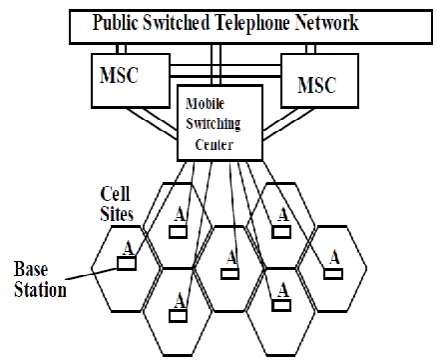
The concept of cellular mobile systems developed with the advent of mobile radio systems. The cellular system consists of three main components: Mobile Switching Center (MSC) , Cell Site (Base Station Equipment), and Mobile User Equipment. The three components work together to provide cellular service. The system can be visualized functionally as seen in Figure 1. The MSC coordinates all cellular system activities between mobile users, cell sites and the Public Switched Telephone Network (PSTN). These activities include establishing connections, assigning channels, verification of users and handoff coordination to name a few. The MSC incorporates the features of a regular telephone switching center with added capabilities to handle the activities throughout the system. The MSC software controls the necessary signaling needed to perform the activities which are sent to the cell sites and the mobile users. Cellular
[image:1.595.323.542.281.462.2]systems operate in the frequency region of 825-890 MHz with a difference of 45 MHz between transmitting and receiving frequencies.
Figure 1: Cellular System Architecture.
© 2017, IRJET | Impact Factor value: 5.181 | ISO 9001:2008 Certified Journal | Page 3096 amplifier for all channels that use a single transmitting
[image:2.595.49.270.211.353.2]antenna. The first scenario is known as a channelized scheme and the latter scenario is known as a frequency division multiplexed scheme as seen in Figure 2. The dashed lines in each scheme are control channels.
Figure 2: Channel Schemes.
The base station antenna has several set ups, the most common being an omnidirectional combination of antennas, with two antennas for receiving and one for transmitting. Depending on the placement of the antennas, cells are considered center excited, edge excited, or umbrella cells. The center excited cells use the omnidirectional configuration discussed above. Edge excited cells use directional antennas placed in the corner of a cell site, which is best for co-channel interference. The umbrella cells use tilted beam pattern antennas that provide a shadow effect of the cell site area. The amplifier(s) in each scheme provide enough gain to each channel frequency. The combiner then serves the function of combining all individual channels and sending them to the transmitting antenna. The receivers at the base station receive the incoming electromagnetic signals and convert them to perceptible forms.
2. CELL REUSE PARTITIONING
The mobile cellular communication services industry is expected to continue growing rapidly in the next decade. The main limitation to supporting a large number of subscribers
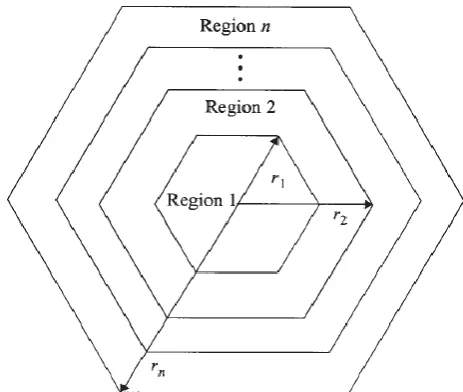
is the shortage of available radio frequency spectra. The system capacity, i.e., the number of subscribers per unit area that can be supported at some minimum quality of service level, is an important parameter. One method to increase the capacity of cellular systems is to reduce the cell size. However, this solution results in an increase in the number of base stations (BS), and hence, cost. An alternative method is reuse partitioning (RP) [2], which uses multiple reuse distances. In a conventional mobile cellular system using fixed channel assignment (FCA), a single cluster size is used [3]. The aim is to achieve a minimum target carrier-to-interference ratio (CIR) at any point in the cell. For a system that does not employ power control, the received signal power for a mobile station (MS) close to its BS is higher than that for a more distant MS. As a consequence, the signal from a nearby MS can tolerate a higher interference level and the channel reuse distance may be smaller. In RP, this characteristic is exploited to increase the system capacity. RP is implemented by dividing the cell into two or more concentric regions as shown in Figure 3.
Figure 3: Frequency Reuse Partitioning.
[image:2.595.316.548.472.668.2]© 2017, IRJET | Impact Factor value: 5.181 | ISO 9001:2008 Certified Journal | Page 3097 by allowing calls in an inner region to use (i.e., overflow into)
channels allocated to higher-numbered regions [4].
The call blocking probability of RP with FCA, hereafter referred to as fixed reuse partitioning (FRP), for stationary users has been examined in [4] and [5] by computer simulation. The results show that RP can increase the capacity compared to conventional FCA with a single reuse distance. Other studies of FRP assuming stationary users include [6] and [8]. In [9], the performance of an overlapping coverage scheme with RP for mobile users is studied. However, because the inner and outer RP regions correspond to the non-overlapping and overlapping regions, respectively, the effect of RP cannot be separated from that of overlapping. In this article, an analytical traffic model is developed to study the impact of mobile users on the new call blocking probability, Pb, and the call dropping probability, Pd, in a
two-region FRP system. This model allows Pb and Pd to be
evaluated numerically. A simplified model that allows the derivation of approximate closed-form expressions for Pb and Pd in certain cases is also presented. The effect of a cutoff
priority scheme for handoff calls on capacity is considered, with the capacity defined as the total offered traffic that can be supported in a cell at a certain value of grade of service (GOS) as given by [10].
GOS = (1-α)Pb + αPd
Where α ϵ [0,1] is the GOS parameter and indicates the relative importance of Pb and Pd in a given system. This article
is organized as follows. The traffic model for a two-region FRP system is formulated. The channel assignment scheme is described, followed by the performance analysis of the two-region FRP system for both stationary and mobile users.
3. TRAFFIC MODEL
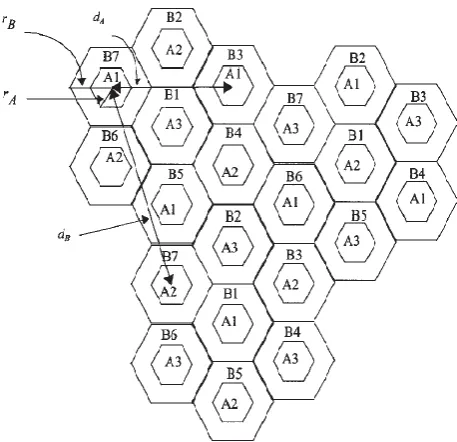
In analytic model, a two-region FRP system with hexagonal cells and omnidirectional antenna base stations is assumed. An example with an inner region cluster size, NA = 3, and
outer region cluster size, NB = 7, is shown in Figure 4. With a
reuse cluster size of NA, we have [3]
dA / rB = (3NA) 1/2
where dA is the reuse distance associated with inner region
and rB is the radius of the cell as shown in Figure 4. Because
the targets CIR for both inner and outer region calls are the same, we have
dA / rA = dB / rB = (3NB) 1/2
where rA is the radius of the inner region. From above
equations, it follows that
(rA / rB )1/2 = NA / NB
[image:3.595.318.547.437.658.2]Note that NB = N, the cluster size for the conventional FCA.
Figure 4: Cellular Grid with Cluster Sizes NA = 3 and NB = 7.
4. HANDOFF
be-© 2017, IRJET | Impact Factor value: 5.181 | ISO 9001:2008 Certified Journal | Page 3098 tween base stations within the network. This process is
[image:4.595.51.277.192.428.2]known as handoffs. The process is initiated when the signal strength of the mobile users call fall below a certain threshold level, usually around 32 dB.
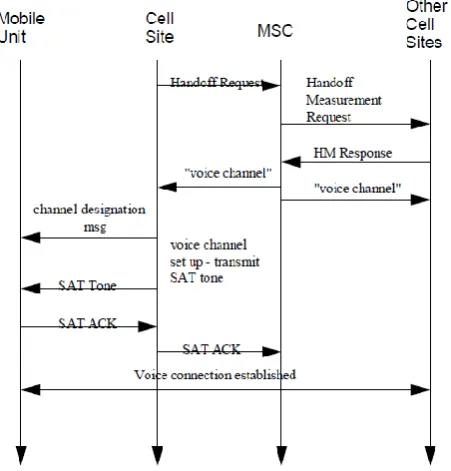
Figure 5: Mobile Call Handoff.
The base station then notifies the MSC that a call handoff will be necessary The MSC then sends out a handoff mea-surement request to the adjacent base stations for a measure-ment of the strength on a specific channel. In return, all the base stations send the signal strength level on the channel. The MSC then goes through a selection process to select the base station with the best signal level. Once the base station is selected, it is notified of the call transfer that is necessary and the channel it will be on. The MSC also forwards the same information to the base station that is currently carrying the call, which forwards the information about the new channel to the mobile unit. Once the mobile is tuned to the new channel the process is completed. This process may happen several times within a call due to the mobile user’s movement. Since the handoff process is initiated by a drop in signal strength, base stations generally look for a consistent pattern of decrease in the signal strength around 10 dB per
decade. The assumption made by the base station monitoring this pattern is that the mobile unit is moving toward the boundary of the cell. Figure 5 shows the process of a call handoff within the coverage of a single MSC.
Within the network, several things affect a call and its signal strength. The most common of these problems include: Propagation Path Loss
Co-Channel Interference
Multipath Fading Raleigh Fading
Doppler Shifts
Propagation path loss is the dropping of the signal level due to the terrain and manmade noise (buildings, bridges, etc.). The main drivers of propagation path loss are the distance of the mobile unit from the base station and the frequency of the channel. Co-channel interference involves disturbances occurring from two mobile units operating on the same channel. Another type of channel interference is adjacent channel interference, which occurs when energy from a carrier spills over into another carrier. Solutions to deal with channel interference involve a method of channel schemes either multiplexed or channelized, which was previously discussed. Multipath Fading involves disturbances due to the multiple paths of the signals between the transmitter and the receiver as a result of the terrain and man-made noise. Raleigh Fading are rapid fluctuations in the signal strength that occur in statistical distribution known as Raleigh. Finally, Doppler Shifts are variations in the frequency of the received signal caused by the relative motion of the mobile unit. These problems all bear an effect on the signal strength of the mobile unit.
5. CONCLUSIONS
© 2017, IRJET | Impact Factor value: 5.181 | ISO 9001:2008 Certified Journal | Page 3099 can be increased by about 30% compared to conventional
FCA. With mobile users, the capacities for both FRP and FCA decrease with average handoff rates. In addition, the capacity improvement of FRP relative to FCA is reduced as the average handoff rates increase. It is found that even though prioritized handoff can reduce the call dropping probability, in some cases it may also degrade the capacity. The choice of the number of channels reserved for handoffs which maximizes the capacity was also examined.
REFERENCES
[1] S. W. Halpern, “Reuse partitioning in cellular systems.” In Processing IEEE Vehicular Technology Conference, Toronto, Canada, pp. 322–327, May 1983.
[2] W. C. Y. Lee, “Mobile Cellular Communication Systems,” 2nd edition. McGraw-Hill, New York, 1995.
[3] K. Sallberg, B. Stavenow, and B. Eklundh, “Hybrid assignment and reuse partitioning in a cellular mobile radio telephone system.” In Processing IEEE Vehicular Technology Conference, Tampa, FL, pp. 405–411, June 1987.
[4] S. Papavassiliou, L. Tassiulas, and P. Tandon, “Meeting QOS requirements in a cellular network with reuse partitioning,” IEEE Journal Selection Areas Communication, Vol. 12, No. 8, pp. 1389–1400, Oct. 1994.
[5] Pattavina, S. Quadri, and V. Trecordi, “Spectral efficiency improvement of enhanced assignment techniques in cellular networks.” In Processing IEEE GLOBECOM’96, Vol. 2, London, pp. 1031– 1035, Nov. 1996.
[6] J. Choi and J. A. Silvester, “A fair-optimal channel borrowing scheme in multiservice cellular networks
with reuse partitioning.” In Processing IEEE International Conference on Universal Personal Communication, Florence, Italy, pp. 261–265, 1998.
[7] P. H. J. Chong and C. Leung, “Capacity improvement in cellular systems with reuse partitioning,” Journal of Communications and Networks, Vol. 3, No. 3, pp. 280– 287, Sept. 2001.
[8] T. Chu and S. Rappaport, “Overlapping coverage with reuse partitioning in cellular communications systems,” IEEE Transaction Vehicular Technology, Vol. 46, No. 1, pp. 41–54, Feb. 1997.
[9] D. Hong and S. Rappaport, Traffic model and performance analysis for cellular mobile radio telephone systems with prioritized and nonprioritized handoff procedures, IEEE Transaction Vehicular Technology, Vol. 35, No. 3, pp. 77–92, Aug. 1986.
[10]H. Kim, G. de Veciana, X. Yang and M. Venkatachalam, “Distributed a Optimal User Association and Cell Load Balancing in Wireless Networks". IEEE/ACM Transactions on Networking, Volume: 20, Issue: I, pp. 177 - 190, 2012.
[11]C. Yuan-yuan, Q. Bing, L. Yi-ting and T. Liang-rui, "A Hybrid Dynamic Load Balancing Algorithm in Heterogeneous Wireless Packet Networks", 9th International Conference on Fuzzy Systems and Knowledge Discovery (FSKD 2012), Chongqing, China, pp. 2052 - 2056,29-31 May 2012.
© 2017, IRJET | Impact Factor value: 5.181 | ISO 9001:2008 Certified Journal | Page 3100
[13]K. T. Kim and S. K. Oh, "An Incremental Frequency Reuse Scheme for an OFDMA Cellular System and Its Performance", IEEE Vehicular Technology Conference, VTC Spring 2008, pp. 1504 - 1508,11-14 May 2008.
[14]X. Zhang, C. He, L. Jiang and J. Xu, "Inter-cell interference coordination based on softer frequency reuse in OFDMA cellular systems", International Conference on Neural Networks and Signal Processing, pp. 270 - 275, 7-11 June 2008.
[15]E. Oh, M.G. Cho, S. Han, C. Woo, and D. Hong, "Performance Analysis of Dynamic Channel Allocation based on Reuse Partitioning in Multi cell OFDMA Uplink Systems", IEICE Transactions on Fundamentals of Electronics, Communications and Computer Sciences, Vol. E89-A Issue 6, pp. 1566-1570, June 2006.