© 2018, IRJET | Impact Factor value: 6.171 | ISO 9001:2008 Certified Journal | Page 745
Digital Image Steganography Using Non Dominated Sorting Genetic
Algorithm(NSGA)Within Discrete Wavelet Transform(DWT)
Beenish Siddiqui
1, Sudhir Goswami
21 Student, Department of CSE, M.tech, Meerut Institute of Engg. & Technology, Uttar Pradesh, India. 2Associate Professor, Department of CSE, Meerut Institute of Engg & Technology, Uttar Pradesh, India.
---***---Abstract -
Steganography is the technique used to hide thedata in different format such as text, images, audio, video etc. Image steganography is widely used technique and various methods have been developed to hide the secret information in images. Conventional techniques used for steganography LSB and DCT possess high hiding capacity and imperceptibility but these are not secure. In this thesis, a new approach is proposed in which discrete wavelet transform (DWT) is applied on cover image to get wavelet coefficient and singular value decomposition (SVD) is applied to get singular values. Secret image is scrambled using chaos and then embedded into these singular values using non dominated sorting genetic algorithm. The main goal of the presented method is to increase the embedding capacity and improve the image quality of the stego-image. Scrambling is used to make the algorithm more secure. The experimental results show better performance of the proposed method compared to the corresponding methods, in terms of PSNR. The effectiveness of the model is estimated from the viewpoint of both the amount of data hidden and the image quality of the cover image.
Key Words: Genetic Algorithm, Non Dominated Sorting Algorithm (NSGA), DWT, Chaotic Maps
1. INTRODUCTION
Steganography is the Greek word i.e “stegano” means “covered” and “graphy” means “writing”. Steganography is the art and science of hiding the messages in such way that it is difficult to detect. Steganographic methods can be classified into Spatial Domain Embedding and Frequency Domain Embedding. Spatial Domain Embedding contains of the LSB method. In these methods, to communicate secretly is done by embedding the message in least significant bits of the cover object. As the resulting change in colour is irrelevant, the hidden image goes undetected by human vision. This technique allows high capacity embedding without rendering any significant changes to the cover image. The selection of LSB’s could be random using a stego-key or could be confined to the noisy areas i.e., areas with large colour variation of the image so as to generate least suspicion. The selection of LSB’s could be done using a stego-key when security is the priority. Although the LSB method is a high capacity embedding technique, it leaves behind statistical evidences making it vulnerable to attacks. The Frequency Domain Embedding contains the Discrete cosine
transform (DCT) and Discrete Wavelet Transform (DWT) methods to embed the secret message to be
communicated secretly. In DCT method, the image is first converted to frequency domain which results in spectral sub-bands. The spectral sub-bands are classified as High and Low frequency components. The Discrete Cosine coefficients of hidden image are embedded into the cover image such that the distortion is minimum and no significant changes in the statistical features of the stego image with respect to cover image occur. In DWT method, the image is decomposed based on frequency components into detailed and approximation bands, also called the sub-bands. Detailed band contains vertical, horizontal and diagonal bands. The total Information of the image is present in the approximation band. Hence the payload is normally embedded in the detailed band and rarely in the approximation band.
1.1 OBJECTIVES
a. To study and analyse various stenographic techniques utilizing optimization strategies. b. To propose new wavelet based embedding that uses
natural selection for optimization.
c. To implement and evaluate the performance of proposed system using various parameters
2. DISCRETE WAVELET TRANSFORMS
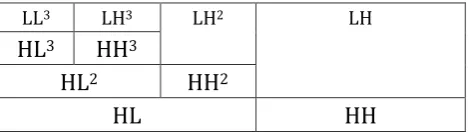
An image is divided into four parts in DWT namely a lower resolution approximation component (LL) as well as horizontal (HL), vertical (LH) and diagonal (HH) detail components. Low pass filtering is applied to both the rows and columns and found the LL sub band and contains a irregular description of the image. The HH sub band is high-pass filtered in both directions and have the high-frequency components along the diagonals. Low pass filtering is applied in one direction and high pass filtering is applied in other direction to get the HL and LH sub bands. Most of the information contained in the host image is concentrated into the LL image after processing the image by wavelet transform. LH sub band contains mostly the vertical detail information which corresponds to horizontal edges. The horizontal details of information is represented by HL sub band from the vertical edges. The process can be repeated to obtain multiple ‘scale’ wavelet decomposition. Figure 1 shows the DWT decomposition.
© 2018, IRJET | Impact Factor value: 6.171 | ISO 9001:2008 Certified Journal | Page 746 transforms such as Discrete Fourier Transform (DFT) and
Discrete Cosine Transform (DCT). The DFT and DCT are full frame transforms and hence the entire image is disturbed by any modification in the transform coefficient However, there are some cases where the transformation is performed using a block based approach to improve this problem. Because of these reasons, the wavelet based watermarking techniques are getting more significant.
Wavelets are special functions that are used for representing signals. Wavelet, the little wave of signal processing, is a small wave that performs signal analysis when signal frequency varies over time. Wavelet transform divides a signal into different frequency components each with different resolution. In wavelet based image processing, the choice of wavelet and wavelet filter defines the performance [1].
LL3 LH3 LH2 LH
HL
3HH
3HL
2HH
2HL
HH
Fig -1: DWT Decomposition
The robustness is improved by embedding the low frequency bands. Whereas, the edges and textures of the image is included in the high frequency sub-bands HH and the human eye is less sensitive to changes in such sub-bands. It allows the watermark to be embedded without being perceived by the human eye. Watermark embedding is done in the intermediate frequency bands HL and LH to improve the robustness and imperceptibility.
3. GENETIC ALGORITHM
The name of GA comes from the concept of evolutionary biology. For solving both unnatural and natural optimization problems based on natural selection process, a Genetic Algorithm is one of the popular algorithms. The problems which are not well suited for standard optimization, here we can apply genetic algorithm for better result.
GA works and start with an initial generation of candidate solutions that are tested against the objective function. It creates subsequent generation progress from the first through selection, crossover and mutation.
3.1 SELECTION
It is process to recollect the best performing bit strings from one generation to the next. To create a second generation population of solutions from those selected bits is done by a combination of genetic operator: crossover (also called recombination), and mutation.
3.2 CROSSOVER
It is a genetic operator used to vary the programming of a chromosome from one generation to the next.
3.3 MUTATION
It is also a genetic operator used to maintain genetic multiplicity from one generation of a population of genetic algorithm of chromosomes (genotype) to the next. It is similar to biological mutation.
The GA optimization techniques is based on the principle of natural selection and genetics. The most common steps of genetic algorithm found in paper of sengul dogan [2].
Step 1: In accordance with the purpose, the population is formed with a group of randomly created individuals.
Step 2: These individuals are evaluated in the population.
Step 3: The evaluation algorithm is provided by the system and gives the individuals a score according to the fitness function of the system.
Step 4: The two best individuals are selected based on fitness function. The higher the fitness value, the higher the chance of being selected.
Step 5: The individuals reproduce to form one or more individuals, after which the new individuals are randomly mutated.
Step 6: This process proceeds until a convenient solution has been found or a certain number of generations have passed, depending on the requirement of the system.
4. PROPOSED METHOD
Proposed method introduces a new method of embedding secret data within the discrete wavelet transform using SVD and NSGA algorithm. In this paper first the secret image is scrambled using chaos and then embedded into the DWT of the cover image using SVD and NSGA algorithm.
Non Dominated Sorting Genetic Algorithm (NSGA) NSGA is multi objective optimization and it is an extension of genetic algorithm for multi objective function optimization. To improve the adaptive fit of a population of candidate solution to a pareto front is the main objective of NSGA.
[image:2.595.37.273.291.359.2]© 2018, IRJET | Impact Factor value: 6.171 | ISO 9001:2008 Certified Journal | Page 747 algorithm. To increase the success rate of data hiding
algorithms, various optimization techniques are applied. In the proposed method, randomness of NSGA will be provided using randomness chaotic maps.
4.1 SCRAMBLING
For scramble the secret image we first generate elements from chaos map equal to the dimension of 3 × M × N matrix. For the secret image 225 × 225 × 3 = 151875 elements are generated with henon map. The equation 1 is used to generate the Henon map and iterated for n=1 to 151875 times to get the required elements.
(1) (2)
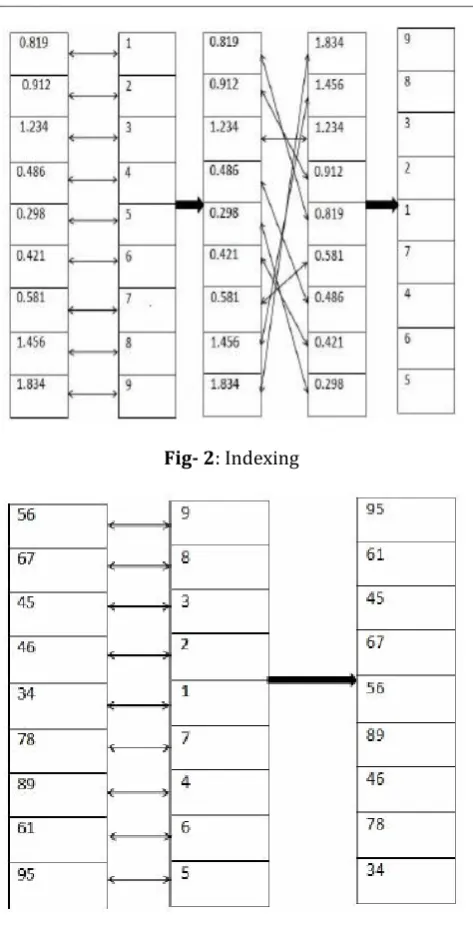
The following values are used for the constants ‘a’ and ‘b’ to get a random sequence. a=1.76, b=0.1 and y(n)=1. Now divide the generated elements into three blocks of each equal to M×N. In our example secret image each block is of dimension 1×50625. Now sort the elements of each block in ascending/ descending form and compare the disorder between the original and sorted elements of each block and tabulate the index change. We have got three series of index change values in according to three blocks.. Arrange the elements in decreasing order and tabulation of the displacement in the index is noted by comparing the elements before and after sorting as in Figure 2. For example after arranging element values in descending order, the element value 1.834 is the first value whose corresponding index value is 9 tabulated in first location. This procedure is repeated for all the three colors. Now according to the obtained index, we change the intensity position to get scrambled image.
4.2 DESCRAMBLING
Descrambling is done by the reverse process followed for scrambling. In the Figure 3 column 1 represents intensity value of image, column 2 represents the tabulated index value obtained from the previous step and column 3 represents the arranged intensity value according to column 2.
In Figure 4 column 1 represents the sequence of received elements; column 2 represents sorted index elements obtained from the scrambling process and column 3 represents resorted index elements. At the receiving point, the same random sequence is generated with Henon map to obtain back the sorted index elements as in Figure 4.Original pixel values are obtained back as in Figure 5
Fig- 2: Indexing
Fig-3: arrangement of pixel sorting elements .
[image:3.595.318.555.68.532.2] [image:3.595.318.550.556.731.2]© 2018, IRJET | Impact Factor value: 6.171 | ISO 9001:2008 Certified Journal | Page 748 Figure 5: Original Pixel Element
4.3 EMBEDDING PROCEDURE
Input: cover image, secret image
Output: Stego image
Step1: Scramble the secret image using chaotic map
Step2: Apply DWT on the cover image and decompose the cover image into four sub-bands.
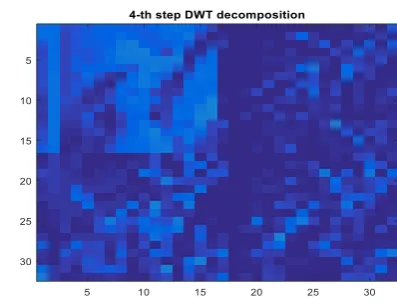
Step3: Further decompose the LL (low frequency) band to the 4th level decomposition.
Step4: Apply the SVD to HH (high frequency) band to get singular values.
Step5: Replace the singular values of HH with the singular values of secret image using non dominated sorting genetic algorithm (NSGA).
Step 6: Apply SVD to obtain the modified HH band which now holds the singular values of secret image.
Step 7: Apply inverse of DWT with modified LL and HH band to obtain the stego image.
4.4 EXTRACTION PROCEDURE
Step1: Apply DWT on stego image and decompose the stego image into four sub-bands, LL, HL, LH, HH.
Step2: Further decompose the LL band to the 4th level
Step3: Apply SVD to HH band and extract the singular values from HH bnad
Step4: Construct the secret image using singular values.
Step5: Descramble the secret image.
5. RESULTS AND ANALYSIS
[image:4.595.329.528.273.425.2]Following results are obtained by implementing the propose method with various images at the MATLAB2016a.
Fig-6: First level decomposition
Fig-7: 4th level DWT Decomposition of input image.
Secret image Cover image
Fig-8 Secret image and Cover image
Scrambled secret image Stego image
[image:4.595.304.565.467.580.2] [image:4.595.301.564.616.743.2]© 2018, IRJET | Impact Factor value: 6.171 | ISO 9001:2008 Certified Journal | Page 749 Table-1 The PSNR values of Various Image
Images PSNR
Lena 42.435
Mandril 42.644 Peppers 44.746
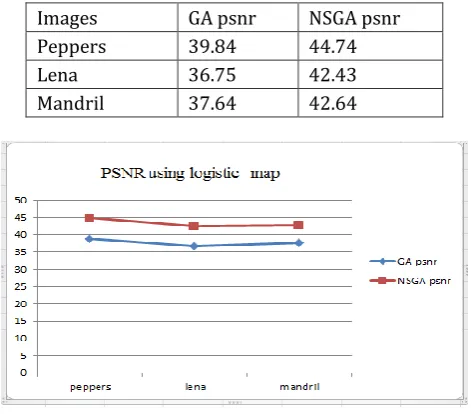
Table-2 Comparision of GA psnr and NSGA psnr
Images GA psnr NSGA psnr Peppers 39.84 44.74 Lena 36.75 42.43 Mandril 37.64 42.64
Chart -1
6. CONCLUSION
Steganography is widely used technique for concealing the data. Many techniques were developed for data hiding. This paper describes new approach for data hiding which is based on discrete wavelet transform and using the non dominated sorting genetic algorithm for natural selection. For better quality of image it uses chaotic maps. The proposed approach is implemented on MATLAB 2016a and gives the results shown above.
References
[1] sengual Dogan “a new data hiding method based on chaos embedded genetic algorithm for color image”
[2] Palak mahajan Heena gupta “Improvisation of security in image steganography using DWT, Huffman encoding & RC4 based LSB Embedding” 978-9-3805-4421-2/16/$31.00_c 2016 IEEE.
[3] https://en.wikipedia.org/wiki/Genetic_algorithm