An English Electric-Leo-Marconi mini-manual
KDF9
ALGOL
programming
C
All rights reservedENGLISH ELECTRIC-LEO-MARCONI COMPUTERS
Ltd.
KIDSGROVE STOKE .ON. TRENT STAFFORDSHIRE Telephone: Kidsgrove 2141
i
ALGOL PROGRAMMING FOR, KDF 9
CONTENTS
Section Page
LIST OF ABBREVIATIONS USED IN THIS MANUAL iv
SECTION 1· INTRODUCTION
SECTION 2· 'IWO STIIll'LE PROGRAMS 5
SECTION 3' PROGRAM STRUCTURE AND BASIC SYMBOLS 7
SECTION 4· DECIMAL NUMBERS 9
SECTION 5' IDENTIFIERS 11
SECTION
6·
SDlIPLE ARI'J.'H!.{ETIC EXPRESSIONS 13SEXlTION 7' SIMPLE BOOLEAN EXPRESSIONS 17
SECTION 8· ARITHMETIC AND BOOLEAN EXPclESSIONS 19
If Clauses 8·1 19
Use of the If Clause in Arithmetic Expressions 8·2 19
Use of the If Clause in Boolean Expressions 8'3 20
A Use for Parentheses 8·4 21
SECTION 9' STANDARD FUNCTIONS 23
SECTION 10· STATEMENTS 25
SECTION 11- ASSIGNMENT STATEMENTS 27
SECTION 12- GOTO STATEMENTS AND LABELS 31
Goto Statements 12·1 31
Labelled Basic Statements 12·2 31
SEXlTION 13- FOR STATEMENTS 33
The General Form of the For Statement 13. 1 33
Step-until Element While Element
i t
CONTENTS ( Continued)
Miscellaneous Notes on For Statements
SECTION 14· COMPOUND STATEMENTS
SECTION 15· CONDITIONAL STATEMENTS
SECTION 16· SUBSCRIPTED VARIABLES AND ARRAYS
Use of Subscripted Variables in Expressions Use of Subscripted Variables in Statements
SECTION 17· INPUT AND OUTPUT OF DATA Device Numbers
Simple Forms for Reading and Writing Numbers Further Input and Output Statements
The Layout
The Format Expression Input and Output of Text
Initialisation and Closure of Devices Manipulation of Magnetic Tapes Restrictions
SECTION 18· DECLARATIONS, BLOCKS AND PROGRAMS
Declaration of Simple Variables
Array Declarations Blocks
Definition of a Program
SECTION 19· PROCEDURES
The Purpose and Application of Procedures Procedure Declarations and Corresponding Calls
Declaration of Procedures Defining a Function DeSignator The Value Part .
The Specification Part
The Procedure Body
The ALGOL Procedure Library
SmTIOJi 20· CCIIIIElI'r COBVEHTIONS
iii
CONTENTS
(Continued)
SECTION 21· SWITCHES AID DESIGNATIONAL EXPRESSIONS
Sec tiOD Page
SECTION 22· BLOCK STRUCTURE AND ASSOCIATED RESTRICTIONS 77
84 The Relation between Procedures and the Block Structure
Restrictions Impo'sed upon Arr83 Bounds by the Block S true ture
The Inf'luenoe of Block Structure on Sri tch Designators Use of the Block Structure '
SECTION 2:5· ADVANCED USE OF PROCElXJ1IES
Jensen's Device
lrraT Identifiers' as Parameters Procedure Identifiers as Parameters
Switch Identifiers and Designational Expressions as Parameters
Recursive Use of Procedures
Use of Non-local Variables in Procedure Bodies
SECTION 24·
APPENDIX 1 APPENDIX 2
APPENDIX :5
APPENDIX 4 lPPERDIX 5
lPPElIDIX 6
lPPERDIX 7
lPPElIDIX 8
IlfJla
CHroKING .AN ALGOL PROGRAM BEFORE TEST
A Specimen ALGOL Program
Simple Boolsan Expression - General Form
Action of Por List Elements
Own Variables and ~s
Procedure Bodies in KDI' 9 Code
Strinss
Solutions to Problems
Basic SJ1IIbols - Standard Representations 2:5·1 2:5·2 2:5·:5
iv
LIST OF ABBREVIATIONS USED IN THIS NUUfITAL
A array identifier
AE arithmetic expression
AN array name AP actual parameter BE boolean expression BS basic statement BV boolean variable
DE designational expression DM number of dimensions
DV device number FE format expression
F1 for list
FLE for list element
FP formal parameter
FS for statement
L label LAY layout
LB lower bound of subscript LO logical operator
LS letter string LV logical value N unsigned number
o
arithmetic operator P procedure identifier R relationRO relational operator S statement
SAE simple arithmetic expression SBE simple boolean expression SDE simple designational expression
ST string SUB subsoript
SW switch identifier
T type
1 • AUfHOR'S INTRODUCTION
ALGOL 60 is a programming language for describing numerical processes and has the unique advantage of international recognition as a common language. ALGOL's inherent merits are the bases of its widening acceptance for both scientific and engineering applications. The power of its state-ments often surprises newcomers. Its conciseness avoids much of the tedium in other forms of programming, simplifies the programming of complex
problems, and makes it an acceptable medium for solving the occasional problem. The use of conventional symbols of mathematics and the borrowing of ordinary English words to form ALGOL symbols helps to make an ALGOL program easy to read and understand. The ALGOL identifiers are much more
~asily recognised and distinguished by the human eye than the numerioal storage representation of computer codes. These advantages, by making programming easier, also enable a program to be written in a shorter time and result in fewer mistakes.
Of particular value are the ALGOL programs and procedures published throughout the world, which are immediately available to the user of the language. By their means he has access to the work of recognised experts in the field of numerical analysis and to a wider variety of computer programs and techniques than can be obtained by using one machine code only.
The ALGOL 60 language is defined in an official publication entitled:
"Revised Report on the Algorithmic Language ALGOL 60"*
There are practical objections to the implementation of the complete language for programming use on KDF
9.
For the information of those already familiar with ALGOL, KDF 9 ALGOL is a proper subset of ALGOL 60 consisting of the complete language restricted as follows:(1) No integer labels.
(2) No own arrays with "dynamic bounds".
(3) Each formal parameter must appear in the specification part of the procedure; actual parameters corresponding to a formal parameter called by name to which assignments are made, or which is specified as an arr~, must have the same type as specified for the formal parameter.
(4) Actual procedures used in place of the same formal parameter must have similar specification parts.
The ALGOL 60 Report allows procedure bodies to be expressed in "non-ALGOL language". For KDF 9 this possibilit,y offers two adTantages:
(i) Proced1It'e bodies in KDF 9 user code may be used for the realis-ation of input-output facilities, or perhaps to obtain increased speed of execution of computational procedures;
2
1· Author's Introduction (cont.) 1·
(ii) Segmentation of large programs becomes convenient - a code bo~
can be a call of an already translated ALGOL procedure: a preliminary description of segmentation is given in a KDF 9L1brary Service note
-ALGOL Note 1.
It must be Q~derstood that the input-output facilities described in this manual are not part of the language as such; they are provided in the form of procedures and consequently can be accepted, or rejected and others used in their place. In practice some proce~ures will come to be regarded as stand~rd; but, equally, the range of available procedures. may be extended to cover requirements as yet unforeseen.
Before a program written in the ALGOL language can be run on KDF 9 a compiler is needed to produce an equivalent program in machine code. Two such compilers accepting the same ALGOL programs are provided.* One aims at fast compiling and is of particular application to'ALGOL programs in the testing stage. The other takes longer to comyile but produces a faster object program. and is therefore more suitable at a later stage of program development. Given the Advance Control facility of KDF 9 it is
predioted that there will be little difference in speed of operation between the translated program and an ordinary hand-coded version, when this second compiler is used.
The present edition of the manual is a reV1S1on of the "Simple Introduction to ALGOL Programming for KDF 9" (December 1961) and includes a description of those aspects of KDF 9 ALGOL omitted in that document. Subscripted variables and arrays are introduced immediately after ALGOL statements. The section on input and output of data is re-written to convey the new system as now being implemented. Switches and designa-tionsl expressions are introduced in Section 21. This could be omitted at a first reading. Another new section (Section 23) on the advanced use
of procedures discusses some important ideas, although there again paragraph 23·4 dealing with parameters which are switches or designational expressions could be omitted on first reading. Own variables, procedure bodies in oode, and strings are considered in new appendices.
Systems adapted to the needs of KDF 9 users, programmers, and operators
are being built around the KDF 9 ALGOL compilers both for compiling, testing and running programs. Since description of these is expecte1 to appear in a separate publication it is not attempted here, except that the final section of this manual touches slightly upon testing facilities •••
gor a working knowledge of ALGOL. merely reading the text of the manual is hardly sufficient. T'ne reader should attempt at least a fair proportion cf the problems and if possible find someone capable of correcting his answers.
*For descriptions of the compiling methods see the followiDg papers.
(1) "A muli;i-pass translation scheme for ALGOL 60" by D. H. B. Huxtable
and E. N. Hawkins, Annual Review in Automatic Programming, Vol. III,
1963-(2) "The Whetstone KDF 9 ALGOL Translator" by B. Randell to appear in Automatic Programming ~ystems, A.P.I.C. Studies in Data Prooessing,
Vol. IV.
1. Author's Introduction (cont.)
We gratefully acknowledge that some of the examples and problems are due to Dr. P. Naur and are indebted to Mr. M. Woodger for reading the manuscripts of both editions. Comments on the first edition received from many different sources, especially Prof. H. Rutishauser, have greatly helped in making the present revision.
It is perhaps also appropriate here to acknowledge help and encourage-ment over long periods received by our compiler writers from Professors A. van Wijngaarden, E. W. Dijkstra, W. L. van der Poel, and Dr. Naur.
J. S. GREEN. Ph.D.
5
2· 'fiIW SHa'LE PROGRAMS
Here is an ALGOL program:
be in ~x,y, Z; open (20);
x := read (20); y , - read (2O); close (20); z := x + Yj open (1O); output (10, z); close (10) end
This program will read two numbers supplied by means of punched paper tape. It will add the numbers together and then punch the result on paper tape. (The output paper tape may be printed when desired on an off-line flexowriter).
The above program illustrates some of the elements of ALGOL
programming which we shall now proceed to examine. The actual operations on the computer are stimulated by the statements:
x := read (20), y := read (20),
z
:= x + y, and output (10,z).
The first two of these read two consecutive numbers from device number 20, a paper tape reader, respectively assigning them as values to
x and y. The third statement
z := x + y
takes the values of x and y, adds them and assigns the result to the new variable z. Finally, the fourth statement takes the value of z and punches it out on a paper tape punch, device number 10, in a standard form.
The reader will note that besides the four statements which stimulate the actual operations of the program, it contains also the underlined words begin and ~ at the beginning and end of the program respectively, a rather odd phrase, ~ x, y, z, and four further statements containing the words 'open' and 'close'. The underlining indicates a word that is to be taken as a basic ALGOL symbol. The begin and ~ brackets, as they are called, are used to bracket together pieces of program which are to be treated as one whole.* In this particular case they enclose a single program.
6
2· Two Simple PrOgrams (cont.)
The phrase real x, y, z is called a declaration and the particular declaration given-here states that the quantities represented by x, y and z are to be treated as ordinary numbers. Any arithmetic performed upon these numbers will use a floating decimal point. The statements using the word 'open' are concerned with preparing the reading and writing devices the pumbers of which appear as arguments. Statements using the word 'close', shut down the devices specified. Finally, the reader will also notice a sprinkling of semicolons. These are used to mark the divisions between declarations and statements.
,
Here iSianother program:
be n real x, y, z; open (20);
end
x :z read (20);
y := read (20); close (20);
z := (xt2 + 3) X (x + 1) X (xX y - 2)/3; open (10);
output (10, z); close (10)
This program again reads the values of x and y, but computes a much more complicated arithmetic expression before finally punching out the result. Writing the formula for z in normal mathematical form we have:
z
=
{x2 + 3){x + 1)(xy - 2)/3.By comparing this with the ALGOL form readers will be able to appreciate the meaning of the ALGOL arithmetic operator symbols. This example serves to illustrate the inherent power of an ALGOL statement. Even more complicated expressions are allowed and the rules for constructing them will be described later.
In ALGOL the symbols x, y, and z are known as identifiers and in the two programs given here they represent variables which take numerical values. The 'read', 'output', 'open' and 'close' ooourring in the programs are also called identifiers, but they are used to identify a particular process or procedure to be followed by the computer.
The reader may now wish to glance at a larger and more practical type of program. Such a program has been provided in Appendix 1 of this manual, but at this stage it is not expected to be fully understood by the reader.
In KDF 9 ALGOL it is possible to stipulate completely the form in
which results are to be laid out when printed. The program of Appendix 1 contains such stipulations about l~out, the result of which can be seen in the results sheet following the program. The headings, column l~out,
I I I I I I I I
I I I I I
I I I I I I
I I I I I
DELIMITERS
/~
DECU RA TO"'OPERATORS SEPARATORS BRACKETS & SPECIFICATORS
own
(
booleanARITHMETIC RELATIONAL LOGICAL SEQUENTIAL
)
integer[
real10
--+
<
and(1\)
go to]
array~
QE(V)
if ;C
(
.
)
procedureX
-
not(0)
then 0 -.-
J
(
.
)
switch/
~
~(=)
else*
(w)
begin label.
>
(=»
.
i!!!P for .lli.E. end stringf
¥:
do until valuewhile
~
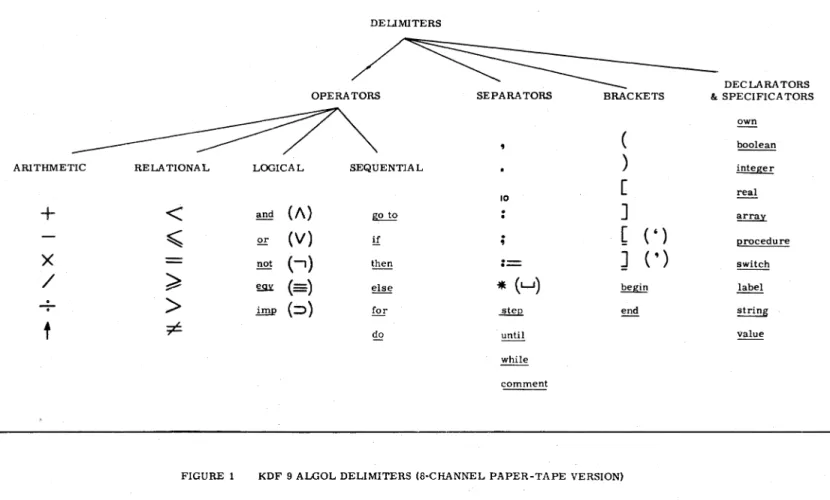
FIGURE 1 KDF 9 ALGOL DELIMITERS (S-CHANNEL PAPER-TAPE VERSION)
7
PROGRAM STRUCTURE AND BASIC gOLS
In the previous section we have attempted to convey some idea of the general structure of an ALGOL program by means of two simple examples. We propose in the .following sections to examine the detailed grammatical
structure of the ALGOL language, considering first the basic ALGOL symbols and in later sections the various language entities which may be built up from these symbols.' The review includes:
1. Basic symbols. 2. Numbers.
3·
Identifiers. 4. Expressions. 5. Statements.6. Declarations, blocks and programs.
7·
Procedures.Some of the above entities will provide ideas new to the readsr but few of them are inherently difficult to understand. Together with their associated rules they are required in order to systematize the expression of computational processes. Computers are not sufficiently versatile to absorb information about problems without such systematization. Because of this it is the duty of the programmer to obey the rules in formulating his problem.
The building bricks of an ALGOL program are called basic symbols. These are:
1., The letters of the English alphabet, both lower and upper case.
2. The digits 0 to
9.
3. The logical values
.E:!!!.
andl!!!!!!..
4. S1JIlbols called delimiters.Delimi ters are:
1 • Operators. 2. Separators. 3. Brackets.
4. Declarators andspecificators.
8
3- Program Structure and Basic Symbols (cont.)
All the basic symbols in KDF 9 ALGOL have been collected together in this section for reference. The ALGOL Report allows different 'hardware representations' for equipment with different sets of symbols and the set shown in Figure 1 is that available for use with eight-channel paper tape on KDF
9.
\7herever this differs from the official ALGOL 60 reference language, the latter is given in parentheses. There is another 'hardware representation' available for equipment using five-channel paper tape listed in Appendix 8, but throughout the rest of this manual the eight- ' channel representation is used.The reader should note that when words from the English language have been appropriated for use as basic symbols and given a particular ALGOL significance, they have also been distinguished by means of an underline. Thus the logical values ~ and ~ and delimiters such as
if,
begin, integer, and ~ must always retain their underlines.* They are treated as single symbols, the component letters having no individual significance.Insertion of blank spaces makes no difference to the meaning or operation of any part of ALGOL.** This facility enables the programmer to write his program in a format which makes it easier for others to follow its course of ac tion.
When used in a program .the basic symbols are strung together in a linear sequence with appropriate spacing, making the end of one line of program continue on the next. As alreaQy stated, the basic symbols are used to build up decimal numbers, identifiers, expressions, statements, declarations, blocks, procedures, and, ultimately, programs according to certain rules. We now explain the purpose of these entities, and rules for their construction.
*Bold type is allowed in lieu of underline in published ALGOL 60 programs.
9
DECIMAL NUMBERS 4'
Normal signed and unsigned decimal numbers using the digits 0 to
9
may be written in ALGOL and have the ordina17 meanings.* A decimal point may only be used when it is followed by a fractional part, consisting of at least one digit. Use of decimal integer exponents is also allowed, and these DlUst be written with the base 10 inserted below the line in small type, thus:
decimal number '0 integer exponent.
The exponent may be signed or unsigned. The prelimiD8l7 decimal number
may be omitted, while if the subscript ~ appears the integer exponent ~
not be omitted.
The following examples are
allowed:-0 16 +6 -79 +10 127 783 123·56 -0.00312 +.65 74.0 .00 7.5106 -33. 261'0+2 +210-1 -'7,05 /0-15
The following examples are NOT allowed:
23· 4'0. 25 3"-102 14.,.,5 +6102. 10,000
15'0 3.510(-7)
Numbers in ALGOL and variables denoting numbers are said to be of type integer or
.!:!!!.
Type integer refers to integers having neither exponent part nor decimal fraction part. Type.!:!!!
refers to any allowed form of number which is not of type integer. Integer arithmetic is normally used within the computer for type integer numbers andfloating point arithmetic for type ~.
Examples of type integer: 0
Examples of type ~: +6.0
2
-2·931
-9710 6";'
The maximum working accuracy available in KDF 9 ALGOL for
l:!!!J.
quantities is between eleven and twelve significant decimal figures.
An integer quantity must lie in the range _239 to +239_1.
*Though defined in the ALGOL 60 Report, signed numbers are never in fact used in programs,' signs alw~s being invoked via the definition of expressions (See Section 6). They may however be used for input data or results in KDF
9
ALGOL.10
4· Decimal Numbers (cont.)
Problems
(1) Write numbers having the same values as the folloYiing. but which
co
not include an exponent part.+7. 293,08 98 •12,0+2
(Solutions to Problems will be found in Appendix
7.)
(2) The values given by the following numbers may, in some Clises, be expressed more economically by using a number wit.h an exponent part. Show where this is the case.
17000
1000
-0.00134
1.0024
-0.0020041298
170
(3) Some of the following sequences of Ch2..1'acters represent ALCOL numbers, some do not. Mark those which do.
-.0 ot:
+13. 4710+16
4 X 10⁻² (16.20)
-17.2·30
,i4.2
-88'0-7
1,241()3
13·411 732
2.48,on
X 643.2
11
IDENTIFIERS
Mention of identifiers has already been made in Section 2. They may be single letters of the English alphabet, upper or lower case, or sequences of letters and numbers.* The first symbol of a sequence must be a letter. The following could be used as identifiers.
i
J1
abCD43e
D~s (~35
exp
Delta alpha
In accord with Section 3 the spaces within the identifiers Days 1335 and Delta alpha are ignored by the ALGOL translator. Note that though the sequence A256b might be used as an identifier. 256b may not.
Identifiers are used for a variety of purposes. Amongst others, they may denote labels which mark reference points in the program, and they may also denote variable quantities which take a value in the usual mathematical sense.
An
identifier which is a variable is said to be of type·!!!!, integer. or boolean. Variables of typel!!1
and integer were mentioned in Section 4. Variables of type boolean can take the logical values ~.Dr~. The means of defining the type of a variable will be explained in Section 18.Problem
Some of the following sequences of characters can be used as identifiers, others cannot. Mark those which can.
begin a xv 4111 ppp3
p1·2 Start value number Q(2)
7VPQ
Y.1
a29v3 epsilon
13
6· SrnPLE AlUTHMETIC EXPRESSIONS 6·
Numbers, those identifiers which represent variables, and other ALGOL entities having a single numerical value may be used in combination with arithmetic or logical and relational operators and. certain sequential operators to form arithmetic expressions or boolean expressions.
Initially we shall restrict our attention to subclasses of both these types of expression, namely, simple arithmetic expressions (considered in this section) and simple boolean expressions (considered in the next).*
It is even necessary to leave a general definition of simple arithmetio expressions in ALGOL to Section 8. However, we may now s~
that they include arithmetic expressions as understood in the normal mathematical sense, when these are written in the linear form which follows:
, ,
,
,\0 :
, I
N
o •••••••
0 Vo
N VHere N stands for an unsigned number, V for ~ variable of ~ or integer type, and 0 for an arithmetic opera tor. The diagram is intended to indicate that N and V are interchangeable. The initial operator may
only be an adding operator (+, -) and the broken parentheses indicate that in any case its presence is optional. At least one operand (N or V) must be present in an arithmetic expression.
Example:
2Xx t3+n+2
The meanings of the operators used in this example are given below.
The order of execution of arithmetic operations follows certain definite rules. The operations are executed in order of occurrence from left to right unless the adjaoent operation has a higher priority accord-ing to the followaccord-ing list:
1st 2nd X /
i-3rd
+-Parentheses may be introduced within a simple arithmetic expression to override the order of evaluation given by the above rules provided that the enclosed symbols form a legitimate arithmetic expression. The arithmetic expression with its enclosing parentheses may be introduced within the simple arithmetic expression in aDf situation where an unsigned number or variable is allowed.
The arithmetic operators have the following meanings:
14
6· Simple Arithmetic Expressions (cont.) 6·
t
is the sign of exponentiation. The base precedes the sign and the exponent follows. The operation is effected as in ordinary ari thmetic ~Ii th the following comments and exceptions. No values of base and exponent which would lead to infinite, indeterminate, or imaginary results are allowed, and when the exponent is ~ the value of the base may never be negative. The result of exponentia-tion is of the same type as the base, if the exponent is integer, and positive or zero. O~herwise the result is of type real.x
+ - all have their conventional meanings. The type of the resul t is integer if both operands are integer, otherwise the result is ~./ T both denote division. The first operator ~ be used with any combination of operands and produces a result of type~. The operator;. is only used for two operands both of type integer and yields a result of type integer as folloVls:
n ~ m = sign(n/m»( whole number part (modulus(n/m»
The type of any resul t obtained by the operation of the above rules is as stated. If, for example, the result of some operation involving
~ type numbers happens to have an integer value, its type is not thereby changed from ~ to integer. In terms of the internal working of the computer, though the result happens to be an integer it is still in floating-point form.
Notes:
(1) In multiplication the multiplication Sign must never be omitted. One may wri te 5
X'
y and (a + 2) >< b, but not 5 y and (a +2)b. (2) Two operators must not appear adjacent to one another. Onemay vnrite +3)( (-x) and yf(-4), but not +3 )( -x and yt-4.
Examples of si~ple arithmetic expressions:
2 + 2t3
=
2 + 8=
10 (2 + 2)t3 413=
64'1 + 2>< 5 - 3t2 1 + 10 - 3'2
=
11 - 3t2=
11 - 9 = 2The results of these three expressions are of integer type. The following give ~ type:
3/2 - ·5 1.5 - .5 = 1.0
9t.5t3 - 7 t 2 3.0'3 27.0 - :3
If x = 4.5. y
=
2.3,7 ~ 2
=
27.0 - 7 ~ 2 24.015
6· Simple Arithmetic Expressions (cont.)
Problems
(1) Evaluate the following expressions stating the type of the final res,tlt.
(i)
-4.6/4 X (16
+2)
(ii) +60 - 5 X (3 + 2 t( 4 - 1).
(2) Some of the following sequences are arithmetic expressions, some are not. Uark those which are.
(i) a X b/c'd/e X f (ii) +aX -b
(iii) 2'06 X 4.3 + Q (iv) 2 X 6/4.3
'0
(v) 3.84,0(7 + n)/4 (vi) PQt+ 7.3 (vii) -(+(-v) ) (viii) p/qrs X tu - v
(3) Assuming that at a certain point in a progTam the values of seven simple vaxiables are as follows,
va
=
2, vb=
3, vc=
4, vd=
5, ve=
6,
vf=
7, vg=
8,find the values of the following expressions: (i) va + vc X vb/ve
(ii) vd X (vc + vg)/ve/va (iii) vct(vd - vb)
(iv) vftva X (vf - vc)/vb/(vb + vc) (v) vctvbtva
(Vi) (ve - vf - va) f vc (Vii) vc f (vg - vb) (Viii) (vg - vd)tvb t ve
(4) Write the following mathematical expressions as ALGOL expressions, wi thout using red'mdant parentheses:
(i) S +
.!....::...!
v2
(ii) (u -
w)
(1(iii) a n + m (iv) a bn
b + s n (v) a
16
6· Simple Arithmetic Expressions (cont.)
(vi) (qv)g
(vii) ~
(viii)
17
SIMPLE BOOLEAN EXPRESSIONS
A boolean expression is a rule for computing a logical value. The
res~lt may be either the value t~le or the value false. The boolean expressions which occur in practICe usually also belong to a subclass called simple boolean expressions.
A simple boolean expression consists most frequently of a single relatie'n v/hich takes the value
!!:!a!.
or false. By a relation we mean two s.~mple ari thmetic expressions separated by means of one of the re la tional opera toJ. E. :These operators have their conventional mattematical meanings. An example of a relation might be:
n
=
0This relation takes the value true if n is zero and the value
il!:!!!!.
if nis not zero. Other examples might be:
n)( h X (n X h + 2 .>( z)
>
11.51 (at2 + bt2)t2 -< a + bThe fo~ of a relation can be depicted as follows:
SAE RO SAE
where SAE stands for a simple arithmetic expression and RO for a relational operator. In performing the operations involved in such a relation to find its logical value, the simple arithmetic expressions are evaluated first, from left to right, and the relational operation is performed last.
A sireple boolean expression need not be a relation. It could be merely a logical value or a boolean variable. It could take a complicated form involving a number of relations, boolean variables and logical values, the values of which are operated upon by means of the logical operators
!!2! (-,),
!!!§., (A) and $: (V), amongst others. Appendix 2 describes theforms which !U'e allowed, but the reader may wish to leave this to a second reading.
Problem
If i
=
2, j .. 3. x .. 4.5 and y=
2.2, what are the values of the following simple boolean expressions:(i) (ii) (iii)
(iv)
i><j~i+j
j/ic::::: xjy
19
8· ARIT~~TIC
ANn
BOOLEAN EXPRESSIONS 8·8·1 I f Clauses
It is extremely useful in any programming language to be able to make a program choose its course of action depending upon the
situation arising at run time. Such facility is allowed in ALGOL by mAans of the 'if clause'. Depending upon the truth or falsity of a boolean expression the progr~n will either obey different instructions or supply the values of different expressions.
For example we might wish to have an arithmetic expression which supplies the value of x2 + 1 if X is greater than zero but otherwise supplies the value -1. We could write the ALGOL expressions to do this as follows:
II
x;::> 0 ~ xt2 + 1 ~ -1The first part of this expression,
i f x;:::>O then
is called an if clause. An if clause is always written in the form:
llBE~
where BE stands for a boolean expressions (as yet not fully defined but including simple boolean expressions). The basic symbols
it
and ~ are sequential operators.Example of another if clause:
i f lambda;;;o. 7071 0678 ~
8·2 Use of the If Clause in Arithmetic Expressions
As already shown in the first of the above examples it is possible to extend the idea of the arithmetic expression by means of the if clause. Besides the simple arithmetic expressions considered in Section 6 it is also legitimate to have arithmetic expressions commencing with an if clause and completed by two alternative expressions, the first a simple arithmetic expression, the second itself an arithmetic expression. Thus, an arithmetic expression may be of the form,
i f BE then SAE ~ AE
20
8· Arithmetio and Boolean Expressions (oont.)
Examples:
(a) if n, = 0
!!wl
0.5 ~ 1(b)
g
lambdaf
0 ~ alpha X (1 .. alpha)x
exp{lambd.af2)/ (lambdax
2.3282180).!!.!!.
0.483948·
In the above eX8lllples both the al terna ti ve expreesions following
!!wl
are simple arithmetic expressions.' We could, however, take our more complioated definition for an arithmetioexpression arid use it. for the expression following the symbol!!!!. We might then obtain arithmetio expressions like those which follow.(a)
g
i .. 2l!l!!l
p .. q!!!!
.!!
i=
3 ~ p + q!!!! 0t I I 1
~ I
SAE AE
I AE
(b) (Appendix 2 mUst be read, in order to appreoiate this exa~ple.)
.!!
p <:: 0!!!S
q<:: 0 then (px q ..p
+ q)t2.!1!!.!.
ifp::>
O~ q> 0.l!'!!n
p )( (q + 1)t28·3 Use of the If Clause in Boolean Expressions
Boolean expressions run parallel to arithmetic expressions; they may use if olauses in a similar manner. Thus a boolean expression may be of the following form:
.!!
BE ~ SBE ~ BEOf oourse, boolean expressions also include simple boolean expressions.
The following example shows a boolean expression of a fair~
complex form. The quantities Bi, B2, B3, B4, B5, B6 and B7are variables of type boolean and some are used as simple boolean expressions and others as boolean expressions.
BE I
BE SBE BE
I
0
,----__
.1.-1 - - - - ,i f IUBi then B2 else B3 then B4 .!!!!,Iif B5
~
B6!!!!
B1--Y-, I,J-y-
t,J
~
t,J
BE SSE BE BE SBE BE
21
8· Arithmctic and Boolean Expressions (cont.)
8-8-4 A Use for Parentheses
An arithmetic expression or boolean expression cODUDencing with an if clause may be incorporated wi thin a simple arithmetic or s~ . .Inple boolean expression wherever a variable of the corresponding type is allowed, if and only if, it is enclosed within parentheses. This means that simple arithmetic and simple boolean expressions IrAY be quite complicated. In practice such forms do occur occasionally. The following is an example of a simple arithmetic expresoion incorporating an arithmetic expression in parenthesed.
JO + (x - y) x (if n ~ 0 ~ 0.5 ~ 1)
Problems
(1) Wri te an arithmetic expression which. will evaluate
-1.L
1 + t2
if A is greater than pi/2, otherwise will evaluate
~
1 + t2 (2) Write down an arithmetic expression which will evaluatex - 1
x2 _ 3x + 4 (Ooo;;xtE;;;1)
STANDARD FUNCTIONS
9'
The scope and value of ALGOL expressions are enhanced by a facilit,y for inserting functions, just as variables m~ be inserted. One merely writes down a function's name with appropriate argument or arguments. Here we consider certain standard functions which may be used, although other functions are also available as explained in Section 19 on Procedures.
The standard functions are some of the more frequently occurring functions of analysis and are listed below:
abs (AE)
sign (AE)
sqrt (AE)
sin (AE)
cos (AE)
arctan (AE)
In (AE)
exp CAE)
entier (AE)
for the modulus (absolute value) of the value of the expression AE.
for the sign of the value of AE (+1 for AE >-0,
°
for AE = 0, -1 for AE <0).for the square root of the value of AE.
for the sine of AE radians.
for the cosine of AE radians.
for the principal value in radians of the arctangent of the value of AE.
for the natural logarithm of the value of AE.
for the exponential function of the value of AE.
for the largest integer not greater than the value of AE.
These functions operate indifferently on arguments both of type
!!!l
and integer, which must be arithmetic expressions. The functions all yield values of type real except for sign CAE) and entier (AE) which have values of type integer:-- When quoting a standard function within a program, it is unnecessary to make there any specification of the effect expected from this function.The following examples show the use of standard functions in arithmetic expressions:
FUNCTION
abs (AE) sqrt (AE) exp (AE)
ARITHMETIC EXPRESSION
abs (1 - 2 X J1/JO)
(1 - alpha)/ sqrt (2 X alpha)
JO + exp(- x12) X (g n = 0 then 0.5 ~ 1)
The effect of the function entier is shown by the following results:
entier (6.99) 6 en tier (-4.2)
=
-524
9'
Standard Functions (cont.)9-Problem
Write the following expressions in ALGOL using standard functions:
25
10· STATEMENTS 10·
Those assemblies of basic s,ymbols which form units of operation within an ALGOL program are called statements. Statements written consecutively are usually also executed consecutiyely, and two independent statements written consecutively are always separated by a semicolon, thus:
S; S
The &tatements contained in the two simple programs of Section 2 obey this rule. We repeat the statements of the first of these programs below for the reader to note that this is so.
open (20); x := read (20); y := read (20); close (20); z := x + y; open (10); output (10, z); close (10)
I
I
I
I
I
I
I
I
I
I
I
I
I
I
I
I
I
I
I
I
I
I
I
I
I
I
I
I
I
I
I
I
I
I
I
I
I
I
I
I
27
ASSIGmmrT STATEMENTS
Some of the ALGOL statements appearing in the previous section are assignment statements, for example:
z := x + y
This statement is executed by giving the quantity z the value of x + y.
The symbol, :", is the assignment symbol and is pronounced as "is assigned the value of" or "becomes".* The complete statement would read:
z is assigned the value of x + y.
Tne above example is particularly simple, but more complex forms are allowed. Thus, on the right hand side of the assignment symbol, one could have any arithmetic expression, or even a boolean expression if the variable on the left side were also of type boolean. It is possible to extend the left hand side by writing down a 'list of variables (oalled left part variables) with assignment symbols inserted to separate each from its neighbour. The value of the expression is then assigned to all the left part variables.
The assignment statement in its general form ~ therefore be illustrated as follows using V to stand for any variable:
IV : = V:
= ...
V:=/ {:
ILeft part list
The name left part list is given to the list of all the left part variables together ,dth the assignment symbols as shown in the diagram.
Examples of Assignment Statements:
h := 0.1
JO : .. n := 0 x := z + n X h
JO := JO + exp(-xt2) X (,ll n .. 0 then 0.5 !!§.! 1) Bi := B2 1- B3 := ~
Bool 1- n
f
m + 1TYPes in assignment statements must obey oertain rules, for the most part a fairly obvious set. Thus, all variables in a left part list must be of the same type. If the variables are boolean, so I1II1St be the expression on the right. If the variables are of type
I.!!!!
or integerthe expression must be arithmetic. However, it is allowable to have the
*The symbol := has a different meaning from the symbol
=,
denoting equality. The latter asserts the current situation tohave
aparticular property, while the former performs an operation whioh ~
28
11· Assignment Statements (cont.). 11·
arithmetic expression differing in type from the variables. In this event it is understood that the numerical value of the expression is transferred to
I!!!
variables and the largest integer not greater thanAE + 0.5 to integer variables (that is, the nearest integer). Note that the rule for assignment of a real arithmetic expression to an intege~
variable does not correspond to the system followed in integer division.
Example I
Find the action of the followillg assignment statements, given that n is of integer type, and x and y
I!!!.
n 1= 1;
x 1=
3.2;
y 1= x + 1; n 1= n
+
2;x
1= X + y/2t(n
+1);
Y 1=
II
n - 0.!!W!
x + yo.!!!!.
x - yoWe form a table containing a column for each variable, in which each new value of this variable is entered.
n x y
1
3·2
4.20
5·3
9.5
Final
valuesl- on=
0,
x -5.3,
y a9.5
Problems
(1) Using the scheme of the example above, follow the action of the following statements and find the final values of the variables. !hey are all to be taken as type
I!!!.
a Is b :=
7;
p 1= a + 3 X b - 2.~-1; q 1=
P
+ (a +3)/(-b - 13);
29
11· Assignment Statements (oont.) 11·
(2) Using the same system find the final values of real variables r1, ra, rb, and integer variables n, i, j.
n :=
5;
r1 :s n/(n + 15);
rb := n + 6/(6 X r1 + 0.5);
i := n := n - 2;
j :- rb - i;
ra :,. (j - i) X r1 X (rb - 4);
r1 := ra + rb + n + i + j +
ax
r1;rb := (r1 - rb X n + j - ra)t(rb - j) + raj
j := n := 1 + n
+
(j - 3);i := n + ra
Using the same soheme again find the final values of the real variables ra, rb, the integer variable ia, and the booleaii"Variables ba, bb.
ra := 7.5; ia :=
5;
rb :.. 3 X ra - 2 X ia; ba :- rb>ia
sa
ia>ra; ra :- 2 X (ra - ia) -1; ba :=
!!2!
ra >1& .2£ ha; bb : .. basa
rb::>iasm.
ra.<rb12· GOTO STATEMENTS AND LABELS 12·
12·1 Goto Statements
Goto statements usually take the form:
goto L
where L stands for any label. They interrupt the no~~l sequential flow in the execution of statements by causing a jump to the statement prefixed by the label L. The label L may be any identifier not used for some other purpose,* while the basic symbol ~ may also be written as ~ if desired. The following might occur as goto statements.
R
SKIP &l.1Q. Repeat
L25
x y Z P
Corresponding to the label appearing in the goto statement, the same label must be inserted elsewhere in the program to specify the destination. Insertion of this label is performed by labelling statements, as now described.
12·2 Labelled Basic Statements
The two forms of statement, assignment and goto statements already mentioned are included in the category of unlabelled basic statements (UBS). A d~ statement also exists and is included in the same category. This is simply an empty space which does nothing.
A label may be prefixed to an unlabelled basic statement in the following way:
L : UBS
The result is called a basic statement (BS).
The general form for a basic statement allows any number of labels:
L : L : •••• L : UBS
It also includes the unlabelled basic statement as a special case. (It will now be seen that a d~ statement might sometimes be useful for setting a label).
12· Goto Statements and Labels (cont.) 12·
Problem
The following piece of program generates a sequence of values for SUM. Find the first four of these values. The variables p, q and SUM are ~, while n is integer.
n 1= 1;
P 1= 0.5;
SUM 1= 0;
q 1= 1;
loop I SUM 1= SUM + qfn;
q 1= q X p;
FOR STATEMENTS
ALGOL has a speoial form whioh enables the exeoution of any statement to be repeated a number of times. This is oalled the 'for statement'. It is the most appropriate ALGOL equivalent to a repeated loop in normal maohine language programs and next to the assignment state-ment it is probably the most valuable s'\O&testate-ment available.
Two simple examples will help to ~lain what a for statement is like
befor~ we define the general form.
!2!
i := 1 stElp 1Jmll!
5.S2
x : .. x + 12!2!
x :,. 2.!!lll!
y<.O.S2
y :- y + xThe first of these for statements inoreases the value of x by 12 on five oonseoutive oooasions at the same time incrementing the value of i
by 1 until it beoomes greater than 5. The seoond example repeats the statement, y := y + x, for as long as y<O, keeping x at the value 2 during that time.
13·1 The General Form of the For Statement
The general form of the for statement is written as follows:
is.
V := FL.S2
Swhere V stands for a oontrolled variable and S for any statement. FL stands for a 'for U.st' whioh we now explain.
The for list is oonstructed of for list elements (FLE) according to the form,
FLE, FLE, ••••• FLE
A for list element ~ take any of the following forms:
AE
AE step AE until AE AE.!hll! BE
where the basio symbols step,
.B!U!!
and wbile are separators,separating the arithmetio expressions (AE) and boolean expression (BE).
34
13' For Statements (cont.)
13·2 Arithmetic Expression Element
for x := (p + q)i3, p X q 2£ Y := y/x
This for statement assigns the value of the arithmetic expression (p + q)t3 to x and then executes the statement y := y/x. It then returns to the for list and assigns p x q to x. The statement y := y/x is again executed. The for statement has now been completed and control passes to the next statement in the program.
13'3 Step-until Element
i2!:
n := 1 step 1.!Yill1.
102£ m := nf3This statement calculates the cubes of the first ten integers. It begins by assigning the value 1 to the controlled variable n
and then obeys the statement following the symbol do. The contI~lled
variable is noVl increased by a step of 1 making i t-;;: = 2. The statement is again obeyed using the new value of n, and n increased once more. The process continues until n becomes greater than 10 when the for stateJ:lent is finished and all cubes up to 103 have been calculated (but only 103 remains as the value of m).
Any arithmetic expression may be used for the initial value, the step and the limit in the step-until element. This ~ lead to negative steps or even to steps which change sign during the execution of the for statement. A complete specification of the action in such circumstances is given in Appendix
3.
Problem
(1) Follow the action of the following statements
Delta x : = 0.1;
~ x := 0 step Delta x
B!!.ll!.
0.55 do y := (1 - x)f2(2) Write a for statement to add together the first n integers. First solve the problem by writing a preliminary assignment statement before the for statement, then find another solution which only requires a for statement.
13·4 While Element
i2!:
k := i + 1 :!hilii x (i "- 1)<202£ i : .. k + 235
13' For Statements (cont.)
k i(i
-
1 ) i Initially-
-
0 1 0 34 6 6
7
30The values of i and k immediately before leaving the for statement are i
=
6, k=
7.Problems
Follow the action of the following for statements.
(1) fQr p := p + 2.Y!h.lli pt2 + qt2<:100 .9£ q := p + 1 where before entry p
=
1 and q --7.
(2) for i := 2, 5, 6 sJep 1 .!:!!Ull10, -1
:!hili
m<:0.9£m := i x (i + 1
(3) If p, q, r, s are ~ and k, m are integer, find the values assigned to controlled variables in the following for statements and the final value of s:
p := 1; q := 2; r :=
3;
s := 0;for k := p + q, q - p, r X p - q .9£ s := s + k; for m := q step r.!:!!Ull
7
X q + 1 ~ s := s - m; for k := 2, s, 2 step 2 ..!:!!llil
6 ~ s := s + 2 x k; for m := s + 45. m + 2 ~ s<:O .9£ s := s - m; fQ!: k : = 1 step 1 .!:!!Ull 5 ~ill
m : = 3 step -1 ~ 0 do s : '" s + k + m13'5 Miscellaneous Notes on For Statements
Note (1) In ALGOL the controlled variable has no defined value after the for statement has been completed by exhaustion of the for list. However, the value left by one for list element may be used in the next element of the same list, as in
fQr i := 1. i + 1 while •••
Note (2) Labels may be prefixed to a for statement. form of a for statement is:
L : L : ••• L :
i2!:.
V := FL .9£ S13· For Statements (cont.)
Note (3) Exits from within a for statement body, that is the statement following a~, by means of goto statements are allowed. In such an event the controlled variable keeps its current value on exit. (The importance of this and the following note will be better appreciated when later sections of the manual have been read and it is realised that a for statement body can contain many statements.)
14· COMPOUND STATEMENTS 14·
In Section 10 the reader was told that statements might be grouped together to form blocks or compound statements. We now write down the form to be taken by the compound statement:
L : L : ••••• L : begin S; S; ••••• S; S ~
The sequence of one or more statements is surrounded by the statement brackets, begin and ~. These two basic symbols enable the sequence of statements to be employed as one whole.* Labels ~ also be prefixed if required, but are not essential. Note also as a matter of punctuation that the final statement S in the sequence need not be followed by a semicolon; there is no following statement from which it must be separated.
Examples:
(1) ~ x := z + n>< h;
JO := JO + exp(-xf2) ><
ill
n = 0 ~ 0.5 else 1)(2) begin i := 2; n .- 1; h := h!2; goto R
The compound statement may be used wherever a statement is allowed, in particular, after the do in a for statement. This extends the scope of the for statement, and-enables a number of statements contained within the compound statement to be obeyed repeatedly. Thus Example (1) above forms part of a for statement in the specimen program of Appendix 1.
Problems
(1) Use a for statement to evaluate the product
1 1 ~
( 1 -
'4)(
1 +"9) •••• (1 - - 2 ) n(2) Write a for statement to evaluate the function
y - 2 1 2 [b2 +
~
(1 - e-2a) + 22ab 2 fe-a(a sinb + b cosb)-l a + b a + b Twhere a = -Tt (1 - s), b
=
~
1 - s for s=
0.1 (0.1)0.9.*The programmer will often find it helpful to connect the begin and
.!.!l!
by a vertical line. This will tend to bring cut the program structure but is not by any means essential. It also helps to ensure that an,g
ccrresponding39
CONDITIONAL STATEMENTS 15'
Basic statements and compound statements (but not for statements*) are classified as unconditional statements (US). There is also a conditional statement and this takes one of the following forms:
L L
if clause
I
... L
:I
g BE
~
USI(~~:
I
i f statementif cJause
L : L : ••••• L : lif BE therl FS
where FS stands for a for statement.
Examples:
g
x ..°
.ih!m y := 1 ~ Y := x - 1g
Bo0.ih!m.!2! I := 1 step 1B!!Yl
m ~ n := n)( (n - 1)The if clauses and if statement are essential components of the forms of conditional statement in which they are marked. The broken parentheses around ~ S following the if statement in the first form indicate that this part may be omitted if there is no alternative statement to be
executed. Thus an if statement alone can always be a conditional statement.
In the first form the conditional statement is executed as follows: if BE has the value ~, then US is obeyed and the remainder of the condi tional statement is ignored; otherwise, i f BE has the value ~,
then US is ignored and S is obeyed. If the conditional statement is merely a labelled or unlabelled if statement, so that S does not exist and also BE happens to have the value false, then the statement produces no action beyond that caused by the ev~ion of BE. In the second form, if BE has the value ~ then FS is obeyed; otherwise the state-ment again produces no action beyond that caused by the evaluation of BE.
Further Examples:
g
abs{ 1 - 1/lambda):>,o-5.!h!!1
~ Repeatg
v;;-u.!h!!1
X : q := n + m ~!2.!2.
R Problems(1) Find the final values of all variables when the following statements have been executed. The variables u and W are real and B boolean.
(Appendix 2 is needed in solving this example).
40
15· Conditional Statements (cont.)
u :=
3;
B : = .k.l!!,; repeat: W:= u - 2;
i!
ut2 - 1/u""O ~ W::>-2 ~ u := 1/u else if B ~ goto Z~
&2!2
end;Z: B :=~;
u := W + 2 X u;
~ repeat; end: B := u~W
(2) Construct a loop to evaluate iteratively a root of the equation,
x2 + x .. 16,
using the formula
16
x . =
-x + 1
and the starting value x = 3.0.
Use a condi tional statement to exi t from the loop when x has been determined to four decimal places. Afterwards, write a single for statement which will evaluate the root and follow its action for three iterations.
(3) Write a conditional statement which will cause a jump to four different points in a program, labelled P, Q, R and S. Make the jumps depend respectively upon two boolean variables, B1and B2, by jumping to P, if both.k.l!!" to Q if B1 .k.l!!, and B2 ~, to R if B1 false and B2 true and to S if both false. When finished check
tha t you have no if following a~; this will not be the case if the definitions of the present section have been followed. (Refer to Appendix 2 if necessary, in solving).
(4) Making use of a compound statement, write a for statement to evaluate, xn + 1
y .. -xn _ 1
41
16· SUBSCRIPTED VARIABLES AND ARRAYS 16·
In computational work it is often necessary to perform the same operation on ~ different sets of data. When this is so, it is very convenient to be able to allocate a single name or identifier to groups of data and distinguish between individual items by means of subscripts. The notation using an identifier with subscripts, familiar in mathematics, is available in ALGOL, where it is known as the notation of subscripted variables.
In the particular form it takes in ALGOL we write the identifier common to the variables followed by square brackets encloSing the subscripts, for example,
As the subscripts are varied one obtains the various subscripted variables which are said to form the elements of an array. This arr~ has the common identifier as its name; in the example above, this is ar.
The form taken by any subscripted variable may be depicted as follows:
A [SUB, SUB, ... SUB]
Here A stands for the array identifier. SUB stands for a subscript Y/hich may be any arithmetic expression. I f this arithmetic expression
(AE) is ~ then the largest integer not greater than AE + 0.5 is taken as the value of the subscript (i.e., the nearest integer). The subscripts are evaluated in the order of occurrence.
Examples:
Scorpion
[k,
1, m, nJSubscripted variables may be of one of the three types ~, integer and boolean, but variables corresponding to a single arr~ identifier must be of one type only. In the same 'fIB3 as simple (non-subscripted) variables are admitted to the class of ALGOL variables, so are
subscripted variables. It follows that the uses of subscripted variables to be described in the following sections are allowed.
16·1 Use of Subscripted Variables in ExpreSSions
Expressions involving subscripted variables may be written, and at execution time the program will evaluate the expressions using the subscripted variables selected according to the current values of their subscripts.
Examples of arithmetic expressions using
!!!!
and integer type subscripted variables as operands follow:Mx
[d1, d2]
42
16· Subscripted Variables and Arra,ys (cont.) 16·
g
A>B.!ru!a X [i x j] .~ Y [iJ PQ [1, 2, i f j..::::2 .!ru!a r ~ sJThe following might be boolean expressions using subscripted variables:
Boolean [i, j,
kJ
WX
DJ
>-
YZ [rho]16·2 Use of Subscripted Variables in Statements
The important use of subscripted variables as left part variables in assignment statements is allowed. In such a case the subscript expresaions occurring in any left part variables are evaluated before the expression on the right of the assignment. When more than one left part variable is subscripted, subscript expressions are evaluated in the order of occurrence, i.e., from left to right.
Examples:
!.2£
i : .. 1 step 1!!!ill1.
n ~E en] :" E [n] + A [i]x: S [i]1n
para 1 :- arr 1 [iJ :-,arr 2 [i,jJ := 0
Finally, subscripted variables may also be used as controlled variables in for statements but special care should be taken when the values of the subscripts of the controlled variable are liable to be changed during the execution of the for statement. The actual mode of operation in such cases accords with the action of for list elements defined in Appendix
3.
Problema
(1 ) Calculate the final values of the variables involved. in the following statements:
B [1, 2J :- B [2, -1J :- V [3J :- 2;
i : .. 3 x B [2, -1J -2; B [1, i .;. 2J : .. i :- 1;
V [B [1,2] + B [2, -1]] :- B [1.
i1
1- 6 -V [3]43
11· INPUT AND OUTPUT OF DATA 11·
The ALGOL language as so far defined provides no means for the initial setting of program parameters .when these are to vary from job to job, nor does it provide means of printing out the results of program operation before they are lost. Thus, to produce ALGOL programs of practical value, it is necessary to add to our stock of statements and functions foms which provide input and output facilities.
The ALGOL Report indicates a means of providing these through ALGOL procedures which have bodies ~Titten in user-code. (Procedures are explained in detail in Section
19).
In agreement with this indication English Electric-Leo has produced a ICDF 9 ALGOL input/output scheme which the progra~er may use. If, however, he knows the details of how theperipheral devices work on KDF 9 at the user-code level, there is nothing to prevent the user writing his own scheme, or making additions to the English 3lectric-Leo system. The compilers work independently of what input/output scheme is adopted since the text Which defines the scheme must be \7ritten into the pro~m and is processed just as any normal ALGOL text (see Section
19·6).
The scheme written by English Electric-Leo follows.
11·1 Device Numbers
Since there are a number of different input and output devices on
KDF
9,
a word is needed about the way the progr~er calls for a particular device. The KDF 9 ALGOL statements and functions specified later in Section 11 allow him to write down a device number which will call a particular kind of device according to the ranges given below.Input/Output Device Device NUClber
Monitor typewriter*
Special input/output devices Paper tape punch (a-channel) Paper tape reader (5 or a-channel) Line printer
Card reader
Paper tape punch (5-channel) iree
Line printer/Paper tape punch, common output
Magnetic tape
00
01 - 01
10 - 11
20 - 21
30 - 31
40 - 41 50 - 5160 - 61
10 - 11
{ 100 - 101 110 .. 117
44
17- Input and Output of Data (cont.)
Though the programmer has full control over the kind of device to be called by using a device number in the correot range, the computer (via a fixed control program called the director) in collaboration with the operator deoides which actual device will be chosen for'a particul~ device number.
17·2 Simple Forms for Reading and Writing Numbers
The form for reading a decimal number in characters is
read (DV)
where DV stands for a device number.
The identifier read is a function for use within arithmetic expressions. It is of type
I!!!
and has as its value the next number on the input device, DV. Any device which is suitable for reading may be specified by the device number. Any arithmetic expression is valid as a device number, the nearest integer value being used to call the device.The number to be read on the input medium must be an ALGOL number (see Section 4 for definition) and must be delimited by an ALGOL basic symbol which is not a digit, +, -, ., '0' A failure
message will be printed and the program thrown off the machine if a number being input as data is non-ALGOL. out of range, or has an
exponent out of range. The non~A1GOL symbol -- (end message symbol,
'?'
for 5-channel working) must appear after the last delimiter ofany data paper tape.
Examples:
j := read (21); x := (read (j) + 1)t2
(The value assigned to J is being ueed as the device number in the second statement).
The simplest form for writing data to an output device is
output (DV, AE)
This is an ALGOL statement. It evaluates the arithmetic expression AE, which could of course be a variable, and outputs it to the device, DV. The number produced is in standard floating decimal with an 11 place signed mantissa in the range, 1oe;;N<10, followed by subscript 10
and a 2 digit signed integer exponent. Each number output by this statement is followed by a semicolon and a new line symbol, so that a print-out for more than one such number produces a single column.
Examples: