(
C23-380-101 Conversion Systems/ Terminal Controllers
DCA Irma, Irmaline, and Irmalette
MANAGEMENT SUMMARY
In August 1983, Digital Communications Associates (DCA), a prominent vendor of statistical multiplexers and other network products, acquired Technical Analysis Cor-poration (T AC), the manufacturer of the Irma, Irmaline, and the recently introduced Irmalette. These products, which comprise DCA's Decision Support Interface (DSI) family, allow IBM personal computers to be available for use as terminals within a 3270 network and to access 3270 applications and databases resident on IBM and compati-ble mainframe computers. The Irma and Irmalette are printed circuit boards that are installed into available slots on the IBM PC, PC XT, and certain PC-compatible micro-computers. The Irmaline is a standalone version of the Irma that links an IBM 327X controller to specified person-al computers and asynchronous terminperson-als.
The Irma, the original product in the Decision Support Interface (DSI) line, was first introduced at the 1982 Fall Comdex show and delivered at the beginning of December during the same year. The Irma is a high-speed, micro-processor-based interface that mounts inside the IBM PC in any available slot. It provides the PC with a direct, high-speed coaxial cable attachment to IBM 3274, 3276, and integral Type A terminal controllers.
The Irma board includes a microprocessor, I/O interfaces, a register array, and a screen buffer that together operate independently from the IBM PC's own 8088 microproces-sor to provide protocol compatibility with 3278 Models and 3279 Model2A. The emulation logic is provided by the DSI terminal emulation program, which is resident on a diskette supplied by DCA with the Irma.
The Irma's screen buffer has anon-board storage capacity of one 1920-, 2560-, or 3440-character screen, and is acces-sible from programs running on the PC through simple input/output commands. The PC program reads and modi-fies the screen buffer; using a set of Basic subroutines, users can create PC applications programs that allow the PC to read or modify the screen buffer and send keystrokes to the
t>
The Irma, Irmaline, and Irmalette comprise DCA's Decision Support Interface (051)
product line, and allow an IBM PC, PC XT, and certain PC-compatible microcomputers and asynchronous terminals to function as an IBM 3278/3279 terminal in a 3270 environment.
MODELS: The Irma and Irmalette are print-ed circuit boards; the Irmaline is a stand-alone unit.
CONVERSION: ASCII to BSC or SDLC. TRANSMISSION RATES: Data on the Irma's coaxial line is transmitted at a 2.3587MHz bit rate; the Irmaline supports 45.5 to 19.2K bps transmission.
COMPETITION: AST Research Inc., Local Data, Phone 1.
PRICE: Irma-$1,195; Irmaline-$1,295; Irmalette-$395.
CHARACTERISTICS
VENDOR: Digital Communications Associates, Inc., 303 Technology Park, Norcross, GA 30092. Telephone (404) 448-1400. In Canada: sold through distributors.
DATE OF FIRST ANNOUNCEMENT: Irma-Fall 1982; Irmaline-Spring 1983; Irmalette-Spring 1984.
DATE OF FIRST DELIVERY: Irma-December 1982; Irmaline-first major quantities shipped in December 1983; Irmalette-information not available.
NUMBER INSTALLED ·TO DATE: Irma-more than 40,000; Irmaline-information not available; Irmalette-information not available.
SERVICED BY: Digital Communications Associates, Inc.
MODELS
At present, DCA's Decision Support Interface (DSI) prod-uct line consists of three models: the Irma and Irmalette are . .
The Irmaline links personal com-puters or asynchronous terminals in remote locations with IBM 327 X controllers. The device has a 3278 terminal emulator program, which makes attached terminals or micro-computers look like 3278s to the controller.
C23-380-102
Conversion Systems/ Terminal Controllers
DCA Irma, Irmaline, and Irmalette
t>
327X controller. This capability permits the development of custom applications.The Irma offers emulation of nearly all 3278/79 terminal functions. The Irma's features include light pen support, support for 16 IBM 3270 keyboard types (including APL/ Text keys), extended attributes, keyboard key click, numer-ic lock, and four- and seven-color modes. The Irma's emulator program provides a special system configuration routine called GENX. With this routine, users can select the features and options to match their system require-ments. Selections include keyboard type, color support, auto-residency for the emulator program, APL, and light pen support. GENX selections also include Model 4 and asynchronous character input support.
Also included with the DSI emulator is software for per-forming file transfer between host databases and the IBM Pc. File transfer utilities are available for VM/CMS and MVS/TSO. Both utilities provide a binary mode to transfer files and contain special symbols, such as BAS files. The user can transfer data from PC to PC by using the main-frame as an intermediate storage facility.
The Irmaline, first announced at the 1983 Spring Comdex show, is the only self-contained unit in the present DSI product line. In the network, Irmaline sits between the 327X IBM terminal controller and the microcomputer or terminal and is at the controller site. Irmaline attaches to an IBM 3274, 3276, or integral Type A terminal cluster con-troller that is channel-attached or remote.
Nearly any personal computers or asynchronous terminals that support DEC VT100, IBM 3101, Data General D200, or LSI ADM-3A emulation and provide an RS-232-C interface can be attached to the Irmaline, including the IBM PC, PC XT, the Apple Lisa, and the DEC Rainbow. The personal computer or terminal appears to the control-ler as a 3278 Model 2. The Irmaline connects to the personal computer locally or remotely through an RS-232-C serial interface, which is microprocessor-based and operates independently from the controller interface.
The Irmaline's screen buffer provides on-board storage of a 3440-character screen page; in addition, separate and inde-pendently controlled buffer storage is provided by the RS-232-C interface.
The Irmalette is an intelligent asynchronous interface card that allows users to run any software written for the Irma using Irmaline and a PC with Irmalette. The Irmalette can be installed in any slot on an IBM PC, PC XT, or PC-compatible microcomputer. Functionally, the Irmalette provides Irma software compatibility and facilitates a chain of protocol conversions that makes the PC "see" an Irma card where, in fact, an Irmalette resides.
In the Advantages and Restrictions section" of this report, we discuss some points to consider when selecting Irma, Irmaline, and Irmalette products. Also note that although Irmaline was introduced in the fall of 1983, DCA did not
t>
~ circuit boards tbat run o~ tbe IBM PC, PC XT, or PC-compatible microcomputers; tbe Irmaline is a self-contained unit tbat supports terminals and microcomputers tbat sup-port DEC VT-I00, IBM 3101, Data General D200, or LSI ADM-3A compatibility.
• Irma-provides tbe IBM PC witb a direct, bigh-speed, coaxial cable channel~attachment to IBM 3274,3276, and integral Type A terminal controllers. Irma supports both BSC or SDLC 3274 cluster controllers. It provides a 1920-character screen that is compatible with all 3270 mono-chrome and color character displays up to 80 characters by 24 lines. No extra programming is necessary to fulfill all the normal functions of the IBM 3278 models 2, 3, and 4 and IBM 3279 model 2A, and 3A terminals. Model 4 must be ordered special, at no extra charge.
• Irmalble-Iinks personal computers or asynchronous ter-minals in local or remote locations with IBM 327X con-trollers. Because the Irmaline functions as a 3270 Catego-ry A device, it can be connected via coaxial cable to channel-attached or remote terminal controllers in either BSC or SDLC environments. Irmaline provides emulatioB of 3278 Model 2.
• Irmalette-is a translation device that provides frma soft-ware compatibility for the.lrmaline. Having a PC with an Irmalette installed that communicates over telephone lines with an Irmaline is the functional equivalent of having a PC with an Irma card installed.
TRANSMISSION SPECIFICATIONS
The Irma is a printed circuit board that plugs into allY slot in the IBM PC. A back-panel BNC connector on the Irma provides attachment to an RG-62AU coaxial cable that goes to either a 3274 or 3276 controller or an integral Type A terminal controller. IBM specifications allow up to 1500 meters of cable to the controller. In addition, IBM protocol supports a system where there is one terminal per coaxial cable. The Irma conforms to those specifications. Data on the cable is encoded in a Manchester-like code and transmitted on the baseband at a 2.3587MHz bit rate. Users should note that terminals, e.g., the 3278, and printers, e.g., the 3287, are very different, and controller ports configured for one will not work for the other.
The Irmaline has two BNC connectors and one RS-232-C connector. One of the BNC connectors attaches to the IBM 3274, 3276, or integral Type A terminal controllers; the other attaches to a 3278· or 3279-type terminal or an IBM PC with an Irma board. The RS-232-C port attaches directly to a local terminal or microcomputer with an RS-232-C asynchronous port, or it can attach to a full-duplex asynchronous modem to connect to a remote terminal or microcomputer. Irmaline supports from 45.5 to 19.2K bps transmission rates. It is possible to have both a 327X terminal or IBM PC and an RS·232·C terminal physically attached to Irmaline simultaneously; however, whenever the RS-232-C port is active, the other terminal port is disabled. The Irmalette is an asynchronous interface card that users install in any slot on an IBM PC, PC XT, or PC·compatible machine. With the Irmalette .installed and communicating with an Irmaline standalone unit, users have the functional equivalent of an Irma card in the PC. Irmalette provides the translation necessary to run Irma software on the Irmaline
device. '
DEVICE CONTROL
To explain how one uses the Irma and Irmaline products, we've summarized the basic operating theory that governs . . © 1984, DATA PRO RESEARCH CORPORATION, DELRAN, NJ 08075 USA
REPRODUCTION PROHIBITED
NOVEMBER 1984
,/
(
C23-380-103 Conversion Systems/ Terminal Controllers
DCA Irma, Irmaline, and Irmalette
ChIcago DP Center
IBM
MIIInfrIme
---3705
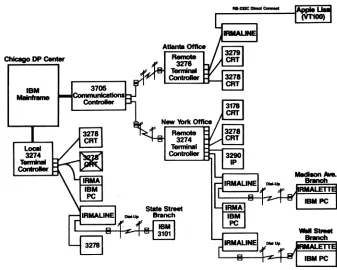
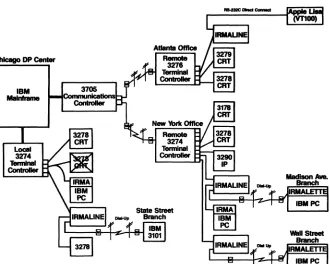
Figure 1. A typical IBM 3270 network with the Irma, Irmaline, and Irmalette installed. The Irma and Irmalette circuit boards plug into the IBM Pc. The Irmaline is a standalone unit.
t>
begin shipping the product in large quantities until Decem-ber because the company had to comply with new FCC requirements for the product. The Irmalette, just recently introduced, will be available in early 1984; when we wrote this report, DCA could not yet provide full documentation for the product.COMPETITIVE POSITION
Immediately noteworthy is the fact that the Irma, intro-duced in 1982, already has an installed base of more than 40,000 units. The product has achieved wide acceptance in a market that demands better data communications capa-bilities for the ubiquitous IBM Pc.
Other vendors offering products that allow IBM PCs and PC-compatible devices to work in an IBM 327X environ-ment include AST Research, Inc., Local Data, and Phone 1. AST Research has several boards-the AST-3780, AST 5251, AST-SNA, AST-PCnet, and AST-PCOX-that plug into an IBM PC to provide a variety of terminal emulation functions. Local Data's Datalynx 3274 supports emulation of the IBM 3278 for certain ASCII CRTs, printers, and personal computers. The Cleo, Phone l's offering, emulates an IBM 3276 Model 2 and supports various display termi-nals, including DEC's VT-52 and VT-100, C. Itoh's 101, and Zenith's Z19, as well as a number of ASCII printers.
ADVANTAGES AND RESTRICTIONS
With the DSI product line, organizations can integrate microcomputers into their existing mainframe environ-ment. The microcomputer can then gain a dual functiona-
t>
.... each device below. At the time we wrote this report, DCA could not provide detailed technical documentation for the Irmalette; therefore, we could not describe the operation of this device in detail.
Operating Theory
Irma. The Irma consists of four major components: an
8X305 microprocessor, DP8340 and DP8341 327X coaxial transmitter/receiver interfaces, a DSI terminal emulator program, a screen buffer, and a dual-port register array.
The 8X305 executes all functions related to the operation of the Irma including the handling of all 327X controller protocol functions, such as data transfer, handshaking, and screen buffer maintenance. For example, it supervises the assignment of entered data to its proper position and func-tion, sending data to the controller, and sending responses from the controller to the proper destination (e.g., an ad-dress in the screen buffer).
The DP8340 and DP8341 provide the interfacing to the IBM PC and to the 327X coaxial cable.
A diskette-resident DSI terminal emulator program pro-vides the logic that enables IBM PC to emulate the 3278/ 3279 terminal. DSI takes commands from the four-byte dual-port register array in addresses 220H to 223H. I/O commands from the PC System Unit access the array. With DSI, the PC can serve in two functions: as a standalone microcomputer, and as part of a 327X network. DSI oper-ates independently ofthe PC's 8088 microprocessor, and the Irma board maintains communications with the 327X con-troller without regard for the operational mode of the PC. The PC appears to the terminal controller as a 3278/3279 terminal, and all programs normally accessible only to 3278/3279 terminals are accessible to the PC. When the terminal emulation program is active, the microcomputer screen contains 25 lines of 80 characters. The DSI buffers a ~
[image:3.612.146.483.70.340.2]C23-380-104
Conversion Systems/ Terminal Controllers
DCA Irma, Irmaline, and Irmalette
t>
lity in the organization; it can work alone as an intelligent computer, but also serves as a terminal that accesses main-frame information. With the Irmaline, users can tie a standalone microcomputer situated locally or remotely to an existing 3278/3279 terminal port into a 3270 networking environment without the addition of anotber telephone line to the 37XX, and without occupying an additional port on a 327X terminal controller or 37XX communications processor. The savings derived from these arrangements can be enormous, particularly in large organizations.The Irma and Irmalette boards operate only on the IBM PC, PC XT, and PC-compatible microcomputers. The standalone Irmaline, however, works with many micro-computer models, as long as they provide an asynchronous port that supports an RS-232-C asynchronous card to establish a link with theIrmaline's asynchronous port and support one of the following'terminal emulation packages: DEC VT100, DEC VT52, IBM 3101, Data General D200, LSI ADM-3A, or TeleVideo 950. Users must buy these packages from a third party, who will usually charge from $75 to $150 for them. The Irmaline also supports ASCII terminal models that provide emulation of these terminals. If an Irmaline-supported terminal emulation package and/ or an asynchronous interface card is not available, the Irmalette is required for attachment of the microcomputer to the Irmaline. With the Irmalette, users get an asynchro-nous port and automatic error detection and correction, as well as communication support to the Irmaline. The Irma-lette is also required when the microcomputer is attached to the controller via an Irmaline but runs software written for the Irma.
DCA can provide a detailed technical description of the interrelationships among the various Irma products. The company will also provide technical assistance to those contemplating the use of these devices in a network.
USER REACTION
DCA provided us with a list of companies that use the Irma, and we were able to contact three individuals who had worked with the products. We asked the users to rate their Irma products in several categories. The results of the user reaction are shown in the following table.
Excellent Good Fair Poor W A * Overall performance 2 I 0 0 3.7 Ease of installation 3 0 0 0 4.0
Ease of expansion 3 0 0 0 4.0
Hardware reliability 2 I 0 0 3.7
Manufacturer's . I 2 0 0 3.3
maintenance & technical support
*Weighted Average based on a Scale of 4.0 for Excellent.
The users were pleased with the products, which they said were .easy to install on the IBM Pc. Because the Irma enhanced the functionality of the microcomputer by bring-ing it into the 3270 network, these users were able to justify their microcomputer purchases for both "intelligent" and
t>
. . full 1920-, 2560-, or 3440-character 24-by-80 screen, just as the 3278/3279 does. When the PC operates in standalone mode, the Irma's buffer saves data received from the control-ler and displays the most current screen when the emulator is reactivated. Thus, it is possible for users to switch from standalone microcomputer operating mode to emulation mode.
Upon activation of the on-board terminal emulator program, .the CRT displays the last screen transmitted from the terminal controller. During the first communication with the mainframe, the user must log onto that system as well. From then on, the chain of events is a repetitive translation and transfer 'sequence that occurs among the devices in the network. When the Irma receives data generated by the IBM PC, the DSI emulator accesses this data, translates it into the 3270 protocol, and sends it to the controller. The controller, in turn, relays the data to the IBM mainframe, which processes the data. Then the mainframe returns the processed data to the controller, and the controller directs the data back to the Irma. The Irma then converts the received data back to the original PC protocol, and the CRT screen at the end of the chain is updated accordingly. The conversion to 3278/79 terminal emulation is handled as follows.
In standalone operating mode, each IBM PC key generates a particular code sequence, called a Basic Input/Output System (BIOS) key code. When a user presses a key, the character translates into its BIOS key code, which the PC's CPU then processes. After processing, the PC updates the screen buffer and displays a new screen.
When the PC performs as a 3278/79 terminal, the functions of the PC keyboard are redefined to meet the specifications of the 3278/79 terminal. The keystrokes receive a double translation: first the PC's CPU translates the actual key-strokes into PC BIOS; the emulator program then converts the BIOS codes into the key positions and key-scan codes of the 3278/79 terminal. The Irma sends the 3278/79 scan code to the controller, which processes the code. The con-troller then modifies the Irma's screen buffer accordingly, and the displayed screen is updated.
The 327X organizes displayed data into fields; attribute characters, normally displayed as blanks, define both to the controller and to the display the type of data entered in a particular field. The Irma supports the use of both attribute and extended attribute characters. Attribute characters de-fine the beginning of a field, whether a field is protected or unprotected, and so forth. Extended attribute characters define the character type, character color, and character set. The Irma's DSI supports all the programming definitions for the attribute characters and the fields which they define. Keyboard operations, such as Clear or Enter, function in the same manner as on 3278/79 terminals. However, Irma currently does not support program symbols.
Irmaline. Like the Irma, the Irmaline consists of a main 8X305 microprocessor, a screen buffer, a dual-port register array, and a DSI terminal emulator program. A second microprocessor handles the RS-232-C protocol. The unit has two terminal ports-one coaxial port and one RS-232-C port-and handles simultaneous attachment of a coax-connected 327X device and an RS-232-C device (the 327X terminal port is disabled whenever the RS-232-C device is active). As' soon as Irmaline receives power, it accepts the 327X protocol from the terminal controller over a third port, which must be 3270 coax-compatible. The Irmaline operates in a manner similar to the Irma with the following exceptions. When the Irmaline receives data from a 3270 terminal or IBM .PC (witl;1 the Irma) via t~e
coaxial terminal port, there is no additional processing of ~ © 1984 DATAPRO RESEARCH CORPORATION, DELRAN, NJ 08075 USA
REPRODUCTION PROHIBITED
NovEMBER 1984
(
(
C23-380-105 Conversion Systems/ Terminal Controllers
DCA Irma, Irmaline, and Irmalette
!:>
"nonintelligent" functions. For one user, Irma provided the "glue" to pull his network together, in that the micro-computers were able to be used for intelligent functions when not emulating a terminal in a network configuration.Citing a limitation of the product, one user noted that when running the Irma, the microcomputer must be located near a cluster controller, to which it connects via coaxial cable. DCA's Irmaline ameliorates this problem and provides greater flexibility by allowing users to connect terminals and micros located at remote sites.
Because the Irma requires "do-it-yourself' installation, we asked the users to comment upon the documentation that accompanied it. One user noted, "Even a totally nontechni-cal person could put the board into the computer. The directions were simple and straightforward. The only real problem we had was applying the sticky decals to the keyboard." (DCA provides decals to show which personal computer keys perform particular 3278 functions.) DCA now provides a keyboard template, which can be used instead of the decals.
Two users also noted that it takes some time for terminal operators to master the various keystroke combinations and code translations that are necessary to execute the entire emulation process. Each user also noted that the now-expanded Irma product line would help solve future problems they anticipated as their networks grew and more people within their organizations purchased microcomput-ers. Both users cited this as a strong trend in their organiza-tions.D
~ this data, which goes directly to the controller. When the microcomputer or terminal attached to the RS-232-C port generates data and sends it to the Irmaline, the coaxial terminal port is disabled; the terminal emulator accesses the data, translates it into the 3270 protocol, and sends it to the controller.
Like the Irma, the Irmaline supports attribute characters and extended attribute buffers, as well as the programming definitions for the attribute characters and the fields· they define. Irmaline supports a 1920-character screen. Operating Procedures
Irma. Once the Irma circuit board resides in the microcom-puter, users must perform a series of steps to ensure proper function:
• Attach a coaxial cable from the terminal controller to the BNC connector on the Irma board;
• Make sure the communications port is "system generat-ed" for the correct 327X and keyboard;
• Boot the operating system prior to running the emulator program;
• Make a duplicate copy of the Irma diskette;
• Insert the duplicate diskette into Drive A or B on the microcomputer; and
• Enter an E78 to activate the emulator program. Making the emulator resident allows the user to exit and reenter the emulator with greater speed. But to make the
emulator resident, the microcomputer must have at least 96K of memory. Note, also, that the PC's Disk Operating System (DOS) does not provide the disk input/output re-quired to save screens from a resident program. By using the Control and Print Screen function that copies a current screen to disk, however, the user can have a copy of both forms of the emulator active simultaneously to compensate for this DOS limitation.
To activate functions, the user presses certain sets of keys simultaneously. For example, pressing Control and Home creates the resident emulator, pressing Control and 4 moves the cursor to the left two character positions, pressing Control and F3 places dots in unprotected null fields, and so forth.
Because no single PC program can handle all of the data-handling routines, a series of common routines have been formulated into subroutines for use with Basic programs. These subroutines provide the foundation for automatic data transfer via Irma and offer the means to generate keystrokes and read and write screens from within a user program. These subroutines also serve as a model for a programmer to write programs which access the Irma in Pascal, Fortran, and other languages. DCA provides a section on these various Basic subroutines in the Irma User's Manual.
Irmoline. Once the Irmaline is installed, powered on, and the connection made, the terminal operator receives a menu-driven configuration routine through which he or she can set up passwords and define defaults for the modem and termi-nal type. During the initial configuration, users must log into Irmaline's supervisor mode. Later configurations can be made through a general user password. Once defaults have been specified for a given configuration, the Irmaline retains the information in nonvolatile memory.
Examples of available configurable parameters include se-lecting terminal type, baud rate, parity autobaud, and so forth.
After the initial configuration procedure, Irmaline asks the terminal operator if he/she wishes to save changes as the last prompt in the menu-driven routine.
During subsequent uses of the Irmaline, new parameter resettings are not necessary if the parameters have been saved during the initial configuration. The user simply enters a password to obtain logon. Three unsuccessful logon attempts will result in a break in the modem connection, as well as an Invalid Logon Attempt message. In the event this occurs, the Irmaline locks for 20 seconds. During logon, if the terminal type or baud rate has changed, Irmaline prompts the user for the necessary input. Once a connection to the mainframe is established, the CRT displays the last screen sent over the coaxial cable.
The 3278 terminals have several special control keys not found on most ASCII terminals. Charts in the Irmaline documentation list the translation the Irmaline uses to access these keys. Many of the functions have several "aliases" as necessary to support all the various terminals supported by Irmaline.
The Irmaline's front panel has green, yellow, and red LEDs. The green LED blinks steadily when the Irmaline is operat-ing normally. The yellow LED indicates the activity on the RS-232-C line. The red LED briefly flashes to indicate a communications error (usually parity), but stays on steadily to indicate a hardware failure.
PHYSICAL SPECIFICATIONS
The Irma is a single printed circuit card that installs into any IBM PC slot. Its board size, power consumption, and ~
023-380-106' Conversion Systemsj' Terminal Controllers
DCA Irma,
Irmaline, and trmalette
~ beat load are compatible with IBM PC standards. The Irmaline is It standalone unit that is 2.22 inches high, 8.625 inches wide, 12.7 inches deep, and weighS 4 pounds.
$1,195; the Irmaline sells for $1,295. Irmalette costs $395 ••
PFUCING
The, Irma, Irmaiine, and Irmalette each come with a 12-month, return-to-factory warranty. The Irma sells for
© 1984 DATA PRO RESEARCH CORPORATION. DELRAN. NJ 08075 USA REPRODUCTION PROHIBITED
(
C23-380-101 Conversion Systems! Terminal Controllers
DCA Irma, Irmaline, and Irmalette
MANAGEMENT SUMMARY
In August 1983, Digital Communications Associates (DCA), a prominent vendor of statistical multiplexers and other network products, acquired Technical Analysis Cor-poration (T AC), the manufacturer of the Irma, Irmaline, and the recently introduced Irmalette. These products, which comprise DCA's Decision Support Interface (DSI) family, allow IBM personal computers to be available for use as terminals within a 3270 network and to access 3270 applications and databases resident on IBM and compati-ble mainframe computers. The Irma and Irmalette are printed circuit boards that are installed into available slots on the IBM PC, PC XT, and certain PC-compatible micro-computers. The Irmaline is a standalone version of the Irma that links an IBM 327X controller to specified person-al computers and asynchronous terminperson-als.
The Irma, the original product in the Decision Support Interface (DSI) line, was first introduced at the 1982 Fall Comdex show and delivered at the beginning of December during the same year. The Irma is a high-speed, micro-processor-based interface that mounts inside the IBM PC in any available slot. It provides the PC with a direct, high-speed coaxial cable attachment to IBM 3274, 3276, and integral Type A terminal controllers.
The Irma board includes a microprocessor, I/O interfaces, a register array, and a screen buffer that together operate independently from the IBM PC's own 8088 microproces-sor to provide protocol compatibility with 3278 Models and 3279 Model2A. The emulation logic is provided by the DSI terminal emulation program, which is resident on a diskette supplied by DCA with the Irma.
The Irma's screen buffer has an on-board storage capacity of one 1920-character screen, and is accessible from pro-grams running on the PC through simple input/output commands. The PC program reads and modifies the screen buffer; using a set of Basic subroutines, users can create PC applications programs that allow the PC to read or modify the screen buffer and send keystrokes to the 327X control-
I:>
The Irma, Irma line, and Irmalette comprise DCA's Decision Support Interface (DSI) product line, and allow an IBM PC, PC XT, and certain PC-compatible microcomputers and asynchronous terminals to function as an IBM 327B/3279 terminal in a 3270 environment.
MODELS: The Irma and Irmalette are print-ed circuit boards; the Irmaline is a stand-alone unit.
CONVERSION: ASCII to BSC or SDLC. TRANSMISSION RATES: Dataonthe Irma's coaxial line is transmitted at a 2.35B7 MHz bit rate; the Irmaline supports 110 to 9600 bps transmission.
COMPETITION: AST Research Inc., Local Data, Phone 1.
PRICE: Irma-$1, 195; Irmaline-$1,295; Irmalette-$325.
CHARACTERISTICS
VENDOR: Digital Communications Associates, Inc., 303 Technology Park, Norcross, GA 30092. Telephone (404) 448-1400. In Canada: sold through distributors.
DATE OF FIRST ANNOUNCEMENT: Irma-Fall 1982; Irmaline-Spring 1983; Irmalette-1984.
DATE OF FIRST DELIVERY: Irma-December 1982; Irmaline-first major quantities shipped in December 1983; Irmalette-sometime in 1984.
NUMBER INSTALLED TO DATE: Irma-approximate-ly 40,000; Irmaline-information not available; Irmalette-information not applicable.
SERVICED BY: Digital Communications Associates, Inc.
MODELS
At present, DCA's Decision Support Interface (DSI) prod-uct line consists of three models: the Irma and Irmalette are ~
The Irmaline links personal com-puters or asynchronous terminals in remote locations with IBM 327X controllers. The device has a 3278 terminal emulator program, which makes attached terminals or micro-computers look like 3278s to the controller.
C23-380-102
Conversion Systems! Terminal Controllers
DCA Irma. Irmaline. and Irmalette
t:;>
ler. This capability permits the development of custom applications.The Irma offers emulation of nearly all 3278/19 terminal functions. The Irma's features include light pen support, support for 16 IBM 3270 keyboard types (including APL/ Text keys), extended attributes, keyboard key click, numer-ic lock, and four- and seven"color modes. The Irma's emulator program provides a special system configuration routine called GENX. With this routine, users can select the features and options' to match their system require-ments. Selections include keyboard type, color support, auto-residency for the emulator program, APL, and light pen suppoI1. GENX selections also include Model 4 and asynchronous character input support.
Also included with the DSI emulator is software for per-forming file transfer between host databases and the IBM Pc. File transfer utilities are available for VM/CMS and MVS/TSO. Both utilities provide a binary mode to transfer files and contain special symbols, such as BAS files. The user can transfer data from PC to PC by using the main-frame as an intermediate storage facility.
The Irmaline, first announced at the 1983 Spring Comdex show, is the only self-contained unit in the present DSI product line. In the network, Irmaline sits between the 327X IBM terminal controller and the microcomputer or terminal and is at the controller site. Irmaline attaches to an IBM 3274, 3276, or integral Type A terminal cluster troller. The Irmaline provides a microprocessor-based con-troller, which is channel-attached or remote.
Nearly any personal computers or asynchronous terminals that support DEC VT100, IBM 3101, Data General D200, or LSI ADM-3A emulation and provide an RS-232-C interface can be attached to the Irmaline, including the IBM PC, PC XT, the Apple Lisa, and the DEC Rainbow. The personal computer or terminal appears to the control-ler as a 3278 Model 2. The Irmaline connects to the personal computer locally or remotely through an RS-232-C serial interface, which is microprocessor-based and operates independently from the controller interface.
The Irmaline's screen buffer provides on-board storage of a 3440-character screen page; in addition, separate aIid inde-pendently controlled buffer storage is provided by the RS-232-C interface.
The Irmalette is an intelligent asynchronous interface card that allows users to run any software written for the Irma without modification, using Irmaline and a PC with Irma-lette. The Irmalette can be installed in any slot on an IBM PC, PC XT, or PC-compatible microcomputer. Functional-ly, the Irmalette provides Irma software compatibility and facilitates a chain of protocol conversions that make the PC "see"an Irma card where, in fact, an Irmalette resides.
In the Advantages and Restrictions section of this report, we discuss some points to consider when selecting Irma, Irmaline, and Irmalette products. Also note that although Irmaline was introduced in the fall of 1983, DCA did not
I:>
. . circuit boards that run on the IBM PC, PCXT, or PC-compatible microcomputers; the Irmaline is a seH-contained unit that supports terminals and microcumputers that sup-port DEC VT-l00, IBM 3101, Data General D200, or LSI ADM-3A compatibility.
• Irma-provides the IBM PC with a direct, high-speed, coaxial cable channel-attachment to IBM 3274, 3276, and integral Type A terminal controllers. Irma supports both BSC or SDLC 3274 c1uster.controllers.1t provides a 1920-character screen that is compatible with all 3270 mono-chrome1Uld color character displays up to 80 characters by 24 lines. No extra programming is necessary to fulfill all the normal functions of the IBM 3278 models 2, 3, and 4 and IBM 3279 model 2A terminals. Model 4 must be ordered special, at no extra charge.
• Irmaline-links personal computers or asynchronous ter-minals in local or remote locations with IBM 327X con-trollers. Because the Irmaline functions as a 3270 Catego-ry A device, it can be connected via coaxial cable to channel-attached or remote terminal controllers in either BSC or SDLC environments. Irmaline provides emulation of 3278 Model 2.
• Irmalette-is a translation device that provides Irma
soft-ware compatibility for the Irmaline. Having a PC with an Irmalette installed that communicates over telephone lines with an Irmaline is the functional equivalent of having a PC with an Irma card installed.
TRANSMISSION SPECIFICATIONS
The Irma is a printed circuit board that plugs into any slot in the IBM PC. A back-panel BNC connector on the Irma provides attachment to an RG-62A U coaxial cable that goes to either a 3274 or 3276 controller or an integral Type A terminal controller. IBM specifications allow up to 1500 meters ofmuItidrop cable to the controller. In addition, IBM protocol supports a single-drop system where there is one terminal per coaxial cable. The Irma conforms to those specifications.
Data on the cable is encoded in a Manchester-like code and transmitted on the baseband at a 2.3587M Hz bit rate. Users should note that terminals, e.g., the 3278, and print-ers, e.g., the 3287, are very different, and coaxial cables configured for onew-i11 not work for the other.
The Irmaline has two BNC connectors and one RS-232-C connector. One of the BNC connectors attaches to the IBM 3274, 3276, or integral Type A terminal controllers; the other attaches to a 3278- or 3279-type terminal or an IBM PC with an Irma board. The RS-232-C port attaches directly to a local terminal or microcomputer with an RS-232-C asynchronous port, or it can attach to a full-duplex modem to connect to a remote terminal or microcom-puter. Irmaline supports from 110 to 9600 bps transmission rates. It is possible to have both a 327X terminal or IBM PC and an RS-232-C terminal physically attached to Irmaline simultaneously; however, whenever the RS-232-C port is active, the other terminal port is disabled. If the terminal controller is remote from the Irmaline, a second RS-232-C port can be opted in lieu of the BNC cOntroller port.
The Irmalette is an asynchronous interface card that users install in any slot on an IBM PC, PC XT, or PC-compatible machine. With the Irmalette installed and communicating with an Irmaline standalone unit, users have the functional equivalent of an Irma card in the PC. Irmalette provides tlie translation necessary to run Irma software on the Irmaline
device. . .
© 1984 OAT APRO RESEARCH CORPORATION, DELRAN, NJ 08075 USA REPRODUCTION PROHIBITED
JULY 1984
/
(
{
(
C23-380-103 Conversion Systems/.
Terminal Controllers
DCA Irma, Irmaline, and Irmalette
ChIcago DP Center
IBM
MalnIIame
---Figure 1. A typical IBM 3270 network with the Irma, Irmaline, and Irmalette installed. The Irma and Irmalette circuit boards plug
into the IBM Pc. The Irmaline is a standalone unit.
I>
begin shipping the product in large quantities until Decem-ber because the company had to comply with new FCC requirements for the product. The Irmalette, just recently introduced, will be available in early 1984; when we wrote this report, DCA could not yet provide full documentation for the product.COMPETITIVE POSITION
Immediately noteworthy is the fact that the Irma, intro-duced in 1982, already has an installed base of approxi-mately 40,000 units. The product has achieved wide acceptance in a market that demands better data communi-cations capabilities for the ubiquitous IBM Pc.
Other vendors offering products that allow IBM PCs and PC-compatible devices to work in an IBM 327X environ-ment include AST Research, Inc., Local Data, and Phone 1. AST Research has several boards-the AST -3780, AST 5251, AST -SNA, AST -PCnet, and AST -PCOX-that plug into an IBM PC to provide a variety of terminal emulation functions. Local Data's Datalynx 3274 supports emulation of the IBM 3278 for certain ASCII CRTs, printers, and personal computers. The Cleo, Phone 1 's offering, emulates an IBM 3276 Model 2 and supports various display termi-nals, including DEC's VT-52 and VT-lOO, C. Itoh's 101, and Zenith'sZI9, as well as a number of ASCII printers.
ADVANTAGES AND RESTRICTIONS
With the DSI product line, organizations can integrate microcomputers into their existing mainframe environ-ment. The microcomputer can then gain a dual functiona-l:>
.... DEVICE CONTROL
To explain how one uses the Irma and Irmaline products, we've summarized the basic operating theory that governs each device below. At the time we wrote this report, DCA could not provide detailed technical documentation for the Irmalette; therefore, we could not describe the operation of this device in detail.
Operating Theory
Irma. The Irma consists of four major components: an
8X305 microprocessor, DP8340 and DP8341 327X coaxial transmitter/receiver interfaces, a DSI terminal emulator program, a screen buffer, and a dual-port register array.
The 8X305 executes all functions related to the operation of the Irma including the handling of all 327X controller protocol functions, such as data transfer, handshaking, and screen buffer maintenance. For example, it supervises the assignment of entered data to its proper position and func-tion, sending data to the controller, and sending responses from the controller to the proper destination (e.g., an ad-dress in the screen buffer).
The DP8340 and DP8341 provide the interfacing to the IBM PC and to the 327X coaxial cable.
A diskette-resident DSI terminal emulator program pro-vides the logic that enables IBM PC to emulate the 3278/ 3279 terminal. DSI takes commands from the four-byte dual-port register array in addresses 220H. to 223H. I/O commands from the PC System Unit access the array. With nSI, the PC can serve in two functions: as a standalone microcomputer, and as part of a 327X network. DSI oper-ates independently of the PC's 8688 microprocessor, and the Irma board maintains communications with the 327X con-troller without regard for the operational mode of the PC. The PC appears to the terminal controller as a 3278/3279 terminal, and all programs normally accessible only to ....
[image:9.612.144.474.78.342.2]C23-380-104 Conversion Systems/ Termina1 Controllers
DCA Irma, Irmaline, and Irmalette
1:>
lity in the organization: it can work alone as an intelligent computer, but also serves as a terminal that accesses main-frame information. With the Irmaline, users can tie a standalone microcomputer situated locally or remotely to an existing 3278/3279 terminal into a 3270 networking environment without the addition of another telephone line and without occupying an additional port on a 327X terminal controller or 37XX communications processor. The savings derived from these arrangements can be enor-mous, particularly in large organizations.The Irma and Irmalette boards operate only on the IBM PC, PC XT, and PC-compatible microcomputers. The standalone Irmaline, however, works with many micro-computer models, as long as they provide an asynchronous port that supports an RS-232-C asynchronous card to establish a link with the Irmaline's asynchronous port and support one of the following terminal emulation packages: DEC VT100, DEC VT52, IBM 3101, Data (Jeneral D200, LSI ADM-3A, or TeleVideo 950. Users niust buy these packages from a third party, who will usually charge from $75 to $150 for them. The Irmaline also supports ASCII terminal models that provide emulation of these terminals. If an Irmaline-supported terminal emulation package and/ or an asynchronous interface card is not available, the Irmalette is required for attachment of the microcomputer to the Irmaline. With the Irmalette, users get an asynchro-nous port and automatic error detection and correction, as well as communication support to the Irmaline. The Irma-lette is also required when the microcomputer is attached to the controller via an Irmaline but runs software written for the Irma.
DCA can provide a detailed technical description of the interrelationships among the various Irma products. The company will also provide technical assistance to those contemplating the use of these devices in a network.
USER REACTION
DCA provided us with a list of companies that use the Irma, and we were able to contact three individuals who had worked with the products. We asked the users to rate their Irma products in several categories. The results of the user reaction are shown in the following table.
Excellent Good Fair Poor W A
*
Overall performance 2 I 0 0 3.7 Ease of installation 3 0 0 0 4.0 Ease of expansion 3 0 0 0 4.0 Hardware reliability 2 I 0 0 3.7 Manufacturer's I 2 0 0 3.3maintenance & technical support
*Weighted Average based on a scale of 4.0 for Excellent.
The users were pleased with the products, which they said were easy to install on the IBM PC. Because the Irma enhanced thefunctionality ofthe microcoinputefby bring-ing it into the 3270 network, these users were able to justify their microcomputer purchases for both "intelligent" and
1:>
~ 3i78/3279 terminals are accessible to the PC. When the
terminal emulation program is active, the microcomputer screen contains 2S lines of 80 characters. The DSI buffers a full 1920-character 24-by-80 screen, just as the 3278/3279 does. When the PC operates in standalone mode, the Irma's buffer saves data received from the controller and displays the most current screen when the emulator is reactivated. Thus, it is possible for users to switch from standalone microcomputer operating mode to emulation mode.
Upon activation of the on-board terminal emulator program and Irmaline log-on, the CRT displays the last screen transmitted from the terminal controller. During the first communication with the mainframe, the user must log onto that system as well. From then on, the chain of events is a repetitive translation and transfer sequence that occurs among the devices in the network. When the Irma receives data generated by the IBM PC, the DSI emulator accesses this data, translates it into the 3270 protocol, and sends it to the controller~ The controller, in turn, relays the data to the IBM mainframe, which processes the data. Then the main-frame returns the processed data to the controller, and the controller directs the data back to the Irma. The Irma then converts the received data back to the original PC protocol, and the CRT screen at the end of the chain is updated accordingly.
The conversion to 3278/79 terminal emulation is handled as follows.
In standalone operating mode, each IBM PC key generates a particular code sequence, called a Basic Input/Output System (BIOS) key code. When a user presses a key, the character translates into its BIOS key code, which the PC's CPU then processes. After processing, the PC updates the screen buffer and displays a new screen.
When the PC performs as a 3278/79 terminal, the functions of the PC keyboard are redefined to meet the specifications of the 3278/79 terminal. The keystrokes receive a double translation: first the PC's CPU translates the actual key-strokes into PC BIOS; the emulator program then converts the BIOS codes into the key positions and key-scan codes of the 3278/79 terminal. The Irma sends the 3278/79 scan code to the controller, which processes the code. The con-troller then modifies the Irma's screen buffer accordingly, and the displayed screen is updated.
The 327X organizes displayed data into fields; attribute characters, normally displayed as blanks, define both to the controller and to the display the type of data entered in a particular field. The Irma supports the use of both attribute and extended attribute characters. Attribute characters de-fine the beginning of a field, whether a field is protected or unprotected, and so forth. Extended attribute· characters define the character type, character colot, and character set. The Irma's DSI supports all the programming definitions for the attribute characters and the fields which they define. Keyboard operations, such as Clear or Enter,function in the same manner as on 3278/79 terminals.
Irmaline. Like the" Irma, the Irmaline consists of a main
8X30S microprocessor, a screen buffer, a dual-port register array, and a DSI terminal emulator program. A second microprocessor handles the RS-232-C protocol. The unit has two terminal ports-one coaxial port and one RS-232-C port-and handles simultaneous attachment of a coax-connected 327X device and an RS-232-C device (the 327X terminal port is disabled whenever the RS-232-C device is active). As soon as Irmaline receives power, it accepts the 327X protocol from the terminal controller over a third port, which must be 3270 coax-compatible.
The Irmaline operates in a manner similar to the Irma with the following exceptions. When the Irma receives data from ~
©1984 DATAPRO RESEARCH CORPORATION. DELRAN. NJ 08075 USA REPRODUCTION PROHIBITED
(
C23-380-105 Conversion Systems/ Terminal Controllers
DCA Irma, Irmaline. and Irmalette
i1:>
"nonintelligent" functions. For one user, Irma provided the "glue" to pull his network together, in that the micro-computers were able to be used for intelligent functions when not emulating a terminal in a network configuration.Citing a limitation of the product, one user noted that when running the Irma, the microcomputer must be located near a cluster controller, to which it connects via coaxial cable. DCA's Irmaline ameliorates this problem and provides greater flexibility by allowing users to connect terminals and micros located at remote sites.
Because the Irma requires "do-it-yourself' installation, we asked the users to comment upon the documentation that accompanied it. One user noted, "Even a totally non-technical person could put the board into the computer. The directions were simple and straightforward. The only real problem we had was applying the sticky decals to the keyboard." (DCA provides decals to show which personal computer keys perform particular 3278 functions.) DCA now provides a keyboard overlay, which can be used instead of the decals.
Two users also noted that it takes some time for terminal operators to master the various keystroke combinations and code translations that are necessary to execute the entire emulation process. Each user also noted that the now-expanded Irma product line would help solve future problems they anticipated as their networks grew and more people within their organizations purchased microcomput-ers. Both users cited this as a strong trend in their organizations. 0
~ a 3270 terminal or IBM PC (with the Irma) via the coaxial terminal port, there is no additional processing of this data, which goes directly to the controller. When the microcom-puter or terminal attached to the RS-232-C port generates data and sends it to tile Irmaline, the coaxial terminal port is disabled; the terminal emulator accesses the data, translates it into the 3270 protocol, and sends it to the controller.
Like the Irma, the Irmaline supports attribute characters and extended attribute buffers, as well as the programming definitions for the attribute characters and the fields they define. Irmaline supports a 1920-character screen.
Operating Procedures
Irma. Once the Irma circuit board resides in the
microcom-puter, users must perform a series of steps to ensure proper function:
• Attach a coaxial cable from the terminal controller to the BNC connector on the Irma board;
• Make sure the communications port is "system generat-ed" for the correct 327X and keyboard;
• Boot the operating system prior to running the emulator program;
• Make a duplicate copy of the Irma diskette;
• Insert the duplicate diskette into Drive A or B on the microcomputer; and
• Enter an E78 to activate the emulator program.
Making the emulator resident allows the user to exit and re-enter the emulator with greater speed. But to make the emulator resident, the microcomputer must have at least 96K of memory. Note, also, that the PC's Disk Operating System (DOS) does not provide the disk input/output re-quired to save screens from a resident program. By using the Control and Print Screen function that copies a current screen to disk, however, the user can have a copy of both forms of the emulator active simultaneously to compensate for this DOS limitation.
To activate functions, the user presses certain sets of keys simultaneously. For example, pressing Control and Home creates the resident emulator, pressing Control and 4 moves the cursor to the left two character positions, pressing Control and F3 places dots in unprotected null fields, and so forth.
Because no single PC program can handle all of the data-handling routines, a series of common routines have been formulated into subroutines for use with Basic programs. These subroutines provide the foundation for automatic data transfer via Irma and offer the means to generate keystrokes and read and write screens from within a user program. These subroutines also serve as a model for a programmer to write programs which access the Irma in Pascal, Fortran, and other languages. DCA provides a section on these various Basic subroutines in the Irma User's Manual.
Irmali"e. Once the Irmaline is installed and powered, the
terminal operator receives a menu-driven configuration rou-tine through which he or she can set up passwords and define defaults for the modem and terminal type. During the initial configuration, users must log into Irmaline's supervi-sor mode. Later configurations can be made through a general user password. Once defaults have been specified for a given configuration, the Irmaline retains the informa-tion in nonvolatile memory.
Examples of available configurable parameters include se-lecting terminal type, baud rate, parity autobaud, and so forth.
After the initial configuration procedure, Irmaline asks the terminal operator if he/she wishes to save changes as the last prompt in the menu-driven routine.
During subsequent uses of the Irmaline, new parameter resettings are not necessary if the parameters have been saved during the initial configuration. The user simply enters a password to obtain log on. Three unsuccessful log-on attempts will result in a break in the modem clog-onnectilog-on, as well as an Invalid Log-on Attempt message. In the event this occurs, the Irmaline locks for 20 seconds. During log-on, if the terminal type or baud rate has changed, Irmaline prompts the user for the necessary input. Once a connection to the mainframe is established, the CRT displays the last screen sent over the coaxial cable.
The 3278 terminals have several special control keys not found on most ASCII terminals. Charts in the Irmaline documentation list the translation the Irmaline uses to access these keys. Many of the functions have several "aliases" as necessary to support all the various terminals supported by Irmaline.
The Irmaline's front panel has green, yellow, and red LEDs. The green LED blinks steadily when the Irmaline is operat-ing normally. The yellow LED indicates the activity on the RS-232-C line. The red LED briefly flashes to indicate a communications error (usually parity), but stays on steadily to indicate a hardware failure. ~
C23-380-108 Conversion Systemsl Terminal Controllers
DCA Irma, Irmaline, and Irmalette
~ PHYSICAL SPECIFICATIONS
The Irma is a single printed circnit card that installs into
any IBM PC slot. Its board size,powercoDSlIDlption; and heat load are compatible with IBM PC standards. The Irmaline is a standalone nnit that is 2.22 inches high, 8.625 inches wide, 12.7 inches deep, and weighs 4 pounds.
PRICING
The Irma, Irmalineyand Irmaletteeach come .with a 12-month, return-to-ractory warranty. The Irma sells Cor $1,195; the Irmaline sells fur $1,295. Irmalette costs $325 ••
®' 19'8'4I'J>ATAPRO RESEARCH CORPORATION, DELRAN, NJ 08075 USA REPRODUCTION PROHIBITED
JULY 1984
(
{
(
C23-380-101 Conversion Systemsj Terminal Controllers
DCA Irma, Irmaline, and Irmalette
MANAGEMENT SUMMARY
In August 1983, Digital Communications Associates (DCA), a prominent vendor of statistical multiplexers and other network products, acquired Technical Analysis Cor-poration (T AC), the manufacturer of the Irma, Irmaline, and the recently introduced Irmalette. These products, which comprise DCA's Decision Support Interface (DSI) family, allow IBM personal computers to be available for use as terminals within a 3270 network and to access 3270 applications and databases resident on IBM and compati-ble mainframe computers. The Irma and Irmalette are printed circuit boards that are installed into available slots on the IBM PC, PC XT, and certain PC-compatible micro-computers. The Irmaline is a standalone version of the' Irma that links an IBM 327X controller to specified person-al computers and asynchronous terminperson-als.
The Irma, the original product in the Decision Support Interface (DSI) line, was first introduced at the 1982 Fall Comdex show and delivered at the beginning of December during the same year. The Irma is a high-speed, micro-processor-based interface that mounts inside the IBM PC in any available slot. It provides the PC with a direct, high-speed coaxial cable attachment to IBM 3274, 3276, and integral Type A terminal controllers.
The Irma board includes a microprocessor, I/O interfaces, a register array, and a screen buffer that together operate independently from the IBM PC's own 8088 microproces-sor to provide protocol compatibility with 3278 Models and 3279 Model2A. The emulation logic is provided by the DSI terminal emulation program, which is resident on a diskette supplied by DCA with the Irma.
The Irma's screen buffer has an on-board storage capacity of one 1920-character screen, and is accessible from pro-grams running on the PC through simple input/output commands. The PC program reads and modifies the screen buffer; using a set of Basic subroutines, users can create PC applications programs that allow the PC to read or modify
t>
The Irma, Irmaline, and Irmalette comprise DCA's Decision Support Interface (DSI) product line, and allow an IBM PC, PC XT, and certain PC-compatible microcomputers and asynchronous terminals to function as an IBM 327B/3279 terminal in a 3270 environment.
MODELS: The Irma and Irmalette are print-ed circuit boards; the Irmaline is a stand-alone unit.
CONVERSION: ASCII to BSC or SDLC. TRANSMISSION RATES: Data on the Irma's coaxial line is transmitted at a 2.3587 MHz bit rate; the Irmaline supports 110 to 9600 bps transmission.
COMPETITION: AST Research Inc., Local Data, Phone 1.
PRICE: Irma-$1,195; Irmaline-$1,395; Irmalette-$325.
CHARACTERISTICS
VENDOR: Digital Communications Associates, Inc., 303 Technology Park, Norcross, GA 30092. Telephone (404) 448-1400. In Canada: sold through distributors.
DATE OF FIRST ANNOUNCEMENT: Irma-fall 1982; Irmaline-spring 1983; Irmalette-1984.
DATE OF FIRST DELIVERY: Irma-December 1982; Irmaline-first major quantities shipped in December 1983; Irmalette-sometime in 1984.
NUMBER INSTALLED TO DATE: Irma-over 20,000; Irmaline-information not available; Irmalette-informa-tion not applicable.
SERVICED BY: Digital Communications Associates, Inc. ~
The Irmaline links personal com-puters or asynchronous terminals in remote/ocations with IBM 327 X controllers. The device has a 3278 terminal emulator program, which makes attached terminals or micro-computers look like 3278s to the controller.
C23-380~1 Q2
Conversion Systems/ Terminal Controllers
DCA Irma, Irmaline, and Irmalette
1:>
the screen buffer and send keystrokesto
the 327X control-ler. This capability permits the development of custom applications.The Irma offers emulation of nearly all 3278/79 terminal functions. The Irma's features include light pen support, support for 16 IBM 3270 keyboard types (including APL/ Text keys), extended attributes, keyboard key click, numer-ic lock, and four- and seven-color modes. The Irma's emulator program provides a special system configuration routine called GENX. With this routine, users can select the features and options to match their system require-ments. Selections include keyboard type, color support, auto-residency for the emulator program, APL, and light pen support.
Also included with the DSI emulator is software for per-forming file transfer between host databases and the IBM Pc. File transfer utilities are available for VM/CMS and MVS/TSO. Both utilities provide a binary mode to transfer files and contain spread symbols, such as BAS files. The user can transfer data from PC to PC and use the main-frame as an intermediate storage facility.
The Irmaline, first announced at the 1983 Spring Comdex show, is the only self-contained unit in the present DSI product line. In the network, Irmaline sits between the 327X IBM terminal controller and the microcomputer or terminal and can be installed at either the controller site or the microcomputer or terminal site. Irmaline attaches to an IBM 3274, 3276, or integral Type A terminal cluster troller. The Irmaline provides a microprocessor-based con-troller interface that allows the concon-troller to be connected directly via native-mode coaxial cable or remotely via an SDLC or BSC communications link.
Nearly any personal computers or asynchronous terminals that support DEC VT100, IBM 3101, Data General D200, or LSI ADM-3A emulation and provide an RS-232-C interface can be attached to the Irmaline, including the IBM PC, PC XT, the Apple Lisa, and the DEC Rainbow. The personal computer or terminal appears to the control-ler as a 3278 Model 2, 3, or 4 or 3279 Model 2A or 3A, depending on the personal computer or terminal model and the configurational parameters set on the Irmaline. The Irmaline connects to the personal computer locally or remotely through an RS-232-C serial interface, which is microprocessor-based and operates independently from the controller interface.
The Irmaline's screen buffer provides on-board storage of a 3440-character screen page; in addition, separate and inde-pendently controlled buffer storage is provided by the RS-232-C interface. The Irmaline also provides 3279 col-or-character emulation, and by using the unit's vertical scrolling features, personal computer and terminal users can access Model 3 and Model 4 extended-screen informa-tion on their 1920-character displays.
The Irmalette is an intelligent asynchronous interface card that allows users to run any software written for the Irma
1:>
~ MOOEL$
At present, DCA's Decision Support Interface (DSI) prod-uct line consists of three models: the Irma and Irmalette are circuit boards that run on the IBM PC, PC xt,or PC-compatible microcomputers; the Irmaline is a self-contained unit that supports terminals and microcomputers that sup-port DEC VT-I00, IBM 3101, Data General D200, or LSI ADM-3A compatibility.
• Irma-provides the IBM PC with a direct, high-speed, coaxial cable channel-attachment to IBM 3274, 3276, and integral Type A terminal controllers. Irma supports both BSC or SDLC 3274 cluster controllers. It provides a 1920-character screen that is compatible with all 3270 mono-chrome and color character displays up to 80 characters by 24 lines. No extra programming is necessary to fulfill all the normal functions of the IBM 3278 model and IBM 3279 model 2A terminals.
• Irmaline-links personal computers or asynchronous
ter-minals in local or remote locations with IBM 327X con-trollers. Because the Irmaline functions as a 3270 Catego-ry A device, it can be channel-attached to the controller or be connected remotely via an SDLC or BSC communica-tions link. Irmaline provides emulation of 3278 Models 2, 3, and 4 and 3279 Model 2A and 3A.
• Irmalette-is a translation device that provides Irma
soft-ware compatibility for the Irmaline. Having a PC with an Irmalette installed that communicates over telephone lines with an Irmaline is the functional equivalent of having a PC with an Irma card installed.
TRANSMISSION SPECIFICATIONS
The Irma is a printed circuit board that plugs into any slot in the IBM PC. A back-panel BNC connector on the Irma provides attachment to an RG-62AU coaxial cable that goes to either a 3274 or 3276 controller or an integral Type A terminal controller. IBM specifications allow up to 1500 meters of multidrop cable to the controller. In addition, IBM protocol supports a single-drop system where there is one terminal per coaxial cable. The Irma conforms to those specifications.
Data on the cable is encoded in a Manchester-like code and transmitted on the baseband at a 2.3587 MHz bit rate. Users should note that terminals, e.g., the 3278, and print-ers, e.g., the 3287, are very different, and coaxial cables configured for one will not work for the other.
The Irmaline has two BNC connectors and one RS-232-C connector. One of the BNC connectors attaches to the IBM 3274, 3276, or integral Type A terminal controllers; the other attaches to a 3278- or 3279-type terminal or an IBM PC with an Irma board. The RS-232-C port attaches directly to a local terminal or microcomputer with an RS-232-C asynchronous port, or it can attach to a full-duplex modem to connect to a remote terminal or microcom-puter. Irmaline supports from 110 to 9600 bps transmission rates. It is possible to have both a 327X terminal or IBM PC and an RS-232-C terminal physically attached to Irmaline simultaneously; however, whenever the RS-232-C port is active, the other terminal port is disabled. If the terminal controller is remote from the Irmaline, a second RS-232-C port can be opted in lieu of the BNC controller port.
The Irmalette is an asynchronous interface card that users install in any slot on an IBM PC, PC XT, or PC-compatible machine. With the Irmalette installed and communicating with an Irmaline standalone unit, users have the functional equivalent of an Irma card in the PC. Irmalette provides the . .
© 1984 DA T APRO RESEARCH CORPORATION, DELRAN, NJ 08075 USA REPRODUCTION PROHIBITED
C23-380-103 Conversion Systems/ Terminal Controllers
DCA Irma, Irmaline, and Irmalette
Chicago DP Center
IBM
[image:15.612.129.469.88.350.2]Mainframe
Figure 1. A typical IBM 3270 network with the Irma, Irmaline, and Irmalette installed. The Irma and Irmalette circuit boards plug
into the IBM Pc. The Irmaline is a standalone unit.
I>
without modification, using Irmaline and a PC withIrma-lette. The Irmalette can be installed in any slot on an IBM PC, PC XT, or PC-compatible microcomputer. Functional-ly, the Irmalette provides Irma software compatibility and facilitates a chain of protocol conversions that make the PC "see" an Irma card where, in fact, an Irmalette resides.
In the Advantages and Restrictions section of this report, we discuss some points to consider when selecting Irma, Irmaline, and Irmalette products. Also note that although Irmaline was introduced in the fall of 1983, DCA did not begin shipping the product in large quantities until Decem-ber because the company had to comply with new FCC requirements for the product. The Irmalette, just recently introduced, will be available in early 1984; when we wrote this report, DCA could not yet provide full documentation for the product.
COMPETITIVE POSITION
Immediately noteworthy is the fact that the Irma, intro-duced in 1982, already has an installed base of20,000 units. The product has achieved wide acceptance in a market that demands better data communications capabilities for the ubiquitous IBM Pc.
Other vendors offering products that allow IBM PCs and PC-compatible devices to work in an IBM 327X environ-ment include AST Research, Inc., Local Data, and Phone 1. AST Research has several boards-the AST-3780, AST 5251, AST-SNA, AST-PCnet, and AST-PCOX-that plug into an IBM PC to provide a variety of terminal emulation functions. Local Data's Datalynx 3274 supports emulation
1:>
. . translation necessary to run Irma software on the Irmaline device.
DEVICE CONTROL
To explain how one uses the Irma and IrmaIine products, we've summarized the basic operating theory that governs each device below. At the time we wrote this report, DCA could not provide detailed technical documentation for the Irmalette; therefore, we could not describe the operation of this device in detail.
Operating Theory
Irma. The Irma consists of four major components: an
8X305 microprocessor, DP8340 and DP8341 327X coaxial transmitter/receiver interfaces, a DSI terminal emulator program, a screen buffer, and a dual-port register array.
The 8X305 executes all functions related to the operation of the Irma including the handling of all 327X controller protocol functions, such as data transfer, handshaking, and screen buffer maintenance. For example, it supervises the assignment of entered data to its proper position and func-tion, sending data to the controller, and sending responses from the controller to the proper destination (e.g., an ad-dress in the screen buffer).
The DP8340 and DP8341 provide the interfacing to the IBM PC and to the 327X coaxial cable.
A diskette-resident DSI terminal emulator program pro-vides the logic that enables IBM PC to emulate the 3278/ 3279 terminal. DSI takes commands from the four-byte dual-port register array in addresses 220H to 223H. I/O commands from the PC System Unit access the array. With DSI, the PC can serve in two functions: as a standalone microcomputer, and as part of a 327X network. DSI oper-ates independently of the PC's 8088 microprocessor, and the Irma board maintains communications with the 327X con- . .