S T U D Y P R O T O C O L
Open Access
Protocol for a partially nested randomized
controlled trial to evaluate the
effectiveness of the Scleroderma
Patient-centered Intervention Network Support
Group Leader EDucation (SPIN-SSLED)
Program
Brett D. Thombs
1,2,3,4,5,6,7*, Kylene Aguila
1, Laura Dyas
8, Marie-Eve Carrier
1, Claire Fedoruk
1, Linda Horwood
1,2,
Mara Cañedo-Ayala
1, Maureen Sauvé
9, Linda Kwakkenbos
10, Vanessa L. Malcarne
11,12, Ghassan El-Baalbaki
13,
Sandra Peláez
1,6, Kerri Connolly
14, Marie Hudson
1,4, Robert W. Platt
1,3and SPIN-SSLED Support Group Advisory
Team
Abstract
Background:Some people with rare diseases rely on peer-led support groups for disease-specific education and emotional and practical support. Systemic sclerosis (SSc), or scleroderma, is a rare autoimmune connective tissue disease. Many people with SSc cannot access support groups, and, when support groups exist, they may not be sustained due to challenges that could be addressed via leader training. The Scleroderma Patient-centered Intervention Network (SPIN), along with SSc patient organization partners, developed a training program for SSc patient support group leaders, the Scleroderma Support group Leader EDucation (SPIN-SSLED) Program. We recently completed a feasibility trial in which we successfully delivered the program to two groups of support group leaders who reported a high level of satisfaction with the program and its delivery. The primary objective of the full-scale SPIN-SSLED trial is to evaluate the effect of the program on support group leaders’self-efficacy for carrying out their leadership role. Secondary objectives include evaluating effects on leader burnout, leader satisfaction (participation efficacy), and emotional distress.
Methods/design:The SPIN-SSLED trial is a pragmatic randomized controlled trial (RCT) in which 180 support group leaders will be randomly allocated to training groups of 6 participants each or to a waitlist control. We will use a partially nested RCT design to reflect dependence between individuals in training groups, but not in the waitlist control. Participants allocated to the training program will receive the 13-module SPIN-SSLED Program, delivered via webinar over the course of 3 months in weekly 60–90-min sessions. The primary outcome is leader self-efficacy, measured by the Scleroderma Support Group Leader Self-efficacy Scale post-intervention. Secondary outcomes are leader self-efficacy at 3 months post-intervention, and leader burnout, volunteer job satisfaction (participation efficacy), and emotional distress post-intervention and at 3 months post-intervention.
(Continued on next page)
© The Author(s). 2019Open AccessThis article is distributed under the terms of the Creative Commons Attribution 4.0 International License (http://creativecommons.org/licenses/by/4.0/), which permits unrestricted use, distribution, and reproduction in any medium, provided you give appropriate credit to the original author(s) and the source, provide a link to the Creative Commons license, and indicate if changes were made. The Creative Commons Public Domain Dedication waiver (http://creativecommons.org/publicdomain/zero/1.0/) applies to the data made available in this article, unless otherwise stated. * Correspondence:[email protected]
1Lady Davis Institute for Medical Research, Jewish General Hospital, Montreal,
QC, Canada
2Department of Psychiatry, McGill University, Montreal, QC, Canada
(Continued from previous page)
Discussion:The SPIN-SSLED trial will test whether a training program for SSc patient support group leaders increases the self-efficacy of group leaders to carry out leadership tasks. The program has the potential to significantly improve the effectiveness and sustainability of existing SSc support groups, to increase the number of available support groups, and to be adapted for other chronic diseases.
Trial registration:ClinicalTrials.gov,NCT03965780. Registered on 29 May 2019.
Keywords:Patient education, Peer support, Feasibility trial, Scleroderma, Support groups, Systemic sclerosis
Background
People with rare diseases face the same challenges as those with more common diseases plus other unique challenges, including limited education on disease and a lack of spe-cialized support options [1–5]. Professionally organized support services for people with common diseases are often available through the healthcare system [6, 7], but are not typically available in rare diseases [8]. As a result, many people with rare diseases look to peer-led support groups for disease-specific education and support [9–14]. Support groups provide important benefits to people with burdensome medical conditions, based on the principle that people who face similar challenges can empower one another through emotional and practical support [7, 14]. Support groups may be held face to face or online, led by professionals or peers, and have a structured or unstruc-tured format. Activities typically involve an educational or information-sharing component and the exchange of emotional and practical support [7,11].
Peer support interventions, including support groups, have been found to increase positive health behaviors, self-efficacy for disease management, and mental health [15–17]. Disease-specific peer support services, however, are often not accessible to people with rare diseases [8]. One reason is that there are major obstacles to evaluat-ing and deliverevaluat-ing organized support (e.g., support groups, peer-to-peer support) for people with rare dis-eases. We previously searched PubMed using the names of the approximately 7000 rare diseases listed in Orpha-net’s Orphadata database [18] but did not find any trials of organized support programs for patients with any rare disease [19].
Peer-led support groups play an important role for many people with systemic sclerosis (SSc), or scleroderma. SSc is a rare, chronic, autoimmune disease characterized by vasculopathy and excessive collagen production [20, 21]. Onset typically occurs between the ages of 30 and 50 years, and approximately 80% of people with SSc are women [20,21]. SSc can affect multiple organ systems, in-cluding the skin, lungs, gastrointestinal tract, and heart. Common manifestations include Raynaud’s phenomenon, skin thickening, dyspnea and cough, gastroesophageal re-flux and other gastrointestinal symptoms [20,21]. People
with SSc commonly experience hand function and mobil-ity limitations, pain, fatigue, sleep problems, pruritus, de-pression, and body image distress from disfigurement (e.g., skin tightening, pigment changes, hand contractures, telangiectasias) [22–28]. Disease presentation is extremely heterogeneous, and the course of the disease is highly un-predictable [20,21].
Currently, there are over 250 leaders and co-leaders af-filiated with Scleroderma Canada and Canadian provin-cial organizations, the Scleroderma Foundation of the United States, Scleroderma & Raynaud’s UK, Sclero-derma Australia and Australian state organization, and Scleroderma New Zealand; almost all of these leaders are people with SSc [29–32]. Many people with SSc, however, cannot access support groups, and many initi-ated support groups are not sustained due to challenges that could be addressed via leader training [10–13, 29– 32]. Currently, there are only a handful of support groups offering support delivered via teleconference or videoconference [29–32]. As such, most people with SSc must live close enough to a local group and be able to travel to participate [11, 12]. However, when local groups do exist, they are sometimes not sustained due to the leader’s health or to issues related to untrained peer leaders. Some patients have reported that they prefer not to attend SSc support groups because the group in their area is poorly organized or is overly negative [11,12].
group members, even in urban settings, and limited sup-port from healthcare and patient organizations, which are not as well-resourced as organizations for people with more common diseases, such as cancer, heart dis-ease, or arthritis [13,19].
The Scleroderma Patient-centered Intervention Net-work (SPIN) partnered with SSc patient organization leaders and with a Support Group Leader Advisory Team that was formed by SPIN to develop the Sclero-derma Support group Leader EDucation (SPIN-SSLED) Program. The program is a 3-month group videoconfer-ence training program, designed to improve skills and self-efficacy, reduce burden, and reduce emotional dis-tress among support group leaders. By providing key knowledge and skills, the SPIN-SSLED Program may im-prove the ability of SSc peer support group leaders to lead sustainable, effective support groups; reduce burden on leaders; and encourage new leaders to set up support groups where none exist, locally or via the Internet.
The program is designed to be delivered by videocon-ference because in rare diseases, including SSc, support group leaders are widely dispersed geographically. Vid-eoconferencing has been successfully used to train edu-cators, therapists, and other health service providers [36–40]. Systematic reviews have found that training healthcare service providers via videoconferencing achieves similar learning outcomes to traditional face-to-face models [39,40].
We previously conducted a systematic review of trials that have evaluated the effects of training programs for patient leaders of illness-based support groups on the competency, self-efficacy, burden, and emotional well-being of group leaders [41]. Only one randomized con-trolled trial (RCT) met inclusion criteria [42]. That study evaluated confidence and self-efficacy of cancer support group leaders randomized to either 4-month-long high-resource (N= 29; website, discussion forum, 2-day face-to-face training) or low-resource (N= 23; website, dis-cussion forum) interventions. The RCT did not find evi-dence that the high-resource program was more effective. However, the trial was substantially underpow-ered, not enough information was provided to determine intervention content or how it was delivered, and risk of bias was high due to methodological limitations. A re-cent update of the systematic review did not identify any additional trials [43].
We recently conducted a feasibility trial of the SPIN-SSLED Program (ClinicalTrials.gov, NCT03508661) that involved delivery of the SPIN-SSLED Program to two training groups of five participants each [44]. Sclero-derma Canada and the ScleroSclero-derma Foundation each provided the names of 6 potential participants who were current support group leaders; all 12 agreed to partici-pate in the program. We enrolled 10 participants initially
and wait-listed the other 2, but 1 participant was hospi-talized before the trial began; therefore, we added 1 par-ticipant who had been waitlisted. Parpar-ticipant attendance was high for the 13 sessions (95%; 123 of 130 possible sessions). All 10 participants completed all baseline and post-intervention measures, including an interview that addressed topics related to usability, understandability, organization and clarity of the SPIN-SSLED program. No sessions were missed or delayed due to technological difficulties, and time spent on technological support for participants from our team was < 2 h for the entire pro-gram [44].
In the feasibility trial, the pre-intervention mean (standard deviation (SD)) total score on a measure of support group leader self-efficacy, the Scleroderma Sup-port Group Leader Self-efficacy Scale (SSGLSS) [45], the primary outcome for the planned full-scale trial, was 124.4 (22.0). Post-training, the mean (SD) total score in-creased to 159.2 (17.1), indicating inin-creased participant self-efficacy. The standardized mean difference effect size was 1.7. Items are scored on a scale of 1–6; the average item score increase pre-post training was 1.1 points [44]. Participant satisfaction was high. The mean (SD) post-training score on the Client Satisfaction Questionnaire-8 (CSQ-8) [46] was 30.6 (2.2). On a per item basis, the mean item score was 3.8 (item range 1– 4). In post-intervention interviews, there were relatively minor suggestions for improving the program, and feed-back was extremely positive. The overall mean rating given by participants for the program was 9.4/10, and all 10 participants indicated they would recommend the program to other support group leaders.
The planned full-scale SPIN-SSLED trial will be a parallel-group, partially nested RCT (PN-RCT) with a 1: 1 allocation ratio that will test the superiority of the SPIN-SSLED Program to a waitlist control group for im-proving support group leaders’ self-efficacy (defined as their perceived ability to carry out actions needed to be successful in support group leadership) [47] and improv-ing leader satisfaction and reducimprov-ing leader burnout (in-cluding emotional exhaustion and disengagement) [48] and emotional distress. The reason that we will use a waitlist control group that will receive the program post-trial is that our patient organization partners are invested in providing the training program, regardless of trial outcomes, for reasons of organizational liability and in order to support their support group leader commu-nity, the members of which have expressed a strong de-sire to receive training.
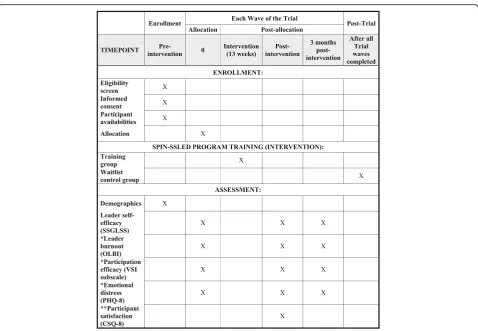
at 3 months post-intervention; (2) burnout, measured by the Oldenburg Burnout Inventory (OLBI) [48,49] post-intervention and 3 months post-post-intervention; (3) leader satisfaction that leading a support group is helping others, measured by the Participation Efficacy subscale of the Volunteer Satisfaction Index (VSI) [50] post-intervention and 3 months post-post-intervention; and (4) emotional distress, measured by the Patient Health Questionnaire-8 (PHQ-8) [51, 52] post-intervention and 3 months post-intervention. In addition, we will evaluate participant satisfaction with the program among those randomized to the program via the CSQ-8 post-intervention [46].
Methods
The planned trial has been registered (ClinicalTrials.gov, NCT03965780), and the present protocol follows recom-mendations for reporting from the Standard Protocol Items: Recommendations for Interventional Trials (SPIRIT) 2013 statement [53]. Results of the trial will be reported in accordance with standards articulated in the Consolidated Standard of Reporting Trials (CONSORT) statement [54] and CONSORT extensions for nonphar-macologic trials [55], cluster trials [56], pragmatic trials [57], and e-health trials [58]. Initial participant enroll-ment is planned for July and August 2019 with randomization of participants into the first wave of training and waitlist control groups scheduled for Sep-tember 2019.
The trial will be a pragmatic RCT that tests whether the SPIN-SSLED Program improves support group leader outcomes compared to leaders assigned to a wait-list control. Pragmatic RCTs are intended to replicate real-world conditions and support a decision on whether an intervention should be provided [57,59,60].
Support group leaders randomly assigned to the SPIN-SSLED Program will be clustered into training groups. Members of each training group will interact during videoconference training modules. Support group leaders randomly assigned to the waitlist control will not be clustered; they will only complete trial measures. A standard cluster RCT design is used when interventions are delivered to groups, rather than individuals, in order to account for dependence between individuals within clusters [56]. The SPIN-SSLED trial will need to account for clustering in the intervention arm but not the control arm. Thus, we will use a PN-RCT trial design [61]. The PN-RCT design is a hybrid between a conventional RCT with individual participant randomization and a cluster RCT, in which pre-existing clusters (e.g., primary care practices) are randomized to intervention or control arms. In the PN-RCT design, analyses account for de-pendence within intervention arm clusters but treat par-ticipants assigned to the control arm individually as in a
conventional RCT [61, 62]. Although less common in medical research, PN-RCTs are used extensively in edu-cational and behavioral research [61].
Study setting and eligibility
Trial participants will include current support group leaders and candidate leaders who are affiliated with Scleroderma Canada and Canadian provincial organiza-tions, including Sclérodermie Québec; the Scleroderma Foundation in the USA; Scleroderma & Raynaud’s UK; Scleroderma Australia and Australian state organiza-tions; and Scleroderma New Zealand. To be eligible, support group leaders must be identified by one of our partner organizations as a current or candidate leader, must be able to use the Internet to access training ses-sions, must indicate that they would be comfortable with participating in sessions offered in English or French, and must be able to complete study questionnaires on-line in English or French. In addition to these require-ments, we will only enroll one support group leader per support group in order to avoid contamination, whereby leaders in the waitlist arm could receive training mate-rials from their support group co-leader. In the case where there are multiple leaders for a single existing support group, the co-leaders must come to a decision together on who they would like to be the primary leader and prioritized for enrollment. The leader(s) des-ignated as secondary will only be enrolled if the primary leader in the group must drop out prior to random se-lection and allocation or does not have any day and time availabilities that match those offered as part of the trial and, thus, will not be eligible for random selection and allocation. Leaders who are designated as secondary and who do not undergo training will be placed in the wait-list to undergo training post-trial. All participants were free to access any care resources or other interventions made available to them throughout the course of the trial.
The SPIN-SSLED Program
a guided discussion among training group participants about possible approaches and solutions.
The SPIN-SSLED Program will be offered in English or in French; the English version of the Program was translated into French by a research assistant and then reviewed for consistency by bilingual research team members. The program includes 13 modules that are de-livered via videoconference over the course of the 3-month program in weekly 60–90-min sessions. Module topics include (1) The leader’s role; (2) Starting a sup-port group; (3) Structuring a supsup-port group meeting; (4) Scleroderma 101; (5) Successful support group culture; (6) Managing support group dynamics; (7) Loss and grief: The support group leader; (8) Loss and grief: sup-porting group members; (9) Advertising and recruitment for the support group; (10) The continuity of the group; (11) Supporting yourself as a leader; (12) Remote sup-port groups; and (13) Transitions in supsup-port groups. See Additional file1for an overview of module content.
All English-language SPIN-SSLED training groups will be facilitated by a single instructor who assisted in the development of the SPIN-SSLED training program and delivered the program during the feasibiilty trial. She is a trained social worker with 28 years of total experience and over 10 years of experience working in SSc. The French-language training groups will be facilitated by a single instructor who is a recent graduate of the SPIN-SSLED program and has led a support group in Quebec for the last 5 years. Instructors will guide each session using the SPIN-SSLED instructor manual, which is based on the program manual but includes guidance on introducing material and discussion prompts. Partici-pants will receive a SPIN-SSLED program manual that summarizes didactic material from sessions. Based on our previous experience and consistent with previous trials of videoconference training, six support group leaders will be assigned to each training group to maximize effective interaction and participation [36,37]. Training sessions will be delivered using the GoToMeet-ing® videoconferencing platform, a high-performance platform that has been used successfully in similar appli-cations [38, 65] and that was used successfully in the SPIN-SSLED Feasibility trial [44]. In addition to the videoconference sessions, participants will have access to a secure, monitored SPIN-SSLED online forum to inter-act with other participants about program content and a resource center with video presentations for patients made by SSc expert physicians and other material that they can use for their support groups.
All SPIN-SSLED sessions will be video-recorded and audited for fidelity to the program manual by two mem-bers of the research team. We will use standard methods for evaluating intervention fidelity [66], including obser-vation of entire sessions for a randomly selected sample
of 25% of sessions. Raters will evaluate adherence to each session’s goals and content. Consistent with best-practice recommendations for assessing treatment fidel-ity [66], this will be done using a checklist based on a standardized format adapted for the specific components of the SPIN-SSLED Program manual.
Participants may choose to discontinue their participa-tion in the training sessions at any time. We do not en-vision, however, the need to modify the intervention or intervention assignment for any participants or to dis-continue their participation in the program.
Outcomes
The primary outcome analysis will compare SSGLSS [45] scores between group leaders allocated to the SPIN-SSLED Program versus the waitlist control post-intervention. The SSGLSS is a 32-item scale designed to assess SSc support group leader confidence to success-fully perform leader tasks (e.g., organizational skills), manage group and interpersonal interactions, and bal-ance group leadership and self-care needs. The measure reflects the core educational content of the SPIN-SSLED Program. It utilizes a 6-point Likert scale ranging from 1 (strongly disagree) to 6 (strongly agree), with higher total scores indicating greater self-efficacy. Prior to the devel-opment of the SSGLSS, there were no measures of sup-port group leader self-efficacy. We developed the SSGLSS with our Support Group Leader Advisory Team, translated it into French using an accepted forward-backward translation method, [67] and validated it in two samples of SSc support group leaders (N= 102,N= 55). We found that it had good internal consistency (Cronbach’s alpha 0.96 and 0.95) and hypothesis-consistent convergent validity with a burnout measure, the OLBI [45]. In our feasibility trial [44], SSGLSS pre-post difference was large among participants (standard-ized mean difference = 1.7; 1.1 point difference per item), suggesting sensitivity to change.
two-factor structure (exhaustion and disengagement) with good measurement properties [48,49,68]. Higher scores on each factor indicate higher levels of exhaustion and disengagement. Internal consistency reliability (Cron-bach’s alpha) in patients with SSc was 0.84 for exhaus-tion and 0.80 for disengagement [45]. Leader satisfaction (participation efficacy) will be measured using a modi-fied version of the participation efficacy subscale of the VSI. The original version of the VSI was validated using a sample of volunteers (N= 327) and was found to be re-liable and constructually valid [50]. As in other studies [70,71], we modified the wording of some of the items to reflect participants’ volunteer role as support group leaders. The participation efficacy subscale asks respon-dents to indicate their level of satisfaction on 7 items using a 7-point Likert scale from 1 (very dissatisfied) to 7 (very satisfied). Emotional distress will be assessed using the PHQ-8 [51,52]. PHQ-8 items measure depres-sive symptoms over the last 2 weeks on a 4-point scale, ranging from 0 (not at all) to 3 (nearly every day) with higher scores indicating more depressive symptoms. The PHQ-8 performs equivalently to the PHQ-9 [51], which is a valid measure of depressive symptoms in patients with SSc [52]. Leader burnout, participation efficacy, and emotional distress will be measured only among trial participants who already lead support group at the time of trial enrollment. The PHQ-8 is available in French and English. Participant satisfaction with the SPIN-SSLED Program among those allocated to the training program will be evaluated usingith the CSQ-8 [46], a standardized measure that is used to assess satisfaction with health services. Items are scored on a Likert scale from 1 (low satisfaction) to 4 (high satisfaction) with total scores ranging from 8 to 32. The CSQ-8 has been widely validated across a range of populations [46] and is available in French.
Sample size
We identified several meta-analyses that have evaluated self-efficacy in terms of knowledge acquisition and confi-dence in implementing skills acquired in training pro-grams. A 2016 Cochrane review reported a standardized mean difference effect size of 0.87 for four educational interventions designed to change knowledge of sickle cell disease among patients and caregivers (standardized mean difference = 1.12 with an outlier study removed) [72]. Several other meta-analyses have reported effect sizes of between 0.58 and 0.94 [73–76]. In the SPIN-SSLED feasibility trial, which only included 10 partici-pants, the pre-post change in self-efficacy for carrying out leadership tasks was 1.7 [44]. For an assumed effect size of 0.70, a two-tailed test withα= 0.05, and an intra-class correlation coefficient (ICC) of 0.05, a sample size of 75 participants would provide ≥80% power for
self-efficacy for carrying out leader tasks. There was no loss to follow up in our feasibility trial. Assuming 20% loss to follow up in the proposed trial, we would need to randomize 94 support group leaders. We believe that this is a conservative power and sample size estimate. First, based on previous systematic reviews and on the results of our feasibility trial, we believe that the true ef-fect size is likely larger than 0.70. Second, in cluster RCTs, ICC values for individual patient outcomes are typically lower than our 0.05 estimate, even when differ-ent interveners are involved [77–79], and we will use the same trainer across groups in each language. If the true ICC is lower than our 0.05 estimate, this will result in greater power than estimated. Third, there was no loss to follow up in our feasibility trial, and in our previous completed studies in SSc that required follow up, loss to follow up has been 10% or less [25,80].
For the secondary outcomes, burnout and emotional distress, based on published meta-analyses, a standard-ized mean difference effect size of 0.50 represents a clin-ically meaningful effect size for improvement that has been achieved in training programs for managers, care-givers of chronically ill patients, and parents of children with difficult behavior [73, 81–83]. This is also consid-ered a clinically meaningful effect size for patient-reported health outcomes, including depressive symp-toms [84]. For effect size of 0.50, a two-tailed test with α= 0.05, and an ICC of 0.05, a sample of 146 partici-pants would provide ≥80% power for both self-efficacy and patient-reported health outcomes. Assuming 20% loss to follow up in the proposed trial, we would need to randomize 182 support group leaders. We did not esti-mate power for leader satisfaction.
Members of our Support Group Leader Advisory Team and our patient organization partners have em-phasized the importance of evaluating the trial’s planned secondary outcomes. Thus, we will attempt to enroll 180 participants total (15 training groups of 6 participants; 90 participants in the waitlist control) in order to have sufficient power to adequately evaluate secondary outcomes.
Recruitment
SPIN-SSLED personnel will then send an email invita-tion with a link to a Qualtrics survey containing the con-sent form, a demographic questionnaire with information about participants’ support group experi-ence (e.g., years of experiexperi-ence or candidate leader), and questions on the days and times when the interested group leaders could attend training sessions. In addition to describing the study, the consent form will explain (1) that some group leaders who enroll in the study will be randomly selected every 3 months to participate in the SPIN-SSLED Program and that others will be allocated to a waitlist; (2) that participants randomized to partici-pate in the program plus those allocated to the waitlist will complete measures online at the time of randomization, intervention, and 3 months post-intervention; (3) that, depending on the number of leaders who enroll, it is possible that some group leaders will not be selected to receive the training nor be asked to complete trial measures as part of the control group; and (4) that enrolled participants who do not receive the training as part of the trial, either because they are se-lected for the waitlist or because they are not sese-lected for the training group or the waitlist, will be offered the training post-trial per our agreement with our partner patient organizations. At the initiation of the trial, we will send up to three emails, one per week, to leaders who do not respond to the initial email or enroll in the trial. For existing support groups where there are co-leaders, one will be specified as the primary participant and any others as secondary; only one leader per support group will be eligible for inclusion in the trial, and the secondary leaders will only be enrolled if the primary leader day and time availabilities do not match those that are able to be provided in the trial. All interested leaders will be provided contact information for SPIN-SSLED trial personnel, who will answer any questions they may have during the consent process and over the course of the trial.
We can feasibly deliver the program to 3 training groups simultaneously: thus, to deliver the 15 planned training groups, the intervention will be delivered in five
“waves”with 3 training groups of 6 participants each per wave, plus 18 participants randomized to the waitlist control per wave. Prior to starting a new wave, we will email participants who have not yet been selected for participation in a prior wave to allow them to update their available days and times. We will then determine characteristics (language, day, time) of the training groups that are needed for the new wave and initiate random selection of participants and random allocation.
To ensure that we will achieve adequate enrollment to reach our target sample size, we are working closely with partner patient organizations, who will inform potential participants of the trial and will emphasize to their
affiliated support group leaders the organizations are partners in the trial. They will inform affiliated leaders that participation will allow them to be certified as trained support group leaders and that the organizations plan to require the training in the future.
We will also advertise the trial through SPIN’s active Facebook and Twitter media and on the SPIN website so that potential participants and group leaders may contact their patient organizations. Additionally, a web-page [85] has been created that features a brief introduc-tory video on the SPIN-SSLED Program, video and written testimonials from support group leaders who participated in the SPIN-SSLED Feasibility trial, and in-formation about the program structure and content. Contact information will be provided for anyone who is interested in participating in the trial. We routinely have the opportunity to present at international, national, provincial, and local events, and we will present informa-tion on the SPIN-SSLED Program and trial at these events. We also have the opportunity to contribute to the newsletters of our patient organization partners, where we can similarly feature SPIN-SSLED. Any poten-tial participants identified through these methods will be referred to their patient organization to ensure that they have the organization’s support to participate.
Random selection and allocation
maximum number of candidate leaders per 12 selected will be either 2 or 4, and randomization will be stratified by existing and candidate leaders.
All 12 leaders (training group = 6, waitlist = 6) will re-ceive an email invitation including a clickable link to the online survey platform Qualtrics, where they will be asked to complete the study baseline measures. This email will also communicate participants’assignment to the training program or waitlist control. A second email will be sent to leaders allocated to the training group with the date and time of their first training session, the topic of the first session, the program manual, and infor-mation on how to log in to the videoconferencing sys-tem and online chatroom. Calls will be made if measures are not completed. Similar procedures will occur post-intervention and 3 months post-post-intervention.
Blinding and protecting against sources of bias
A potential concern is that participants will not be blinded to intervention status. In most pragmatic trials of training, education, or behavioral interventions, as in the SPIN-SSLED trial, participants cannot be blinded. This is understood as part of the response to being of-fered a treatment, similar to what occurs in clinical
practice [62]. Since there is no blinding of participants or trainers, there is not a protocol for unblinding.
A second concern relates to the potential for contam-ination if participants randomized to the SPIN-SSLED Program share learning material with participants in the waitlist control. It is not likely that material would be shared between leaders from different support groups. Nonetheless, to attempt to minimize the influence of possible contamination, we will explain this concern to participants in the training arm of the trial and ask them not to share their material or discuss the training ses-sions with other group leaders during the trial.
Data collection and management
[image:8.595.59.538.84.415.2]will be treated confidentially within the limits of the law. To protect the participants’ privacy, upon inclusion in the SPIN-SSLED trial, a unique participant identification number will automatically be assigned to each partici-pant. An encrypted database will be created for the SPIN-SSLED Program, which includes the participant identification number and name. Data security measures in place at Qualtrics are described in the Qualtrics se-curity statement [88]. Information obtained from the survey and video recordings of the training sessions used to evaluate fidelity to the program will be kept for 10 years on encrypted hard drives. Access to the data dur-ing the trial will be limited to the study investigators. Once trial results are reported, de-identified data will be made available upon reasonable request. No biological specimens will be collected.
Data analysis
Analyses will be conducted by a statistician blind to trial arm allocation. For the primary outcome analysis (SSGLSS post-intervention), we will use an intent-to-treat analysis that compares all patients randomly allocated to the SPIN-SSLED Program to all patients allocated to the wait-list control. Intervention effect will be estimated using a linear mixed model, adjusted for baseline SSGLSS scores. The model will include a random effect to account for clustering of participants in the training groups, but not for participants in the waitlist control arm, because there is no clustering in the control arm [61,62]. We will inves-tigate the effects of missing data using multiple imputation analysis. As a secondary analysis, we will examine SSGLSS scores post-intervention adjusted for baseline SSGLSS scores, age, sex, whether or not the leader has SSc, and candidate versus experienced leader status. The SSGLSS at 3 months post-intervention will be analyzed similarly to the primary and secondary analyses.
Analyses of leader burnout, participation efficacy, and emotional distress outcomes will only include experi-enced leaders because candidate leaders would not yet have experienced burnout, participation efficacy, or emotional distress due to the burden of leading a group. These outcomes will similarly be analyzed (1) controlling for baseline scores only and (2) controlling for baseline scores, age, sex, and whether or not the leader has SSc. Statistical significance for all analyses will be determined based on two-sidedα= 0.05.
Data monitoring
The trial will be overseen by the SPIN Steering Committee along with the trial investigators and the Support Group Advisory Team. The Steering Committee will provide sci-entific direction for the RCT and will meet periodically to assess its progress. It will be responsible for RCT protocol execution, routine monitoring of data quality, and will
meet semi-annually to discuss recruitment and retention and to assess that the trial is meeting key milestones con-sistent with the timeline.
Risks and potential benefits of participating in the SPIN-SSLED trial
Participation in the SPIN-SSLED trial will involve weekly online training sessions and completion of online mea-sures. We do not anticipate any safety concerns with the use of the SPIN-SSLED program, although if there are any adverse events, they will be reported to the local research ethics committee. Although it is hypothesized that the SPIN-SSLED Program will improve leaders’ self-efficacy for performing leader tasks, reduce burnout, and reduce emotional distress, it cannot be guaranteed that leaders will receive any benefits from this study. However, infor-mation learned from this research may lead to more ef-fective SSc support group leader training programs, which may benefit those living with SSc in the future or people with other diseases. There will be no financial compensa-tion for leaders who participate in the SPIN-SSLED trial.
Ethics and dissemination
The SPIN-SSLED trial has been approved by the Research Ethics Committee of Centre intégré universitaire de santé et de services sociaux (CIUSSS) du Centre-Ouest-de-l’ Île-de-Montréal (#2020–1780). All participants will provide electronic consent prior to taking part in the study. Any modifications to the protocol which may impact on the conduct of the study, including changes of study objectives, study design, patient population, sample sizes, study proce-dures, or significant administrative aspects will undergo a formal amendment to the protocol. This amendment will be submitted to the Research Ethics Committee for ap-proval and documented in the trial registration.
Our trial team has worked closely with patient organization partners from around the world and with a Support Group Advisory Team to design each stage of preliminary research, the SPIN-SSLED Program, and the SPIN-SSLED feasibility and full-scale trials. To the best of our knowledge, once tested, SPIN-SSLED will be the only peer support group leader training program that has been evaluated in a well-conducted RCT in any dis-ease. Our SSc organization partners plan to implement the program post-trial to train and certify peer support group leaders, and the trial team will work with them to do this. Beyond SSc, the SPIN-SSLED Program will be easily adapted for use in other diseases.
Trial status
Supplementary information
Supplementary informationaccompanies this paper athttps://doi.org/10. 1186/s13063-019-3747-z.
Additional file 1.SPIN-SSLED Program module overview.
Abbreviations
CONSORT:Consolidated Standard of Reporting Trials; CSQ-8: Client Satisfaction Questionnaire-8; IBM SPSS: International Business Machines Corporation Statistical Package for the Social Sciences; ICC: Intra-class correlation coefficient; OLBI: Oldenburg Burnout Index; PHQ-8: Patient Health Questionnaire-8; PN-RCT: Partially nested randomized controlled trial; RCT: Randomized controlled trial; SD: Standard deviation; SPIN: Scleroderma Patient-centered Intervention Network; SPIRIT: Standard Protocol Items: Recommendations for Interventional Trials; SSc: Systemic sclerosis; SSGLSS: Scleroderma Support Group Leader Self-efficacy Scale;
SSLED: Scleroderma Support group Leader EDucation Program; UK: United Kingdom; VSI: Volunteer Satisfaction Index
Acknowledgements
SPIN-SSLED Support Group Advisory Team Members include Stephen Elrod, Southern California Patient Group, Los Angeles, California, USA; Catherine Fortuné, Ottawa Scleroderma Support Group, Ottawa, Ontario, Canada; Karen Gottesman, Director of Pharma & Biotech Engagement Scleroderma Foundation, Los Angeles, California, USA; Karen Nielsen, Scleroderma Society of Ontario, Hamilton, Ontario, Canada; Geneviève Guillot, Sclérodermie Québec, Longueuil, Quebec, Canada; Ken Rozee, Scleroderma Society of Nova Scotia, Halifax, Nova Scotia, Canada; Amy Gietzen, Scleroderma Foundation, Danvers, Massachusetts, USA; Michelle Richard, President of Scleroderma Canada, Halifax, Nova Scotia, Canada; Nancy Stephens, Michigan Patient Group, Detroit, Michigan, USA.
Authors’contributions
BDT, KA, LD, MEC, CF, MCA, LH, MS, LK, VLM, GEB, SP, KC, MH, and RWP were responsible for the study conception and design. BDT, KA, MCA, and LH drafted the manuscript. All authors provided a critical review and approved the final manuscript. BDT is the guarantor.
Funding
This work was supported by funding from the Canadian Institutes of Health Research (PI Thombs; PJT–162126), MITACS (IT13561), and the Scleroderma Society of Ontario. No funding body had any input into any aspect of this manuscript.
Availability of data and materials
All data and materials will be provided upon reasonable request. SPIN-SSLED Program materials are copyrighted under a Creative Commons Attribution-NonCommercial-ShareAlike license.
Ethics approval and consent to participate
The SPIN-SSLED Trial was approved by the Research Ethics Committee of Centre intégré universitaire de santé et de services sociaux (CIUSSS) du Centre-Ouest-de-l’Île-de-Montréal (#2020–1780). All participants will provide electronic consent prior to taking part in the study.
Consent for publication Not applicable.
Competing interests
The authors declare that they have no competing interests.
Author details
1
Lady Davis Institute for Medical Research, Jewish General Hospital, Montreal, QC, Canada.2Department of Psychiatry, McGill University, Montreal, QC,
Canada.3Department of Epidemiology, Biostatistics, and Occupational
Health, McGill University, Montreal, QC, Canada.4Department of Medicine,
McGill University, Montreal, QC, Canada.5Department of Psychology, McGill University, Montreal, QC, Canada.6Department of Educational and
Counselling Psychology, McGill University, Montreal, QC, Canada.7Biomedical
Ethics Unit, McGill University, 4333 Cote Ste Catherine Road, Montreal, QC
H3T 1E4, Canada.8Scleroderma Foundation Michigan Chapter, Southfield, MI,
USA.9Scleroderma Society of Ontario and Scleroderma Canada, Hamilton,
ON, Canada.10Department of Clinical Psychology, Behavioural Science
Institute, Radboud University, Nijmegen, the Netherlands.11Department of Psychology, San Diego State University, California, USA.12San Diego Joint
Doctoral Program in Clinical Psychology, San Diego State University/ University of California, California, USA.13Department of Psychology,
Université du Québec à Montréal, Montreal, QC, Canada.14Scleroderma Foundation, Danvers, MA, USA.
Received: 30 July 2019 Accepted: 23 September 2019
References
1. Kole A, Faurisson F. The voice of 12,000 patients. Experiences and expectations of rare disease patients on diagnosis and care in Europe: EURORDIS-Rare Diseases Eu; 2009. Available from:http://www.eurordis.org/ IMG/pdf/voice_12000_patients/EURORDISCARE_FULLBOOKr.pdf. Accessed 15 July 2019
2. European Organisation for Rare Diseases. Rare diseases: understanding this public health priority. 2005. Available from:https://www.eurordis.org/IMG/ pdf/princeps_document-EN.pdf. Accessed 15 July 2019.
3. Huyard C. What, if anything, is specific about having a rare disorder? Patients’judgements on being ill and being rare. Health Expect. 2009;12(4): 361–70.
4. Anderson M, Elliott EJ, Zurynski YA. Australian families living with rare disease: experiences of diagnosis, health services use and needs for psychosocial support. Orphanet J Rare Dis. 2013;8(1):1.
5. Holtzclaw WP. Policy framework for rare disease health disparities. Policy Polit Nurs Pract. 2011;12(2):114–8.
6. Newman S, Steed L, Mulligan K. Self-management interventions for chronic illness. Lancet. 2004;364(9444):1523–37.
7. Davison KP, Pennebaker JW, Dickerson SS. Who talks? The social psychology of illness support groups. Am Psychol. 2000;55(2):205–17.
8. Kwakkenbos L, Jewett LR, Baron M, Bartlett SJ, Furst D, Gottesman K, et al. The Scleroderma Patient-centered Intervention Network (SPIN) cohort: protocol for a cohort multiple randomised controlled trial (cmRCT) design to support trials of psychosocial and rehabilitation interventions in a rare disease context. BMJ Open. 2013;3(8):e003563.
9. Reimann A, Bend J, Dembski B. Patient-centred care in rare diseases. A patient organisations’perspective. Bundesgesundheitsblatt
Gesundheitsforschung Gesundheitsschutz. 2007;50(12):1484–93.
10. Gumuchian ST, Delisle VC, Kwakkenbos L, Pepin M, Carrier ME, Malcarne VL, et al. Reasons for attending support groups and organizational preferences: the European scleroderma support group members survey. Disabil Rehabil. 2019;41(8):974–82.
11. Delisle VC, Gumuchian ST, Pelaez S, Malcarne VL, El-Baalbaki G, Korner A, et al. Reasons for non-participation in scleroderma support groups. Clin Exp Rheumatol. 2016;34 Suppl 100(5):56–62.
12. Gumuchian ST, Delisle VC, Peláez S, Malcarne VL, El-Baalbaki G, Kwakkenbos L, et al. Reasons for not participating in scleroderma patient support groups: a cross-sectional study. Arthritis Care Res (Hoboken). 2018;70(2):275–83. 13. Delisle VC, Gumuchian ST, El-Baalbaki G, Korner A, Malcarne VL, Pelaez S,
et al. Training and support needs of scleroderma support group facilitators: the North American Scleroderma Support Group Facilitators Survey. Disabil Rehabil. 2019;41(20):2477–2482.
14. Ayme S, Kole A, Groft S. Empowerment of patients: lessons from the rare diseases community. Lancet. 2008;371(9629):2048–51.
15. Dale JR, Williams SM, Bowyer V. What is the effect of peer support on diabetes outcomes in adults? A systematic review. Diabet Med. 2012;29(11): 1361–77.
16. Parry M, Watt-Watson J. Peer support intervention trials for individuals with heart disease: a systematic review. Eur J Cardiovasc Nurs. 2010;9(1):57–67. 17. Pfeiffer PN, Heisler M, Piette JD, Rogers MA, Valenstein M. Efficacy of peer support interventions for depression: a meta-analysis. Gen Hosp Psychiatry. 2011;33(1):29–36.
18. Orphanet. Rare diseases free data 2019. Available from:www.orphadata.org/ cgi-bin/inc/product1.inc.php. Accessed 15 July 2019.
maintain patient support groups in rare diseases: a scoping review. Patient. 2017;10(3):283–93.
20. Mayes MD. Systemic sclerosis: clinical features. In: Klippel JH, Stone JH, Crofford LJ, White PH, editors. Primer on the rheumatic diseases. 13th ed. New York: Springer and Arthritis Foundation; 2008. p. 343–50.
21. Wigley FM, Hummers LK. Clinical features of systemic sclerosis. In: Hochberg MC, Silman AJ, Smolen JS, Weinblatt ME, Weismann WH, editors. Rheumatology. 3rd ed. Philadelphia: Mosby; 2003. p. 1463.
22. Thombs BD, van Lankveld W, Bassel M, Baron M, Buzza R, Haslam S, et al. Psychological health and well-being in systemic sclerosis: state of the science and consensus research agenda. Arthritis Care Res. 2010; 62(8):1181–9.
23. Haythornthwaite JA, Heinberg LJ, McGuire L. Psychologic factors in scleroderma. Rheum Dis Clin N Am. 2003;29(2):427–39.
24. Bassel M, Hudson M, Taillefer SS, Schieir O, Baron M, Thombs BD. Frequency and impact of symptoms experienced by patients with systemic sclerosis: results from a Canadian National Survey. Rheumatology (Oxford). 2011;50(4): 762–7.
25. Thombs BD, Jewett LR, Kwakkenbos L, Hudson M, Baron M, Canadian Scleroderma Research Group. Major depression diagnoses among patients with systemic sclerosis: baseline and one-month followup. Arthritis Care Res (Hoboken). 2015;67(3):411–6.
26. Razykov I, Levis B, Hudson M, Baron M, Thombs BD, Canadian Scleroderma Research Group. Prevalence and clinical correlates of pruritus in patients with systemic sclerosis: an updated analysis of 959 patients. Rheumatology (Oxford). 2013;52(11):2056–61.
27. Milette K, Hudson M, Korner A, Baron M, Thombs BD, Canadian Scleroderma Research Group. Sleep disturbances in systemic sclerosis: evidence for the role of gastrointestinal symptoms, pain and pruritus. Rheumatology (Oxford). 2013;52(9):1715–20.
28. Jewett LR, Kwakkenbos L, Thombs BD. Psychosocial issues and care for patients with systemic sclerosis. In: Varga J, Denton CP, Wigley FM, Allanore Y, Kuwana M, editors. Scleroderma: from pathogenesis to comprehensive management. 2nd ed. Cham: Springer International Publishing; 2017. p. 615–21.
29. Scleroderma Canada. Find a support group 2017. Available from:https:// web.archive.org/web/20180904003727/www.scleroderma.ca/Support/Find-A-Support-Group.php. Accessed 15 July 2019.
30. Scleroderma Foundation. Support groups. 2019. Available from:www. scleroderma.org/site/PageServer?pagename=patients_supportgroups#. Vbec7RZvdFw. Accessed 15 July 2019.
31. Scleroderma & Raynaud’s U.K. Find support. Available from:www.sruk.co.uk/ find-support/. Accessed 15 July 2019.
32. Scleroderma Association of New South Wales. Regional support group contacts. Available from:www.sclerodermansw.org/regional-support-groups. Accessed 15 July 2019.
33. Butow P, Ussher J, Kirsten L, Hobbs K, Smith K, Wain G, et al. Sustaining leaders of cancer support groups: the role, needs, and difficulties of leaders. Soc Work Health Care. 2006;42(2):39–55.
34. Kirsten L, Butow P, Price M, Hobbs K, Sunquist K. Who helps the leaders? Difficulties experienced by cancer support group leaders. Support Care Cancer. 2006;14(7):770–8.
35. Zordan RD, Juraskova I, Butow PN, Jolan A, Kirsten L, Chapman J, et al. Exploring the impact of training on the experience of Australian support group leaders: current practices and implications for research. Health Expect. 2010;13(4):427–40.
36. Xavier K, Shepherd L, Goldstein D. Clinical supervision and education via videoconference: a feasibility project. J Telemed Telecare. 2007;13(4):206–9. 37. Marziali E, Donahue P. Caring for others: Internet video-conferencing group
intervention for family caregivers of older adults with neurodegenerative disease. Gerontologist. 2006;46(3):398–403.
38. Fisher WW, Luczynski KC, Hood SA, Lesser AD, Machado MA, Piazza CC. Preliminary findings of a randomized clinical trial of a virtual training program for applied behavior analysis technicians. Res Autism Spectr Disord. 2014;8(9):1044–54.
39. Tomlinson J, Shaw T, Munro A, Johnson R, Madden DL, Phillips R, et al. How does tele-learning compare with other forms of education delivery? A systematic review of tele-learning educational outcomes for health professionals. N S W Public Health Bull. 2013;24(2):70–5. 40. Johnsson G, Lincoln M, Bundy A, Costley D. A systematic review of
technology-delivered disability training and support for service providers:
implications for rural and remote communities. Rev J Autism Dev Disord. 2016;3(4):387–98.
41. Delisle VC, Gumuchian ST, Kloda LA, Boruff J, El-Baalbaki G, Korner A, et al. Effect of support group peer facilitator training programmes on peer facilitator and support group member outcomes: a systematic review. BMJ Open. 2016;6(11):e013325.
42. Zordan R, Butow P, Kirsten L, Charles M, Hobbs K, Batterby E, et al. Supporting the supporters: a randomized controlled trial of interventions to assist the leaders of cancer support groups. J Community Psychol. 2015;43(3):261–77. 43. Turner KA, Rice DB, Carboni-Jimenez A, Boruff J, Thombs BD. Effects of
training and support programs for leaders of illness-based support groups: commentary and updated evidence. Syst Rev. 2019;8(1):67.
44. Thombs BD, Dyas L, Pépin M, Aguila K, Carrier ME, Tao L, et al. The Scleroderma Patient-centered Intervention Network - Scleroderma Support group Leader Eductation (SPIN-SSLED) program: non-randomised feasibility trial. BMJ Open. 2019;9(11):e029935.
45. Pal NE, Gumuchian ST, Delisle VC, Pépin M, Malcarne VL, Carrier M-E, et al. Development and preliminary validation of the Scleroderma Support Group Leader Self-efficacy Scale. J Scleroderma Relat Disord. 2018;3(1):106–11. 46. Kelly PJ, Kyngdon F, Ingram I, Deane FP, Baker AL, Osborne BA. The Client
Satisfaction Questionnaire-8: psychometric properties in a cross-sectional survey of people attending residential substance abuse treatment. Drug Alcohol Rev. 2018;37(1):79–86.
47. Bandura A. Self-efficacy: the exercise of control, vol. ix. New York: W.H. Freeman and Company; 1997. 604 pages illustrations 24 cm p 48. Demerouti E, Bakker AB, Vardakou I, Kantas A. The convergent validity of
two burnout instruments: a multitrait-multimethod analysis. Eur J Psychol Assess. 2002;19(1):12–23.
49. Halbesleben JRB, Demerouti E. The construct validity of an alternative measure of burnout: investigating the English translation of the Oldenburg Burnout Inventory. Work Stress. 2005;19(3):208–20.
50. Galindo-Kuhn R, Guzley RM. The Volunteer Satisfaction Index. J Soc Serv Res. 2002;28(1):45–68.
51. Kroenke K, Strine TW, Spitzer RL, Williams JBW, Berry JT, Mokdad AH. The PHQ-8 as a measure of current depression in the general population. J Affect Disord. 2009;114(1–3):163–73.
52. Milette K, Hudson M, Baron M, Thombs BD, Canadian Scleroderma Research G. Comparison of the PHQ-9 and CES-D depression scales in systemic sclerosis: internal consistency reliability, convergent validity and clinical correlates. Rheumatology (Oxford). 2010;49(4):789–96.
53. Chan AW, Tetzlaff JM, Gotzsche PC, Altman DG, Mann H, Berlin JA, et al. SPIRIT 2013 explanation and elaboration: guidance for protocols of clinical trials. BMJ. 2013;346:e7586.
54. Moher D, Hopewell S, Schulz KF, Montori V, Gotzsche PC, Devereaux PJ, et al. CONSORT 2010 explanation and elaboration: updated guidelines for reporting parallel group randomised trials. BMJ. 2010;340:c869.
55. Boutron I, Moher D, Altman DG, Schulz KF, Ravaud P, Group C. Extending the CONSORT statement to randomized trials of nonpharmacologic treatment: explanation and elaboration. Ann Intern Med. 2008;148(4):295–309. 56. Campbell MK, Piaggio G, Elbourne DR, Altman DG, Group C. Consort 2010
statement: extension to cluster randomised trials. BMJ. 2012;345:e5661. 57. Zwarenstein M, Treweek S, Gagnier JJ, Altman DG, Tunis S, Haynes B, et al.
Improving the reporting of pragmatic trials: an extension of the CONSORT statement. BMJ. 2008;337:a2390.
58. Eysenbach G, Group C-E. CONSORT-EHEALTH: improving and standardizing evaluation reports of Web-based and mobile health interventions. J Med Internet Res. 2011;13(4):e126.
59. Loudon K, Treweek S, Sullivan F, Donnan P, Thorpe KE, Zwarenstein M. The PRECIS-2 tool: designing trials that are fit for purpose. BMJ. 2015;350:h2147. 60. Roland M, Torgerson DJ. Understanding controlled trials: what are
pragmatic trials? BMJ. 1998;316(7127):285.
61. Lohr S, Schochet PZ, Sanders E. Partially nested randomized controlled trials in education research: a guide to design and analysis. Washington, DC: NCER 2014-2000: National Center for Education Research; 2014. 62. Roberts C, Roberts SA. Design and analysis of clinical trials with clustering
effects due to treatment. Clin Trials. 2005;2(2):152–62.
63. Hmelo-Silver CE. Problem-based learning: what and how do students learn? Educ Psychol Rev. 2004;16(3):235–66.
65. Williams LK, McCarthy MC, Burke K, Anderson V, Rinehart N. Addressing behavioral impacts of childhood leukemia: a feasibility pilot randomized controlled trial of a group videoconferencing parenting intervention. Eur J Oncol Nurs. 2016;24:61–9.
66. Schoenwald SK, Garland AF, Chapman JE, Frazier SL, Sheidow AJ, Southam-Gerow MA. Toward the effective and efficient measurement of
implementation fidelity. Admin Pol Ment Health. 2011;38(1):32–43. 67. World Health Organization. Process of translation and adaptation of
instruments.https://www.who.int/substance_abuse/research_tools/ translation/en/. Accessed 15 July 2019
68. Reis D, Xanthopoulou D, Tsaousis I. Measuring job and academic burnout with the Oldenburg Burnout Inventory (OLBI): factorial invariance across countries and samples. Burn Res. 2015;2(1):8–18.
69. Chevrier N. Adaptation Québécoise de l’Oldenberg Burnout Inventory (OLBI) [Quebec adaptation of the Oldenburg Burnout Inventory (OLBI)]. Montreal: Université du Québec; 2009.
70. Boezeman EJ, Ellemers N. Volunteer recruitment: the role of organizational support and anticipated respect in non-volunteers’ attraction to charitable volunteer organizations. J Appl Psychol. 2008; 93(5):1013–26.
71. Boezeman EJ, Ellemers N. Pride and respect in volunteers’organizational commitment. Eur J Soc Psychol. 2008;38(1):159–72.
72. Asnani MR, Quimby KR, Bennett NR, Francis DK. Interventions for patients and caregivers to improve knowledge of sickle cell disease and recognition of its related complications. Cochrane Database Syst Rev. 2016;10:CD011175.
73. Kaminski JW, Valle LA, Filene JH, Boyle CL. A meta-analytic review of components associated with parent training program effectiveness. J Abnorm Child Psychol. 2008;36(4):567–89.
74. Armour TA, Norris SL, Jack L Jr, Zhang X, Fisher L. The effectiveness of family interventions in people with diabetes mellitus: a systematic review. Diabet Med. 2005;22(10):1295–305.
75. Jiang X, Wang J, Lu Y, Jiang H, Li M. Self-efficacy-focused education in persons with diabetes: a systematic review and meta-analysis. Psychol Res Behav Manag. 2019;12:67–79.
76. Zhao FF, Suhonen R, Koskinen S, Leino-Kilpi H. Theory-based self-management educational interventions on patients with type 2 diabetes: a systematic review and meta-analysis of randomized controlled trials. J Adv Nurs. 2017;73(4):812–33.
77. Taljaard M, Donner A, Villar J, Wojdyla D, Velazco A, Bataglia V, et al. Intracluster correlation coefficients from the 2005 WHO Global Survey on Maternal and Perinatal Health: implications for implementation research. Paediatr Perinat Epidemiol. 2008;22(2):117–25.
78. Smeeth L, Ng ES. Intraclass correlation coefficients for cluster randomized trials in primary care: data from the MRC Trial of the assessment and management of older people in the community. Control Clin Trials. 2002; 23(4):409–21.
79. Hannan PJ, Murray DM, Jacobs DR Jr, McGovern PG. Parameters to aid in the design and analysis of community trials: intraclass correlations from the Minnesota Heart Health Program. Epidemiology. 1994;5(1):88–95. 80. Jewett LR, Razykov I, Hudson M, Baron M, Thombs BD, Canadian
Scleroderma Research G. Prevalence of current, 12-month and lifetime major depressive disorder among patients with systemic sclerosis. Rheumatology (Oxford). 2013;52(4):669–75.
81. Collins DB, Holton Iii EF. The effectiveness of managerial leadership development programs: a meta-analysis of studies from 1982 to 2001. Hum Resour Dev Q. 2004;15(2):217–48.
82. Lundahl B, Risser HJ, Lovejoy MC. A meta-analysis of parent training: moderators and follow-up effects. Clin Psychol Rev. 2006;26(1):86–104. 83. Sörensen S, Pinquart M, Duberstein P. How effective are interventions
with caregivers? An updated meta-analysis. The Gerontologist. 2002; 42(3):356–72.
84. National Institute for Clinical E, Britain G. Depression: management of depression in primary and secondary care: National Institute for Clinical Excellence; 2004.
85. The Scleroderma Patient-centered Intervention Network. SPIN-SSLED Program 2019. Available from:https://spinsclero.com/en/projects/ssled. Accessed 15 July 2019.
86. Griffith University. Griffith Randomisation Service. Queensland: Griffith University; 2019. Available from:https://www151.griffith.edu.au/. Accessed 15 July 2019
87. Schulz KF, Grimes DA. Generation of allocation sequences in randomised trials: chance, not choice. Lancet (London, England). 2002;359(9305):515–9. 88. Qualtrics. Security statement: Qualtrics; 2019. Available from:https://www.
qualtrics.com/security-statement/. Accessed 15 July 2019
Publisher’s Note