l"i!
!=;·�
�
�
Fi
F"'
p-<:!:l
t"'
v
Digital
Technical
Journal
lillD 0
-
-��.!!.
P1 �
77
- 1/_'\._
.._;s�r64_Q R.20
v
S1r64
L
Rl.2v
I
FX!32 EMULATION AND TRANSLATION
VISUAL FORTRAN
MEMORY CHANNEL 2 INTERCONNECT
OBJECTBROKER SECURITY
STRONGARM MICROPROCESSOR
Editorial
Jane C. Blake, Managing Editor Kathleen M. Stetson, Editor Helen L. Patterson, Editor
Circulation
Catherine M. Phillips, Administrator
Production
Christa W. Jessica, Production Editor Elizabeth McGrail, Typographer Peter R. Woodbury, Illustrator
Advisory Board
Samuel H. Fuller, Chairman Donald Z. Harbert Richard J. Hollingsworth William A. Laing Richard F. Lary Alan G. Nemeth Robert M. Supnik
Cover Design
The display of program code in the fore ground and the background of our cover represents one of the unique aspects of the DIGITAL FX'32 software, the opening topic in this issue. By emulating an appli cation in the foreground and later translat ing the execution profile into native Alpha code in the background, FX!32 enables 32-bit applications that run on lntel-based machines to also run on Alpha-based machines. The combination of emulation and binary translation provides Alpha users with additional applications and good per formance with transparent operation.
The cover design is by Lucinda O'Neill of the DIGITAL Industrial and Graphic Design Group.
The Digilal Tecbn.ical.foumalis a refereed journal published quarterly by Digital Equipment Corporation, 50 Nagog Park, AK02-3/B3, Acton, MA 01720-9843.
Hard-copy subscriptions can be ordered by sending a check in U.S. funds (made payable to Digital Equipment Corporation) to the published-by address. General subscription rates arc $40.00 (non-U.S. $60) for tour issues and $75.00 (non-U.S. $!15) for eight issues. University and college professors and Ph.D. srudents in the electrical engineering and com puter science fields receive complimentary sub scriptions upon request. DIGITAL customers may qualifY tor gifT subscriptions and arc encour aged to contact their account representatives.
Electronic subscriptions arc available at no charge by accessing URL
http://www.digital.com/infojsubscription. This service will send an electronic mail notification when a new issue is available on the Internet.
Single copies and back issues c,m be ordered by sending the requested issue's volume and number and a check for $16.00 (non-U.S. $18) each to the published-by address. Recent issues arc also available on the lmernct at http://www.digital.com/i nfo/dtj.
DIGITAL employees may order subscrip tions through Readers Choice at U RL http://wcb7-c.das.dcc.com or by entering VfX PROFILE at the Open VMS system prompt.
Inquiries, address changes, and compli mentary subscription orders can be sent to the Digital 'f'echnicaljourna!at the published-by address or the electronic mail address, [email protected]. Inquiries can also be made by calling the.fourua! office at 508-264-7549.
Comments on the content of any paper and requests to contact authors Jrc welcomed and may be sent to the managing editor at the published-by or electronic mail address.
Copyright© 1997 Digital Equipment Corporation. Copying without fcc is per mitted provided that such copies arc made for usc in educational institutions by fcKulry members and arc not distributed for com mercial advantage. Abstre1cting with credir of Digital Equipment Corporation's author ship is permitted.
The information in theJourualis subject to change without notice and should not be construed as a commitment by Digital Equipment Corporation or by the compan ies herein represented. Digital Equipment Corporation assumes no responsibility tor anv errors that may appear in the .fou rua!.
ISSN 0898-901 X
Documentation Number EC-N7963-18 Book production was done by Quantic Communications, Inc.
The following arc trademarks of Digital Equipment Corporation: AlphaServcr, DEC, DIGITAL, the DIGITAL logo, DIGITAL UNIX, Open VMS, and TruCiuster.
ARM and StrongAJ{J\11 arc registered trademarks of Advanced RISC Machines Ltd.
BEA ObjectBroker is a registered trademark of B EA Systems, Inc.
Bull is a registered trademark of Bull Worldwide Information Systems.
Cray is a registered trademark of Cray Research, Inc.
Encore is a registered trademark and MEMORY CHANNEL is a trademark of Encore Computer Corporation.
Gradient is a registered trademark of Gradient Technologies, Inc.
HAL is a registered trademark of HAL Com purer Systems, lnc.
Hitachi is a registered trademark of Hitachi, Ltd. H P is a registered trademark of Hewlett-Packard Company.
IBM and SP2 arc registered trademarks and Power PC and Power PC 603 arc trademarks of I ntcrnational Business Machines Corporation. Intel and Pentium arc registered trademarks of Intel Corporation.
Kcrbcros is a trademark of Massachusetts Institute of Technology.
Lucellt Technologies is a trademark of Lucent Technologies.
Microsoft, Visual Basic, Visual C++, Win32, Windows, and Windows NT arc registered trademarks and Active X and Visual J++ are trademarks of Microsoft Corporation. MOTIVE is a registered trademark of Quad Design Technologies, Inc.
NCR is a registered trademark of NCR Corporation.
NEC is a registered trademark of NEC Corporation.
Object Managemem and OMG arc registered trademarks and COREA is a trademark ofrhe Object Management Group.
Olivetti is a registered trademark of In g. C. Olivetti.
Oracle Parallel Server is a trademark of Oracle Corporation.
PAL is a regisrercd trademark of Advanced Micro Devices, 1 nc.
Photoshop is a trademark of Adobe Systems, Incorporated.
POSIX is a registered trademark of the lnstirute of Electrical and Electronics Engineers.
SCO is a registered trademark of The Santa Cruz Operation, Inc.
Siemens Pyramid is a registered trademark of Siemens P):ramid Information Sysrcms, Inc. Stratus is a registered trademark of Stratus Computer, Inc.
Synopsys is a registered trademark of Synopsys, Inc.
Tandem is a registered trademark of Tandem Computers Incorporated.
The Open Group is a trademark of rhc Open Software Foundation, Inc. and X/Opcn Company Ltd.
TPC-C is a registered trademark of the Transaction Processing Performance Council. Transarc is a registered trademark of Transarc Corporation.
UNIX is a registered trademark in the United States and other countries, licensed exclusively through X/Open Companv Lrd.
Veri log is a registered trademark of Cadence Design Systems, Inc.
Contents
DIGITAL FX!32: Combining Emulation and
ltwmon
dJ.
Hookw;ll' �nd JVI<lrk A. Her,kgBinary Translation
Development of the Fortran Module Wizard
Leo P. Trcggi,lriwithin DIGITAL Visual Fortran
Architecture and Implementation of MEMORY CHANNEL 2
Marco fillo and Richard R. CillcrrIntegrating ObjectBroker and DCE Security
John H. p,,rodi ;md fred W. BurgiKt·A 160-MHz, 32-b, 0.5-W CMOS RISC Microprocessor
);uncs
Montan�ro, RichardT. Wirck,Krishna Anne, Andrc11 J. Bbck, r.liz,lbcth M. Cooper, Daniel W. Dobbeqmhl, !'�til M. Don.1hue, Jim Fno, Crcgory \V. Hoeppner, Da1·id Kruckcnw<:r, Thonus H. L<:c, Peter C. M. Lin, Li;H111Vladden,
Daniel Murray, Mark H. Pearce, Srib;llan S:mth;lll;1111, Kathryn J. Snvder, R�1· Stephanv, and
Stephen C. Thicrauf
13
27
42
49
2
Editor's
Introduction
No matter holl' powcrflli the under lving lurdw�1re, most important to
users is how that power translates to greater application perr(xmance �111d availability. Among the di1·erse topics in this issue of'thcjourna/ an: inno vative ways engineers have devised to meet application pert(mnance and �wailability requiremcms, and new
rools f(Jr applications developers.
DIGITAL FX132 is a unique soft ware product tiMt makes available huudreds ofapplic1tions written t()r Intel machines to users ofAlplu
111<Khines. Described bv Ray Hookll'<ll' and tVLlrk Hcrdeg, FX132 combines
soft11·:�re crnuhtion and �1dvanccd bin<lrl' tmnslation techniques to emble
32-bit applications that run on !mel based nuchines ll'ith Windows NT
ro also run on 64-bit IUSC Alpha
based machines with VVindows NT The design provides both the pertor m:�nce benefits and the r.mnsp:�rency ofoperJtion that
the project engi
neering team sought t(Jr users./\lso designed for the Windoii'S environment is DIGITAL Visu�11 Fortran,�� tool f(x Fonran dei'\:Jopcrs that combines technologies ti·om DIGITAl, and Microsotr Corpora tion. Leo Treggiari reviell's the tool's
components, which include the Component Object Model (COM), Fortran 90, and Microsoft Developer Studio. 1:-le addresses the question of whv developers need help accessing dvnamic link libraries and servers
based on COM, and then f(xuses on the newlv cre<lted tool that providt:s this f11nctionalitv, the Fortran Module Wizard.
Dig;ir�l Tcchnic1l Journal
DIGITAL's shared-memorv cluster interW1111ect, MEt'vlORY CHANNEL 2, delivers the high levels oh:ompu
utionaJ pertonnance nccess�1rv ro
su1)porr the l<�rgest rechnic1l and con1men:ial :�pplications. Marco Fillo and Rick Cillcrt :�ssess experiences ll'ith the first implemcnt�Hion of MEMORY CHAJ\:1\:EI, tlw led to such enhanccmcms as the cross-bar design in this latest implememation. They conclude ll'ith ped(>n11�11Ke cbra that denmnstLite unp�1ralleledperf(>nlHncc in terms ofl,ltency and b�111d11·idth comp�H'Cll ll'ith traditional inrm:onnccts. MEMORY CHA.'\JNEI, 2 provides latency of less than 2.2 microseconds and banclll'idrh of 1 ,000 megabytes per second in an
8-node duster.
n�,t�l sccurirv has long been impor tant to svstem managers but nor easily achieved in distributed heterogeneous svsten1s. l) I G ITA
L
�md B EA Svstems- '
luve imegrated Object Broker middle ll'are ll'ith the Distributed Computing Environment's Genuic Sccuritv Service Appl ic1tion Programming lnterbce (CSS-APl), �1s described here bv John Parodi and Fred Burgher. The authors cx�1111ine rhe choice ofGSS-API f()r OhjecrBrokcr �md future directions in authentication sofiw�1re.
Design decisions made in rhe de,·el opment of DIGITAL's StrongAR.i\1 microprocessor ll'ere driven by the
son1et.imcs opposing requirements of high pcrf(mnancc and l011' poll'er consumption. T1rgeted f(Jr usc in h<llld held appliances usldlv powered
by wnvention�11 batteries, Strongf\RJ\11 otters signifiuntlv higher perf(mnance
Vol.') :-:o. I llJlJ7
rhan compar�1ble
microprocessors:
It operates ar 160 Ml:-lz, dissipating less than 450 millill'atrs. James Montanaro,Rich Witek et al. step through the decisions designers made to imple ment the ARM V4 instruction set ri·om Advanced !USC i\lbchines Ltd.
Upcoming in the next i
s
sue of the Journal :11-c technical p3persabout nell' Alta Vist:� software and a new VVindOII'S NT personal work stJtion basecl on an Alpha 64-bit
!USC processor. To view the results ob recent survcv sent rojournal Web subscribers, see http:/
jwww.
digital .comjinto/dtj.Jane C. Blake
DIGITAL FX!32:
Combining Emulation
and Binary Translation
The DIGITAL FX!32 software product uniquely combines emulation and binary translation to enable any 32-bit application that executes on an Intel x86 microprocessor running the Windows NT 4.0 operating system to be installed and to execute on an Alpha m icroprocessor run ning Windows NT 4.0. Benchmark tests indicate that after translation, x86 applications run as fast on a 500-MHz A l pha system with DIGITAL FX!32 software installed as on a 200-MHz Pentium Pro system. The emulator and its associated run time software provide transparent execution of applications written for x86-based platforms. The emulator produces profile data that is used by the translator and takes advantage of trans lation results as they become available. The translator provides native Alpha code for the portions of an x86 application that have previ ously been executed. A server manages the translation process for the user, making the process completely transparent.
I
Raymond J. Hook:way
Mat·k
A.Herdeg
Three
factors contribute to the success of a micro processor: price, performance, and software availability. The DIGITAL FX132 product add resses the third factor,
softwareavailability, by making hundreds of new
applications available on Alpha-based platforms run ning the Windows NT operating system. DIGITAL FX132 software combines emulation and binary trans lation to prov
ide
fast, transparent execution of Intelx86
applications on Alpha systems.
Since its introd uction in 1992, the Alpha micro processor has been the f1stcst m icroprocessor available. A l arge number of native applications are available on Alpha systems, particularly those applica tions that require
a
high-pertormance processor.With
the introduction of DIGITAL t:X!32 software, 32-bit programs that can
be
installed and executed onx86
systems running the Windows NT 4.0
operating
sys temcan also be installed
and executed on Alpha sys tems running Window NT 4.0. Excepttor
having to speci�' that a program is anx86
application, i nstalling and ru
nni
ngan
app
lic
ati
on is the same on an Alphasystem as on an
x86
system . The performance of anx86
app
li
cat
i
on runn i ng on a h igh-end Alpha system issimilar to the performance
of
the same application ru
nni
ng on a high-endx86
system.A numbe
r
of systemshave
successfully used emula
tors to run appl ications on platfC.>rms tor which tbe applications were not initially targeted.U Themajor
drawback has been poorpertormance.2
Several emu la tors have used dynamic translation, translating small segments of a program as it is executed, to achieve better pertormancc than thatobtained
by an inteqxcter alone.'-' Dynamic translation involves a basic trade-off between the amount of time spent translating and the resulting benefit of the translation. I fan emulator spends too m uch time on the translation and related processing, the executing program will be u nresponsive. This limits the optimizations that can be performed by the emula tor using dynamic translation .FX! 32 overcomes the performance problem by not doing any translation while the application is execut ing. Rather, FX132 captures an execution profile that is later used by a binary translator5 to translate into native Alpha code those parts of the application
that
havebeen executed . Since the translator runs in the
4
ground, it can use computationally intensive algo
rithms to improve the quality of the generated code.
To our knowledge, fX!32 is the first system to explore
this combination of emulation and binary translation.
In this paper, we describe how FXI 32 works. We begin
with an overview <H1d discuss each ofthe major compo
nents in more detail. \Ve then present some benchmark
test
r
es
ul
ts
andb1idly
describe several limitations of the
current version
ofDlGITALFX132 somvare.
Overview
On Alpha systems, the Windows NT operating system
uses an cmul:1tor to run 16-bit x86 applications. These
applications can be installed and
ru11in the same way as
they are installed and run on x86 systems, but the exe
cution is slower. The emulator built into FX!32 pro
vides a similar capability for 32-bit x86 applications.
Unlike the emulation software in the 16-bit envi
ronment, t-:X132 provides a binary translator that
translates 32-bit x86 applications into native AJph:1
code. The translation is done in the b:1ckground and
requires
nouser interaction. Using background trans
lation allows the
translator topert(mn
optimizations
that, in terms of computational resources, would be
too expensive to accomplish while an
application isrunning. An application translated by means oft-:X132
runs up to
10times faster than the same application
running under the emulator.
DJ(;JTAL FX!32
software consists of the t()llowing
seven major components:
1. The transparency agent, which provides t(lr trans
parent launching of 32-bit x86 applications.
2. The runtime, 1vhich loads x86 images and sets up
the run-time environment to execute them. As part
of loading an image, the runtime component jack
ets imported application programming interrace
(API)
routines. Jackets are small code fragments
that allow the x86 code to call Alpha Windows
NT API routines.3. The emulator, which runs an x86 application mak
ing usc of translated code when it is available.
4.
The translator, which produces a translated image
using profile inb·mation received ti.·om
the
emulator.
5.
The lbtabase, which stores execution profiles pro
duced
bythe emulator and used by the translator.
Translated i
mages
arc
::�lsostored in the database,
along with configuration infi:m11ation.
6. The server, which maintains the database
and runsthe transiJtor JS appropriate.
7.
The manager, which allows the user to control
resources used by the DI G ITAL FX132 somvare.
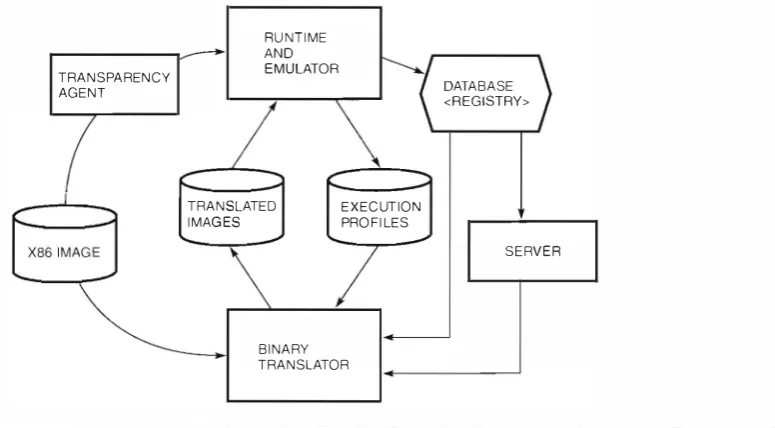
figure
l
shows the relationships between these
major components, each of which is discussed in more
detail in the sections that t()IIOiv.
The Transparency Agent
The transparency agent provides t(>r transparent
launching
of
32-bit x86 applications. LaunciJing an
:�pplication on the
VVindows NToperating
system
always results in a call to the Create Process
APIroutine.
By hooking calls to this routine, the transparency agent
can examine every image as it is about to be executed.
If a call to Create Process specifies that an x86 image is
to be executed, the transparency agent invokes the run
time component to execute the image.
FX!32 inserts the transparency agent into the address
space of each
process.
Aprocess that comains the
trans-TRANSPARENCY AGENT
RUNTIME AND EMULATOR
TRANSLATED IMAGES
EXECUTION PROFILES
DATABASE <REGISTRY>
SERVER
[image:6.597.151.539.496.710.2]BINARY TRANSLATOR
Figure
1DIGITAL FX'32
Svstcm
Componentspan:ncy agent is said to be enabled. Once a process is
enabled, any attempt to execute an x86 image causes
the rumime to be invoked to execute the process. The
agent is propagated through the system because each
attempt to create a process to run an Alpha image
resultsin that created process being en�1bled.
By the rime a user is logged on, fX132 has enabled
all the top-level processes, and any attempt to execute
a 32-bit x86 applicationinvokes the
runtime compo
nent.
Theinitial processes that are enabled are the
Windows shell ( explorcr.exc ), the service control man
ager (serviccs.exe), and the remote procedure call
server ( rpcss.exe ). When
fX!32 is installed, the
fx32strt.exe file is registered as the Windows shell.
When a user logs on, fx32srn.exe runs and enables the
real Windows shell, explorer.exe. The FX132 server
enables the servicecontrol manager when it starts,
usually when the system is booted. Currently, any ser
vice process that is started by the service control
manager bdc)re the server is started is not enabled. (The
only exception is rpcss.cxe, which is explicitly enabled
by the server). \Ne hope to alleviate this limitation in a
future version of the DIGITAL FX!32 software.
Processes arc enabled using a technique described
by Jdhcy Richter in Chapter 16 of his book
Aduanced
\Vinduu•s NT"to inject a copy of the trans
parency :�gent into the process' address space.
The Runtime
The transparency agent invokes the runtime whenever
an attempt is m:�de to execute an x86 image. The
runtime loads the image into memory, sets up the run
time environment required by the emulator, and then
calls the enur!Jtor ro execute the image.
The runtime replaces the Windows NT loader,
which can only load Alpha images; the Windows NT
loader returns :�n error reporting an image of the
wrong architecture if it is invoked to load an x86
image. The runtjmc duplicates the hmctionality of rhe
Windows
NT
IO<lder, which includes rcloc:Jting images
that arc not loaded at their preferred base address, set
ting up shared
sections,and processing static thread
local storage sections.
The runtime registers each
image it processes withthe Windows
NT
operating system by inserting point
ers to that inugc into v:�rious lists that are used inter
nally by the system. Maintaining these lists allows the
n:�tive \Vindmvs NT code to correctly implement
API
routines, such as Load Resource and Gen\1odulcHandlc,
which require access ro images that have been loaded.
The registrationalso ensures that the DllJ\ilain tunc
tions of the loaded dynamic link
libraries
( DLLs)
are
called as �1ppropriarc. (The entry points
ofx86 DLLs
�1rc jacketed b)' the runtime.)
Fortunately, the inuge lists that fX132 must modit)'
arc in the user's address space, and no modification of
the vVindows
NT
operating system was required to
reg
is
ter images with the system. Unr()rtunatcly, the
structure of
theselists is not part of the dowmcnrcd
Win32 interface, and using them creates
adependency
on the Windows NT version that is being run. fX!32
has dependencies on a
number of undocumented ka
turcs of the Windows NT operating system. Although
the
DIGITAL
FX!32 product is more dependent on a
particular version of t he opcr:�ting system than a typi
cal layered application is, it is rcmarbble rhar the
implementationof FX132 did not require :�ny changes
to the Windows NT opcrJting
system.The runtime also registers the image in the FX132
database. This database maintains inbrmarion about
x86 images that have
beenloaded, including the appli
cation that loaded the image, profile data that was pro
duced by the interpreter, and any translation of the
image. The runtime accesses the database with a
u nique image identifier
(ID),
which the runtime
obtains
byh
as
h
i
ng the image's header. Thercti:Jrc, the
image
I D
is determined by
thecontent of the image,
nor by
itslocation in the file system, and the inhmna
rion that FX132 associates with the image can be
accessed independently of rbc image's location on
thedisk. For example, if an application is installed in one
directory and some of the images lo:�ded bv the appli
cation arc subsequently translated by FX!32, the
translated images will be located by FX132 even if the
application
is
laterinstalled in a difkrenr directory.
When the runtime finds a rransi<Hcd
imagein the
dat:�base, it loads this image along with
theco
rre
sponding x86 image. Translated images arc normal
DLLs, loaded by the n:�tivc Load Library
APl
routine.
Translated images contain additional sections that
store information required by the runtime to map x86
routines to the corresponding Alpha code.
The runr.ime duplicates the Windows NT loader
function of
bindingan image's imports, using sym
bolic inti:m11arion in the image to locate the
addressof
the imported routine or data. The runtime treats
imports that refer to entries in Alpha images speci:�Jiy,
however, by redirecting the imports to rekr to the
correct jacket enrrv in the
fX!32
DLL, jacket.dll.
The jacket routines in jackcr.dll enable an x86 user
program to call
thenative Alpha implementation of
the Win
3
2
API.
Thesejacket routines JIT extremely
important because they allow x86 applications to use
high-pcrt(xmance code that has been
tu
ned to theAlpha platti:mn. Some x86 applications run faster on
the Alpha plartcm11 than on the x86 platform, even
without being translated, because of the large amount
of time the applications spend in native DLLs.
Each jacket contains an illegal x86 instruction that
serves as a signal
tothe interpreter that <l change is to
be
mad
e
to theAlpha environment. The interpreter
calls an Alpha jacket
routineat
arixcd offset ti·orn the
illegal x86 instn1crion. The basic operation
ofmost
6
jacket routines is
to move
arguments tt·om the x86 stack to the appropriate Alpha registers, as dictated by the Alph a calling standard . Some j acket routi nes pro vide special semantics t()l" the native routineb
e
in g called, as required by F X ! 3 2 . For example, the jacket tor the GetSystcmDirectory routine returns the path to the FX! 32 directory rather than the path to the true system directory so that x86 applications do not over write native Alpha DLLs.For an x86 application to run under F X 1 3 2 , every image it loads must be either an x86 image or an Alpha i mage t(Jr which jackets exisr. Therct(xe, f X 1 3 2 pro
vides jack
et
s tor all the DLLs that implement the Wi n32 imertiKe and tor many redistributableD LLs.
F X I 32 currently provides jackets tor more than 50 native Alpha DLLs, which has enabled the FX! 3 2 devel opment te
amto run
almost all the commercial applica
tions tested. Each new release of DIG ITAL FX132 sofrware provi
des additional jackets, and the developers i ntend to jacket new i nterbces as they are released.The Emulator
The fu ndamental job of the emulator is
to
run x86 applications betore they arctranslated . The
tirst time an x86 image executes u nder FXI 32, the image is exe cuted by the emu
lator.The emulator also serves as a backup for translated code. Because it is not possible to statically d etermine all the code that can ever be executed by an application (especial ly for applications that generate code on-rhe tly) , the emulator is always present to execute such untranslated x86 a
pplication
code . Previous binary translators built by DIGITAL also depended on the presence of an emulator in this role.' Emu lator perf
or mance is more of an issue for F X ! 32 becHISC, u n li ke those earlier binary translators, all application code is interpreted when the x86 application is first run.The emulator is an Alpha assembly language program that interprets the subset ofx86 instructions that can be executed by a Win32 application. While
an
x86 applica tion is run ning, the x86 processor state is kept partially in Alpha registers and partially in a per-thread data structure called the CONTEXT The x86 integer regis ters arc permanently mapped to Alpha registers, and Alpha registers store thestare
of the x86 conditioncodes. Whi.Je the
emulator is running,a
dedicated Alpha register pointsto
the CONTEXT The CONTEXT stores the x86 per-thread processor context and any part of the x86 processor state that must be maintain ed acrosscal ls
to otherparts
of the system,f(n
example, calls to Alpha API routines.Pipelined Dispatch
The structure of
the
emulatoris a
classic fetch-andeva! uat<::
loop . The
emulator dispatches on the tirs
ttwo
byresof
e�\Ch instruc6on , performing the lookupDigirJI Tcchnic1l )ourn<1l Vol. 9 N o . 1 1997
in a table of
64
K entries.Each
entry contains rl1eaddress of
the routine to execute to i n terpret an i nstruction and the lengthof
the i nstruction .The structure of the d ispatch loop has been care tll
l
ly crafted to make eftlcient use of64-bit Alpha registers and to efficiently schedule the execution of code in the loop. Software pipe l i ni ng is used to overlap the retch and dispJtch table lookup for the next i nstruc tion with the execution of the c urrent i nstruction. At the top of the loop, at least eight bytes, starting at the add ress
of the current i nstruction, are
inAlpha
registers. Length information from the dispatch table determines the tirst two bytes of the next i nstruction, allowing the dispatch table lookup to be overlappedwith the execution of the current instruction . A tCtch
of additional bytes from the i nstruction streJm is also initiated . Fina
l
ly, the loop d ispatches to the routine whose address was obtained ti·om the table on the pre vious iteration of the loop.The individual rou tines have been factored by using su broutines and coroutines
to
pertorm operations like oper
and fetching, making them as smal
l as possible.As
a result, the emulator code re
q uire
dto
execute themost frequently
executed x86 i nstructi ons fits in the tirst-level cache.Condition Code Evaluation
Condition codes are generated by the execution of many o f the x86 i nstructions. \tVe have observed that cond i tion codes arc fi-cq uently set and relatively i n frequently exami ned . The e m u lator takes advan t<lge
of this by evaluating the cond i ti o n codes only
when they arc used, that is, by using a "lazy eva l u a tion"tech
nique. The execution of atypical i nstruc
tion saves only enough state to allow the eva l uation
of conditioncodes, if
req uired, a t a l ater time . This takes much less effort than initial ly evaluating the condition codes. The additional advantage in defer ring the eva luation is that only the cond i tion codes that are used need ro be generate d . For example, the overflow condition code may never be computed if only the zero tlag is used .Floating-point Instruction Emulation
The em ulator also implements a somewhat simpl i fied model of the x 8 6 FPU's register fi le . Most instruc tions use the x86
FPU
register file as a traditional operand stack; however, several i nstructions can create a register file state that is not strictly a stack by freeing registers in the middle of the stack, by moving the stack pointer without pushing or popping, or by ini tializi ng the register tile i n a way that breaks the stack model . Modeling the ful l complexity of the x86FPU
register file would be extremely expensive, and experi ence l1as shown that almost all programs use the regis ter tile strictly as a stack. The current version of the emulator takes advantage of t his. We are investigating ways to model the floatjng-point registers in a way that maintains good performance but docs not depend on their being treated as a stack.
Generation of Profiles
While it is interpreting an x86 program, the emulator generates profile data tor use by the translator. The profile data includes the following information:
• Addresses that are the targets of cal l instructions
•
(Source address,
target address)
pairs tor indirect control transfers• Addresses of instructions that make u naligned ref erences to memory
The translator uses this i n formation to generate routines, that is, units of translation that approximate a source code routine. The emu lator generates profile data by inserting values in a hash table whenever a rel evant instruction is interpreted . For example, as part of inte rpreting the call instruction, the emulator makes an entry i n a hash table that records the target of the call . When an image is u nloaded (either as a result of a call on the FreeLibrary routine or when the applica tion exits ) , the ru ntime processes the hash table to produce a p rofile file for tbat image. This profile is processed by the server and can result in the server invokjng the transl ator to create a new translation of the image .
To detect available translated code, the emu lator uses the same hash table that i t employs to gather the profi l e data. The x 8 6 add resses for which there are translated routines and the address of the correspond ing translated code are entered i nto the hash table by the runtime when i t loads an x86 image that has been translated . When a call instruction is interpreted , the emulator l ooks up the target address. If a correspond ing translated add ress ex ists, the emulator transfe rs control to that address.
The Translator
The server invokes the translator to translate x86 images tor which a profile exists in the database. The translator uses t he profile to prod uce a translated
i mage. On su bseq uent executions of the image, the translated code is used, substantially speed i ng up the application.
Structure and Order of Operations
The translator has eight major components (or phases ) : the regionizer, build , the register mangler, the comli tion code m angler, improve, the code selector, the scheduler, and the assembler. (An additional phase that performs various peephole optimizations is dis abled in the DIG ITAL
FX 1 32 V l . O
translator. ) The major components function as fol lows:l . The Regionizer-The regionizer uses data i n the profile to divide the source image code i nto rou
tines, which are described i n the section Generation of Profiles. Each cal l target in the profile is used to generate an entry to a routine. The regionizer rep resents routi nes as a collection of regions. Each region is a range of contiguous add resses, which contains i nstructions that can be reached from the entry add ress of the routi ne. U n li ke basic blocks, regions can have multiple entry poi nts. The small est col lection of regions that contain a l l the i nstruc tions that can be reached from the routine entry is used to represent the routine. Many routines have a single region. This represen tation was chosen to efficiently describe tl1e division of the source image into units of translation.
The regionizer builds routines by followi ng the control flow of the source image. When an indirect jump instruction is encountered while f()llowing the control flow, the possible targets of the i nstruc tion are obtained ti·om the profil e . Without this profile information, it would be very difficu lt to reliably identifY these targets, and indirect jumps would have to be treated as returns from the rou tine. The profile i n formation makes it possible to reliably generate a more complete representation of routines with correct control flow.
After the regionizer runs, each of the other major components is run in sequence for each routine.
2. Build-Build reparscs the x86 i nstructions in the routi n e to create an i nternal representation ( l R) of the routine tor use by the subsequent components. The I R is a graph of basic blocks and is similar to the IR used by many optimizing compilers.
3 .
The Register Mangl er-The initial I R is a straight forward representation of the source x86 cod e . This representation ignores the overlap of the x86 registers; the I R treats each occurrence of EAX,AX ,
AH ,
and AL as a separate register. The register mangler adds i nsert and extract operations as nec essary to represent the actual semantics of the x86 registers.8
4.
The Condition Code !Ylangler-The eftect of x86
instructions on condition codes is represented
implicitly in the initial JR. The condition code mangler adds instructions
roexplicitly generate condi
tion codes. Since the cond ition code mangler
understands the control flow of the emire routine,
it knows when condition codes are live and only
adds code to generate condition codes when they
are used later in the routine .
5 .
Improve-Improve performs several transforma
tions that produce code more s uited to the Alpha
architecture. In the initial
IR,each push and pop
instr uction is explicitly represented as a decrement/
increment of the x86 stack pointer, accompanied by
a store/load. Improve collects all the manipulation
of the x86 stack pointer into a single decrement at
the beginning of a basic block and a single incre
ment at the end of t
h
a
t block.Improve also uses
simple value numbering and analysis of memory
references to try to eliminate loads and stores to
both the x86 stack and the t-loating-point stack and
to perform constant f()lding. Although Improve
performs only relatively simple optimizations on a
single basic block, we have fo und it
tobe quite
effective in improving the q uality of the code that is
generated .
6. The Code Selector-The code selector transf(mm
the
I Rfrom a representation that contains mostl y
x86 instructions to one that contains onl y Alpha
instructions . This transformation is done instruction
by instr uction, with each x86 instruction being
replaced by a sequence of Alpha instructions that
produce the same effect. The implementation of the
code selector is based on the TWIG rode generator.'
Although the code selector is capable of dealing
with much more complicated patterns of instruc
tions, this capability is nor currently used .
7.
The Scheduler-After the code selector is r u n , all
the instructions in the
IRare Alpha instructions.
The sched uler reorders the instructions within a
basic block to minimize the cycle co unt for the tar
get processor.
8 . The Assembler-The assembler builds the o utp ut
translated image.
Use of Profile Data
The regionizer is the only component of the current
translator that uses the control flow int(>rmation in the
protik . The
regionizeruses the profile to d etermine
which parts of the source image arc translated. Futu re
versions of the rransbter will usc the profi l e to perform
path
-
directed optimizations and ro place code so as to
red uce cache misses. Those changes wil l improve the
pert(mnance of translated code .
Digircll Technic.1l journal Vol . 9 No. I 1997
Rctranslation of an image is triggered by growth in
the size of the profile. Because profile data is generated
onl y when the emulator executes previously untrans
l ated parts of the source image, an increase in the size
of the pro file indicates that new parts of the program
have been executed. Retranslating with the new pro
ti le will cause these additional parts of the image to be
translated.
Alignment Issues
On an Alpha system, references to memory locations
that are not naturally aligned res ult in exceptions that
arc hand led
bythe Windows
NT
kernel.
Alignmentexceptions can be avoided
byusing unaligned code
sequences that usc
the LDQ_Uand
STQ _Uinstruc
tions . Unaligned code sequences are slower than
aligned seq uences for accessing locations that are nat
urally aligned b ut m uch t:1ster for accessing locations
tlut are not natural ly aligned . Native Alpha compilers
ahvays try to generate unaligned code sequences when
referencing unaligned data ro avoid the expense of
dealing with alignment exceptions .
When generati ng the code for an instruction that
references memory, the code selector must determine
whether to usc an aligned sequence or an unaligned
sequence. To make the determination, the code selec
tor needs to know the aJ ignment of the address being
referenced . In general, this cannot be d etermined by
static analysis of the x86 code . To solve the problem,
the code selector uses information in the profile abour
the alignment of memory addresses . The profi le con
rainsthe
addressof every instruction that made an
unaligned reference to memory. The code selector
generates unaligned sequences for those instructions
and aligned sequences for al l other memory references.
Although this code generation process is eftcctive most
of the time,
someprograms exhibit different memory
rckrcncc behavior on s uccessive runs . For those pro
grams, alignment exceptions can sti l l occur.
Shadow Stack
problems m ust be solved, though. First, some mecha nism is needed to determine if rhe x86 return address has been modified . Second, a location is needed to save the native return address. Both problems are solved by using the shadow stack.
The shadow stack resides at the top of the native Alpha stack and is maintained by the translated code ( with help fi·om the emulator). A shadow stack fi·ame is created for each call of a translated routine. When one b·anslated routine calls another, the calling routine saves the x86 return address and the current x86 stack pointer in its shadow stack frame. The called routine then saves the native return address i n the ca.l ling routine's shadow stack frame. On return, the called routine expects to find the x86 return address and the current x86 stack pointer in the calling routine's shadow stack frame. In this case, the cal led routine is returning to the environ ment that the calling routine expected and performs a native return. I f the val ue of either the return address or the stack pointer has changed from the value expected by the calling routine, the called routine returns to the emulator.
In a similar manner, the emulator uses the infimna tion in the shadow stack to determine when it can return to translated code . A num ber of conditions can cause translated code to reenter the emulator. For example, the emulator is entered if the target of a translated indirect jump instruction is not known at translation time. Having the emulator return to trans lated code on a n.:turn instruction minimizes the amount of time that is spent in the emulator; however, the emulator can only return to the translated code i fit knows that i t has a valid return address. The shadow
stack provides a mechanism to perform that validation.
The Database
The database consists of rwo parts. As described tor the runtime, the first part of the database is a d irectory tree th:tt cont:tins profile files, translator log files, and translated i mages. The second part of the database is kept in the registry and consists of
information
about x86 applications and images that the D I G ITAL FX!32software has run on the system, together with config uration information . The configuration i n formation i ncludes the maximum amount of disk space that can be used by F X ! 3 2 , the maximum number of i m ages that can be stored in the database, the default transla tion options, the work list that the server uses to schedule translations, and the DatabaseDirectoryList. The DatabascDirectoryList is a list of paths to add i tional databases that arc t o b e searched tor image pro tiles and translation results when the image is first exec uted . Directories on this list can be used to access information about the image from other machines on a network, making available to a user translations per f(xmcd on another, perhaps more powerfu l , machine.
The Server
The server is a \Vi ndows NT service that normally starts whenever the system is rebooted. The server automatically runs the translator when appropriate, thus m aking the translation process completely trans parent to the user. The server also maintains the data base to control D I GITAL FX ! 32 resource usage.
The Manager
Usually the operation of DIG ITAL fX!32 software is completely transparent to the user. Like any other pro gram, though, FX1 32 consumes system resources and a user must be able to control that resource usage. One ofthe roles of the manager is to provide a user interface to the configuration information kept in the database.
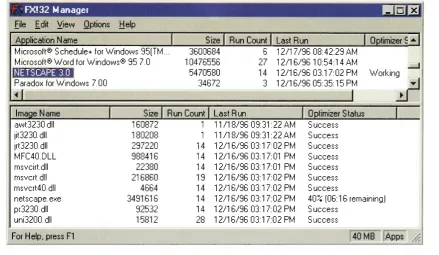
Figure 2 shows the manager window. The upper pane contains information about t he various appl ica tions that have been run on the system : the total amount of disk space being used for profiles and trans lations of images loaded by the applicatjon, the num ber of times the application has been run, the date when it was l ast run, and the optimizer ( translator) status. The lower pane contains i n formation about the i mages that have been loaded by the h ighlighted application in the upper pane: the total amount of disk space used to
store
the profile and translation of the image, the number of times the image has been loaded, the date on which it was last loaded, and the status of the last translation of the image.By interacting with the manager, the user can con trol various aspects of f X ! 3 2 operation, such as the maximum amount of disk space to use, which informa tion to retain in the database, and when the translator should run.
Results
The D I G ITAL fX ! 32 development team had two pri mary goals for the sofuvare: ( l ) to achieve transparent execution of 32-bit x86 applications and ( 2 ) to yield approximately the same performance as a high-end x86 platform when running applications on a high performance Alpha system . The DIG ITAL FX1 32
product meets both goals.
Transparency is provided by the transparency agent and a run-time environment that can load and execute a n x86 application without a translation step. Appli cations can be launched and executed on an Alpha system that is running FX! 32 just as they can on an x86 system . We h ave performed extensive testing of more than 7 5 applications that run using f X ! 3 2 , including major commercial applications s u c h as Microsoft Office 9 5 , Visual Basic 4.0, Photoshop 4.0, and Corel D RAW 6.0.
FX!32
M anage1l!lliJEJ
file �dit Y:iew .Qptions !::!elp
A
lication N ame
M icrosoft® S chedule+ for Windows 95[TM . . M icrosoft® Word for Windows® 95 7 0
l�llil!mi
B
•
I
Paradox for Windows 7 00 �
awt3230.dll jit3230 dll jrt3230 dll M FC40. DLL msvcirt.dll msvcrt. dll msvcrt40. dll netscape. exe pr3230 dll uni3200. dll
[image:12.597.90.530.46.301.2] [image:12.597.82.498.492.699.2]For H elp, press F1
Figure
2The D I G ITAL F X ' 3 2 J'vLmagcr
D I G ITAL
F X 1 32
software also met its pcrtixmancc goa l . Figure3 shows
the relative performance on fl }7t· JI!Jap,azine's BYTEmark bench mark ofa
2 0 0-megahertz ( M H z ) Pentium Pro system and a 5 0 0
-JV! H z AJ pha
system
r u n n i n gF X ! 3 2 .
F o r this benchmark, the Alpha system provides about the same perf()rmance as the 2 00 - Jv! H z Penti u m Prosyste m . Figure
3
also shows that the Alpha native8
6
Last R un
1 2/1 7/96 08: 42:29 AM 1 2/1 6/96 1 0:54 1 4 AM 1 2/1 6/96 03 1 7: 02 PM 1 2/1 6/96 05 35: 1 5 PM
Last
R un1 1 /1 8/96 09:31 22 AM 1 1 /1 8/96 09: 31 : 22 AM 1 2/1 6/96 03 1 7 02 PM 1 2/1 6/96 03 1 7: 01 PM 1 2/1 6/96 03 1 7 01 PM 1 2/1 6/96 03: 1 7: 02 PM 1 2/1 6/96 03 1 7 02 PM 1 2/1 6/96 03: 1 7 02 PM 1 2/1 6/96 03: 1 7 02 PM 1 2/1 6/96 03: 1 7:02 PM
S uccess S uccess S uccess S 1JCcess S uccess S uccess S uccess
40% [06: 1 6 remaining) S uccess
S uccess
version of the benchmark runs t
w
ic
eas bst as the
Pent i u m Proversion.
Of course, no singlt: benchmark characterizes the performance of a system . Even so, when running translated x86 applications, we have
consistently mea
sured performance on a 5 0 0 - M Hz AJpha system to bein the range between that of a 200- M H z Penti u m
sys
tem and that of a 2 0 0 - M H z Penti u m Pro svstem . For-
,---4
,.----
,--,.----
,---2
0
200-MHZ P ENTIUM P RO 500-MHZ ALP HA 2 1 1 64A 500-MHZ ALPHA 2 1 1 64A
KEY
D
IN TEGERD
FLOATING P OINTFigure 3
RUNNING D I GI TAL FX'32 (NATIVE ONLY)
DIG ITAL fX 1 32 Pcrti>rmancc on
the
B YTE Benchmark)some applie<nions, pertormance can exceed that of <1
Pentium Pro svsrem .
The initial version o f the DIGITAL FX132 software
has some l imitations.
FX1 32
executes only application
code; it does not execute d rivers. Consequently, native
drivers arc required for any peripheral that is installed
on an Al pha system . Also, as described in the
Transparency Agent section,
FX! 32
does not provide
complete support tor x86 services. Further,
FX1 3 2
does not support tile Windows N T Debug AP1 .
Supporting that i nterface would req uire the capability
to rematerial ize the x86 state ati:er every x86 i nstruc
tion, thus severely l imiting optimizations that the
translator cou ld pert(mn . Optimizing compi lers make
a similar trade-off by restricting optimization when
debugging information is required. Since
FX! 32
does
nor support the Debug intertace, applications that
require it do not run under
FX 1 3 2 .
Those applications
arc mosrly x86 development environments, and it
probably makes more sense to run them on an x86
system . The limitations described are not serious, and
most x86 applications that execute on an x86 proces
sor that is running the 'vVindows NT operating system
�1lso execute on an Alpha system run ning Windows NT
and DIGITA L
FX132
soti:ware.
Summary
DI GITAL FX! 32
soti:ware provides bst, transparen t
execution of 32- bir x86 applications on Alpha systems
running the Windows NT operating system . This is
accompl ished usi ng a
unique combination of emula
tion and bi nary translatio n . The emulator runs an
appl ication, int e rprets the code, and generates proti l e
i n formation. For su bsequent executions, t h e translator
uses the protile data to produce translated images that
contain optimized native Alpha code. An application
translated by means of
D I G ITAL FX!32software runs
up to
10ti mes taster than the same application run
ning under the emu lator alone. Moreover, the transla
tion takes place in the background and is therdore
rr:111sparenr ro
rhe user.
Acknowledgments
Building the
DIGITA
LrX!32
prod uct required some
extremely talented people to pertc>rm a lot ofdifticult
work. The mem bers of tbe
DIGITAL FX1 32d evelop
ment
teaminclude Jim C<lm pbcll, Anton
Chernoff,George Darcy, Tom Evans, Jim Givler, Charlie
Greenm:1n, Pippa Jollie, Mark Herdeg, Ray Hookway,
Maurice Marks, Sriniv:1san J'vlurari, Brian Nelson ,
Scott Robinson, Norm Rubin, Sherry Scskavich, Joyce
Spencer, Tony Tye, and John Yates. Many of these
individuals contribu ted the ideas descri bed
in
this
paper.
References
I . B . C1se , " Rehosting Binary Code tor Software Porta
bility," Microprocessor Report (Sebastopol, Calif. : Micro Design Resources, Janua
r
y 1 989 ).2 . T.
HaHhill,
"Emulation: !U SC's Secret Weapon,"8}T/:.' Magazine (April 1 994 ) .
3. R. Red i..: hek, "Some Efti..:ient Ar..:hirecture Simul:nion Techniques," /!SEN/X (Winter 1 99 0 ) .
4. L. Deutsch and A. Schitlin<ln, "Efficicnr Implementa
tion of the Smal lulk-80 System,'' Record uf the t'/euenth A nnual A CH Symposiu m on Principles uj' Pro,15rwnming Languaiw'· ( 1 98 3 ) .
5 . R. Sites,
A .
Chernoff, M. Kirk, lvl . Jvbrks, a n d S . Robin son, "Binary Translation," D(v,ital Tedmical journal. vol
. 4 , no. 4 ( J\!Llynard , Mass . : Digital Equipment Corporation, 1 992 ).6. J. Richter, Aduanced \'Kiirzdows NT chap. 1 6 ( Red mond, Wash . : M icrosoft Press, 1 994 ) .
7 . A. Aho, M . Ganapathi
,
a n d S . Tjiang, "Code Generation Using Tree Matching and Dvnamic Progra m m i ng," A CJ\11 Transactions on Procr.:ramminct.: Languages and.5)•stems,
v
ol.
I I , no. 4 (October 1 989 ) .Biographies
Raymond
J.
HookwayRay Hookway led the DTCTTAI. FX 1 32 development ream and \vas a key conrri buror to the binary translation compo nent of tbc DlGJTA I . F X 1 3 2 software prod uct. He has been a mem bn of the AMT group ofDJClTAL Semiconductor since 1 993. Ray joined DIG ITAL in 1989 and has worked in the CAD and AD groups of DIGITAL Semicond uctor, where he conrri bu ted to the first Alpha PC project
.
Prior ro joining DIGITAL , he was Director
of Engineeri ng ri:>rEndot, I nc . , where he developed one of rhe first V H D L . simulation environments. H e was also a n Assistant Professor ar Case Weste
rn
Reserve University, where he did researchon program
v
erific<Jrion, and he was <l Visiting Professor <lt the University of Ups
alla, Sweden. Ray received i'vi .S. and Ph.D. degrees in compu ter science ti·om Case vVestern Reserve Univers
ity
and a B.S. in engineeri ng fi·om C<lSeIn
s
titute ofTechnologv. He has app
lied for several parents rehned to his DIGITAL F X ! 3 2 work.1 2
Mark A . Herdeg
Mark Herdeg has been with DIG ITAL since 1 98 5 . He is cu rrently a principal software engineer in the A.tv!T group ofDIGITAL Semiconductor. Previouslv, he worked on con sole software tor the Nautilus ( VAX 8500) and Argonaut projects. The Alpha simulator developed tor the Argonaut project, M ANNEQUIN, became the tirst Alpha system on which the OpenVJv!S operating system successfu l l y booted . Mark contributed ro a rel ated project that used the Alpha
simulator and a dual-architecture-aware debugger ro allow developmeiJt and execution of applications with a m ix of VAX and Alpha code. A founding member ofrhc Alpha Migration Tools group, Mark worked on its tirst prod uct, VEST, the Open VMS V�\-to--Alpha binar·y translator. He then helped design and develop the DIGITAL FX 1 32 soft ware product, with particu lar focus on the runtime compo nent . Cu rrently, he is the project leader tor the next release ofDJGJTAL fX 1 32 software. J\i!Jrk has submitted several patent applications tor work on the rnu l tiple-architecture execution environment and for the DIG ITAL f X 1 32 design .
Development of the
Fortran Module Wizard
within DIGITAL Visual
Fortran
The Fortran Module Wizard i s one of the tools in DIGITAl Visual Fortran, a DIGITAl product for the Fortran development environment. Visual
Fortran consists of the DIGITAl Fortran
90
compiler and run-time libraries and the Microsoft Developer Studio. Together, these technologies provide a rich set of tools for the Fortran developer who is using the Windows NT and Windows95
sys tems. The Fortran Module Wizard generates complete Fortran source code, allowing Fortran applications to invoke routines in a dynam ic link library, methods of an Automation object, and member functions of a Component Object Model (COM) object.I
Leo P.
TreggiariDIGITAL Visual Fortran is an integrated development environment tor Fortran applications.' It is supported on
the Windows NT version 4 . 0 operating system on both
AJpha and I nteJ hardware and on the Windows 95 sys
tem. DIGITAL Visual Fortran is a combination of tech nologies ti·om D I GITAL and Microsott Corporatjon. The DIG ITAL-supplied compiler and run-time l ibraries
support the DIGITA L Fortran 90 Janguagc.' DIGITAL
Fortran 90 conforms to American National Standard
Fortran 90
(
ANSI X3 . 1 98- l 99 2 ) and provides manyextensions to the Fortran 90 standard . The Microsoft
supplied i ntegrated development environment is the Microsott Developer Studio, which is also used by !Yl.icrosoft Visual C++, Microsoft VisuaJ J++ ( tor Java), other Microsoft tools, and other companies' develop ment tooJs. DeveJoper Studio i ncludes a text editor, resomcc editors, project build facilities, an incremental linker, a source code browser, an integrated debugger, and a profiler. The operation of all these tools is con·
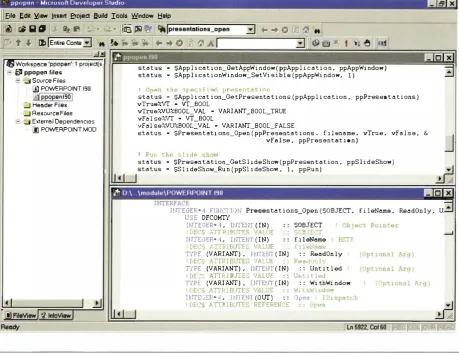
trolled ftom a single application. Figure
l
shows anexample of Microsoft Developer Studio fi-om which two Fortran source files are being edited . DIGITAL adds a number of Fortran-specific tools to the environment, one of which is the Fortran Module Wizard .
Design of the Fortran Module Wizard
DIGITAL designed the Fortran Moduk Wizard to help Fortran developers working in the application-rich Windows environment. The Fortran Module Wizard supports access to dynamic link libraries ( D LLs) and servers based upon Microsoft's Component Object Model (COM ). This support allows Fortran developers to usc the popu lar mechanisms that make functionality (services) available to other software (clients) .
TraditionaJ ly, Microsoft and others have provided system i nterfaces and reusable libraries of code as D LLs. A D LL is a file
containing
fun
cti
ons that can be called by programs and other D LLs. The role of D LLs on a Windows system is very simiJar to that of share able images on the Open VMS operating system and shared Jibraries on the UNIX system. Today, DLLs are still the primary mechanism t(Jr accessing system inter faces on Windows.1 4
• ppnpen Mocrosoft Oev.,luper Studoo
1!1!1
£i
ll
fila �dit ::iiew Insert froject auild Ioots Window tielp�Iii �
j� P
:... · • · •ro lll
�
'A rlp-re_s_a-:nt-:at-:io_n_s_-o_p_an--OiJ--,• +- -+ O1
\ 1" ...r:z, IEntire C<Jnte:i]
M �· * ,.. * ... -+ 0 ,'� A
I
�
�==
�
��
d�� �
==============
========
�
�================
�. Workspe.ce 'ppopen'· 1 project(•: l- @'l ppopen Iiies
:...:l
Source
Files IB POWERPOINTf90[[J
ppopen
190I
....J Hee.der FilesResource Files .:1 '.:...:l Externe.l D
e
penden
coes I [image:16.597.75.535.50.404.2][lj POWERPOINTMOD
Figure 1
stotus • $App l l co t l on_GetAppWl ndow ( ppApp l l COt l o n . ppAppW1 ndow ) status • $App l i co t i onW i n dow_SetVi s i b l e ( ppAppWi ndow. I )
I 1p�n t b� p �ctft�rl pr� � r lOh
status • $App l l cot i on_Ge tPresento t l ons ( p pApp l l co t i on . ppPresen t a t i ons )
vTrue%VT • VT_BOOL
vTru e%VU%BOOL_VAL • VARI ANT_BOO L_TRUE
vfo l se%VT • VT_BOOL
vfa l se%VU%800L_VAL • VAR IANT_BOOL_FALSE
stotus • $Presen tat1 ons_Open ( ppPresento t 1 ons , f i l ename , vTru e , vfa l s e . & vfa l se . ppPres entat 1 o n )
1 Run the s lltl� shoJ
status • $Presen t a t l on_GetS l i deShow ( p pPresen tot ion . p pS l i d eShow ) $S l i deShow_Ru n ( ppS! i deShow . I . ppRu n )
ItrrERFArE
IlTTEGER• 4 fUNC'TE•N USE DFCOMTY
INTEGER•.;. ItTTDlT(I N ) I I>E•-'S A TI P. ! BIJIT: JALUE ItiTWER• 1 . HTTE�TT( IN)
. . SOBJECT s Of! 'E• 'T . . f i l eName I I>E·:-; ATIP!o:llirE.; J;..LUE t , ,..tf ,,.. B'IP TYPE (VARIANT) . HITEtTT( IN) : : RaodOn ly I
I f•E '< ATrP.l Sl TTC VALUE Ht"orli"•rol ' TYPE (VARIANT) , ItTTEtiT(I N) : : Unt 1 t l ed
I [IE :c_ .�TIP. I SlifE.: V . . LIJE IJ" t l t lo;d riPE (VARI ANT) . I lTTEtiT ( IN) : : Wi thW1 ndow
I I• E :;;, ,,,TI.Pl BIIT!:. · �.Ll E ,;1 t I l li<l ,., ltTTE1;EP.•4. HTTDIT(O Uf ) .. l)pr;on I l l 1 p o t o h
I [oE•'S ATIP I BlJIT .. P.EfEREil•"E 'I""'
Ln
( Hp lOt•-' :. Ar
Microsoft Developer Studio, Two Fortran Source Fi les Being Edited
J
When Microsoft introduced 0 LE version l , the name OLE was an acronym for object linking and embedding. OLE version
l
enabled compound docu ments by allowing a document to link to, or embed data from, another document. In1 99 3 ,
Microsoft introduced COM as the base architecture of OLE version 2 .3 COM is an extensible architecture that pro vides mechanisms for creating and using sofuvare com ponents.A
software component consists of reusable pieces of code and data in binary form that can be pl ugged into other software components from other vendors with relatively little effort.' Like DLLs, COM allows a software developer to provide a set of services to multiple clients. In addition, COM has the advan tage of allowing the services to reside i n another process and on another machine. (Distributed COM [DCOM] allows objects ro be created and used on remote machines. ) COM also contains features that aid in the deployment and evolution of the services.' M icrosoft has extended its languages and tools to aid software developers in the creation of clients and servers based upon COM ( hereafter referred to as clients and servers in this paper).Why does a Fortran developer need help accessing services in DLL.s and servers? Calling code that is writ ten in another programming language is, in genera l , difficult. There are complex issues around calling stan dards and data type representations. If a m istake is made in manually translating a fu nction signature from one language into another, today's program ming environments arc of little hel p. The application can fail at a point i n the code, for example in the rou tine prolog, vvhich does little ro suggest the cause of the proble m . Often, solving these probl ems requires understanding the i ntricacies of call i ng standards and single stepping through assem bly code. Calling the components in a server also req uires understanding and properly using a n umber of COM programming interfaces.
Digital Technical Journal Vol . 9 No. l 1997