http://dx.doi.org/10.4236/oja.2015.54013
A Study on the Linear Piezoelectric Motor of
Mode Shape
Jwo Ming Jou
Department of Mechanical Engineering, Cheng Shiu University, Taiwan
Received 1 October 2015; accepted 1 December 2015; published 4 December 2015
Copyright © 2015 by author and Scientific Research Publishing Inc.
This work is licensed under the Creative Commons Attribution International License (CC BY). http://creativecommons.org/licenses/by/4.0/
Abstract
In this paper, we want to make a new type linear piezoelectric motor by mode shape coating or ef-fective electrode surface coating. The mode shape is derived from the mechanical boundary con-ditions of the linear piezoelectric motor. We only have access to the first three modes of formas, the effective electrode surface coating basis, as well as with the linear piezoelectric motor of nor-mal shape do comparison. Next, we will inspect their gain or axial velocity through theoretical analysis, simulation and experiment. According to the results of the theoretical analysis, we have found that the gain or axial velocity of the linear piezoelectric motors of mode shape is much larg-er than the linear piezoelectric motors of normal shape. Howevlarg-er, according to the results of si-mulation and experiments, we have found that the gain or axial velocity of the linear piezoelectric motors of mode shape is much greater than the linear piezoelectric motors of normal shape, which is about 1.2 to 1.4 times. The linear piezoelectric motor of mode shape 3 has the fastest axial ve-locity, which is about −48 mm/s and 48 mm/s under conditions of 180 Vp−p driving voltage, 21.2
kHz driving frequency (the third vibration modal), 25 gw loading and the position of loading or mass at x = 5 mm & 45 mm respectively. And its axial velocity is about 1.4 times the linear piezoe-lectric motor of normal shape under the same conditions. Overall, the mode shape coating helps to enhance the gain or axial velocity of the linear piezoelectric motor.
Keywords
Linear Piezoelectric Motor (LPM), Mode Shape (MS), Normal Shape (NS), Gain, Axial Velocity
1. Introduction
Table 1.The performance comparison of the linear piezoelectric motors [1]-[19].
Year Movement Speed (mm/s) Thrust or Loading (N) Driving Frequency (kHz) Driving Conditions References
2006 810 100 31.5 ~ 31.75 150 VP−P [1]
2007 44.8 12.85 63.4 100 VP−P [2]
2008 1280 45 27.476 150 Vrms [3]
2008 235 21.4 36 200 Vrms [4]
2009 960 103 23.9 200 Vrms [5]
2009 1500 13 or 140 14330 80 Vp−p or 2 W [6]
2009 286 142 42.9 200 Vp−p [7]
2010 1160 20 25.7 ~ 26.8 200 Vrms [8]
2011 240 29.43 34 100 VP−P [9]
2011 150 30 17.9 30 Vp−p [10]
2012 854 40 23.59 200 Vrms or 10.39 W [11]
2013 88 1.96 41.13 16 Vp−p [12]
2013 230 0.6 92.00 150 Vp−p [13]
2013 928 60 22.50 200 Vrms [14]
2013 1527 50 24.80 200 Vrms [15]
2014 170 1.8 136.5 100 Vp−p [16]
2014 760 64.2 50.00 100 Vp−p or 17.4 W [17]
2014 140 0.3 99.00 100 Vp−p or 9.3 mW [18]
2015 230 0.3 174.0 80 Vp−p [19]
transducer [15], the ultrasonic linear motor using traveling surface acoustic wave [6] and a linear ultrasonic mo-tor using push-pull type L-B hybrid Langevin transducer with single foot [3]. Their linear movement speed of the fastest are 1527 mm/s, 1500 mm/s and 1280 mm/s respectively. If we only pay attention to thrust or loading ability, such as the square matrix type ultrasonic motor [7], a 2-DOF planar ultrasonic motor using longitudinal- bending hybrid transducer [5] and aultrasonic linear motor using longitudinal and bending multimode bolt- clamped Langevin type transducer [1] have the best performance. Their maximum thrust or loading are 142N, 103N and 100N respectively. If it focuses on energy efficiency, they are a linear piezoelectric motor driven by a single-phase signal [12], a multimode ultrasonic motor [10] and an ultrasonic linear motor using traveling sur-face acoustic wave [6]. Their minimum driving voltages are 16 Vp−p, 30 Vp−p and 80 Vp−p respectively. Due to the linear piezoelectric motors have superior performance, and they have a high use value in the precision me-chanical systems. So in addition to the above the linear piezoelectric motors, in any form or performance of the linear piezoelectric motors are worth trying to develop. In addition, we, according to the rotary piezoelectric motor of mode shape, have the advantage of a high rotational speed and excellent performance [20]. We try to use the same mode shape coating method to produce a new linear piezoelectric motor, and hope the linear pie-zoelectric motor of mode shape also have a more superior performance with respect to the linear piepie-zoelectric motor using normal shape coating, which is our motivation and main purpose in this paper.
2. The Function of Mode Shape and Effective Electrode Surface
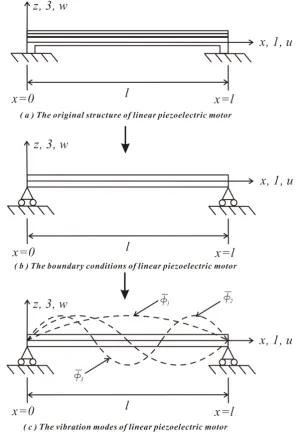
In this study, the linear piezoelectric motor can be regarded as a like simple supported beam with pinned-pinned boundary conditions [20][21], shown inFigure 1. So we can get the origin function of mode shape φn
( )
x ofFigure 1. The origin functions of mode shape of the linear piezoelectric mo-tors under pinned-pinned boundary conditions.
( )
sin , 0 1n x nx x
φ = λ ≤ ≤ . (1)
where the dimensionless eigenvalues λn is defined as:
π; 1,2,3, , .
n n n
λ = = ∞ (2)
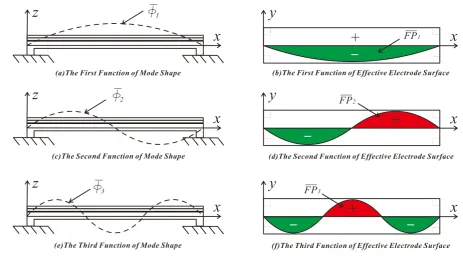
And further we can get another function of the effective electrode surface FPn
( )
x from Equation (1) asfollows or shown inFigure 2 and Table 2:
( )
( )
( )
2 2( )
21
n NS
NS
n
n n
MS n
FP x C
FP x x
FP x
x
φ λ
=
= ∂
=
∂
. (3)
Figure 2.The first three functions of mode shape and the effective electrode surface of the linear piezoelectric motors.
Table 2. The first three vibration modes and effective electrode surfaces of the mode shape piezoelectric ceramics under pinned-pinned boundary conditions.
x/L φ1 φ2 φ3 FP1 FP2 FP3
0.0 0.00 0.00 0.00 0.00 0.00 0.00
0.1 0.31 0.59 0.81 −0.31 −0.59 −0.81
0.2 0.59 0.95 0.95 −0.59 −0.95 −0.95
0.3 0.81 0.95 0.31 −0.81 −0.95 −0.31
0.4 0.95 0.59 −0.59 −0.95 −0.59 0.59
0.5 1.00 0.00 −1.00 −1.00 0.00 1.00
0.6 0.95 −0.59 −0.59 −0.95 0.59 0.59
0.7 0.81 −0.95 0.31 −0.81 0.95 −0.31
0.8 0.59 −0.95 0.95 −0.59 0.95 −0.95
0.9 0.31 −0.59 0.81 −0.31 0.59 −0.81
1.0 0.00 0.00 0.00 0.00 0.00 0.00
3. The Composition and Operation Principle
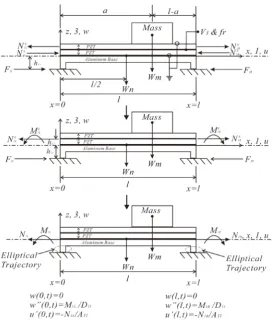
[image:4.595.89.541.385.592.2]Figure 3. The composition of the linear piezoelectric motors of normal shape and mode shape.
[image:5.595.178.452.370.692.2]membrane force, the piezoelectric motor will move to the right. On the contrary, the piezoelectric motor will then move to the left.
4. The Equations of Axial and Transverse Vibration
In order to distinguish differences of the linear piezoelectric motor of the normal shape and mode shape, we can simplify the equations of motion of 3D structure into the equation of motion of the two 1D structures. One of which is the equation of motion of the axial vibration direction, the other is the equation of motion of the trans-verse vibration direction as follow:
( )
2 12 , u x t N
hl
x ρ t
∂ ∂
=
∂ ∂ , (4)
and
( )
2 2 2 1 2 2 , w x t Mhl
x ρ t
∂ ∂
=
∂ ∂ , (5)
where the membrane force (N1) and of bending moment (M1) unit width are defined as:
( )
1 11 3 31
1 n n k k u
N A V e FP x
l x =
∂
= −
∂
∑
, (6)and
( )
21 11 2 2 3 31
1 n n k k w
M D zV e FP x
l x =
∂
= −
∂
∑
. (7)We can let Equation (1)-(3) & (6) (7) are substituted into Equation (4) & (5), and then after finishing, we can get the equations of motion by axial and transverse displacement of the linear piezoelectric motor of the normal shape and mode shape as follow:
( )
( )
2 2 2
2 2
11
, ,
NS
u x t hl u x t
A x t ρ ∂ ∂ = ∂ ∂
. (8)
( )
( )
( )
( )
2 2 2 3
3
2 2 2 3
11 11
, , n
PZT n MS
u x t hl u x t t x
A
x t A h x
φ ρ
λ
∂ ∂ Π ∂
= +
∂ ∂ ∂
. (9)
and
( )
( )
4 4 2
4 2
11
, ,
0
NS
w x t hl w x t
D x t ρ ∂ ∂ + = ∂ ∂
. (10)
( )
( )
( )
( )
4 4 2 4
3
4 2 2 4
11 11
, , n
n MS
w x t hl w x t t x
D
x t D x
φ ρ
λ
∂ ∂ Π ∂
+ =
∂ ∂ ∂
. (11)
According above the Equations (8)-(11), we can get the general solutions of axial and transverse vibration displacement (u and w) of the linear piezoelectric motors of normal shape and mode shape can be expressed as follow:
( )
,( )
e i(
1sin 2cos)
e ij t j t
u i u i
NS NS NS
u x t U x ω C βx C βx ω
= = +
, (12)
( )
,( )
e 1sin 2cos( )
i
j t
u i u i p
MS MS MS
u x t U x ω C βx C βx U x
= = + +
(13)
and
( )
,( )
e 1sinh 2cosh 3sin 4cos ei i
j t j t
NS NS w i w i w i w i
w x t =W x ω =C λx+C λx+C λx+C λx ω , (14)
( )
,( )
e i 1sinh 2cosh 3sin 4cos( )
e ij t j t
MS MS w i w i w i w i n n
where the definition of constants or symbols in the above Equations (4)-(15) as follow:
( )
11 11 1 n k k A hc ==
∑
, (16)2 3 4 4 11 wn n wn wi A D λ λ λ Π =
− , (17)
( )
(
3 3)
11 11 1
1 1 3 n k k k k
D c z z −
=
=
∑
− , (18)1 k k k
h =z −z − , (19)
1 n k k k h h ρ ρ =
=
∑
, (20)4 2 4 2 2
4
11 11
4 π
i i
i
hl hl f
D D
ρ ω ρ
λ = = , (21)
4 2 4 2 2
4
11 11
4 π
n n
n
hl hl f
D D
ρ ω ρ
λ = = , (22)
11 i i h l A ρ
β = ω , (23)
( )
3 3e 31 3e
i i
j t j t
PZT
t ω h e V ω
Π = Π = . (24)
where in above the symbols of A11, An, c11, D11, e31, fi, fn, h, t, U, u, V3, W, w, x, z, ρ, ωi, ωn, λ λ βi, n, i and Π3
are defined as the membrane stiffness constant per unit width, amplitude, Young’s modulus, bending stiffness constant per unit width, an arbitrary frequency, the resonance frequency, total height or thickness of piezoelec-tric ceramic or aluminum base, time, the axial displacement dependent on the axial coordinate, the axial dis-placement dependent on the axial coordinate and time, the transverse driving voltage, the transverse displace-ment dependent on the axial coordinate, the transverse displacedisplace-ment dependent on the axial coordinate and time, axial coordinate, transverse coordinate, density, the angle velocity of arbitrary frequency, the angle velocity of resonance frequency, the eigenvalues of arbitrary frequency of transverse direction, the eigenvalues of resonance frequency of transverse direction, the eigenvalues of arbitrary frequency of axial direction and the electric mo-ment. Which Cwp (p = 1 ~ 4) and Cuq (q = 1 ~ 2) represent undetermined coefficients of transverse and axial
direction. Where the eigenvalues λwi ≠λwn and i∈R and n∈I.
Where above undetermined coefficients can be determined by the following electro-mechanical boundary conditions:
( )
0, 1L 11; 1,( )
1R 11 NSu′ t N A u′ t N A
= − = −
, (25)
( )
0, 1L 11; 1,( )
1R 11 MSu′ t N A u′ t N A
= − = −
(26)
and
( )
( )
1( )
( )
111 11
0, 0; 0, L; 1, 0; 1, R
NS
M M
w t w t w t w t
D D
′′ ′′
= = = =
, (27)
( )
( )
1( )
( )
111 11
0, 0; 0, L; 1, 0; 1, R
MS
M M
w t w t w t w t
D D
′′ ′′
= = = =
, (28)
where
3 3
1 1 1 ; 1 1 1
E M NS E M NS
L L L fL R R R fR
PZT PZT NS
C C
N N N F N N N F
h h
= + = Π − = + = Π −
( )
( )
2 2
3 3
1 1 1 2 2 1 1 1 2 2
0 1
;
n n
E M NS E M NS
L L L fL R R R fR
PZT n x PZT n x
MS
x x
C C
N N N F N N N F
x x
h h
φ φ
λ = λ =
Π ∂ Π ∂
= + = − = + = − ∂ ∂ (30) and 3 3
1 1L 1 2 1 2 1; 1 1R 1 2 1 2 1
E M E E M E
L L L c fL c R R R c fR c
i i NS
M M M N h F h M M M N h F h
λ λ
= + =Π + + = + =Π + +
, (31)
( )
( )
2 31 1 1 2 2 1 2 1
0
2 3
1 1 1 2 2 1 2 1
1
;
.
n
E M E
L L L L c fL c
n x
n
E M E
R R R R c fR c
n x
MS
x
M M M N h F h
x
x
M M M N h F h
x φ λ φ λ = =
Π ∂
= + = + + ∂ ∂ Π = + = + + ∂ (32)
Another the frictional force is defined as follow:
1 1
;
2 2
fL k mass net fR k mass net
a l a
F W W F W W
l l
µ µ −
= + = +
, (33)
where FfL, FfR, M1L, M1R, N1L and N1R represent the frictional force per unit width of left side, the frictional
force per unit width of right side, the bending moment per unit width of left side, the bending moment per unit width of right side, the membrane force per unit width of left side and the membrane force per unit width of right side. And a W, mass, Wnet and µk represent the intercept, mass or loading per unit width, net weight per
unit width of the piezoelectric motor and coefficient of dynamic friction. Which hc1 and hc2 represent the cen-troid of the linear piezoelectric motor and the intercept of the piezoelectric ceramics. The superscript of E and M represent the electrical and mechanical.
Because the functions of mode shape are equal to zero under pinned-pinned boundary conditions as:
( )
0( )
1 2( )
2 2( )
20 1
0
n n
n x n x
x x MS
x x x x x x φ φ φ φ = = = = ∂ ∂ = = = = ∂ ∂
. (34)
So the Equation (30) and Equation (32) can be rewritten as follows:
1 1 1 ; 1 1 1
E M E M
L L L fL R R R fR MS
N N N F N N N F
= + = − = + = −
, (35)
and
1 1L 1 1; 1 1R 1 1
E M E M
L L fL c R R fR c
MS
M M M F h M M M F h
= + = = + =
, (36)
where
1 1 0; 01 1R
E E E E
L R L MS
N N M M
= = = =
. (37)
Let Equations (25)-(36) are substituted into Equations (12)-(15), we can get the solution of the axial and transverse vibration displacement of the first three modes of the linear piezoelectric motors as follow:
1 1 1 1 2 11 11 cos ; sin
R L i
L
u u
i i i NS
N N
N
C C
A A
β
β β β
−
= − =
, (38)
( )
21 1 3
1
1 2
11 11 11
cos
; ; cos
sin 2
R L i n
L
u u p n
i i i PZT i MS
N N
N
C C U x x
A A A h
β λ λ
β β β β
− Π
= − = =
(39)
and
1 1 1 1 1
1 2 2 2 4 3 2
11 11 11
cosh cos
; ;
2 sinh 2 2 sin
R L i L L i R
w w w w
i i i i i NS
M M M M M
C C C C
D D D
λ λ
λ λ λ λ λ
= − = = − = −
1 1 1 1 1
1 2 2 2 4 3 2
11 11 11
cosh cos
; ;
2 sinh 2 2 sin
R L i L L i R
w w w w
i i i i i MS
M M M M M
C C C C
D D D
λ λ
λ λ λ λ λ
= − = = − = −
. (41)
Let Equations (35)-(41) are substituted into Equations (12)-(15), we can get the particular solutions of the transverse and axial vibration displacement of the linear piezoelectric motor as follow:
( )
1 11 11
cos 1
, cos sin e
sin
i
j t
R L i
i L i
NS
i i NS
N N
u x t x N x
A
ω
β β β
β β
−
= −
, (42)
( )
1 1 3 21
11 11
cos 1
, cos sin cos e
sin 2
i
j t
R L i n
i L i n
MS
i i PZT i
MS
N N
u x t x N x x
A A h
ω
β β β λ λ
β β β
− Π
= − + (43) and
( )
(
1 1)
(
1 1)
1(
)
2 11
,
sinh sin
1
cosh cos cosh cos e
2 sinh sin
i
NS
j t
i i
R L i L i R L i i
i i i NS
w x t
x x
M M M M M x x
D
ω
λ λ
λ λ λ λ
λ λ λ
= − + − + − , (44)
( )
(
)
( )
1 1 1 1
2 2
11 11
2
1 3
2 4 4
11 11
cosh sinh cos sin
,
2 sinh 2 sin
cosh cos
e .
2
i
R L i i L i R i
MS
i i i i
L i i n j t
n
i n i
MS
M M x M M x
w x t
D D
M x x
x D D
ω
λ λ λ λ
λ λ λ λ
λ λ λ
φ
λ λ λ
− − = +
− Π
+ + − (45)
Further, we can make Equations (42)-(45) simplified as follows:
( )
, NS NSsin(
i)
u x t U ωt
= + Φ
, (46)
( )
, MSsin(
i)
MS
u x t U ωt
= + Φ
(47)
and
( )
, NScos(
i)
NS
w x t W ωt
= + Φ
, (48)
( )
, MScos(
i)
MS
w x t W ωt
= + Φ
, (49)
where Φ is defined as driving phase angle.
Therefore, we can once again get the equations of elliptical trajectory of the linear piezoelectric motor of normal shape and mode shape at contact points on both sides from above Equations (46)-(49), as follow or shown in Figure 4:
2 2 1 NS NS u w U W + =
, (50)
and 2 2 1 MS MS u w U W + =
. (51)
5. Special Case Study of Theoretical Analysis, Simulation Analysis and
Experiments
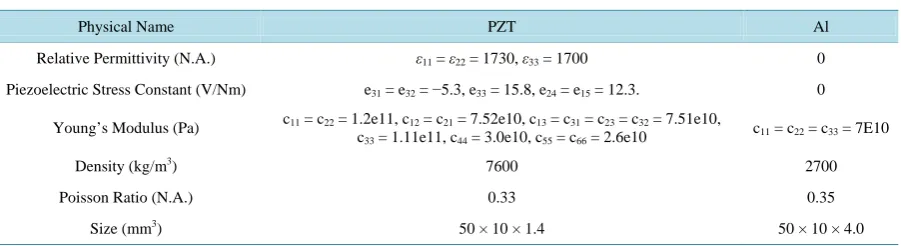
We have to understand the differences and gain between the linear piezoelectric motors of the normal shape and mode shape in this study. We will try to verify the differences and gain of the linear piezoelectric motors through theoretical analysis, simulation analysis and experiments. Where in the associated electrical and me-chanical properties of the linear piezoelectric motors in special case study is shown inTable 3.
The first is theoretical analysis in this special case study, which is as follows:
(5-1-1) Try to find the approximate solution of the transverse displacement of the linear piezoelectric motors of the normal shape and mode shape in the special case study. We can take to understand their difference and gain under condition of the normal shape and different mode shape electrode coating.
(5-1-2) Try to find the approximate solution of the axial displacement of the linear piezoelectric motors of the normal shape and mode shape in the special case study. We can further understand the impact of the axial or li-near movement under conditions of the normal shape and different mode shape electrode coating or the above modal vibration.
(5-1-3) Try to understand the impact of the axial or linear movement of the linear piezoelectric motors of the normal shape and mode shape under conditions of the different loading (or mass) and positions.
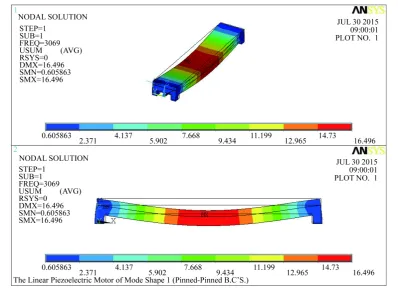
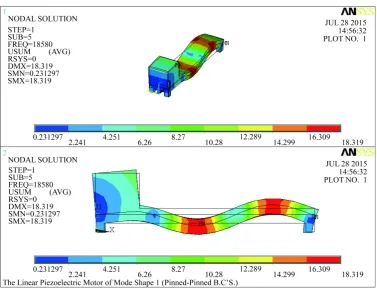
Second is simulation analysis by ANSYS code (its modal analysis under different driving conditions shown in Figures 5-10, its main analytical work as follows:
(5-2-1) Try to find the vibration modal of the linear piezoelectric motors of the normal shape and mode shape in the special case study.
(5-2-2) Try to find the axial (or linear) and transverse displacement from the above vibration modal under condition of net weight.
(5-2-3) Try to find the axial (or linear) and transverse displacement under conditions of different loading, po-sition and steady state.
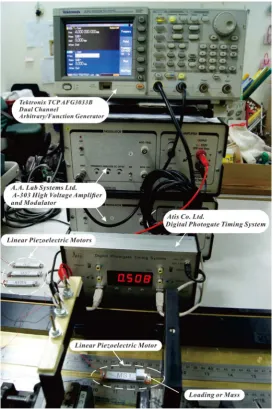
(5-3-1) Finally the experimental work (its prototype and structure shown in Figure 11, Figure 12 as follows: (5-3-2) Try to find the maximum axial (or linear) speed of linear piezoelectric motors of the normal shape and mode shape under condition of net weight.
(5-3-3) Try to find the maximum axial (or linear) speed of linear piezoelectric motors of the normal shape and mode shape under condition of the different loading (or mass) and position.
6. Results and Discussion
According to the results of theoretical analysis, simulation analysis and experiments, we found:
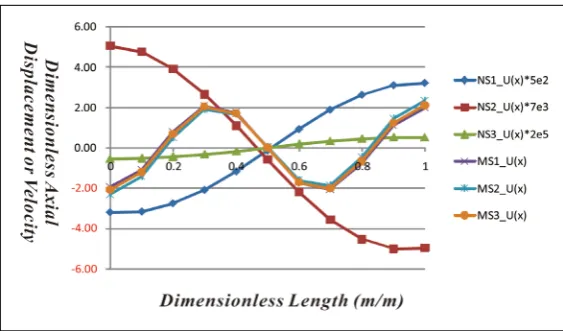
1) Shown in Figures 13-15, we have found that the change in axial displacement or velocity of more focus and smooth of the linear piezoelectric motors of mode shape with respect to the linear piezoelectric motor of normal shape by theoretical analysis under conditions of the first three vibration modal or driving frequency, 180 Vp−p driving voltage, net weight, frequency spacing of 1 Hz and the first three eigenvalues.
[image:10.595.89.540.600.723.2]2) Shown in Figure 16, we have found that the gain in transverse displacement or velocity of the linear pie-zoelectric motors of mode shape is much larger than the linear piepie-zoelectric motor of normal shape by theoreti-cal analysis under conditions of the first three vibration modal or driving frequency, 180 Vp−p driving voltage, net weight, frequency spacing of 1 Hz and the first three eigenvalues.
Table 3. The material properties and size of the linear piezoelectric motor.
Physical Name PZT Al
Relative Permittivity (N.A.) ε11 = ε22 = 1730, ε33 = 1700 0
Piezoelectric Stress Constant (V/Nm) e31 = e32 = −5.3, e33 = 15.8, e24 = e15 = 12.3. 0
Young’s Modulus (Pa) c11 = c22 = 1.2e11, cc 12 = c21 = 7.52e10, c13 = c31 = c23 = c32 = 7.51e10,
33 = 1.11e11, c44 = 3.0e10, c55 = c66 = 2.6e10 c11 = c22 = c33 = 7E10
Density (kg/m3) 7600 2700
Poisson Ratio (N.A.) 0.33 0.35
Figure 5. The first modal analysis of the linear piezoelectric motors of mode shape 1 under 180 Vp−p, 17 gw net weight and pinned-pinned boundary conditions.
[image:11.595.125.502.401.693.2]Figure 7. The third modal analysis of the linear piezoelectric motors of mode shape 1 under 180 Vp−p, 17 gw netweight and pinned-pinned boundary conditions.
[image:12.595.124.503.404.694.2]Figure 9. The second modal analysis of the linear piezoelectric motors of mode shape 1 under 180 Vp−p, 25 gw loading, the position of loading at x = 5 mm and pinned-pinned boundary conditions.
[image:13.595.125.503.404.694.2]Figure 11. The prototype of the linear piezoelectric motors of normal shape and mode shape.
[image:14.595.177.451.292.702.2]Figure 13. The dimensionless axial displacement or velocity relative to the dimensionless length of the linear piezoelectric motors of the normal shape and mode shape by theoretical analysis under conditions of the first vibration modal, 180 Vp−p driving voltage, 17 gw net weight, frequency spacing of 1 Hz, eigenvalues of λ1and β1.
Figure 14. The dimensionless axial displacement or velocity relative to the dimensionless length of the linear piezoelectric motors of the normal shape and mode shape by theoretical analysis under conditions of the first vibration modal, 180 Vp−p driving voltage, 17 gw net weight, frequency spacing of 1 Hz, eigenvalues of λ2and β2.
[image:15.595.172.454.520.687.2]3) Shown inFigure 17, we have found that the gain in axial displacement or velocity of the linear piezoelec-tric motors of mode shape is much larger than the linear piezoelecpiezoelec-tric motor of normal shape by theoretical analysis under conditions of the first three vibration modal or driving frequency, 180 Vp−p driving voltage, dif-ferent position of loading or mass, frequency spacing of 1 Hz and the first three eigenvalues.
4) Shown in Figure 18, we have found that the gain in axial displacement or velocity of the linear piezoelec-tric motors of mode shape is much slightly than the linear piezoelecpiezoelec-tric motor of normal shape by simulation analysis under conditions of different position of loading or mass, 180 Vp−p driving voltage, 25 gw loading and the first three vibration modal or driving frequency.
5) Shown in Table 4, the modal resonance frequency of the linear piezoelectric motors of normal shape and mode shape by 1D theoretical analysis, 3D simulation analysis and experiments, there are 2.14 kHz ~ 3.2 kHz, 8.56 kHz ~ 11.2 kHz and 19.26 kHz ~ 21.2 kHz respectively.
[image:16.595.169.460.251.434.2]6) Shown in Figure 19, we have found that the gain in axial displacement or velocity of the linear piezoelec-tric motors of mode shape is much slightly than the linear piezoelecpiezoelec-tric motor of normal shape by experiments
Figure 16. The dimensionless transverse displacement or velocity relative to the dimension-less length of the linear piezoelectric motors of the normal shape and mode shape by theoret-ical analysis under conditions of the first three vibration modal, 180 Vp−p driving voltage, 17 gw net weight and frequency spacing of 1 Hz.
[image:16.595.168.463.485.675.2]Table 4.The modal resonance frequency of the linear piezoelectric motors of normal shape and mode shape by 1D theoreti-cal analysis, 3D simulation analysis and experiments.
Mode Fr(kHz)_1D Theory Analysis Fr(kHz)_3D Simulation Analysis Fr(kHz)_Experiments
1 2.140 2.658 ~ 3.103 2.800 ~ 3.200
2 8.560 8.197 ~ 10.419 10.800 ~ 11.200
[image:17.595.158.470.420.637.2]3 19.260 18.574 ~ 21.734 20.800 ~ 21.200
Figure 18. The dimensionless axial displacement or velocity relative to the position of loading or mass of the linear piezoe-lectric motors of the normal shape and mode shape by simulation analysis under conditions of 180 Vp−p driving voltage, 25 gw loading and the first three vibration modal.
Figure 19. The axial displacement velocity relative to the position of loading or mass of the linear piezoelectric motors of the normal shape and mode shape by experiments under conditions of 180 Vp−p driving voltage, 25 gw loading, and the
driv-ing frequency of the first three vibration modal.
kHz driving frequency (the third vibration modal), 25 gw loading and the position of loading or mass at x = 5 mm & 45 mm respectively. And its axial velocity is about 1.4 times the linear piezoelectric motor of normal shape under the same conditions.
7. Conclusion
According to the results of theoretical analysis, simulation analysis and experiments, we have found that the change in axial displacement or velocity of the linear piezoelectric motors of mode shape is more focus and smooth than the linear piezoelectric motor of normal shape. We also have found that the gain in axial and trans-verse displacement or velocity of the linear piezoelectric motors of mode shape is much larger than the linear piezoelectric motor of normal shape. We have further found that the axial velocity of the linear piezoelectric motors of mode shape is much larger than the linear piezoelectric motor of normal shape under condition of ec-centric loading or mass. We also have found that the linear piezoelectric motors of normal shape and mode shape cannot move faster, when the state of net weight or the loading (or mass) placed at the center position of the motors. When the loading or mass is farther away from the center, it’s moving faster. And we also have found that the placement of the loading or mass can change the direction of axial movement of the motors. Overall, for all motors, the gain of the axial velocity of the third vibration modal is much larger than the first and second vibration modal. From the above results, we have found that the transverse mode shape coating has a positive effect on the axial displacement. That is, the transverse mode shape coating can make energy more concentrated with respect to the normal shape coating, so that axial displacement can more quickly move.
Acknowledgements
This study can be finished smoothly, I especially want to thank MOST of Taiwan of ROC sponsor on funding, (Project No.: MOST104-2221-E-230-016).
References
[1] Shi, S.J., Chen, W.S. and Liu, J.K. (2006) A High Speed Ultrasonic Linear Motor Using Longitudinal and Bending Multimode Bolt-Clamped Langevin Type Transducer. Proceedings of the 2006 IEEE International Conference on Mechatronics and Automation, Luoyang, 25-28 June 2006, 612-617.
[2] Jou, J.M. and Hou, J.L. (2007) A Study on the New Type Linear Ultrasonic Motor. 2007 IEEE International Ultrason-ic Symposium, New York, 28-31 October 2007, 2554-2557.
[3] Shi, S.J., Chen, W.S., Liu, Y.X., Liu, J.K. and Xie, T. (2008) Design and Fabrication of a Linear Ultrasonic Motor Us-ing Push-Pull Type L-B Hybrid Langevin Transducer with SUs-ingle Foot. 2008 IEEE International Ultrasonics Sympo-sium, Beijing, 2-5 November 2008, 157-160.
[4] Yao, Z.Y., Yang, D., Wu, X. and Zhao, C.S. (2008) Structure Design Method of Bar-Structure Linear Ultrasonic Mo-tors. 2008 IEEE International Ultrasonics Symposiums, Beijing, 2-5 November 2008, 639-642.
[5] Shi, S.J., Liu, J.K., Chen, W.S. and Liu, Y.X. (2009) Development of a 2-DOF Planar Ultrasonic Motor Using Longi-tudinal-Bending Hybrid Transducer. 18th IEEE International Symposium on Applications of Ferroelectrics, Xian, 23-27 August 2009, 1-5.
[6] Kurosawa, M.K. (2009) Ultrasonic Linear Motor Using Traveling Surface Acoustic Wave. 2009 IEEE International Ultrasonics Symposium, Rome, 19-23 September 2009, 1096-1105.
[7] Jou, J.M., Kung, H.-K. and Huang, B.-W. (2009) A Study on the Square Matrix Type Ultrasonic Motor. 2009 Interna-tional Symposium on Mechatronic and Biomedical Engineering & Applications, Taiwan, 5 November 2009, 247-252.
[8] Liu, Y.X., Chen, W.S., Liu, J.K. and Shi, S.J. (2010) A High-Power Linear Ultrasonic Motor Using Longitudinal Vi-bration Transducers with Single Foot. IEEE Transactions on Ultrasonics, Ferroelectrics, and Frequency Control, 57, 1860-1867.
[9] Jou, J.-M. (2011) A Study on the Arch Type Ultrasonic Motor. International Conference on Electric Information and Control Engineering, ICEICE 2011, IEEE Publication, Jiangxi, 6-8 April 2011, 1123-1126.
[10] Takasaki, M., Takano, H., Ji, H. and Mizuno, T. (2011) Modified Transducer for Multimode Ultrasonic Motor. IEEE/ ASME International ConferenceonAdvanced Intelligent Mechatronics (AIM), Budapest, 3-7 July 2011, 623-628.
[12] Liu, Y.X., Chen, W.S., Liu, J.K. and Shi, S.J. (2013) Analysis of a Linear Piezoelectric Motor Driven by a Sin-gle-Phase Signal. IEEE International Ultrasonics Symposium (IUS), Prague, 21-25 July 2013, 481-484.
[13] Chen, Z.J., Li, X.T., Chen, J.G. and Dong, S.X. (2013) A Square-Plate Ultrasonic Linear Motor Operating in Two Or-thogonal First Bending Modes. IEEE Transactions on Ultrasonics, Ferroelectrics, and Frequency Control, 60, 115- 120. http://dx.doi.org/10.1109/TUFFC.2013.2543
[14] Liu, Y.X., Chen, W.S., Liu, J.K. and Shi, S.J. (2013) A Rectangle-Type Linear Ultrasonic Motor Using Longitudinal Vibration Transducers with Four Driving Feet. IEEE Transactions on Ultrasonics, Ferroelectrics, and Frequency Control, 60, 777-785. http://dx.doi.org/10.1109/TUFFC.2013.2626
[15] Liu, Y.X., Chen, W.S., Liu, J.K. and Yang, X.H. (2013) A High-Power Linear Ultrasonic Motor Using Bending Vibra-tion Transducer. IEEE Transactions on Industrial Electronics, 60, 5160-5166.
http://dx.doi.org/10.1109/TIE.2012.2233691
[16] Ci, P.H., Chen, Z.J., Liu, G.X. and Dong, S.X. (2014) A Square-Plate Piezoelectric Linear Motor Operating in Two Orthogonal and Isomorphic Face-Diagonal-Bending Modes. IEEE Transactions on Ultrasonics, Ferroelectrics, and Frequency Control, 61, 159-165. http://dx.doi.org/10.1109/TUFFC.2014.6689783
[17] Zhou, S.L. and Yao, Z.Y. (2014) Design and Optimization of a Modal-Independent Linear Ultrasonic Motor. IEEE Transactions on Industrial Electronics, 61, 535-546. http://dx.doi.org/10.1109/tuffc.2014.2937
[18] Guo, M.S., Pan, S., Hu, J.H., Zhao, C.S. and Dong, S.X. (2014) A Small Linear Ultrasonic Motor Utilizing Longitu-dinal and Bending Modes of a Piezoelectric Tube. IEEE Transactions on Ultrasonics, Ferroelectrics, and Frequency Control, 61, 705-709. http://dx.doi.org/10.1109/TUFFC.2014.2958
[19] Li, X.T., Ci, P.H., Liu, G.X. and Dong, S.X. (2015) A Two-Layer Linear Piezoelectric Micromotor. IEEE Transactions on Industrial Electronics, 62, 405-411. http://dx.doi.org/10.1109/tuffc.2014.006796
[20] Jou, J.-M. (2015) A Study on the Mode Shape Piezoelectric Motor. Open Journal of Acoustics, 5, 45-65.
http://dx.doi.org/10.4236/oja.2015.52005
![Table 1. The performance comparison of the linear piezoelectric motors [1]-[19].](https://thumb-us.123doks.com/thumbv2/123dok_us/8038719.770846/2.595.86.538.100.448/table-performance-comparison-linear-piezoelectric-motors.webp)