http://dx.doi.org/10.4236/pp.2014.54049
How to cite this paper: Hou, N. and Tang, H. (2014) Analysis of 3 Serious Medication Errors in Provincial Hospital. Pharma-cology & Pharmacy, 5, 408-412. http://dx.doi.org/10.4236/pp.2014.54049
Analysis of 3 Serious Medication Errors in
Provincial Hospital
Ning Hou*, Hui Tang
Pharmacy, Shandong Provincial Hospital Affiliated to Shandong University, Jinan, China Email: *[email protected]
Received 10 February 2014; revised 22 March 2014; accepted 8 April 2014
Copyright © 2014 by authors and Scientific Research Publishing Inc.
This work is licensed under the Creative Commons Attribution International License (CC BY).
http://creativecommons.org/licenses/by/4.0/
Abstract
Background: Medication errors are a common problem in Chinese hospital, with potentially harmful consequences for patients. The objective of this study was to analyze the cause of typical serious medication errors in some first-class provincial hospital to prevent medication error and improve rational use of drug and ensure patients administration security. Medication errors were collected between September 1, 2012 and August 31, 2013. 332 cases’ medication errors were ca-tegorized as harmful or not according to NCC MERP’s Index and other indexes such as type of error and causes of error. We focus on analyzing the 3 serious cases (0.9%, n = 3) among the all MEs that may have contributed to or resulted in temporary harm to the patient and required intervention, including the process and the cause and the background of the errors. The case analysis reminds us to pay more attention to prevent medication errors. The preventive medication error’s meas-ures are explored through the analysis of the causes, such as forcing functions and constraints, automation and standardization, double-checking systems, rules and policies, information and more careful working. Conclusion: This analytical study demonstrates that medication error is an objective existent in hospital. It is especially important to ensure patient medication safety for reporting and analyzing medication error in order to explore measures preventing medication error.
Keywords
Medication Error; Cause Analysis; Medication Safety; Prevent Measure
1. Introduction
Drug is a key factor in patient safety events [1]. Medication error (ME) is any preventable event that may cause
*
or lead to inappropriate medication use or patient harm while the medication is in the control of the health care professional. Medication errors which are objective existence occur as a result of personal factors and/or system performance deficits [2]-[4]. MEs can occur at any stage during the medication ordering and delivery pathway
[5], particularly at the time of prescribing, dispensing, distribution, packaging, product labeling, using and mon-itoring [6]. People usually focus on responsibility or punishment of physicians and pharmacists in the domestic medical-related environment [7] [8], while they don’t attach great importance to the analysis of medication er-rors and don’t develop the necessary measures to prevent the medication erer-rors. This study focuses on analysis of 3 serious out errors in collecting medication errors of one first-class provincial hospital from 2012 to 2013, and analyzing the cause of error in order to make appropriate precautionary measures which could reduce errors and improve rational use of drug and ensure patients administration security.
2. Methods and Results
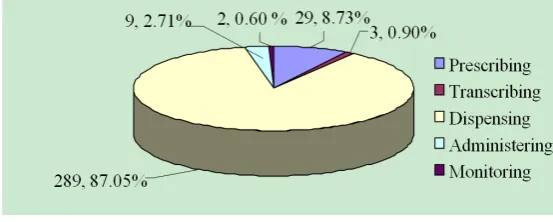
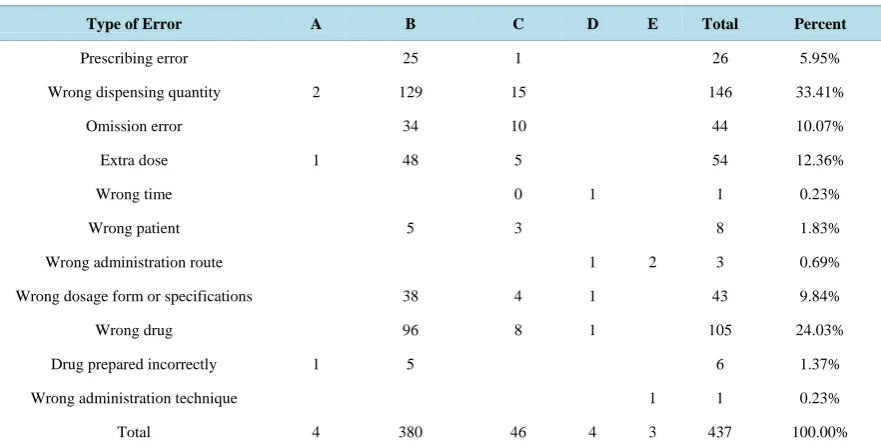
The hospital was first-class provincial hospital setting 3600-bed university teaching hospital in China. The hos-pital pharmacy receives nearly3.54 million medication orders (including outpatient prescription) and dispenses over1350 million RMB medications during one-year period. MEs included errors during medication ordering, transcribing, dispensing, administering and/or monitoring. We collected 332 cases’ medication errors prospec-tively between September 1, 2012 and August 31, 2013, the ratio of internal and out errors is 251:81. All the medication errors were categorized as harmful or not according to NCC MERP’s Index [9] and other indexes such as type of error and cause of error, it’s shown inTable 1andFigure 1. Serious MEs were analyzed for in-jury severity or potential severity. We will focus on 3 cases of lever E (NCC MERP’s Index) that may have con-tributed to or resulted in temporary harm to the patient and required intervention. There were no fatal medication errors and the limit value of injuries was 0.90% (n = 3). A total of 332 cases were categorized according to the type of medication errors (Table 2).
3. Discussion
We found that medication errors were frequent in the first-class provincial hospital, while there were fewer life- threatening and no fatal error. Human factors, systems causes and environment conditions were judged to be most frequently primary cause. 3 serious errors which resulted in temporary harm were out errors. Table 1
shows that the 3 errors falls into the category of E, andTable 2 shows that the 3 cases of error that resulted in temporary damage need treatment or intervention for patients may be the administration route or the drug ad-ministration technique in the medicine.
3.1. The 3 Errors Required Intervention to the Patient Were Some Near Misses, as Follows 3.1.1. Wrong Administration Route about Lyophilizing Thrombin Powder
[image:2.595.174.451.598.709.2]This is serious medication error about wrong administration route, if not timely give emergency treatment the patient would have life-threatening. A patient developed severe pain and arm skin darker after intravenous injec-tion of lyophilizing thrombin powder which should have been topical delivery and forbidden to injecinjec-tion. Acinjec-tion is taken to prevent the adverse event immediately with subcutaneous injection of low molecular heparin sodium 5000U. We found that nurses with insufficient responsibility and not implementation of check systems maybe the main reason. Meanwhile, the original packaging of hemocoagulase atrox for injection and lyophilizing
Table 1.NCC MERP’s index for categorizing medication errors.
Category Result of Error n Percent
No Error
A Circumstances or events that have the capacity to cause patient 4 1.20%
Error, No Harm
B An error occurred ,but the error did not reach the patient 287 86.45%
C An error occurred that reached the patient but did not cause patient harm 35 10.54%
D An error occurred that reached the patient and required monitoring to confirm
that it resulted in no harm to the patient and/or required intervention to preclude harm 3 0.90%
Error, Harm
E An error occurred that may have contributed to or resulted in
temporary harm to the patient and required intervention 3 0.90%
F An error occurred that may have contributed to or resulted in temporary harm to the patient and required initial or prolonged hospitalization 0 0
G An error occurred that may have contributed to or resulted in permanent patient harm 0 0
H An error occurred that required intervention necessary to sustain life 0 0
Error, Death
I An error occurred that may have contribute to or resulted in the patient’s death 0 0
Total 332 100%
Table 2.Crosstab of error category index (multiple select).
Type of Error A B C D E Total Percent
Prescribing error 25 1 26 5.95%
Wrong dispensing quantity 2 129 15 146 33.41%
Omission error 34 10 44 10.07%
Extra dose 1 48 5 54 12.36%
Wrong time 0 1 1 0.23%
Wrong patient 5 3 8 1.83%
Wrong administration route 1 2 3 0.69%
Wrong dosage form or specifications 38 4 1 43 9.84%
Wrong drug 96 8 1 105 24.03%
Drug prepared incorrectly 1 5 6 1.37%
Wrong administration technique 1 1 0.23%
Total 4 380 46 4 3 437 100.00%
thrombin powder were look alike, and were deposited close to each other, which made pharmacist and nurse easily dispense wrong.
3.1.2. Incompatibility of the Riboflavin Sodium Phosphate and the Glucose Injection of Sodium Potassium Magnesium Calcium
fol-lows that the doctor shouldn’t comprehend these pharmaceutical incompatibilities when prescribing likely. Meanwhile the system cannot provide technical support by which pharmacists can check prescription and nurses do not able to be detect timely, maybe lack of pharmaceutical knowledge.
3.1.3. Wrong Administration Route about Carboprost Tromethamine Injection
This is another case about wrong administration route. A patient with pregnant for three months treated with carboprost tromethamine injection, wrong intramuscular into intravenous drip, result in nausea, vomit and headaches, the adverse event was stopped by the physician timely and avoided serious consequences. Tracked the past medical records of this department we found that the doctors neglected the medication basis which should be shown in progress note. But it reflected also to doctors short of knowledge about using correctly of drug, with numerous in variety of clinical medicine in china.
3.2. Measures and Suggestions of Preventing Medication Error
The errors what is said above warn that action needs to be taken as soon as possible to keep continuous im-provement in order to prevent or reduce medication errors.
1) In terms of personnel, doctors, pharmacists and nursing staff must strictly implement the check system and turn it into jobs meanwhile they should improve their professional knowledge and skills so as to reduce human errors and ensure medication safety. It is important about conduct root cause analysis on critical incidents.
2) For the hospital, more concern and care should be given to medical workers by the hospital, lessening their burden, in order to make them energetic to work in positive manner. In the field of hostital management, the leaders should pay much attention to medication safety. The pre-warning system and strict incident reporting system should be established, and improving constantly, modern network supervision and warning method should be adopted. Pharmacy department and ward should store drugs separately and scientifically, such as high-alert medications and other special medicines should be marked obvious signs and be standardized the or-dering, storage, preparation, and administration.
3) Governments should adopt advance safe medication practices, and much advance publicity should be given, and conduct root cause analysis on critical incidents should be supportive by government, so as to provide safe medication practice recommendations and strategies for preventing ME. In addition, Drug manufacturers should be advised to make changes, such as design different drug packing which can be shown highlight instruction in accordance with different drug delivery.
4. Conclusion
In conclusion, this study in some first-class provincial hospital showed that MEs are common and cause harm to patient but tend to be less life-threatening and fatal. 332 cases’ medication errors were categorized as harmful or not according to NCC MERP’s Index and other indexes such as type of error. We focus on analyzing the 3 se-rious cases among the all MEs that may have contributed to or resulted in temporary harm to the patient and re-quired intervention, including the process and the cause and the background of the errors. The preventive ME’s measures are explored through the analysis of the causes, such as forcing functions and constraints, automation and standardization, double-checking systems, rules and policies, information and more careful working. With the further development of Chinese medical reform and continuously absorbing and drawing lessons from for-eign advanced management concept, hospital staff will be aware of the importance of reporting medication error. Medication safety self-assessment for hospital and conducting root cause analysis on critical incidents will be increasingly important to evaluate their medication safety practices. Safe medication use will require actions at all levels, and more education and research. Additional studies are needed to determine which intervention strategies are the most efficacious in this setting for preventing or reducing medication error and ensuring the safety and efficiency of drug-use.
References
[1] Kohn, L.T., Corrigan, J.M. and Donaldson, M.S., Eds. (1999) To Err Is Human: Building a Safer Health System. Na-tional Academy Press, Institute of Medicine, Washington DC.
[3] Teinilä, T., Kaunisvesi, K. and Airaksinen, M. (2011) Primary Care Physicians’ Perceptions of Medication Errors and Error Prevention in Cooperation with Community Pharmacists. Research in Social and Administrative Pharmacy, 7, 162-179. http://dx.doi.org/10.1016/j.sapharm.2010.03.007
[4] Aronson, J.K. (2009) Medication Errors: Definitions and Classification. British Journal of Clinical Pharmacology, 67, 599-604. http://dx.doi.org/10.1111/j.1365-2125.2009.03415.x
[5] Peth, H.A. (2003) Medication Errors in the Emergency Department: A Systems Approach to Minimizing Risk. Emer-gency Medical Clinics of North America, 21, 141-158. http://dx.doi.org/10.1016/S0733-8627(02)00085-8
[6] Hayley, M.V., Lauren, E.W., Jennifer, A.P., Sharon, J.G. and Manya, T.A. (2009) The Effect on Medication Errors of Pharmacists Charting Medication in an Emergency Department. Pharmacy World and Science, 31, 373-379.
http://dx.doi.org/10.1007/s11096-008-9271-y
[7] Leape, L.L. (1994) Error in Medicine. JAMA, 272, 1851-1857. http://dx.doi.org/10.1001/jama.1994.03520230061039
[8] Reason, J. (2000) Human Error: Models and Management. BMJ, 320, 768-770.
http://dx.doi.org/10.1136/bmj.320.7237.768