Brenda C. Sun
All rights reserved
INFORMATION TO ALL USERS
The quality of this reproduction is dependent upon the quality of the copy submitted.
In the unlikely event that the author did not send a complete manuscript and there are missing pages, these will be noted. Also, if material had to be removed,
a note will indicate the deletion.
Dissertation Publishing
UMI U615636
Published by ProQuest LLC 2014. Copyright in the Dissertation held by the Author. Microform Edition © ProQuest LLC.
All rights reserved. This work is protected against unauthorized copying under Title 17, United States Code.
ProQuest LLC
789 East Eisenhower Parkway P.O. Box 1346
This dissertation is set out to evaluate the effectiveness o f China’s wage and employment reforms against a major objective - the revival o f motivation among individuals to adapt to new and changing environmental demands and challenges in their jobs in the face o f intensifying global competition and increased resource constraints. It extends existing motivation research in several important ways. First, although the reforms began as early as the late 1970s and have had a profound impact on the nation’s 100 million-strong industrial workforce, their dual impact on motivation was only empirically explored fo r the first time in this study due to extremely high research barriers. Second, since motivation research tends to focus on pay systems and especially rewards, this thesis also represents the first empirical attempt assessing the simultaneous motivational impact o f wage and employment systems reform in the world.
Third, with the advantage o f an interdisciplinary approach, I developed a research model that accounts for uncertainty and risks, thus setting the model apart from existing frameworks. By testing a primary dataset o f more than 1,000 units of analysis on the proposed framework o f Environmental Perception and Adaptive Motivation
&
List o f illustrations x
Acknowledgements xii
List o f abbreviations xiii
Chapter 1 Introduction
1.1 Overview 2
1.2 Sectional Summaries o f the Thesis 7
Chapter 2 Context
2.1 Context o f China’s Employment and Wage Reforms 10
2.1.1 Strategic Overview 10
2.1.2 Historical Summary o f the Two Reforms 16
2.2 Uncertainty and Risks under “Deepening o f Reforms” 29
2.2.1 Employment Risks at The Steel Conglomerate 36
2.2.2 Compensation Risks at The Steel Conglomerate 41
2.3 Conclusion 48
Chapter 3 Literature Review: W ork Motivation
3.1 Motivation Theory and Research 51
3.1.1 Expectancy, Goal Setting, Equity, and Reinforcement 52
3.1.2 Causal Uncertainty and Between-Concept Ambiguity 76
3.2 Research on Performance-Related Pay 80
3.2.1 Theoretical Justification and Empirical Findings 82
3.2.2 Review of Impact, Objectives, and Motives 88
3.3 Research on Incentives in Chinese Industry 92
3.4 Discussion and Conclusion 102
Chapter 4 Uncertainty and Risks
4.1 Reality o f Uncertainty and Risks in the Workplace 106
4.1.1 Employment Risks for all 109
4.1.2 Compensation Risks for all 112
4.2 Research on Employment and Compensation Risks 118,
4.2.1 Study of Employment Risks 119
4.2.2 Study o f Compensation Risks 123
4.3 How Work Motivation Theory Fares under Uncertainty and Risks 127
4.3.1 Adversity and Expectancy Theory 129
4.3.2 Risk Aversion and Goal Setting Theory 130
4.3.3 Environmental Uncertainty and Reinforcement Theory 133
4.3.4 Interaction Complexity and Equity Theory 134
4.3.5 Significance o f the “Flexible Firm” for Motivation Theory 136
4.4 Discussion and Conclusion 138
5.1 Existing vs. Proposed Views o f Motivation 143
5.1.1 Assumptions about the Environment 146
5.1.2 Assumptions about the Person 151
5.1.3 Theoretical Approach 152
5.1.4 Conceptualization o f Motivation 158
5.2 A Model of Environmental Perception and Adaptive Motivation 163
5.2.1 Threat and Opportunity Perceptions and Adaptive Motivation 168
5.2.2 Proposed Concept of Threat Perception 170
5.2.3 Proposed Concept of Opportunity Perception 175
5.2.4 Testable Propositions 180
5.3 Discussion and Conclusion 182
Chapter 6 Antecedents of Threat and Opportunity Perceptions
6.1 Introduction 186
6.2 Proposed Antecedents o f Threat Perception 187
6.2.1 Risk of Noncompliance 191
6.2.2 Pressure to Perform 192
6.3 Proposed Antecedents o f Opportunity Perception 194
6.3.1 Perceived Organizational Support 196
6.3.2 Willingness to Bear Cost 197
6.4 Proposed Antecedents o f Perceived Organizational Support and 200
Willingness to Bear Cost
6.4.1 Overall Situation Enhancement 201
6.4.2 Reward Consistency 203
6.4.3 Expectancy 205
6.4.4 Organizational Commitment 206
6.5 Organizational Commitment as a Mediating Variable 207
6.6 Discussion and Conclusion 209
Chapter 7 Methods and Measures .
7.1 Methodology in a Research-Averse Setting 212
7.1.1 Research Strategy 213
7.1.2 Data Collection Preparatory to Main Study 217
7.1.3 Main Study 222
7.2 Measures 227
7.2.1 Scale Development 228
7.2.2 Measures 229
7.2.3 Reliability 237
7.2.4 Validity 240
7.3 Conclusion 247
8.2 Antecedents of Adaptive Motivation 252
8.2.1 Testing of Hypotheses 1 - 2 252
8.3 Antecedents of Threat Perception 255
8.3.1 Testing of Hypotheses 3 - 4 255
8.3.2 Testing o f Hypothesis 5 257
8.4 Antecedents of Opportunity Perception 259
8.4.1 Testing o f Hypotheses 6 - 7 259
8.4.2 Testing o f Hypothesis 8 261
8.5 Antecedents of Perceived Organizational Support 265
8.5.1 Testing o f Hypotheses 9, 11 - 12 265
8.5.2 Testing o f Hypotheses 1 3 - 1 4 268
8.6 Antecedents o f Willingness to Bear Cost 270
8.6.1 Testing o f Hypotheses 10,15 —18 270
8.7 Antecedents of Organizational Commitment 274
8.7.1 Testing o f Hypotheses 1 9 - 2 0 274
8.8 Mediating of Organizational Commitment in Adaptive Motivation 277
8.8.1 Testing o f Hypothesis 21 277
8.8.2 Final Testing o f Hypotheses 1 - 2, 21 278
8.9 The Proposed vs. Existing Models 281
8.9.1 Summary of Findings o f the Proposed Model 281
8.9.2 How It Compares to Existing Theories in Explanatory Power 285
8.10 Conclusion 289
Chapter 9 Discussion
9.1 Implications o f Key Findings 291
9.1.1 Environmental Perception and Adaptive Motivation 293
9.1.2 Superior Explanatory Power o f Threat and Opportunity 298
Perceptions
9.1.3 Factors Conducive to Threat and Opportunity Perceptions 299
9.2 Implications o f Related Findings 306
9.2.1 Role o f Existing Concepts in Adaptive Motivation 308
9.3 Limitations and Extensions 322
9.4 Conclusion 325
Chapter 10 Conclusion and Outlook
10.1 Summary o f this Research 328
10.2 Implications 332
10.2.1 Rethinking Organizational Approaches to Motivation 333
10.2.2 The Future Role o f Risks in Work Motivation Research 341
10.3 Conclusion and Directions for Future Research 346
References 349
Appendix A: Questionnaire 382
Appendix B: Questionnaire (English Translation) 388
Tables
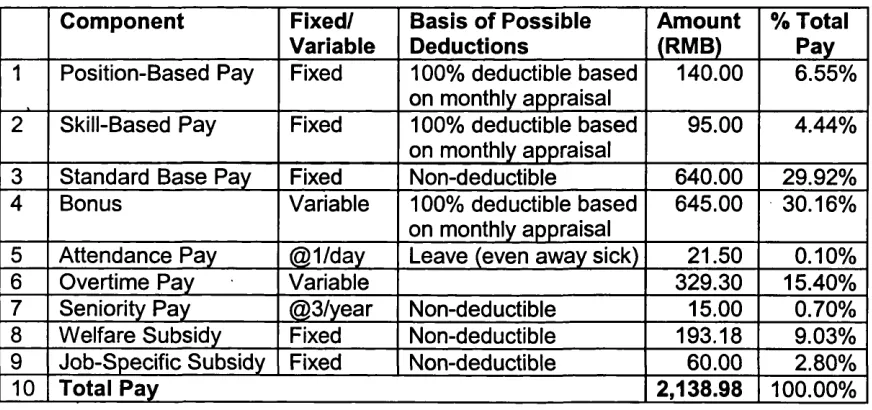
2.1 Sample Monthly Pay Slip of a Production Worker 43
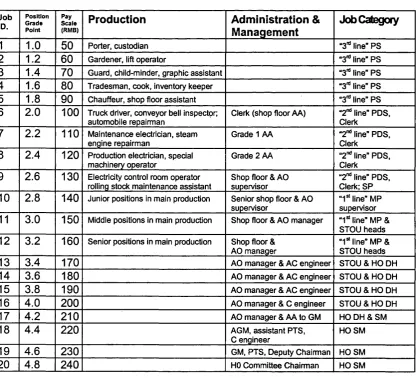
2.2 Monthly Position-Based Pay Scale at The Steel Conglomerate 44
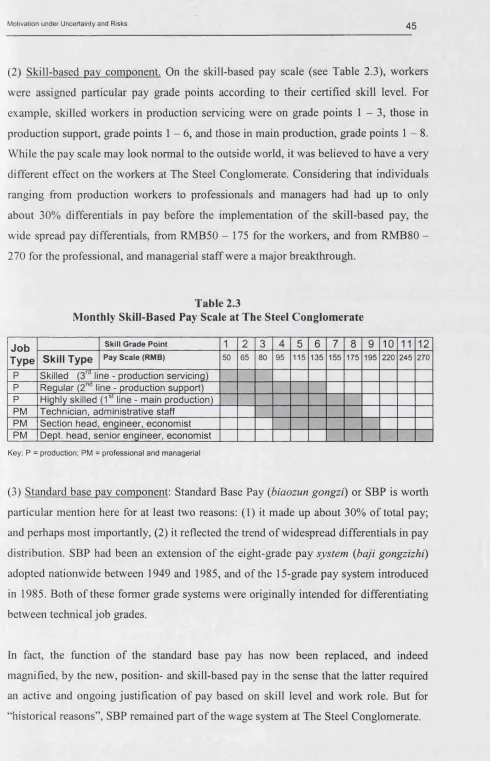
2.3 Monthly Skill-Based Pay Scale at The Steel Conglomerate 45
2.4 Monthly Standard Base Pay Scale at The Steel Conglomerate 46
2.5 Monthly Bonus and Penalty Calculations 47
3.1 Representative Studies of Expectancy Theory 56
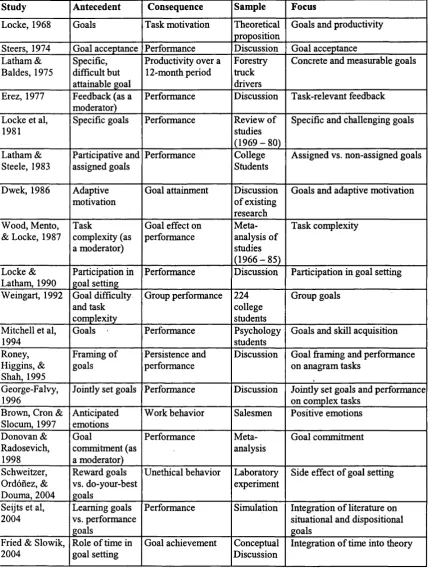
3.2 Representative Studies o f Goal Setting Theory 62
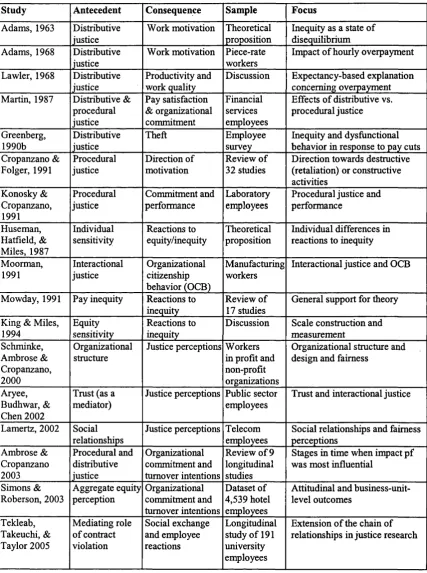
3.3 Representative Studies o f Equity Theory 67
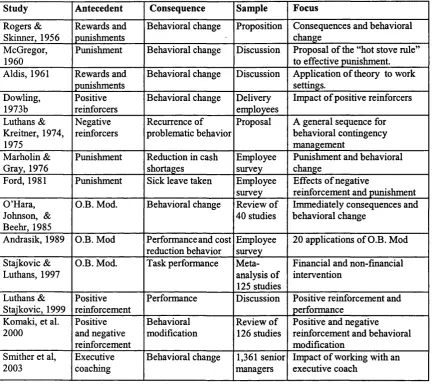
3.4 Representative Studies o f Reinforcement Theory 73
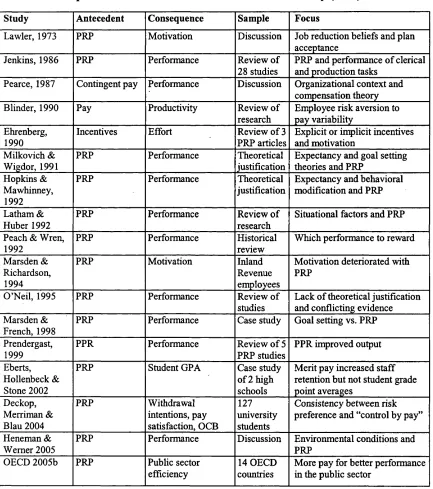
3.5 Representative Studies o f Performance-Related Pay (PRP) 85
3.6 Representative Studies o f Incentives in Chinese Industry 94
4.1 Limitation of Existing Theory in Predicting Motivation under Uncertainty and Risks
128
5.1 Differences between Existing and Proposed Views o f Motivation 145
5.2 Empirical Study o f Change in Work Motivation Research 154
5.3 Schema o f Threats and Opportunities in Social Sciences Research 168
5.4 When Reward is Not Perceived as “Opportunity” 176
6.1 Definitions of Key Variables 188
7.1 Components of Data Collection 217
7.2 Descriptive Statistics, Reliabilities, Variances Extracted, and Pearson Correlations
238
7.3 Factor Loadings for Pattern Matrix of Explanatory Variables o f Environmental Perception
242
7.4 Results of Mediated Regression Analysis 246
8.1 Results o f Regression Analysis: Antecedents o f Adaptive Motivation 254
8.2 Results o f Regression Analysis: Antecedents o f Threat Perception 256
8.3 Results o f Regression Analysis: Relationship between Risk of Noncompliance and Pressure to Perform
258
8.4 Results o f Regression Analysis: Antecedents o f Opportunity Perception 261
8.5 Results o f Regression Analysis: Relationship between Perceived Organizational Support and Willingness to Bear Cost
262
8.6 Results o f Regression Analysis: Antecedents o f Perceived Organizational Support
266
8.7 Results o f Regression Analysis: Relationship between Reward Consistency and Overall Situation Enhancement
269
8.8 Results o f Regression Analysis: Antecedents o f Willingness to Bear Cost 272
8.9 Results o f Regression Analysis: Antecedents o f Organizational Commitment
276
8.10 Final Results o f Regression Analysis: Antecedents o f Adaptive Motivation 279
8.11 Summary of Results of Regression of Dependent Variables 282
8.12 Results o f Regression Analysis o f Existing Theories: Antecedents of 287
Adaptive Motivation
9.1 Key Findings and Implications 292
9.2 Other Related Findings and Implications 307
10.1 Existing and Emergent Patterns o f Organizational Approaches to 335
Motivation
10.2 Some Characteristics of the Changing Contemporary Workplace 343
Figures
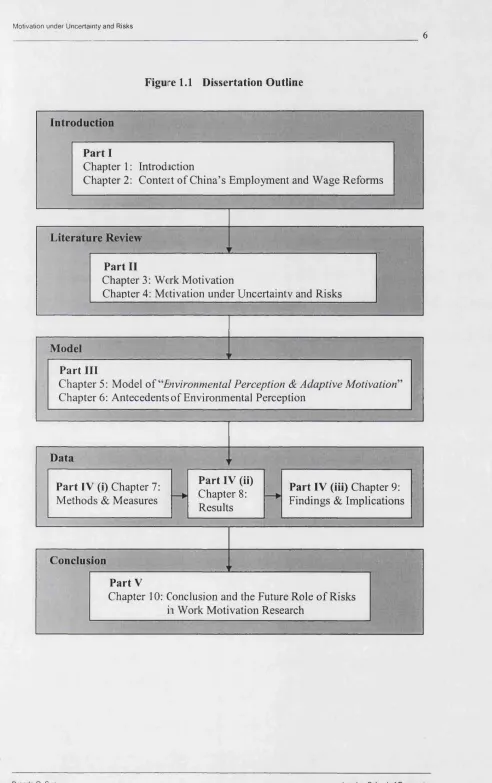
1.1 Dissertation Outline 6
2.1 Reward and Punishment System (jiangcheng zhidu) at The Steel Conglomerate
30
6.1 Proposed Antecedents of Environmental Perception and Adaptive
Motivation
189
7.1 Evolution o f my Research on China’s Employment and Wage Reforms 214
7.2 Map of the People’s Republic of China 216
8.1 Outcome in Adaptive Motivation 251
8.2 Tested Model o f Environmental Perception and Adaptive Motivation 264
8.3 Tested Antecedents o f Environmental Perception and Adaptive Motivation 284
The biggest thanks go to my thesis supervisor Professor John Kelly, who was quick to identify my strengths and weaknesses in helping me become strong, confident, and productive. Without his first-class supervision and strategic input, this thesis would have no life.
I am also indebted to my advisors and research collaborators in China, including President Yang Jingyiin ( ^ # 2? & K ), Professor Wang Lizhen ( I j t & H ) ,
Professor Dong Keyong , and the many government officials, experts,
and friends in the enterprises they brought my way to expand my knowledge and understanding as well as help and sustain me in my fieldwork. I am most grateful and privileged to have had my earlier supervisor Dr. Ray Richardson, faculty members at the Department of Industrial Relations and especially Professor Richard Hyman, Convenor of Doctoral Program, and my bubbly colleagues at LSE.
CASS Chinese Academy of Social Sciences (zhongguo shehui kexue yenjiuyuan)
CCP Chinese Communist Party {zhongguo gongchandang)*
CCPCC Chinese Communist Party Central Committee {zhongguo gongchandang
zhongyang weiyanhui)*
CBE Competition-Based Employment (jingzheng shanggang)*
COE Collective-Owned enterprise (jitiqiye)*
FIE Foreign-invested enterprise {waiziqiye)*
ICT Information and Communication Technologies
IDD Income Data Services (U.K.)
ILO International Labor Organization
ILE Independent Legal Entities {duli faren)*
IPM Institute o f Personnel Management (U.K.)
LDC Limited Duration Contract (guding laodong hetong)
JTC Job Transfer Center (juanggangjidi)*
JV Joint Venture
MNC Multinational Corporation
NMO Nonmember-based organizations (as in unionism)
PFN Pay for Needs {anxii fenpei)* (as against PFL)
PSP Position- and Skill-Based Pay (gangwei jineng gongzi)*
OECD Organization for Economic Cooperation and Development
PFL Pay for Labor {anlao fenpei)* (as against PFN)
PSP Position- and Skill-Based Pay (gangwei jineng gongzi)*
RPS Reward and Punishment System (jiangcheng zhidu)*
RMB Unit of Currency {renminbi)*
RSC Reemployment Services Center {zaijiuye fuwuzhongxin)*
SSB State Statistical Bureau {guojia tongjijii)*
STOU Second-Tier Operation Unit (within the SOE) {erji danwei)*
SOE State-Owned Enterprise (guoyou qiye)
SBP Standard Base Pay {biaozun gongzi)*
SSB State Statistical Bureau {Zhongguo tongjibu)*
TVE Township and Village Enterprise {xiangzhen qiye)*
WRPS Worker Representation and Participation Survey (U.S.)
WTO World Trade Organization
Chapter 1
Introduction
This chapter consists o f two components. Section 1.1 provides an overview o f the
research question and the theoretical background o f the research framework. Section 1.2
presents the sectional summaries o f the thesis, which is organized into five parts
consisting a total o f 10 chapters.
1.1 Overview
R esea rch Q u estio n
My research, entitled, “Motivation under Uncertainty and Risks: Evaluation o f the Effects o f China s Employment and Wage Reforms”, is aimed at exploring the individual-level impact of the accumulative employment and wage systems reform over the last two
decades. Although the reform approach has been incremental and experimental, the
reform measures represent some o f the most extensive and radical changes in
employment and wage policies. First, the reforms affect China’s 100 million-strong
“army of workers” (zhigong duiwu), representing the largest industrial workforce o f a nation to ever to join the WTO. Second, they brought about an unprecedented level of
instability and turbulence in the organizational setting o f the state enterprise. In essence,
these changes involve a fundamental shift from lifetime employment and need-based egalitarian pay to jobs that can be terminated and wages that are increasingly based on
skill, responsibility, and results.
The “Long March” in Search of an Answer
The idea for this thesis, or more accurately, the wage reform aspect of it, began to
germinate in the latter part o f 1990s when public debates about the use o f incentives in
the Chinese industry intensified. I embarked on what at first glance appeared to be a
straightforward undertaking as I sought to understand, as numerous studies in the West
have done, the motivational impact of pay system change amongst the Chinese workers. I
set out to fill the gap in the lack o f motivational studies on the wage reform at the
individual worker level, as studies in this area tended to explore incentives and labour
productivity at the firm level. My biggest challenge was to overcome the barriers of entry
to research on workers in state industry, which has principally maintained a closed-door
policy to academic research.
I managed over a period o f three years with various direct and indirect contacts from my
former business and advisory roles in the government and associated think tanks to
observe the motivational phenomenon in state industry, and principally at enterprises in
the oil, petrochemical, and steel industries, dubbed the “strategic sector” (cheluhangye).
It emerged that the original framing of my research question did not fit the evolving
realities. In particular, it was not only the wage reform that mattered, but perhaps more
so, the employment reform. And it was not only the opportunities o f better pay under the
“pay-for-labor” system (anlao fenpei) that mattered, but perhaps more so, the threats of job loss under the “competition-based employment” system (jingzheng shanggang).
This realization, which had not been captured in existing literature on Chinese business
studies at the time, forced me to reshape my research question to encompass both the
wage and employment reforms and subsequently engage with the examination o f a whole new range of literature in the broader social sciences discipline to bring in a new
perspective to help understand motivation under uncertainty and risks.
Motivation under Uncertainty and Risks
Motivation is subject to varying environmental influences such as changes on the
employment and wage scenes, and structural reform of industries. Despite positive
developments in many industrialized countries and the quick pace o f recovery in East
Asia from its financial crisis, the global employment situation continues to pose
formidable challenges in terms o f employment insecurity and earning instability (ILO
2001). In particular, the use o f contingent labor, i.e., workers on limited duration
contracts and those hired through temporary work agencies, have increased considerably
since 1990 in the U.S. and in most European labor markets (Bergstrom and Storrie 2003).
Furthermore, “pay at risk” or variable pay, once a feature unique to executive and
salesman compensation, is becoming an integral part o f compensation for ordinary
workers (Gottschalk and Moffitt 1994; Turner 2001). Despite Pearce’s (1987) call to
address these issues and the ‘insecurity thesis’ evident in the study o f the global
workplace (Heery and Salmon 2000), research on work motivation remains focused on
rewards in presumably stable and secure settings. The extent to which a framework goes
beyond stable and secure settings to account for employment insecurities and
compensation risks in what Beck (1999; 2000) refers to as the “world risk society” is as
important to understanding motivation in the West as among workers in the Chinese
industry, for whom mere survival is a daily battle and adversity a prevailing condition
under the ‘deepening of the economic reform’ (shenhua gaige).
Theoretical Background
Starting points and main definitions. In search o f a theoretical framework to explain
the Chinese phenomenon that existing motivation theory cannot explain, I adopted an
interdisciplinary approach. I explored perspectives on uncertainty and risks by drawing
upon the risk literature. Based on further insights from research in evolutionary
economics, strategic management, international conflict, and negotiation, I put forth a view o f “environmental perception and adaptive motivation”.
The proposed view differs fundamentally from the conventional perspective, which tends
to focus on the individuals within, rather than forces o f the environment confronting
them. In particular, the existing view suggests that “the emergence o f a need, desire, or
expectation generally creates a state o f disequilibrium within the individuals which they
will try to reduce” in order to be restored to a state o f equilibrium (Steers and Porter
1 9 9 1 :6 -7 ).
The existing view is helpful for understanding motivation in stable settings where
changes are infrequent, discontinuous, and intentional. The emphasis on the individual,
however, becomes problematic in more complex and rapidly changing settings such as
the Chinese workplace, where the environment seems to be the source o f multiple
selective pressures that bear on individual survival and success (cf. Lane 1991). Under
these circumstances, it seems more beneficial to explore motivation not strictly as a
process of equilibrium restoration within the person, but from the broader view of
individual adaptation to continuous environmental change (Nicholson 2001), in other
words, the view of adaptive motivation.
Following the above reasoning and based on the work o f Foster (2000), Hanna and
Freeman (1989), Klinger, Barta, and Mahoney (1975), Kuhn and Beam (1982), and Rook
(1987), I define adaptive motivation as the motivation to adapt to new and changing environmental demands and challenges with the purpose o f increasing one’s chances o f survival and success under uncertainty and risks.
Environm ental perception. Central to the proposed framework o f “environmental
perception and adaptive motivation” are the twin concepts o f “threat perception” and
“opportunity perception”. My definitions of these concepts are based on the work of
Boulding (1978), Cyert and March (1963), Fredrickson (1985), Jackson & Dutton (1988),
Singer (1958), and Tedeschi (1970).
I define threat perception as the perception o f an environmental cue, situation or set o f circumstances as presenting a risk to the individual’s current interests in such a way that it is feared, i f not acted upon efficiently, will impinge on one ’s survival.
I define opportunity perception as the perception o f an environmental cue, situation or set o f circumstances as presenting a potential o f working toward the individual’s advantage in such a way that it is hoped, i f acted upon efficiently, will further one’s growth and advancement.
The proposed perspective suggests two distinct forms of motivation: (1) the motive to
protect what one currently has (e.g., a job) is based on the fear o f loss, which results in “protection motivation” (Rogers 1975; Arrow 1996); and (2) the motive to achieve what
.one does not yet have (e.g., a promotion) stems from the hope fo r gain, which results in “achievement motivation”1. The fundamental idea animating this distinction is quite
simple; it is that employees may not necessarily be motivated by the hope for gain (alone)
but (also) the fear o f loss. What then lie at the heart o f the proposed analysis of
motivation under uncertainty and risks are the considerations o f “Can I afford not to?” and “Is it worth it fo r me?”
1 This is different from Atkinson’s (1964) definition of achievement motivation as a personality disposition.
Figure 1.1 Dissertation Outline
Introduction
P a r ti
Chapter 1: Introdiction
Chapter 2: Context o f China’s Employment and Wage Reforms
L iterature Review
P art II
Chapter 3: Wcrk Motivation
Chapter 4: Motivation under Uncertainty and Risks
Model
P art III
Chapter 5: Model o f “Environmental Perception & Adaptive Motivation’ Chapter 6: Antecedents o f Environmental Perception
Data
Part IV (i) Chapter 7: Methods & Measures
Part IV (ii) Chapter 8: Results
Part IV (iii) Chapter 9: Findings & Implications
Conclusion
Part V
Chapter 10: Conclusion and the Future Role o f Risks ii Work Motivation Research
1.2 Sectional Summaries of the Thesis
As shown in Figure 1.1, the thesis is organized into five distinct yet interrelated parts and
contains 10 chapters in total.
P a rt I: Introduction. Covering Chapters 1 and 2, Part I is an introduction to the
dissertation. Chapter 1 provides an overview o f the research question, the theoretical
background o f the research framework, and sectional summaries o f the thesis. Chapter 2
discusses the context o f China’s employment and wage reforms.
P a rt II: L iteratu re review. Consisting o f Chapters 3 and 4, Part II o f the thesis provides
the review o f the literature. In particular, Chapter 3 reviews the work motivation
literature from the turn of the 20th century, with special interests in the burgeoning of
North America-based theories o f the 1960s and 1970s that continue to dominate today’s
research. Chapter 4 reviews the research in other social sciences disciplines that
addresses the important and pressing issue of uncertainty and risk, which is neglected in
much o f the current work motivation literature.
P a rt III: Model. Covering Chapters 5 and 6, Part III o f the thesis deals with the
interdisciplinary development of a research model for understanding motivation under
uncertainty and risks. It represents the most significant contribution o f this dissertation in
that it does not only facilitate the study of employment and wage reforms on Chinese soil,
but also enables the empirical investigation of work motivation in global organizational
contexts that are characterized by uncertainty and risks. Chapter 5 lays down the
backbone o f the model on environmental perception and adaptive motivation. Chapter 6
expands on the core propositions to encompass the antecedents o f threat and opportunity
perceptions in a completed model consisting o f 12 variables and 21 hypotheses.
P a rt IV: D ata. Consisting o f Chapters 7, 8, and 9, Part IV presents the data of the
empirical work o f the thesis. In particular, Chapter 7 discusses (1) the methodology for
breaking through various research barriers to evaluate the reforms, and (2) the measures.
Chapter 8 presents the results. Chapter 9 is a detailed discussion o f and reflection on the
findings, which confirm the superior explanatory power o f the proposed model vis-a-vis
that of existing frameworks, which were also tested with the same data.
Part V: Conclusion. The Concluding chapter summaries the study, discusses its
implications, and highlights its major contributions. Mindful of the phenomenon of
unprecedented changes in the business environment that bear on the organization and the
individuals within, I provide a re-examination o f organizational approaches to
motivation. In light o f the prevalence of uncertainty and risks in today’s workplace and
society at large, the chapter closes with a thought-provoking assessment of the future role
of risks in motivation research.
Chapter 2
Context
This chapter is divided into three sections. The first section provides an overview of
wage and employment reforms from both a strategic and a historical perspective. The second section discusses specific aspects o f reforms as implemented and advanced at my
research organization. The final section concludes.
2.1 Context of China’s Employment and Wage Reforms
As revealed by the title o f this thesis, the research setting concerns China’s employment
and wage reforms. In light of the complexity of the subject at hand, I shall approach the
discussion in two parts. The first part is taken up in Section 2.1.1 and represents a
strategic overview of the reforms. The second part is taken up in Section 2.1.2 and
covers major events in the processes o f the two reforms.
2.1.1 Strategic Overview
It is important to note for the analysis in this section that where references are not
provided it is due to the fact that the information has been obtained from personal
interviews and visits with policy makers and the like, and that the same information was
not available in a published format in the public domain. As such, this analysis serves as
an executive summary o f the “strategy inquiry” component o f my research discussed in
Section 7.1 - Methodology in a Research-Averse Setting.
From the beginning of economic reform in the late 1970s to “deepening o f reform”
{shenhua gaige) from the 1990s onwards, individual workers, like the enterprises they worked for, were confronted with an increasingly uncertain and risky future (cf.
Ginzberg, 1985). Essentially, individuals would know no precedence and thus have no
basis to ascertain as to where they might end up in the “mounting waves of reforms”
(gaigede dachau), referring to the intensifying processes o f natural selection and elimination at both enterprise and individual levels. Before setting out to analyze how
individuals responded to the opportunities and threats brought about by the employment
and wage reforms in particular, it is necessary to assess the immediate cause that
prompted these reforms.
In the beginning o f China’s economic reform in 1978, state-owned enterprises (SOEs)
accounted for nearly 80% of gross industrial output. By 1998, their percentage of output
by value had fallen to less than 25%. The problematic performance o f the state industry
was reflected in the increase in the number o f loss-making enterprises. From 1985 -
1998, for example, there had been a three-fold increase in the number o f loss-making
SOEs from 6,700 to 24,000 (see Field, 1992; Ma, 2000). The root o f the unsatisfactory
performance o f SOEs has largely been the absence of ap economic rationale in
enterprise management and the state’s adoption of a “closed door policy”, which
effectively protected the SOEs from the forces o f an open market. With the SOE’s being
totally dependent on subsidies for economic survival, the exhaustion o f state budget was
an inevitable outcome.
The year 1998 saw a major turning point in the history o f reforms at the enterprise level.
In an attempt to hasten the reform process, the then Premier Zhu Ronji had set a three-
year timeframe for SOE’s to either “fold up” or redeem themselves (sannian jiekun) by way o f “reform, reorganization, transformation, and strengthened management” (see
Holz, 2003; Ma, 2000; Tang, 1998). This mandate encompassed all aspects o f enterprise management whereby employment and wage distribution were among the priorities for
large-scale structural adjustment and correction. Although the cutoff date had since been
re-negotiated, revised, and stretched according to the “peculiar conditions and circumstances o f individual enterprises” (changqing), there was to be no turning back to the old world of enterprise welfare. In other words, this was where the highway of unparalleled uncertainty and risks began.
The Old and New W orlds
The change to the new world involves the transition from a planned economy to a
“socialist market economy” (shehuizhuyide shichangjingji) in which the means of production would be retained by the state but the control o f wages, prices, employment,
and production would be gradually relaxed and a private sector would be allowed to
develop in the interstices o f the state socialist economy (see Clarke, 2005). A way of
understanding what went on in the old world and how it made the transition to the new
particularly challenging is the evolving relationships between the State and the
enterprise, and the enterprise and its workers. In the pre-reform setting, for example, the
enterprise was viewed not as an economic entity per se but a political establishment
whereby supply and demand o f raw materials and finished goods as well as wage setting
and the allocation and deployment of personnel and staff were all controlled by the State.
The enterprise manager (changjingli) or head o f the enterprise was responsible for the fulfillment o f production quotas set by the State but had no say on other aspects of
management such as strategy, business development, human resources, R & D, and
marketing and distribution. Although managers might have a certain degree o f influence
on the internal reallocation of human resources and the types and quantities o f industrial
output to be produced, it was the enterprise’s Party Secretary (<dangshuji) who had the ultimate authority in prescribing its economic activities and political objectives.
Since the appointment of enterprise managers was made on the basis o f political
credentials and largely determined by their personal relationships with the State, it was
not unusual for a manager to receive a promotion despite the fact that his enterprise was
in the red or on the verge o f bankruptcy. By the same token, the contrary could also be
true, and that is, a manager could get a demotion regardless o f his demonstrated ability
to revive or transform an enterprise if he was after all not politically favored by the
central government.
In the earlier stage o f the reform process, politically influential managers who had a
good relationship (guanxi) with the state would typically also be assigned “sweetheart deals” and have their enterprises’ success measured against a different, if not mysterious,
set of criteria that was out of line with the rest of the industry. In sum, it seems fair to
conclude that notwithstanding the extent o f organizational performance or professional
competence o f enterprise managers, their role in relation to the state was primarily
submissive, if not also totally passive, except for the minority o f individuals who were in
a position to exert their influence through political means.
In the late 1990s, with increasingly grave and unrelenting budget constraints and the
subsequent resolve of the state to deepen the reforms, dynamics o f the relationship
between the State and enterprise began to experience a sea change. Enterprises were to
continue to submit to the arrangements o f the state, but they could no longer depend on
it for their survival. And while the power struggle between the enterprise manager and
the enterprise Party Secretary persisted, the emphasis in management had taken on an
evident shift from political concerns toward economic efficiency. Instead o f being
paternally protective o f the state industry, the state was now seen to make an
unprecedented move o f transferring the risk of economic failure to the enterprises
themselves. For example, the enterprise wage bill was from now on determined without
exception by productivity rather than by headcount. In this spirit, the state might provide
no coverage at all for redundant staff or redundant anything. As their criteria indicate,
these measures were designed with profound attention to reducing the waste caused by
the entrenched mentality o f communist-style entitlement and non-accountability at the
enterprise level.
Where the cycle of risk transfer led us. Since the ailing state industry had no way of
absorbing the economic risks transferred by the communist-turned socialist-market state, these risks were in turn channeled, albeit reluctantly, to the industry’s 100 million-strong
workforce. A distinctive feature o f such risk transfer was the new form the relationship
between the state enterprise and its workers took.
In the pre-reform era, workers had always been ideologically referred to as the “masters
o f the enterprise” {qiyede zhurenweng). Generations o f men and women from the same immediate and extended families typically toiled and labored at the same enterprise.
Their bond with the enterprise could best be described as relational (cf. Rousseau, 2000)
in the sense that (1) the enterprise was committed to the workers to the extent that the
latter were guaranteed lifetime employment, egalitarian wages, and cradle-to-grave
benefits based on the communist ideology o f “to each according to his needs; from each
according to his ability”; (2) in reciprocation the workers were committed to the State,
which the enterprise represented and acted on behalf o f in multiple political, social, and
economic capacities; and (3) the relationship was stable and deep-rooted.
It was not until the nationwide introduction o f limited duration contracts in 1995 that
workers found themselves suddenly identified by the state as “employees” (guyuan). Besides being imposed this new and unfamiliar identity, the workers were confronted
with the yet more unfamiliar, and indeed shocking, reality o f risks in employment and pay. Given that the industry had an admittedly high redundancy rate o f 40 - 60% and the
social net or unemployment insurance system was only in its infancy (Sun, 2000b), it
seemed that such risks in their class and magnitude would certainly have a hold on the
vast majority of the workers, whose skills were either below satisfactory standards or
altogether non-transferable to the non-state workplace. What was uncertain but worth
assessing from both a strategic and an academic point o f view was the direction and
extent o f the workers’ subsequent response in motivation, which might hopefully, as
reformers had intended, translate into productivity to help revive the state sector.
A critical consideration in this regard was the peculiar conditions and circumstances of
individual enterprises” (changqing) as they had a direct and immediate bearing on the workers’ prospects for continued employment and pay as well as other impending risks
they were made to bear. Particularly, enterprises that were in the red or faced with a
forced merger or worse yet, the fate of imminent bankruptcy, would least likely see a positive outcome in motivation. In fact, with an emphasis on downsizing and
restructuring whereby production would likely be severely interrupted, motivation could
hardly be an immediate concern.
Putting the issue o f motivation aside, a popular interim solution to the workers’
predicament, as I had witnessed on numerous occasions while roaming the streets of
Beijing and other parts o f Northern China, was for individuals to be given surplus
materials and products by the ailing enterprises they worked for to sell and hawker off
for profit. In more extreme cases where workers were not likewise pacified, symptoms
of social unrest were quick to emerge. Indeed, there had not been a lack o f reports and
anecdotes in the press concerning the workers’ dramatic reactions to back pay and
layoffs, especially in their display o f anger and aggressive behavior toward enterprise
managers and the so-called culprits o f their misfortune (see Cai, 2002; Tang, 1998).
From a strategic point o f view, these issues would rise above the level of the enterprise
for want o f solutions at the societal level. They are nevertheless given attention at this point in my discussion for two important reasons. First, what went on at the macro level
and particularly around the workers had a profound effect on how they perceived the
challenges in their own immediate environment. This is in line with Harvey’s (1966)
argument that adaptive activity is "knowledge-motivated" whereby the individual is
concerned first and foremost with searching and scanning for cues in the face of
environmental complexity and change, interpreting them so as to know where they
stand. Second, in order to more accurately process and decode the complex issues
therein, as the researcher I felt the need to be able to also see the context as the
policymakers saw it and as those affected would likely see it. Empathy then became a
key to my understanding.
Following up on the issue o f “where the cycle o f transfer risk led us” at enterprises where production remained relatively normal and workers were still paid continually
regularly, is the challenge o f getting these same individuals to come to work more
consistently daily, perform more effectively on the team, be willing to upgrade their
skills and even take on more responsibilities, and in all, adapt to the new and
increasingly challenging demands in their jobs.
However, incentives or bonuses (jiangjin) had since the beginning o f wage reform been distributed more or less equally rather than made contingent on performance (see Sun,
2000a for a review). This ironically resulted not so much in an increase in work motivation as an escalation in pay expectations both financially and in kind and the
subsequent phenomenon o f excessive labor remuneration across the state industry (e.g.,
see Gang & Woo, 1996; Sachs & Woo, 1997), which by 1988 were fueling both cost
and demand inflation (Howe, 1992). The unprecedented categories and level of risks
brought about by “deepening o f reforms” and especially employment reform thus
seemed to offer an ultimate, decisive solution to the much intended but so far little
achieved objective o f wage reform in inducing work effort solely by way of rewards.
For with the magnification of employment uncertainty and compensation risks came the
long-awaited, and indeed even now hurried, change in the entrenched communist
workplace mentality o f “misbehavior with no consequence”. Unarguably, the
competition-based reforms presented the biggest blow to “free riders o f the former need- based systems” (jideliyizhe), that is, those who did not manage to reciprocate with the parallel conviction o f “from each according to their ability” and subsequently stood to
receive something for nothing. At the same time, the new systems also created some of
the most heartwarming opportunities especially for those who were already convinced o f
their responsibility to contribute to the success and advancement o f the enterprise and
the state and/or the need for personal fulfillment and recognition.
Despite uncertainty and risks, the setting presented a favorable set o f prospects for the
revival of motivation. To begin with, the principle of “survival o f the fittest” (shizhe shengcun) governing the new employment and pay systems appeared conducive to self regulation and discipline. But that is not enough. To facilitate adaptive motivation and
r
performance also requires the provision o f organizational support to help individuals
succeed in the face o f new challenges in their jobs and not just in political advancement
and indoctrination, as was the case before. Turning now to the chapter’s thematic section - Historical Summary o f the Two Reforms, the analysis should improve understanding of reform and accompanying measures, covering a 20-year span from its initiation in 1978
to its culmination in 1999.
2.1.2 Historical Summary of the Two Reforms
A central dilemma in research, as pointed out by Lounamaa and March (1987), is the
mismatch between the analytical capabilities of the researcher and the complexity o f the
environment. For instance, the temptation to apply the same assumptions and decision
rules that seemed valid and sensible in familiar and/or more simplistic environments, if
not consciously resisted, could lead to the partial, if not total, misinterpretation o f the
phenomenon at hand and the drawing of hasty conclusions thereof. My strategy of
guarding off this tendency whilst operating in the complex Chinese reform environment
was to develop, as a prerequisite to analysis, an in-depth understanding o f the major
events in the country’s political and economic development that led to the reforms rather
than yield to a “snapshot” approach to data processing, which could have offered the
advantage o f speed but not quality.
In line with this strategy, I shall proceed with the discussion in this section by first
highlighting the challenges facing the country from more than half a century ago to the
time prior to the deepening of the reforms in the latter part o f the 1990s. In 1949, in particular, upon the end of the civil war between the Communist Party and Guomindang
and the founding of the People’s Republic of China or “new China” (xinzhongguo), the pressing concerns for both the state and its people were the reestablishment o f social
order and the guarantee of “a bowl o f rice” for all. It was with these issues in mind that
the national policies o f zero employment by way of low wages (Wang, 1999) or “low
wages, employment for all” (digongzi, quanminjiuye) were contemplated.
With the implementation o f these policies in the poverty-stricken setting o f the new
republic, individuals received low, egalitarian wages and meager living subsidies but
were all guaranteed lifetime employment. Based on the Soviet model at the time (see
Frazier, 2002; Howe, 1992), the country’s manpower planning at the national level and
human resources management at the micro operational level were planned and
controlled by the state. Individual workers, intellectuals, and peasants alike, simply
answered to the call of the Central Communist Party (or hereafter simply referred as the
“Party”) in landing a job wherever their contribution and sacrifice were needed. The
relationship between the enterprise and its workers was compatible to that between the
traditional Chinese parent and child - the latter were cared for in virtually all aspects of their economic, social, and domestic lives.
With the enticement o f political and moral incentives on the one hand and piece rate and
bonuses on the other, morale and work motivation were said to be at an all-time high
especially during the so-called post-war period from 1949 - 1966. As explained to me by a leading Chinese scholar, the workers were motivated to the extent that they
competed with each other on the basis of giving oneself to the Party and the State no matter how trivial, insignificant or trying their calling might be, thus the widespread
aspiration, “May I be a nail that never rusts!” (zuoyigen yongbushengxiude luoshiding).
Events, however, took a dramatic turn from 1966 - 1976 during the Cultural Revolution
or “ten-year disorder” (shinian dongluan), when the focus o f activities in the workplace was shifted from industrial production to class struggle. Financial incentives, despite
being nominal, were now condemned as “material poison” by the extreme left wing
(jizuopai) of the Party. From this time up to the early stage o f economic reform in the late 1970s and including a good part o f the 1990s, individuals seemed to take on a
remarkably different attitude toward work. In particular, negative economic phenomena,
such as absenteeism, inefficient use o f working time, reluctance to learn job skills, and
high wastage o f energy and raw materials could be observed at the shop-floor level in
almost every state enterprise (Holton, 1990; Zhu & Dowling, 1994).
The following popular workplace jingles, “I t ’s All the Same” (yigeyang) and “Are you OK?”(nixingbuxing), vividly capture the spirit of helplessness and sarcasm among the workers as to how need-based employment and compensation systems had evolved over
time to result in the lack of recognition for individual differences in contribution at work
and the lack of objectivity in performance evaluation:
It’s all the same {yigeyang)
It’s all the same to work or not to work (zuoyubuzuo yigeyang)
It’s all the same to work hard or not to work hard {zuoduozuoshao yigeyang)
It’s all the same to do well or to do poorly (zuohaozuohuaiyigeyang)
Are you OK? {nixingbuxing)
Are you OK? {nixingbuxing)
You are if (the boss) says you are, even if you aren’t {shuonixingjiuxing buxinyexing)
You aren’t if (the boss) says you aren’t even if you are {shuonibuxing jiubuxing xinyebuxing)
Problems such as these were in turn manifested in low productivity and efficiency. For example, as explained to me in interviews with the government ministries and confirmed
the case at enterprises I had visited with (see Sections 7.1.2 and 7.1.3), typically the
production frontline would be understaffed while the supporting and backroom
operations, overstaffed, due to differences in workload and labor intensity. At length, the
efficacies of wage and employment policies were to be rigorously reexamined by central
policymakers against the evolving political and economic objectives o f the country. In particular, the prospects for an improving economic situation for the emergent socialist-
market state would depend largely on how quickly (or slowly) various ideology-based
adjustments in the employment and wage policies would be received or even once again
embraced with fervor and a sense of commitment by members o f its workforce.
Increm ental and experimental approach. In the following, I shall proceed with a
chronological summary o f the two reforms, beginning with wage reform, which was
initiated at the time of economic reform in 1978. It is important to note that, due to the
uneven economic development of geographical regions across the country and its
industry, reform measures were typically introduced on an experimental and incremental
basis often taking up to five to ten years, if not longer, to warm up to at test sites
(shidian) and follow through at other select enterprises where peculiar conditions and circumstances o f the select region, industry, economic zone, and enterprise were
considered by policymakers as feasible to begin with and preferably also among the
most conducive to success in implementation.
Geographically, this has special relevance for inland regions or the hinterland (see
Nolan, 2001) and especially the “big northwestern region” (xidabei), which has been much less economically nourished and developed in contrast to the coastal cities or
southern regions in general (see Minematsu, Sakata et al, 1998). The same may be said
o f industries and enterprises in the north, which were among the most severely affected
in financial turmoil during industrial restructuring and other trying periods o f enterprise
reform (Tang, 1998). This is essentially the reason for some of the dates given
previously and yet to be given in relation to the reforms in this analysis to appear
indecisive on the surface, being necessarily accurately framed in a manner o f speech of
“by”, rather than “in”, a particular year or period. As such, unless the new policies were
enforced legally and referred as “national”, one need not assume that the introduction
represented blanket or instant coverage for all enterprises or geographical locations.
The incremental and experimental approach to wage and employment reforms is
strategically congruent with the economic reform policy set out by the late premier Deng
Xiaoping, who proclaimed the determined departure from a communist economy by
boldly suggesting, “Let’s allow a portion of the population take lead in the creation of
wealth (according to their own strengths and abilities)” (xianyang yibufenderen fuqilai)
(Deng, 1987, 1989). As was imparted by policymakers and shared by enterprises and
workers alike, these reforms were first and foremost about “change o f mindset”
(guanniande zhuanbian) or “thought reform” (sixiang gaige) in preparing the hearts and
minds o f individuals to change, and in particular, from need-based egalitarianism to
competition-based adaptation and survival.
Wage Reform (ongoing since 1978)
The wage reform was launched in 1978 as an attempt by the State Council to revive
work motivation and turn around enterprise performance, which were believed to have
reached a rock-bottom level at the end o f the Cultural Revolution. The reform has been a
major component o f China’s economic reform, which represented a clear departure from
the totalitarian economic policy that was predicated on political priorities to the
socialist-market economic policy that was to be geared toward the revitalization o f a
stagnant economy (Sun, 2000a).
The reform strategy for the revival of the state sector, as mapped out by Deng Xiaoping, the then Party Chairman and “chief architect o f reform” (geigede zhongshejishi) for the next two decades, was to “install a competitive mechanism within the enterprise”
{yingru jingzhengjizhi), which would mirror the dynamics o f market forces and operate according to the reform principle o f “survival of the fittest”. Importantly, it was expected
to facilitate the conversion among workers from the former communist mentality of
need-based pay to a new style o f competition-based wage distribution.
As explicated by Liu and Lian (1994) and Takahara (1992), such approach consisted o f
three main components: (1) the advancement o f autonomy in internal pay distribution at
the enterprise level (qiyezizhu fenpei); (2) responsiveness to market supply and demand
(shichangjizhi jueding); and (3) governmental supervision, regulation, and control at the macro-economic level (zhengfu jiandutiaokong). As such, throughout the period o f the ongoing reforms, polices were targeted toward both the determination o f wage bill at the
enterprise level and the distribution o f pay at the individual worker level. In both cases, the creation o f enlarging differentials on the basis of contribution was crucial.
When the wage system was more substantially reformed in the mid-1980s, progress was
slow. By the early 1990s, however, several significant changes had occurred vis-a-vis
matching rewards with skills and training, effort and productivity (Warner, 1995).
Although the enterprise wage bill remained a contractual arrangement between the state
and the enterprise, the latter was now given a certain degree o f autonomy in wage
distribution corresponding to the enterprise’ operating conditions and circumstances.
Pay-for-labor (PFL). A common strand in the complex tapestry o f reform policies and
measures was the fundamental shift in the ideology o f distribution from the pre-reform
principle of “to each according to his needs” or “pay for needs” (anxii fenpei) to the reform principle o f “to each according to his contribution” or “pay for labor” (anlao fenpei), which was adopted as a means to “unleash (labor) productivity” (jiefang
shengchanli) and improve the living standard o f the masses” (Deng, 1987).
Pay-for-labor was about rewarding contribution, which was not necessarily accounted
for on the job, as would normally be in the case of pay-for-performance schemes in the west. Work contribution (laodong gongxian) in the Chinese context referred primarily to the skill required of and responsibility vested in a job, as manifested, for example, in the
form o f position- and skill-based pay {gangwei jineng gongzi) for manual workers. Among professional and managerial staff, however, pay-for-labor schemes would more
likely involve incentive pay and performance bonuses that bore a closer resemblance to
pay-for-performance schemes in the west (Sun, 2000a).
During the more mature stage of the wage reform when the total wage bill o f the state
enterprise became more closely linked to enterprise performance, and personal income
in turn more closely linked to contribution at work, the term “labor” has also come to
mean individual contribution at the individual level, as could be measured by the state-
recommended wage system o f 15 technical grades (among many other alternative
methods). In 1990, the state issued further guidelines on the enhancement of wage
distribution along the finer lines o f position and skill levels. As the state continued to
allow a high degree o f autonomy in the actual formulation o f internal wage policy and
the administration of wages within the enterprise, the concept of work contribution at the
individual level would translate not just into labor intensity or technical competency, but
also job responsibility or performance.
O f the various reform policies, six are particularly noteworthy:
1. Restoration of piece rate and incentives. Major policies o f the early reform period
from 1978 - 1983 included the restoration o f piece rate and incentive schemes (liu and
Lian, 1994). In 1978, the state council introduced an incentive guideline of 10% - 12%
of basic wage. The following year, enterprises were encouraged to set up an incentive
fund from retained earnings. The fund was intended for differential distribution to
reward workers who deserved a merited pay increase. In 1981, incentives were
recommended to increase again, this time, to 16.7% o f basic wage or the equivalent of
two months’ salary.
2. “ Floating wage system”. As there was no strict control from the Party administration
as to how or how much had to be allocated as the incentive portion o f pay, enterprises
experimented with three major categories o f incentive pay or “floating wage
systems”(fudong gongzizhi): (1) “small float” (.xiaofudong) by which 20% o f the total wage was assigned as a floating wage to be pegged to worker contribution and enterprise performance; (2) “medium float” (zhongfudong) by which 50% o f the total wage was similarly linked; and (3) “complete float” (chuanfudong) by which the floating wage entirely substituted the basic wage (Liu & Lian 1994). In other words, the entire monetary portion o f pay became incentive-based. The sudden surge in bonuses without
proper state control or self-surveillance measures at the enterprise level had quickly
resulted in wage expenditure overtaking increases in productivity and profitability.
Corrective measures were taken by the state Council to impose a ceiling on bonuses.
3. “Perform ance-related wage bill”. In 1985, an administrative fiat known as
“(enterprise) performance-related wage bill” (jgongxiao guaguo) was introduced at the enterprise level to keep potential increases in the annual wage bill in line with that in
enterprise performance. The base o f the enterprise wage bill and the ratio of growth o f
wage bill to that o f enterprise’ performance were to be determined by way o f annual
consultation and negotiation with the state authority.
4. “Fifteen-grade wage system”. In the same year, the original eight-grade wage
system, which was based on eight standard technical work grades were substituted by a 15-grade wage system (shiwuji gongzizhi). The new wage system made it possible for wages to be differentiated among workers within a specific technical job grade on the
basis o f changing work assignments and job responsibilities. At the same time, small
variations in pay might also be possible for workers who achieved a different level of
performance or contribution in the job at different times.
5. The “two below V \ In 1993, facing the industry-wide problem o f upward wage drift
(see Gang & Woo, 1996), the State Council passed a revised policy known as the “two-
belows” {Hang diyu), which stipulated that the percentage growth in enterprise wage bill and worker income be kept below two main performance indicators such that (1) the
growth rate of enterprise wage bill is no higher than that of enterprise performance; and
(2) the growth rate o f average worker wage is no higher than that o f enterprise
productivity. A major provision o f this new policy was that wage bill and enterprise
performance reviews were now to be conducted by the state authority every three to five years instead of annually. This means that the enterprise could now formulate its year-
to-year wage plans and policies with more autonomy and over a longer planning period.
6. “Position- and skill-based pay” . Position and skill-based pay (gangwei jineng gongzi) was introduced by the state in 1992. It represented a more sophisticated attempt to promote the concept o f “pay for labor”. Under the initiative, the core wage system of
SOEs was to be substituted by two major pay scales -one being specific to the position held by the employee and the other relevant to the certified skill level of the individual
concerned. Position grades and wage level were to be mapped out by individual SOEs
according to four criteria: (1) responsibility, (2) labor intensity, (3) working conditions,
and (4) skill and ability required in the position held.
As greater wage differentials were to become available between employees working in
demanding, front-line production vis-a-vis those working in secondary production and
supporting roles, there would now be unprecedented incentives for workers to compete
for, instead o f the tendency to withdraw from demanding roles in the workplace. By
mid-1993, more than 2000 medium and large SOEs had installed some form o f position-
and skill-based pay, making the number of employees under the new wage system a total
o f 10 million. However, due to financial difficulties, many enterprises, my research organization included, only adopted the new wage system years later.
Whether pay-for-labor applied to pay according to a wage system that was differentiated
only in terms o f pre-determined level of position and/or skill, or also embodied the
concept o f accountability and on-the-job performance (laodong biaoxian) would be a matter o f individual enterprise wage policy. Overall, the scope and intensity o f linking
pay to contribution, be it in the form of position- and skill-based pay or performance
bonuses, would determine whether the wage reform process was propelling the
workforce toward a reward system that was driven by competition or constituted only
another form of need-based wage supplement. This issue would be further explored in
the context of the research enterprise in Section 2.2 - Uncertainty and Risks under “Deepening o f Reforms
Employment Reform (ongoing since 1985)
As is the case with wage reform, employment reform represented a corrective
mechanism aimed at tackling the challenges and unanticipated issues that had emerged
with the evolution o f time under the old economic system. In particular, the lifetime
employment system or “iron rice bowl” (tiefanwan) together with its cradle-to-grave benefits had caused and long tolerated the widespread and serious problems o f (1) job inheritance (Howe, 1992) and “backdoor recruitment” (zhouhoumen) through “guanxi” or social relations (Bian, 1994), (2) excessive headcount and overstaffing (Gan, Tang, &
Wu, 1997; Korzec, 1992; Wang, 1999), and (3) loss o f human motivation and low work
morale (Ding & Warner, 2001; Warner, 1996). Since overstaffing and redundancy were
what policymakers frequently referred to as a bottleneck that slowed the progress o f
enterprise reform, it is important for the issue to be discussed in further detail.
Redundancy a th reat to survival. According to industry sources and as revealed in
local Chinese publications on unemployment and labor reform (e.g., see Gan, Tang, &
Wu 1997; Wang, 1999) and confirmed to me in a preliminary interview with the
Ministry o f Labor and Personnel back in the mid-1990s, redundancy in industry was
estimated at 40 - 60%, whereby the “workload o f three persons was (typically) had by
five” (sangerendehuo wugerengan). This suggests that, o f the 100 million industrial workers at the time, almost half was “superfluous” or excessive labor (fuyu renyuan).