International Journal of Emerging Technology and Advanced Engineering
Website: www.ijetae.com (ISSN 2250-2459, ISO 9001:2008 Certified Journal, Volume 5, Issue 2, February 2015)
448
Analysis of Self-Data Devastation Using Active Storage
Object for Improving Security
Dolly Verma
Department of Computer Science & Engineering, SVCE, Indore (M.P.), India
Abstract-- Cloud computing is very much popular because it provides everything according to the user need but every good thing attached with some problems. In cloud when data transfer from source to destination temporary dossier that stored must be deleted from each point but in many case that does not happens. Self-dossier devastation is the way by which whole data with its metadata is deleted itself without any force from the user side. In this paper we implement the solution to the prescribed problem which increase privacy. By this whole data is unavailable after a prespecified time if anyone get that dossier that has no meaning after the prespecified time duration.
Index Terms: Cloud Computing, dossier, Self-Data Devastation;
I. INTRODUCTION
Cloud computing is very much amongst peoples because of its services. By using these service business can focus on their main work to get profitability and increase productivity.
Companies are joined o increase their profit. As we know if people like to use the cloud services then they post some private or confidential information to the CSP. So there is a big risk related to the privacy and when this most important dossier float from one system to another this is cached at every location without the user knowledge and the number of copies that is made is also not known to the customer.
The computing is becoming the most adaptable services which was provided on the web. There are various staged of dossier from its generation to its devastation and the privacy is required at every stage of the dossier life cycle. If at any point the security leaks then the attacker can hack it or misuse it without the knowledge to the user. Various methods are adopted by the firms for data devastation. But now the copies or replicas of dossier is getting multiplicatively increased so annuling all in a single go is very much complicated task. Even by using this the whole deletion is not done some parts or residues is present by that the dossier is reformed for misuse purpose.
Data devastation is the process of deleting the dossier and its overall components and imitates when the lifecycle of its operations is finished [2].the anuuling is in such a way that none of the part or whole dossier is reconstructed but still the firms works in the area of self devastation but still unable to achieve such.
The annulling is quite complicated task if the no of copies is not known. For this something should be attached with every copy that is generated and location where it is generated so there may be a record of whole copies number by doing so the devastation becomes easy. In this work we give the solution like we thought to overcome others to enhance security & providing security to the dossier, its owner, the person who demand it.
II. BACKGROUND
As we know data in todays life is everything and it is the most valuable asset so there should be more focus on the privacy while the dossier is transmitted over network through cloud. Because we know that dossier travels various nodes and depot at various storage devices. So it becomes a necessary to annul all parts of dossier and all its imitates when its usage and life cycle is over. Mainly dossier has travels various stages from its generation to its devastation the dossier that is used frequently stay longer but the dossier that is no longer in use is deleted , But in contemporary scenarios there are no such rules obtainable for effective dossier devastation. It could be named in several ways by different authors like destruction, deletion, removal, decommissioning, sanitizing, vanishing, disposal etc.
Removing the complete copy of dossier is a devastation activity and is based on the futuristic aspects and time which defines the scope of its usability. Also during the fault tolerant procedure the system normally replicates the imitate of dossier to several locale and after the recovery these temporary or permanent imitates needs to be removed. At the time point of deletion points, some files and their metadata residues are remains at the different locations which later be used for some attack initiations or might compromises the security of the system. Such issues are not taken over in the current dossier devastation in lifecycle management or depot schemes.
International Journal of Emerging Technology and Advanced Engineering
Website: www.ijetae.com (ISSN 2250-2459, ISO 9001:2008 Certified Journal, Volume 5, Issue 2, February 2015)
449
Some more guidelines are available with ISO standards like 270001 and NIST standards of devastating dossier completely after usability period is over [4]. For making the improvements in the security of remaining copies of the data some policies related to the data removal and its metadata structure usages needs to be defined [5]. The policy should consider the time as a primary factor for deleting the file according to its lifecycles. The solution should sustain some behaviour before replicating to itself. Also, the solution is of like, instead of replicating the complete data, its object is created for defined lifecycle usages and will be destroyed automatically. Performing task by using these onetime defined objects is known as active objects of storage as mentioned in [6]. The instances of same work are presented using the distributed hash table in [7].
III. LITERATURE SURVEY
Cloud computing environment provides or enables hat the dossier and its services are available to any user at any place. Serving this reliability feature there should be focus on providing security and anuuling less important dossier. For this SLA is maintained between user and provider for providing security after the period is over. Removing this dossier effectively and purely comes under the data devastation activity. Various methods are provided previously for self dossier devastation. Among them, few approaches show their strong presence is covered here as the surveyed literature and given as:
Taking the privacy a major concern before and after the service usage, the paper [8] proposes a scheme for Zero Data Remnance Proof (ZDRP). In this SLA is used as security control. It is a combined evidence given by the CSP as regards to zero data remnance proof the after the SLA period is over. The mechanism holds the various SLA’s and maintained them as a proof for annuling the dossier after end of usages. In the absence of this SLA management, dossier don't secure even after the devastation has taken place.
Some of the authors focus on the encryption mechanism for securing the users dossier and metadata. Likewise suggested in the paper [9], in which a formal cryptographic based model for secure deletion is given. For this various method of cryptography is used and key is also used ad security depends on the key. The work regularly maintains some of the deletion class in which the members are regularly updating their entries and those who required complete removal can be erased automatically with all its related entries.
Some of the authors also focused their intentions towards the deletion of less important data or used data from the P2P systems. In such systems the type of attacks occurred due to remaining residues of the deleted files is very high.
Specifically the copies related to the data have to be taken over specifically because their locations are different from the actual copies. In the paper [10] a Vanish system is proposed for completely removing the data using a global scale cryptographic technique and distributed hash table (DHT).
Carrying forward the above approach of Vanish and updated model Safe Vanish is proposed in [11]. This is an improved mechanism by which the data can be able to destruct itself after the end of use and increases the privacy parameter. The approach implements a threshold function k for generating the composite key. It sustains the self-devastation nature by limiting the attacker's prone zone and sniffing the attacks in real systems.
In the paper [12], there are three modifications suggested which includes cascading operation, tide operation and Existing Vanish mechanism.
Thus the aim is to remove all the dossier and its imitates completely from the server and storage locations. It makes the data privacy a stronger hand over other security parameters. Most of the existing mechanism is suggesting the approaches based on copies, but none of them focusing on complete deletion. Complete removal and self-destruction is the primary aim of the approach SeDas in [13]. It is an active object based approach in which apart from creating the copies of the data some active objects is created which decreases the probability of leaving the data residues after deletions.
IV. PROBLEM STATEMENT
Cloud is used everywhere due to its scalability feature and pay per click feature they should provide security, confidentiality to the person who trust on it so they still work on it But still some problems related to fault and theft present some are planned problem that can’t be egnored.It comes under the attack category and has to be procured. In recent times the trust on the trusted third locale is increased and hence the dossier and their accesses are more frequently is start operating from these locations. For assuring the data availability at any point of failure, its multiple imitates is stored at different locale. These locale and their retrieval policies have various rules for accessing these dossier securely. Also the data is in use for a specific limit and after this period of usages all the copies including the temporary generated files have to be removed completely. The annulling should be like that no metadata is left but this doesn’t happens some part still there which supports attacker to reoriganate dossier.
International Journal of Emerging Technology and Advanced Engineering
Website: www.ijetae.com (ISSN 2250-2459, ISO 9001:2008 Certified Journal, Volume 5, Issue 2, February 2015)
450
But still there are some unsolved issues which the approaches faces while performing these automatic destruction in complete manner. Thus this work had identified few of the working are for operating on such deletion actively.
After considering the above problems, this work suggested a new self data destruction mechanism for zero remnance proof based replica and original file removal.
V. PROPOSED SOLUTION
Removing the dossier is important point here in cloud computing dossier is stored at different location so multiple copies are present at different data centre and removing all in single go is not done with the traditional methods. Here a work done in that dossier is self-destroyed from each and every location in a single go without the external efforts from the user side. Here active object based retrieval is done later on this object is given to each user who demand it then this active object is deleted from every location when its use is complete.
The detailed view of overall process of suggested SDD-H is given in figure 1.
The suggested approach works with following components:
(i) Active Object Generation with Self Destruction (ii) Handling Object Security
(iii) Lifecycle Handling
(iv) Replica Changes Management
VI.RESULT EVALUATION
Here the result are analysed by using some parametric evaluation for accurate assessments. Here two comparisons are made feature based and performance based.
A)Feature based :
Results are captured which shows the above proposed work is done.
B)Performance based:
Result measurement tracks the process of developed prototype towards its operation for making single file secure against attacks.
After the deletion the removal of data is not complete and there exist its residues
Lifecycle factor muste be added
Active object based tranition
Distribution and number of copies record
Users
request for
data
For each request active object
is created
Request proceed
by application
server
Lifecycle of data is over
then self destruction is
called
Active object table
record the locartion of
data
FIGURE 1:PROPOSED SDD-HSCHEME FOR
CLOUD COMPUTING
Parallel Handling of Multiple Active Objects Rev erse Decr ypti Active Object Table
E
Encr ypti
on Algo
rith m App
licat ion Ser ver
K e
Encrypted Active Objects A
cti ve
D at
D est
D es tr O b U
U U
U
Local
E
Object
contains
Name
ID
Data
Destroy
time
Record of
total no.
of objects
created
and
destroyed
Server calls
the
International Journal of Emerging Technology and Advanced Engineering
Website: www.ijetae.com (ISSN 2250-2459, ISO 9001:2008 Certified Journal, Volume 5, Issue 2, February 2015)
451
Statistical Analysis
Table-1
Functionality and Their Deployment against Data Protection and Replication
Table-2 User Details
Table-3
Get Details User Activity Description S.
No User
ID
Title Length (Bytes)
Time Taken (mili Sec)
Trigger Attached
1 1 File
Length
8802 47 Read Based
Count
2 1 Chat
Length
26 0 Min
3 1 Chat
Length
11 16 Min
4 1 Message
Length
19 0 Sec 10
5 1 Chat
Length
6 0 Sec 10
6 1 Message
Length
10 0 Time Based
7 1 File
Length
516424 93 Time Based
[image:4.595.16.560.178.814.2]Table I & II Description: These tables cover the system usability and analyses the systems performance by making the file exchanges securely. It also restricts the unauthorized distribution of the replicated copies along with the self-destructive trigger assessment.
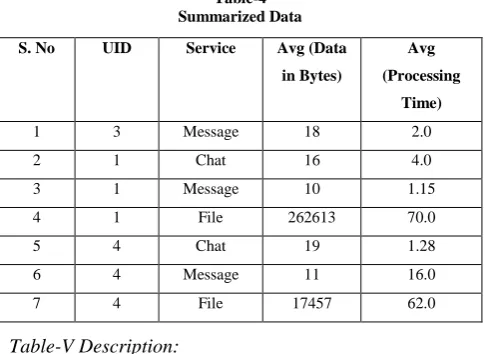
Table-4 Summarized Data S. No UID Service Avg (Data
in Bytes)
Avg (Processing
Time)
1 3 Message 18 2.0
2 1 Chat 16 4.0
3 1 Message 10 1.15
4 1 File 262613 70.0
5 4 Chat 19 1.28
6 4 Message 11 16.0
7 4 File 17457 62.0
Table-V Description:
This table shows the various aspect of transferring the data and its processing time for a specific type of service. Here the service used is to perform the triggering operation along with the size of the data used against that service for exchanging the information.
Table-5 User Panel Monitor S. No File Name /Text Ob ject ID Sent /Rec eive d Fr o m /T o Time /Date Ope n /Vie w Tim e Vi ew ed Ti me s File Opene d
1 Input1
.docs
3 Rece
ived
D 8:40
(08/01/
2015)
0 0 C:/dele
te it
2 Input2
.xlx
1 Sent C 8:45
(08/01/
215)
0 0 C:/dele
te it
3 Welco
me.jpe
g
2 Sent A 09:00
(08/01/ 2015) 9:05 (08/0 1/20 15)
2 C:/dele
te it
4 Dolly.
png
3 Rece
ived
C 9:05
(08/01/ 2015) 09/0 8 (08/0 1/20 15)
1 C:/dele
te it
Security Impact Status
Disable on Join Replication Restrict the Data
Dispersion
Successful and
Deployed
Control Conditional
Replication
Restrict the Data
Dispersion
Successful and
Deployed
Triggered Control
Replication
Restrict the Data
Dispersion
Successful and
Deployed
Remnance Proof
Condition
Verify Temporary
Dispersion
Successful and
Deployed
Object Based Replication Limits Data Fabrication Successful and
Deployed
S. No User Name User ID Get Details (Hyperlinked)
1 Admin 1 Get Details
2 A 2 Get Details
3 B 3 Get Details
4 D 4 Get Details
5 M 5 Get Details
[image:4.595.311.554.204.381.2]International Journal of Emerging Technology and Advanced Engineering
Website: www.ijetae.com (ISSN 2250-2459, ISO 9001:2008 Certified Journal, Volume 5, Issue 2, February 2015)
452
Benefits of Approach:-
Simultaneous operation (R/W).
Proper management of replicates and devastation.
Lifecycle based dossier sustainability for optimize depot.
Zero remnance proof based anuul to assure complete anuul.
Object based dossier handling for instances based execution.
Reduced vulnerability from ambush planned to devastate the privacy and security of the systems.
VII. FUTURE WORK
Distributed computing raises the clients trust on restrictive stockpiling at outsider areas for third party data centres location. Here the work done satisfy the user demand with respect to the security by providing self-deletion on the basis of trigger facility but still some work is there to do when the data travels from system to system over the network the file is in the form of object file but if the user wants to modify it in a single go it can’t be happened in this scenario that is left as a future work.
REFERENCES
[1] Deyan Chen and Hong Zhao, “Data Security and Privacy
Protection Issues in Cloud Computing”, in International Conference on Computer Science and Electronics
Engineering, IEEE Computer Society, DOI
10.1109/ICCSEE.2012.193, 2012.
[2] Frank Simorjay, Ariel Siverstone and Aaron Weller, “The
Microsoft approach to cloud transparency”, at www.microsoft.com/twcnext, 2012.
[3] Josiah Dykstra, “Seizing Electronic Evidence from Cloud
Computing Environments”, in IGI Global, Chapter 7, DOI: 10.4018/978-1-4666-2662-1.ch007, 2013.
[4] Product Description Amazon Web Services: “Overview of
Security Processes”, at http://aws.amazon.com/security/, June 2013.
[5] M. Nandhini and S. Jenila, “Time Constrained Data
Destruction in Cloud”, in International Journal of Innovative Research in Computer and Communication Engineering, ISSN (Online): 2320-9801, Vol.2, Special Issue 1, March 2014.
[6] Yulai Xie, Kiran Kumar Muniswamy-Reddy, Dan Feng
and Others, “Design and Evaluation of Oasis: An Active Storage Framework Based on T10 OSD Standard”, a presentation on Storage System Research Centre, 2012.
[7] Prashant Pilla, “Enhancing Data Security by Making Data
Disappear in a P2P Systems”, in Computer Science Department, Oklahoma State University, Stillwater.
[8] Mithun Paul and Ashutosh Saxena, “Zero Data Remnance
in Cloud Storage”, in International Journal of Network
Security & Its Applications (IJNSA), DOI :
10.5121/ijnsa.2010.2419, Vol.2, No.4, October 2010
[9] Christian Cachin, Kristiyan Haralambie and Hsu-Chun
Hsiao, “Policy-based Secure Deletion”, at IBM Research, Zurich, Aug 2013.
[10] Roxana Geambasu, Tadayoshi Kohno, Amit A. Levy and Henry M. Levy, “Vanish: Increasing Data Privacy with Self-Destructing Data”, in University of Washington, Supported work of Grant NSF-0846065, NSF-0627367, and NSF-614975,
[11] Lingfang Zeng, Zhan Shi, Shengjie Xu and Dan Feng, “SafeVanish: An Improved Data Self-Destruction for Protecting Data Privacy”, Presentation at CloudCom, Dec 2013.
[12] Roxana Geambasu, Tadayoshi Kohno, Arvind
Krishnamurthy, Amit Levy and Henry Levy, “New Directions for Self-Destructing Data Systems”, in University of Washington, 2010
[13] Lingfang Zeng, Shibin Chen, Qingsong Wei and Dan Feng, “SeDas: A Self-Destructing Data System Based on Active Storage Framework”, in IEEE Transaction on
Knowledge and Data Engineering, DOI:
10.1109/TMAG.2013.2248138, 2013.
[14] Backya S and Palraj K, “Declaring Time Parameter to
Data in Active Storage Framework”, in International Journal of Advanced Research in Computer Engineering & Technology (IJARCET), ISSN: 2278 – 1323, Volume 2, Issue 12, December 2013.
[15] David Logue and Kroll Ontrack, “SSDs: Flash Technology