International Journal of Emerging Technology and Advanced Engineering
Website: www.ijetae.com (ISSN 2250-2459,ISO 9001:2008 Certified Journal, Volume 5, Issue 4, April 2015)
204
Survey on Energy Optimized Routing Protocol for Wireless
Sensor Networks
Pradyumna K P
1, Pritam Deshraj
2, Rohith H Y
3, Sharan R
4, Lohith J.J.
51,2,3,4
UG Student, 5Assistant Professor, Department of Computer Science & Engineering, BMSCE, Karnataka, India Abstract— The emergence of Wireless Sensor Networks
[WSN] as one of the dominant technology trends in the modern era has posed several interesting challenges to researchers in the field. The sensing technology, combined with wireless communication makes it lucrative for this technology to be exploited in the future. The sensor nodes are equipped with sensing, communication, computation and power as four basic elements. However, the inclusion of wireless communication also incurs various kinds of security threats. The challenge is to investigate the different kinds of security threats in a meticulous way and also to propose certain measures to counteract this threat to security. The WSNs consists of computing, transmitting and receiving nodes. These are networked together in a wireless manner which is suitable for control, communication, sensing and actuation purposes.
Keywords-- DEEC, E-LEACH, LEACH, SEP, WSN,
I. INTRODUCTION
A wireless sensor network (WSN) of spatially distributed autonomous sensors can be used to monitor physical or environmental factors, like sound, temperature, pressure, etc. and to coordinate their data through the network to a centric location[6]. The recent modern networks are bi-directional hence enable the control of sensor activity. The enhancement of wireless sensor networks was driven by the motivation of military needs such as battlefield surveillance; today such networks are used in many industrial and consumer applications, such as industrial process auditory and control, machine health invigilating, and so on [15].
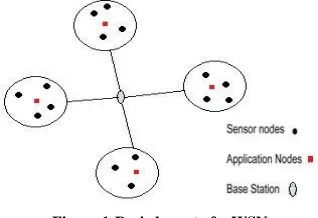
[image:1.612.364.523.227.336.2]Size and cost constraints on sensor nodes result in the corresponding constraints on resources like energy, memory, computational speed and communications bandwidth. The geology of the WSNs can differ from a simple star network to an advanced multi-hop wireless mesh network. The propagation manner between the hops of the network can be routing or flooding the individual sensor nodes [14] [21].
Figure 1-Basic layout of a WSN
The WSN is built of "nodes" – from a few to several hundreds or even thousands, where each node is connected to one (or sometimes several) sensors. Each such sensor network node usually has several parts: an electronic circuit for interfacing with the sensors and an energy source, a radio transceiver with an internal antenna or connection to an external antenna, a microcontroller, usually a battery or an embedded form of energy harvesting. The Sensor nodes might vary in size from that of a box down to the size of a grain of dust, although functioning "motes" of genuine microscopic dimensions have yet to be created. Their cost is similarly variable, ranging from a few to hundreds of dollars, depending on the complexity of the network [19].
II. WSNROUTING PROTOCOLS
A.Data Centric Protocols
International Journal of Emerging Technology and Advanced Engineering
Website: www.ijetae.com (ISSN 2250-2459,ISO 9001:2008 Certified Journal, Volume 5, Issue 4, April 2015)
205
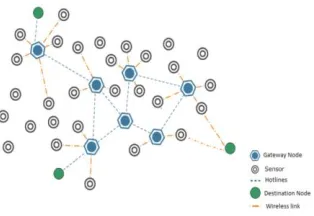
[image:2.612.87.249.247.354.2]Sensor Protocols for Information through Negotiation (SPIN) is the first data-centric protocol, which requires data negotiation between nodes in order to eliminate redundant data and save the energy. Further, Directed Diffusion [9] has been developed and has become a breakthrough in data-centric routing. A good number of other protocols such as Energy aware routing, Rumor routing, Minimum Cost Forwarding Algorithm and Gradient-Based Routing have also been proposed based on Directed Diffusion [16].
Figure 2-Relay of information through the network
Figure 3- Topology of cluster heads and nodes
B.Hierarchical Routing Protocols
Hierarchical or cluster-based routing methods, originally proposed in wire networks, are well-known techniques with special advantages related to scalability and efficient communication. The concept of hierarchical routing is also utilized to perform energy-efficient routing in WSNs. In this hierarchical architecture, high energy nodes are used to process and send the information, while low energy nodes can be used to perform the sensing work in the proximity/affinity of the target. The scrutiny and development of these clusters and the assignment of special tasks to cluster heads can contribute in a great way towards the overall scalability of the system, its lifetime, and energy efficiency. Hierarchical routing is a good way to lower energy consumption in a cluster, perform data aggregation and fusion in order to decrease the number of transmitted messages to the sink.
Hierarchical routing is mainly a two-layer routing where one layer is used to select cluster heads and the other for routing. But most techniques in this category are not about routing, but rather “who and when to send or process/aggregate” the information, allocation of channels and so on, which could be orthogonal to the multichip routing function. The main aim of the hierarchical routing is to efficiently maintain the energy consumption of sensor nodes by involving them in the multi-hop mode of communication. Cluster formation is typically based on the energy reserve of sensors and sensor‟s proximity/distance to the cluster head in that particular cluster. LEACH is one of the first approaches towards hierarchical routing for sensors networks [7].
C. Location Based Routing Protocols
Most of the routing protocols for sensor networks require location information for sensor nodes. In many cases the information of the exact location is needed in order to calculate the distance between two particular nodes so that energy consumption can be estimated. Relative coordinates of neighboring nodes can be obtained by exchanging such information between neighbors.
Alternatively, the location of nodes may be available directly by communicating with a satellite using GPS if the nodes are equipped with a small low-power GPS receiver. With a view to save energy, some location-based schemes require that nodes should go to sleep if there is no activity. Greater energy savings can be obtained by having as many sleeping nodes in the network as possible [19][26].
III. LEACH
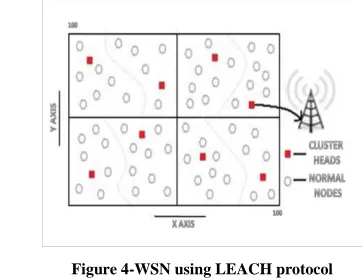
LEACH is a hierarchical protocol in which most of the nodes transmit to cluster heads, and the cluster heads forward the aggregated and compressed data to the base station. Every node uses a stochastic algorithm at every round to determine whether it will become a cluster head in a specific round. LEACH presumes that each node has a
Radio, powerful enough to directly reach the base station or the closest cluster head, but using the radio at its maximum power all the time would waste energy [5].
[image:2.612.91.248.382.490.2]International Journal of Emerging Technology and Advanced Engineering
Website: www.ijetae.com (ISSN 2250-2459,ISO 9001:2008 Certified Journal, Volume 5, Issue 4, April 2015)
206
All nodes that are not cluster heads only communicate
with the cluster head in a TDMA manner, according to the
schedule created by the cluster head. They do so using the least energy needed to reach the cluster head, and only require keeping their radios on during their time slot.
LEACH also uses CDMA so that every cluster uses a
[image:3.612.67.248.257.396.2]different set of CDMA codes, to reduce interference between the clusters [9].There are different variations of LEACH currently implemented. They are explained below: [1]
Figure 4-WSN using LEACH protocol
A.TL LEACH
Introducing a new level of hierarchy we allow to elaborate the information to transfer to a Base Station (BS) over two different levels and this allows for the better use the energy in the network [2].The cluster formation protocol is a local process that realizes, where it is possible, a two-level hierarchy. In this way each node can decide, in a way that is autonomous, to result in a good cluster. The use of two-levels of clusters for transmitting data to the base stations leverages the advantages of small transmit distances for more nodes more than in the original LEACH. In this way fewer nodes are required to transmit to far distances from the base station and it is particularly true in networks where the density of nodes is high [26]. The use of clusters for transmitting data to the base station leverages the advantages of small transmit distances for most nodes, compelling only a few nodes to broadcast to far distances from the base station. We think that this advantage is higher if a bigger number of hierarchy levels is used. Hence for this reason we introduce two-level hierarchy: a top head called here primary cluster-head (CHi), a second level represented from secondary cluster-head (CHij) and finally simple node, indicated as SN. In this way we introduce partial local computation in each cluster-head at the second level and we complete the local computation at top level where data will be transmitted to the base station directly[17][2].
B. E-LEACH
In the E-LEACH algorithm, the original way of the selection of the cluster heads is random and the round time for the selection is fixed. In the E-LEACH algorithm, we consider the remnant power of the sensor nodes in order to balance the network loads and changes the round time depending on the optimal cluster size. The simulation results show that the proposed protocol increases network lifetime at least by 40% when compared with the LEACH algorithm.
Energy-LEACH protocol improves the CH selection process. It makes the residual energy of node as the main metric which decides whether the nodes turn into CH or not after the first round. Same as LEACH protocol, E-LEACH is split into rounds, in the opening round, every node has the same probability to change into CH, that mean nodes are randomly chosen as CHs, in the next rounds, the residual energy of each node is different after one round communication and taken into account for the election of the CHs. The nodes having more energy will become CHs rather than the nodes with lesser energy [18].
C.A-LEACH
It introduces the concept of Helper Nodes which assist Cluster Heads for Multi-hop Routing. A new algorithm has been developed to facilitate energy efficient Multi-hop Route Setup for helper nodes to reach the base station. The proposed protocol increases the lifetime of the network, minimizes the overall energy dissipation in the network and distributes the dissipation among the Cluster Heads, Sensor Nodes and Helper Nodes vis-à-vis LEACH [4].
D. LEACH-C
International Journal of Emerging Technology and Advanced Engineering
Website: www.ijetae.com (ISSN 2250-2459,ISO 9001:2008 Certified Journal, Volume 5, Issue 4, April 2015)
207
If a cluster head ID is the same as its own ID, the node is a cluster head; else the node determines its TDMA slot for data transmission and goes sleep until it‟s time to transmit data. The steady-state stage of LEACH-C is identical to that of the LEACH method [18].
E.V-LEACH
In this version of LEACH protocol, the cluster contains; CH (responsible only for sending data that is received from the cluster members to the BS), vice-CH (the node that will become a CH of the cluster in case a CH dies), cluster nodes collecting the data from the environment and sending to the CH). In the leach, the CH always receives data from the cluster members, combine the data and then transfer to the BS that might be located at a far distance. The CH will die prior to the other nodes in the cluster because of its operation of transmitting and overhearing. When the CH dies, the cluster will become useless because the data gathered by cluster nodes will never reach the base station. In our V-LEACH method, besides acquiring a CH in the cluster, a vice-CH is present which takes the role of the CH when the CH dies because of the above mentioned reasons [18][27].
IV. REVIEW OF CLUSTERING ALGORITHMS FOR WIRELESS SENSOR NETWORKS
F. LEACH (Low Energy Adaptive Clustering Hierarchy) LEACH is one of the most popular clustering algorithms. The main idea behind leach is to form clusters based on the signal strength of the sensors. Some nodes are randomly chosen as the cluster heads(CH) and a node is assigned to the CH based on the signal strength received by that node from the CH [23].CHs do a lot more work than the normal nodes, hence they give out a lot more energy and may die quickly. In order to keep a stable network, CHs keep on shifting, in the entire round. So, a node which has become CH might not get an opportunity to become CH again before a set interval of time [22][24].
Advantages:
• LEACH is completely distributed. LEACH does not require the control information from the base station, and the nodes don‟t require the knowledge of the global network in order for LEACH to operate [29].
• LEACH reduces communication energy by up to8 times as compared to direct transmission and minimum transmission energy routing [11].
SEP (Stable Election Protocol)
SEP [5] was an improvement over LEACH in a way that it took into account the heterogeneity of networks. In SEP, some of the superior energy nodes are referred to as advanced nodes and the probability of advanced nodes to become CHs is more as compared to that of non-advanced nodes.
Advantage:
• SEP does not require any global knowledge of energy at every election round.
Limitations:
• The drawback of the SEP method is that the election of the cluster heads among the two types of nodes isn‟t dynamic, which results in the nodes that are far away from the powerful nodes to die first [10][12].
G.DEEC (Distributed Energy Efficient Clustering)
In DEEC [3] protocol all the nodes use the initial and the residual energy level to define the cluster heads. DEEC estimated the ideal value of network lifetime to compute the reference energy that each node should expend during each round.
In a two-level heterogeneous network, where we have two categories of nodes, m. N advanced nodes with initial energy equal to Eo(1+a) and (1 − m) normal nodes, where the initial energy is equal to E. Where „a‟ and „m‟ are two variables which control the nodes percentage types (advanced or normal) and the total initial energy in the network Etotal [27].
Advantages:
• DEEC doesn‟t require the global knowledge of energy at every election round [30].
• Unlike SEP and LEACH, DEEC performs well in multi-level Heterogeneous wireless network [28].
Limitations:
• Advanced nodes always penalize in the DEEC, particularly when their residual energy reduces and come in the range of the normal nodes. In this position, the advanced nodes die rapidly than the other nodes [31]
V. CONCLUSION
International Journal of Emerging Technology and Advanced Engineering
Website: www.ijetae.com (ISSN 2250-2459,ISO 9001:2008 Certified Journal, Volume 5, Issue 4, April 2015)
208
In this paper, the key concepts of WSN are presented with highlighting the importance of its different types of routing protocols which can be used in WSN. Different energy aware routing protocols working process using clustering approach is also presented which can be very important factors for improvising the life time of wireless sensor networks.
Acknowledgement
The work reported in this paper is supported by the college through the TECHNICAL EDUCATION QUALITY IMPROVEMENT PROGRAMME [TEQIP-II] of the MHRD, Government of India.
REFERENCES
[1] Heinzelman, W., Chandrakasan, A., and Balakrishnan, H., "Energy-Efficient Communication Protocols for Wireless Micro sensor Networks", Proceedings of the 33rd Hawaaian International Conference on Systems Science (HICSS), January 2000.
[2] A Two-Levels Hierarchy for Low-Energy Adaptive Clustering Hierarchy (TL-LEACH) V. Loscrì, G. Morabito, S. Marano D.E.I.S. Department, University of Calabria via P.Bucci, 42/c 87036 Rende, CS, Italy, IEEE 2005 Paper.
[3] JiaXu Dept. of Inf. Eng., China Jiliang Univ., Hangzhou, China Ning Jin ; Xizhong Lou ; Ting Peng ; Qian Zhou ; Yanmin Chen at Fuzzy Systems and Knowledge Discovery (FSKD), 2012 9th International Conference on29-31 May 2012
[4] Assisted-Leach (A-Leach) Energy Efficient Routing Protocol for Wireless Sensor Networks SunkaraVinodh Kumar and Ajit Pal at International Journal of Computer and Communication Engineering, Vol. 2, No. 4, July 2013
[5] Comparative Analysis Of Leach And Its Descendant Protocols In Wireless Sensor Network by Ravneet Kaur ,Deepika Sharma and Navdeep Kaur at International Journal of P2P Network Trends and Technology- Volume3Issue1- 2013.
[6] F. Akyidiz, Y. Sankarasubramaniam W. Su, and E. Cayirci, "A survey on sensor networks", IEEE Commune, August 2002. [7] J. N. Al-Karaki and A. E. Kamal, "Routing techniques in wireless
sensor networks: a survey," IEEE Wireless Communications, vol. 11, no. 6, pp. 6-28,Dec. 2004.
[8] L. Qing, Q. Zhu, M. Wang, "Design of a distributed energy-efficient clustering algorithm for heterogeneous wireless sensor networks". ELSEVIER, Computer Communications 29, pp 2230-2237, 2006. [9] W. R. Heinzelman, A. Chandrakasan, and H. Balakrishnan.
"Energy-efficient communication protocol for wireless micro sensor networks", Proceedings of the 33rd Hawaii International Conference on System Sciences (HICSS-33), January 2000.
[10] G. Smaragdakis, I. Matta, A. Bestavros, "SEP: A Stable Election Protocol for clustered heterogeneous wireless sensor networks", Second International Workshop on Sensor and Actor Network Protocols and Applications (SANPA 2004), 2004.
[11] Ming Yu, Leung, K.K. and Malvankar, A. “A dynamic clustering and energy efficient routing technique for sensor networks”. IEEE on Wireless Communications, Vol: 6(8): pp3069-3079, August 2007,
[12] Jiun-JianLiaw, Chen-Yi Dai, Yi-Jie Wang “The Steady Clustering Scheme for Heterogeneous Wireless Sensor Networks “ in Proceeding of Ubiquitous, Autonomic and Trusted Computing, 2009. UIC-ATC '09. Symposia and Workshops on 7-9 July 2009. [13] Younis O, Fahmy S. “Heed: A hybrid, energy efficient, distributed
clustering approach for adhoc sensor networks”. IEEE Trans. on mobile Computing, 2004,3(4), pp 660−669.
[14] Dargie, W. and Poellabauer, C., "Fundamentals of wireless sensor networks: theory and practice", John Wiley and Sons, 2010 ISBN 978-0-470-99765-9, pp. 168–183, 191–192
[15] Sohraby, K., Minoli, D., Znati, T. "Wireless sensor networks: technology, protocols, and applications", John Wiley and Sons, 2007 ISBN 978-0-471-74300-2, pp. 203–209
[16] SURVEY ON DATA ROUTING IN WSN José Cecílio, EudisleyAnjos, João Costa, Pedro Furtado University of Coimbra, DEI/CISUC {jcecilio, eudis, jpcosta, pnf}@dei.uc.pt
[17] A Two-Levels Hierarchy for Low-Energy Adaptive Clustering Hierarchy (TL-LEACH) V. Loscrì, G. Morabito, S. Marano D.E.I.S. Department, University of Calabria via P.Bucci, 42/c 87036 Rende, CS, Italy.
[18] Improvement on LEACH Protocol of Wireless Sensor Network (VLEACH) M. BaniYassein, A. Al-zou'bi, Y. Khamayseh, W. Mardini. doi: 10.4156/jdcta.vol3.issue2.yassein
[19] A Survey on Wireless Sensor Network based Approaches Ankita Scholar, Department of Computer Science and Applications Kurukshetra University, Kurukshetra, India Volume 4, Issue 4, April 2014 ISSN: 2277 128X International Journal of Advanced Research in Computer Science and Software Engineering
[20] Jennifer Yick, Biswanath Mukherjee, Dipak Ghosal, “Wireless sensor network survey,” Computer Networks Elsevier 52 (2008) 2292–2330.
[21] I.F. Akyildiz, W. Su*, Y. Sankarasubramaniam, E. Cayirci. Wireless sensor networks: a survey. Computer Networks 38 (2002) 393–422. [22] DATA-CENTRIC ROUTING PROTOCOLS IN WIRELESS
SENSOR NETWORKS: A SURVEY Raj Kumar Mondal , Debabrata Sarddar Department of Computer Science & Engineering, Hooghly Engineering & Technology College, Hooghly Department of Computer Science & Engineering, University of Kalyani, Kalyani
[23] S.K. Singh, M.P. Singh, and D.K. Singh, “A survey of Energy Efficient Hierarchical Cluster-based Routing in Wireless Sensor Networks”, International Journal of Advanced Networking and Application (IJANA), Sept.–Oct. 2010, vol. 02, issue 02, pp. 570– 580
[24] Energy Efficient Cluster based Hierarchical Routing Protocols in Wireless Sensor Network – a Survey Soumitra Das Dept. of CSE Sathyabama University Chennai, India
[25] Pramod D Ganjewar Dept. of CSE Sathyabama University Chennai, India Multidisciplinary Journal of Research in Engineering and Technology, Volume 1, Issue 1 (April 2014) Pg. 06-22
[26] V.Loscri, G.Morabito, and S.Marano, “A Two-Levels Hierarchy for Low-Energy Adaptive Clustering Hierarchy (TL-LEACH),” in 62nd Vehicular Technology Conference, IEEE, vol.3, 2005, pp.1809-1813.
International Journal of Emerging Technology and Advanced Engineering
Website: www.ijetae.com (ISSN 2250-2459,ISO 9001:2008 Certified Journal, Volume 5, Issue 4, April 2015)
209
[28] M.Usha and Dr.N.Sankarram, “A Survey on Energy Efficient Hierarchical (Leach) Clustering Algorithms in Wireless Sensor Network,” International Journal of Innovative Research in Computer and Communication Engineering (IJIRCCE), Proceedings of International Conference On Global Innovations In Computing Technology (ICGICT‟14), vol.2, special issue 1, pp. 601- 609, March 2014.
[29] M.Ahmad Jan and M.Khan, “A Survey of Cluster-based Hierarchical Routing Protocols,” IRACST – International Journal of Computer Networks and Wireless Communications (IJCNWC),vol.3, no.2, pp. 138-143, April 2013.
[30] Performance Analysis of Low Energy Adaptive Clustering Hierarchy and Optimization M.Sanjana International Journal of Scientific & Engineering Research, Volume 5, Issue 4, April-2014 ISSN 2229-5518