Distributed Agile Patterns: An Approach to
Facilitate Agile Adoption in Offshore Software
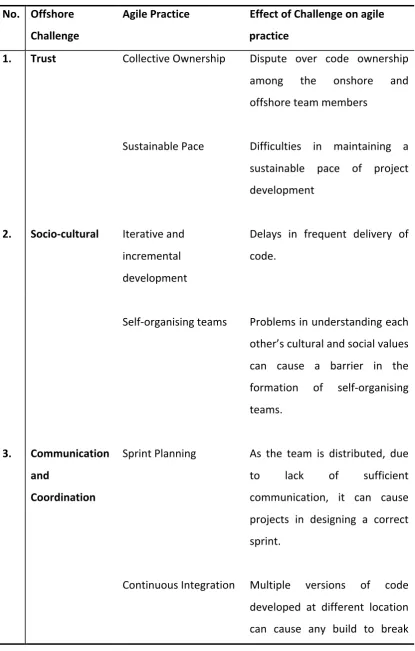
Development
Maryam Kausar
College of Science and Technology School of Computing, Science and Engineering
University of Salford, Manchester, UK
Submitted in Partial Fulfilment of the Requirements of the Degree of Doctor of Philosophy
Table of Contents
LIST OF TABLES 5
LIST OF FIGURES 6
ACKNOWLEDGEMENTS 7
DECLARATION 8
ABSTRACT: 9
CHAPTER 1 INTRODUCTION 11
1.1RESEARCH PROBLEM 13
1.2RESEARCH AIM AND OBJECTIVES 16
1.3 RESEARCH QUESTIONS 16
1.4RESEARCH CONTRIBUTIONS 17
1.5RESEARCH METHODOLOGY 18
1.6STRUCTURE AND HOW TO READ THE REPORT 21
1.7CHAPTER SUMMARY 22
CHAPTER 2 OFFSHORE SOFTWARE DEVELOPMENT 23
2.1INTRODUCTION 23
2.2BACKGROUND OF OFFSHORE SOFTWARE DEVELOPMENT 23
2.2.1OVERVIEW OF OFFSHORE MODELS 23
2.2.1.1 Domestic Outsourcing 24
2.2.1.2 Shared Services 25
2.2.1.3 Internal Offshoring 26
2.2.1.4 Offshore Outsourcing 27
2.2.2BENEFITS OF OFFSHORE SOFTWARE DEVELOPMENT 29
2.2.2.1 Economic Benefits 29
2.2.2.2 Political- Legal Benefits 31
2.2.2.3 Demographic and Geographic Benefits 32
2.2.3.4 Technological Benefits 33
2.3ASTUDY ON IDENTIFYING THE CHALLENGES OF OFFSHORE SOFTWARE DEVELOPMENT 34
2.3.1TRUST ISSUES 36
2.3.2SOCIO-CULTURAL ISSUES 37
2.3.3COMMUNICATION AND COORDINATION ISSUES 44
2.3.4KNOWLEDGE TRANSFER ISSUES 46
2.4CRITICAL ANALYSIS OF OFFSHORE CHALLENGES ON SOFTWARE DEVELOPMENT PHASE 50
2.5AGILE OFFSHORE SOFTWARE DEVELOPMENT 64
2.5.1AGILE SOFTWARE DEVELOPMENT 64
2.5.2AGILE METHODOLOGY IN OFFSHORING 65
2.6 AGILE ADOPTION IN OFFSHORE SOFTWARE DEVELOPMENT 67
2.6.1TRANSITION FROM TRADITIONAL SOFTWARE DEVELOPMENT TO ADOPTING AGILE PRACTICES 67
2.6.1.1 Facilitators to Assist Agile Adoption 67
2.6.1.2 Framework to Support the Evaluation, Adoption and Improvement of Agile
Methods 68
2.6.1.3 Shared Mental Models to Understand Agile Practices 69
2.6.2AGILE ADOPTION IN OFFSHORING 70
2.6.3EFFECT OF OFFSHORING ON AGILE ADOPTION 77 2.7ASTUDY ON THE USE OF PATTERNS IN AGILE ADOPTION IN OFFSHORE DEVELOPMENT 83
2.7.1CURRENT PATTERNS FOR AGILE ADOPTION 84
2.7.2DISTRIBUTED AGILE PATTERNS 94
2.8 CHAPTER SUMMARY 94
CHAPTER 3 RESEARCH METHODOLOGY 96
3.1INTRODUCTION 96
3.2OVERVIEW OF RESEARCH ONION 96
3.3RESEARCH METHODOLOGY USED TO DESIGN DISTRIBUTED AGILE PATTERNS 103
3.3.1RESEARCH PHILOSOPHY 103
3.3.2RESEARCH APPROACH 104
3.3.3RESEARCH STRATEGY 111
3.3.4CHOICE 120
3.3.5TIME HORIZON 122
3.3.6DATA COLLECTION 123
3.4CHAPTER SUMMARY 124
CHAPTER 4 DISTRIBUTED AGILE PATTERNS 125
4.1INTRODUCTION 125
4.2DESIGNING TEMPLATE FOR DISTRIBUTED AGILE PATTERNS 125 4.3SELECTING THE RIGHT PATTERN FROM THE DISTRIBUTED AGILE PATTERNS CATALOGUE 128 4.4ORGANISING THE DISTRIBUTED AGILE PATTERNS CATALOGUE 131 4.5 FULL DISTRIBUTED AGILE PATTERNS CATALOGUE 133
4.5.1 MANAGEMENT PATTERNS 133
4.5.1.1 Distributed Scrum of Scrum Pattern 133
4.5.1.2 Local Standup Meeting 136
4.5.1.3 Local Sprint Planning Meeting Pattern 139
4.5.1.4 Local Pair Programming Pattern 141
4.5.1.5 Asynchronous Retrospective Meetings Pattern 143
4.5.2COMMUNICATION PATTERNS 146
4.5.2.1 Global Scrum Board Pattern 146
4.5.2.2 Central Code Repository Pattern 149
4.5.2.3 Asynchronous Information Transfer Pattern 151
4.5.2.4 Synchronous Communication Pattern 153
4.5.3COLLABORATION PATTERNS 155
4.5.3.1 Collaborative Planning Poker Pattern 156
4.5.3.2 Follow-the-Sun Pattern 158
4.5.3.3 Collective Project Planning Pattern 161
4.5.3.4 Visit Onshore-Offshore Team Pattern 164
4.5.4VERIFICATION PATTERNS 166
4.5.4.1 Project Charter Pattern 166
4.5.4.2 Onshore Review Meeting Pattern 168
4.6CHAPTER SUMMARY 171
CHAPTER 5 VALIDATION AND EVALUATION OF THE DISTRIBUTED AGILE
PATTERNS CATALOGUE 172
5.1INTRODUCTION 172
5.2REVISED DISTRIBUTED AGILE PATTERNS 172
5.3EVALUATING DISTRIBUTED AGILE PATTERNS 179
CHAPTER 6 CASE STUDY TO SHOW APPLICABILITY OF DISTRIBUTED AGILE
PATTERNS 185
6.1INTRODUCTION 185
6.2OVERVIEW OF REQUIREMENTS ENGINEERING PROCESS 185 6.3REQUIREMENTS ENGINEERING PROCESS IN TRADITIONAL SOFTWARE DEVELOPMENT VS.AGILE
METHODOLOGY 186
6.4APPROACHES TO IMPROVE REQUIREMENTS ENGINEERING PROCESS IN AGILE 187 6.5DISTRIBUTED AGILE PATTERNS USED TO OVERCOME REQUIREMENTS ENGINEERING
CHALLENGES 193
6.6MAPPING DISTRIBUTED AGILE PATTERNS ON THE REQUIREMENTS ENGINEERING
LIFECYCLE 196
6.7CHAPTER SUMMARY 198
CHAPTER 7 CONCLUSIONS AND FUTURE WORK 199
7.1INTRODUCTION 199
7.2MEETING THE AIM AND OBJECTIVES AND ANSWERING THE RESEARCH QUESTIONS 200
7.3RECOMMENDATION FOR FUTURE WORK 201
7.4LIMITATION OF THE STUDY 202
7.5CHAPTER SUMMARY 203
REFERENCES: 204
APPENDIX A: SELECTED STUDIES FOR OFFSHORE CHALLENGES 223
APPENDIX B: OVERVIEW OF EXISTING SOFTWARE DEVELOPMENT APPROACHES 228
APPENDIX C: OVERVIEW OF BEECHAM ET AL. (2014) GSD SOLUTION 229
APPENDIX D: SAMPLE QUESTIONS FOR SEMI-STRUCTURED INTERVIEWS 230
APPENDIX E: CONSENT FORM AND DATA PROCESSING STATEMENT 232
APPENDIX F: UNREVISED DISTRIBUTED AGILE PATTERN CATALOGUE 234
List of Tables
TABLE 2.1. CHALLENGES IN OFFSHORE SOFTWARE DEVELOPMENT. 35 TABLE 2.2 SEVEN VALUES FOR CULTURAL DIMENSIONS (TROMPENAARS ET AL., 2004). 38 TABLE 2.3. CULTURAL COMPARISON BETWEEN JAPAN AND CHINA (OZAWA ET AL., 2013). 41 TABLE 2.4. CULTURAL PATTERNS IN SOFTWARE PROCESS MISHAPS (MACGREGOR ET AL. 2005). 42 TABLE 2.5. FACTORS AFFECTING TASK ALLOCATION PROCESS IN OFFSHORE DEVELOPMENT
(SAJJAD ET AL. 2015). 47
TABLE 2.6. OFFSHORE CHALLENGES AFFECTING SOFTWARE DEVELOPMENT PHASES. 51 TABLE 2.7. OVERVIEW OF EXISTING APPROACHES USED TO OVERCOME OFFSHORE CHALLENGES. 59 TABLE 2.8. COMPARISON OF AGILE DEVELOPMENT VERSES OFFSHORE DEVELOPMENT (ŠMITE ET AL. 2010). 66 TABLE 2.9. AGILE PRACTICES USED FOR OFFSHORE DEVELOPMENT (PAASIVAARA ET AL., 2009). 76 TABLE 2.10. AGILE PRACTICES AFFECTED BY OFFSHORE CHALLENGES. 78 TABLE 2.11. DETAIL OF THREE SITES ADOPTING AGILE PRACTICES AT R & D UNIT OF ERICSSON (PAASIVAARA ET
AL., 2013). 80
TABLE 2.12. EXISTING OFFSHORE SOFTWARE DEVELOPMENT PATTERNS. 85 TABLE 2.13. PATTERNS FOR AGILE SOFTWARE DEVELOPMENT. 89 TABLE 2.14. OVERVIEW OF AGILE ADOPTION PATTERNS (ELSSAMADISY ET AL., 2006). 93
TABLE 3.1. OVERVIEW OF RESEARCH ONION. 98
TABLE 3.2: KEY CONCEPTS SELECTED FOR RELATIONAL ANALYSIS. 106
TABLE 3.3. SEARCH TERMS USED IN THIS REVIEW. 114
TABLE 3.4. OCCURRENCE OF AGILE PRACTICES IN LITERATURE 115 TABLE 3.5. SIX SOURCES FOR DATA COLLECTION COMPARISON (YIN, 2003). 116 TABLE 3.6. TYPE OF INTERVIEWS (EASTERBY-SMITH ET AL., 2012). 118
TABLE 3.7. DETAIL OF COMPANIES INTERVIEWED. 119
TABLE 3.8. OVERVIEW OF THE QUANTITATIVE AND QUALITATIVE METHODS USED IN THIS RESEARCH. 120 TABLE 3.9. TIME HORIZON ACROSS FOUR-YEAR PHD RESEARCH. 122
TABLE 4.1. COMPARISON OF EXISTING PATTERNS. 125
TABLE 4.2. CATEGORIES OF DISTRIBUTED AGILE PATTERNS. 132
TABLE 5.1. DETAILS OF THE COMPANIES. 172
TABLE 5.2. DETAILS OF THE PARTICIPANTS ATTENDED THE WORKSHOP. 173
TABLE 5.3. AGENDA OF THE REFLECTION WORKSHOP. 174
TABLE 5.4. FLIP CHART FORMAT FOR THE REFLECTION WORKSHOP (KERTH, 2001). 174 TABLE 5.5. FLIP CHART OF COMPANY 3 PARTICIPANT 5 (C3P5). 176
TABLE 5.6. SUMMARISED FLIP CHART OF THE COMPANIES. 177
TABLE 5.7. FEEDBACK ON THE CHALLENGES DISTRIBUTED AGILE PATTERNS SOLVE. 178 TABLE 5.8. EXISTING SOLUTIONS IN COMPARISON TO THE DAP CATALOGUE. 180 TABLE 6.1. USING DISTRIBUTED AGILE PATTERNS TO ADDRESS REQUIREMENTS ENGINEERING CHALLENGES IN
List of Figures
FIGURE 1.1 RESEARCH METHODOLOGY 18
Acknowledgements
First and foremost, this research would not be possible without the blessing of my Lord ALLAH, the most Merciful, who has given me the patience and strength to finish this PhD journey.
I would like to express my gratitude and sincere appreciation to my supervisor, Dr. Adil Al-Yasiri, for his assistance, guidance, and feedback during my PhD.
Special thanks to my parents, Kausar Iqbal Malik and Khalida Parveen, for their encouragement and prayers.
I would like to extend my thanks to the members of the School of Computing, Science, and Engineering at the University of Salford, for supporting me during my PhD.
Declaration
Parts of the research presented in this thesis has been published in the following papers and presentations:
1- Kausar, M., & Al-Yasiri, A. (2015). Distributed Agile Patterns for Offshore Software Development. Presented in the 12th International Joint Conference on Computer Science and Software Engineering (JCSSE 2015). IEEE Conference 2015.
2- Kausar, M., & Al-Yasiri, A. (2016). Using Distributed Agile Patterns for Developing Offshore Projects. Presented in the Proceedings of the CSE 2016 Annual PGR Symposium (CSE-PGSym 16), University of Salford, Manchester, United Kingdom, 2016
Abstract:
Over a decade, companies have been using agile methods for the development of software. However with the increasing trends of offshore software development, companies are becoming more interested in using agile methods for such projects. While offshore development has several dynamic benefits such as cost reduction, flexibility, proximity to market, concentration on core processes and easy access to talent, they have introduced new challenges, such as trust, socio-cultural, communication and coordination, and knowledge transfer issues. These challenges not only affect the development process but also affect the applicability of agile practices in offshore development. As a consequence, companies have been modifying and adapting agile practices to overcome these challenges. However there has been little effort put to collect and document the common practices that have been used repeatedly to solve recurring problems in offshore development.
Using the systematic literature review approach and applying customised search criteria based on the research questions, we identified and reviewed over 200 cases from literature. As part of this research we also conducted semi-structured interviews, in which we involved practicing professionals who were working with distributed teams. As a result, we identified and documented a number of solutions to address the common agile issues in software development, which we classified as distributed agile patterns.
Chapter 1 Introduction
Recent advances in software development have made it possible and attractive for the industry to move towards Global Software Development (GSD). GSD is referred to the practice in which companies move some/all part of their software project to an offshore location. For some companies the motivation is to cut down on cost, while for others the motivation is to benefit from the variety in talents available from all over the world, or closeness to market. Nonetheless, whatever the reason was to making such a decision, it is very important for them to consider which type of global software engineering business model they will be using. Work has been done on proposing different frameworks from which organisations can select which type of GSD model they want to use (Robinson et. al, 1996; Prikladnicki et al. 2007 and Agerfalk et al. 2008). We have presented an overview of different models in Section 2.2.1.
The term “offshore outsourcing or offshoring” is commonly used for the practice of a company to subcontract work to third party companies, which are placed at countries like India, Pakistan, China and Russia (Prikladnick et al., 2007). This way, a company can focus on its core business and leave the development of products to companies that can perform them in higher standards or at cheaper rates (Pilatti et al., 2006).
The concept of offshoring isn’t new or exclusive to software development; many companies for years have been using subcontractors to provide assistance in multiple areas, from cleaning services to consultations (Jahns, et al., 2006). What has changed is that with the help of technology the scope of offshoring has expanded internationally (Van, 2004). As technology has reduced the cost of communication, companies can exchange work products to far away places, cheaply and efficiently.
The main reason why companies choose offshoring is because of lower production cost (Pilatti et al., 2006) which is mainly because of low salaries in countries outside Europe, the US and Japan. For example in India an average ICT worker earns one seventh of the amount earned by a British employee (Global Wages Comparison, 2013).
Offshoring can offer additional commercial advantages beyond cheaper labour; for example in a country like India, which profits 90% of the revenues of all IT and service offshore activity, produces two million university graduates per year (Kobayashi-Hillary, 2005). With this offshore companies can see new opportunities such as access to larger pool of skilled people, shared best practices and proximity to markets and customers (Smite et al., 2011). Kobayashi-Hillary who went to Bangalore to open a software facility comments “The issue now was not finding good people; it was filtering the excellent from the good” (Kobayashi-Hillary, 2005).
1.1Research Problem
Traditionally, software was developed at one location where the whole team worked from the same office. Similarly the clients/sponsors of the project were situated in the same country. But as onshore software development became expensive companies started looking for alternative ways to cut down on software development cost (Pilatti, Audy, 2006). One such alternative was to move some of their processes to offshore locations, as due to decrease in global communication rates companies could coordinate work via online communication tools and setup cost in countries like India and China is cheaper in comparisons to countries like USA, UK and Japan (Prikladnick & Audy, 2012; Bush, Tiwana, and Tsuji, 2008; McLaughlin, 2003)
But as companies continued to switch to offshore development it became clear that achieving reduced cost is not as straightforward as it initially seemed. As even if companies manage to cut down cost on development by setting up cheap offices and finding cheap labor (Global Wages Comparison, 2013), offshoring introduces new challenges. These challenges appear because companies distributed their team to different locations having different time zones, different language and social values, causing challenges such as:
• The issue of trust causes difficulty in forming alliances among firms that do not
know each other. It also introduces a risk of project failure as clients are concerned with whether the offshore service provider will deliver the work promised without compromising on their requirements. Lack of trust can cause misunderstanding and conflicts between the firms (Battin et al., 2001). This issue will be discussed in detail in section 2.3.1.
• Socio- Cultural conflicts, such as a difference in languages, national traditions,
difference in language the onshore team cannot understand their comments hence resulting in a delay in the project development. This issue will be discussed in detail in section 2.3.2.
• The team faces communication and coordination issues (Beulen et al., 2002), as
the team members are distributed on different locations and time differences, which makes it difficult to have real-time face-to-face communication. This can cause problems in sharing information. This issue will be discussed in detail in section 2.3.3.
• Companies started to face knowledge transfer issues they moved their business
and development process to offshore locations, as any mistake in the transfer process can cause projects to fail (Kedia et al., 2007). This issue will be discussed in detail in section 2.3.4.
These challenges were not part of traditional software development because the team worked in the same country having the same time zone, face-to-face communication, and same social values (Meyer, 2006). If these challenges are not handled properly they can make the overall cost of the project several times higher than if the project was developed at any onshore location (Iacovou et al., 2008; Hartmann et al.,2011).
In offshoring, companies also have to deal with additional tasks as the team is distributed over different time zones (Evaristo et al., 2004). The additional tasks are:
i) They have to maintain good communication with all its offshore offices otherwise the information flow will be affected (Carmel et al., 2005),
iii) Once the project or process is selected they need to be coordinated with the onshore office in order to develop a product that meets the clients requirements (Aundh et al., 2009).
Another problem with offshoring is that the development methodology for offshore software development is different from the traditional approach as now companies can either follow a global standard methodology for all its offices or it can have different development methodologies for distributed locations (Sengupta et al., 2006).
Similarly the standard development methodologies starting from waterfall development life cycle to agile assume that the team is located at the same location. So if a company applies any of the standard development techniques by the book, offshore projects are bound to fail. Many companies have customised agile methodologies for offshore projects, but there are still limitations to how successful those projects will be as agile methodology focuses on face-to-face meetings such as daily-stand up meeting and retrospective meetings (Beck et al., 2001).
1.2 Research Aim and Objectives
In order to address the challenges between onshore and offshore teams such as trust, socio-cultural, communication and coordination, and knowledge transfer issues, this research aims to propose a pattern based approach by identifying repeating solutions which have been proven in overcoming those challenges so that practitioners can apply this approach in order to mitigate the effect of the challenges in their projects. In addition to the main goal of the research, we have four specific objectives and they are summarised as the following:
i. To conduct systematic literature review to understand and analyse the existing literature on offshore software development. This will build up the research foundation and form the research questions for this research.
ii. Identifying the key challenges from literature that occur while developing software on offshore locations and investigate how agile practices can be used to overcome those challenges and. Based on literature and interviews identify if there is a recurring agile practices being used to solve the same challenge that we can classify as a pattern.
iii. Develop a catalogue of the identified patterns that will be documented, as it will focus on facilitating offshore software development projects by providing as a guideline for practitioners that want to offshore their projects.
iv. Validating the Distributed Agile Patterns catalogue by using Kerth’s reflection workshop method (Kerth, 2001) and evaluate the catalogue by comparing the existing solutions presented in literature.
1.3 Research Questions
RQ: What are the recurring adaptations of agile practices that are being used within offshore software development in order to address the identified issues?
To be more specific, the study’s focus was on the following two questions:
RQ1: What are the agile practices that are being commonly used to deal with offshore challenges?
RQ2: Are the challenges identified in RQ1 recurring in offshore software development?
1.4 Research Contributions
There is a lack of effort in collecting common practices that have been used repeatedly to solve recurring problems in offshore development. In this research we have studied over 200 cases from the literature and interviewed practicing professionals that work in distributed teams. As a result we have observed a number of solutions for agile issues in distributed development settings, which we have classified as Distributed Agile Patterns. We defined distributed agile patterns as adaptation of an agile practice that is being repeatedly applied in order to solve a recurring challenge in a distributed project scenario. The difference between distributed patterns and distributed agile patterns is that distributed patterns only focus on practices that are being repeatedly applied in order to solve a recurring challenge in an offshore project irrespective of if those practices are agile or not whereas distributed agile patterns focus on repeating agile practices.
The findings of this research will strengthen the existing literature on distributed software development and provide a knowledge base for agile practitioners who use or intend to use agile approaches in offshore software development. The documented findings have been observed from literature and practitioners in order to prepare the patterns catalogue.
Practitioners can use the pattern catalogue in the beginning of offshore projects and make informed decisions about how to adopt agile approaches as generalized patterns make it easier for other companies to reflect on and to apply the results to their own cases.
1.5 Research Methodology
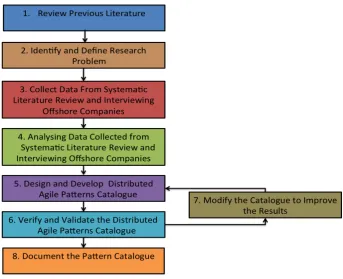
The following research methodology is developed and adopted for this research. The main stages of the methodology are outlined in Figure 1.1 and detail of each stage is presented in Chapter 3 Research Methodology.
[image:18.595.150.494.444.723.2]Step 1: Review Previous Literatures and Relevant Offshoring Challenges.
In this step the previous relevant works is reviewed, to identify challenges practitioners faces while developing their projects offshore. This helps in acquiring a good understanding of what factors affect offshore projects. This step also helps in answering the RQ1 mentioned in Section 1.3, as there was a need to study what agile practices are being used in GSD.
Step 2: Identify and Define the Research Problem.
The research starts by making assumptions on how to successfully develop software on offshore locations to meet the objectives of the research. To do this, the research focuses on studying and analysing factors that affect offshore software development, based on the case studies of different companies as this helps in answering the RQ1 mentioned in Section 1.3 in order to identify what agile practices are being used and also to answer RQ2 that is to identify if those practices are recurring or not.
To perform this step semi-structured interviews are conducted with companies who had chosen offshore processes for their projects. The research also analyses how many companies use agile development methodologies for their offshore software development projects and what limitations they face.
Step 3: Collect Data from Systematic Literature Review and Interviewing Offshore Companies.
Step 4: Analyse Data collected from Systematic Literature Review and Interviewing Offshore companies.
To analyse the data collected we use content analysis as proposed by Kripendorff to verify the results of our findings (Kripendorff, 2004). Details of this step is presented in section 3.3.2.
Step 5: Design and develop the Distributed Agile Patterns Catalogue.
Based on the findings a Distributed Agile Patterns Catalogue is developed; this is presented in Section 4.5.
Step 6: Validate and Evaluate the Pattern Catalogue.
In order to validate the Distributed Agile Patterns Catalogue, we conducted a workshop by using Kerth’s keep/try reflection workshop method (Kerth, 2007). By doing this, feedback collected from the companies (who would have been interviewed) is sought to obtain their views on the catalogue, and its effectiveness. Based on their answers the catalogue is validated and this helps in answering the RQ2 mentioned in Section 1.3 as it confirms that these agile practices are being used to solve recurring problems in GSD.
To evaluate the pattern catalogue we compare the catalogue with other solutions mentioned in the literature for solving GSD challenges, which is presented in Section 5.3.
Step 7: Modify the Catalogue to Improve Results.
Step 8: Document the Pattern Catalogue.
The final stage of the research is to document the patterns catalogue, which incorporates the answers of all the research questions mentioned in Section 1.3.
Based on the above discussion it can be seen that we have used an inductive approach, as the research moves from specific to general. As we first identified and designed a specific research problem and then developed a generic catalogue of distributed agile patterns. In section 3.3.2 we have presented detail explanation on how we have applied inductive approach in our research approach.
1.6 Structure and How to Read the Report
patterns catalogue and finally in Chapter 7, the conclusions has summarised the findings of this research and we have presented an overview of the future work.
1.7 Chapter Summary
This chapter presented an introduction to the thesis through defining the research problem and discussing the research motivation, then the aim of the research, the objectives, and research questions were presented. The research contributions have been defined along with the research methodology, in addition to defining the outline of the thesis.
Chapter 2 Offshore Software Development
2.1 Introduction
This section summaries the work that has been completed to-date. It presents the background research that has been done on offshore software development so far. The background involves reviewing the models of offshoring and the benefits it provides. The review also covers and highlights the main challenges and issues offshore software development which we identified using Systematic Literature Review. We have also mentioned how agile can be used to overcome those challenges and what are the limitations of agile. We have also presented five approaches used in literature to facilitate practitioners in agile adoption. Lastly we have mentioned how patterns can aid in agile adoption in offshore software development by presenting an overview of current patterns being used for agile adoption and giving an overview of the distributed agile patterns.
2.2 Background of Offshore Software Development
In this section we have presented a background study on offshore software development to understand why organisation move towards offshoring their processes. We gave an overview of different types of offshore models based on what type of business model they chose to follow while offshoring their projects. We also presented what are the key benefits that organisations consider while deciding to go for offshore software development.
2.2.1 Overview of Offshore Models
business models based upon relationship structure and geographical location (Robinson et al., 2004).
Prinkladnicki used an adaptation of Robinson’s framework based on the most common models used in practice, which was than presented in Agerfalk and Fitzgerald work (Prinkladnicki et al., 2007; Robinson et al. 2004; Agerfalk et al., 2008). In this thesis we have used a further adapted version with inputs from the Organisation for Economic Co-operation & Development report (OECD, 2004) shown in Figure 2.1. The reason for choosing this version is because it clearly identified the four main business models selected by organisations that decide to move their processes to a different location, where its in the same country or an offshore location. This section discusses each of these models in detail.
Figure 2.1 Business Models for Global Software Engineering (OECD, 2004).
2.2.1.1 Domestic Outsourcing
companies that select this type of business model go for a joint-venture offshoring approach.
In joint venture offshoring, an organisation collaborates with a local company to develop software. This collaboration can take many different forms. In some cases the revenue stream is separated from rest of the company’s business as the servers being outsource generates its own revenue which results in reduced risk for the company offshoring their services. Both the company share a percentage of the revenue earned.
In other cases, joint ventures can be between two or more companies, the goal being to build an offshore centre with multiple owners in order to reduce the start-up costs and operational risks. Hence in joint ventures companies’ collaboration can be equal that is both of the company have equal stake or the companies can be independent but just contribute their resources to each other. The goal of this model is to benefit from the strengths of the organisations, in order to achieve a win-win situation for both of them (Babu, 2005).
To motivate both the companies to go for joint venture contracts, many companies include a build-operate-transfer (BOT) clause. This clause helps the companies to decide on how they will work together in order to complete the products (Vashistha et al., 2005) and furthermore it also allows the onshore companies to sell their stakes to foreign companies after achieving agreed-upon milestones.
Joint venture offshoring has many advantages such as both the companies learn from each other. It also helps build relationships across the venders and both the companies share their recourses to develop the best product (Babu, 2005).
2.2.1.2Shared Services
2012). This model is the most simple and known business model as not many risks are involved in adopting it since all the teams are working in the same country (Prikladnicki et al., 2007).
Many companies choose onshore insourcing in order to avoid the risk of moving their processes to an offshore location. A study done by Amiti in the United States, the United Kingdom, and many other industrialised countries showed that jobs in these countries are preferred to be insourced rather than to outsource them because they are concerned that if they outsourced more jobs they will be losing a net amount of jobs for their nationals (Amiti et al., 2005).
Onshore insourcing is considered the better alternative to outsourcing as the jobs stay in the country and they do not have to invest in the start-up costs (Prikladnicki et al., 2012). Similarly companies can avoid challenges such as communication and coordination problems, language issues, software quality standard issues and trust issues (Prikladnicki et al., 2007).
2.2.1.3Internal Offshoring
Internal Offshoring is also referred as offshore insourcing. In this business model, a company internally offshores its services by creating its own software development centre (subsidiary) in foreign country (Prikladnicki et al., 2012). Some companies opt for the ultimate approach, “do it yourself ” that is go out and built your own subsidiary centre in an offshore location (Vashistha et al., 2005). Many companies go directly in for a subsidiary or local offices instead of opting for joint ventures, as there management is comfortable in dealing with international and local market operations. The common terms used for this kind of model include offshore development centre (ODC), captive development centre, branch or local office.
run independent businesses with their own budget and bottom-line accounting. GE, HSBC, and American Express are considered the most sophisticated at deploying this model. Another example is Citibank who does commercial banking in Brazil and Portland.
The advantages of this model are, it guarantees market for a company’s services and it helps in establishing management hierarchy. It also alleviates some organisational issues such as control and politics that manage the back-office offshore activities with external vendors (Robinson et al., 2004). This approach has one key challenge that apart from internationalisation and localisation of business management, managers are concerned about finding the right staff, line works, technical experts and line managers from multicultural backgrounds (Aron et al., 2005).
Many large organisations are comfortable in managing their technology development and innovation at local offices. Large software development companies including IBM, Microsoft and Oracle already have global marketplace and are comfortably moving work around the world (Babu, 2005).
2.2.1.4Offshore Outsourcing
Offshoring Outsourcing is also referred, as offshoring. It is the most commonly used business model by companies. In this business model external suppliers that are located in other countries (offshore) provide software development services (Prikladnicki et al., 2012). Carmel defines offshoring as moving business processes that were being done at a local company to a foreign country in order to take advantage of cheap labour (Carmel et al., 2005). While selecting this business model companies can choose from three different approaches such as:
In service-provider offshoring, companies subcontract development work to offshore organisations in order to focus on core business activities (Vashistha et al., 2005). The advantages of choosing this type of offshoring rather than building subsidiary outlets is similar to the advantages provided by offshoring rather than keeping all the functionalities in house such as getting product developed at low cost and concentrating more on core business activities (Vashistha et al., 2005). Hence in order to avoid the risks attached with offshoring and capitalize from the benefits it provides companies choose to outsource projects, program, and individual work orders to offshore vendors.
This model is becoming increasingly popular and it encompasses a wide range of work including small projects to multi-year contracts containing of budget up-to millions of dollars (Aron et al., 2005). Popular companies such as GE, American Express, VeriSign and Abbey National are already using this model successfully (Vashistha et al., 2005).
Another approach of this model is to create a dedicated centre that is some companies are too cautious about quality, which prevents them from hiring an offshore service provider, and they also have issues with cost, which prevents them from building their own offshore centre. Such companies take an alternative approach in which they build dedicated centre relationship. In this model an offshore supplier operates a dedicated centre for a company but the staff, equipment and resources are all wholly dedicated to the company.
In third-party transplant approach, a third-party rather than a company builds and maintains the offshore presences of a company (Vashistha et al., 2005). Many companies that already outsources their work on onshore third- party locations use this model as it’s a natural progress to move their work to offshore locations in order to either cut down on cost or to gain profit by margining with a third-party, or both.
An example of a company using such a model is Accenture. It has more than 83,000 employees; over 5,000 are based in low-cost delivery centres in locations such as India and the Philippines (Robinson et al., 2004). This allows its client companies to that advantage from the low- priced labour without having to go through the risk of starting up in those markets. The objective of Accenture is to provide a faultless outsourcing experience for corporations (Hendrik et al., 2011).
This model allows companies like Accenture to distribute and manage their activities across multiple global locations at lower rates without risk. It also answers to faster time-to-market requests by dividing work among onshore and offshore locations (Robinson et al., 2004). Many large companies that hire global outsourcers prefer this distributed approach as this model saves clients from huge investments on team employment and it adapts to the changing requirements of the client.
2.2.2 Benefits of Offshore Software Development
Based upon the framework mentioned in Figure 2.1 the focus of this report is on the offshoring. In this section we will discuss the benefits due to which companies choose offshore software development (Hitt et al., 2002).
2.2.2.1Economic Benefits
salaries to their employees (Smite et al., 2011). As in India, a software developer’s base annual salary is U.S $15,000 that is one quarter of the salary of an Irish developer who earns half in comparison to a US developer (Conchúir et al., 2009). Other economical factors that encourage offshoring are interest rates, development of capital markets, capital cost and development of technology centres.
Among the above-mentioned factors, development of technology centres plays an important role in finding the required resources. We know that talented developers are the key factor for great development productivity and quality however it is difficult to find them in general. With the help of offshoring this constraint has been solved as it provides companies’ access to technical experts from all over the world (Smite et al., 2011). For example countries like India and China are highly populated as they have 1 billion people and they produce hundreds of thousands of software engineers per year (Conchúir et al., 2009).
Many software companies get into offshore software development in order to provide their clients with a wide horizon of experts to choose from. As they gather specialised people with specific skill set and ability to excel in one area, which enables them to deliver perfect-engineered applications.
2.2.2.2Political- Legal Benefits
Political-legal benefits include taxation laws (Hitt et al., 2002), rights and working hours of labours, trade barriers such as tariff and non-tariff barriers (Stack et al., 2005). Treaties and agreement within trade unions such as MERCOSUE, NAFTA and ASEAN play an important role in encouraging companies to go for offshoring. An example of trade barriers is that for the past 10 years they keep on decreasing, which aid in facilitating offshore agreements (Jahns et al., 2006; Oshri et al., 2015).
An example of flexible labour laws can be see from the success of an overseas IT services provider Wipro. It is India’s most successful outsourcing consultant. It gets 12% of its work from UK companies (The Economist, 04-03-2004) and in 2012 it has achieved the award of ‘Offshoring Project of the Year' by UK's National Outsourcing Association for their project ‘BT Recognized’ (Wipro, 14-12-2012). In a study done by Economic Times showed that India is still the No. 1 destination for IT offshoring (The Economic Times 21-12-2010).
Considering that UK economy only represents one-sixth of the west-European total economy shows how much UK companies are inclined towards offshore business. One major reason behind this is the flexible labour laws in the UK, which makes it relatively easy for UK companies to relocate jobs offshore.
2.2.2.3Demographic and Geographic Benefits
Socio-demographic benefits include population size, age structure, education levels, work force motivation and time zone difference. As mentioned earlier that in countries like India and China are highly populated. They have 1 billion people in which 53% of the population is under the age of 25 (Robinson et al., 2004) hence producing hundreds of thousands of software engineers per year (Conchúir et al., 2009). Another significant factor is the availability of English-speaking population in counties like India, South- Africa and Philippines, which makes it easy for companies to outsource customer services such as call-centres to such locations (van Zoest, 2004).
Considering the time zone difference between the offshore countries companies cut down on cost by increase development time by adopting “follow the sun” workflow which means it allows 24 hours development as due to different time zones a company’s employees can do development 24hrs a day (Carmel, et al., 2001). For example an employee works from 9 a.m. to 5p.m. in the USA. At 5 p.m. she hands over the incomplete task to a colleague in Australia who works from 9 a.m. to 5 p.m. based on his time zone. At 5 p.m. according to his country, he transfers the updated task to a colleague in Poland who works on the updated task for the next eight-hours and then forwards it to his colleague in the USA (Gupta, 2009).
While the employee in the USA had left work two of her colleagues worked on her task as when she will come to the office next morning a lot of the work would have been done. This work scenario takes advantage of the geographical distances as it allows people from different time zones to work round-the- clock in order to build software (Gupta, 2007).
for example in Figure 2.2 we can see how a problem has been distributed among different teams all over the world.
Figure 2.2. Distribution of Work among Multiple Distributed Teams.
2.2.3.4Technological Benefits
Technological benefits are referred to the development of telecommunication and transportation technologies especially the Internet and mobile communication. Most of these developments happened due to the dramatic increase in the memory size of microprocessors, storage, increase in the integration of information technologies and telecommunications (Picot et al., 2003).
Many companies started moving towards offshoring as it became cheaper to communicate with offshore offices via conference calls and video conferencing (Prikladnicki et al., 2012). With the help of cheaper technology available the organisational and national boundaries remained no longer important as now companies can relocate their offices to offshore locations without facing a huge hurdle of communication and transportation costs (Jahns et al., 2006; Oshri et al., 2015).
consistent and cost effective service provisioning, which means it allows consistent follow of information throughout the team and it encourages efficient delivery of services (Beulen et al., 2005).
2.3 A Study on Identifying the Challenges of Offshore Software Development
As highlighted in the previous section there are many benefits to adopting offshore development, however as it continues to grow (Damian et al., 2006) it has been observed that it causes some challenges, due to temporal, geographical and socio-cultural differences (Holmstrom et al., 2006). As software development is a human-centric and socio-technical process, it depends on complex interaction, attitudes, behavioural norms and communication approaches, which can lead to misunderstandings due to any misinterpretation of the project aims that can result into conflicts, mistrust and underutilization of talent (Ozawa et al., 2013). Studies done by Carmel (Carmel et al., 2005) and by Sahay (Sahay et al. (2003) show that these challenges can cause complications to the project processes such as communication, coordination and control of project activities (Damian, 2002, Jan et al., 2016).
It has also been observed that due to the significant differences in engineering culture/style around the world collaborations between countries have unique flavours (Herbsleb et al., 2005). In this section we will study how temporal, geographical and socio-cultural differences can pose different challenges for companies adopting offshore software development. The study focuses on the challenges that occur in the-offshoring business model, offshore outsourcing.
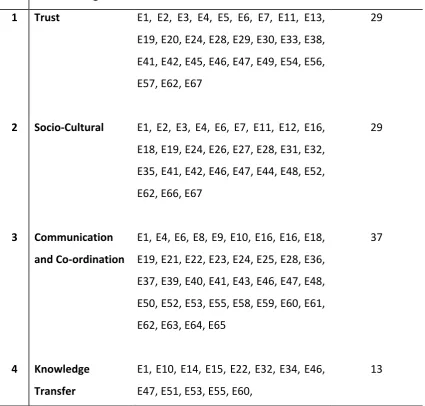
shows the results of the study that we carried out to identify the inherent challenges, which are trust; socio-cultural; communication and co-ordination; and knowledge transfer issues. The reason for choosing to focus on these four challenges is because of their repeated occurrence in literature. Table 2.1 shows the frequency that these challenges have occurred in the literature. The first column shows the categories of the challenges constructed from the data extracted from the evidence that are presented in the second column. Each occurrence has the same weight, thus the frequency of the occurrence shows the number of times a category has occurred in literature. The selected studies are presented in Appendix A.
Table 2.1. Challenges in Offshore Software Development.
No. Challenge Evidence Occurrence
1 Trust E1, E2, E3, E4, E5, E6, E7, E11, E13, E19, E20, E24, E28, E29, E30, E33, E38, E41, E42, E45, E46, E47, E49, E54, E56, E57, E62, E67
29
2 Socio-Cultural E1, E2, E3, E4, E6, E7, E11, E12, E16, E18, E19, E24, E26, E27, E28, E31, E32, E35, E41, E42, E46, E47, E44, E48, E52, E62, E66, E67
29
3 Communication and Co-ordination
E1, E4, E6, E8, E9, E10, E16, E16, E18, E19, E21, E22, E23, E24, E25, E28, E36, E37, E39, E40, E41, E43, E46, E47, E48, E50, E52, E53, E55, E58, E59, E60, E61, E62, E63, E64, E65
37
4 Knowledge Transfer
E1, E10, E14, E15, E22, E32, E34, E46, E47, E51, E53, E55, E60,
2.3.1 Trust Issues
The first major challenge to offshore development is the factor of trust. Trust is an important aspect of interpersonal (Boon et al., 1991) as well as inter-organisational relationship (Ring et al., 1994) in order to have successful partnership and alliances among the firms (Das et al., 1998). It is also considered as a crucial factor for building business relationships as trust enables open communication which, results in high performance of the team, high quality of projects and satisfactory decision making process (Kanawattanachai et al., 2002; Morgan et al., 1994; Rousseau et al., 1998).
In terms of software outsourcing, trust helps in establishing an open exchange of information and cooperative behaviour among the companies. It also helps in removing conflict and negotiation on software development cost and it also improves response to any crises, which might occur during a project (Rousseau et al., 1998). Moreover trust also enables ease in development process as it encourages an open discussion in the requirement gathering process and helps remove unnecessary expensive documentation (Humphrey, 1989).
Trust plays an important role in offshore software development however it is difficult to establish because it is difficult to develop a relationship with unknown foreign partners that are timely and geographically distant (Prikladnicki et al., 2012). The main reason behind this is that the companies do not have any relationship beyond the project itself, which is of a limited duration. Moreover trust can be difficult to establish as most projects are developed through structural mechanisms, which include deliverables, penalty clauses and reporting arrangements whereas in-house development relays more on trust rather than on details structured reporting (Lander et al., 2004).
(Sabherwal, 1999). Issues in trust have led some organisations to create their own software development centres in countries like India, China, Russia and Brazil (Prikladnicki et al., 2012). In Section 2.4 we have demonstrated how trust effects each stage of software development lifecycle.
2.3.2 Socio-Cultural Issues
In offshore development distributed teams face many socio-cultural differences, such as difference in languages, national traditions, values and norms. Kluckhohn identify five areas which all-cultural groups have fundamental through differing beliefs, which are listed as follows (Kluckhohn et al., 1961):
• How a culture views human nature,
• The relationship of its people with nature
• Priority it gives to traditional customs, future plans or present events.
• How is the society organised, is it linear in hierarchy?
• How is business and life conducted? Publically or privately, or a mix of both?
Similarly another widely refereed work on culture is by Hofstede (1980,1997), who developed a set of cultural indices. He identified five cultural dimensions, which are:
• Power Distance
• Individualism/Collectivism
• Masculinity/ Femininity
• Uncertainty Avoidance
• Long-Term/ Short-Term Orientation.
members with different values cause conflicts within the team resulting in decrease in motivation, involvement and cohesiveness with the team members (Ozawa et al., 2013).
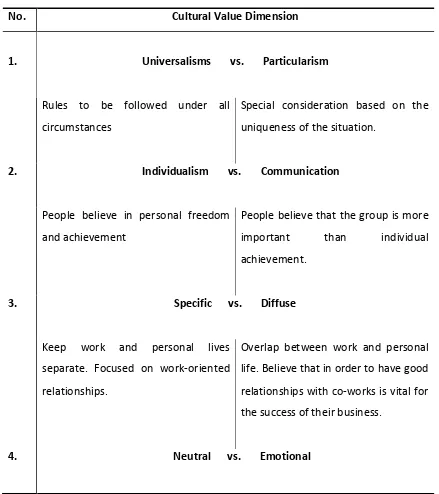
[image:38.595.91.530.271.765.2]Trompenaars and Hampden-Turner build their work on Hofstede’s cultural dimensions with the focus on the impact of intercultural variances on business and management process (Trompenaars et al., 2004). They developed a set of seven values for dimension, which are shown in Table 2.2 below:
Table 2.2 Seven Values for Cultural Dimensions (Trompenaars et al., 2004).
No. Cultural Value Dimension
1. Universalisms vs. Particularism
Rules to be followed under all circumstances
Special consideration based on the uniqueness of the situation.
2. Individualism vs. Communication
People believe in personal freedom and achievement
People believe that the group is more important than individual achievement.
3. Specific vs. Diffuse
Keep work and personal lives separate. Focused on work-oriented relationships.
Overlap between work and personal life. Believe that in order to have good relationships with co-works is vital for the success of their business.
Reluctant to reveal their feelings and make an effort to control their emotions.
Display their thoughts and feelings openly. People find ways to express their emotions, even spontaneously at work.
5. Achievement vs. Ascription
The organisational culture values you based on your performance at work. They believe that you are what you do.
Status in the organisation is based on a variety of factors such as power, title and position.
6. Sequential Time vs. Synchronous Time
Like events to happen in a sequential order. They place a high value on punctuality, planning and sticking to schedules.
Focus on past, present and future events as interwoven periods. Work on several projects at once and consider planning and commits flexibly.
7. Internal Direction vs. Outer Direction
Control nature of their environment to achieve their goal. This includes how they work with teams within their organisations.
Tylor, a well known Sociologist and Anthropologist defined culture, as “Culture is that complex whole which includes knowledge, belief, art, morals, law, customs and any other capabilities and habits acquired by man as a member of society” (Tylor 1871). From this definition of culture it is clear that culture plays a great role in all aspect of life. Similarly in offshore software development the socio-cultural distance between distributes teams is a complex dimension as it involves organisational culture, national culture and language, politics and motivation of individuals and work ethics (Holmstrom et al., 2006).
Ozawa et al. (2013) identified three main challenges causes due to socio-cultural differences, which are:
i) Difference in the openness in the society.
ii) Difference in the willingness to adopt new techniques and technologies. iii) Difference in communication methods, implicit over explicit communication
The most obvious disadvantage is language, as English is not the first language in counties like India, Pakistan and China so extra effort is required to communicate. Differences in language can lead to miscommunication due to language style or incorrect use of vocabulary (Carmel, 1999; Hofner et al., 2007). Some reports show that language problem affects the product and the code itself as the comments in the code from an offshore team whose first language is not English may seem odd or not understandable by onshore team. Hence adding a hidden cost of code maintenance (Matloff, 2005).
how cultures of two different countries affect the workplace environment as in India, they follow strict management hierarchies and in US they don’t (Matloff, 2005).
[image:41.595.98.514.285.694.2]A similar experience was observed when a Japanese company offshored their software project to a company in China (Ozawa et al., 2013). They were facing difficulties due to the low quality deliverables and a high turnover rate of Chinese members because of socio-cultural differences. Based on Ozawa et al. (2013) we present a summary of the socio-cultural difference between Japan and China in Table 2.3 (Ozawa et al., 2013).
Table 2.3. Cultural Comparison between Japan and China (Ozawa et al., 2013).
No. Japan China
1. A job is for a lifetime. Acquire new skills and switch jobs.
2. Hire fresh graduates and teach them to fit in their organisation rather than to hire experienced people.
Prefer hiring experienced people.
3. Focus on avoiding failure and use existing methodologies rather then focusing on attaining success and trying new technologies.
Want to acquire new skills and try
new methodologies and
technologies. More focused on success.
4. Tight grouped communities, so they understand each other without “implicitly” saying them.
More diversity, so use more explicit information in communication.
5. Questioning considered humiliation. Questioning considered humiliation.
information, which were not clear to the Chinese team members and since questioning is considered humiliation in both the cultures, the Chinese team members didn’t ask the Japanese clients to clarify the requirements hence resulting in low quality deliverables.
[image:42.595.96.522.325.762.2]MacGregor identified 5 cultural patterns, which highlight the problems caused by socio-cultural challenge when the team is distributed over different locations (MacGregor et al., 2005). Table 2.4, gives an overview of their patterns. Though they are calling them patterns they have classified some of them as anti-patterns.
Table 2.4. Cultural Patterns in Software Process Mishaps (MacGregor et al. 2005).
No. Pattern Name Assumption Pattern Overview
1. Yes (but No) Person A has assumed Person B meant “Yes I will do it, when Person B meant I heard what you said.”
- Person B perceived Person A to be higher in
hierarchy.
- B doesn’t want to affect the deadline.
- Make clarification and rephrase request.
2. Proxy Pattern Companies are not willing to invest in intercultural training
- Place bi-coded individuals in a position where they can translate between the cultures.
3. We’ll- take-you- literally (Anti-Pattern)
Different cultures may have different perceptions for a development
artefact.
4. We’re-one-single-team
Agile encourages “flat team” however in some cultures they follow a more hierarchical approach depending on power distance
- Formal communication with people on higher hierarchy level.
- Developers don’t feel they have a right to take
decisions regarding the system they are
developing.
5. The-customer-is-king (Anti-Pattern)
Less hierarchy dominant structure encourage open and direct communication between the client and developers. While high hierarchy organisation prefer indirect
communication between the client and developers.
- When problem arises, developers from high hierarchy organisation, the developers cannot contact the client directly hence causing delay in development time.
- Similarly the client might feel that the
communication is limited.
- As nature of social culture also affects the
relationship between the developers and client such as where it is
From the above examples, we can see that socio-cultural conflicts can cause problems in the development of an offshore project. In order to solve such conflicts, the organisations need to create an environment that encourages teams to communicate with each other. They need to continuously adapt team roles based on the changing relationship between the team members. This can reduce dissatisfaction among the employees and increase trust resulting in giving each other more responsibilities, thus improving the quality of software.
2.3.3 Communication and Coordination Issues
In offshore development as the team is separated and implemented at different geographical locations they face many communication and coordination issues because the team members work on different time zones or time shifts in a day (Alzoubi et al., 2016). This reduces the opportunity for real-time communication (Al-Zaidi et al., 2017). The basic issue in offshoring is handling the complex communication and team coordination, as they can’t have frequent face-to-face communication (Sahay et al., 2003). Insufficient team communication often creates challenges such as trust, relationships and efficiency of the team (Lanubile et al., 2013).
A research done by Ebert shows that approximately half of all the distributed projects fail due to insufficient communication and trust among the team members (Ebert, 2012). In order to increase communication among the team members, awareness is necessary. Awareness in distributed teams helps in ensuring that individual contributions, contribute to the whole group’s effort to develop software successfully. Paul Dourish and Victoria Bellotti described group awareness as “ an understanding of the activities of others, which provides a context for your activity” (Dourish et al., 1992).
• Informal awareness provides information about which team members are
around and available for work.
• Group-structural awareness focuses on the knowledge roles on team members
and structure of the team.
• Workspace awareness gives information about the interactions the team
members have with shared resources at a workspace.
• Social awareness consists of information that team members maintain about
each other in conversational context for the purpose of social connections within the team.
In order to achieve group awareness in distributed teams, technology plays an important role. In the survey conducted by Lanubile focused on which technologies and tools support group awareness and collaboration such as for informal awareness, IM (Instant Message) and VoIP (Voice over Internet Protocol) tools can be used similarly for workspace awareness emails and RSS can be used (Lanubile et al., 2013).
Another way to increase the communication between the teams is to keep the working hours flexible so that the onshore and offshore teams can achieve overlapping hours with each other. For example in order to get real-time communication, occasionally one team has to stay late and the other team has to come early to have a combined meeting via video/audio conferencing tools (Yu et al., 2016). Hence in order to organise work between geographically distributed teams we must consider temporal distance to facilitate the real-time communication (Holmstrom et al., 2006). Temporal distance is a measure of the dislocation in time experienced by two actors who wish to interact (Pilatti et al., 2006).
creates a feeling of “being behind” as when one location sends a request they get reply the next day. As seen in the case study done by Boland and Fitzgerald asynchronous communication overnight can be overwhelming for a developer beginning work in the morning (Boland et al., 2004). Also a study done by Holmstrom shows that limited overlap with colleges causes delay in response which makes people lose track of the overall work process which leads to problems in distributed yet time-crucial work (Holmstrom et al., 2006). Similar results were noted by Herbsleb, the drag in the problem and response could cause increase in the cost (Herbsleb, 2007). As a result response time increases when working hours do not overlap between the remote locations (Sarker et al., 2004).
2.3.4 Knowledge Transfer Issues
Knowledge is a very common and widely used concept. In order to clarify what is referred as knowledge we have used the definition provided by Davenport and Prusak (Davenport et al., 1998). They defined knowledge as “A fluid mix of framed experience, values, contextual information, and expert insight that provides a framework for evaluating and incorporating new experiences and information. It originates and is applied in the minds of knowers. In organisations, it often becomes embedded not only in documents or repositories but also in organisational routines, processes, practices, and norms.” (Davenport et al., 1998)
the knowledge transfer process but if there is poor management it can cause projects to fail (Javidan et al., 2005). Similarly in a study done by Radoff’s shows that if we do not understand the cultural differences between the countries it can cause a negative impact on outsourcing (Radoff, 2006). As we need to understand the cultural differences in order to successfully manage the projects. The report also shows that the companies that educate their employees of intercultural communication increase their productivity by 30%.
[image:47.595.96.524.494.760.2]One major challenge organisations face, which directly affects the knowledge transfer process, is when they decide to offshore their process before they have tested the readiness of their management. This includes the difficulties of keeping awareness, and knowledge cohesion when various working groups concurrently access it (Khan et al., 2014). These difficulties directly affect how work is distributed through task allocation in distributed environment. According to Sajjad the factors presented in table 2.5 should be considered while allocating tasks when the team is distributed to overcome the knowledge transfer challenges (Sajjad et al., 2015).
Table 2.5. Factors Affecting Task Allocation Process in Offshore Development (Sajjad et al. 2015).
No. Factors Percentage Affect of Factor on Task Allocation Process in Offshore Development
1. Site Technical Expertise
68% Select site with appropriate domain expertise and knowledge is crucial.
2. Time Zone Different
allow knowledge sharing.
3. Resource Cost
47% Project Managers do aim to assign work units to low cost labour sites in order to cut down on development cost.
4. Task
Dependency
44% Keeping the cost benefit in mind, it is however advised to not only consider the cost while assigning the tasks but to also consider task dependencies. As high task dependent tasks should be assigned to the same location in order to save time on communication and coordination.
5. Vendor Reliability
36% The perceived reliability of a particular vendor helps clients to better manage tasks allocation in global software development.
6. Task Size 29% Task size has also been considered important as it helps in deciding how much time the team will spend to develop it.
7. Vendor Maturity Level
21% It is important to consider the maturity level of the vendor as, if they are new to offshore development, they may face issues in code integration.
8. Local
Government Regulations
9. Requirements Stability
7% Based on the type of project, requirements stability is important in order to break them into tasks for the team to develop. However it has only been considered to be an important factor by 7% based on the selected literature of this research, as it is a universal fact that requirements do change and organisations have placed requirement change management models in place to handle this issue.
10. Product Architecture
7% Since the requirements keep changing, the product architecture keeps evolving throughout the software development lifecycle. This has been considered as an important factor by 7% based on the articles selected from literature.
11. Intellectual Property Ownership
2% In distributed software development, as code is being developed at different locations, it is important to consider the issue of intellectual property however this factor isn't considered critical for task allocation as the client is usually the one who has the intellectual property of the code being developed.
2.4 Critical Analysis of Offshore Challenges on Software Development Phase
In this section we will discuss how the above, identified challenges affect the different phases of software development and present a critical analysis.
The traditional software development lifecycle consists of five stages, which are, Requirements, Design, Coding, Testing and Integration. Figure 2.3 below shows the software development lifecycle.
Figure 2.3. Traditional Software Development Lifecycle.
The execution of these phases depends on whichever software development approach the development team decides to selected. An overview of the existing approaches is presented in the Appendix B showing how these phases are executed based on the selected approach.
Table 2.6. Offshore Challenges Affecting Software Development Phases.
No. Phase Offshore
Challenge
Effect of Offshore Challenge on Software Development Phase
1. Requirements Trust • Establishing correct estimates of
requirements is difficult, as onshore team does not have clear understanding of offshore team skills (Alnuem et al., 2012).
• Getting the main objective and core
functional requirements of the project clear to all the team members located at different sites is difficult (Herbsleb et al., 2001).
Socio-Cultural • Differences in cultural values and
language can cause misunderstanding of requirements (Damian et al., 2003).
• As at the beginning of the project the
client isn't sure of all the requirements, which can result in vague requirements, which need to be later clarified to the teams who aren’t on-site (Bird et al., 2009).
• Difference in ways to express