Roadmap for implementation of BIM in
the UK construction industry
Khosrowshahi, F and Arayici, Y
http://dx.doi.org/10.1108/09699981211277531
Title
Roadmap for implementation of BIM in the UK construction industry
Authors
Khosrowshahi, F and Arayici, Y
Type
Article
URL
This version is available at: http://usir.salford.ac.uk/27319/
Published Date
2012
USIR is a digital collection of the research output of the University of Salford. Where copyright
permits, full text material held in the repository is made freely available online and can be read,
downloaded and copied for noncommercial private study or research purposes. Please check the
manuscript for any further copyright restrictions.
For more information, including our policy and submission procedure, please
Engineering, Construction and Architectural Management
Emerald Article: Roadmap for implementation of BIM in the UK construction
industry
Farzad Khosrowshahi, Yusuf Arayici
Article information:
To cite this document: Farzad Khosrowshahi, Yusuf Arayici, "Roadmap for implementation of BIM in the UK construction industry", Engineering, Construction and Architectural Management, Vol. 19 Iss: 6 pp. 610 - 635
Permanent link to this document:
http://dx.doi.org/10.1108/09699981211277531
Downloaded on: 20-11-2012
References: This document contains references to 30 other documents
To copy this document: [email protected]
Access to this document was granted through an Emerald subscription provided by UNIVERSITY OF SALFORD
For Authors:
If you would like to write for this, or any other Emerald publication, then please use our Emerald for Authors service. Information about how to choose which publication to write for and submission guidelines are available for all. Please visit www.emeraldinsight.com/authors for more information.
About Emerald www.emeraldinsight.com
With over forty years' experience, Emerald Group Publishing is a leading independent publisher of global research with impact in business, society, public policy and education. In total, Emerald publishes over 275 journals and more than 130 book series, as
well as an extensive range of online products and services. Emerald is both COUNTER 3 and TRANSFER compliant. The organization is a partner of the Committee on Publication Ethics (COPE) and also works with Portico and the LOCKSS initiative for digital archive preservation.
Roadmap for implementation of
BIM in the UK construction industry
Farzad Khosrowshahi
School of the Built Environment and Engineering,
Leeds Metropolitan University, Leeds, UK, and
Yusuf Arayici
School of the Built Environment, University of Salford, Salford, UK
Abstract
Purpose– Building information modelling (BIM) implementation is a major change management task, involving diversity of risk areas. The identification of the challenges and barriers is therefore an imperative precondition of this change process. This paper aims to diagnose UK’s construction industry to develop a clear understanding about BIM adoption and to form an imperative step of consolidating collective movements towards wider BIM implementation and to provide strategies and recommendations for the UK construction industry for BIM implementation.
Design/methodology/approach – Through comprehensive literature review, the paper initially establishes BIM maturity concept, which paves the way for the analysis via qualitative and quantitative methods: interviews are carried out with high profile organisations in Finland to gauge the best practice before combining the results with the analysis of survey questionnaire amongst the major contractors in the UK. Findings– The results are established in the form of the initial phase of a sound BIM implementation guidance at strategic and operational levels. The findings suggest three structured patterns to systematically tackle technology, process and people issues in BIM implementation. These are organisational culture, education and training, and information management. The outcome is expressed as a roadmap for the implementation of BIM in the UK entailing issues that require consideration for organisations to progress on the BIM maturity ladder.
Practical implications– It paves a solid foundation for organisations to make informed decisions in BIM adaptation within the overall organisation structure.
Originality/value– This research consolidates collective movements towards wider implementation of BIM in the UK and forms a base for developing a sound BIM strategy and guidance.
Keywords Building information modelling, Information management, Organizational culture, Maturity model, Process improvement, United Kingdom
Paper type Research paper
1. Introduction
Today, in many organisations multi-disciplinary teams are experiencing conflicts, complexities, uncertainties and ambiguities with traditional practices (e.g. business models, processes, legal and compensation schemes, etc.) that impede knowledge sharing which cause duplication of processes on a daily basis. Fragmentation and calcified processes inhibit widespread change in the building industry (Bernstein and Pittman, 2004; Aranda-Menaet al., 2009). However, technology alone cannot influence the required changes. Barriers recognised by researchers include a need for well-defined business process models, for practical information integration strategies for tools that are used by the industry, and computable model-based digital design data (Bernstein and Pittman, 2004; The NBS, 2011). The integrative use of building information modelling (BIM) for the building lifecycle not only facilitates integration of
The current issue and full text archive of this journal is available at
www.emeraldinsight.com/0969-9988.htm
Engineering, Construction and Architectural Management Vol. 19 No. 6, 2012 pp. 610-635
rEmerald Group Publishing Limited 0969-9988
DOI 10.1108/09699981211277531
The authors would like to express their gratitude and acknowledge the contribution of Phillip Ternouth and Amanda Marshall-Pointing for their highly valued insight and guidance.
610
disjointed practices, it can also act as the catalyst for changing business processes (Aranda-Menaet al., 2009).
Over the past decade, many pilots and live projects have been completed and documented in Finland, Sweden, Norway, Germany, France, Singapore and Australia, which demonstrate the capability of using BIM in construction. Projects are demonstrated for more sustainable products, compared to non-BIM usage (Mihindu and Arayici, 2008). For example, the HITOS project used IFC model server technology in a comprehensive manner (www.epmtechnology.com). Further works on BIM and associated IFC files were carried out in the technology programme launched by TEKES (value networks in construction, 2003-2007) focusing on developing eco-efficient solutions for multi-storey and low-rise buildings and it provides tools to facilitate the adoption of BIM in construction. During the programme, BIM tools and processes have been developed in order to considerably improve productivity in the industry and make it possible to manage the information generated and maintained throughout the lifecycle of buildings more efficiently. Finland as the world leader in BIM implementation has 108 projects (TEKES, 2008). The researchers concluded that current business processes need to change to gain advantage from BIM (Leˆet al., 2006). The realisation of the benefits of BIM is contingent upon a proper implementation of BIM at an organisational level and its integration at the industry level. Research has shown that both business directors and IT directors of UK’s largest contractors and consultants are fully aware of the benefits of advancements in information and communication technologies, and the main barriers to implementation relate to organisational readiness to change (Alshawiet al., 2008). To this end, this research aims to identify the current state of BIM realisation and the readiness of UK construction organisations to implement BIM. It is envisaged that any progress in this area will need to be based on a proper understanding of the current state of organisations’ maturity and readiness to accept and implement BIM (Computer Integrated Construction (CIC) Research Program, 2010).
On the other hand, this paper seeks to answer why very slow progressive changes occur and how a momentum can be gained in BIM implementation in UK’s construction sector, which is essential to know before recommending strategies for BIM implementation. This is because many firms still seem to be happy to continue using traditional CAD whereas it is noticeable that US organisations working in the UK markets are effectively converting their processes to utilise BIM technologies (Oakley, 2008) implicating the leveraging of BIM in competitive incursion (The NBS, 2011). Furthermore, there has been extensive research that documented what type of BIM technology is required (CIC, 2010). However, there is hardly any research that documents the business model that entails the BIM use. Therefore, the third question the paper seeks to answer is what strategy should be used for the development of the business model for the UK construction sector.
The paper attempts to answer these questions through a research methodology employing qualitative and quantitative techniques. First, it introduces a systematic approach for BIM implementation maturity stages. It then, applies concept mapping to analyse the result of a series of interviews held in Finland in order establish the best practice before conducting a survey to map the case in the UK. This analysis shows that fragmented consideration of BIM as opposed to complete and complementary strategic planning, and lack of business process models have contributed to BIM use at very basic level. Further, the analysis recognises the internal and external reasons that slow down the momentum in BIM use at an advanced level.
611
The analysis in the paper did not involve inferential analysis or test of significance. Due to the nature of the work the analysis is purely of descriptive nature. As for the data population, the sources have been carefully selected so to ensure that they represent the knowledge side of the industry. The motivation was to ensure that a true picture of the situation in the UK will be identified through the knowledge of the experts. Finally it concludes with answers to those aforementioned questions with recommendations such as how to move up the maturity ladder in BIM implementation from the basic to advanced level and lay the foundation for how to systematically overcome the challenges in BIM implementation.
2. Research methodology and plan
The focus of this paper is to assess the current readiness and maturity level of UK’s construction industry to adopt BIM and their expectations for the future development in this area.
The research philosophy reflects the way the authors’ beliefs in gathering, analysing, and using data about the phenomenon under investigation. There are commonly known two philosophical branches, namely ontology and epistemology. Logically, epistemology comes after ontology because ontology is the study of the nature of reality or existence in general and its categories and their relations (Lawson, 2004), while epistemology concerns with the theory of knowledge, and how the reality is perceived and the methods are evaluated. Epistemological stance is required to determine the true from the false, and to obtain knowledge about the reality around the domain under investigation (Dawood and Underwood, 2010). Therefore, epistemology is regarded as the philosophy of knowledge that helps the researchers to understand what knowledge is, describe the ways to acquire knowledge and subsequently answer the targeted research questions. Two epistemological philosophies are namely positivist and interpretivist. Each has meta-theoretical assumptions about each of the aforementioned philosophical branches in terms of the research objectives, methods, and theory of truth, validity and reliability.
The positivist thinks about reality as it can be observed, studied and modelled, while the interpretivist thinks that the reality can be interpreted and theories can be proposed to define new knowledge according to that interpretation. The research in this paper attempts to apply the existing knowledge about BIM implementation in Finland and conduct comparative interpretation and diagnosis of BIM implementation in the UK, and proposes systematic approach and strategies for BIM implementation in the UK. While it adopts the interviews in Finland for gathering data about BIM implementation in Finland, leading to qualitative assessment, and questionnaire-based surveys in the UK for gathering data about the real situation and issues of BIM implementation in the UK, leading to quantitative assessment before proposing a systematic approach and strategies for BIM implementation in the UK.
Therefore, the data gathering and data analysis approaches and the way the researchers apply the existing knowledge on BIM implementation reflects an objectivism ontological position, while the epistemological position for the researchers throughout the study is positivism as the research depends mainly on the best practice of BIM implementation experience in Finland, which is the knowledge of BIM implementation reality in Finland, and the quantitative method of data gathering and analysis of UK’s status in BIM implementation. In other words, the paper applies
612
the existing knowledge about BIM implementation in Finland the current status of BIM implementation in the UK to propose UK’s construction sector BIM implementation strategies that are believed to enhance the BIM adoption and implementation efficiently in the UK.
As shown in Figure 1, the research consists of a number of stages. The overarching methodology is based on the use of maturity concept using the Succar (2009) framework. Initially, literature review will establish the contextual setting by identifying the drivers and barriers of BIM implementation. This leads to the identification of a set of criteria for different levels of maturity. A separate study of the case in Finland – generally recognised as the most advanced in this area – will help to identify the best practice. This stage is aided by a concept map which facilitates the analysis of data collected through a series of face-to-face interviews with eight organisations in Finland. This will pave the way for conducting a systematic survey of IT directors of the largest and most proactive contracting organisations in the UK. It is envisaged that a large part of the industry is somewhat oblivious towards intricate BIM definition and issues. Therefore, the questions are designed to elicit the opinion of experts about the industry and not just their own organisation. These organisations are deliberately targeted because their insight into the state of the case in the UK construction industry will provide objective and informed responses. The product of this exercise will be another concept map that reflects the case in the UK.
The stages of the research plan are described in the upper boxes whereas the description in the lower boxes refers to the research tools and instruments that have been exploited here. In accordance with the proposed methodology, initially, BIM maturity levels of implementation are explored through literature review in Section 2.1 in order to establish a consistent analytical framework for a systematic assessment of BIM implementation. The literature review also helped with the development of a consistent and stimulating definition of “BIM” which is necessary because the term can have different meanings for different professionals dependent on their background and experiences. Then, the research employed interviews and questionnaire-based survey techniques in Finland and UK, respectively. The interviews were conducted in Finland to characterise a systematic approach to BIM implementation and the questionnaire-based survey was carried out in the UK for quantitative analysis of data relating to BIM adoption in the UK.
Establish contextual setting for a systematic approach
Literature review
BIM maturity context
Literature review BIM maturity framework
Expert opinion
Questionnaire survey concept map
Current state of organisation readiness in UK construction sector
Implementation road map
Best practice Finland case
Interviews concept map
Figure 1. Research plan – stages
613
3. BIM implementation maturity stages
BIM can be defined differently by various people due to their perceptions, background and experiences. Some consider BIM as object-oriented modelling technology and others assert that IFC as the intermediate data model is itself BIM (Aranda-Menaet al., 2009; CIC, 2010). Therefore, it is necessary for this research to establish a common definition, which would be based on an analytical framework which describes BIM in terms of maturity level of end use. For example, Succar (2009) carried out a systematic analysis of the BIM domain to yield a clear, use-based description of BIM, and how to implement it in an incremental and sustained fashion. To systematically analyse and understand BIM, Succar (2009) identified the BIM maturity stages by subdividing it into its components.
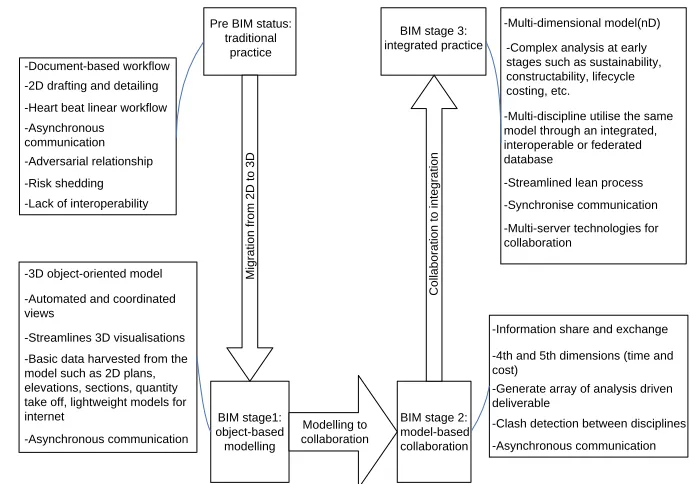
As depicted in Figure 2 there are three stages in the BIM implementation: (1) Stage 1 (object-based modelling).
(2) Stage 2 (model-based collaboration). (3) Stage 3 (network-based integration).
The BIM maturity stages provided a systematic framework for the classification of the BIM implementation. These stages are used as a benchmarking tool for the comparison of data from the Finnish interviews and the UK questionnaire-based survey. In order to provide a clear insight, the BIM maturity stages are described briefly below.
3.1 The pre-BIM status
Pre-BIM status refers to traditional construction practice which embraces significant barriers and inefficiencies. For example, much project information is stored on paper as
Pre BIM status: traditional
practice
-3D object-oriented model
BIM stage1: object-based modelling
Modelling to collaboration
BIM stage 2: model-based collaboration
-Information share and exchange BIM stage 3:
integrated practice
Collaboration to integration
Migration from 2D to 3D
-Multi-dimensional model(nD)
-2D drafting and detailing -Heart beat linear workflow -Asynchronous communication -Adversarial relationship -Risk shedding -Document-based workflow
-Lack of interoperability
-Automated and coordinated views
-Streamlines 3D visualisations -Basic data harvested from the model such as 2D plans, elevations, sections, quantity take off, lightweight models for internet
-Asynchronous communication
-Complex analysis at early stages such as sustainability, constructability, lifecycle costing, etc.
-Multi-discipline utilise the same model through an integrated, interoperable or federated database
-Streamlined lean process -Synchronise communication -Multi-server technologies for collaboration
-4th and 5th dimensions (time and cost)
-Generate array of analysis driven deliverable
[image:7.522.113.458.372.614.2]-Clash detection between disciplines -Asynchronous communication Figure 2.
BIM maturity stages in BIM implementation
614
drawings and written documents. This is frequently unstructured and difficult to use. It is also easy to lose or damage. Thousands of documents are shared during a typical project, causing significant human errors in version control and use. Poor information management process leads to incomplete understanding of the planned construction, functional inefficiencies, inaccurate initial work or clashes between components. Furthermore, lessons learned are not organised well and are buried in details. It is therefore difficult to compile and disseminate useful knowledge and best practice to other projects.
3.2 BIM Stage 1
Stage 1 refers to the migration from 2D to 3D and object-based modelling and documentation. The BIM model is made of real architectural elements that are represented correctly in all views. The BIM model is still single-disciplinary and the deliverables are mostly CAD-like documents, existing contractual relationships and liability issues persist
3.3 BIM Stage 2
Stage 2 progresses from modelling to collaboration and interoperability. Designing and managing a building is a highly complex process that requires smooth communication and collaboration among all members of the project team. Stage 2 maturity requires integrated data communication and data sharing between the stakeholders to support this collaborative approach.
3.4 BIM Stage 3
This stage is the transition from collaboration to integration and it reflects the real underlying BIM philosophy. At this stage, project lifecycle phases dissolve substantially and players interact in real time to generate real benefits from increasingly virtual workflows. BIM Stage 3 models become interdisciplinary nD models (Leeet al., 2005) allowing complex analyses at early stages of virtual design and construction. At this stage, model deliverables extend beyond semantic object properties to include business intelligence, lean construction principles, green policies and whole lifecycle costing.
4. Research data
Having established the 3-stage maturity measurement criteria, the research focused on mapping the best practice structure on the maturity framework, thus laying the foundation for cross-referencing against the situation in the UK. While the best practice data are solicited through interviews in Finland, the data relating to UK companies were obtained through the use of a questionnaire.
4.1 BIM implementation best practice
Many researchers have discussed best practice examples and the maturity of the process of BIM utilisation in construction projects (Eastman et al., 2008). Recent exemplar developments include the HUT-600 (Helsinki University of Technology) auditorium extension project in Finland and the construction of Eureka Tower project (2002-2006) in Melbourne with the total of 92 stories (Khemlani, 2004). New tools, techniques and applications are being researched and best practices are being created in many countries. For example, the Building Construction Authority in Singapore developed ePlanCheck system for assessment and regulatory approval, through an
615
independent platform called FORNAX. This platform uses the basic BIM information from IFC files to incorporate relevant code checking requirements. This system identifies the designs to be submitted to local authorities in an IFC file format. This has become a reference point for how local governments and authorities can utilise BIM within their strategy for the development of the built environment.
Over the past seven years many pilots and live projects have been completed and documented in Finland, Sweden, Norway, Germany, France, Singapore, UK and Australia, which demonstrate the capability of using BIM in the construction lifecycle process. Projects have been demonstrated to develop more environmentally sustainable products, compared to non-BIM usage. Tocoman Professional Services of Finland (www.tocoman.com) claims to have facilitated over 200 projects using BIM within building construction lifecycle activities, producing significantly better infrastructures with improved stakeholder satisfaction. Software such as Vicosoft aimed to provide full lifecycle services much more successfully than other competitive products.
4.1.1 Current acceptance of BIM in the industry – international. Some governments (such as those of Finland, Denmark, Norway and the USA) have endorsed the use of BIM for state projects; others are making progress towards endorsement (www.bdcnetwork.com/blog/1340000734/post/1350047735.html). The US General Services Administration (US-GSA, 2008) notified the requirement of utilising IFC standard by October 2006. In the USA, ten pilot projects have resulted in BIM authoring tools being certified as “fit for use” (US-GSA, 2008) and the development of modelling requirements continues. Fuller analysis of the external influences which have promoted successful BIM adoption may indicate how development of the use of BIM in the UK might be stimulated. The chief construction advisor to the current coalition government in the UK has already pledged his support to promote the use of BIM, particularly for public projects and indicated that future public projects will be based on the use of BIM (Morrell, 2010). Factors in the UK might include the attitudes of market constituents and compliance with standards such BS16001.
Details of the IFC version specification supporting each of these tools were published by Dimyadi (2007). During 2007 the National Building Information Model Standard (NBIMS) has initiated another US project, which aimed to raise awareness of using BIM systems and consequently NBIMS has released National BIM Standard Version 1. National CAD Standard (NCS) Version 4.0 was released in January 2008 to further streamline design, construction and facilitate through lifecycle communication among construction stakeholders. Improved communication through these standards is intended to reduce errors and lower costs for all disciplines. Classifying electronic building design data consistently is intended to streamline communication among owners, and design and construction project teams (NIBS, 2008). BuildingSMART is an alliance of international organisations within the construction and facilities management industries dedicated to improving processes through active collaboration. BuildingSMART started as a Norwegian activity, which followed the IFC compatibility introduced by IAI (http://cig.bre.co.uk/iai_uk/new/index.jsp). International chapters of BuildingSMART are promulgating and sharing the latest findings concerning BIM implementation within the project lifecycle.
The HITOS project of the University of Tromso has been one of the well-known international activities that used IFC model server technology in a comprehensive manner (www.epmtechnology.com). The researchers concluded that current business processes need to change to gain advantage from BIM (Leˆet al., 2006). The Norwegian
616
Directorate of Public Construction and Property, Statsbygg, has also produced brief documentation of the project. Statsbygg aims to utilise BIM in all phases, to a complete extent for projects by the year 2010 (Statsbygg, 2007). Further works on BIM and associated IFC files were carried out in the technology programme launched by TEKES (value networks in construction, 2003-2007) focusing on developing eco-efficient solutions for multi-storey and low-rise buildings and it provides tools to facilitate the adoption of BIM in construction. During the programme, BIM tools and processes have been developed in order to considerably improve productivity in the industry and make it possible to manage the information generated and maintained throughout the lifecycle of buildings more efficiently. Finland as the world leader in BIM implementation has 108 demonstration projects (TEKES, 2008).
The slow progressive changes in the UK industry are the subject of the research in this project but many firms are happy to continue using traditional CAD. However, it is noticeable that US organisations working in the UK markets are effectively converting their processes to utilise BIM technologies (Oakley, 2008) implicating the leveraging of BIM in competitive incursion suggested above. The requirements of such strategic change are substantial. These are further examined later in this paper. Such change is non-trivial requiring investment in both technology and human resources development. However, having a clear strategy along with the correct guidance will assist this process if the circumstances which promote adoption are laid (Oakley, 2008).
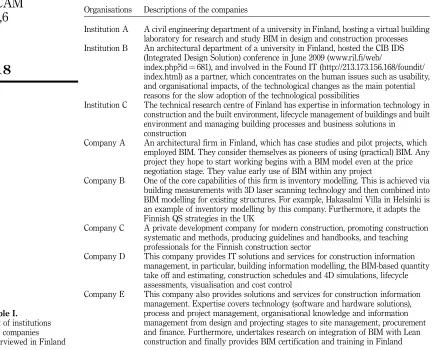
4.1.2 BIM implementation best practice – data from Finnish interviews. Finland is seen as a leader in BIM use and implementation in the construction sector (Wonget al., 2010). They have a clear vision of BIM implementation at both governmental and operational levels. They have also demonstrated best practice examples of BIM implementation. An understanding of the best practice in Finland is intended to help with the identification of the systematic approach to BIM implementation. The aim is to develop an in-depth understanding of substantial experience in BIM adoption, challenges and barriers as well as strategies for solutions to them. The result of the face-to-face interviews with some key institutions and companies from Finland are described in Table I.
The result of the face-to-face interviews with a senior member of staff in some key institutions and companies from Finland, who had either practical experience about BIM implementation or being involved in research on BIM implementation are described in Table I. These companies and institutions were selected during the literature review in the research due to their company or institutional profile in BIM implementation.
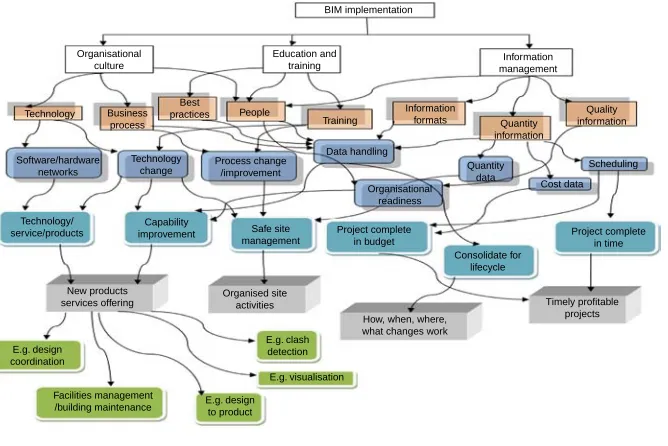
The interviews were carried out in a semi-structured manner, as each company and institution had a unique experience of BIM and varying viewpoints on their activities. The semi-structured approach to the interviews was adopted in order to capture their uniqueness as well as commonalities in their BIM experiences. The interviews all had the same objective, which was to understand their views and strategies for BIM use and implementation in practice at BIM Stage 3 maturity level. These interviews enabled the perception of every company’s experience about BIM use and implementation from their research and practical projects in the last 15 years not only in-depth but also in a broad manner. The concept mapping technique (Novak and Can˜as, 2008) was employed for the presentation and examination of the results of the survey. The outcome is shown in Figure 3.
617
4.2 Case in UK construction sector – questionnaire-based survey
Based on the maturity platform, a questionnaire survey was designed, reflecting the outcome of further literature review in conjunction with the examination of the case in Finland. There were 16 questions in total, grouped into five categories as follows:
(1) Section A: BIM understanding and awareness:
. Based on your experience, can you describe what BIM is?
. What BIM tools or systems have you used or have seen being used by
colleagues/clients, etc.?
. What is the best definition of BIM to your understanding?
(2) Section B: barriers and challenges to BIM use:
. Describe why your firm does not use BIM currently? . What was the primary reason not to implement BIM?
. What were the challenges of using BIM? Select applicable items from the list
Organisations Descriptions of the companies
Institution A A civil engineering department of a university in Finland, hosting a virtual building laboratory for research and study BIM in design and construction processes Institution B An architectural department of a university in Finland, hosted the CIB IDS
(Integrated Design Solution) conference in June 2009 (www.ril.fi/web/
index.php?id¼681), and involved in the Found IT (http://213.173.156.168/foundit/ index.html) as a partner, which concentrates on the human issues such as usability, and organisational impacts, of the technological changes as the main potential reasons for the slow adoption of the technological possibilities
Institution C The technical research centre of Finland has expertise in information technology in construction and the built environment, lifecycle management of buildings and built environment and managing building processes and business solutions in
construction
Company A An architectural firm in Finland, which has case studies and pilot projects, which employed BIM. They consider themselves as pioneers of using (practical) BIM. Any project they hope to start working begins with a BIM model even at the price negotiation stage. They value early use of BIM within any project
Company B One of the core capabilities of this firm is inventory modelling. This is achieved via building measurements with 3D laser scanning technology and then combined into BIM modelling for existing structures. For example, Hakasalmi Villa in Helsinki is an example of inventory modelling by this company. Furthermore, it adapts the Finnish QS strategies in the UK
Company C A private development company for modern construction, promoting construction systematic and methods, producing guidelines and handbooks, and teaching professionals for the Finnish construction sector
Company D This company provides IT solutions and services for construction information management, in particular, building information modelling, the BIM-based quantity take off and estimating, construction schedules and 4D simulations, lifecycle assessments, visualisation and cost control
[image:11.522.33.469.84.434.2]Company E This company also provides solutions and services for construction information management. Expertise covers technology (software and hardware solutions), process and project management, organisational knowledge and information management from design and projecting stages to site management, procurement and finance. Furthermore, undertakes research on integration of BIM with Lean construction and finally provides BIM certification and training in Finland Table I.
List of institutions and companies interviewed in Finland
618
(3) Section C: problems solved based on the BIM services offered:
. What services have you been able to offer to clients as a result of using
BIM?
. In your opinion what are the issues or problems that can be overcome by the
implementation of a BIM system within a firm?
(4) Section D: vision and future estimates for BIM implementation:
. Do you believe that BIM will result in improving the construction practices? . In your estimation, what percentage of firms/organisations is using BIM
currently for any of their projects?
. How long do you think it will be before 50 per cent of the AEC industry uses
BIM on a regular basis?
. How long do you think it will before 90 per cent of the AEC industry uses
BIM on a regular basis?
. What assistance would you like to receive if your firm were to go ahead
with BIM uptake over the next six months to one year?
(5) Section E: personal experience and background of the respondents:
. How many years of experience do you have in the industry?
. Considering your personal professional experience, what type of projects
are you involved with the majority of the time?
. Considering your personal professional experience, in which sector of
construction are most of your projects?
The questionnaire was distributed to members of UK Construction Domain, predominantly targeting the informed members of the industry; all represented at the IT directorship and/or board management levels. As noted earlier, these members have an objective and holistic view of the industry and are fully aware of BIM use,
BIM implementation Organisational culture Education and training Technology Software/hardware networks Technology/ service/products Technology
change Process change/improvement
Capability
[image:12.522.70.404.82.305.2]improvement Safe site management Data handling Organisational readiness Project complete in budget Organised site activities New products services offering E.g. design coordination Facilities management
/building maintenance E.g. designto product E.g. clash detection E.g. visualisation Business process Best practices People Training Information formats Information management Quality information Scheduling Quantity information Cost data Quantity data Project complete in time Consolidate for lifecycle Timely profitable projects How, when, where,
what changes work
Figure 3. BIM implementation concept map from the interviews in Finland
619
barriers, challenges and other IT-related developments and experiences not only in their own organisation but also across the UK. They were considered appropriate sources of information about the state of the industry and for the provision of timely, accurate and efficient survey results.
The questionnaire-based survey was issued to via the Construct IT network to 75 recipients and 32 (43 per cent) complete responses were received, which is deemed statistically adequate (Spiegel and Stephens, 1998, p. 242). The extracted survey information is based on these responses. The survey results are collated and evaluated in detail in Section 3.2 based on the BIM maturity levels and the interview findings from Finland.
5. Analysis of data
5.1 Current state of organisation readiness
This section initially presents and interprets the interview findings and the observations from the visited companies and institutions in Finland in a qualitative manner. The implementation of any technological system within an organisation should accommodate its impact on culture, personnel and the organisation’s use of technologies. Every organisation has its own culture and capabilities based on the competencies of their employees and technological assets used for standard processes. For implementation of information systems to be successful and make an effective contribution to the implementation of a business strategy requires that there is a strategic fit between the business strategy and the external domain and (Venkatraman et al., 1993) and that the organisation factors described above are aligned in support of the business strategy.
The concept map in Figure 3 shows the key findings from the interviews, which have provided a focus on three predominant themes which are organisational culture, education and training, and information management. Overall, these three key themes are not only focusing on technology, they are also about process and people. Based on these general themes and inherited parameters in the concept map, the arguments above are further elaborated in detail under the subheadings in the following sections. 5.1.1 Organisation culture. As noted from the interviews, the organisational culture is predominantly created and practiced by everyone involved in the organisation, see for example the pervasive and persistent nature of the “cultural web” (Johnson, 1992). Further, it is an aspect that is inherited as the organisation changes, grows and merges. Its effects can be identified within the business process, technologies used and people’s work practices. Whilst the nature of the business culture will contribute to the organisational readiness to adopt BIM successfully it is also necessary for the new business and administrative processes are understood and accepted by the staff and the necessary training programme is also installed. The interviewees stated that obtaining the benefits of BIM implementation required a change in technology and business processes which then enabled improved capabilities and service improvements. Technology changes in most cases included either the integration or replacement of hardware and software systems used. Venkatraman et al. (1993) concluded that the changes needed to implement an ICT-based business strategy also included changes to the administrative infrastructure, including roles and reporting relationships, the articulation of workflows and the associated information flows, and the key capabilities and skill of the individuals and organisation.
The industrialists expressed that new systems also provided challenges in data handling, which require training within the whole organisation. Due to the nature of
620
BIM, consolidation of data throughout the lifecycle of a given project will arise. Therefore, many other applications will be able to access such data streams to provide further services, e.g. asset management and demolition management during the lifecycle. In addition, such changes will create new opportunities and improvements, e.g. design coordination, clash testing, virtualisation and cloud services and streamlined design to product workflows, which can become a part of the core business process model of the organisation.
5.1.2 Education and training. Education and training has become an important part of BIM implementation due to the process and technological changes within the organisation. All the interviewees confirmed that all affected people require up skilling for successful implementation. For example, some positions may require that post holders gain certified standards of education and training. Those who could complete such certification programmes can reach a skill level to engage and administer organisational process and technological changes initiated through BIM implementation. However, such standards are not being implemented by training providers currently leading to a growing need for such educational programmes to be hosted by academic organisations. Currently only a handful of academic programmes based on such expertise exist around the world. Professional practise development is another important aspect since BIM technology is linked with many profession-specific sources of data, e.g. costing, scheduling and materials flow. However, depending on the tools being used such links may or may most of the links between data from the building lifecycle become visible.
5.1.3 Information management. Interviewees agreed that BIM was seen as an efficient information management methodology within construction projects. It heavily involves people’s perspectives, first as creators or collectors of data from the site and other sources, and second as users of processed data, i.e. information or knowledge from the building models. Different BIM technologies available to date may provide different organisational capabilities and hence the stakeholders are required to assess currently available technologies on the market so that selection of suitable technology may intercept a future strategy. This may incorporate further services that the organisation is willing to provide in the future. Similarly in some circumstances multiple tools may be required to achieve specific outcomes. Due to the variety of software and tools being used many different types of files formats are involved. Some interviewees concluded that greater simplicity could be achieved by using integrated products, e.g. Vicosoft and Tocosoft. Given that such tools provide various features with different complexities, stakeholders should ensure forward compatibility with their goals. Quantity and quality management has been an important part of such product listings. Quantity data can also assist the appropriate site management feature, e.g. site safety and minimising onsite storage. Costing and scheduling can provide timely project completions with maximum profits/savings.
5.2 BIM use and understanding in the UK construction sector
The systematic approach from Finnish experience for BIM implementation is identified above through interviews in Finland. The analysis of the best practice case in Finland together with Succar’s (2009) BIM maturity levels provided a basis of assessment for BIM adoption in the UK construction industry.
The systematic analysis is based on categories of questions. These categories are personal experience and background, recognition of the understanding of BIM, barriers and challenges to BIM use, BIM services offered and problems solved,
621
and vision and future estimates for BIM use and implementation. Below, after discussing the general background of the respondents, the results for each category are explained.
5.2.1 Personal experience and background of the respondents. Respondents reflect a broad variation in their number of years of experience. While ten people have more than 25 years of experience in the industry, seven people have experience of more than 20 years and nine people have experience of more than ten years. On the other hand, two people have experience between five and nine years but four respondents have experience up to four years. This means that, as intended, the overall survey results are dominated by the people who have substantial experience and understanding about the progress of the construction industry over the last two decades.
Despite the commonalities of their role as the IT director, the profiles of the respondents shows a wide range of professional experience and varying specialism in construction such as low-rise buildings, mid-rise buildings, bridges and transportation infrastructure, consultancy, airport infrastructure, civil engineering, and IT supply, CAD development, railway, highway, energy, environment and power plant, and hall mark building projects. The sectors of the construction projects concerned include commercial, residential, governmental and industrial. As a result, the survey result will be able to reflect use and attitude of BIM across the UK construction industry.
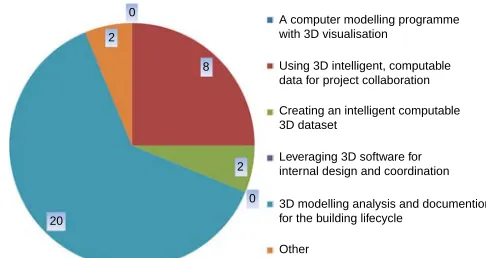
5.2.2 Recognising BIM understanding and awareness. As seen in Figure 4, there is general consensus about which definition, from the five different BIM definitions put forward, is the best. Over 62 per cent defined BIM as “3D modelling, analysis and documentation for the building lifecycle” whereas 25 per cent defined it as “using 3D, intelligent, computable data for project collaboration” and 6.2 per cent (only two) believe that BIM is “creating an intelligent, computable 3D data set”. However, another 6.2 per cent did not agree with any of the above definitions and each stated BIM to be “Multidimensional data concerning cost and value” and “5D modelling, creating an intelligent computable, 5D dataset which includes time and cost”.
With an awareness of varying understanding of BIM in the literature, these definitions were generated by the researchers of the paper based on the maturity level stages in Figure 2 in order to reflect different levels of understanding in maturity stages from Stage 1 to Stage 3. For example, while first and third definitions are related to Stage 1, the second and fourth definitions are reflecting Stage 2 maturity levels. Finally, the fifth definition corresponds to the Stage 3 level of maturity in understanding BIM.
A computer modelling programme with 3D visualisation
Using 3D intelligent, computable data for project collaboration
Creating an intelligent computable 3D dataset
Leveraging 3D software for internal design and coordination
3D modelling analysis and documention for the building lifecycle
Other 20
0 2 8 2
[image:15.522.165.408.483.612.2]0
Figure 4.
Shows the distribution of the answers by the respondents to the question of “what is the best definition of BIM to your
understanding?”
622
The figure shows that while 60 per cent of the respondents have BIM understanding at Stage 3, 30 and 10 per cent have BIM understanding at Stage 2 and Stage 1 levels, respectively.
On the other hand, responses to the question about which BIM tools have been used or seen being used shows that traditional CAD vendors such as Autodesk, ArchiCAD and Bentley are the most popular ones amongst the users (see Figure 5). Most respondents selected more than one BIM tool as they use different systems. It can be argued that these CAD vendors have taken the lead to introduce BIM to their current users in construction. Although digital project from CATIA, which was initially designed for the manufacturing and aerospace industries where a BIM philosophy is already in place, it is not very popular with construction practitioners. This can be attributable to the fact that users tend to continue using their current CAD tools by adopting the BIM upgrades from the same CAD vendors. On the other hand, all the respondents have selected at least one BIM tool for object-based modelling. This shows clear evidence of use of BIM in practice at Stage 1 maturity level. However, this also indicates that the respondents’ practical experience for BIM is mainly limited to the remit of their traditional software vendors as nobody has indicated any tool or technology for BIM implementation at Stage 2 or Stage 3 maturity levels.
5.2.3 Barriers and challenges to BIM use. The primary reasons and barriers to BIM implementation at Stage 2 and beyond for many UK construction companies are listed below. The list is ordered from higher to lower rank based on the number of selections by the respondents:
(1) firms are not familiar enough with BIM use; (2) reluctance to initiate new workflows or train staff;
(3) benefits from BIM implementation do not outweigh the costs to implement it; (4) benefits are not tangible enough to warrant its use;
(5) BIM does not offer enough of a financial gain to warrant its use;
(6) lacks the capital to invest in having started with hardware and software;
25
20
15
10
5
0
Revit architecture Revit str
ucture Revit MEP
Bentle
y architecture Bentle
y electr ical
Digital projectTekla str uctureAllplan
AutoCAD ADT ArchiCAD
Bentle y str
ucture
Bentle y mechanical
Figure 5. Shows the distribution of the answers given by the respondents to the question of “what BIM tools or systems have you used or have seen being used by colleagues/ client, etc.?
623
(7) BIM is too risky from a liability standpoint to warrant its use; (8) resistance to culture change; and
(9) no demand for BIM use.
Several of these barriers (rank orders 3-5, 7, 9) relate to the potential lack of marginal utility and risk weighted business benefits to be realised by BIM adoption. It is not clear from these results as to whether these perceptions reflect reality for the companies concerned or, for example to what extent they reflect a lack of perception of opportunity resulting in a failure to trigger knowledge acquisition to implement adoption of BIM
Challenges for BIM implementation emerged in line with the barriers listed above. It is noted that the respondents have selected some challenges, which are ranked below, based on the ranking identified through their number of selections by the respondents:
(1) training staff on new process and workflow; (2) training staff on new software and technology;
(3) effectively implementing the new process and workflow; (4) establishing the new process, workflow and client expectations; (5) understanding BIM enough to implement it;
(6) realising the value from a financial perspective; (7) understanding and mitigating liability;
(8) purchasing software and technology; and (9) liability for common data for subcontractors.
These results tally with the conclusions from the interviews that practitioners need clear guidance, training and technical support for BIM implementation in practice as they are not knowledgeable and experienced about BIM at Stage 2 and Stage 3 maturity levels although they are familiar with the BIM tools to practice it at Stage 1 maturity.
5.2.4 Problems solved based on the BIM services offered. In the questionnaire, five options were provided and multiple selections were possible for this question. These are “none”, “third party integration”, “shop drawing production”, “construction management”, “Not sure” and “other”. As shown in Figure 6, about 19 per cent selected first option that no extra services to solve any problem were offered to their clients via BIM implementation and 9 per cent stated that they were not sure about it (option v) while nine people selected the third party integration consulting (option ii) and 28 per cent selected shop drawing production (option iii) and over 15 per cent selected construction management (option iv). Therefore, nearly half the respondents – the total of number people who selected the third party integration consulting and construction management options – appear to have visionary perspective and awareness about BIM Stage 2 and Stage 3 maturity levels whereas the rest of them have a realised vision limited to BIM maturity Level 1 as they only realise BIM in practice from the BIM tools highlighted in the previous section.
Options two, three and four in particular in the questionnaire provided some potential examples of BIM services to be offered as it was not practical to list all the
624
potential services in the questionnaire. Therefore, the respondents were encouraged to note down any added-value BIM services to be offered. The majority of them also provided some examples as below:
. information management for the building lifecycle; . increased efficiency leading to improved design; . helping clients develop BIM capabilities themselves;
. visualisation to manage client expectation and enable awareness for training; . guidelines, implementation support and monitoring;
. 3D walkthroughs, visualisation, quick analysis of alternatives; . quick revisions to schemes;
. material supplier integration, better modelling; and . high-quality documentation.
The above list correlates with the interpretation of their understanding of BIM because apart from the first and second items, the remaining items in the list refer to benefits from BIM implementation at Stage 1 of maturity. Expectations of issues or problems can be overcome by the implementation of BIM are shown in Figure 7 (a multi-selection question).
Efficient collaboration among the stakeholders
9
23
23 24
22
Availability of the accurate documentation
Common understanding of project costs schedules
Ability to assess the design alternatives and lifecycle impact
Others
Figure 7. Shows the distribution of the answers given by the respondents to the question of “in your opinion, what are the issues or problems that can be overcome by the implementation of a BIM system within a firm”
None 6
9
3
5
6
9
[image:18.522.114.366.322.615.2]Third party integration consulting
Shop drawing production
Other
Construction management
Not sure
Figure 6. Shows the distribution of the answers given by the respondents to the question of “what services have you been able to offer to your clients as a result of using BIM”
625
The legend shows those options available. Two-thirds of the respondents have a theoretical understanding of BIM to solve some issues and problems related to BIM implementation at Stage 2 maturity levels. Besides, 20 per cent of respondents also specified other examples of what issues can be overcome by BIM implementation such as:
. reduced error, rework and waste for better sustainability for design and
construction;
. improved risk management;
. removal of waste from process, lean construction and design;
. whole lifecycle asset management, better facility management/asset
management;
. ability to better deal with client made changes to the design and the lifecycle
implications of these;
. gaining supply-chain support in producing documentation and supply-chain
skill set; and
. construction management appreciation of the use of technology.
It is interesting to see that these respondents have linked BIM to lean construction and sustainable design concepts, which positions them at stages three maturity level of BIM perception.
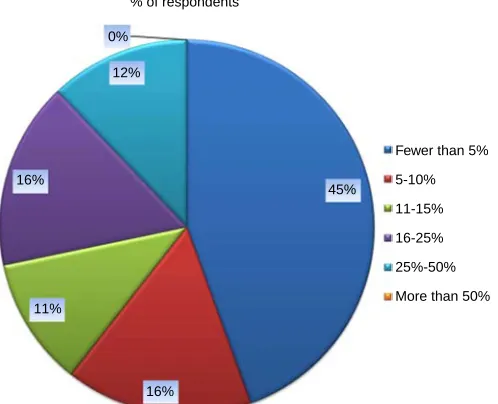
5.2.5 Vision of current and future estimates for BIM implementation. The overall configuration of the current implementation of BIM in UK is given in Figure 8. All the respondents believe that “BIM will result in improving the construction practices” However, expectations of actual adoption are much lower with 44 per cent of the respondents believing that fewer than 5 per cent of firms are currently using BIM in the UK. On the other hand, 16 per cent of the respondents think that 5-10 per cent of
% of respondents
0%
12%
16%
11%
16%
45%
Fewer than 5%
5-10%
11-15%
16-25%
25%-50%
[image:19.522.168.417.410.612.2]More than 50%
Figure 8.
Shows the distribution of the answers given by the respondents to the question of “in your estimation, what percentage of firms is using BIM currently for any of their projects?”
626
construction firms are utilising BIM while 10 per cent of the respondents believe that 11-15 per cent of the UK construction firms are using BIM in construction projects. Another 16 per cent believe that between 16 and 25 per cent of construction firms uses BIM in their projects while 12 per cent believe that between 25 and 50 per cent of construction firms use BIM.
Respondents have varying understandings about BIM implementation and use. For example, 38 per cent of respondents, who believe that current BIM use in the UK construction sector is between 11 and 50 per cent, interpret the use of BIM tools such Revit and ArchiCAD as BIM implementation reflecting Stage 1 maturity. On the other hand, 16 per cent of the respondents, who believe that 5-10 per cent of construction firms are utilising BIM, recognise the BIM use for collaboration, which reflects the BIM Stage 2 maturity level because most of the respondents in this category have specifically noted down BIM use for collaboration and 4D and 5D what-if analysis. However, 44 per cent of the respondents believe that less than 5 per cent of UK firms utilise BIM. Arguably these respondents have the most mature understanding of BIM implementation as they are all aware of BIM tools and do not interpret merely use of BIM tools as complete BIM implementation and interpret BIM implementation as Stage 2 or Stage 3 maturity level.
Regarding rates of diffusion and adoption, 26 per cent of the respondents think that 50 per cent of construction firms will use BIM in the construction projects within next five years. A further 40 per cent of them anticipate that it will take between five and ten years from now for 50 per cent of the UK construction firms to use BIM in their construction projects, and 14 per cent think that it will take even longer (from 11 to 15 years from now). Finally 10 per cent of the respondents predict that it will take up to 16-20 years whilst another 10 per cent anticipate that it will take more than 20 years. This is illustrated in Figure 9.
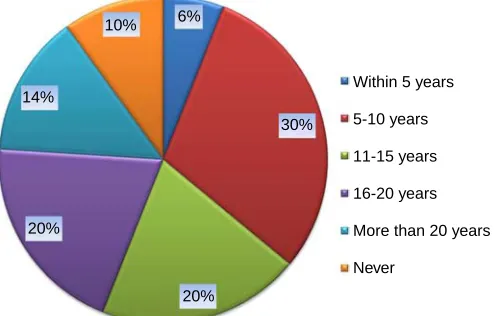
In terms of use of BIM by 90 per cent of the UK construction firms on a regular basis as illustrated in Figure 10, only 6 per cent believe that it will happen within five years whereas 30 per cent of them anticipate that it will take up to 10 years; 20 per cent think that it will happen in 11-15 years time whereas another 20 per cent anticipate that it will happen in the next 15-20 years. Another 14 per cent envisage that it will even take
Within 5 years 0%
10%
14%
10%
26%
5-10 years
11-15 years
16 -20 years
More than 20 years
Never 40%
Figure 9. Shows the distribution of the answers given by the respondents to the question of “how long do you think it will be before 50% of AEC industry uses BIM on a regular basis?”
627
over twenty years to have BIM in the mainstream of construction work whereas another 10 per cent believe that it will never happen. This distribution across ten to 15 years is reflective of the knowledge and prospect of the respondents, whose expectation of the implementation is at maturity Level 2.
The predictions by the respondents about the future BIM use also reflect a normalised understanding and expectations from BIM implementation and the level of BIM maturity.
Finally, with regard to the type of assistance required by AEC firms to adopt BIM according to the respondents, 40 per cent claim that they do not need assistance because their firms are already using BIM. This suggests that these respondents have a BIM understanding at Stage 1 and possibly Stage 2 maturity level because some examples of BIM use were given by the respondents such as model-based documentation and 4D analysis and collaboration. This is somewhat expected, as for this survey, mainly progressive companies and IT directors were targeted. On the other hand, 60 per cent of the respondents have selected the items in the list below in order for the type of assistance they would like to receive if their firm is to go ahead with BIM uptake within the next year. These items are ranked according to the perceived need of respondents, for BIM implementation:
(1) clear understanding of benefits that outweigh the cost and other factors; (2) required training and know-how transfer to their firm and staff;
(3) attending workshops to discuss BIM uptake and further information; (4) recommendation of a way forward with regards to software and hardware; (5) support for uptake and implementation through projects; and
(6) collaboration between the construction stakeholders such contractors, to populate the databases, spread the investment risk.
From the survey results, it is understood that ongoing training, consultancy and support for successful BIM adoption are vital ingredients in achieving a good return on the company’s investment. In addition, currently BIM is mainly used for object-based modelling and model-based documentation. There is only a little evidence of BIM use
Within 5 years 6%
30%
20% 20%
10%
14%
5-10 years
11-15 years
16-20 years
More than 20 years
[image:21.522.168.415.454.612.2]Never
Figure 10.
shows the distribution of the answers given by the respondents to the question of “how long do you think it will be before 90% of AEC industry uses BIM on a regular basis?”
628
at Stage 2 maturity level such as 4D time analysis, cost estimation, energy analysis, etc. However, there is no evidence of BIM use at Stage 3 maturity level although a large number people are aware of BIM at Stage 3 maturity level.
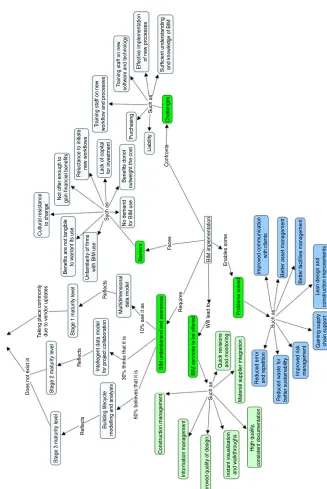
The concept illustration of the findings from the survey is encapsulated and depicted in Figure 11. The figure highlights the relevant issues, their sub-sections and interrelations. In order to make a meaningful interpretation of the concept map in Figure 11, it is required to follow the directions of the arrows from the main source concept to the targeted sub-concepts, which imply meaningful, interrelated sentences. Different colouring in the concept map represents different hierarchical levels.
6. BIM implementation roadmap
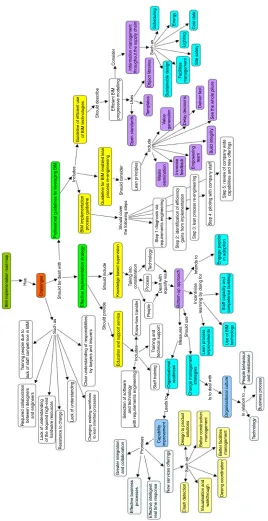
The paper aimed at providing a basis for a viable BIM strategy and guidance for its implementation. The interviews and the questionnaire-based survey were designed to achieve this aim and lay the foundation for the UK construction industry to prepare moving up the maturity ladder. The results suggest that a certain degree of intervention by researchers in the built environment is needed before higher levels of maturity could be achieved. To this end, an implementation roadmap is required for the industry to evaluate its standing to that of more BIM-advanced countries such as Finland. The convergence of the results from the literature review, the surveys and the questionnaire, into a roadmap is expressed in a customised refined version of a concept-map which is shown in Figure 12. This figure also can be meaningfully interpreted as aforementioned for Figure 11. Furthermore, the concepts in the map are elaborated below in the following sub-sections.
6.1 Implementation of BIM at Stage 3 maturity
Findings from the interviews emphasise BIM’s extensive effects: seamless collaboration, construction sequencing, shareable databases and fully integrated project delivery, which reflect the BIM Stage 3 maturity level, embracing process improvement, people’s training and technology change. While all these possibilities are foreseen today and are becoming more readily accessible, in the light of the findings from the survey, it is envisaged that the roadmap will help the UK firms focus on the task at hand, better allocate available resources and prepare for the BIM-enabled future.
Both the questionnaire-based survey and the interviews have highlighted a number of key issues. First, BIM implementation at Stage 3 maturity undeniably entails change and adoption which is not likely to be easy for those who are uncomfortable with change. Education and awareness, not just about BIM tools but about BIM in general are critical to tackle the resistance to change. This is often paralleled with process improvement and sometimes re-engineers the process and how to assign responsibilities.
In adopting the maturity concept, the research, has identified the following three categories of key findings:
(1) Challenges identified in implementing BIM: challenges in implementing BIM in the UK construction practice were identified via the survey in the light of the findings in the concept map from the interviews in Finland:
. overcoming the resistance to change, and getting people to understand the
potential and the value of BIM over 2D drafting;
629
Figure 11. Concept map for the case of UK construction industry
630
Figure 12. BIM implementation concept map as a roadmap for UK construction industry
631
. adapting existing workflows to lean-oriented processes;
. training people in BIM, or finding employees who understand BIM; . the understanding of the required high-end hardware resources and
networking facilities to run BIM applications and tools efficiently;
. the required collaboration, integration and interoperability between the
structural and the MEP designers/engineers; and
. clear understanding of the responsibilities of different stakeholders in the
new process by construction lawyers and insurers.
Thus, there appears a need for providing education and specific support services to those who implement BIM process within their organisations.
(2) Need for an effective implementation strategy: implementing BIM effectively requires significant changes in the way construction business work at almost every level within a building process. Most organisations from the interviews and majority of the respondents from the survey highlighted that BIM implementation not only requires learning new software applications, but also requires learning how to reinvent the workflow, how to train staff and assign responsibilities, and the way of modelling the construction. It was seen that most firms are grappling with the same fundamental issues of change in the UK construction sector. Thus, it appears that they could all benefit from a clear set of guidelines and possibly a roadmap outlining an effective strategy and methodology of implementing BIM at BIM Stage 3 maturity level.
(3) Need for professional guidelines on leveraging BIM: BIM is currently benefitting adopters as a better and more efficient tool for design and construction. The full potentials of BIM at Stage 3 maturity level that will facilitate building lifecycle management (BLM) are not yet realised. Some organisations from the interviews and some firms from the survey in the study stated that building owners and clients are still unaware of BIM or BLM and also indicated that for an average architectural firm. BIM implementation does not immediately translate into more business. Thus, there appears to be a need for providing professional guidance to BIM adopters.
5. Conclusions
The importance of BIM adoption is becoming increasingly recognised by the construction industry that has been facing barriers and challenges to increase productivity, efficiency, quality and in order for sustainable development.
By using the BIM Maturity gauge, the research has shown that the UK construction industry has clear evidence of BIM use in Stage 1 maturity level. There is evidence of some BIM use at Stage 2 maturity level, but none at Stage 3 maturity level, even though more than 60 per cent of industry representatives have good awareness about BIM at Stage 3 maturity level, which incorporates key challenges for its adoption. The work has then identified the need for an effective implementation strategy that meets the challenges and offer guideline for organisations to leverage BIM at Stage 2 and Stage 3 maturity levels. The literature review and study of the case in Finland confirmed that this guideline should cover topics under three themes: technology, process and people. The concept-map from the Finnish interviews, drilled down these themes into more detailed factors that are covered under organisation culture, education and training and information management headings. However, each
632
category implies a different perspective to the BIM implementation, and the emphasis throughout the transition will continuously swing from technology and people to data and process. Therefore, there is a need for complementary methodologies such as soft system methodology (people oriented), information engineering (data-driven approach) and process innovation (process-oriented approach).
However, the interview-based study of BIM implementation helped to identify the best practice in Finland, which was analysed and interpreted via concept mapping, paved the way for conducting a systematic survey of IT directors of the largest and most proactive contracting organisations in the UK and subsequently facilitated the comparative analysis of the survey findings in UK with the best practices in Finland before the articulation of the BIM implementation roadmap for the UK construction industry, illustrated in Figure 12. The analysis did not involve inferential analysis or test of significance. Due to the nature of the work the analysis is purely of descriptive nature. As for the data population, the sources have been careful selected so to ensure that they represent the knowledge side of the industry. The motivation was to ensure that a true picture of the situation in the UK will be identified through the knowledge of the experts.
The study also highlighted relevant issues that would prevent or facilitate maturity enhancement, such as the importance of interoperability between construction-related applications which was identified relevant to BIM implementation at Stage 2 and Stage 3 maturity levels. This issue has on the one hand become a battleground for major BIM providers to bid for supremacy, but on the other hand facilitated their collaborative working under the banner of global BuildingSMART movement for interoperability.
Finally, while dealing with the issue of BIM implementation, the work has also identified some areas of future research in this area. These are primarily concerned with intricate issues that have enabled one set of organisations and countries to embrace BIM and prevented others.
References
Alshawi, M., Goulding, J., Khosrowshahi, F., Lou, E. and Underwood, J. (2008), “Strategic positioning of IT in construction, an industry leaders’ perspective”, proceedings of the International Conference on Computing in Civil and Building Engineering, Nottingham University Press.
Aranda-Mena, G., Crawford, J., Chevez, A. and Froese, T. (2009), “Building information modeling demystified: does it make business sense to adopt BIM?”, International Journal of Managing Projects in Business, Vol. 2 No. 3, pp. 419-34.
Bernstein, P.G. and Pittman, J.H. (2004), “Barriers to the adoption of building information modelling in the building industry”, White paper, Autodesk Building Solutions. Computer Integrated Construction (CIC) Research Program (2010), BIM Project Execution
Planning Guide – Version 2.0, The Pennsylvania State University, University Park, PA. Dawood, E. and Underwood, J. (2010), “Research methodology explained”, PM-05 – Advancing
Project Management for the 21st Century – Concepts, Tools & Techniques for Managing Successful Projects, Heraklion, Crete, 29-31 May.
Dimyadi, J.A.W. (2007), “Generating FDS fire simulation input using IFC-based building information model”, Fire Engineering Research Report No. 07/1, Masters research project report, University of Canterbury, Christchurch.
Eastman, C., Teicholz, P., Sacks, R. and Liston, K. (2008), BIM Handbook: A Guide to BIM for Owners, Managers, Designers, Engineers and Contractors, John Wiley and Sons, Inc, New Jersey, NJ.