International Journal of Emerging Technology and Advanced Engineering
Website: www.ijetae.com (ISSN 2250-2459,ISO 9001:2008 Certified Journal, Volume 4, Issue 6, June 2014)
139
High Data Aggregation in Wireless Sensor Networks Using
Rendezvous-Drina
G. Rekha
1, A. S. AjeethaKumari
21,2
Assistant Professor, ECE & K.L.N. College of Information technology, Tamilnadu.
Abstract— Wireless Sensor Networks (WSN) will be established in distinct category of fashion such as healthcare application, home automation, defense etc.. As a consequence of plenty of nodes in WSN, unified data and energy preservation is in need for efficient transmission. Due to the massive node environment in WSN, redundant data will be detected by immediate nodes. Here, redundant data can be unified by intermediate nodes because to reduce the communication cost and size of control messages. In existing work, Data Routing In Network Aggregation (DRINA) algorithm proposed for reducing redundant data size and improving energy conservation in cluster nodes. But it is not promptly detect the failure of cluster head. Inspite of this critical nature, we propose a new routing protocol known as RENDEZVOUS Data Routing In Network Aggregation (R-DRINA) for data aggregation and recover the cluster head failure immediately. This is done by the RENDEZVOUS cluster, it act as an administrator in selection of alternative cluster head when the assigned cluster head is dropped out.
Keywords— Cluster Protocols, DRINA, Rendezvous-DRINA, Routing Protocols, WSN.
I. INTRODUCTION
Wireless sensor networks are usually composed of either hundreds or thousands of inexpensive, low power sensing devices with finite memory and communicational resources. The challenge of WSN is how to guarantee the data delivery even the node failures. Basically sensor nodes are fitted with on-board processor. However, realization of sensor network needs to satisfy the constraints introduced by the factors such as fault tolerance, scalability, cost etc... Since these constraints are highly stringent and specific for sensor networks, the wireless adhoc networking technique are required [2].Sensor networks to be deployed in an adhoc fashion. The Data aggregation aware routing algorithms play an essential role in WSN. It is the combination of data from different sources and can be implemented in number of ways. It has wide application in communication, weather monitoring, security systems, Area monitoring, Forest fire detection [6].
The main goal of routing protocols is to find out the shortest path which connects all the source nodes to the sink, while maximizing the data aggregations. The data aggregation routing algorithms which can reduces the number of messages setting up a routing tree, increased the number of overlapping routes and achieve high aggregation rate [1]. In Shortest Path Tree (SPT) data aggregation scheme ,every node that detects an events report and send the information along the shortest path to sink node[10].In most cases, Greedy incremental tree(GIT) build the shortest path in the network and also minimize the minimum spanning tree problem[14].one more approach in data aggregation is Center at Nearest (CNS)algorithm, it has an aggregator, which sends the information to a specific node when the event is detected in the cluster[10].
International Journal of Emerging Technology and Advanced Engineering
Website: www.ijetae.com (ISSN 2250-2459,ISO 9001:2008 Certified Journal, Volume 4, Issue 6, June 2014)
140
Fig1. Data aggregation aware routing, a key algorithm for data-driven WSNs.
Tree Based Approaches
Based on the network topology the routing protocols are classified under the tree based approaches and mesh based approaches. In tree based approaches, there exist only a single path between source node and the destination node. The nodes are basically in hierarchical structure in network. One of the way to aggregate the data flowing from source to sink node is to selects some special nodes that act as an aggregation points which used to forwarding data packets to preferred directions.
In tree structure, protocols are either to route the aggregated data or to respond the queries send by the sink node. Aggregation is the process to combine the data received by two or more same node of the tree and the only one packet may be send to the sink node. Suppose a packet is lost at certain level the whole sub tree information will be totally vanished. But the tree based structure potentially high cost for maintaining the structure and tolerance of the failure is very critical. One of the major aspects of tree-based networks is the formation of an energy efficient data aggregation tree.
One of the most popular algorithm is Shortest Path Tree Algorithm (SPT) which used to find the set of edges connecting all nodes such that the sum of the edge lengths from the source to each node is minimized. Another algorithm familiarly known as maximum-energy shortest path tree algorithm (MESPT), which is a two-phase algorithm, for data aggregation in wireless sensor networks. It constructs a maximum-energy path tree (MEPT) which balances the energy consumption among the sensor nodes and it restructures the tree by the shortest path algorithm based on MEPT trying to minimize the data aggregation.
The novel algorithm for data aggregation is Adaptive State-Aware Routing Algorithm for data aggregation (ASARA).It construct the shortest path tree based on the node local state and events occurance.
Whenever the path in poor state, new path will be build forcely. The author deal only to save the transmission data energy that the same to maximize the data aggregation.
Unfortunately the coordinator node failure situation, there is no alternates provided in ASARA.
Mesh Based Approches
Protocols that fall under this family, do not maintain the network topology information and it establish the path whenever the information need to be exchanged. There is no necessary to exchange the routing information periodically. These protocols are familiarly known by the name of an on-demand routing protocols.
Cluster Based Approaches
The whole network has been divided into small cluster groups. Some special nodes are selected as cluster head based on their energy and other parameters. They collect sensor data and aggregate the collected data, finally communicate with sink node.
One of the Cluster based approach familiarly known as Maximum Lifetime Data Aggregation (MLDA) Algorithm which finds data gathering schedule with maximum lifetime for a wireless sensor network which permit in network data aggregation. Each node within the cluster such as for a neighbor closer to the cluster head which is known as data relay point and set up data relay link. An aggregation tree specifies the data packets from all sensor are collected, aggregated and transmitted to the sink node. But it has a very high time complexity.
LRS Algorithm is based on their distances from each other and sink node. All gathered data moves along the chain, gets aggregated and reaches a designated cluster head. The cluster head are selected in each level of hierarchy, naturally defines an aggregation tree structure. But it has potentially high cost of maintaining a hierarchical structure in each stage.
In Low Energy Adaptive Cluster Hierarchy (LEACH) Algorithm, the rest of the cluster nodes transmit data to the cluster head and the cluster head aggregate the received data and transmit it to sink node which limits the size of the network and the cluster head selected randomly in each round according to the energy consumption. Our R-DRINA routing algorithm tends to maximize the aggregated data rate and it does not generate a message whenever a new event occurs.
II. RENDEZVOUS -DATA ROUTING IN NETWORK
AGGREGATION (R-DRINA)
International Journal of Emerging Technology and Advanced Engineering
Website: www.ijetae.com (ISSN 2250-2459,ISO 9001:2008 Certified Journal, Volume 4, Issue 6, June 2014)
141
It plays an important role in energy constrained WSN and aggregation is performed interior nodes reducing size and number of messages swap across the network.
The data aggregation is the synchronization of data transmission among the nodes. It will improve the performance of the algorithm and save energy. There are three main strategies are analyzed in existing work:
Periodic simple aggregation:
Each node to wait for a specified time period while aggregating all received data packets and then forward a single packet to the sink.
Periodic per hop aggregation:
Each hop have a specific time period for data aggregation. When the time exceeds, the event is get over nevertheless transmission is not complete.
Periodic per hop adjusted aggregation:
There is no predefined transmission time assigned for nodes. It will vary according to the node position.
The R-DRINA algorithm considers the following parts in the network creation:
Collaborator: Detects an event and send the collected
data to a Coordinator node.
Coordinator: It aggregating the collected data from
Collaborator and sending it towards sink nodes.
Sink: It receiving data from a set of Coordinator and
Collaborator nodes.
Relay: It is an interior node that forwards the data
towards sink.
2.1 Formation of Hop Tree
Hop Configuration message (HCM) is used to build the HopTree in DRINA. The hop ID and HopToTree are the two fields in HCM. ID is node identifier and HopToTree is the distance in hops. The sink node start to send HCM message to each neighboring hops and it find the shortest path, it brings the HCM ID to each node. Suppose the node already received the HCM, the node discards the HCM message. On the first event occurrence HopToTree will still be the shortest distance, to establish a new route.
HopToTree stores the smaller of two values; distance to the sink or distance to the nearest already established route.
2.2 Creation of cluster
The group Coordinator will be the one that is nearer to the sink node. Only one node in the group will be declared as Coordinator, all other nodes that detected the same event will be the Collaborator.
Group Coordinator collects the information from Collaborators and that aggregate data send to sink. Before the first event occurs there is no route established and HopToTree variable reserve the smallest distance to the sink.
The coordinator elect based on the following algorithm
(1) Where define the clusters during each round and defines the total number of nodes in the entire network. The
Probability of which elect coordinator itself at the
beginning of the round and the probability of each node to be a coordinator at time is given as
(2)
determines whether node to be a cluster-head in
most reason rounds.
(3)
The term depicts the eligible coordinators at
time . This ensures energy at each node to be
approximately equal after every rounds. From the above
equations (2) & (3) the expected coordinators per round is given as
(4)
*
Let we assume is the percentage of coordinator, is the current round number and is the group of nodes that
have not been a coordinator for past rounds. Whenever
a round starts, each node in the cluster decides to be (or not to be) the coordinator based on a probability function. Every node in the cluster selects a random number between 0 and 1if the number is less than the threshold probability, the node is selected to be the coordinator for the current round
International Journal of Emerging Technology and Advanced Engineering
Website: www.ijetae.com (ISSN 2250-2459,ISO 9001:2008 Certified Journal, Volume 4, Issue 6, June 2014)
142
The coordinator election is based on energy level where nodes having greater energy than the threshold (i.e the average energy of the previous cluster) which has been elected as coordinator for the next round by Rendezvous algorithm.
(6)
2.3 HopTree updation
The group Coordinators sends a route establishment message to its NextHop node, it retransmits the message to its NextHop, in this similar way the HopTree updating process will be started. The routes are formed by selecting the best neighbor at each hop. The possibility for choosing the best neighbor depends on two situations: i) After the occurrence of First Event the node that create a shortest path to sink is chosen ii) After several consequent events, the best neighbor is the one that leads to the nearest node i.e. already part of an established route. Finally the tree connects Coordinators to the sink. The main focus of this part is to update the HopToTree value of all nodes so they can take into consideration to establish a new route by using relay.
2.4 Route Recovery
Our R-DRINA algorithm provides acknowledgment based Route Recovery mechanism which consists of two parts: Failure node detection and Selection of a new NextHop node. When a relay node needs to forward the data to its NextHop node, it senses the data packet and waits for a retransmission of the data packet by its next hop. If the sender receives the acknowledgement, it can infer that the next hop node is dead and everything is ok. Otherwise, another node should be selected as the new next hop node. Always the next hop node is chosen on the base of energy level that is the highest energy level node only fit for next hop node. After the Route Recovery mechanism is applied a newly reconstructed path is create as depicted in figure.
Performance Evaluation
We evaluate the R-DRINA and compare its performance to InFRA and SPT algorithms. The following Metrics are evaluated
1. Bandwidth Efficiency
2. Packet Delay
3. Packet Delivery Ratio
4. Energy Consumption
5. Delivery Rate of aggregated data packets
6. Control overhead
7. Data Packet loss
III. SIMULATION RESULTS
For the result comparison analysis, we used the parameters in Table 1.
Table1
Simulation Parameters
Parameter Description
Antenna Model Omni Directional
Channel Type Wireless Channel
Routing Protocol AODV
Radio Propagation Model Two-ray Ground
Interference Queue Type Drop Tail; PriQueue
Link Layer Type LL
Simulation Time 100 sec
Communication Range 250 m
CBR Packet Size 512 (bytes)
The spatially distributed nodes in the network, RENDEVEROS node and the coordinator assigning has been shown in following Figures.
International Journal of Emerging Technology and Advanced Engineering
Website: www.ijetae.com (ISSN 2250-2459,ISO 9001:2008 Certified Journal, Volume 4, Issue 6, June 2014)
143
Fig 3. Detection of cluster head failure by Rendezvous
[image:5.612.337.549.127.445.2]The Rendezvous node is assigned to detect the failures among the coordinators which illustrated in Fig2. After the death node identification by Rendezvous in Fig3, that elects the new coordinator within the cluster. Consistently, routing process will happen through the elected new coordinator which was shown in Fig 4.
[image:5.612.63.275.132.285.2]Fig 4. Rendezvous alter the cluster head when the assigned cluster head is dropped out
Fig 5. Delivery Rate of aggregated data packets Vs. Loss Probability
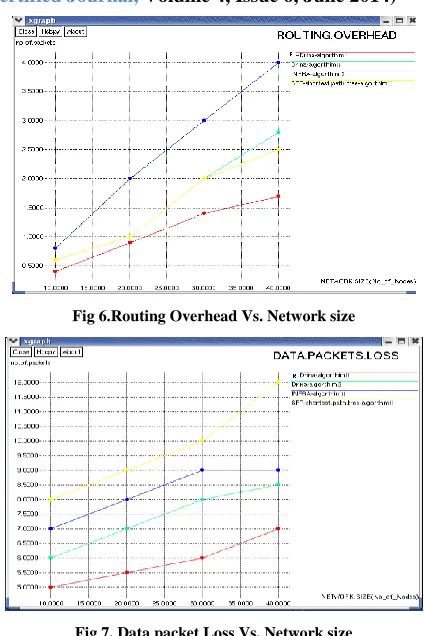
Fig 6.Routing Overhead Vs. Network size
Fig 7. Data packet Loss Vs. Network size
Above figures shows the performance analysis of different data aggregated algorithms such as SPT, InFRA, DRINA & R-DRINA. Fig 5. depicts the aggregated rate of transmitted data and shows its corresponding loss probability. It clearly seems that more number of data packets is aggregated with less loss probability. The routing overhead of R-DRINA is comparatively very less in Fig 6. Finally, the transmitted data packets should drop across the medium is very minimum. So we achieve the reliable transmission in Fig 7.
IV. CONCLUSION
[image:5.612.62.276.377.521.2] [image:5.612.67.273.556.699.2]International Journal of Emerging Technology and Advanced Engineering
Website: www.ijetae.com (ISSN 2250-2459,ISO 9001:2008 Certified Journal, Volume 4, Issue 6, June 2014)
144
Also, we show that our proposed algorithm has some key aspects required by WSN aggregation aware routing algorithms such as maximized number of overlapping routes, high aggregation rate, Reliable data aggregation and Transmission.
REFERENCES
[1] L. A.Villas, A. Boukerche, H. S. Ramos, ―DRINA: A Lightweight and Reliable Routing Approach for In-Network Aggregation in Wireless Sensor Networks‖, IEEE transactions On Computers, Vol. 62, NO. 4, APRIL 2013.
[2] I.F. Akyildiz, W. Su, Y. Sankarasubramaniam, and E. Cyirci, ―Wireless Sensor Networks: A Survey,‖ Computer Networks, vol. 38, no. 4, pp. 393-422, Mar. 2002.
[3] Poonam Vishal Sadafal, R. H. Borhade, ―Secure Clustering Algorithm for WSN‖ Vol-2, Issue-2, Dec.2013,//http/ ijese.org /attachments/ File/ v2i2/ A0574112113.pdf.
[4] K. Romer and F. Mattern, ―The Design Space of Wireless Sensor Networks‖, IEEE Wireless Comm., vol. 11, no. 6, pp. 54-61, Dec. 2004.
[5] Pravallika, T. Venkata Naga Jayudu, ―A Trivial and Consistent Routing within Network Aggregation in Wireless Sensor Networks‖, International Journal of Science and Research, Wireless Sensors, 2012.
[6] O.Younis, M. Krunz, and S. Ramasubramanina, ―Node Clustering in Wireless Sensor Networks: Recent Developments and Deployment Challenges‖, IEEE Network, vol. 20, no. 3, pp. 20-25, Dec. 2006. [7] Based Reliable Routing for in-Network Aggregation in Wireless
Sensor Network‖, IJCATR, Volume 3– Issue 4, 209 - 212, 2014. [8] F. Hu, X. Cao, and C. May, ―Optimized Scheduling for Data
Aggregation in Wireless Sensor Networks‖, Proc. Int’l Conf. Information Technology: Coding and Computing (ITCC ’05), pp. 557- 561, 2005.
[9] I. Solis and K. Obraczka, ―The Impact of Timing in Data Aggregation for Sensor Networks‖, IEEE Int’l Conf. Comm., vol. 6, pp. 3640-3645, June 2004.
[10] B.Krishnamachari, D. Estrin, and S.B. Wicker, ―The Impact of Data Aggregation in Wireless Sensor Networks‖, Proc. 22nd Int’l Conf. Distributed Computing Systems (ICDCSW ’02), pp. 575-578, 2002. [11] J. Al-Karaki, R. Ul-Mustafa, and A. Kamal, ―Data Aggregation in Wireless Sensor Networks—Exact and Approximate Algorithms‖, Proc. High Performance Switching and Routing Workshop (HPSR ’04), pp. 241-245, 2004.
[12] J. Al-Karaki and A. Kamal, ―Routing Techniques in Wireless Sensor Networks: A Survey‖, IEEE Wireless Comm., vol. 11, no. 6, pp. 6-28, Dec. 2004.
[13] E. Fasolo, M. Rossi, J. Widmer, and M. Zorzi, ―In-network Aggregation Techniques for Wireless Sensor Networks: A Survey‖, IEEE Wireless Comm., vol. 14, no. 2, pp. 70-87, Apr. 2007. [14] B.Krishnamachari,D.Estrin,S.Wicker, ―Impact of data aggregation in
wireless sensor networks‖, IEEE conference,pp.457-458.
[15] S. Madden, M.J. Franklin, J.M. Hellerstein, and W. Hong, ―Tag: A Tiny Aggregation Service for Ad-Hoc Sensor Networks‖, ACM SIGOPS Operating Systems Rev., vol. 36, no., pp. 131-146, 2002. [16] S. Madden, R. Szewczyk, M.J. Franklin, and D. Culler, ―Supporting
Aggregate Queries over Ad-Hoc Wireless Sensor Networks‖, Proc. IEEE Fourth Workshop Mobile Computing Systems and Applications (WMCSA ’02), pp. 49-58, 2002.
[17] M.Aravindan,Dr.R.Sivakumar, ―A Peculiat cluste based routing in wireless sensor networks‖, IJCSMC ,Vol 2,pp.376-382,Dec 2013. [18] A. Boukerche, ―Algorithms and Protocols for Wireless Sensor
Networks‖, Wiley-IEEE Press, 2008.
[19] C. Siva Ram Murthy and B. S. Manoj, ―Ad Hoc Wireless Networks Architectures and Protocols‖, Prentice Hall, PTR, 2004.