0095-1137/09/$08.00⫹0 doi:10.1128/JCM.01537-08
Copyright © 2009, American Society for Microbiology. All Rights Reserved.
Staphylococcal Interspersed Repeat Unit Typing of
Staphylococcus aureus
:
Evaluation of a New Multilocus Variable-Number Tandem-Repeat
Analysis Typing Method
䌤
Teresa Conceic¸a
˜o,
1Marta Aires de Sousa,
1,2and Hermínia de Lencastre
1,3*
Laboratory of Molecular Genetics, Instituto de Tecnologia Química e Biolo´gica (ITQB), Oeiras, Portugal1; Escola Superior de
Sau´de da Cruz Vermelha Portuguesa (ESSCVP), Lisbon, Portugal2; and Laboratory of Microbiology,
The Rockefeller University, New York, New York3
Received 8 August 2008/Returned for modification 14 September 2008/Accepted 25 February 2009
The present study evaluates the performance of the staphylococcal interspersed repeat unit (SIRU) method applied to a diverse collection of 104Staphylococcus aureusisolates previously characterized by pulsed-field gel electrophoresis (PFGE),spa typing, multilocus sequence typing (MLST), and staphylo-coccal cassette chromosomemectyping for methicillin-resistantS. aureus. The SIRU method distributed the 104 strains into 81 SIRU profiles that could be clustered into 12 groups and 29 singletons. The discriminatory power of the method at the profile level, translated by Simpson’s index of diversity (SID), was similar to that of PFGE subtyping (SIDⴝ99.23% versus 99.85%) and slightly higher than that ofspa
typing (SIDⴝ 97.61%). At the group level, the SIRU SID (93.24%) was lower than that of PFGE typing (95.41%) but higher than that of MLST (SIDⴝ91.77%). The adjusted Rand (AR) coefficient showed that SIRU typing at the group level had the highest congruence with MLST (ARⴝ 0.5736) and with clonal complex (CC) (ARⴝ0.4963) but the lowest congruence with PFGE subtype (ARⴝ0.0242). The Wallace coefficient indicated that in the present collection, two strains with the same SIRU profile have a 100% probability of belonging to the same CC, a 90% probability of sharing the samespa type, and an 83% probability of being classified in the same sequence type. The high discriminatory power of the SIRU method, along with its apparent concordance with MLST results, makes it potentially valuable for S. aureusshort-term epidemiological investigations and population dynamics as well.
Staphylococcus aureus, especially methicillin-resistantS.
au-reus(MRSA), continues to be a major cause of health care-associated and, more recently, community-care-associated infec-tions (40, 62). It is critical to have access to an accurate typing method to design cost-effective intervention and prevention strategies (45, 48, 61). A large number of molecular typing methods have been developed to assess strain relatedness for outbreak control, surveillance programs, and population struc-ture and evolution studies (58, 61). The three most used typing methods forS. aureushave advantages and disadvantages, as follows. (i) Pulsed-field gel electrophoresis (PFGE), which is the “gold standard” typing method, has high discriminatory power and accuracy, but it is time-consuming and expensive, and the interlaboratory exchange of results is challenging. (ii) Sequence-based multilocus sequence typing (MLST) is easy to perform, and the results, given as an allelic profile, are portable and easy to exchange due to a public database available on the Internet (http://www.mlst.net), but it is expensive and not use-ful for local outbreak investigations. MLST is frequently com-bined with staphylococcal cassette chromosome mec (SCC-mec) typing in order to define clonal types of MRSA (24). (iii) spa typing, a single-locus sequence typing method, is being used more frequently forS. aureustyping, and the develop-ment of a public database on the Internet (http://spaserver
.ridom.de), as with MLST, ensured an international typing nomenclature and thus a great facility in exchanging typing data. By calculation of Simpson’s index of diversity (SID), it was shown thatspatyping is nearly as discriminatory as PFGE (1, 25), although it takes into account a single variable region of the protein A gene.
In choosing a new method, it is worth taking into consider-ation that PCR-based methods are commonly used in typing laboratories because of their accuracy, ease of use, low cost, and speed in retrieving results (in a few hours).
Many bacterial genomes carry loci of repetitive DNA, which may contain variable repeated units among strains (43, 60). Systems based on a multilocus variable-number tandem-repeat (VNTR) analysis (MLVA) have been used extensively for typ-ing of clinical isolates of several bacterial species and were shown to perform well compared to other genotyping methods (43, 61).S. aureusharbors a diverse population of DNA re-peats, which allowed the design of various MLVA schemes (28, 30, 39, 53, 60). Hardy et al. (36, 38) developed a MLVA scheme forS. aureuswhere seven novel multiple tandem re-peats with a high degree of similarity in the flanking regions were identified based on the alignment of seven S. aureus sequenced genomes (strains N315, MW2, Mu50, MSSA476, MRSA252, NCTC8325, and COL). Six of these seven loci were located on intergenic regions scattered around theS. aureus genome; the remaining locus corresponds to the protein A gene,spa. The method, designated staphylococcal interspersed repeat unit (SIRU) typing, relies on PCR amplification of the seven loci of repetitive DNA, using primers specific for
* Corresponding author. Mailing address: The Rockefeller Univer-sity, 1230 York Ave., New York, NY 10021. Phone: (212) 327-8278. Fax: (212) 327-8688. E-mail: [email protected].
䌤Published ahead of print on 4 March 2009.
1300
on May 16, 2020 by guest
http://jcm.asm.org/
generating a combination of seven numbers that characterizes each strain and corresponds to the allelic profile. This allelic profile makes the SIRU method amenable to interlaboratory comparisons and database management, comparable to MLST. So far, the SIRU method has been applied toS. aureus isolates from nosocomial outbreaks in the United Kingdom and Germany, mainly MRSA isolates, and therefore to highly related strains (29, 35–37). Very recently, a single study eval-uated a MLVA scheme including the SIRU typing loci and the sspA gene, using a European collection of contemporary S.
aureusisolates (39).
The aim of the present study was to evaluate the SIRU method with a more diverse collection of S. aureus isolates, including MRSA and methicillin-susceptibleS. aureus(MSSA) isolates, from different continents, isolated throughout several decades and previously characterized by well-established typ-ing methods (PFGE, spa typing, MLST, and SCCmec for MRSA).
MATERIALS AND METHODS
Bacterial isolates. A collection of 104 strains (78 MRSA and 26 MSSA strains), previously characterized by PFGE (16),spatyping (1, 56), MLST (3), and SCCmectyping (for MRSA strains) (46), was selected from the Laboratory of Molecular Genetics collection at Instituto de Tecnologia Química e Biolo´gica, Oeiras, Portugal (Table 1). The selected collection included hospital- and com-munity-related strains isolated during a period of over 50 years (from 1943 to 2006) from 17 countries distributed over four continents. Efforts were made to select strains with various degrees of genetic relatedness. Therefore, the collec-tion included (i) strains belonging to the five main clonal complexes (CCs) ofS. aureus—CC5 (n⫽23), CC8 (n⫽32), CC22 (n⫽4), CC30 (n⫽7), and CC45 (n⫽9); (ii) isolates belonging to minor CCs—CC1 (n⫽7), CC509 (n⫽3), CC50, CC59, CC97, CC101, CC228, CC398, and CC1021 (one isolate of each); (iii) two isolates belonging to CC80, ST80, and SCCmectype IV, identified as community-acquired MRSA; (iv) six single CC isolates, referred to as singletons (S1, sequence type 157 [ST157]; S2, ST447; S3, ST668; S4, ST707; S5, ST580; S6, ST445); and (v) four strains belonging to nondefined CC groups (CC assign-ments assessed by eBURST v3) and designated ND1 to ND4.
Strains N315, NCTC8325, COL, and MW2 were included for reproducibility and methodology control, since their genomes are fully sequenced and were used in the theoretical design of the SIRU method (38).
PFGE analysis.PFGE patterns were analyzed in BioNumerics, version 4.61, software (Applied Maths, Sint-Martens-Latem, Belgium) as previously described (25), with minor modifications, including an optimization setting of 1.0% for band pattern comparisons and a 98% Dice coefficient similarity cutoff for PFGE subtypes.
spatyping and MLST analysis.spatypes were assigned through the Ridom web server (http://spaserver.ridom.de). Additionally, for one isolate previously characterized as nontypeable, thespatype was determined through sequencing of SIRU21 (see below). MLST alleles and STs were identified through the MLST database (http://www.mlst.net), and CCs were defined using the eBURST v3 algorithm (http://eburst.mlst.net).
SIRU typing. DNA was extracted as previously reported (3). The SIRU method was performed as previously described (36, 38), with the following minor modifications: (i) 0.5 U of AmpliTaq DNA polymerase (Applied Biosystems, CA) was used per PCR in a final volume of 25l, (ii) an annealing temperature of 59°C was used with primer SIRU05R2 (see below), and (iii) PCR products (10
l) were resolved in a 2.5% Seakem LE (Cambrex, Rockland, ME) agarose gel in 0.5% Tris-borate-EDTA buffer (Bio-Rad, Hercules, CA) at 5 V/cm for 2.5 h. The size of each amplicon was determined by visual inspection by comparison with a 50-bp ladder size marker and by computer analysis using Bionumerics, version 4.61, software, which facilitates marker-based normalization of the mi-gration distances and therefore guarantees accurate length measurements. The number of repeats was calculated, taking into account the combined size of the
bp; (iv) for SIRU13, 64 bp⫹148 bp⫽212 bp; (v) for SIRU15 131 bp⫹212 bp⫽
343 bp; (vi) for SIRU16, 159 bp⫹162 bp⫽321 bp; and (vii) for SIRU21, 24 bp⫹96 bp⫽120 bp.
The primers used to amplify each of the seven loci were previously published (36), except for those for locus 16 (SIRU16) and an additional reverse primer for locus 5 (SIRU05). New SIRU16 primers, SIRU16_2F (5⬘-TGGTGTTAATTTA GCTTGC-3⬘) and SIRU16_2R (5⬘-AAACGCAACTTGAAGAAACG-3⬘), were designed through sequence alignments of the SIRU16 loci of the sevenS. aureus genomes previously considered for the design of the primers for the remaining loci (38). The new SIRU05 locus reverse primer was designed specifically for strains for which there was no amplification with the previously published prim-ers (SIRU05L and SIRU05R), namely, for strains belonging to STs 1, 22, 45, and 80. Therefore, primer SIRU05R2 (5⬘-AGTTGTAGTCATCTTACTGC-3⬘) was designed through sequence alignments of the available SIRU05 loci of MW2, MSSA476 (both ST1), and EMRSA-15 (ST22) (sequence from the EMRSA-15 genome sequencing project at the Wellcome Trust Sanger Institute [http://www .sanger.ac.uk/sequencing/Staphylococcus/aureus/EMRSA15]). All sequence align-ments were performed using ClustalW2 (http://www.ebi.ac.uk/Tools/clustalw2/index .html), with default parameters.
eBURST v3 software was used to cluster SIRU profiles. Isolates sharing six of seven loci with at least one isolate (single-locus variants) were included in the same SIRU group. Singletons represent profiles that appear once and have no related profiles in the collection.
Comparison of typing methods.SID and the respective confidence intervals were calculated as described previously (33, 57). The quantitative level of con-gruence between typing methods was assessed by a framework proposed by Carric¸o et al. (15), based on the adjusted Rand (AR) and Wallace (W) coeffi-cients, available at http://www.comparingpartitions.info/. The AR coefficient quantifies the global agreement between two methods, whereas the W coefficient indicates the probability that two isolates classified as the same type by one method are also classified as the same type by another method (15).
RESULTS
SIRU typeability.In a first approach, we tested the method with four completely sequenced strains (N315 [ST5-SCCmec II], NCTC8325 [ST8-MSSA], COL [ST250-SCCmec I], and MW2 [ST1-SCCmecIV]) for which theoretical SIRU profiles had previously been published (36, 38). Five of the seven loci were amplified from the four tested strains; SIRU16 was am-plified from strain MW2 only, whereas SIRU05 was amam-plified from all strains except MW2. A BLAST search showed that the published SIRU16 forward primer (SIRU16_L) (36) has sim-ilarity with strain MW2 but not with the three remaining tested strains. The SIRU16_L primer was found to have similarity with strain MSSA476, which belongs to ST1, like MW2, and with strain MRSA252 (ST36-SCCmec II). The primer was tested on additional ST36 isolates, and it performed well. These preliminary results led us to design a new SIRU16 primer that anneals with all available genomes of S. aureus strains (see Materials and Methods). The SIRU typing method using the new SIRU16 primers was applied to the whole col-lection. A seven-digit profile was obtained for only 70 of 104 strains, indicating a typeability of 67% when isolates with at least one nonamplified locus were considered nontypeable.
Considering the typeability of each locus separately, SIRU07 was the unique locus that showed 100% typeability. SIRU05 showed the lowest typeability (72%), followed by SIRU15 (95%), while the remaining SIRUs showed a typeability of 99% (one isolate was nontypeable). The consistent nonampli-fication of SIRU05 from all strains belonging to particular CCs, i.e., CC22, CC45, and CC80, led us to perform a BLAST
on May 16, 2020 by guest
http://jcm.asm.org/
TABLE 1. Characteristics of the 104 S. aureus isolates and SIRU typing results Strain Isolation date (yr) Country No. of SIRU repeats a SIRU profile b SIRU group c PFGE type d spa type ST CC e SCC mec type f Reference(s) SIRU01 SIRU13 SIRU15 SIRU16 SIRU21 SIRU05 SIRU07 IPOP38 2001 Portugal 1 1 1 3 7 5 g 3 1 G1 T2 t127 1 1 MSSA 5 CV73 1997 Cape Verde 1 1 2 3 7 5 g 3 2 G1 T1 t127 1 1 MSSA 11 HU332 2003 Hungary 1 1 2 3 7 5 g 3 2 G1 F11 t127 1 1 II 17 HGSA240 2003 Portugal 1 1 2 3 7 2 3 3 G1 T7 t127 81 1 MSSA 13 HSA49 1993 Portugal 2 2 1 3 10 3 1 4 G2 P1 t002 5 5 IV 7 122MEXU 1998 Mexico 2 3 1 3 10 3 1 5 G2 M2 t002 5 5 II 63 78MEXC 1997 Mexico 2 3 1 3 10 3 1 5 G2 A2 t002 5 5 II 63 79MEXC 1997 Mexico 2 3 1 3 10 3 1 5 G2 N3 t002 5 5 II 63 ARG229 1995 Argentina 2 3 1 3 10 3 1 5 G2 A4 t002 100 5 II 7, 9, 18 BK2464 1990 United States 2 3 1 3 10 3 1 5 G2 A1 t002 5 5 II 52 BM18 1989 United States 2 3 1 3 10 3 1 5 G2 B2 t002 5 5 IV 22, 51 N315 1982 Japan 2 3 1 3 10 3 1 5 G2 Q2 t002 5 5 II 41 47MEXU 1997 Mexico 2 3 1 3 8 3 1 6 G2 A3 t895 5 5 II 63 COB3 1996 Colombia 2 3 1 3 7 3 1 7 G2 B3 t045 5 5 IV 31 HU245 2001 Hungary 2 3 1 3 10 5 1 8 G2 A1 t002 5 5 II 17 HU317 2003 Hungary 2 3 1 3 6 3 1 9 G2 T5 t062 5 5 II 17 HU363 2004 Hungary 2 3 1 3 6 3 1 9 G2 T6 t062 5 5 II 17 JP1 1997 Japan 2 3 1 3 10 1 1 10 G2 M1 t002 5 5 II 8 JP26 1997 Japan 2 3 1 2 10 2 1 11 G2 ZF t002 5 5 II 7, 8 PL72 1991 Poland 2 3 1 3 10 7 1 12 G2 P2 t053 5 5 IV 42 POL3 1992 Poland 2 3 1 3 10 8 1 13 G2 B4 t053 5 5 IV 42 ARG33 1996 Argentina 2 3 1 3 10 99 1 14 G2 Q1 t001 85 5 IIIA 7, 9, 18 ARG64 1996 Argentina 2 3 1 3 10 99 1 14 G2 S1 t001 85 5 I 7, 9, 18 HAR41 1998 Germany 2 3 1 3 10 2 1 15 G2 I2 t001 228 228 I 47 HU2 1996 Hungary 3 0 1 3 12 2 2 16 G3 D2 t989 239 8 III 23 HUSA304 1993 United States 3 0 1 3 12 2 2 16 G3 D1 t1053 239 8 III 23 HU270 2002 Hungary 3 0 1 2 6 2 2 17 G3 E4 t030 239 8 III 17 HU294 2003 Hungary 3 0 1 3 13 2 2 18 G3 D5 t538 239 8 IIIA 17 TUR1 1996 Turkey 3 0 1 3 6 2 2 19 G3 E7 t030 239 8 III 7 TUR27 1996 Turkey 3 0 1 3 6 2 2 19 G3 E8 t030 239 8 III 7 PL46 1995 Poland 4 0 1 2 6 2 2 20 G3 E6 t030 157 S1 III 42 CPS22 1985 Portugal 4 0 1 3 6 1 2 21 G4 E1 t421 239 8 IIIvar 21 CPS68 1985 Portugal 4 0 1 3 6 1 2 21 G4 E3 t421 239 8 IIIvar 21 HSA10 1992 Portugal 4 0 1 3 6 1 2 21 G4 E2 t421 239 8 IIIvar 7 GRE108 1998 Greece 4 0 1 3 7 2 2 22 G4 C5 t461 239 8 III 4, 7 HGSA142 2003 Portugal 4 0 1 3 7 0 2 23 G4 D3 t037 239 8 IIIA 13 HGSA339 2003 Portugal 4 0 1 3 7 0 2 23 G4 C3 t037 239 8 IIIA 13 HGSA57 1995 Portugal 4 0 1 3 7 0 2 23 G4 C6 t037 239 8 IIIA 12 HSJ216 1997 Portugal 4 0 1 3 7 99 2 24 G4 C1 t037 239 8 IIIA 10 HU25 1993 Brazil 4 0 1 3 6 0 2 25 G4 C1 t138 239 8 IIIA 59 HU272 2002 Hungary 4 0 1 3 10 2 2 26 G4 R2 t787 239 8 III 17 TAW166 1998 Taiwan 4 0 1 3 10 8 2 27 G4 N2 t036 254 8 IV 6, 7 TAW97 1998 Taiwan 4 0 1 3 7 3 2 28 G4 C2 t037 239 8 IIIA 6, 7 BK1953 1995 United States 4 0 1 4 11 4 2 29 G5 F1 t051 247 8 IA 52 HGSA13 1998 Portugal 4 0 1 4 11 4 2 29 G5 N1 t051 247 8 IA 12 HUR97 1998 Hungary 4 0 1 4 11 4 2 29 G5 F8 t051 247 8 IA 50 COL 1965 United Kingdom 4 0 1 4 10 6 2 30 G5 F6 t008 250 8 I 51 E2213 1965 Denmark 4 0 1 4 11 6 2 31 G5 F4 t051 247 8 I 19 E2453 1965 Denmark 4 0 1 4 11 6 2 31 G5 F2 t051 247 8 I 19 HPV107 1992 Portugal 4 0 1 3 11 4 2 32 G5 F1 t051 247 8 IA 55 GRE18 1998 Greece 4 0 99 2 7 2 2 33 G6 F5 t037 239 8 III 7 HGSA15 1994 Portugal 4 0 99 2 7 99 2 34 G6 C4 t037 239 8 IIIA 12 HAR22 1991 United Kingdom 2 3 0 3 15 12 g 2 35 G7 J1 t022 22 22 IV 47 HGSA128 2000 Portugal 2 3 0 3 16 12 g 2 36 G7 J2 t032 79 22 IV 7, 12 HU303 2003 Portugal 2 3 0 3 16 12 g 2 36 G7 J3 t032 22 22 IV 17 IPOP2 2001 Portugal 2 3 99 3 16 12 g 2 37 G7 J1 t032 22 22 IV 7 DEN4415 2001 Denmark 2 1 2 2 9 3 2 38 G8 K1 t021 36 30 II 26 HAR24 1993 United Kingdom 2 1 2 2 11 2 2 39 G8 K1 t018 36 30 II 47 HGSA202 2003 Portugal 2 1 2 2 11 3 2 40 G8 K3 t018 30 30 MSSA 13 DEN4358 2001 Denmark 0 0 0 3 10 1 g 2 41 G9 H8 t116 45 45 V 26
on May 16, 2020 by guest
http://jcm.asm.org/
PLN49 1997 Poland 0003 1 0 1 g 2 41 G9 H9 t015 45 45 IV 7, 42 CA04 1998 United States 00138 1 g 2 42 G9 H6 t124 45 45 IV 20 CV81 1997 Cape Verde 0013 1 1 1 g 2 43 G9 H3 t861 508 45 MSSA 11 HAR38 1996 Germany 00139 1 g 2 44 G9 H1 t004 45 45 IV 47 HU281 2002 Hungary 00139 1 g 2 44 G9 H5 t038 45 45 IV 17 HSA19 1992 Portugal 00137 1 g 2 45 G9 H4 t1072 45 45 MSSA 5 IPO516 2006 Portugal 0013 1 0 1 g 2 46 G9 H7 t2429 45 45 V 2 IPOP56 2001 Portugal 0013 1 0 1 g 2 46 G9 H2 t1538 45 45 MSSA 5 HU109 1996 Hungary 10138 1 2 4 7 G 9 E 5 t984 239 8 III 50 GRE14 1998 Greece 42637 1 g 1 48 G10 L1 t044 80 80 IV 4, 7 HFF189 2005 Portugal 42637 1 g 1 48 G10 L2 t044 80 80 IV This study CHL5 1997 Chile 20133 2 1 4 9 G 1 1 I1 t535 83 5 I 7, 9 JP82 1997 Japan 20138 2 g 1 50 G11 G2 t375 92 509 IVA 7, 8 COB111 1998 Colombia 21237 3 1 5 1 G 1 2 G 1 t1572 84 509 IV 7, 31 HFF202 2005 Portugal 21237 2 1 5 2 G 1 2 X t1537 707 S4 MSSA This study MW2 1998 United States 12238 5 g 3 53 S1 T3 t128 1 1 IV 14 IPOP58 2001 Portugal 12336 2 3 5 4 S 2 U 1 t189 188 1 MSSA 5 HSJ109 1995 Portugal 4242 1 1 9 3 5 5 S 3 Z C t1897 573 1 MSSA 5 HDE1 1996 Portugal 2 3 99 3 9 12 1 56 S4 B1 t311 5 5 IV 54 HBA3 2006 Portugal 23123 3 1 5 7 S 5 A 1 t535 5 5 IV 2 HDE288 1996 Portugal 23139 1 1 1 5 8 S 6 B 1 t311 5 5 VI 54 NCTC8325 1943 United Kingdom 3014 1 0 6 3 5 9 S 7 F 3 t211 8 8 MSSA http://www.nctc.org.uk ARG199 1996 Argentina 4 99 7 3 11 9 1 60 S8 D4 t148 86 8 II 7, 9, 18 GRE4 1998 Greece 99 0 99 99 7 3 2 61 S9 R1 t037 239 8 IIIA 7 HAR36 1993 Germany 4013 1 3 6 2 6 2 S 1 0 F 7 t009 254 8 IV 47 DEN2946 2001 Denmark 21127 5 2 6 3 S 1 1 K 4 t975 30 30 IV 26 CV11 1997 Cape Verde 21227 4 2 6 4 S 1 2 K 2 t942 30 30 MSSA 11 HGSA256 2003 Portugal 2122 1 2 1 1 6 5 S 1 3 K 5 t166 34 30 MSSA 13 IPOP24 2001 Portugal 21225 3 1 6 6 S 1 4 K 6 t1076 34 30 MSSA 5 E1114 1960 Denmark 01138 2 1 6 7 S 1 5 W t518 50 50 MSSA 32 TAW214 1998 Taiwan 21427 1 1 g 4 68 S16 ZG t437 59 59 IV 6, 7 IPOP50 2001 Portugal 22139 1 g 3 69 S17 T4 t359 97 97 MSSA 5 IPOP51 2001 Portugal 24229 9 9 2 7 0 S 1 8 U 2 t1075 106 101 MSSA 5 CV55 1997 Cape Verde 31138 2 2 7 1 S 1 9 Z B t937 398 398 MSSA 11 JP87 1997 Japan 21138 9 g 1 72 S20 V t375 89 509 IIvar 7, 8 E260 1957 Denmark 2110 1 0 2 3 7 3 S 2 1 Z E t1194 446 1021 MSSA 32 E3373 1967 Denmark 31438 1 0 2 7 4 S 2 2 F 1 0 t164 447 S2 MSSA 32 CV87 1997 Cape Verde 3222 9 9 9 4 7 5 S 2 3 S 2 t941 668 S3 MSSA 11 DCC1185 1997 Portugal 22237 2 2 7 6 S 2 4 Z A t1065 580 S5 MSSA 5 E216 1957 Denmark 1272 1 1 1 1 1 7 7 S 2 5 Z H t1191 445 S6 MSSA 32 E691 1959 Denmark 2114 1 3 2 2 7 8 S 2 6 Z D t1207 49 ND1 MSSA 32 DCC300 1996 Portugal 2112 1 2 2 1 7 9 S 2 7 Y t166 10 ND2 MSSA 5 DEN2230 2001 Denmark 3023 1 0 2 2 8 0 S 2 8 Z t355 152 ND3 V 26 CV161 1997 Cape Verde 34239 1 g 3 81 S29 F9 t359 669 ND4 MSSA 11 a0, the size of the amplicon obtained was shorter than that of a complete repeat; 99, no amplification was obtained. bNumerical nomenclature of SIRU profiles. New numbers are attributed to profiles that dif fer in at least one allele. cS, singletons, i.e., SIRU profiles that appear once and have no related profiles. dPFGE types and subtypes were determined using thresholds of 80% and 98% similarity, respectively. eCC assignments were assessed by eBURST v3 on 9 June 2008. S, singletons; ND, not determined. The sequence types are included in groups for which no found er could be determined. fStrains that do not have SCC mec are labeled as MSSA strains. gSIRU05 amplification using the SIRU05R2 reverse primer.
on May 16, 2020 by guest
http://jcm.asm.org/
search with differentS. aureusgenomes which showed that the published SIRU05 reverse primer (SIRU05_R) (36) has no similarity with strains MW2, MSSA476, EMRSA-15 (ST22), and RF122 (ST151). Therefore, a new SIRU05R2 reverse primer was designed considering these particular strains (see Materials and Methods), and a new PCR was performed on all isolates for which this locus was not amplified with the previ-ously published SIRU05R primer.
The sequential use of the SIRU05R2 reverse primer in-creased the typeability from 67% to 89.4%. Moreover, the typeability of the SIRU05 locus alone rose to 95%. Among the 11 nontypeable isolates, 9 isolates showed no amplification for a single locus, 1 isolate showed no amplification for two loci (SIRU05 and SIRU15), and another isolate showed no ampli-fication for three loci (SIRUs 1, 15, and 16).
For further evaluation of the method, an arbitrarily chosen neutral number of repeats (99) was attributed to all nonam-plified loci. However, this artifact creates a limitation because two isolates showing no amplification at the same locus are considered identical in this allele.
SIRU locus discriminatory power.Considering the discrim-inatory power of each locus, SIRU07 showed four different allele numbers, SIRU16 showed five, SIRU01 and SIRU13 showed six, and SIRU15 showed eight. Loci 5 and 21 showed the highest variability among the seven loci, with 14 and 13 different allele numbers, respectively. The SIRU21 locus, the
only one located in a coding region, thespagene, had a direct correlation with thespatype. However, an identical number of repeat units may contain sequence variations which are not detected by SIRU typing.
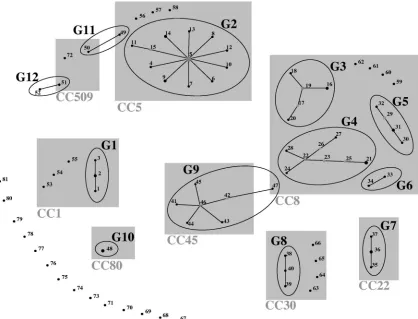
SIRU typing clonal assignment. The 104 strains were dis-tributed into 81 SIRU profiles (differing in at least one of the seven loci) that could be clustered into 12 groups and 29 singletons (Table 1). Figure 1 shows the assignment of groups when the eBURST v3 algorithm was applied to the collection. The largest SIRU group, G2 (n⫽20), included the majority (19 of 23) of the strains belonging to CC5 (ST5, ST85, and ST100) and the related strain CC228-ST228. SIRU group G9 included the nine strains belonging to CC45 (ST45 and ST508). Similarly, G7 included the four CC22 strains (ST22 and ST79), and G10 included the two CC80-ST80 strains. SIRU group G8 included only three (ST30 and ST36) of the seven CC30 strains. The remaining four strains (ST30 and ST34) were classified as singletons. CC8 strains were divided into four SIRU groups (G3, G4, G5, and G6) and four singletons. Cu-riously, ST247 and ST250 strains were found in G5 only, while ST239 strains were distributed over G3, G4, and G6 but not in G5. SIRU group G1 included four of the seven CC1 strains.
[image:5.585.83.501.69.388.2]Unexpectedly, two isolates which were totally different by all other typing methods were grouped in the same SIRU group, G12. In the same way, one CC8 strain appeared to be a single-locus variant of a CC45 strain and was therefore included in
FIG. 1. Schematic representation of the SIRU groups identified by eBURST v3 analysis. The size of the dots is proportional to the number of isolates of each SIRU profile. Single-locus variants are linked by lines; CCs are highlighted in gray.
on May 16, 2020 by guest
http://jcm.asm.org/
the same G9 SIRU group, and a single CC5 strain was clus-tered with a CC509 strain in G11.
Three of the 12 SIRU groups included a single PFGE type, as follows: G7, PFGE J; G8, PFGE K; and G10, PFGE L. Eleven of the 13 singletons defined by PFGE were also defined as singletons by SIRU typing.
Concerning spatyping, all SIRU groups contained related spatypes, except for (i) one G4 strain (TAW166, t036), (ii) one G9 strain (HU109, t984), (iii) two G11 strains (CHL5, t535; and JP82, t375), and (iv) the two G12 strains. Moreover, each spatype was associated with a single SIRU group, with the exception of t037, found in SIRU groups G4 and G6 belonging to the same CC, and t375, found in a G11 isolate and in singleton S20 (Table 1). Among the 11 different SCCmectypes that characterized the MRSA collection (n⫽78), with a few exceptions (Table 1), each SIRU profile was associated with a single SCCmectype.
Comparison of the discriminatory power of SIRU typing with that of other typing methods.The SID values obtained for the different typing methods are presented in Table 2. Considering the 104 isolates, the SIRU method showed a very high discriminatory power at the profile level (SID ⫽ 99.23%), similar to that observed for PFGE at the subtype level (SID⫽99.85%) and higher than that observed forspa typing, considering both the length and sequence variation (SID ⫽ 97.61%). Considering discrimination of the SIRU method at the group level (SID⫽ 93.24%), it was higher than that of MLST (SID⫽ 91.77%) but lower than that of PFGE at the type level (SID⫽95.41%). However, since the confidence intervals of the methods overlap (Table 2), we cannot exclude the hypothesis that they have similar dis-criminatory powers at a 95% confidence level.
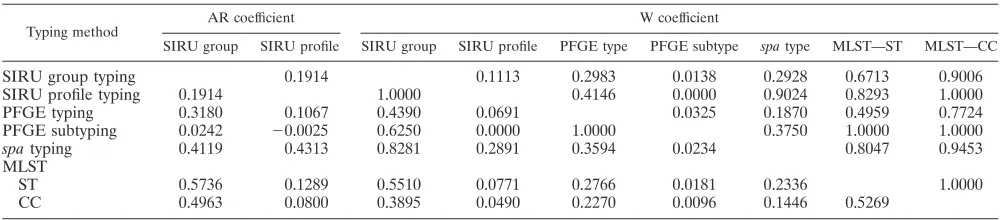
the calculation of AR coefficients for the whole collection (Table 3). The AR values obtained for the SIRU typing method indicated that the highest level of congruence was at the group level for the ST (ARSIRU group-ST ⫽ 0.5736), followed by the CC (ARSIRU group-CC⫽0.4963). At the pro-file level, the highest congruence was with spa type
(ARSIRU profile-spa type ⫽ 0.4313). Congruence between
PFGE (type and subtype levels) and SIRU typing was shown to be particularly low (ARSIRU profile-PFGE type ⫽ 0.1067;
ARSIRU profile-PFGE subtype⫽ ⫺0.0025).
The W coefficient was calculated to determine the capacity of SIRU typing to predict the classification achieved by other methods (Table 3). The results obtained showed that in this collection, two strains with the same SIRU profile have a 100% probability of belonging to the same CC, a 90% probability of sharing the same spatype, and an 83% probability of being classified in the same ST. The capacity of SIRU typing at the profile level to predict the PFGE type was low
(WSIRU profile-PFGE type⫽ 0.4146), and there was no
corre-lation with the PFGE subtype (WSIRU profile-PFGE subtype⫽ 0). On the other hand, the SIRU group showed a high correlation with the CC (WSIRU group-CC⫽0.9006).
DISCUSSION
In the present study, we evaluated the performance of the SIRU typing method applied to a diverse collection ofS. au-reusisolates previously characterized by well-established typing methods. The SIRU method’s typeability, i.e., the method’s ability to assign a type to all isolates tested, was 89.4% when new primers designed for SIRU05 and SIRU16 locus amplifi-cation were used. The consistent nonamplifiamplifi-cation of SIRU05 from all strains belonging to ST1, CC22, CC45, and CC80 observed with our collection when we used the previously pub-lished SIRU05 primers is in agreement not only with previous studies focusing on SIRU typing of EMRSA-15 (CC22) iso-lates (29, 35–37) but also with the work of Ikawaty et al., who reported a reduced typeability for this specific locus on CC1, CC5, CC8, CC97, and CC228 isolates as well (39).
The ability of SIRU typing to assign a different type to two unrelated strains randomly sampled from the collection, i.e., its discriminatory power, was found to be very high (⬎99%) and
identified
interval (%)
PFGE subtyping 97 99.85 99.69–100.00
SIRU profile typing 81 99.23 98.66–99.81
spatyping 61 97.61 96.36–98.86
PFGE typing 33 95.41 94.11–96.70
SIRU group typing 41 93.24 90.62–95.87 MLST
ST 42 91.77 88.52–95.01
[image:6.585.43.283.89.200.2]CC 25 84.37 79.68–89.06
TABLE 3. AR and W values for the entire collection (n⫽104)
Typing method AR coefficient W coefficient
SIRU group SIRU profile SIRU group SIRU profile PFGE type PFGE subtype spatype MLST—ST MLST—CC
SIRU group typing 0.1914 0.1113 0.2983 0.0138 0.2928 0.6713 0.9006
SIRU profile typing 0.1914 1.0000 0.4146 0.0000 0.9024 0.8293 1.0000
PFGE typing 0.3180 0.1067 0.4390 0.0691 0.0325 0.1870 0.4959 0.7724
PFGE subtyping 0.0242 ⫺0.0025 0.6250 0.0000 1.0000 0.3750 1.0000 1.0000
spatyping 0.4119 0.4313 0.8281 0.2891 0.3594 0.0234 0.8047 0.9453
MLST
ST 0.5736 0.1289 0.5510 0.0771 0.2766 0.0181 0.2336 1.0000
CC 0.4963 0.0800 0.3895 0.0490 0.2270 0.0096 0.1446 0.5269
on May 16, 2020 by guest
http://jcm.asm.org/
[image:6.585.42.542.615.725.2]was due mainly to the individual high levels of variability of SIRU05 and SIRU21 loci. High variability in SIRU21 is not surprising, since it is located in the known highly variable polymorphic region of thespagene. The discriminatory power of SIRU typing at the profile level (SID⫽99.23%) is similar to that of PFGE subtyping (SID ⫽ 99.85%) and spatyping (SID ⫽ 97.61%), considering the overlapping of the confi-dence intervals at 95%. Our results are concordant with a recent study, besides the fact that only six of the seven SIRU loci were taken into account (39). The observed high discrim-inatory power makes SIRU typing suitable for outbreak inves-tigations, as also shown in studies by Hardy et al. where strains belonging to an outbreak or consecutively isolated from the same ward had the same or highly related SIRU profiles (35, 37). Moreover, in a study involving seven different outbreaks, variations in the number of SIRU repeats in strains belonging to the same outbreak were found to be rare (40).
The concordance between SIRU typing and well-established typing methods was measured by the calculation of the AR coefficient. We demonstrated that at the group level, SIRU typing showed the highest congruence with MLST (ST and CC), whereas at the profile level it showed the highest congru-ence withspatyping. The correspondence with PFGE was low, in contrast to the study of Ikawaty et al. on 50 S. aureus isolates, where the AR coefficient between the MLVA method and PFGE (AR⫽0.599) was higher than that forspatyping (AR⫽0.435) (39).
The major CCs defined by MLST (CC5, CC8, CC22, CC30, and CC45) were maintained when the eBURST v3 algorithm was applied to our SIRU profile data. The exception was CC8, known to include a high degree of variability in STs, which was divided into four well-distinguished groups. Moreover, a single CC8 strain was surprisingly clustered with CC45 isolates (G9). Considering that MLST is based on the variation in house-keeping genes that have a slow evolutionary clock and that the SIRU method looks into variable repeat regions that could evolve more rapidly by an introduction or deletion of a single repeat, clonal types might be affected by genomic rearrange-ments to different extents in the two methods. The SIRU loci in noncoding regions are less likely to be subject to natural selection that affects some VNTRs located on coding regions or promoters (43). Interestingly, among the seven SIRU loci, different evolutionary clocks could be observed, since SIRU01, SIRU07, SIRU13, SIRU15, and SIRU16 appeared to be gen-erally monomorphic between strains from the same group and therefore more conserved during evolution. SIRU05 and SIRU21 add high levels of variability to the method and could be especially informative for recent levels of evolutionary di-vergence. Therefore, the SIRU typing method includes differ-ent scales of evolutionary divergence within the same system, making it suitable for studies with different purposes.
The predictive power between SIRU typing and other meth-ods, translated by the W index, was maximum for CC and very high forspatyping and MLST in our collection. In opposition, the prediction of the PFGE results was low, as SIRU typing was able to distinguish among isolates with the same PFGE subtype and vice versa. Noller et al. (49) showed that during an investigation of anEscherichia coliO157:H7 outbreak, MLVA appeared to have a sensitivity equal to that of PFGE and a specificity that was even superior to that of PFGE. On another
hand, SIRU typing showed the highest congruence with MLST results, i.e., ST and CC results. It is noteworthy that the pre-dictive power of a method seems to be linked to the variability in the collection studied, as in a recent study involving two collections ofS. aureusisolates, where for the first collection the MLVA method predicted thespa typing results but the reverse was not observed, while for the second collection both methods proved to be mutually predictive (39).
Our results show that SIRU typing analysis adds to the knowledge of the variability of theS. aureusgenome and con-tributes to the understanding of genetic relationships among MRSA clones, as seen by Malachowa et al. (44).
In terms of convenience, the SIRU method was shown to be easy to perform, since it is based on single-locus PCRs, which could minimize the drawback of band size determination and even reduce the total time required for practical procedures if allied to the use of automated systems. Automated MLVA approaches were already proposed forS. aureusand
Staphylo-coccus epidermidisgenotyping through different PCR schemes
(27, 28). In terms of cost, SIRU typing (11.2€/strain) is com-parable to PFGE (13.2€/strain), but it is faster and technically easier to perform and much cheaper than spatyping (15.5€/ strain) or MLST (80€/strain). Additionally, SIRU typing could be combined withspatyping, since thespatype may be deter-mined by sequencing of the SIRU21 amplicons of nontypeable strains with conventional primers (1, 56).
In summary, as a PCR-based method, the SIRU typing method is relatively fast, accessible, and not expensive, which combined with its high discriminatory power makes it useful and reliable for short-term epidemiological investigations ofS.
aureus. In addition, its congruence with MLST results (at the
CC and ST levels) makes it potentially valuable for evolution-ary studies. In order for SIRU typing to be considered a useful tool in terms of epidemiological surveillance networks and evolutionary purposes, a public database similar to the data-bases available for other bacterial MLVA schemes (34) may be created for SIRU typing, allowing harmonization ofS. aureus MLVA schemes and the interlaboratory exchange of data.
ACKNOWLEDGMENTS
This work was supported by project POCTI/SAU-ESP/57841/2004 from Fundac¸a˜o para a Cieˆncia e Tecnologia (FCT), Portugal, awarded to H. de Lencastre. T. Conceic¸a˜o was supported by grant SFRH/BD/ 21424/2005 from FCT.
We thank H. Westh for critical comments on the manuscript.
REFERENCES
1.Aires-de-Sousa, M., K. Boye, H. de Lencastre, A. Deplano, M. C. Enright, J. Etienne, A. Friedrich, D. Harmsen, A. Holmes, X. W. Huijsdens, A. M. Kearns, A. Mellmann, H. Meugnier, J. K. Rasheed, E. Spalburg, B. Strom-menger, M. J. Struelens, F. C. Tenover, J. Thomas, U. Vogel, H. Westh, J. Xu, and W. Witte.2006. High interlaboratory reproducibility of DNA se-quence-based typing of bacteria in a multicenter study. J. Clin. Microbiol.
44:619–621.
2.Aires-de-Sousa, M., B. Correia, H. de Lencastre, et al. 2008. Changing patterns in frequency of recovery of five methicillin-resistantStaphylococcus aureusclones in Portuguese hospitals: surveillance over a 16-year period.J. Clin. Microbiol.46:2912–2917.
3.Aires-de-Sousa, M., C. E. Parente, O. Vieira-da-Motta, I. C. Bonna, D. A. Silva, and H. de Lencastre.2007. Characterization ofStaphylococcus aureus isolates from buffalo, bovine, ovine, and caprine milk samples collected in Rio de Janeiro State, Brazil. Appl. Environ. Microbiol.73:3845–3849. 4.Aires de Sousa, M., C. Bartzavali, I. Spiliopoulou, I. S. Sanches, M. I.
Crisostomo, and H. de Lencastre.2003. Two international methicillin-resis-tantStaphylococcus aureusclones endemic in a university hospital in Patras, Greece. J. Clin. Microbiol.41:2027–2032.
on May 16, 2020 by guest
http://jcm.asm.org/
Tomasz, and H. de Lencastre.2003. Frequent recovery of a single clonal type of multidrug-resistantStaphylococcus aureusfrom patients in two hospitals in Taiwan and China. J. Clin. Microbiol.41:159–163.
7.Aires de Sousa, M., and H. de Lencastre.2003. Evolution of sporadic isolates of methicillin-resistantStaphylococcus aureus(MRSA) in hospitals and their similarities to isolates of community-acquired MRSA. J. Clin. Microbiol.
41:3806–3815.
8.Aires de Sousa, M., H. de Lencastre, I. Santos Sanches, K. Kikuchi, K. Totsuka, and A. Tomasz.2000. Similarity of antibiotic resistance patterns and molecular typing properties of methicillin-resistantStaphylococcus au-reusisolates widely spread in hospitals in New York City and in a hospital in Tokyo, Japan. Microb. Drug Resist.6:253–258.
9.Aires de Sousa, M., M. Miragaia, I. S. Sanches, S. Avila, I. Adamson, S. T. Casagrande, M. C. Brandileone, R. Palacio, L. Dell’Acqua, M. Hortal, T. Camou, A. Rossi, M. E. Velazquez-Meza, G. Echaniz-Aviles, F. Solorzano-Santos, I. Heitmann, and H. de Lencastre.2001. Three-year assessment of methicillin-resistantStaphylococcus aureus clones in Latin America from 1996 to 1998. J. Clin. Microbiol.39:2197–2205.
10.Aires de Sousa, M., I. S. Sanches, M. L. Ferro, M. J. Vaz, Z. Saraiva, T. Tendeiro, J. Serra, and H. de Lencastre.1998. Intercontinental spread of a multidrug-resistant methicillin-resistantStaphylococcus aureusclone. J. Clin. Microbiol.36:2590–2596.
11.Aires De Sousa, M., I. Santos Sanches, M. L. Ferro, and H. De Lencastre.
2000. Epidemiological study of staphylococcal colonization and cross-infec-tion in two West African hospitals. Microb. Drug Resist.6:133–141. 12.Amorim, M. L., M. Aires de Sousa, I. S. Sanches, R. Sa-Leao, J. M. Cabeda,
J. M. Amorim, and H. de Lencastre.2002. Clonal and antibiotic resistance profiles of methicillin-resistantStaphylococcus aureus(MRSA) from a Por-tuguese hospital over time. Microb. Drug Resist8:301–309.
13.Amorim, M. L., N. A. Faria, D. C. Oliveira, C. Vasconcelos, J. C. Cabeda, A. C. Mendes, E. Calado, A. P. Castro, M. H. Ramos, J. M. Amorim, and H. de Lencastre.2007. Changes in the clonal nature and antibiotic resistance profiles of methicillin-resistantStaphylococcus aureusisolates associated with spread of the EMRSA-15 clone in a tertiary care Portuguese hospital. J. Clin. Microbiol.45:2881–2888.
14.Baba, T., F. Takeuchi, M. Kuroda, H. Yuzawa, K. Aoki, A. Oguchi, Y. Nagai, N. Iwama, K. Asano, T. Naimi, H. Kuroda, L. Cui, K. Yamamoto, and K. Hiramatsu.2002. Genome and virulence determinants of high virulence community-acquired MRSA. Lancet359:1819–1827.
15.Carrico, J. A., C. Silva-Costa, J. Melo-Cristino, F. R. Pinto, H. de Lencastre, J. S. Almeida, and M. Ramirez.2006. Illustration of a common framework for relating multiple typing methods by application to macrolide-resistant Streptococcus pyogenes. J. Clin. Microbiol.44:2524–2532.
16.Chung, M., H. de Lencastre, P. Matthews, A. Tomasz, I. Adamsson, M. Aires de Sousa, T. Camou, C. Cocuzza, A. Corso, I. Couto, A. Dominguez, M. Gniadkowski, R. Goering, A. Gomes, K. Kikuchi, A. Marchese, R. Mato, O. Melter, D. Oliveira, R. Palacio, R. Sa-Leao, I. Santos Sanches, J. H. Song, P. T. Tassios, and P. Villari.2000. Molecular typing of methicillin-resistant Staphylococcus aureus by pulsed-field gel electrophoresis: comparison of results obtained in a multilaboratory effort using identical protocols and MRSA strains. Microb. Drug Resist.6:189–198.
17.Conceicao, T., M. Aires-de-Sousa, M. Fuzi, A. Toth, J. Paszti, E. Ungvari, W. B. van Leeuwen, A. van Belkum, H. Grundmann, and H. de Lencastre.
2007. Replacement of methicillin-resistantStaphylococcus aureusclones in Hungary over time: a 10-year surveillance study. Clin. Microbiol. Infect.
13:971–979.
18.Corso, A., I. Santos Sanches, M. Aires de Sousa, A. Rossi, and H. de Lencastre.1998. Spread of a methicillin-resistant and multiresistant epi-demic clone ofStaphylococcus aureusin Argentina. Microb. Drug Resist.
4:277–288.
19.Crisostomo, M. I., H. Westh, A. Tomasz, M. Chung, D. C. Oliveira, and H. de Lencastre.2001. The evolution of methicillin resistance inStaphylococcus aureus: similarity of genetic backgrounds in historically early methicillin-susceptible and -resistant isolates and contemporary epidemic clones. Proc. Natl. Acad. Sci. USA98:9865–9870.
20.Daum, R. S., T. Ito, K. Hiramatsu, F. Hussain, K. Mongkolrattanothai, M. Jamklang, and S. Boyle-Vavra.2002. A novel methicillin-resistance cassette in community-acquired methicillin-resistantStaphylococcus aureusisolates of diverse genetic backgrounds. J. Infect. Dis.186:1344–1347.
21.de Lencastre, H., I. Couto, I. Santos, J. Melo-Cristino, A. Torres-Pereira, and A. Tomasz.1994. Methicillin-resistantStaphylococcus aureusdisease in a Portuguese hospital: characterization of clonal types by a combination of DNA typing methods. Eur. J. Clin. Microbiol. Infect. Dis.13:64–73. 22.de Lencastre, H., A. de Lencastre, and A. Tomasz.1996. Methicillin-resistant
Staphylococcus aureusisolates recovered from a New York City hospital: analysis by molecular fingerprinting techniques. J. Clin. Microbiol.34:2121– 2124.
B. G. Spratt.2002. The evolutionary history of methicillin-resistant Staphy-lococcus aureus(MRSA). Proc. Natl. Acad. Sci. USA99:7687–7692. 25.Faria, N. A., J. A. Carrico, D. C. Oliveira, M. Ramirez, and H. de Lencastre.
2008. Analysis of typing methods for epidemiological surveillance of both methicillin-resistant and methicillin-susceptible Staphylococcus aureus strains. J. Clin. Microbiol.46:136–144.
26.Faria, N. A., D. C. Oliveira, H. Westh, D. L. Monnet, A. R. Larsen, R. Skov, and H. de Lencastre.2005. Epidemiology of emerging methicillin-resistant Staphylococcus aureus(MRSA) in Denmark: a nationwide study in a country with low prevalence of MRSA infection. J. Clin. Microbiol.43:1836–1842. 27.Francois, P., A. Hochmann, A. Huyghe, E. J. Bonetti, G. Renzi, S. Harbarth,
C. Klingenberg, D. Pittet, and J. Schrenzel.2008. Rapid and high-through-put genotyping ofStaphylococcus epidermidisisolates by automated multilo-cus variable-number of tandem repeats: a tool for real-time epidemiology. J. Microbiol. Methods72:296–305.
28.Francois, P., A. Huyghe, Y. Charbonnier, M. Bento, S. Herzig, I. Topolski, B. Fleury, D. Lew, P. Vaudaux, S. Harbarth, W. van Leeuwen, A. van Belkum, D. S. Blanc, D. Pittet, and J. Schrenzel.2005. Use of an automated multiple-locus, variable-number tandem repeat-based method for rapid and high-throughput genotyping ofStaphylococcus aureusisolates. J. Clin. Microbiol.
43:3346–3355.
29.Ghebremedhin, B., W. Konig, W. Witte, K. J. Hardy, P. M. Hawkey, and B. Konig.2007. Subtyping of ST22-MRSA-IV (Barnim epidemic MRSA strain) at a university clinic in Germany from 2002 to 2005. J. Med. Microbiol.
56:365–375.
30.Gilbert, F. B., A. Fromageau, L. Gelineau, and B. Poutrel.2006. Differen-tiation of bovineStaphylococcus aureusisolates by use of polymorphic tan-dem repeat typing. Vet. Microbiol.117:297–303.
31.Gomes, A. R., I. S. Sanches, M. Aires de Sousa, E. Castaneda, and H. de Lencastre.2001. Molecular epidemiology of methicillin-resistant Staphylo-coccus aureusin Colombian hospitals: dominance of a single unique multi-drug-resistant clone. Microb. Drug Resist.7:23–32.
32.Gomes, A. R., H. Westh, and H. de Lencastre.2006. Origins and evolution of methicillin-resistant Staphylococcus aureus clonal lineages. Antimicrob. Agents Chemother.50:3237–3244.
33.Grundmann, H., S. Hori, and G. Tanner. 2001. Determining confidence intervals when measuring genetic diversity and the discriminatory abilities of typing methods for microorganisms. J. Clin. Microbiol.39:4190–4192. 34.Guigon, G., J. Cheval, R. Cahuzac, and S. Brisse.2008. MLVA-NET—a
standard-ized web database for bacterial genotyping and surveillance. Euro Surveill.13:pii 18863. http://www.eurosurveillance.org/ViewArticle.aspx?ArticleId⫽18863. 35.Hardy, K. J., S. Gossain, N. Henderson, C. Drugan, B. A. Oppenheim, F.
Gao, and P. M. Hawkey.2007. Rapid recontamination with MRSA of the environment of an intensive care unit after decontamination with hydrogen peroxide vapour. J. Hosp. Infect.66:360–368.
36.Hardy, K. J., B. A. Oppenheim, S. Gossain, F. Gao, and P. M. Hawkey.2006. Use of variations in staphylococcal interspersed repeat units for molecular typing of methicillin-resistantStaphylococcus aureusstrains. J. Clin. Micro-biol.44:271–273.
37.Hardy, K. J., A. Szczepura, R. Davies, A. Bradbury, N. Stallard, S. Gossain, P. Walley, and P. M. Hawkey.2007. A study of the efficacy and cost-effec-tiveness of MRSA screening and monitoring on surgical wards using a new, rapid molecular test (EMMS). BMC Health Serv. Res.7:160.
38.Hardy, K. J., D. W. Ussery, B. A. Oppenheim, and P. M. Hawkey.2004. Distribution and characterization of staphylococcal interspersed repeat units (SIRUs) and potential use for strain differentiation. Microbiology150:4045– 4052.
39.Ikawaty, R., R. J. Willems, A. T. Box, J. Verhoef, and A. C. Fluit.2008. A novel multiple-locus variable-number tandem repeat (VNTR) analysis (MLVA) for rapid molecular typing of humanStaphylococcus aureus. J. Clin. Microbiol.46:3147–3151.
40.Kloos, W. E., and T. M. Bannerman.1999.StaphylococcusandMicrococcus, p. 264–282.InP. R. Murray, E. J. Baron, M. A. Pfaller, F. C. Tenover, and R. H. Yolken (ed.), Manual of clinical microbiology, 7th ed. ASM Press, Washington, DC.
41.Kuwahara-Arai, K., N. Kondo, S. Hori, E. Tateda-Suzuki, and K. Hira-matsu.1996. Suppression of methicillin resistance in amecA-containing pre-methicillin-resistantStaphylococcus aureusstrain is caused by the mecI-mediated repression of PBP 2⬘production. Antimicrob. Agents Chemother.
40:2680–2685.
42.Leski, T., D. Oliveira, K. Trzcinski, I. S. Sanches, M. Aires de Sousa, W. Hryniewicz, and H. de Lencastre.1998. Clonal distribution of methicillin-resistantStaphylococcus aureusin Poland. J. Clin. Microbiol.36:3532–3539. 43.Lindstedt, B. A.2005. Multiple-locus variable number tandem repeats anal-ysis for genetic fingerprinting of pathogenic bacteria. Electrophoresis26:
2567–2582.
44.Malachowa, N., A. Sabat, M. Gniadkowski, J. Krzyszton-Russjan, J. Empel, J.
on May 16, 2020 by guest
http://jcm.asm.org/
Miedzobrodzki, K. Kosowska-Shick, P. C. Appelbaum, and W. Hryniewicz.
2005. Comparison of multiple-locus variable-number tandem-repeat analysis with pulsed-field gel electrophoresis,spatyping, and multilocus sequence typing for clonal characterization ofStaphylococcus aureusisolates. J. Clin. Microbiol.
43:3095–3100.
45.Melles, D. C., R. F. Gorkink, H. A. Boelens, S. V. Snijders, J. K. Peeters, M. J. Moorhouse, P. J. van der Spek, W. B. van Leeuwen, G. Simons, H. A. Verbrugh, and A. van Belkum.2004. Natural population dynamics and ex-pansion of pathogenic clones ofStaphylococcus aureus. J. Clin. Investig.
114:1732–1740.
46.Milheirico, C., D. C. Oliveira, and H. de Lencastre.2007. Update to the multiplex PCR strategy for assignment ofmecelement types in Staphylococ-cus aureus. Antimicrob. Agents Chemother.51:3374–3377.
47.Murchan, S., M. E. Kaufmann, A. Deplano, R. de Ryck, M. Struelens, C. E. Zinn, V. Fussing, S. Salmenlinna, J. Vuopio-Varkila, N. El Solh, C. Cuny, W. Witte, P. T. Tassios, N. Legakis, W. van Leeuwen, A. van Belkum, A. Vindel, I. Laconcha, J. Garaizar, S. Haeggman, B. Olsson-Liljequist, U. Ransjo, G. Coombes, and B. Cookson.2003. Harmonization of pulsed-field gel electro-phoresis protocols for epidemiological typing of strains of methicillin-resis-tantStaphylococcus aureus: a single approach developed by consensus in 10 European laboratories and its application for tracing the spread of related strains. J. Clin. Microbiol.41:1574–1585.
48.Naimi, T. S., K. H. LeDell, K. Como-Sabetti, S. M. Borchardt, D. J. Boxrud, J. Etienne, S. K. Johnson, F. Vandenesch, S. Fridkin, C. O’Boyle, R. N. Danila, and R. Lynfield.2003. Comparison of community- and health care-associated methicillin-resistantStaphylococcus aureusinfection. JAMA290:
2976–2984.
49.Noller, A. C., M. C. McEllistrem, A. G. Pacheco, D. J. Boxrud, and L. H. Harrison.2003. Multilocus variable-number tandem repeat analysis distin-guishes outbreak and sporadicEscherichia coliO157:H7 isolates. J. Clin. Microbiol.41:5389–5397.
50.Oliveira, D. C., I. Crisostomo, I. Santos-Sanches, P. Major, C. R. Alves, M. Aires-de-Sousa, M. K. Thege, and H. de Lencastre.2001. Comparison of DNA sequencing of the protein A gene polymorphic region with other molecular typing techniques for typing two epidemiologically diverse collec-tions of methicillin-resistantStaphylococcus aureus. J. Clin. Microbiol.39:
574–580.
51.Oliveira, D. C., A. Tomasz, and H. de Lencastre.2001. The evolution of pandemic clones of methicillin-resistantStaphylococcus aureus: identification of two ancestral genetic backgrounds and the associated mecelements. Microb. Drug Resist.7:349–361.
52.Roberts, R. B., A. de Lencastre, W. Eisner, E. P. Severina, B. Shopsin, B. N. Kreiswirth, A. Tomasz, et al.1998. Molecular epidemiology of methicillin-resistantStaphylococcus aureusin 12 New York hospitals. J. Infect. Dis.
178:164–171.
53.Sabat, A., J. Krzyszton-Russjan, W. Strzalka, R. Filipek, K. Kosowska, W. Hryniewicz, J. Travis, and J. Potempa.2003. New method for typing Staph-ylococcus aureusstrains: multiple-locus variable-number tandem repeat anal-ysis of polymorphism and genetic relationships of clinical isolates. J. Clin. Microbiol.41:1801–1804.
54.Sa-Leao, R., I. Santos Sanches, D. Dias, I. Peres, R. M. Barros, and H. de Lencastre.1999. Detection of an archaic clone ofStaphylococcus aureuswith low-level resistance to methicillin in a pediatric hospital in Portugal and in international samples: relics of a formerly widely disseminated strain? J. Clin. Microbiol.37:1913–1920.
55.Sanches, I. S., M. Ramirez, H. Troni, M. Abecassis, M. Padua, A. Tomasz, and H. de Lencastre.1995. Evidence for the geographic spread of a methi-cillin-resistant Staphylococcus aureusclone between Portugal and Spain. J. Clin. Microbiol.33:1243–1246.
56.Shopsin, B., M. Gomez, S. O. Montgomery, D. H. Smith, M. Waddington, D. E. Dodge, D. A. Bost, M. Riehman, S. Naidich, and B. N. Kreiswirth.1999. Evaluation of protein A gene polymorphic region DNA sequencing for typing ofStaphylococcus aureusstrains. J. Clin. Microbiol.37:3556–3563. 57.Simpson, E. H.1949. Measurement of species diversity. Nature163:688. 58.Struelens, M. J.1996. Consensus guidelines for appropriate use and
evalu-ation of microbial epidemiologic typing systems. Clin. Microbiol. Infect.
2:2–11.
59.Teixeira, L. A., C. A. Resende, L. R. Ormonde, R. Rosenbaum, A. M. Figueiredo, H. de Lencastre, and A. Tomasz.1995. Geographic spread of epidemic multiresistantStaphylococcus aureusclone in Brazil. J. Clin. Microbiol.33:
2400–2404.
60.van Belkum, A.2007. Tracing isolates of bacterial species by multilocus variable number of tandem repeat analysis (MLVA). FEMS Immunol. Med. Microbiol.49:22–27.
61.van Belkum, A., P. T. Tassios, L. Dijkshoorn, S. Haeggman, B. Cookson, N. K. Fry, V. Fussing, J. Green, E. Feil, P. Gerner-Smidt, S. Brisse, and M. Struelens.2007. Guidelines for the validation and application of typing methods for use in bacterial epidemiology. Clin. Microbiol. Infect.13(Suppl. 3):1–46.
62.Vandenesch, F., T. Naimi, M. C. Enright, G. Lina, G. R. Nimmo, H. Heffer-nan, N. Liassine, M. Bes, T. Greenland, M. E. Reverdy, and J. Etienne.2003. Community-acquired methicillin-resistant Staphylococcus aureus carrying Panton-Valentine leukocidin genes: worldwide emergence. Emerg. Infect. Dis.9:978–984.
63.Velazquez-Meza, M. E., M. Aires de Sousa, G. Echaniz-Aviles, F. Solorzano-Santos, G. Miranda-Novales, J. Silva-Sanchez, and H. de Lencastre.2004. Surveillance of methicillin-resistantStaphylococcus aureusin a pediatric hos-pital in Mexico City during a 7-year period (1997 to 2003): clonal evolution and impact of infection control. J. Clin. Microbiol.42:3877–3880.