Design and Development of a Microcontroller
Based Electronic Stethoscope
Champak Talukdar1, Riku Chutia2 1, 2
Dept. of Electronics and Communication Engineering, Tezpur University
Abstract: In this paper, the design and development of an electronic stethoscope to amplify, record the heart sound is presented. The electronic stethoscope is battery powered and can amplify and record heart beat sound. The recorded heart beat sound can played back later and further diagnosis. The heart beat sound is picked up by a microphone embedded in a regular stethoscope and amplified by a custom made amplifier circuit. The amplified heart sound is recorded in a semiconductor storage memory- APR6016 Integrated Circuit (IC). The APR6016 IC can record and playback up to 16 minutes of audio. An 89S52 microcontroller has been used to control the APR6016 chip through serial peripheral communication (SPI). The detail algorithm of software design has been discussed and results presented.
Keyword: Heart sound, stethoscope, amplifier, APR6016, embedded system
I. INTRODUCTION
A stethoscope is one of the simplest basic diagnostic tools for assessing the heart of a human. The heart sound heard through a conventional stethoscope by the physicians is different due to model variation of stethoscope. But an electronic stethoscope overcomes the limitations of a conventional stethoscope as the sound data can be transformed in to electrical signals which can be amplified, stored, replayed and analyzed for further studies. Various works on electronic stethoscope has been reported in the literature. In [1], the researchers acquire the results from their designed electronic stethoscopes and transfer the data to computer to process, analyse and replay immediately. The design of the system based on already existing electronic stethoscopes. In which data acquisition part and dedicated software for data acquisition and processing is essential.
achieving the desired frequency range the signal is again amplified by power amplifier. The electrical signal fed to the analog input of APR6016. The heart sound can be stored, played and analysed by interfacing APR6016 IC to microcontroller 89S52.
II. EXPERIMENTALSETUPOFTHESYSTEM
The experimental setup of the system can be divided into two parts: hardware and software. The hardware part mainly consists of a sensing unit, signal processing unit and acquisition unit. The sensing unit consists of a condenser microphone and a powering circuit. The condenser microphone have been placed on the left side of the chest which acquire and converts the heart sounds to analog signal by using the powering circuit. The raw analog signal is of very low amplitude as well as noisy. So a signal processing unit has been used to get the desired signal. After that the signal is fed to the microcontroller and APR6016 for desired operation. Finally signal can be analyzed by using headphone and digital storage oscilloscope (DSO). The details description of each part is presented separately as below in Figure 1.
[image:3.612.128.471.220.422.2]
Fig 1: Block Diagram of electronic Stethoscope
A. Sensing Unit
In the sensing unit a stethoscope head is used to acquire the heart sound and one end of an acoustically insulted tube is inserted in this head through which the acquired signal is passed to condenser microphone present in the tube at another end. For using condenser microphone a powering circuit is needed. The pressure generated by heart sounds is converted into analogous electrical signal which is basically the change in resistance because of compression and decompression and converting the resistance change into proportional voltage signal.
B. Signal Conditioning Unit
The signal processing unit consists of preamplifier, the filtering circuit and the driving amplifier. As a preamplifier opamp LM741 is used and adjusted for the gain up to 1000. Depending upon the requirement, gain is set to an appropriate value. The filter circuit has two sections: a high pass section and a low pass section. The cut off frequency is set to 10 Hz for high pass filter and 1 kHz for the low pass filter. Both the high pass and low pass filter are designed as 80 dB second order Butterworth filter. The driving amplifier is simple non-inverting amplifier configured to have a variable gain in the range of 20–200. As a driving amplifier LM 382 is used.
C. Signal Acquisition Unit
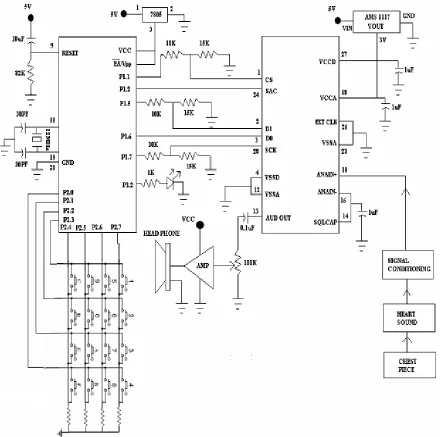
The analog electrical signal is obtained at the output of the signal processing unit. This signal is fed to the analog input of the APR6016 voice recording integrated circuit (IC). Microcontroller 89S52 is used to control the APR6016 through SPI interface. In the APR6016 IC, heart sound can be recorded up to 16 minutes.
To reproduce the heart sound positive terminal of the headphone is fed to the audio output pin of the APR6016 IC and negative terminal is grounded. The heart sound signal can also monitor and analyzed in DSO. The detail schematic diagram of hardware design of the system is shown in Figure 2.
Fig 2: The circuit diagram of the recording and playback system
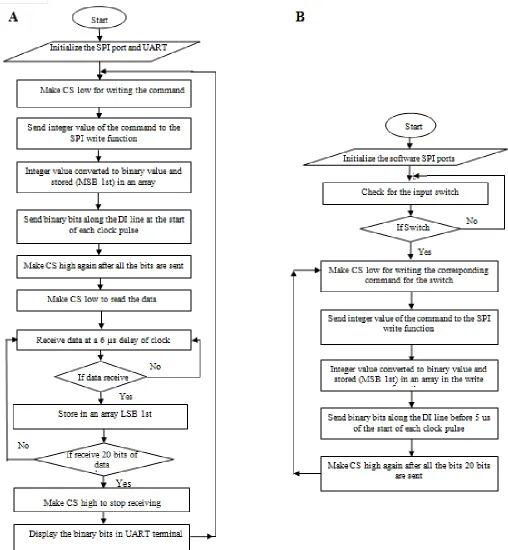
D. Software Design of the System
Fig. 3: Flow Chart for Reading the Device Identification (A) and Flow chart for Recording and Playing Audio (B)
III. RESULTSANDDISCUSSIONS
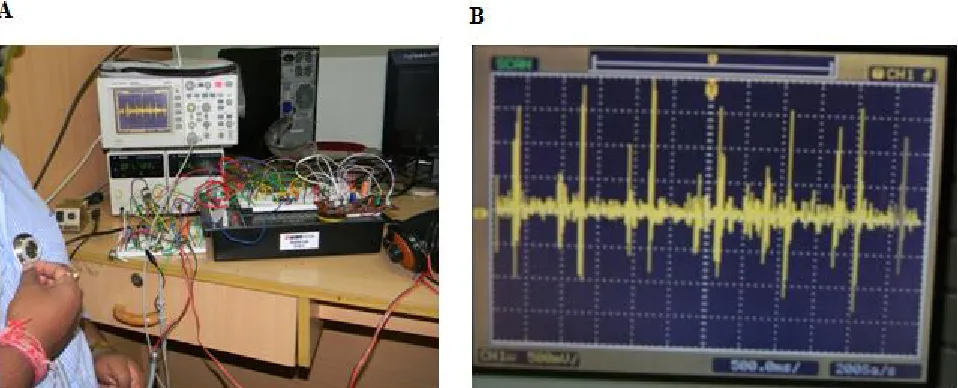
headphone. The recorded audio signal is also applied to the DSO for visualisation. Figure 4 (B) shows a recorded heart beat audio waveform.
Fig. 4: Photograph of the hardware experimental setup (A) and Photograph of recording audio waveform in DSO (B)
IV. CONCLUSION
In this paper, the design and development of an electronic stethoscope was discussed and results presented. The electronic stethoscope could electronically pickup the heart beat signals, amplify it and reproduce it in the headphone in real time. The electronic stethoscope also has the feature of recording the sounds and playback. The system is battery powered and portable. The voice recording IC APR6016 has been used to record the heart sound, which makes the system portable. The electronic stethoscope makes the different features of the biomedical sounds more distinct and thus better diagnosis is possible.
REFERENCES
[1] O. Szymanowska, B. Zagrodny, M. Ludwicki and J. Awrejcewicz, “Development of an electronic stethoscope,” In Mechatronics: Ideas, Challenges, Solutions and Application, Springer, vol. 414, pp.189-204, Dec.2016.
[2] B. Malik, N. Eva, H. Migdadi, M. J. Ngala, R. A. Abd-Alhameed and J. M. Noras, “Design and Development of an Electronic Stethoscope,” in proc. ITA ’17,2017, UK.
[3] S. Leng, R. S. Tan, K. T. C. Chai, C. Wang, D. Ghista and L.Zhong, “ The electronic stethoscope,” Biomedical engineering online, Vol.14, pp.66-103,Jul. 2015.
[4] A. Lakhe, I. Sodhi, J. Warrier and V. Sinha, “Development of digital stethoscope for telemedicine,” Journal of medical engineering & technology, vol.40, pp.20-24, Jan.2016.
[5] R.S.Anand, “PC based monitoring of human heart sounds,” Computers & Electrical Engineering, vol.31, pp.166-173.Mar.2005.
[6] J. Zhongwei and C. Samjin, “ Development of wireless electronic stethoscope system and abnormal cardiac sound analysis method,” Nihon Kikai Gakkai Ronbunshu, C Hen/Transactions of the Japan Society of Mechanical Engineers, vol.71,pp.3246-3253, 2005.
[7] Datasheet, 89S52 microcontroller, Available at http://ww1.microchip.com/downloads/en/DeviceDoc/doc1919.pdf.