BIROn - Birkbeck Institutional Research Online
Grubert, Anna and Fahrenfort, J. and Olivers, C.N.L. and Eimer, Martin
(2017) Rapid top-down control over template-guided attention shifts to
multiple objects. NeuroImage 146 , pp. 843-858. ISSN 1053-8119.
Downloaded from:
Usage Guidelines:
Please refer to usage guidelines at or alternatively
1
Running Head: RAPID CONTROL OF ATTENTION SHIFTS
Rapid top-down control over template-guided attention shifts to multiple objects
Anna Grubert1, Johannes Fahrenfort2, Christian N. L. Olivers2, and Martin Eimer1
1
Department of Psychological Sciences, Birkbeck, University of London
2
Department of Experimental and Applied Psychology, VU University
Correspondence concerning this article should be addressed to Martin Eimer, Department
of Psychological Sciences, Birkbeck, University of London, Malet Street, London WC1E 7HX,
2
Abstract
Previous research has shown that when observers search for targets defined by a
particular colour, attention can be directed rapidly and independently to two target objects
that appear in close temporal proximity. We investigated how such rapid attention shifts are
modulated by task instructions to selectively attend versus ignore one of these objects. Two
search displays that both contained a colour-defined target and a distractor in a different
colour were presented in rapid succession, with a stimulus onset asynchrony (SOA) of 100
ms. In different blocks, participants were instructed to attend and respond to target-colour
objects in the first display and to ignore these objects in the second display, or vice versa.
N2pc components were measured to track the allocation of spatial attention to
target-colour objects in these two displays. When participants responded to the second display,
irrelevant target-colour objects in the first display still triggered N2pc components,
demonstrating task-set contingent attentional capture while a feature-specific target
template is active. Critically, when participants responded to the first display instead, no
N2pc was elicited by target-colour items in the second display, indicating that they no longer
rapidly captured attention. However, these items still elicited a longer-latency contralateral
negativity (SPCN component), suggesting that attention was oriented towards
template-matching objects in working memory. This dissociation between N2pc and SPCN
components shows that rapid attentional capture and subsequent attentional selection
processes within working memory can be independent. We suggest that early attentional
orienting mechanisms can be inhibited when set matching objects are no longer
task-relevant, and that this type of inhibitory control is a rapid but transient process.
Keywords: visual attention, top-down control, visual search, event-related brain
3
1. Introduction
In visual search tasks, observers try to find a specific target object that appears
among task-irrelevant distractor objects. Although the location of target objects is not
known, search can be guided by knowledge about the features of these objects.
Representations of the visual properties of looked-for objects are assumed to be activated
prior to the start of a particular search process, and these representations have been
described as attentional task set or attentional templates (Duncan & Humphreys, 1989;
Folk, Remington, & Johnston, 1992; Wolfe & Horowitz, 2004; Olivers, Peters, Houtkamp, &
Roelfsema, 2011). Once a particular attentional control set is activated, stimuli with features
that match this set will attract attention, while stimuli with non-matching features do not.
As a result, attention can be deployed preferentially to candidate target objects that possess
one or more template-matching features (e.g., Wolfe, 2007; see also Eimer, 2014, 2015a, for
a more detailed discussion of the cognitive and neural basis of template-guided visual
search).
Although attentional templates are critical for the guidance of attention during visual
search, activating a particular feature-specific target template can also result in attentional
capture by task-irrelevant distractor objects, provided that these objects possess a
template-matching feature. This has been shown in spatial cueing experiments that
demonstrated task-set contingent involuntary attentional capture effects (Folk et al., 1992;
Folk, Remington, & Wright, 1994; Folk & Remington, 1998). When search arrays are
preceded by spatially uninformative and task-irrelevant cue arrays that have to be ignored,
cue stimuli that match current target attributes trigger spatial cueing effects (i.e., faster RTs
to targets at cued versus uncued locations), indicating that these cues are able to attract
attention in a task-set contingent fashion. This was also confirmed by event-related
potential (ERP) studies that have measured the N2pc component as an electrophysiological
marker of spatially selective attentional processing. The N2pc is an enhanced negativity that
is elicited at posterior electrodes contralateral to the visual field of a target object in
multi-stimulus visual displays. This component typically emerges 180-200 ms after multi-stimulus onset,
is generated in extrastriate areas of the ventral visual processing stream (Hopf et al., 2000),
and reflects the attentional selection of candidate target objects among distractors in visual
4
where target displays were preceded by uninformative cue displays, template-matching cue
objects were found to trigger reliable N2pc components, demonstrating that they captured
attention in spite of the fact that they were known to be task-irrelevant (e.g., Eimer & Kiss,
2008; Lien et al., 2008). Task-set contingent automatic attentional capture effects have also
been found when target-matching cue stimuli were not physically salient (Lamy, Leber, &
Egeth, 2004; Eimer et al., 2009), demonstrating that these effects do not depend on
bottom-up salience signals, but are the result of a match with a currently active attentional
target template.
The phenomenon of task-set contingent attentional capture by task-irrelevant cues
presented prior to the target shows that before an attentional goal (i.e., the selection of the
target) has been achieved, template-matching nontarget objects cannot be excluded from
attentional processing. That is, observers apparently cannot selectively attend to only the
second of two potentially relevant events presented in rapid sequence, while ignoring the
first. What is not yet known is how fast observers can abandon a particular search goal once
the target has been found. Specifically, can observers selectively attend to the first of two
potentially relevant events, while ignoring the second? If attentional templates can be
switched off rapidly, template-matching distractor objects that follow the target should no
longer be able to capture attention. If this was the case, it would demonstrate effective and
rapid control over attentional templates. The goal of the present study was to investigate
this type of attentional control.
We used procedures that were similar to those employed in a recent study from our
lab (Eimer & Grubert, 2014) that investigated the time course of allocating attention to two
target objects that were presented sequentially and in rapid succession by measuring N2pc
components to these objects. The procedures used in this earlier study and the main N2pc
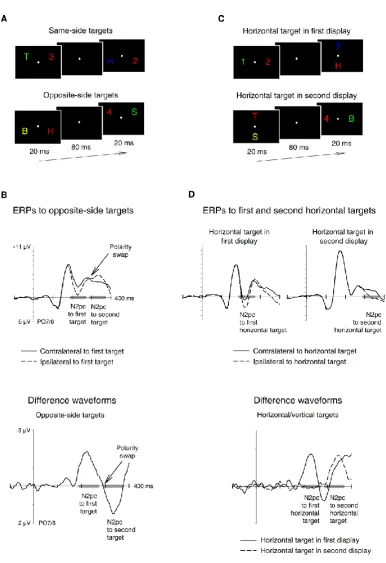
results are illustrated in Figure 1. On each trial, two search arrays that contained a
colour-defined target and a distractor on different sides were presented in rapid succession, and
the stimulus onset asynchrony (SOA) between the two arrays was manipulated. In blocks
where the targets in the first and second display appeared on opposite sides (see Figure 1A),
an N2pc was first triggered contralateral to the first target, before a second N2pc with
opposite polarity emerged contralateral to the second target. The point in time when the
second opposite-polarity N2pc started to emerge closely matched the SOA between the two
5
emerged about 100 ms after the onset of the N2pc to the first target. With shorter SOAs (10
or 20 ms) the N2pc reversal elicited by the second target started within 20 or 30 ms after
selection of the first target. The fact that these polarity reversals were tightly time-locked to
the onset of the second target strongly suggests that the presentation of a new target
object on the opposite side can affect the current distribution of spatial attention very
rapidly, and elicit rapid attention shifts towards the location of this new target object. In
another condition of the same study, the target in one display appeared on the vertical
meridian and the target in the other display on the horizontal meridian (Figure 1C). Because
the N2pc is a contralateral component, it is not elicited by targets on the vertical meridian,
and therefore only reflects the attentional selection of the other (horizontal) target object
(see also Hickey, McDonald, & Theeuwes, 2006; Hickey, Di Lollo, & McDonald, 2009; Eimer,
Kiss, & Nicholas, 2011). When the SOA between the two displays was 100 ms, the N2pc to
horizontal targets in the first display (H1) preceded the N2pc to horizontal targets in the
second display (H2) by almost exactly 100 ms (Figure 1D). When this SOA was reduced to 20
or 10 ms, the onset latency difference between the N2pc components to H1 and H2 targets
mirrored this objective time interval perfectly, and both N2pc components overlapped in
time.
These earlier N2pc results demonstrate that different target objects can be selected
concurrently, with each selection process following its own independent time course (see
also Grubert & Eimer, 2015, for similar observations in tasks where two successively
presented targets were defined by two different colours, and Jenkins, Grubert, & Eimer, in
press, for evidence that rapid concurrent attentional selection processes can also be
activated when target objects are defined by their shape or alphanumerical category). They
suggest that multiple template-guided attentional allocation processes can be activated in
parallel, in line with parallel models of visual attention (e.g., Desimone & Duncan, 1995;
Bundesen, Habekost, & Kyllingsbaek, 2005), but not with strictly serial models of attentional
object selection in visual search (e.g., Treisman, 1988; Wolfe, 1994, 2007; but see Woodman
& Luck, 1999, 2003, and Grubert & Eimer, 2016, for N2pc evidence that selection processes
can operate serially in different task contexts). However, the question remains whether and
to what degree such rapid parallel selection processes are subject to top-down attentional
control. Because the features of the target objects were known in advance, the allocation of
6
relevant task settings that were established at the start of the experiment by instructing
participants to detect specific target colours (e.g., Folk et al., 1992).
We tested this hypothesis in the present study with a stimulus setup that was
identical to our previous experiment (Eimer & Grubert, 2014), but where participants were
now instructed to find and respond to only one of the two target-colour items that were
presented on each trial, and to ignore the other target-colour item. In Experiment 1, two
displays that each contained one target-colour item and a distractor item in a different
nontarget colour were separated by a 100 ms SOA. In some blocks, stimulus pairs were
presented to the left and right of fixation (bilateral presentation condition), and the two
target-colour items appeared either on the same side or on opposite sides in the two
successive displays (as shown in Figure 1A). In other blocks, one stimulus pair on the vertical
meridian and another pair on the horizontal meridian were presented successively
(horizontal/vertical presentation condition; Figure 1C). The order in which display types
(same side versus opposite side or horizontal versus vertical stimulus pair) varied randomly
across trials. Participants’ task was to attend and respond only to the target-colour item in
one of the two successively presented displays, and to ignore the target-colour item in the
other display. In some blocks, participants had to identify the target-colour item in the first
display (digit versus letter) and to ignore the target-colour item in the second display (first
display task-relevant: D1 blocks). In other blocks, the target-colour item in the second
display had to be identified and the first display had to be ignored (second display
task-relevant: D2 blocks).
N2pc components to horizontal target-colour objects in the first and second display
were measured separately in D1 and D2 blocks, in order to find out whether the ability of
these objects to attract attention was affected by instructions to selectively attend to only
one of these objects. If template-guided attentional target selection processes are generally
insensitive to such task instructions, N2pc results in Experiment 1 should be essentially
identical to the results from our previous experiment (Eimer & Grubert, 2014) shown in
Figure 1, where template-matching objects in both displays were task-relevant. In D2 blocks
where participants had to find the target object in the second display, target-colour objects
in the first display appeared before this search goal had been achieved. If
template-matching but task-irrelevant objects cannot be prevented from capturing attention under
7
attentional capture described above), both target-colour objects should attract attention in
D2 blocks, and both should therefore elicit N2pc components (as in Eimer & Grubert, 2014;
see Figure 1B and D). When the two target-colour items are presented successively on
opposite display sides, an N2pc should initially be elicited by the first target and then
reverse polarity, reflecting the subsequent allocation of attention to the target in the second
display. In the horizontal/vertical presentation condition, horizontal targets in the first and
second display should trigger N2pc components that emerge within approximately 100 ms
of each other, matching the objective SOA between the two displays.
In D1 blocks where participants had to find targets in the first display, the
task-irrelevant target-colour object in the second display always appeared after the target object
had been encountered. Our starting hypothesis was that if attentional templates are
de-activated rapidly after a search goal has been achieved (cf. Olivers & Eimer, 2011), these
irrelevant target-colour objects may no longer be able to attract attention in these blocks. If
this was the case, these objects should not elicit N2pc components. In D1 blocks where the
two target-colour items appear on opposite sides, N2pc components should be elicited
exclusively contralateral to the target in the first display, and no additional reverse-polarity
N2pc to target-colour items in the second display should be observed. In the
horizontal/vertical presentation condition, an N2pc should be triggered by horizontal target
objects in the first display, but not on trials where a horizontal target-colour item was
presented in the second display. Given that the SOA between the two displays was only 100
ms, such a pattern of N2pc results would suggest that attentional task sets can be switched
off extremely rapidly. The alternative possibility is that target-colour objects in both displays
elicit N2pc components of similar size in D1 blocks (similar to the pattern of N2pc
components found when both objects are task-relevant; Eimer & Grubert, 2014). Such a
result would show that feature-specific search templates cannot be deactivated
immediately after a target object has been found. To foreshadow, our results suggested a
more complex scenario, in which the template remains active, but spatial orienting is
delayed.
8
2.1. Methods
2.1.1. Participants.
Fifteen paid participants were tested. Three of them were excluded from analyses
because of excessive eye movement activity resulting in a loss of more than 60% of all trials.
The remaining twelve participants were 25 to 37 years old (mean age 28.8 years). Five were
female; two were left-handed. All participants had normal or corrected-to-normal vision,
including colour vision (tested with the Ishihara colour vision test; Ishihara, 1972).
2.1.2. Stimuli and procedure.
Participants were tested in a dimly illuminated soundproof and electrically shielded
cabin. Stimuli appeared on a 22-inch Samsung wide SyncMaster 2233 LCD monitor with a
resolution of 1280x1024 pixels and a 100 Hz refresh rate at a viewing distance of
approximately 100 cm. Manual responses were registered with two purpose-built response
keys, vertically aligned and centred in front of the observers. Stimulus presentation, timing,
and response recording were controlled by a LG Pentium PC running under Windows XP,
using the Cogent 2000 toolbox (www.vislab.ucl.ac.uk/Cogent/) for MATAB (Mathworks,
Inc.).
On each trial, two search displays were presented in rapid succession (Figures 1A
and C). The two displays were presented for 20 ms each and were separated by a 100 ms
SOA. Each display contained one item in the target colour (i.e., the red items in Figures 1A
and C), and a second item in a nontarget colour, presented against a black background. The
four possible stimulus colours were red (CIE colour coordinates .616/.338), green
(.261/.558), blue (.183/.178), and yellow (.399/.476). All colours were equiluminant (~11.8
cd/m2). Each of the four colours served as the target colour for three participants. The nontarget colour in each display was randomly chosen from the three remaining colours,
with the constraint that it was never identical in the two displays of the same trial. The two
displays on each trial contained four different alphanumerical stimuli that were selected
randomly from a set of uppercase letters (B, H, S, or T) and digits (1, 2, 3, or 4). Each
stimulus subtended 0.9° x 0.9° of visual angle and was presented at an eccentricity of 2.4°
from central fixation. A central grey (.324/.348) fixation cross was present throughout each
9
There were two blocked stimulus presentation conditions. In bilateral blocks, all
search displays contained one stimulus on the left side and one on the right side of fixation
(Figure 1A). To avoid masking interference between the two successive displays presented
on each trial, one stimulus pair always appeared in the upper visual field and the other one
in the lower visual field, with presentation sequence (upper→lower; lower→upper)
randomized across trials. The two successive target-colour stimuli were equally likely to
appear on the same side or on opposite sides on any given trial. In horizontal/vertical blocks,
one stimulus pair was presented on the horizontal meridian, and the other one on the
vertical meridian (Figure 1C), with presentation sequence (horizontal→vertical, vertical
→horizontal) randomised across trials.
Participants’ task was to report the identity (digit or letter) of one of the two
target-colour items, and to ignore the target-target-colour item in the other display. Which of the two
displays was task-relevant was varied across blocks. In D1 blocks, the target-colour item in
the first display had to be reported, and the target-colour item in the second display had to
be ignored. In D2 blocks, the second display was task-relevant, and the target-colour item in
the preceding display could be ignored. To report the presence of a digit or letter target in
the relevant display, participants pressed the top or bottom response key, respectively. The
key-hand mapping (left or right hand on top or bottom key) was counterbalanced across
participants and remained constant for each participant.
The experiment included 24 blocks, with six successive blocks for each combination
of presentation condition (bilateral versus horizontal/vertical) and relevant display (D1
versus D2). Each block contained 64 trials, resulting in 1536 experimental trials in total. In
the bilateral presentation condition, target-colour items appeared on the same or on
opposite sides on 32 trials per block, and each trial was equally likely to start with a
target-colour item in the left or right visual field. In the horizontal/vertical presentation condition,
there were 32 trials per block where the horizontally arranged display preceded the vertical
display, and 32 trials where this order was reversed. Target-colour items were equally likely
to appear at the top or bottom position of the vertical display, and at the left or right
position of the horizontal display. Six participants completed twelve D1 blocks where the
first display was task-relevant followed by twelve D2 blocks, and this order was reversed for
10
bilateral stimulus displays prior to six blocks with horizontal/vertical displays, and this order
was reversed for the other three participants.
2.1.3. EEG recording and data analysis.
EEG was DC-recorded from 23 scalp sites at standard positions of the extended
10/20 electrode placement system, sampled at 500 Hz and digitally low-pass filtered at 40
Hz. No additional off-line filters were applied. Impedances were kept below 5 kΩ. All
electrodes were referenced to the left earlobe during recording, and were re-referenced
offline to the average of both earlobes. Trials with artifacts (eye movements exceeding ±30
µV in the HEOG channels; blinks exceeding ±60 µV at Fpz; muscular movements exceeding
±80 µV in all other channels), with incorrect, anticipatory (faster than 200 ms), very slow
(slower than 1500 ms), or missing responses were excluded from EEG analyses. After trial
rejection, 89.6% and 93.7% of all trials remained in the analysis of bilateral D1 and D2 blocks
(overall ranging between 82.8% and 98.2% between participants), and 89.1% and 92.9% of
all trials remained in the analysis of horizontal/vertical D1 and D2 blocks, respectively
(ranging from 79.2% to 96.9% between participants). For the analyses of N2pc components,
EEG on these remaining trials was segmented into 600 ms epochs, from -100 ms to 500 ms
relative to the onset of the first display. All ERPs were corrected relative to a 100 ms
pre-stimulus baseline. For the bilateral presentation condition, ERPs were computed only for
trials where the two colour-target items were presented on opposite sides, separately for
each combination of relevant display (D1 or D2), and side of first target-colour object (left or
right). For the horizontal/vertical presentation condition, ERPs were computed separately
for each combination of relevant display (D1 or D2), display sequence (horizontal display
first or second: H1 or H2), and side of the horizontal target-colour object (left or right). N2pc
components to target-colour items in the first and second display were quantified on the
basis of ERP mean amplitudes measured at lateral posterior electrode sites PO7 and PO8
within two 80 ms time windows that were separated by 100 ms, reflecting the SOA between
the two displays (190-270 ms and 290-370 ms post-stimulus relative to the onset of the first
display). N2pc onset latencies were calculated separately on the basis of jack-knifed
difference waves (Miller, Patterson, & Ulrich, 1998; Ulrich & Miller, 2001). Difference waves
obtained by subtracting ipsilateral from contralateral ERPs, were averaged for twelve
11
defined as the point in time when the voltage of the negative going deflection of the
difference waveform of each subsample exceeded 50% of its peak value. The statistical
values of the t-tests on jack-knifed data were corrected according to the formula described
by Miller et al. (1998; denoted as tc). All t-tests were two-tailed and Bonferroni corrected
where necessary. Effect sizes are reported in terms of partial eta squared for F-tests and
t-tests on jackknifed means (labelled ηp2c; see Grubert & Eimer, 2016, for more details on this
procedure) and Cohen’s d (Cohen, 1988), with a confidence interval of 95%, for all other
t-tests. Longer-latency lateralised ERP components beyond the N2pc were assessed on the
basis of EEG epochs that were computed within a longer time window (from 100 ms prior to
700 ms after D1 onset, relative to a 100 ms pre-stimulus baseline).
2.2. Results
2.2.1. Behavioural results
Trials with anticipatory (< 200 ms) and slow (> 1500 ms) reaction times (RTs) were
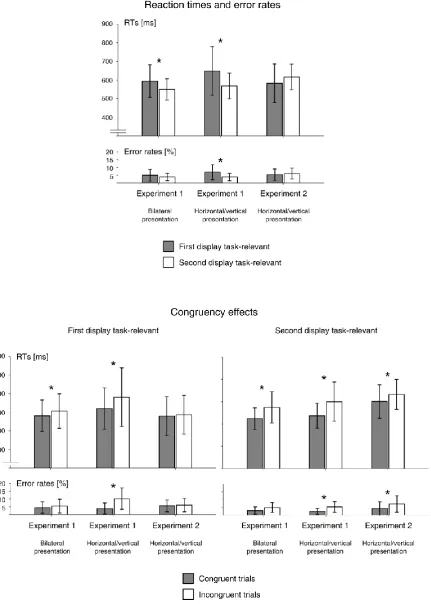
excluded from analysis (less than 1% of all trials). Figure 2 (top panel) shows mean RTs and
error rates in the bilateral and horizontal/vertical presentation conditions, separately for
blocks in which the first or second display was task-relevant.
Bilateral presentation. RTs were analysed with a repeated-measures ANOVA with the
factors relevant display (D1 versus D2) and target colour sequence (same-side trials versus
opposite-sides trials). RTs were faster in D2 blocks where the second display was
task-relevant relative to D1 blocks (549 versus 594 ms), F(1,11) = 7.5, p = .019, ηp2 = .41. There
was no RT difference between same-side and opposite-side trials (569 versus 575 ms),
F(1,11) = 1.5, p = .243. An interaction between relevant display and target colour sequence,
F(1,11) = 5.8, p = .035, ηp2 = .34, was due to the fact that the RT advantage for D2 over D1
blocks was more pronounced for same-side than different-side trials (53 versus 36 ms).
Error rates were generally low (5.0 and 3.9% in D1 and D2 blocks, respectively), and did not
differ reliably between conditions, all F(1,11) < 1.4, all p > .277.
To determine whether the category of the target-colour stimulus (letter or digit) in
the currently task-irrelevant display affected responses to target letters versus digits in the
12
where the two target-colour items were both letters or digits and incongruent trials where
one of them was a letter and the other a digit (Figure 2, bottom panels). RTs were faster on
congruent as compared to incongruent trials, and this was the case both in D1 blocks where
the first display was task-relevant (581 versus 607 ms), t(11) = 4.3, p = .001, d = .29, and in
D2 blocks (524 versus 575 ms), t(11) = 5.0, p < .001, d = .85. These RT congruency effects
were larger in D2 as compared to D1 blocks (50 versus 25 ms), t(11) = 2.9, p = .015, d = .88.
There were no reliable congruency effects on error rates, all t(11) < 2.2, all p > .055.
Horizontal/vertical presentation. RTs were analysed with the factors relevant display
(D1 versus D2) and display sequence (horizontal vertical versus vertical horizontal).
Responses were faster in D2 blocks relative to D1 blocks (568 versus 649 ms), F(1,11) = 8.9,
p = .012, ηp2 = .45. There was no main effect of display sequence and no interaction
between relevant display and display sequence, both F(1,11) < 3.1, both p > .113. The same
pattern was found for accuracy, with higher error rates in D1 as compared to D2 blocks
(7.0% versus 3.9%), F(1,11) = 10.8, p = .007, ηp2 = .49, and no significant effects involving the
factor display sequence, both F(1,11) < 3.5, both p > .093. As in the bilateral presentation
condition, RTs were faster on congruent relative to incongruent trials, both in D1 blocks
where the first display was task-relevant (620 versus 681 ms), t(11) = 3.3, p = .007, d = .45,
and in D2 blocks (537 versus 600 ms), t(11) = 4.9, p < .001, d = .85 (Figure 2, bottom panels).
The size of these RT congruency effects did not differ between D1 and D2 blocks (61 versus
63 ms), t(11) < 1. There were also congruency effects on error rates (3.8 versus 10.2% and
2.4 versus 5.3% on congruent and incongruent trials in D1 and D2 blocks, respectively), both
t(11) > 3.5, p < .005, d > .99, which were more pronounced in D1 relative to D2 blocks (6.4
versus 2.9%), t(11) = 3.8, p = .003, d = .85.
2.2.2. ERP results
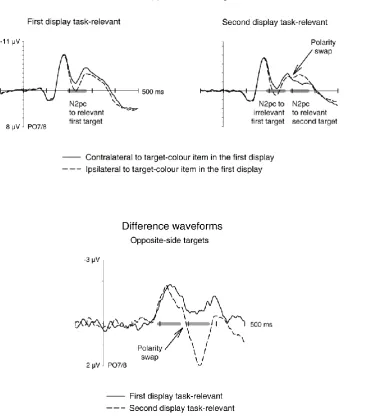
Bilateral presentation – Opposite Side Trials. Figure 3 (top panels) shows
grand-average event-related potentials (ERPs) elicited at electrode sites PO7 and PO8 contra- and
ipsilateral to the target-colour stimulus in the first display on trials where the target-colour
items in the two displays appeared on opposite sides. ERPs are shown separately for D1
blocks where the first display was task-relevant and the second display had to be ignored
13
response-relevant (right panel). Target-colour items in the first display triggered N2pc
components both in D1 and in D2 blocks. When the second target-colour item was relevant
(D2 blocks), ERP waveforms reversed polarity (arrow in Figure 3), reflecting the emergence
of an N2pc contralateral to the side of the target item in the second display. Importantly, no
such polarity reversal was elicited in D1 blocks where the target-colour item in the second
display could be ignored. This pattern of N2pc results is illustrated in N2pc difference
waveforms obtained by subtracting ipsilateral from contralateral ERPs, separately in D1 and
D2 blocks (Figure 3, bottom panel). The N2pc to the target-colour item in the first display
emerged 190 ms after display onset, and its size was very similar in D1 and D2 blocks. When
the second display was task-relevant (D2 blocks), the N2pc reversed polarity around 290 ms
after the onset of the first display (i.e., 190 ms after the second array was presented). No
such N2pc polarity reversal was apparent in D1 blocks where the target-colour item in the
second display could be ignored.
These informal observations were confirmed by repeated measures ANOVAs of N2pc
mean amplitudes for the factors relevant display (D1 versus D2) and laterality (electrode
contralateral versus ipsilateral to the target-colour item in the first display). In the time
window corresponding to the N2pc to the first display (190-270 ms post-stimulus), a main
effect of laterality, F(1,11) = 38.3, p < .001, ηp2 = .78, confirmed that reliable N2pc
components were elicited by target-colour items in the first display. Importantly, there was
no interaction between laterality and relevant display, F(1,11) = 1.1, p = .315, demonstrating
that N2pc components to target-colour items in the first display were equally large
regardless of whether these targets were task-relevant or had to be ignored. Follow-up
t-tests conducted separately for D1 and D2 blocks confirmed the presence of reliable N2pc
components to target-colour items in the first display both in D1 blocks (-1.4 µV), t(11) = 5.2,
p < .001, d = .35, and in D2 blocks (-1.2 µV), t(11) = 6.8, p < .001, d = .27. Onset latencies of
the N2pc components to target-colour items in the first display did not differ between D1
and D2 blocks (198 versus 193 ms), tc(11) = 1.3, p = .224.1
1
As can be seen in Figure 3, both contralateral and ipsilateral ERPs in the N2pc time
14
In the time window corresponding to the N2pc to target-colour items in the second
display (290-370 ms after the onset of the first display), there was no overall main effect of
laterality, F(1,11) < 1, but a significant interaction between laterality and relevant display,
F(1,11) = 39.2, p < .001, ηp2 = .78, reflecting the fact that ERP waveforms switched polarity
when the target in the second display was task-relevant, but not in blocks where the second
target had to be ignored. This was confirmed by follow-up analyses conducted separately
for D1 and D2 blocks. In D2 blocks, there was a reliable N2pc contralateral to the visual field
of the second target (1.2 µV), t(11) = 3.0, p = .013, d = .25. The onset of this
opposite-polarity N2pc component in D2 blocks was delayed by approximately 120 ms relative to the
onset of the N2pc in response to the first display (315 versus 193 ms), tc(11) = 14.9, p < .001,
ηp2c = .95. In D1 blocks, there was no such N2pc polarity reversal. Here, the enhanced
negativity contralateral to the first target remained present during the 290-370 ms
post-stimulus interval in D1 blocks (-0.6 µV), although this effect only approached significance,
t(11) = 2.0, p = .067.
Horizontal/vertical presentation. Figure 4 shows grand-average ERPs triggered at
electrodes PO7 and PO8 contra- and ipsilateral to horizontal target-colour items on trials
where this item appeared in the first display (H1 trials, left panels) and trials where it
appeared in the second display (H2, right panels). ERPs are shown separately for D1 blocks
where the first display was task-relevant (top panel) and for D2 blocks (middle panel).
Difference waveforms obtained by subtracting ipsilateral from contralateral ERPs in D1 and
D2 blocks are presented in Figure 4 (bottom panel), separately for H1 and H2 trials. When
the horizontal target-colour item was presented in the first display (H1 trials), an N2pc was
elicited both when this item was response-relevant (D1 blocks) and when it had to be
ignored (D2 blocks). In contrast, horizontal target-colour items in the second display
appeared to elicit an N2pc only when they were relevant (D2 blocks), but not in D1 blocks.
These observations were verified by means of two repeated measures ANOVAs
conducted separately on N2pc mean amplitudes obtained in response to horizontal
target-colour items in the first display (190-270 ms post-stimulus) and in the second display
relevant (Figure 3, top right panel) than when the first display was relevant (top left panel),
15
370 ms after the onset of the first display). Both analyses included the factors relevant
display (D1 versus D2) and laterality (electrode contralateral versus ipsilateral to the
horizontal target-colour item). For target-colour items in the first display, a main effect of
laterality, F(1,11) = 41.1, p < .001, ηp2 = .79, confirmed the presence of reliable N2pc
components. An interaction between laterality and relevant display, F(1,11) = 5.3, p = .042,
ηp2 = .32, was due to the fact that N2pc amplitudes were larger in D1 blocks where
target-colour items were task-relevant relative to D2 blocks (see Figure 4, bottom left panel).
However, follow-up analyses conducted separately for D1 and D2 blocks confirmed that
N2pc components were reliably elicited by horizontal target-colour items in the first display
not only in D1 blocks (-1.7 µV), t(11) = 7.0, p < .001, d = .30, but also in D2 blocks where they
were task-irrelevant (-1.3 µV), t(11) = 5.2, p < .001, d = .23. N2pc onset latencies were also
virtually identical in D1 and D2 blocks (203 versus 202 ms), tc(11) < 1.
For trials where horizontal target-colour items appeared in the second display, a
main effect of laterality, F(1,11) = 10.9, p = .007, ηp2 = .50, was accompanied by a significant
interaction between laterality and relevant display, F(1,11) = 18.1, p = .001, ηp2 = .62.
Follow-up t-tests confirmed that in D2 blocks, task-relevant horizontal target-colour items in
the second display elicited a reliable N2pc (-1.3 µV), t(11) = 4.5, p = .001, d = .28. In contrast,
no significant N2pc was triggered by these items in D1 blocks where they had to be ignored
(-0.3 µV), t(11) = 1.3, p = .212 (see Figure 4, bottom right panel). Additional analyses directly
compared N2pc components triggered in D2 blocks by horizontal target-colour items in the
first or second display. There was no amplitude difference between these N2pc
components, t(11) < 1. Their respective onset latencies were 202 ms and 310 ms, tc(11) =
9.1, p < .001, ηp2c = .88, which closely matched the objective 100 ms onset asynchrony
between the two successive displays.
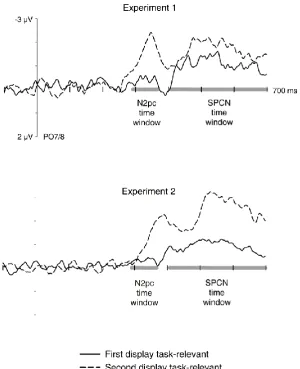
While target-colour items in the second display did not trigger reliable N2pc
components in D2 blocks, they still elicited a considerable sustained posterior contralateral
negativity (SPCN component; e.g., Mazza et al., 2007; Jolicoeur, Brisson, & Robitaille, 2008)
that started at around 300-350 ms after the onset of the second display and remained
present for at least another 300 ms. This is illustrated in Figure 5 (top panel), which shows
contralateral-ipsilateral difference waveforms for trials from horizontal/vertical blocks
where a task-relevant or -irrelevant horizontal target-matching item appeared in the second
16
presence of SPCN components, we conducted an additional analysis of ERPs elicited by
target-colour items in the second display at lateral posterior electrodes PO7/8 in D1 and D2
blocks. These ERPs were computed on the basis of epochs that were extended by 200 ms
relative to the epochs used for the N2pc analyses (from 100 ms prior to 700 ms after onset
of the first display, as shown in Figure 5). A repeated measures ANOVA on SPCN amplitudes
(measured during a 400-700 ms time-window relative to the onset of the first display, which
corresponds to the 300-600 ms interval after the onset of the second display) obtained a
main effect of laterality (electrode contralateral versus ipsilateral to the horizontal
target-colour item in the second display), F(1,11) = 53.5, p < .001, ηp2 < .83, reflecting the presence
of reliable SPCN components to these items. The interaction between laterality and relevant
display (D1 versus D2) approached significance, F(1,11) = 4.7, p = .054, ηp2 < .30, indicating
that target-colour items in the second display tended to elicit larger SPCN components in D2
blocks. However, and critically, follow-up analyses conducted separately for D1 and D2
blocks showed that SPCN components were reliably elicited by target-colour items not only
when they were relevant (D2 blocks; -1.6 µV; t(11) = 5.9, p < .001, d < .42) but also in D1
blocks where they had to be ignored (-1.0 µV; t(11) = 5.9, p < .001, d < .34).
2.3. Discussion of Experiment 1
The results of Experiment 1 confirmed that while a search template for a particular
target colour is active, template-matching nontarget objects will attract attention. In D2
blocks where participants were instructed to respond to target items in the second display
and to ignore target-colour objects in the first display, target-colour objects in the first
display elicited solid N2pc components. In line with previous behavioural and N2pc studies
investigating task-set contingent attentional capture effects (e.g., Folk et al., 1992; Eimer &
Kiss, 2008), this result demonstrates that these objects attracted attention even though
they were not response-relevant. When the two target-colour items appeared on opposite
sides in the first and second display in D2 blocks (bilateral presentation condition), the N2pc
was initially triggered contralateral to the first of these items, and then changed polarity,
reflecting the emergence of an N2pc to the second target-colour item (Figure 3). In D2
blocks where one display contained a horizontal stimulus pair and the other a vertical pair
17
display also triggered N2pc components (Figure 4). The observation that N2pc amplitudes to
target-colour objects in the first display were smaller in D2 blocks where they had to be
ignored than in D1 blocks suggests that task instructions had some modulatory effect on the
ability of these objects to attract attention. However, and critically, the fact that N2pc
components were elicited by both task-irrelevant first and response-relevant second
horizontal target-colour items in D2 blocks clearly shows that while a target template for an
upcoming selection episode is active, template-matching items that have to be ignored
cannot be prevented from attracting attention.
At first sight, the N2pc results found for D1 blocks appear to suggest that such
templates are switched off extremely rapidly once the target is found and the current
selection goal has been achieved. In these blocks, participants had to select the target
object in the first display and to ignore the other target-colour item in the second display
that was presented 100 ms later. N2pc components were only elicited by targets in the first
display, but not by target-colour items in the subsequent task-irrelevant display. There was
no polarity reversal of N2pc waveforms in trials where the two target-colour items appeared
on opposite sides in the two displays (Figure 3), suggesting that the irrelevant target-colour
item in the second display did not attract attention. This was confirmed in the
horizontal/vertical presentation condition, where horizontal target-colour items in the
second display of D1 blocks did not elicit an N2pc (Figure 4).
The absence of an N2pc to template-matching but task-irrelevant objects that were
presented 100 ms after a target search display suggests that once the task goal has been
achieved by selecting the target object in the first display, the corresponding attentional
template is deactivated rapidly, and therefore no longer facilitates attentional capture by
template-matching items in the subsequent display. However, before accepting this
conclusion, it is important to consider other evidence from Experiment 1, which suggests
that irrelevant target-colour items in the second display were not completely excluded from
spatially selective processing in D1 blocks. The presence of significant behavioural
congruency effects (i.e., faster RTs to targets that matched the category of the target-colour
item in the other irrelevant display than to category-mismatching targets) demonstrated
that the alphanumerical identity of the nominally irrelevant target-colour items was
registered. This was not only the case in D2 blocks where these items attracted attention, as
18
The presence of behavioural congruency effects in D1 blocks is not necessarily inconsistent
with the hypothesis that irrelevant target-colour items were successfully prevented from
attracting attention. Visual search for letters among digits, or vice versa, is generally very
efficient (e.g., Egeth, Jonides, & Wall, 1972), which suggests that the alphanumerical
category of letters and digits can be detected rapidly and in parallel at pre-attentive
processing stages (Duncan, 1980). Along similar lines, attentional blink experiments have
reported evidence for the semantic analysis of unattended words (e.g., Luck, Vogel, &
Shapiro, 1996; Martens, Wolters, & Van Raamsdonk, 2002). Such findings show that the
processing of category and other semantic stimulus attributes does not depend on focal
attention – at least not the attentional selection processes that are reflected by the N2pc.
The presence of behavioural congruency effects for irrelevant target-colour items in
D2 blocks could suggest that even though these items were apparently unable to rapidly
attract attention, their identity was still encoded into working memory. Indeed, these items
elicited reliable SPCN components (as shown in Figure 5, top panel), as in several previous
ERP studies of attentional target selection (e.g., Mazza et al., 2007; Jolicoeur et al., 2008).
The SPCN is usually interpreted as reflecting the sustained activation of working memory
representations during the identification and categorization of visual objects, analogous to
the contralateral delay activity (CDA) that is observed during the delay period of visual
working memory tasks (e.g., Vogel & Machizawa, 2004). While N2pc components are
triggered by target objects both in simple detection and more complex target discrimination
tasks, SPCN components are only elicited in tasks that require an in-depth analysis of target
features (Mazza et al., 2007). This suggests that these two components reflect dissociable
processes associated with the rapid attentional selection of target objects versus the
sustained processing of selected objects in working memory (see also Eimer, 2014, 2015a,
for a detailed discussion of such dissociations between ERP markers of object selection and
identification processes). The presence of lateralised SPCN components for task-irrelevant
target-colour items in D1 blocks shows that the location of these items was registered, and
suggests that they were encoded into working memory, which may also explain why these
items produced behavioural congruency effects. These observations are problematic for the
hypothesis that attentional templates are immediately deactivated once the target in the
first display has been selected. If this were the case, template-matching items in the
19
SPCN component. Experiment 2 was conducted to further investigate this issue. Stimulation
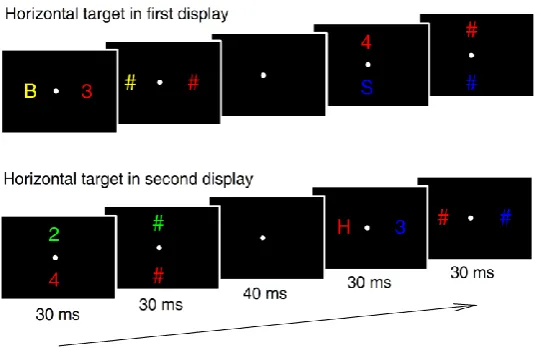
parameters were identical to the horizontal/vertical blocks of Experiment 1, except that
now all search display items were immediately followed by pattern masks (see Figure 6).
Because masking limits the time available for the perceptual extraction of identity
information (Scheerer, 1973; Turvey, 1973; Kolers, 1968), the inclusion of backward masks
in Experiment 2 should make it less likely that the identity of task-irrelevant items in D1
blocks would be represented in working memory when not immediately attended. If this
was the case, these items should not elicit behavioural congruency effects in Experiment 2,
and should also no longer trigger any SPCN components.
3. Experiment 2
3.1. Methods
3.1.1. Participants
Fifteen different participants were paid to participate in Experiment 2. Three of them
were excluded from analyses due to excessive EEG artefacts resulting in an exclusion of
more than 60% of all trials. The remaining twelve participants were aged between 20 and 41
years (mean age 31.3 years). Six were female; one was left-handed. All participants had
normal or corrected-to-normal vision, including colour vision (tested with the Ishihara
colour vision test; Ishihara, 1972).
3.1.2. Stimuli and procedure
These were identical to the horizontal/vertical condition of Experiment 1, with the
exception that the two consecutive search displays in each trial were each presented for 30
ms and were immediately followed by a mask display (30 ms duration). There was a 40 ms
blank screen between the offset of the mask for D1 and the onset of the D2 display,
resulting in the same 100 ms SOA between D1 and D2 as in Experiment 1. The masking
stimuli were hash marks (0.9° x 0.9°) which were presented at the same locations and in the
same colours as the preceding letters/digits in the D1 and D2 displays (see Figure 6 for
illustration). Experiment 2 comprised 12 blocks with 64 trials, resulting in a total of 768
task-20
relevant display, with task order (D1 blocks preceded by D2 blocks, or vice versa)
counterbalanced across participants.
3.1.3. EEG recording and data analysis
Recording and analysis procedures were the same as in Experiment 1. After exclusion of
trials with incorrect, anticipatory, very slow, or missing responses, and of trials with EEG
artefacts, 81.1% and 84.5% of all trials were retained for D1 and D2 blocks, respectively
(ranging from 60.9% to 97.1% across participants). EEG on these remaining trials was
segmented into 800 ms epochs, from -100 ms to 700 ms relative to the onset of the first
display, separately for each combination of relevant display (D1 or D2), display sequence
(horizontal display first or second: H1 or H2), and side of horizontal target-colour object (left
or right). As in Experiment 1, N2pc mean amplitudes to horizontal target-colour items in the
first and second display were measured in the 190-270 ms and in the 290-370 ms time
window after onset of the first display, respectively. SPCN components were computed
during the 400-700 ms time window after onset of the first display for H2 trials in D1 and D2
blocks separately.
3.2. Results
3.2.1. Behavioural results
Trials with anticipatory (< 200 ms) and slow (> 1500 ms) reaction times (RTs) were
excluded from analysis (less than 1.5% of all trials). Mean RTs and error rates, separately for
blocks in which the first or second display was task-relevant, are shown in Figure 2 (top
panel). A repeated-measures ANOVA with the factors relevant display (D1 versus D2) and
display sequence (horizontal vertical versus vertical horizontal) showed that mean
correct RTs did not differ significantly between D1 and D2 blocks (583 versus 616 ms),
F(1,11) = 1.8, p = .207. There was also no main effect of display sequence and no significant
interaction, both F(1,11) < 1.6, p > .253. Error rates showed the same pattern. Although
error rates were numerically increased in D2 as compared to D1 blocks (6.2 versus 5.4%),
this difference was not statistically reliable, F(1,11) = 4.4, p = .060. There was no effect of
21
RTs on congruent relative to incongruent trials were only observed in D2 blocks where the
second display was task-relevant (601 versus 633 ms), t(11) = 3.6, p = .005, d = .45. No
reliable congruency effect was present in D1 blocks where the second display could be
ignored (579 versus 587 ms), t(11) = 1.5, p = .161 (Figure 2, bottom panels). A direct
comparison between these two types of blocks confirmed that congruency effects were
reliably larger in D2 relative to D1 blocks (32 ms versus 7 ms), t(11) = 2.7, p = .021, d > 1. The
same pattern was observed for error rates, with reliable congruency effects in D2 (4.3
versus 7.2%), t(11) = 2.3, p = .043, d = .60, but not in D1 blocks (5.6 versus 6.0%), t(11) < 1.
However, the difference in the size of these congruency effects on error rates between D1
and D2 blocks was not reliable, t(11) = 1.7, p = .108.
3.2.2. ERP results
N2pc components. Figure 7 shows grand-average ERPs triggered at electrodes PO7
and PO8 contra- and ipsilateral to horizontal target-colour items on trials where this item
appeared in the first display (H1 trials, left panels) and trials where it appeared in the
second display (H2, right panels). ERPs are shown separately for D1 blocks where the first
display was task-relevant (top panel) and for D2 blocks (middle panel). Difference
waveforms obtained by subtracting ipsilateral from contralateral ERPs, separately in H1 and
H2 trials of D1 and D2 blocks are presented in the bottom panels. The N2pc pattern was
essentially the same as in Experiment 1. In H1 trials, an N2pc was elicited both when this
item was response-relevant (D1 blocks) and when it had to be ignored (D2 blocks), while in
H2 trials, an N2pc was only elicited when the horizontal target-colour item in the second
display was response-relevant (D2 blocks), but not in D1 blocks.
Two repeated measures ANOVAs with the factors relevant display (D1 versus D2)
and laterality (electrode contralateral versus ipsilateral to the horizontal target-colour item)
were conducted separately on N2pc mean amplitudes to horizontal target-colour items in
the first (190-270 ms post-stimulus) and second display (290-370 ms after the onset of the
first display). Both ANOVAs revealed main effects of laterality, both F(1,11) > 44.8, p < .001,
ηp2 > .79, confirming the presence of reliable N2pc components. Importantly, there were
also significant interactions between laterality and relevant display, both F(1,11) > 12.8, p <
22
were reliably larger in the blocks in which these respective displays were task-relevant. For
horizontal target-colour items in the first display, follow-up analyses with paired t-tests
showed that N2pc components were reliably present not only when this display was
relevant (-1.8 µV), t(11) = 7.5, p < .001, d = .33, but also in D2 blocks where it had to be
ignored (-1.1 µV), t(11) = 6.2, p < .001, d = .20 (see Figure 7, bottom left panel). N2pc onset
latencies on H1 trials did not differ between D1 and D2 blocks (218 versus 211 ms), tc(11) <
1. For horizontal target-colour items in the second display, reliable N2pc components were
present in D2 blocks when they were task-relevant (-1.0 µV), t(11) = 10.0, p < .001, d = .24.
As in Experiment 1, no reliable N2pc was elicited by these items in D1 blocks when they
could be ignored (-0.3 µV), t(11) = 1.9, p = .082 (see Figure 7, bottom right panel). In D2
blocks, N2pc components to horizontal target-colour items in the first versus second display
did not differ in terms of mean amplitudes, t(11) = 1.1, p = .295. Their onset latency
difference was 118 ms (211 ms versus 339 ms), tc(11) = 15.4, p < .001, ηp2c = .96, which
roughly matched the objective 100 ms SOA time between the two successive displays.
SPCN components. Figure 5 (bottom panel) shows difference waves obtained by
subtracting ipsi- from contralateral ERPs at PO7/8 for trials with a horizontal target-colour
item in the second display during an extended 700 ms post-stimulus time window,
separately for blocks where D1 or D2 was task-relevant. N2pc components were only
reliably elicited by these objects in D2 blocks (see N2pc results), but subsequent SPCN
components were again present both in D1 and in D2 blocks. A repeated measures ANOVA
on SPCN mean amplitudes (measured during the 400-700 ms time-window relative to the
onset of the first display), revealed a main effect of laterality, F(1,11) = 55.8, p < .001, ηp2 <
.84, confirming the reliable presence of SPCN components to horizontal target-colour items
in the second display. There was an interaction between laterality and relevant display (D1
versus D2), F(1,11) = 12.0, p = .005, ηp2 < .52, reflecting the larger SPCN components when
D2 was task-relevant. However, follow-up t-tests demonstrated that SPCN components
were elicited by target-colour items in D2 displays not only when they were task-relevant
(D2 blocks; -2.4 µV), t(11) = 5.8, p < .001, d = .71, but also when they had to be ignored (D1
23
3.3. Discussion of Experiment 2
The N2pc results obtained in Experiment 2 fully confirmed the observations from
Experiment 1. In D2 blocks where target-colour items in the second display were
task-relevant, reliable N2pc components were elicited not only by these items but also by the
nominally task-irrelevant target-colour items in the first display. In D1 blocks where the first
display was relevant, target-colour items in the second display failed to elicit an N2pc
component, indicating that these items did not trigger rapid attentional orienting processes.
This asymmetry again demonstrates that template-matching but task-irrelevant items will
capture attention only before but not after the current search goal has been achieved.
All display items were followed by backward masks in Experiment 2, in order to
reduce the likelihood that the identity of irrelevant target-colour items would be encoded
into working memory when they did not immediately attract attention. In contrast to
Experiment 1, behavioural congruency effects for these items were now only found in D2
blocks, and these effects were no longer present in D1 blocks. The fact that the presence
versus absence of these congruency effects in D2 versus D1 blocks in Experiment 2 was
mirrored by the presence versus absence of N2pc components to irrelevant target-colour
items provides additional evidence that there were indeed systematic differences in the
rapid allocation of attention to these two types of items. When these items captured
attention (in D2 blocks), their alphanumerical category was registered, even though they
were immediately followed by pattern masks. This suggests that the facilitation of sensory
processing by focal attention was sufficient to counteract the adverse effects of these masks
on the processing of stimulus identity. In contrast, when these items failed to attract
attention (in D1 blocks) sensory facilitation was absent, and backward masks therefore
interfered more strongly with the encoding of category-related information.
In spite of the fact that irrelevant target-colour items in the second display triggered
neither N2pc components nor behavioural congruency effects in the D1 blocks of
Experiment 2, they still gave rise to a sustained contralateral negativity that started around
300-350 ms after the onset of the second search display (see Figure 5, bottom panel). Even
though this SPCN component was attenuated relative to D2 blocks where these items were
task-relevant, it remained reliably present, suggesting that some spatially selective
24
this dissociation between N2pc and SPCN components to template-matching but
task-irrelevant target-colour items in D1 blocks for template-guided attentional control processes
will be considered below.
4. General Discussion
Attentional templates are set up during the preparation for a particular search task
and specify the target-defining features for this task. Once such a template is activated,
attention can be allocated rapidly and in parallel to multiple template-matching objects at
different locations in the visual field (Eimer & Grubert, 2014; Grubert & Eimer, 2015). Even
task-irrelevant objects will capture attention if they match the currently active search
template (e.g., Folk et al., 1992; Eimer & Kiss, 2008). The aim of the current study was to
investigate whether template-matching nontarget objects that appear immediately after a
target will still capture attention in a task-set contingent fashion, or whether this type of
attentional capture can be prevented once a target has been found and the search goal has
been achieved. We measured N2pc components as markers of rapid attentional allocation
processes in response to two target-colour objects in two displays that were separated by a
100 ms SOA, in blocks where participants were instructed to selectively attend to one of
these objects and to ignore the object in the other display.
As expected, N2pc components were triggered by target-colour items in the
currently task-relevant display. Furthermore, irrelevant target-colour items in the first
display also elicited N2pc components in D2 blocks where participant were instructed to
respond to the target in the second display. This demonstrates that irrelevant
template-matching items captured attention when they were presented prior to a task-relevant
search display, during the period when the search goal was not yet achieved. This is in line
with previous findings from spatial cueing studies of task-set contingent attentional capture,
and shows that for as long as a feature-specific target template is active, attentional
selection cannot be confined to a particular set of template-matching objects that appear at
a specific moment in time (e.g., to targets but not cues, as in Folk et al., 1992; to items in the
25
The central new finding of the current study was that target-colour items in the
second display only elicited N2pc component when they were task-relevant, but not in D1
blocks when they had to be ignored and were presented after the target item had already
been encountered, despite the fact that the second display appeared only 100 ms after the
first display. The observation that task-irrelevant target-colour items in the second display
failed to trigger N2pc components in both experiments strongly suggests that these items
no longer rapidly attracted attention to their location once the search goal for the current
trial was achieved. This could suggest that attentional templates can be deactivated very
rapidly, within 100 ms after the selection of the current target. However, this conclusion is
not in line with other findings of the present study. In both experiments, target-colour
objects in the second display elicited longer-latency SPCN components in D1 blocks. Because
the SPCN is elicited contralateral to the visual field where these objects appeared, its
presence demonstrates that the location of these objects was being registered, resulting in
a spatially selective modulation of visual processing that emerged around 300-350 ms after
the onset of the second display. If search templates had been switched off entirely
immediately after the target had been found, template-matching objects in the second
display should no longer have been able to trigger a contralateral ERP component such as
the SPCN. As SPCN components are usually interpreted as a marker of the activation of
representations in visual working memory (e.g., Mazza et al., 2007; Jolicoeur et al., 2008),
their presence in response to irrelevant target-colour objects in D1 blocks suggests that
even though these objects failed to capture attention, they were still encoded into working
memory. The fact that, in Experiment 1, the second object still exerted congruency effects
on the response to the first target further corroborates this view.
The dissociation between the absence of N2pc components and presence of SPCN
components that was found for template-matching nontarget objects in D2 blocks in both
experiments demonstrates that task instructions to selectively attend versus ignore these
objects can have different effects on different stages of spatially selective attentional
processing. It suggests that the rapid allocation of spatial attention to template-matching
but task-irrelevant objects can be prevented immediately after a search goal has been
achieved, but that these objects still remain able to attract attention at subsequent
memory-related processing stages. According to this interpretation, attentional templates
26
selected, resulting in reliable SPCN components for a subsequently presented
template-matching nontarget. However, the spatial orienting mechanisms that are responsible for the
rapid allocation of attention to these objects can be temporarily prevented once the target
has been found. In other words, what is being affected by task instructions is not the
activation state of attentional templates as such, but instead the access of these templates
to rapid attentional orienting processes. Once the current search goal has been achieved,
the link between these processes and the target template is temporarily blocked, so that
template-matching objects are no longer able to trigger task-set contingent attentional
capture. However, such spatial orienting towards target-matching objects can then still
occur at a later stage, on the basis of a short-lived memory representation of all stimuli
included in a particular display. In this context, the SPCN would then reflect attentional
orienting processes within this large-capacity visual memory store (e.g., Landman,
Spekreijse, & Lamme, 2003).
Instead of interpreting the late contralateral negativity elicited by
template-matching objects in the second display in D1 blocks as an SPCN component, this negativity
might also reflect a substantially delayed N2pc. This would imply that spatial orienting to
these items was not completely prevented, but was initiated later than would normally be
observed. While this possibility cannot be ruled out conclusively, previous studies have
found that N2pc components can be delayed by up to 30 ms during multiple target selection
(e.g., Pomerleau et al., 2014; Lagroix et al., 2015). In contrast, the contralateral negativity
for template-matching nontargets in D1 blocks emerged at least 100 ms later than the
typical N2pc component, which makes it more likely that this effect is an SPCN that is
associated not with attentional capture but with the activation of working memory.
Before we can conclude that the absence of N2pc components to template-matching
items in the second display in D1 blocks reflects the successful prevention of rapid
attentional capture when observers are instructed to ignore these items, alternative
interpretations of this result need to be considered. In D2 blocks, template-matching but
task-irrelevant objects always appeared prior to targets. In contrast, in D1 blocks the target
always appeared in the first display before the task-irrelevant object. The lack of an N2pc to
irrelevant template-matching items in D1 blocks could therefore be related to the additional
demands associated with the concurrent processing of the preceding target object (e.g., its