N A N O E X P R E S S
Open Access
Solution-Processed Cu
2
ZnSn(S,Se)
4
Thin-Film Solar Cells Using Elemental Cu,
Zn, Sn, S, and Se Powders as Source
Jing Guo
†, Yingli Pei
†, Zhengji Zhou
*, Wenhui Zhou, Dongxing Kou and Sixin Wu
*Abstract
Solution-processed approach for the deposition of Cu2ZnSn (S,Se)4(CZTSSe) absorbing layer offers a route for fabricating thin film solar cell that is appealing because of simplified and low-cost manufacturing, large-area coverage, and better compatibility with flexible substrates. In this work, we present a simple solution-based approach for simultaneously dissolving the low-cost elemental Cu, Zn, Sn, S, and Se powder, forming a
homogeneous CZTSSe precursor solution in a short time. Dense and compact kesterite CZTSSe thin film with high crystallinity and uniform composition was obtained by selenizing the low-temperature annealed spin-coated precursor film. Standard CZTSSe thin film solar cell based on the selenized CZTSSe thin film was fabricated and an efficiency of 6.4 % was achieved.
Keywords:CZTSSe; Thin film; Solar cells; Kesterite; Solution process
Background
Quaternary semiconductor Cu2ZnSnS4 (CZTS) and
Cu2ZnSnSe4(CZTSe) compounds have received
consid-erable interest as new generations of photovoltaic ab-sorbing materials, due primarily to their suitable band gaps, high absorption coefficient, and low material cost [1]. Recently, various approaches have been developed to fabricate the absorber layers, briefly including vacuum-based deposition and non-vacuum-vacuum-based solution process; both strategies have yielded a remarkable improvement in photovoltaic performance [2–8]. Compared to vacuum-based approaches, non-vacuum technologies such as electrodeposition approach [9–11], milling dispersion approach [12], nanoparticle-based approach [13–16], hydrazine-based approach [17–19], and sol–gel approach [20–24] are more feasible for industrial production. Among those solution-based process, the hydrazine-based deposition has made the great progress, achieving the power conversion efficiency (PCE) of 12.6 % [25]. How-ever, as a result of the high toxicity and dangerous in-stability of explosible hydrazine, the non-hydrazine
solvent is more desirable for practical application. There-fore, some non-hydrazine solvents, such as the mixtures of ethanol and water and amine-thiol mixture, have been tried presently to dissolve the metallic oxide or metal salt for preparing the CZTS precursor solution [26–28].
For CZTS (e) thin film solar cell, it is very crucial to precisely control the elemental composition of quater-nary compounds, which regulate the band gap of the semiconductor and further dominate the device per-formance. From this point of view, the ideal precursor is prepared using elemental Cu, Zn, Sn, and S (e) rather than metallic oxide or metal salt to avoid involving im-purity. Furthermore, the elementary metal powder are substantially inexpensive and easy industrially available. Lately, the Pan’s research group has firstly reported an approach to fabricate CZTSe films which used the mix-ture of thioglycolic acid and ethanolamine to dissolve the Cu, Zn, Sn, and Se powder [29]. In order to adjust the viscosity of the solution for subsequent spin coating, another organic solvent of 2-methoxyethanol was added into the mixed solution.
In this paper, we presented a more convenient and quicker method to fabricate the high-quality CZTSSe thin film. 1,2-ethanedithiol and 1,2-ethylenediamine were adopted as a facile and low-toxic solution to * Correspondence:[email protected];[email protected]
†Equal contributors
The Key Laboratory for Special Functional Materials of MOE, Henan University, Kaifeng 475004, China
dissolve the low-cost Cu, Zn, Sn, S, and Se powders as starting materials. A solar cell efficiency of 6.4 % was ob-tained using this novel solution deposition and process procedure of CZTSSe active layer.
Methods Materials
Cu (99.9 %, Aladdin), Zn (99.9 %, Aladdin), Sn (99.8 %, Alfa Aesar), Se (99 %, Alfa Aesar), and S (99.9 %, Alad-din) powders are analytical reagents. 1,2-ethanedithiol (HSCH2CH2SH, AR), 1,2-ethylenediamine (H2NCH2
CH2NH2,AR), ammonium hydroxide (NH4OH, 25 %),
cadmium sulfate (AR), and thiourea (AR) were pur-chased from Alfa Aesar. All chemicals and solvents were commercially available and used as received with-out further purification.
Preparation of CZTSSe Precursor Solution
Cu (1.10 mmol), Zn (0.76 mmol), Sn (0.62 mmol), S (1.50 mmol), and Se (1.50 mmol) were added into a 25-ml round flask. Then, 0.5 25-ml of 1,2-ethanedithiol and 5 ml of 1,2-ethylenediamine were injected into the flask. The mixture was magnetically stirred on a 70 °C hot plate for 1.5 h and a clear orange-colored solution was obtained.
Fabrication of CZTSSe Thin Film and Solar Cell Device The CZTSSe precursor solution was spin-coated on a 2 × 2 cm molybdenum-sputtered soda lime glass (SLG) substrate, followed by heating at 310 °C on a hot plate in argon atmosphere. This coating and sintering procedure was repeated several times till the desired film with thickness of 1.6 μm was obtained. Finally, the thin film was annealed at 550 °C in a graphite box containing 200 mg of Se powder for 15 min. CZTSSe thin film solar cells were fabricated using the selenized CZTSSe thin films by successively depositing the following additional layers: chemical bath deposition (CBD) of ∼60 nm cad-mium sulfide (CdS), sputtering of ∼70 nm intrinsic zinc oxide (ZnO), and ∼200 nm indium-doped tin oxide (ITO). On the top of the device, Al collection grid elec-trodes were deposited by thermal evaporation. No anti-reflection coating was utilized.
Characterizations
Thermogravimetric analysis (TGA) was performed by a TGA/SDTA851e of Mettler-Toledo. The powder X-ray diffraction (XRD) patterns were taken with a Bruker D8 Advance X-ray diffractometer. The Raman spectra were measured by a Renishaw in via Raman microscope using an excitation laser with a wavelength of 532 nm. The scanning electron microscope (SEM) images were col-lected using a Nova NanoSEM 450. Photocurrent density-voltage curves were recorded under the standard
AM1.5 illumination (100 mW · cm−2) with a Keithley 2400 source meter. The external quantum efficiency (EQE) spectrum was measured using a Zolix SCS100 QE system equipped with a 150-W xenon light source and a lock-in amplifier.
Results and Discussion
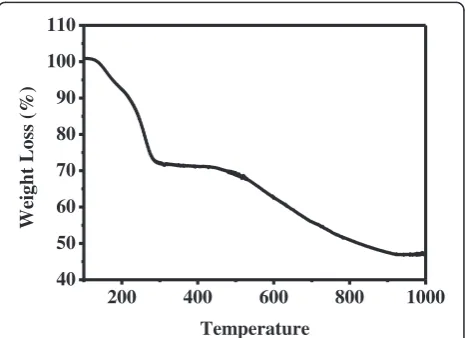
Figure 1 presents the thermogravimetric analysis (TGA) curve for the mixed CZTSSe precursor (Cu/(Zn + Sn)≈ 0.80 and Zn/Sn≈1.22). The TGA sample was prepared from the CZTSSe precursor solution by preheating at 100 °C for 20 min under N2atmosphere to remove the
low-boiling-point molecules. It was found that the CZTSSe precursor exhibited a relatively fast weight loss between 130 and 300 °C, which may be ascribed that the extensive N−H · · · S hydrogen bonding existed in the precursor solution was broken and the CZTSSe nano-crystal formed at this temperature [30]. Thereby, in our experiment, CZTSSe nanocrystal thin films were fabri-cated by spin coating of CZTSSe precursor solution, followed by heating on a hot plate at 310 °C for 5 min. It is noteworthy that in order to form a dense CZTSSe ab-sorbing film, the preheating procedure for removing the organic solvents after each spin coating was essential.
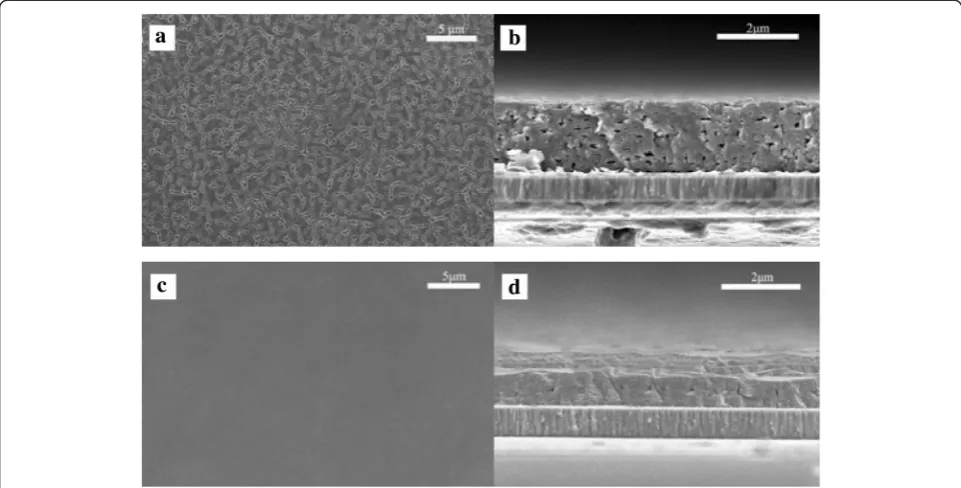
The representative surface topography and cross-sectional FESEM images of the as-prepared CZTSSe films are displayed in Fig. 2a and 2b, respectively. From which we can see that a flat thin film with a thickness of 1.6 μm was obtained through repeating the coating/sin-tering procedure. It is obvious that the CZTSSe nano-crystal thin film was not dense and there were many holes appearing in the film, which may be resulted from the volatilization of partly unreacted Se powder. To con-firm this hypothesis, using S to replace Se, the control experiment was done to fabricate CZTS thin film. The corresponding FESEM images are shown in Fig. 2c and
200 400 600 800 1000
40 50 60 70 80 90 100 110
Weight Loss (%)
Temperature
[image:2.595.306.539.535.704.2]2d. It can be seen that the CZTS nanocrystal films are more compact and dense compared with the CZTSSe films, which were fabricated by the same solution process. Generally speaking, it is undesirable for the ex-istence of pore in the absorbing layer of thin film solar cell, however, the porous structure was beneficial to form well crystallization and large grain CZTSSe thin films in the following selenization process [31].
To further investigate the phase composition and phase structure of as-prepared CZTSSe film and sele-nized CZTSSe film, XRD measurements were carried out. Figure 3 displays the X-ray diffraction patterns of the CZTSSe film before and after selenization treatment. Eliminating the peaks arising from Mo substrate, all the diffraction peaks in XRD patterns are attributed to the kesterite phase of CZTSSe (JCPDS no. 52−0868). Com-paring with the samples of preheated CZTSSe, the (112) lattice plane of selenized CZTSSe films drifts to lower degree, indicating that partial S in the CZTSSe precursor film was replaced by Se after selenization. In addition to the shifting of diffraction peaks in XRD patterns, the in-tensity of the diffraction peaks undergoes a significant increase, which demonstrates that the crystallization of the CZTSSe films was dramatically improved after selenization.
The XRD pattern of some binary and ternary selenide, such as CuxSe, ZnSe, and Cu2SnSe3, are similar to that
of CZTSSe, so it is hard to identify the phase purity of CZTSSe films just by XRD characterization. The Raman spectra can be used as an effective measurement to
differentiate these impurities. Raman spectra of the selenized CZTSSe film is shown in Fig. 4. The peaks at 176, 192, 234, and 329 cm−1 correspond to kesterite CZTSSe [32].
For kesterite thin film solar cells, the morphology and crystal size of the absorber layer play an important role in the finally photovoltaic performance of the devices. In order to eliminate holes and induce crystallization and large grain formation, the selenization was performed at high temperatures under saturated selenium atmosphere in a graphite box. The morphologies of the selenized Fig. 2Top-view(a) andcross-sectional(b) FESEM images of as-prepared CZTSSe thin film, correspondingtop-view(c) andcross-sectional(d) FESEM images of CZTS thin film prepared by using S to replace Se atom
20
40
60
80
Intensity (a.u.)
2Theta (degree)
As-prepared CZTSSe
Selenized CZTSSe
Mo
(112)
(220)/
(024)
(132)/
(116)
(332)/
(136)
(22
8
)
(211)
[image:3.595.57.538.90.334.2] [image:3.595.305.538.522.704.2]CZTSSe thin films were shown in Fig. 5. It was observed that large-grained and densely packed CZTSe thin film with a rough, highly faceted surface has achieved; the average in-plane grain size is 0.5–2μm, which illustrated that the film converted into a high-crystallinity CZTSSe thin film after selenization. From the fractured cross-sectional view of Fig. 5b, the selenized CZTSSe thin film exhibits a typical bilayer (large-grain layer and fine-grain
layer) structure with a thickness of 1.64 μm. Both the thickness of large-grain layer on the top and the fine-grain layer near the molybdenum substrate is about 800 nm.
Using the selenized CZTSSe thin films, solar cell de-vices were fabricated through the general substrate-type configuration (Mo/CZTS/CdS/i-ZnO/n-ZnO/Al). The current density–voltage (J–V) curves of the best CZTSSe solar cell in dark and under AM1.5 illumination are shown in Fig. 6a. The champion device based on an ac-tive area of 0.19 cm2yielded a PCE of 6.4 % with short circuit current density (JSC) of 32 mA cm−2, open circuit
voltage (VOC) of 361 mV, and fill factor (FF) of 0.554.
For further investigation of the device performance, EQE spectra of the corresponding solar cell were measured and shown in Fig. 6b. The results revealed that the photoresponse of the CZTSSe device was stronger in the visible and near-infrared (NIR) region, which is corre-sponding well with other high-efficiency CZTSSe solar cell in the literature [29]. The inset of Fig. 6b shows the
100 150 200 250 300 350 400 450 500
Intensity (a.u.)
Raman Shift (cm-1) 172
196
234
329
Fig. 4Raman spectrum of selenized CZTSSe thin film
Fig. 5Top-view(a) andcross-sectional(b) SEM images of selenized CZTSSe thin film
0.0 0.2 0.4
-30 -15 0 15
Current Density (mA/cm2)
Voltage (V)
Voc=361 mV
Jsc=32.00 mA/cm2
FF=55.4% Eff=6.4%
Area=0.19cm2
Dark Light
a
400 600 800 1000 1200 1400 0.0
0.2 0.4 0.6 0.8 1.0
EQE
Walvelength
b
0.90 0.95 1.00 1.05 1.10 1.15 1.20
[hvxln(1-EQE)]2 (a.u.)
hv (eV)
[image:4.595.57.291.88.267.2] [image:4.595.306.539.349.685.2] [image:4.595.57.293.414.708.2]band gap of CZTSSe thin film by plotting [Eln(1− EQE)]2 versus the photon energy (E), which was esti-mated to be about 1.05 eV.
Compared with hydrazine-based solution method for CZTSSe thin film, the efficiency of photovoltaic device present in our study is still limited, which may be mainly attributed to the existence of small-grained bottom layer in the selenized CZTSSe thin films. It has been reported that a thick small-grained bottom layer would increase the series resistance of devices and further degrade the photoelectric conversion efficiency of CZTSSe solar cells [33]. Therefore, in order to further improve the perform-ance of solar cells, it is necessary to optimize the seleni-zation conditions for reducing or even completely eliminating the small-grained bottom layer of CZTSe films, which is the ongoing research in our laboratory.
Conclusions
In summary, a reproducible and lower-toxicity solution-based process for the fabrication of the CZTSSe ab-sorber layer, involving simultaneous dissolution of elem-ental Cu, Zn, Sn, S, and Se powders in the mixed 1,2-ethanedithiol and 1,2-ethylenediamine solution followed by deposition of a precursor solution, has been pre-sented. After the preheating and post-selenization pro-cesses, an extremely dense and compact CZTSSe thin film with high crystallinity has formed. The CZTSSe thin film solar cells fabricated using this process exhibits an efficiency of 6.4 %, which is expected to further enhance by optimizing the composition and selenization of the CZTSSe film.
Competing Interests
The authors declare that they have no competing interests.
Authors’Contributions
JG and YP carried out the experiments, characterization, and acquisition of data. ZZ participated in designing the experiments, experiment analysis and interpretation of data, and language modification. WZ and DK participated in the discussion. SW is the investigator who helped in the analysis and interpretation of data, drafting of the manuscript, and revisions. All authors read and approved the final manuscript.
Acknowledgements
This project is supported by the National Natural Science Foundation of China (21203053, 21271064, and 61306016), the Joint Talent Cultivation Funds of NSFC-HN (U1204214), and the Program for Changjiang Scholars and Innovative Research Team in the University (PCS IRT1126) of Henan.
Received: 2 June 2015 Accepted: 10 August 2015
References
1. Brammertz G, Buffière M, Mevel Y, Ren Y, Zaghi AE, Lenaers N. Correlation between physical, electrical, and optical properties of Cu2ZnSnSe4based
solar cells. Appl Phys Lett. 2013;102:013902.
2. Shin B, Gunawan O, Zhu Y, Bojarczuk NA, Chey SJ, Guha S. Thin film solar cell with 8.4% power conversion efficiency using an earth-abundant Cu2ZnSnS4absorber. Prog Photovoltaics Res Appl. 2013;21:72–6.
3. Moriy K, Tanaka K, Uchiki H. Fabrication of Cu2ZnSnS4thin-film solar cell
prepared by pulsed laser deposition. Jpn J Appl Phys. 2007;46:5780–1.
4. Chen H, Ye Q, He X, Ding J, Zhang Y, Han J, et al. Electrodeposited CZTS solar cells from reline electrolyte. Green Chem. 2014;16:3841–5. 5. Guo Q, Ford GM, Yang W-C, Walker BC, Stach EA, Hillhouse HW, et al.
Fabrication of 7.2% efficient CZTSSe solar cells using CZTS nanocrystals. J Am Chem Soc. 2010;132:17384–6.
6. Kim Y, Woo K, Kim I, Cho YS, Jeong S, Moon J. Highly concentrated synthesis of copper-zinc-tin-sulfide nanocrystals with easily decomposable capping molecules for printed photovoltaic applications. Nanoscale. 2013;5:10183–8.
7. Zhong J, Xia Z, Zhang C, Li B, Liu X, Cheng Y, et al. One-Pot synthesis of self-stabilized aqueous nanoinks for Cu2ZnSn(S,Se)4solar cells. Chem Mater.
2014;26:3573–8.
8. Todorov TK, Reuter KB, Mitzi DB. High-efficiency solar cell with earth-abundant liquid-processed absorber. Adv Mater. 2010;22:E156–9. 9. Yao L, Ao J, Jeng MJ, Bi JL, Gao S, He Q, et al. CZTSe solar cells prepared by
electrodeposition of Cu/Sn/Zn stack layer followed by selenization at low Se pressure. Nanoscal Res Lett. 2014;9:678.
10. Ahmed S, Reuter KB, Gunawan O, Guo L, Romankiw LT, Deligianni H. A high efficiency electrodeposited Cu2ZnSnS4solar cell. Adv Energy Mater.
2012;2:253–9.
11. Ge J, Jiang J, Yang P, Peng C, Huang Z, Zuo S, et al. A 5.5% efficient Co-electrodeposited ZnO/CdS/Cu2ZnSnS4/ Mo thin film solar cell. Sol Energy
Mater Sol Cells. 2014;125:20–6.
12. Woo K, Kim Y, Moon J. A non-toxic, solution-processed, earth abundant absorbing layer for thin-film solar cells. Energy Environ Sci. 2012;5:5340–5. 13. Cao Y, Denny Jr MS, Caspar JV, Farneth WE, Guo Q, Ionkin AS, et al. High-efficiency solution-processed Cu2ZnSn(S, Se)4 thin-film solar cells prepared from binary and ternary nanoparticles. J Am Chem Soc. 2012;134:15644–7. 14. Zhou H, Hsu W-C, Duan HS, Bob B, Yang W, Song T-B, et al. CZTS
nanocrystals: a promising approach for next generation thin film photovoltaics. Energy Environ Sci. 2013;6:2822–38.
15. Wu W, Cao Y, Caspar JV, Guo Q, Johnson LK, Malajovich I, et al. Studies of the fine-grain sub-layer in the printed CZTSSe photovoltaic devices. J Mater Chem C. 2014;2:3777–81.
16. Xia Y, Chen Z, Zhang Z, Fan X, Liang G. A nontoxic and low-cost hydrothermal route for synthesis of hierarchical Cu2ZnSnS4particles.
Nanoscal Res Lett. 2014;9:208.
17. Bag S, Gunawan O, Gokmen T, Zhu Y, Todorov TK, Mitzi DB. Low band gap liquid-processed CZTSe solar cell with 10.1% efficiency. Energy Environ Sci. 2012;5:7060–5.
18. Todorov TK, Tang J, Bag S, Gunawan O, Gokmen T, Zhu Y, et al. Beyond 11% efficiency: characteristics of stateof-the-Art Cu2ZnSn(S, Se)4 solar cells. Adv Energy Mater. 2013;3:34–8.
19. Yang W, Duan HS, Bob B, Zhou H, Lei B, Chung CH, et al. Novel solution processing of high- efficiency earth-abundant Cu2ZnSn(S, Se)4 solar cells. Adv Mater. 2012;24:6323–9.
20. Ki W, Hillhouse HW. Earth-abundant element photovoltaics directly from soluble precursors with high yield using a non-toxic solvent. Adv Energy Mater. 2011;1:732–5.
21. Xin H, Katahara JK, Braly IL, Hillhouse HW. 8% efficient Cu2ZnSn(S, Se)4 solar cells from redox equilibrated simple precursors in DMSO. Adv Energy Mater. 2014;4:201301823.
22. Su Z, Sun K, Han Z, Cui H, Liu F, Lai Y, et al. Fabrication of Cu2ZnSnS4solar
cells with 5.1% efficiency via thermal decomposition and reaction using a non-toxic sol–gel route. J Mater Chem A. 2014;2:500–9.
23. Jiang M, Lan F, Yan X, Li G. Cu2ZnSn(S1-xSex)4 thin film solar cells prepared by water-based solution process. Phys Status Solidi (RRL). 2014;8:223–7. 24. Schnabel T, Löw M, Ahlswede E. Vacuum-free preparation of 7.5% efficient
Cu2ZnSn(S, Se)4 solar cells based on metal salt precursors. Sol Energy Mater Sol Cells. 2013;117:324–8.
25. Kim J, Hiroi H, Todorov TK, Gunawan O, Kuwahara M, Gokmen T, et al. High efficiency Cu2ZnSn(S, Se)4 solar cells by applying a double In2S3/CdS emitter. Adv Mater. 2014;26:7427–31.
26. Wang G, Zhao WG, Cui Y, Tian QW, Gao S, Huang LJ, et al. Fabrication of a Cu2ZnSn(S, Se)4 photovoltaic device by a low-toxicity ethanol solution process. ACS Appl Mater Interfaces. 2013;5:10042–7.
27. Zhang RH, Szczepaniak SM, Carter NJ, Handwerker CA, Agrawal R. A versatile solution route to efficient Cu2ZnSn(S, Se)4 thin-film solar cells. Chem Mater. 2015;27:2114–20.
sulfide thin films and its application in Cu2ZnSn(S, Se)4 solar cells. Chem Mater. 2014;26:3098–103.
29. Yang YC, Wang G, Zhao WG, Tian QW, Huang LJ, Pan DC. Solution-processed highly efficient Cu2ZnSnSe4thin film solar cells by dissolution of
elemental Cu, Zn, Sn, and Se powders. ACS Appl Mater Interfaces. 2015;7:460–4.
30. Webber DH, Brutchey RL. Alkahest for V2VI3chalcogenides: dissolution of
nine bulk semiconductors in a diamine-dithiol solvent mixture. J Am Chem Soc. 2013;135:15722–5.
31. Chen HL, Kou DX, Chang ZX, Zhou WH, Zhou ZJ, Wu SX. Effect of crystallization of Cu2ZnSnSxSe4−xcounter electrode on the performance for
efficient dye-sensitized solar cells. ACS Appl Mater Interfaces. 2014;6:20664–9. 32. Redinger A, Hönes K, Fontané X, Roca VI, Saucedo E, Valle N, et al. Detection
of a ZnSe secondary phase in coevaporated Cu2ZnSnSe4thin films.
Appl Phys Lett. 2011;98:101907.
33. Guo HL, Cui Y, Tian QW, Gao S, Wang G, Pan DC. Significantly enhancing grain growth in Cu2ZnSn(S, Se)4 absorber layers by insetting Sb2S3, CuSbS2, and NaSb5S8 thin films. Cryst Growth Des. 2015;15:771–7.
Submit your manuscript to a
journal and benefi t from:
7Convenient online submission 7Rigorous peer review
7Immediate publication on acceptance 7Open access: articles freely available online 7High visibility within the fi eld
7Retaining the copyright to your article