BIROn - Birkbeck Institutional Research Online
Archibugi, Daniele and Cellini, M. (2017) The internal and external levers to
achieve global democracy. Global Policy 8 (S6), pp. 65-77. ISSN 1758-5880.
Downloaded from:
Usage Guidelines:
Please refer to usage guidelines at or alternatively
1
18-12-16
The Internal and External Levers to achieve Global
Democracy
Daniele Archibugi* Marco Cellini**
Abstract
The paper explores the methods to introduce democratic devices in global governance. The first part makes an attempt to define what democratic global governance is and what its aims are. The second part provides some benchmark to identify when and how international organizations, the most important and visible part of global governance, correspond to the values of democracy. The third part presents what we label the internal and the external levers. The internal lever is defined as the ways in which democratization within countries helps to foster more transparent, accountable and participatory forms of global governance. The external lever is defined as the ways in which international organizations contribute to promote democratic transition and consolidation in their members. Neither the internal nor the external levers work effectively if they are left to inter-governmental bargaining only. An active participation of non-governmental actors is needed in order to make them effective. The paper finally discusses a list of proposals to democratize global governance.
Policy Implications
Showing the interdependence between the promotion of democratization inside countries
and the reform of international organizations.
Using IOs rather than secretive governance agreements could improve democratic global
governance.
The internal and the external levers are clearly connected in their effects, but too often
elected governments are not willing to pursue consistently their democratic nature also in regards to global governance.
The explicit commitment for democratization and democratic consolidation by IOs can
generate important internal implications.
* Research Director, Italian National Research Council, Institute for Research on Population and Social Policies, Via Palestro, 32- 00185 Rome, Italy, Email: [email protected] and Professor of Innovation, Governance and Public Policy, University of London, Birkbeck College, Malet Street, Bloomsbury, London WC1E 7HX, UK, Email: [email protected] ** Ph.D. student, LUISS University of Rome, Viale Romania, 32, 00198 Rome, Italy, Email: [email protected]
2
What are democratic global governance aims?
Partisans of democracy have, at least two discomforts when they observe the way in which the world is ruled. The first is that not all countries of the world are democratic. The second is that global decisions are not taken democratically and, sometimes, even elected governments forget the basic principles that have led them to power in foreign politics. Some will phrase the same problems in terms of democratic deficit in global governance but the notion can be elusive. According to the first meaning, the democratic deficit in global governance is attributable to the fact that the members of the international community, namely the states, are not sufficiently democratic. According to the second, the democratic deficit is due to the fact that global governance is not subjected to any democratic control (for a discussion, see Nye, 2001; Moravcsik, 2005). Even the institutions that have been designed with the purpose to increase legitimacy, transparency, and accountability in world politics, such as international organizations (IOs), are not sufficiently democratic in their norms and procedures. The first meaning points out at an internal deficiency, the second to a deficiency of the international system.
Both these deficiencies are real and strongly constrain the full accomplishment of democracy. Internally, despite the democratic wave started in 1990s, half of the countries of the world still do not have elected governments. Even part of the other half is not sufficiently democratic and the march of democracy has still to make important steps within countries. Not only autocracies, but even consolidated democracies are rather reluctant to make their global choices accountable, often even in front of their own citizens.
The constitutional structure of intergovernmental organizations (IGOs) do not resemble at all democracy as it has been developed within states. The United Nations, the International Monetary Fund, the World Trade Organizations, just to mention a few of the most important IOs, do not contemplate the election of public officers by the citizenry. Even the European Union, the IO that has been permeated by democratic values, has a constitution that is much less democratic than any of its members (Zurn, 2000). States are often reluctant to concede their sovereignty to international or supranational organizations (Maffettone, 2015) allowing citizens to participate directly to global affairs. Shall we consider the democratic deficit in global governance an issue that can be denounced but not solved, or is there something that can be done about it? And, above all, if we identify the existence of at least two areas in which democracy is not fully realized - the internal and the global - how are they connected?
3
What is democratic global governance?
There are several and contested definitions of global governance. We find close kinship with the following definition: ‘the political actions undertaken by national and/or transnational actors aimed at addressing problems that affect more than one state and/or where there is no defined political authority able to address them’ (Koenig-Archibugi, 2002. See also Koenig-Archibugi and Zurn, 2006; Brown, 2012). In a globalized world, there are a number of issues - such as international security, humanitarian crisis, the environment, and threats of epidemics - which are global in nature, and for this reason they cannot be properly addressed at national level. Therefore, political parties, public administrators, the business sector and the public opinion at large often demands that global issues are addressed through appropriate actions and levels of decision making. When these demands are addressed by individual states, non-governmental actors or a group of states, at least one of the following conditions should be at work:
1) The issue in question is not limited to an individual state;
2) The possibility to address successfully the issue is facilitated by the participation of political players based in more than one state.
Global governance is often evoked for timely and effective decisions. During and after the financial crisis of autumn 2008, for instance, the business sector, trade unions and the public opinion demanded an effective intervention to prevent a collapse of economic activities. Governments with the largest financial reserves undertook a series of coordinated actions to prevent the financial crisis to further blaze up. Many of these decisions have been taken in G8, G20, G4 or G2 Summits.2 This can be considered a case of effective global governance, even if not many parameters of democracy were satisfied: a selected number of governments took part to the negotiation, deliberation was far from being transparent, and the outcome was not accountable to citizens.
While the relevance of global governance has grown exponentially in the last decades (see Held and McGrew, 2002; Woods et al., 2013), this does not necessarily mean that we are also facing a democratization of global governance. This is also related to the fact that there is no shared definition of what democratic global governance is. Most of the debate has been rather explorative, with scholars, policy advisers and policy makers providing indications about what democratic global governance should be, and others arguing that democratic global governance is either impossible or not desirable (for a collection of different views, see Archibugi, 2003; Archibugi et al., 2011).
When in the early 1990s the first attempt to explore under which conditions democratic values and norms could be expanded also to global governance (Archibugi and Held, 1995; Held, 1995), there was an implicit conviction this was the natural way to expand democratic theory and that there would have been a general consensus among democrats about the project. But not every democratic theorist agreed with such an extension. In particular, Robert Dahl, one of the most important democratic theorists of the second half of the XX century, rejected the possibility to achieve democracy beyond states (Dahl, 1999; 2005. See also Urbinati, 2003).
2 The G4 is the label given to the summit among the four main European countries (France, Germany, Italy and
4
The real problem is to understand to what extent the domestic analogy is valid when we deal with democracy beyond state’s borders. Not all democratic procedures applied within states can be expanded at the planetary scale. The strict application of the state system to the global level will lead to develop a world federal state. World federalism is indeed an important line of thought, which contributed to the transformation of international organizations and provided fresh ideas for a more integrated world order (see Cabrera, 2004; Levi, 2008; Marchetti, 2008). However, the programme here is more modest and hopefully more achievable, namely to increase democratic devices in global governance even in absence of a concentration of power in a world state. This implies the belief that democracy as a form of political organization could be developed also in the absence of a state.
In this paper, we will focus on IOs since they are the most transparent component of global governance and thus any democratic deficits affecting them are, a fortiori, very likely to plague more informal, secretive and exclusive settings. Even when power, legitimacy and resources are provided by their members, IOs have their own agency and they cannot be considered just governments’ ‘agents’. When created, to some extent, they gain a sort of independence from the member states. Furthermore, in comparison to other forms of global governance, such as i) unilateral actions undertaken by individual states (e.g. unilateral development assistance), ii) bilateral or multilateral inter-governmental initiatives (e.g. financial coordination initiatives undertaken in the G7), or iii) the activities performed by the business sector (e.g. actions and regulations taken by industry associations), IOs already incorporate some values and principles characterizing democracy, such as:
IOs are based on Charters, Conventions, Treaties and other public acts. This makes them bounded to the rule of law and, more particularly, to international law.
Some IOs have judicial methods to address controversies.
Most of the activities carried out by IOs are transparent and accountable to member states and potentially, at least indirectly, to the member states’ citizens.
Are these elements sufficient to consider IOs democratic institutions? Of course, they are not (Erman and Higgott, 2010). Certainly, they are more legitimate than suitable alternatives, such as summits held behind closed doors or decisions taken by a group of business CEOs (Buchanan and Keohane, 2006). But these criteria are highly insufficient if matched against the requirements of democratic theory. The criteria listed above will certainly not be sufficient to qualify any state as democratic (Patomaki and Teivainen, 2004; Zweifel, 2005; Levi et al., 2014). It is therefore not surprisingly that Dahl (1999, 2005) has challenged the idea that IOs could ever be democratic institutions. Dahl has indicated a few key criteria that qualify the modern term ‘democracy’ in order to show that none of them is fully applied in IOs. But the fact that IOs do not currently satisfy democratic criteria should not imply that they could not satisfy them if appropriately reformed.
5
the state (Held, 2006). A more general definition of democracy does not rely on the existence of a ‘government’ or on ‘statehood’ and it seems more helpful to introduce notions of democracy also at the global level. Concerning the core of global governance, e.g. IOs, Table 1 illustrate to what extent these principles are already applied and what is their potential application. It emerges that these principles can inspire a range of political actions that can be transforming all IOs.
Table 1 - Democratic principles and intergovernmental organizations
Basic
principles Their current application in IOs Democratic reform of IOs Nonviolence Commitment of member
state to address peacefully international conflicts and to use force for self-defence only
Enforcement of the nonviolence principle through i) compulsory jurisdiction of the international judicial power
ii) individual criminal responsibility for international crimes
iii) humanitarian intervention to guarantee the security of peoples threaten by genocide and major human rights violations
Political
Control Control exercised by member governments Publicity and transparency of acts
Norms and procedures codified in International Treaties, Covenants, Charters, and Statutes
Expansion of political control through a World Parliament, the Inter-Parliamentary Union and other peoples’ representatives
Open the rooms of IO to global civil society and its NGOs
Monitoring of national governments by cosmopolitan institutions
Political equality
Formal equality of states Equality of citizens in terms of rights sanctioned by the Universal
Declaration of Human Rights
Equality of states on a substantial rather than formal basis (involvement of states associated to the stake held)
Political equality among citizens on the ground of a minimal list of rights and duties associated to cosmopolitan citizenship
Direct participation in world politics through a directly elected World Parliament or other forms of peoples’ representatives
Source: Archibugi (2008). Political control and equality are drawn from Beetham (1999).
The next section will discuss how the internal political regime of member countries can influence the possibility to get more democratic global governance, while the subsequent section will explore the opposite causal link, namely how the participation to international organizations can foster and consolidate democracy within states. Our starting assumptions are that:
6
regimes are likely to allow and facilitate a battery of interconnections. Political parties, both in government and in the opposition, trade unions, and civil society organizations will be able to develop their own transnational networks and this can be a powerful instrument to make global governance transparent, accountable, participative and ultimately democratic. This is how the internal lever can be used to promote democratic global governance.
b) The long-term path towards democracy and legitimacy within countries is strongly influenced by the international climate. If fear dominates international relations, democratic countries tend to reduce their civil liberties and participation, while authoritarian regimes are reinforced. On the contrary external conditions can act as a powerful engine for transition from authoritarian to democracy and to consolidate and expand it in nations that are already democratic. This is how the external lever can be used to increase the number of democratic countries and their quality.
The internal lever
Each state of the world has a different political regime. Thanks to the efforts made by political scientists, it is possible to identify and measure, on a single scale, the level of democratic participation in each of them. Polity IV index, one of the most used democratic indices produced so far, provides a metric in which individual countries are attributed a score from –10 (total lack of democracy) to +10 (total achievement of democracy). This allows us to see how democracy has evolved across time and space. Figure 1 reports the number of countries classified according to three categories: democracies (+6 to +10), anocracies (intermediate regimes, -5 to +5) and autocracies (-6 to –10). The numbers belonging to each of these categories are shown in the vertical axe on the left side. It clearly shows that democratic nations have increased and, correspondently, autocracies have decreased.
But there is also a problem of ‘intensity’, namely how strong is the regime in each nation. Taking into account the average scores achieved by the monitored countries, as indicated by right vertical axis of Figure 1, it emerges that, in the last sixty years, the quality of democracy as well as the total number of democratic countries have increased. The year 1990 appears as a crucial turning point in two different respects since it is the moment in which: i) democracies outnumber autocracies; ii) the average score for all countries monitored starts to be positive.
7
Source: Elaboration of the authors on Polity IV data. Polity IV mean is the average of the scores achieved by countries from -10 to +10. Total number of countries in 2014: 167.
We may rightly challenge the definitions adopted to classify political regimes. All classifications, including Polity IV, are debatable and criticized in the literature. However, Polity IV data confirms a rather evident fact, namely that democracy has noticeably increased its popularity as a political regime, and that this has become more and more evidence of the last quarter of a century.
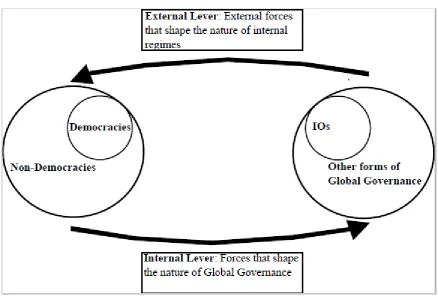
The connection between the internal and the external democratic deficits can be illustrated with two different sets (see Figure 2). On the one hand, we have the political regime within states (left set). This set changed over time: the number of state increased, and their internal regime, as seen in Figure 1, is also evolving. We have now a rather clear idea on how large is the sub-set of democracies: we can measure it according to number of democratic countries, the total population that live in these countries, and even the resources (in terms of share of world GDP, trade, military expenditure, seats in the UN Security Council and so on) associated to democracies and non-democracies.
The second set is represented by the institutions of global governance. Global governance is made by many different aspects, some of which are clearly identifiable, such as IOs, others are less visible, such as diplomatic negotiations, and others are secretive as intelligence. In this case, to quantify the relationship between the set ‘global governance’ on the one hand, and the sub-set ‘international organizations’ on the other hand is impossible. The number of activities carried out within global governance is mysterious and often highly confidential. Only some of these activities can be identified by international relations scholars and specifically of those carried out by international organizations.
The two sets are clearly connected, and the way in which the members of the international community act is influencing global governance and vice versa. We label the internal lever the
8
[image:9.595.78.517.173.469.2]way in which changes in the number and in the quality of democracy within states influence the democratization of global governance. The internal level is both descriptive and prescriptive: on the one hand, we need to know when and how democratic regimes have contributed to the democratization of global governance. But we also need to wonder what they can do to improve it, in order to make global governance more democratic.
Figure 2 – The Internal and the External Levers
Source: Authors’ elaborations
There is one obvious way in which the internal lever has operated and it is the birth of IOs. IOs have been the product of Western democratic countries. The League of Nations, the United Nations, as well as the Fédération Internationale de Football Association, were created from the impulse of democratic countries, leaders and theorists. Assuming, as stated above, that anyhow they represent an improvement over other forms of global governance, such as Summits and secretive diplomatic meetings, one way in which the internal lever has operated is by the very creation of IOs. The willingness of democracies to participate in IOs is confirmed also for new democracies: Mansfield and Pevehouse (2006) indicate that their propensity is higher than for non-democracies.
9
human rights violations than on the introduction of democracy. Some exceptions, however, can be found. The European Union (EU), the Council of Europe, the Southern Common Market (MERCOSUR), and the Organization of American States (OAS) are examples of IOs that contain clauses which requires member to have democratic governments3.
Given the heterogeneous membership of most IOs, it is understandable that there is no consensus on their architecture. In principle, we should expect that, on the one hand, democracies are keen to replicate their internal system also in IOs. And, on the other hand, that authoritarian regimes are reluctant to introduce systems that would allow greater participation of the citizenry in the IOs since this may lead to question why the same devices are not introduced domestically, undermining the regime itself. If this were the case, there would be a full similarity between the internal regimes of states and the form of global governance they aspire to. But, as usual in international politics, we have often seen lack of congruence. Authoritarian regimes have often complained that the veto power in the Security Council is not democratic and have become unexpected supporters in IOs of the same democracy that they deny to their subjects. On the contrary, democratic regimes have often opposed to the expansion of more participatory global governance, especially if they have to share power and decision-making with non-elected governments. The internal regime of a country is not always a good predictor of the willingness of a government to support or obstacle the democratization of global governance.
Recent empirical research carried out by Jonas Tallberg and his colleagues (Tallberg et al., 2013, 2014; Agné et al., 2015) indicates that IOs have become more transparent, accountable and accessible to transnational actors. Non-governmental actors have often managed to increase participation and public opinion awareness also outside IGOs, for example through specific campaigns that have indirect effects on governments’ and IGOs’ policies. There are significant cases of NGOs that manage to interact across borders in defined areas (development aid, trade, human rights promotion) sometimes even in the absence of deliberate inter-governmental agreements (for a case study, see Macdonald and Macdonald 2006). According to Tallberg and colleagues, the opening up of IOs has been driven by democratic governments rather than by transnational actors. However, it is plausible to suppose that in democratic countries, where the actions undertaken by the governments reflect the popular will, the presence and the growth of transnational actors can drive the citizens to push their governments toward a greater commitment in the opening up of IOs.
Nevertheless, we can wonder why democratic governments are often reluctant to expand their internal governance also globally. Here it lays a fundamental conundrum for democratic states: is it possible to introduce democratic devices in IOs even when many of its members are authoritarian? Norberto Bobbio (1995) wondered if it is possible to be democratic also with non-democratic regime. More specifically, the question that many non-democratic regimes had to face is: should a democratic state participate in democratic engagements with non-democratic states? Democracies may be reluctant to have more progressive arrangements if they are surrounded by autocracies. Of course, this is a benevolent explanation which implicitly assumes that democratic states would be willing to expand democratic checks and balances with like-minded states. It is an explanation that realists find risible, arguing that all states, democratic states included, do participate in IOs when they find them useful to serve their purposes (Morgenthau, 1948).
10
The problem, however, should not be seen statically only. Dynamically, we have a context in which the internal regimes of states (Set A of Figure 2) have changed dramatically as a consequence of the democratic wave started in 1990: democracies are now the largest group and their political power and influence is much larger. In spite of this major change in internal regimes the impact on IOs has been rather limited. It is true that the UN, the IMF, the World Bank and the WTO have started to be more transparent and willing to receive inputs and suggestions from NGOs, but it is certainly disappointing that no major constitutional reform has been introduced. It is also true that there has been a recent surge in regional organizations, often, as in the case of Mercosur, composed by young democratic nations still in the process of consolidation (Telò, 2013; Triandafyllidou, 2016). But the internal lever has proven to be too weak.
What can democratic governments do within IOs with heterogeneous membership, to make them more representative and accountable? There are a large number of actions that can serve the double purpose of increasing democratic devices in IOs while also helping to foster internal democratization.
Use IOs rather than secretive governance agreements. The first thing for democratic governments is to use transparent and accountable forms of governance rather than secretive structures when dealing with global issues. Accountability is, indeed, one of the main feature characterizing the democratic method, and the devolution of global issues to designed international institutions will definitely move in the direction of democratizing global governance. Even if indirectly such a commitment would allow citizens to scrutinize the governments’ actions in the international arena. Past and recent experiences show, in fact, that an active and robust participation of the public opinion is needed to constrain democratic governments from using illegitimate methods in international politics. The release of classified information by WikiLeaks, Edward Snowden and Chelsea Manning, have clearly shown that democratic governments often use illegitimate and illegal methods in international (as well as in internal) politics as much as autocratic governments.
The creation and strengthening of international parliamentary assemblies (IPAs). In the last decades, there has been an increase of IPAs in IOs, especially in regional organizations. A recent enquire has surveyed as many as 100 IPAs (Kissling, 2014; Rocabert et al., 2014). With the notable exception of the European Parliament, none of these assemblies is directly elected by citizens, while their members are generally elected by national parliaments (i.e. MPs of national parliaments that are nominated also to serve in the IPAs). Moreover, most of IPAs have been only appointed with consultative powers. Only the EU Parliament shares with the Commission some legislative powers. In spite of these limitations, IPAs help to increase the legitimacy of IOs since the activities of the latter are scrutinized not only by governments. Since members of the national legislative assemblies are selected from both governmental and opposition political parties, there is an increase in transparency and accountability. It is certainly surprising that several IPAs have members from democratic and non-democratic nations (as in the case of the Inter-Parliamentary Union) since we expect that a parliamentary assembly is composed by democratically elected members only.
11
the creation of IPAs in all those IOs. On the other hand, using the internal lever, they should commit themselves to improve the role and the functioning of the IPAs by vigorously sustaining reforms aimed to provide IPAs with legislative powers and to make them directly elected by citizens.
Give more voice to international judicial devices. Democratic governments should promote the role of international judicial devices. Independent judicial review is a fundamental component of modern democracies. Judicial procedures are also very important for the peaceful settlement of conflicts and disputes. As in the case of IPAs, the number of international tribunals has constantly grown (for a review, see, Mackenzie et al., 2010). A greater role and power to judicial review will certainly increase the legitimacy of IOs, especially if states are prepared to accept their jurisdiction. Several states have accepted the mandatory jurisdiction of the International Court of Justice (ICJ) if called by states that have also accepted it. Other states have been more daring and have accepted the jurisdiction of the ICJ regardless what actual or prospective counterparts have done. The underlying assumption is that some countries are willing to respect the rule of law (and the rulings of independent Courts) regardless the internal regime of their counterpart. An honest person does not feel authorized to steal the wallet to a robber, and likewise a democratic regime should respect the rule of law even when it has a controversy with an autocracy.
Opening access to NGOs and civil society. Democratic governments should also allow a more prominent role for NGOs and civil society. Over the last twenty years, IOs have become much keener to open their doors to NGOs (Tallberg et al., 2013). Democratic countries tend to encourage the participation of NGOs since they are already familiar with the internal pressure that lobbies, unions, and civil society exercise on governments. The larger the number of democracies, the more it is likely that they will give space to NGOs and other non-governmental players in IOs. In selected areas ranging from human rights to climate change, IOs have substantially changed their focus as a consequence of a major involvement of non-state and transnational actors. But the most important impulse towards democratization has often occurred outside the formal structure of IGOs: in core issues such as climate change, human rights, economic justice and peace-building, global social movements have managed to shape the agenda of world politics (Della Porta et al., 2009; Scholte, 2011).
The external lever
Do IOs have positive effects on the democratization of states? And if so, through which channels? This is what we will call the external lever. According to the literature, the international arena can affect both the processes of democratic transition and democratic consolidation through four main methods of influence: imposition, example, socialization and conditionality (Morlino, 2011; Morlino and Magen, 2008). Furthermore, we claim that at least another function can be carried out by the international arena in order to foster democracy within states, namely the function of controlling, as impartial actor, the processes of transition to democracy.
12
important factors that can push the elites and the citizens of non-democratic states to undertake a democratic transition (Haveman, 1993). Socialization concerns the internalization of democratic norms, policies, institutions and practices that occur when a transition country establishes and strengthens linkages with democratic states4. Socialization is different from the example: in the latter democratic countries have just passive roles, in the former they have an active role engaging in relations with non-democratic countries and providing a sort of learning mentoring. IOs, inter-exchange among civil societies, professional association, and trade are all methods in which different political systems manage to socialize. Conditionality represents the cases in which non-democratic countries are pushed to undertake democratic advancements by the eventuality of a punishment or a reward. Examples of conditionality can be economic sanctions (negative conditionality) or the possibility to access to a credit line subordinated to the condition of undertaking democratic reforms (positive conditionality). Finally, control is when IOs play a direct role in the way in which political life is organized and administered within countries. A rather low-intensity form of control is when IOs are asked to act as broker of free elections, especially in countries where elections have never been held or suspended for long periods and where there is rooted distrust among the competing political parties (Koenig-Archibugi, 1997). Other forms of control include human rights monitoring.
The different methods, however, are not equally successful. In particular, imposition and negative conditionality have shown, on average, little success in comparison to the others means of influence. Imposition, which can range from full military occupation led by a state or a coalition of states to UN peace-keeping and peace-building operations, has proven to be often weak and controversial because it is generally top-down and it does not succeed in achieving the most important component to implement a democratic transition, namely the support of the citizenry.5 Similarly, negative conditionality has not obtained significant results and it fails to generate internal support for democracy, as the economic sanctions imposed on Iran or the embargo imposed on Cuba have shown.
Example, positive conditionality and socialization have on the contrary proven to be valuable instrument in fostering the spread and consolidation of democracy. Positive conditionality and socialization can be played directly by IOs and can encourage and facilitate democratic transitions in a multilateral context. Control is generally exercised when national authorities agree to open up to external influences and therefore its scope can be temporarily limited (as in the case of electoral assistance) or with longer term (when there are agreements on human rights monitoring).
We focus on the role that IOs can play in the states’ internal affairs through these methods and how they can contribute to the spread and consolidation of democracy within nations. It is possible to single out at least four practical ways in which IOs can actually promote internal democratization (Pevehouse, 2002).
First, IOs can use positive conditionality through granting specific funds to foster democratic government or sustain democratic reforms. This is, for example, the case of the United Nations Democracy Fund. More importantly, they can link membership to the IO itself to the
4 Johnston, 2001; Kelley, 2004; Way and Levitsky, 2005; Morlino, 2011.
5 Germany, Japan and Italy got democratic regimes through the military imposition of the Allied in 1945-1946, but
13
achievement of some minimum democratic threshold. The EU, the MERCOSUR and the OAS are examples of IOs that require to prospective members to achieve some democratic form of government (Hakim, 1993). Membership to some IOs often provides material advantages, ranging from access to free trade zones, security cooperation, and cooperation in cultural, scientific and technological domains. These incentives provide strong reasons for prospective members to start and consolidate the transition to democracy.
Second, using socialization, IOs can provide a space in which transitional countries, through the proximity with consolidated democracy, can learn how develop democratic institution and can interiorize the democratic norms required to rule a democratic polity. In this sense, IOs can be a form of transmission of knowledge on democratic governance and its institutions (Torfason and Ingram, 2010). IOs can help national political parties, professional associations, and the public opinion to learn how to organize controversies in an agonistic rather than an antagonistic format. Often, IOs also play a more active role in providing expertise and training to public and private institutions. During democratic transitions, IOs have helped to train or re-train the police, the judicial system, the media. Particularly important is the role played in socializing the military, the typical institution on which authoritarian regimes are based. Within IOs, the military forces of transition countries can learn from their colleagues in democratic regimes what their role is in a democratic society.
Third, IOs have shown to be a powerful tool in carrying out the function of controlling and therefore they can play a crucial role in the transition from authoritarian to democratic regime. Incumbent authoritarian governments are often reluctant to give up their power because they are uncertain about their future. They may fear that if opposite political groups access the government they will impose their own dictatorship rather than a liberal regime. The incumbent authoritarian forces are more likely to step aside if they envisage a political space as opposition political party and if they are guaranteed that the coming democratic regime will allow government changes associated to free and recurrent elections. Membership in IOs helps to provide a centre of gravity (Pevehouse, 2002) where all governments may act as brokers to guarantee the non-use of violence of the incumbent government against oppositions.
Fourth, IOs are often called as brokers in young and weak democracies, where there is still a fundamental lack of trust among political factions. For example, IOs have been more and more active in contributing in election organization and monitoring, up to the point that it is emerging as a new norm (see Kelley, 2012). A rather young IO, the International Institute for Democracy and Electoral Assistance (IDEA) has frequently helped countries in designing their electoral systems and other IOs have been active as election monitors. Several IOs, especially at the regional level, have helped in election monitoring with various degrees of success (see Lean, 2007).
According to the literature, IOs should not necessarily conform to democratic rules to have a positive effect on the political regime of their member countries (for a review, see Koenig-Archibugi, 2015). However, when they are dominated by democratic countries, they represent a powerful instrument to persuade other members to introduce democratic reforms.
14
As we pointed out earlier, IOs are the most transparent form of global governance and, in comparison to other alternatives, they already incorporate some of the values and principles of democracy. However, there exist a plethora of IOs with different sizes and aims, and not all of them have proven to be equally capable to employ the external lever for improving democratic global governance. In this sense, an important distinction can be done between global and regional IOs (Pevehouse, 2005). According to Whitehead (1996) ‘the importance of such international dimensions of democratization seems much clearer at regional level than at the world-wide level of analysis’. Operating with small numbers and higher levels of interaction and integration, regional IOs can use the means of influence described above in a more readily and easily way than global IOs. For this reasons, in order to assess how the external lever works empirically, in this section we will compare two important regional IOs, the European Union (EU) and the Organization of American States (OAS).
Of course, the EU is a sui generis IO because the degree of integration reached by its members is unique. Nonetheless it represents a valuable benchmark allowing disentangling the policies that led to this degree of success. In the EU, the external lever operates mainly through a two-stages process: prospective members had first to achieve internal democratization and then they could join the EU. The external lever worked in the EU through a promise to prospective member: consolidate your democracy and you will be taken on board with equal dignity.
In at least two moments of its history the EU has played a crucial role in promoting democratization in prospective member countries in all four ways. The first is when Southern European countries still run by dictatorship moved back to democracy. Portugal (1974), Greece (1974) and Spain (late 1970s) have enormously benefited from the EU during their transition from authoritarian to democratic government, and even the starting of the same process of transition have been influenced by the eventuality to join the EU. The public opinion in these countries looked at democratic European countries as a viable and desirable political model, also because they offered superior economic and social systems. In Greece, economic lobbies moved against the dictatorship also because they wanted to join the European Common Market. In Spain, the attempts to return to dictatorship in 1981 and 1982 were contrasted also because this would have implied in the inability to joining the EU (see Whitehead, 2001).
The second case occurred after the fall of the Berlin Wall. It was not obvious what would have been the political future of Central and Eastern European countries. The strategy of the EU was forward-looking: there was a general consensus that these countries should have been integrated both economically and politically. EU member countries had to face several short-term disadvantages to accommodate new members. From the economic viewpoint, foreign direct investments inflows would have chosen not only the old EU countries, but also Central and Eastern European countries and this was particularly damaging for the relatively low-wage economies of Southern Europe. From the social profile, older EU countries had to face important migration flows. But the EU members and their citizens believed that the advantages of integrating new countries, especially from the political viewpoint, were much greater than the short-term economic and social adjustment costs.
15
and the first enlargement to the United Kingdom, Ireland and Denmark in 1973 further contributed to create a club of experienced democracies. When Greece, Spain and Portugal joined (in 1981 and in 1986) the consolidated structure of the EU was in the position to provide substantial economic and social benefits to newcomers. When nine post-communist countries were admitted with the fifth enlargement (2004 and 2007), the centre of gravity of consolidated democracies was stable enough to accommodate them and to demand in advance to the newcomers to strengthen their democratic regime. From its foundation, the European Common Market was committed to democratic principles making clear that no country would have been admitted to the club before a democratic government would have fully settled. Using a mix of conditionality, example and socialization, the EU has been able to foster democracy all over the region.
Moving to the other side of the Ocean, we find a quite different situation. While Northern America hosts two of the most stable democracies in the world, Canada and United States, in Latin America most of the countries have shifted from dictatorship to democracy and vice versa several times. How has the Organization of American States (OAS) acted? Founded in 1948, OAS should have been the champion of democracy since its leading member is the United States. The US could have played a role in democracy-promotion comparable to the invaluable role it had in restoring and supporting democracy in Europe and Japan after WWII. Unfortunately, the US played a much more ambivalent role in Latin America until the end of the 1980s (Schmitz, 2006), and this attitude jeopardised the effectiveness of the OAS to improve democracy in the area.
In 1948, OAS was composed by autocracies only with the notable exception of the US and Costa Rica, while Canada joined it in 1990 only. The United States was the most obvious candidate to become the role model of the organization for both its internal structure and its economic and political power. Unfortunately, the US was keener to get reliable allies rather than democratic partners, up to the point to very often support dictatorships against elected governments.6 It therefore lost a great deal of its prestige for the support provided to authoritarian regimes in many decades, while Canada was in some sense limited by its special relationship with the Commonwealth and too much a OAS latecomer. Differently than in the EU, in the OAS there was not a group of countries with already consolidated democracy able to lead the dance and serve as a democratic centre of gravity.
Therefore, for many year, Latin America has suffered from the lack of a powerful regional democratic centre of gravity willingness to offer solid economic or social incentives to ‘attract’ Latin American countries toward democracy. In other words, since the only two OAS democratic members were not willing (in the case of US) or not able (in the case of Costa Rica) to foster democracy in the region, the OAS has not used by any means the potential offered by the method of positive conditionality. On the contrary, the fact that the largest consolidated democracy of the continent was so uncertain with democratic promotion in the Southern part, created deep resentments and anti-American feelings often ended up to be anti-democratic feelings.
When in the 1990s the USA changed its strategy, this proved to be a decisive force towards democratic transition in the continent and this shift was translated also in the OAS’s politics. With the signing of the Protocol of Washington, in 1992, the OAS included in its Charter a quite
16
weak version of the democratic clause providing that a member state whose elected democratic government would be overthrown by force could be suspended from the exercise of the right to participate in the sessions of the General Assembly, the Meeting of Consultation, the Councils of the Organization and the Specialized Conferences as well as in the commissions, working groups and any other bodies established. However, as shown by Polity IV data, when the clause was added to the charter, more than half of the member countries had already become democratic. Moreover, the clause does not deal in any way with those states that were non-democratic at the moment of the sign of the Protocol.
The comparison between EU and OAS shows that the efficacy of the external lever in pushing internal democratization and fostering its stabilization depended on a number of factors: the presence or the absence of a democratic group of countries acting as a centre of gravity, the willingness to actually promote the democratic form of government, the capability to offer valuable economic and social benefit in order to condition democratic transitions and ultimately the willingness to use the different means of influence to improve and spread democracy and democratic institutions.
What can be done to make the external lever more effective?
The external lever does not provide unique outcomes but can be a crucial vehicle for internal democratization. The brief comparison between the experiences of EU and OAS has highlighted some of the mechanisms that make the external lever working. What can be done to make it more effective? Based on the previous insights we can single out some normative actions that can be undertaken by IOs in order to improve the efficacy of the external lever.
IOs’ explicit commitment toward democracy. The explicit commitment for democratization and democratic consolidation by IOs can generate important internal implications. Pro-democratic political factions can find support and legitimacy in IOs, strengthening their internal bargaining power. The persuasions carried out by IOs have been more fruitful than the unilateral and coercive attempts of the 2000s to export democracy that, so far, failed to obtain any satisfactory transition in Afghanistan and in Iraq. In order to effectively employ the external lever, IOs as well as their member states, need to be perceived as credible institutions. Of course, some IOs (and some states) have been more credible than others. As democratic ambassador, the EU has been credible and effective, while OAS has been much less. However, a changing attitude is also noticeable in most IOs. For example, the UN, an organization born on the premise of non-interference in internal matters, has started to be active also in democratic promotion. Two former Secretary-Generals, Boutros Boutros-Ghali and Kofi Annan, have explicitly committed the UN to foster regime change (Boutros-Ghali, 1996; Annan, 2002). The United Nations Democracy Fund (UNDEF), in spite of its very limited budget, especially in comparison to the military resources devoted to wars for democracy, indicates a commitment to work with countries towards democratic transition and consolidation. But to be effective, the commitment toward democracy should not be just de jure, on the contrary it is necessary that IOs as well as the democratic member states be genuinely willing to such a task.
17
the EU the most powerful bargaining chip has been membership, and this has never been granted to countries below a certain threshold of democracy, the same cannot be said for most other IOs. Economic institutions, the IMF, the World Bank and the WTO, are firmly dominated by consolidated democracies. In spite of that, the attempts made to use soft incentives to promote democracy or even to protect human rights have been rather mild. There is ample manoeuvre for allowing IOs to employ positive conditionality offering to non-democratic states economic as well as social benefits in change of democratic reforms. The European case shows, in fact, that when the incentives are adequate and the institution providing them is perceived as a credible, positive conditionality can obtain significant results.
Use NGOs to develop linkages across civil societies. Empirical research has already clearly indicated that, when IOs allow an active role to NGOs, they generate positive effects on their transparency and accountability. But IGOs can also be an institutional setting where NGOs, especially those acting in authoritarian countries, can acquire international recognition and legitimacy. Greater use of fora of NGOs within IOs can therefore substantially strengthen pro-democratic forces in authoritarian countries, helping them to organize themselves and providing links with democratic countries and IOs.
Equal dignity among members. Political regimes under transformation are particularly sensitive to the role that their countries will acquire in the international context, IOs included. In many countries, the possibility to acquire equal dignity in setting a common agenda can often be a decisive force. The case of the EU has shown how this was a crucial factor to induce élites to abandon authoritarian regimes and to embrace the democratic faith.
Avoid using imposition. The recent history has shown how democracy is commodity that cannot be easily ‘exported’ and imposed from above. The Afghan, the Iraqi, the Libyan and the Syrian experiences, to cite some key examples, have clearly demonstrated that imposing militarily a democratic government on a population is ineffective ore even counterproductive, especially if the task is carried out by a state, a group of states or a IO perceived as hostile. The experiences above mentioned have also shown that the instability deriving from these interventions can negatively affect the entire international community. Therefore, the international community should avoid the use of such a strategy preferring the employment of other means of action such as positive conditionality and socialization that have proven to be more effective.
Conclusions
In this paper, we have tried to highlight that there are two democratic deficits: the internal and the external. More importantly, the two are strongly interconnected. We have pointed out at two different casual devices that can address and hopefully reduce these democratic deficits:
• How democracies contribute to make global governance more democratic; what we have labelled the internal lever.
• How IOs can help internal democratization of its actual and prospective member countries, what we have labelled the external lever.
18
have also noted that the effect of the internal lever over the last quarter of a century has been far too weak: democratic countries have increased, the quality of democracy in many countries has also improved and, in spite of that, IOs have not changed dramatically their operations. They have started to be more accountable to NGOs and other institutions, but we have not experienced democratic constitutional reforms in spite of the fact that they have been advocated by quite a large number of senior officers (Boutros-Ghali 1996; Annan 2002; Lamy 2005). We have also noted another important aspect, namely that success stories are not only associated to the agency of democratic governments, but also to the impetus and the powerful pressure that NGOs and other organizations of civil society put on those governments. If accountability, transparency and participation has increased this has often happened outside IOs rather than inside it. While democratic governments have been willing to receive suggestions and to transmit them inside IOs, they have seldom been a driving force of democratization of global governance.
We have also explored how IOs can act as agents for internal democratization. Even if it cannot be taken for granted, there are several cases in which they have managed to operate effectively for democratic transition and consolidation. We have also singled out two typologies of IOs. The first is centred on the EU, made of democratic states only and that has managed to be an invaluable ‘attractor’ for neighbouring countries. Other regional organizations, such as the OAS, had a lower impact, also because they provided much lower incentives and because the democratic ‘centre of gravity’ has, so far, been much weaker. Even in this case, it emerges the crucial role played by NGOs and civil society: in many cases IOs have been the facilitator for establishing trans-national linkages among societal groups (e.g. the judiciary, the military, the local governments, the press, trade unions) which have helped to disseminate democratic norms and procedures.
19
References
Agné, H., Dellmuth. L. M., and Tallberg, J. (2015) ‘Does Stakeholder Involvement Foster Democratic Legitimacy in International Organizations? An Empirical Assessment of a Normative Theory’, The Review of International Organizations, 10(4), pp. 465-488. DOI: 10. 1007/s11558-014-9212-6.
Annan, K.A. (2002) ‘Democracy as an International Issue’, Global Governance, 8(2), pp135-142.
Archibugi, D., Urbinati, N., Zürn, M., Marchetti, R., Macdonald, T. and Jacobs, D. (2010). ‘Global democracy: a symposium on a new political hope’, New Political Science, 32(1), pp. 83-121.
Archibugi, D. and Held, D. (eds) (1995) Cosmopolitan Democracy: An Agenda for a New World Order. Oxford, UK; Cambridge, MA: Polity.
Archibugi, D. (ed.) (2003) Debating Cosmopolitics. London: Verso.
Archibugi, D. (2008) The Global Commonwealth of Citizens: Toward Cosmopolitan Democracy.
Princeton:Princeton University Press.
Archibugi, D., Koenig-Archibugi, M. and Marchetti, R. (2011) Global Democracy: Normative and Empirical Perspectives. Cambridge: Cambridge University Press.
Beetham, D. (1999) Democracy and Human Rights. Cambridge: Polity Press.
Bobbio, N. (1995) ‘Democracy and the International System’, in D. Archibugi and D. Held (eds), Cosmopolitan Democracy. An Agenda for a New World Order. Cambridge: Polity Press, pp. 17-41.
Brown, G.W. (2012). ‘The Constitutionalization of What?’ Global Constitutionalism, 1(02), pp. 201-228.
Buchanan, A. and Keohane, R. O. (2006) ‘The Legitimacy of Global Governance Institutions’.
Ethics & International Affairs, 20(4), pp405–437. DOI: 10.1111/j.1747-7093.2006.00043x.
Buṭrus Ġālī, B. (1996) An Agenda for Democratization. New York: United Nations.
Cabrera, L. (2004) Political Theory of Global Justice: A Cosmopolitan Case for the World State. London: Routledge.
Dahl, R. A. (1999) ‘Can International Organizations Be Democratic? A Sceptic’s View’, in I. Shapiro, and C. Hacker-Cordón (eds), Democracy’s Edges. Cambridge: Cambridge University Press, pp. 19-36.
20
Democracy and Federalism in the European Union and the United States. Exploring Post-National Governance. London: Routledge, pp. 194-204.
Della Porta, D., Kriesi, H. and Rucht, D. (2009) Social Movements in a Globalizing World. Basingstoke: Palgrave Macmillan.
Dominguez, J. I. (1998) ‘The Americas: Found, and then lost again’, Foreign Policy, 112 (Autumn), pp. 125-137. DOI: 10.2307/1149040.
Erman, E. and Higgott, R. (2010) ‘Deliberative global governance and the question of
legitimacy: what can we learn from the WTO?’, Review of International Studies, 36(02), pp. 449-470.
Gould, C. C. (2004) Globalizing Democracy and Human Rights. Cambridge: Cambridge University Press.
Hakim, P. (1993) ‘The OAS: Putting Principles into Practice’, Journal of Democracy, 4(3), pp. 39-49. DOI: 10.1353/jod.1993.0031.
Haveman, H. A. (1993) ‘Follow the Leader: Mimetic Isomorphism and Entry into New
Markets’, Administrative Science Quarterly, 38(4), pp. 593–627. DOI: 10.2307/2393338.
Held, D. (1995) Democracy and the Global Order. Cambridge: Polity Press.
Held, D. (2006) Models of Democracy. Cambridge: Polity Press, 3rd edition.
Held. D. and Koening-Archibugi, M. (eds) (2005), Global Governance and Public Accountability. Oxford: Blackwell Publishing.
Held, D. and McGrew, A. (eds) (2002) Governing Globalization: Power, Authority and Global Governance. Cambridge: Polity Press.
Johnston, A. I. (2001) ‘Treating International Institutions as Social Environments’, International Studies Quarterly, 45(4), pp. 487–515. DOI: 10.1111/0020-8833.00212.
Kelley, J. G. (2004) ‘International Actors on the Domestic Scene: Membership Conditionality and Socialization by International Institutions’, International Organization, 58(3), pp. 425–57. DOI: http://dx.doi.org/10.1017/S0020818304583017
Kelley, J. G. (2012) Monitoring Democracy: When International Election Observation Works, and why it Often Fails. Princeton: Princeton University Press.
Kissling, C. (2014) ‘The legal and political status of international parliamentary institutions’, in: G. Finizio, L. Levi and N. Vallinoto (eds), The Democratization of International
Institutions. New York: Routledge. pp. 25-53.
Koenig‐Archibugi, M. (1997), ‘International Electoral Assistance’, Peace Review, 9(3), pp. 357-364. DOI:10.1080/10402659708426077
21
Governing Globalization: Power, Authority and Global Governance. Cambridge: Polity Press, pp. 46-69.
Koenig-Archibugi, M., (Forthcoming) ‘International Organizations and Democracy: An Assessment’, in L. Cabrera, and T. Pogge (eds), Institutional Cosmopolitanism. Hew Haven: Yale University Press.
Koenig-Archibugi, M., and Zürn, M. (2006) New modes of governance in the global system: exploring publicness, delegation and inclusiveness. Basingstoke: Palgrave Macmillan.
Lamy, P. (2005) Towards World Democracy. London: Policy Network.
Lean, S. F. (2007) ‘Democracy Assistance to Domestic Election Monitoring Organizations: Conditions for Success’, Democratization, 14(2), pp. 289–312.
DOI:10.1080/13510340701245835.
Levi, L. (2008) Federalist Thinking. Lanham: University Press of America.
Levi, L., Finizio, G. and Vallinoto, N. (eds) (2014) The Democratization of International Institutions: First International Democracy Report. London and New York: Routledge.
Macdonald, T. and Macdonald, K. (2006). ‘Non-Electoral Accountability in Global Politics: Strengthening Democratic Control within the Global Garment Industry’, European Journal of International Law, 17(1), pp. 89–119. DOI: 10.1093/ejil/chi160
Macdonald, K. and Macdonald, T. (2010), Democracy in a Pluralist Global Order: Corporate Power and Stakeholder Representation, Ethics & International Affairs, 24, pp. 19-43. doi:10.1111/j.1747-7093.2010.00242.x.
Maffettone, S. (2015). ‘Justice as Solidarity: Between Statism and Cosmopolitanism’, in J. Salamon (ed.), Solidarity Beyond Borders: Ethics in a Globalising World. London: Bloomsbury
Mackenzie, R., Romano, C., Sands, P. and Shany, Y. (2010) The Manual on International Courts and Tribunals. New York: Oxford University Press, 2nd ed.
Mansfield, E.D. and Pevehouse, J.C. (2006) ‘Democratization and International Organizations’,
International Organization, 60(01), pp137–167. DOI: http://dx.doi.org/10.1017/S002081830606005X
Marchetti, R. (2008) Global Democracy: For and Against: Ethical Theory, Institutional Design and Social Struggles. London; New York: Routledge, Reissue edition.
Moravcsik, A. (2005) ‘Is there a “Democratic Deficit” in World Politics? A Framework for Analysis’, in: D. Held and M. Koening-Archibugi (eds), Global Governance and Public Accountability. Oxford: Blackwell Publishing, pp. 219-239.
22
Morlino, L. (2012) Changes for Democracy: Actors, Structures, Processes. Oxford: Oxford University Press.
Morlino, L. and Magen, A. (eds) (2008). International Actors, Democratization and the Rule of Law: Anchoring Democracy? London: Routledge.
Nye, J. (2001) ‘Globalization's Democratic Deficit: How to Make International Institutions More Accountable’, Foreign Affairs, 80(4), pp. 2-6. DOI: 10.2307/20050221.
Patomäki, H. and Teivainen, T. (2004) A Possible World: Democratic Transformation of Global Institutions. New York: Zed Books.
Pevehouse, J.C. (2002) ‘Democracy from the Outside-In? International Organizations and Democratization’, International Organization, 56(03), pp. 515–549. DOI:
http://dx.doi.org/10.1162/002081802760199872.
Pevehouse, J. C. (2005) Democracy from Above. Regional Organizations and Democratization. Cambridge: Cambridge University Press.
Rocabert, J., Schimmelfennig, F. and Winzen, T. (2014) ‘The Rise of International Parliamentary Institutions? Conceptualization and First Empirical Illustrations’, ECPR Joint Sessions held in Salamanca, 10-15 April 2014.
Schmitz, D. F. (2006) The United States and Right-wing Dictatorships, 1965-1989. Cambridge: Cambridge University Press.
Scholte, J.A. (ed.) (2011) Building Global Democracy? Civil Society and Accountable Global Governance. Cambridge: Cambridge University Press.
Shapiro, I. and Hacker-Cordón, C. (eds) (1999) Democracy’s Edges. London: Cambridge University Press.
Tallberg, J., Sommerer, T., Squatrito, T. and Jönsson, C. (2013) The Opening Up of
International Organizations: Transnational Access in Global Governance. Cambridge: Cambridge University Press.
Tallberg, J., Sommerer, T., Squatrito, T. and Jönsson, C. (2014) ‘Explaining the Transnational Design of International Organizations’, International Organization, 68(04), pp. 741–774. DOI: http://dx.doi.org/10.1017/S0020818314000149.
Telò, M. (ed.) (2013) European Union and New Regionalism: Regional Actors and Global Governance in a Post-Hegemonic Era. Farnham: Ashgate, 2nd edition.
Torfason, M. T. and Ingram, P. (2010) ‘The Global Rise of Democracy a Network Account’,
American Sociological Review, 75(3), pp. 355–377. DOI: 10.1177/0003122410372230.
23
Urbinati, N. (2003) ‘Can Cosmopolitical Democracy Be Democratic?’, in D. Archibugi and M Koenig-Archibugi (eds) Debating Cosmopolitics, London: Verso, pp. 67-85.
Way, L. and Levitsky, S. (2005) ‘International linkage and democratization’, Journal of democracy, 16(3), pp20-34. DOI: 10.1353/jod.2005.0048.
Whitehead, L. (1993) ‘Requisites for Admission’, in P. Smith (ed.), The Challenge of
Integration: Europe and the Americas. New Brunswick, N.J.: Transaction, pp. 149-182.
Whitehead, L. (1996) ‘Three International Dimensions of Democratization’, in L., Whitehead (ed.) The international dimensions of democratization: Europe and the Americas. Oxford University Press, pp. 3-26.
Whitehead, L. (ed.) (2001) The International Dimensions of Democratization: Europe and the Americas. Oxford: Oxford University Press.
Woods, N., Betts, A., Prantl, J. and Sridhar, D. (2013) ‘Transforming Global Governance for the 21st Century’, Social Science Research Network [online], Available from:
http://papers.ssrn.com/abstract=2344484 [Accessed 16 May. 2016].
Zürn, M. (2000) ‘Democratic Governance Beyond the Nation-State: The EU and Other
International Institutions’, European Journal of International Relations, 6(2), pp.183–221. DOI: 10.1177/1354066100006002002