BIROn - Birkbeck Institutional Research Online
Bose, S. and Daripa, Arup (2017) Eliciting Second-Order Beliefs. Working
Paper. Birkbeck, University of London, London, UK. (Submitted)
Downloaded from:
Usage Guidelines:
Please refer to usage guidelines at or alternatively
Eliciting Second-Order Beliefs
Subir Bose
University of Leicester
[email protected]
Arup Daripa
Birkbeck, University of London
[email protected]
December 10, 2017
Abstract
We study elicitation of subjective beliefs of an agent facing ambiguity (model un-certainty): the agent has a non-singleton set of (first-order) priors on an event and a second-order prior on these first-order belief-states. Such a two-stage decompo-sition of uncertainty and reduction of compound lotteries resulting from non-neutrality to the second-order distribution plays an important role in resolving the Ellsberg Paradox. The problem of eliciting beliefs on unobservable belief-states with ambiguity-sensitive agents is novel, and we introduce new elicitation techniques us-ing report-dependent prize variations. We construct a direct revelation mechanism that induces truthful reporting of the first-order belief states as well as the second-order distribution on the belief-states as the unique best response. The technique re-quires knowledge of the sensitivity function to second-order distribution (capturing ambiguity attitude) and the vN-M utility function, which we also elicit.
JEL CLASSIFICATION: D81, D82
KEYWORDS: Ambiguity, second-order beliefs, elicitation of second-order beliefs
1
Introduction
Second-order probabilities and attitude towards such probabilities play an important role in explaining choice that appear anomalous under expected utility. When the data gen-erating process is known, an agent faces only aleatory uncertainty, captured by a (sub-jective) probability model. However, the data generating process itself might be uncer-tain, in which case the agent faces a second layer of uncertainty over possible probability models. Such “model uncertainty” or “ambiguity” is then captured by subjective beliefs– referred to as second-order beliefs–over possible probability models. Non-reduction of consequent two-stage compounding of lotteries is critical for explaining choice behavior categorised as the Ellsberg paradox (Ellsberg,1961).
Introduced bySegal(1987,1990), such non-reduction is key for representations of ambiguity-sensitive preference axiomatised byKlibanoff, Marinacci, and Mukerji(2005) (KMM),Nau (2006), Ergin and Gul (2009), Seo (2009). Consider an act aEb which pays a monetary
amount a if event E happens, and an amount b otherwise. Suppose the agent has a fi-nite set of beliefs {µ1, . . . ,µm} about E, and suppose fi is the second order belief on µi,
i ∈ {1, . . . ,m}. Hereµi ∈ [0, 1], fi ∈ (0, 1]and ∑i fi = 1. In the KMM representation, an agent evaluates this act according to
m
∑
i=1
φ(µiu(a) + (1−µi)u(b))fi
where φ is an increasing function and u is the vN-M utility function. The function φ
captures attitude towards ambiguity: the agent’s preference exhibits ambiguity aver-sion, neutrality or fondness according as φ is strictly concave, linear or strictly convex. Note that the first-order beliefs µi are the belief-states1 with the second-order belief as the (unique) prior over these states. Representations based on different axiomatisations by Nau (2006), Ergin and Gul (2009), Seo (2009) have a similar structure, with attitude towards dispersion of second-order probabilities capturing ambiguity attitude.
In this paper we use this representation class and elicit2 beliefs µi and fi, given that the
agent is sensitive to ambiguity. The precise attitude towards ambiguity is immaterial:
1In the literature, the belief-states are sometimes called second-order states, with the payoff relevant
states (EandEc, the complement of E) being the first-order states. We do not use this terminology in the paper - we refer to the first-order beliefsµias belief states and to fias the second order beliefs.
we elicit the beliefs for any increasing function φ that satisfies a certain “smoothness” property (explained later).3 The idea behind our methods is quite general, and could be adapted to other settings featuring beliefs on unobservable states.
The problem of eliciting (first and second order) beliefs of an ambiguity-sensitive agent throws up challenges that are qualitatively different from those encountered when deal-ing with beliefs on observable events. Since the belief-states are fundamentally unobserv-able,4 standard elicitation techniques fail to work. Indeed, as discussed in the literature review below, all available mechanisms in the literature depend on a reward based on an observable event and/or require the agent to be an SEU maximizer. Therefore solving the current problem requires new techniques.
It is worth noting that even though the states are unobservable, if the set of belief-states of an agent (i.e. the support of the second-order beliefs) were known, we could elicit the second-order beliefs in a relatively straightforward manner using a variation of known mechanisms (described in section 3.1). However, since these are not observable and, except for some special cases (for example, for synthetic ambiguous events created in a laboratory) unknown to the mechanism designer, elicitation presents a significant challenge. In response, we introduce new techniques and conceptual innovations in de-signing the belief-elicitation mechanism. We describe a novel direct revelation mecha-nism in which the agent is asked to report ambiguous beliefs (the first order beliefs and the second-order belief distribution on these belief-states) and show that the unique best response of the agent is to report beliefs truthfully. The literature on belief elicitation on observable states compareslevelsof utility from acts and lotteries. Here, with unobserv-able states and ambiguity-sensitive agents, we show that we need to consider how utility
changesas we vary the prizes. Our mechanism constructs a test of beliefs based on
report-dependent variations in lottery prizes with the property that it is only under the truthful report that the agent receives the most improving variation always.
3Of course, our mechanism for belief elicitation is not meant for agents who are ambiguity-neutral; the
smoothness property onφimplies that the agent cannot have ambiguity-neutral preferences. It is intuitively obvious that when the agent is ambiguity-neutral the agent chooses as if the agent has a unique belief regarding the likelihood of the event E(the “predictive prior”) which is what an elicitation mechanism should be able to elicit. The standard elicitation techniques of the literature elicit this (unique) predictive prior.
4Suppose an agent believesEwill happen with probability either 1/3 or 2/3 and that these two
As the literature shows, beliefs on observable events can be elicited without requiring knowledge of the utility function of the agent. However, as noted above, our mechanism relies on report-dependent variations in lottery prizes, and we do need to know how such variations change the agent’s utility. Therefore, it is no longer possible to be agnostic about the evaluation functions (in this case φand u), and we elicit these as part of our mechanism.
The analysis proceeds in four steps. First, we elicit the vN-M utility function u using a scheme similar to the well-known mechanism of Becker, Degroot, and Marschak (1964). This allows us to write all monetary payoffs as vN-M utilities, so that we can write ex-pected utility from acts with money prizes as simply exex-pected payoffs over corresponding vN-M utilities.
Second, we present a mechanism with prize variations and show some of its properties. We then assumeφis known and elicit beliefs (belief-states and second-order distribution) using the mechanism. This is the main part of the paper and comprises our principal contribution. Since our methods are new, before formally presenting our methods and results, we explain the idea behind our belief elicitation technique in some detail in sec-tion3.
Third, we elicit the φ function by creating a synthetic ambiguous event (so that the set of belief-states for that event are controlled by the mechanism designer, and the realized belief-state is known as it is the designer’s choice) and then employing a variation of the mechanism inKarni(2009). Finally, we set up a grand mechanism to elicit φand beliefs simultaneously.
1.1 Literature review
The literature on eliciting beliefs of agents who have non-standard preferences is rela-tively small. Chambers (2008) studies belief-elicitation of agents with maxmin expected utility preference using proper scoring rules. The main result is that the agent announces a single probability belonging to her set of priors. Bose and Daripa (2016) address the problem of belief-elicitation under the more general α-maxmin preferences, and, in con-trast to the above, elicit the entire set of beliefs as well as the relevant preference parameter forα-maxmin (elicitation of the entire set of beliefs under maxmin is a special case).
The papers mentioned above do not face the question of eliciting beliefs over unobserv-able states. This question does arise in Karni(2016), who considers elicitation of beliefs of decision makers who have non-standard preferences but different from the one we focus on.5 In Karni’s work, the agent faces a multi-stage environment. The agent faces Knightian uncertainty in period 0, but is an SEU maximizer in period 1 when this uncer-tainty is resolved.6 The mechanism elicits the beliefs in period 0 by allowing the choice between acts and lotteries to be delayed to period 1, allowing SEU payoff comparisons across choices. The fact that agents are SEU when making a decision is crucial for elic-itation of beliefs in this work. In contrast, we have the more standard problem where the agent is sensitive to ambiguity, and must make choices while facing ambiguity. For this problem, the procedure inKarni(2016) cannot be applied, and our methods are quite different.
To summarise, all existing belief-elicitation procedures depend on observability of the belief-relevant event and/or agents being SEU maximizers for making choices. The prob-lem we study is a departure from this, and we present novel belief-elicitation methods to address it.
2
Preliminaries
We are interested in eliciting the agent’s beliefs regarding an eventE.
Let a finitenon-singletonset of probabilities represent the agent’s (first-order) beliefs about
5See alsoKarni(2017).
E. The agent’s beliefs involve a second-order belief which is a probability distribution on the first-order beliefs. Any probability in the support of the second-order belief is called a belief-state.
Let the agent’s belief be denoted byB ≡((µ1, f1), . . . ,(µm, fm))where(µ1, . . . ,µm)are the
belief-states, µi ∈ [0, 1] and µi 6= µj for alli,j ∈ {1, . . . ,m}. Further, (f1, . . . ,fm)are the
second-order beliefs, where fi >0 is the belief associated with the stateµi,i ∈ {1, . . . ,m} and ∑i fi =1.
The task is to elicit B, i.e. elicit both the belief-states and the second-order belief attached to each state. We use direct revelation mechanisms for this task and “elicit X” means the agent’suniquebest response is to truthfully report X when facing the mechanism.
We consider eliciting beliefs of an agent with preference represented by theKMMmodel of smooth ambiguity. Consider an actxbEybwhich pays a monetary amountxbifEhappens,
and an amountbyotherwise. An agent with KMM preference evaluates this according to
m
∑
i=1
φ(µiu(bx) + (1−µi)u(yb))fi
whereφis an increasing function anduis the vN-M utility function.
Expressing the payoffs using vN-M numbers simplifies our presentation. Of course the agent’s vN-M utility functionu(·)may be unknown to the mechanism designer but there are known mechanisms for eliciting agent’s risk preference and for the sake of complete-ness, we discuss in the next section a mechanism to elicit the vN-M utility functionu. The agent’s risk preference (as represented by the functionu(·) ) plays no role in our analysis and our mechanisms for belief elicitation would work irrespective of the risk attitude of the agent.
2.1 Eliciting the vN-M utility function
The agent’s risk preference is reflected in the vN-M utility functionu(·). This function can be elicited using a mechanism similar to the well-known scheme of Becker et al. (1964). AppendixA.1describes the mechanism to elicitu(·)7. Sinceu(·)can be elicited and does not play any other role in the analysis, we reduce notation by adopting the convention
that all prizes for objective lotteries or ambiguous acts are vN-M utility numbers rather than money prizes. So, for example, if the money prize is xb, we write the prize as x =
u(xb).
In common with most of the literature, we assume thatalldepartures from expected util-ity is due to ambiguutil-ity aversion. In particular, this means that for all types of ambiguutil-ity- ambiguity-averse preferences, the agent’s payoffs fromobjective compound lotteriesis exactly the same as an expected utility maximizer’s with same risk preferences.
2.2 Notation
In what follows, x, y, z etc denote vN-M numbers generated using u(·) from monetary payoffs. We assume the agent strictly prefers more money; in other words, if the money prize xbgenerating vN-M utility x is strictly higher than the money prize ybgenerating vN-M utilityy, it follows thatx>y.
xEydenotes the (subjective) act that pays xif eventE happens andyif event Edoes not
happen (i.e. event E-complement happens). An agent with KMM preference evaluates this according to
φ◦B=
m
∑
i=1
φ(µix+ (1−µi)y)fi
As noted before, using vN-M payoff numbers simplifies the presentation. We sometimes use the phrase KMM EU to refer toφ◦B.
3
Belief elicitation: an outline
This section provides an informal outline of our belief elicitation procedure. For subsec-tions3.1and3.2we assume that the functionφis known to the mechanism designer.
First, consider a simpler case when the set of belief states are known. Of course this would not be true for most situations. Nevertheless, we consider this case since (i) in
some situations the beliefs states may be known and it would be useful to describe the (simpler) mechanism that can be used in such cases, and (ii) more importantly, discussing this case allows us to explain better the complexities that arise when the mechanism has to elicit both the support (i.e. belief states) and the distribution of second order beliefs.
3.1 A simpler case: set of belief-states known
Here we elicit second-order beliefsF = (f1, . . . , fm)′under the assumption that the set of
belief-states(µ1, . . . ,µm)is known to the mechanism designer. Suppose the agent reports
b
F = (fb1, . . . ,bfm)′. Using a simple Vickrey scheme, it is easy to elicit (as unique best
response) the certainty equivalent (CE) of KMM EU from the actxEy.8 Using this, we can
back outFby creating enough acts as follows.
The agent is asked to report F and reports Fb. The mechanism designer announces m prize vectors(xi,yi),i ∈ {i, . . . ,m}and chooses one prize vector randomly, calculates the
associated report of CE, and runs the CE-elicitation scheme (see footnote8).
Let Hdenote the following m×mmatrix:
H =
φ(µ1x1+ (1−µ1)y1) . . . φ(µmx1+ (1−µm)y1)
... ...
φ(µ1xm+ (1−µ1)ym) . . . φ(µmxm+ (1−µm)ym)
Note that H is known to the designer. The agent faces the problem of ensuring that reported and actual CE coincide for each prize vector, implying HFb= HF.
If Hhas full rank, it is clear thatFb=Fis the only possible solution. So the only question is whether it is possible to ensure H has full rank. This is in fact a non-trivial question. However, we answer this question for a very similar matrix (where elements are deriva-tives of φ and the µ-values are reports) later, and prove that so long as the function φ
has non-zero derivatives of a high enough order, this question can be translated into a question about the rank of a Vandermonde matrix, which is known to have full rank. A very similar proof can be used to show that it is indeed possible to construct a full-rank
8The CE is given byφ−1(φ◦B). The agent is asked to report the CE, and reportsr. The designer draws a valueqrandomly (say, using the unform distribution) from[y,x](recall thatx>y) and awards the agent
the act if r > qand the prize qotherwise. It is straightforward to see that the agent’s best response is to
H. This then completes belief-elicitation if the set of belief-states were known.
3.2 An outline of the elicitation procedure
Unlike the (possibly unrealistic) case above, in the actual procedure we need to elicit the belief-states as well as the second-order probability weights attached to them. Let us see why the above procedure no longer works in this case.
Suppose the agent announces n values (n could be different from m, the actual num-ber of belief-states) (µb1, . . . ,µbn)and corresponding second-order beliefs(fb1, . . . ,bfn). The
mechanism designer would then announcenprize vectors, so that His an n×nmatrix. Since true H is no longer known, the designer can only construct Hb based on reported
µ-values. If we now used the same procedure as in section 3.1, the agent would need to ensureHbFb= HF. The possibility that this equality holds for reportedµand f values that are not truthful cannot be ruled out.
How can we force the agent to truthfully reveal both belief-states and second-order weights? Using prize-variations based on the reports received, we develop a test of the belief re-port. We explain this test in section3.3below. Passing the test forndifferent prize vectors requires the agent to ensuretwoconditions involving announced beliefs and true beliefs. We then show that so long as Ab, then×nmatrix below, spansn dimensions, satisfying these conditions is impossible if the agent lies in any way: misreports any belief-state(s) or any second-order probabilities. It follows that truth-telling is uniquely optimal.
b
A≡
φ′(µb1x1+ (1−µb1)y1) . . . φ′(µbnx1+ (1−µbn)y1)
..
. ...
φ′(µb1xn+ (1−µb1)yn) . . . φ′(µbnxn+ (1−µbn)yn)
(3.1)
The remaining question then is whether it is possible to construct the matrix Ab to have full rank. We show this depends on whether the function φhas enough non-vanishing derivatives. In particular, so long as the first ton-th derivative is non-zero (almost every-where on the set of possible lotteries), the question can be transformed into one asking whether then×nVandermonde matrix is full rank. From standard results in linear alge-bra, we know that Vandermonde matrices are indeed full rank, which then implies Abis full rank.
by the agent, a sufficient condition for belief elicitation to work is that φ has non-zero derivatives (almost everywhere) of all orders. In the paper, we assume this property. This class includes exponential and log functions, power functions such as xt wheret < 0 or tis a positive fraction, functions such asxx, trigonometric functions. Essentially the only class excluded is polynomials of positive integer degree. For this class, our proof works only so long as the degree exceeds the cardinality of the announced set of belief-states.
3.3 Prize variation: an introduction
We now explain the idea of creating a test of belief-reports through prize variations. Con-sider a prize vector (x,y) where x > y and the act xEy. Pick a value of µ from the unit interval. Call thisµc. Consider the following prize variation: increase xand reducey so
as to keep the agent indifferent at the belief-stateµc, i.e. keepµcx+ (1−µc)ythe same.
In this case,
dy =− µc
1−µcdx.
Would the variation make the agent better or worse off? Note that at all belief-states
µ > µc the agent is better off, while the opposite is true for µ < µc. Suppose µc 6 µ1. Then for all µ values in the support of the second-order beliefs distribution, the agent is better off - so he is definitely better off overall. Similarly, the agent would definitely be worse off ifµc >µm. Asµcincreases, the overall payoff continuously (and monotonically)
decreases. It follows that there is a unique µ∗c ∈ [µ1,µm] such that if we were to change
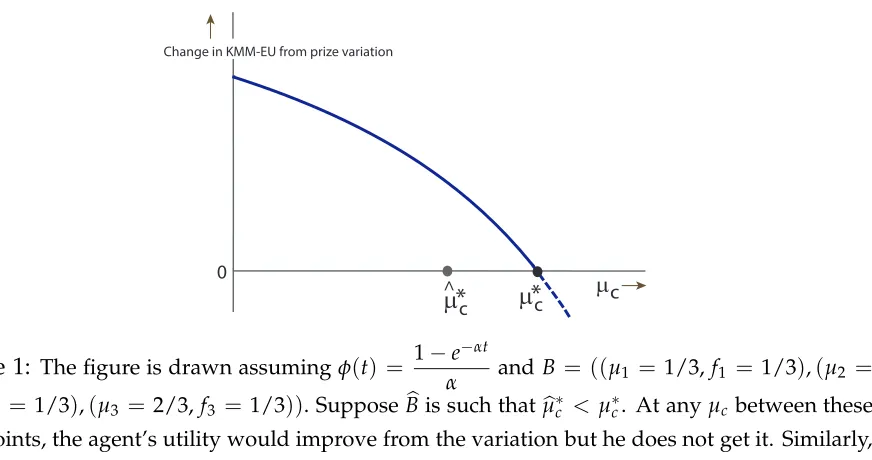
x and yto keep the agent indifferent at belief µ∗c, the agent would be overall indifferent between receiving the variation and not receiving it. Figure 1plots the change in KMM EU (of the actxEy) from the variation.
Formally, starting from the KMM EU of the act xEy, the change in KMM EU from the variation is
m
∑
i=1
φ′(µix+ (1−µi)y)
µi+ (1−µi)dy
dx
fi.
Using the value of dy/dx from above, the cutoff µ∗c is then given implicitly by equating the change to 0:
m
∑
i=1
φ′(µix+ (1−µi)y)
µi−µ∗c
1−µ∗c
fi =0. (3.2)
µ*c Change in KMM-EU from prize variation
µ*c
^ 0
[image:12.612.109.545.75.305.2]µc
Figure 1: The figure is drawn assumingφ(t) = 1−e
−αt
α andB = ((µ1 = 1/3,f1 = 1/3),(µ2 = 1/2,f2 = 1/3),(µ3 = 2/3,f3 = 1/3)). SupposeBbis such thatµb∗c < µ∗c. At anyµc between these
two points, the agent’s utility would improve from the variation but he does not get it. Similarly, ifµb∗c >µ∗
c, at anyµcin between, the agent would rather not get the variation, but does receive it.
as if the mechanism designer knows the true function φ. Of course that is typically not the case and our mechanism asks the agent to report bothφand B.
Suppose the agent reports (φb,Bb). Above we calculated the “true” cutoff value µ∗c using
(φ,B). Letµbc∗ be the value of the cutoff calculated from(φb,Bb).
Let us show that we can elicit µ∗c, i.e. we can construct a mechanism such if the report generates a cutoff µb∗c 6= µ∗c, the report would be suboptimal. This idea – that we can provide incentives to the agent to maintain the cutoffs generated through variations at their true values – forms a crucial part of the mechanism to elicit beliefs. Consider the following scheme.
• Ask the agent to announceφ,B. The agent announcesφb,Bb. Calculateµb∗c.
• Pick aµc randomly (e.g. using a uniform distribution) from (0, 1). Ifµc 6 µb∗c, offer
the variation. Otherwise offer no variation (i.e. simply offer the original act).
Suppose that the agent’s reports are such that µb∗c < µ∗
c. If µc 6 µb∗c, the agent gets the
variation whether his report leads to cutoff value µb∗c orµc∗. Ifµc > µ∗c, the agent gets no
variation in either case. If µb∗c < µc 6 µ∗c, the agent’s utility improves from the variation, but he does not get it under the report, while he would get it if his report had led to the true cutoff value. This can be seen from figure 1. A similar argument shows that any report leading toµb∗c >µ∗
µ∗c at the true value is the weakly dominant strategy.
The above shows that by introducing report-dependent variations, we can generate a cutoff value and create incentives for the agent to ensure that his report leads to the true cutoff value. If we can now show that only the truthful report on beliefs would lead to the true cutoff value, we would be done. However, the mechanism as described so far gives the agent too high a “degree of freedom” - it is perfectly possible for the agent to misreportφand/orBin such a way that the calculated cutoff nevertheless coincides with the true cutoff.
An obvious way to try to fix this problem is to “curtail” the degree of freedom - for ex-ample the mechanism can try to create incentive such that the agent will always want to reportφtruthfully. This is in fact part of what we do: the actual (grand) mechanism elicits
φ(using a mechanism that does not ask for any report on beliefs). So for eliciting beliefs, we can assume, without loss of generality, thatφis known. It follows that the mechanism can use the true function φin its calculation of the cutoff. This curtails degree of freedom to an extent, but this is not enough. Even if φ cannot be misreported, the mechanism with just one single value of cutoff still allows for the possibility that the agent might misreport beliefs B, yet the calculated cutoff coincides with the true one. To solve this problem, we need to generate multiple (at least two) cutoffs with the same property that the agent’s best response is to ensure all report-generated cutoffs are equal to their true values. With (properly chosen) multiple cutoffs, we can show that the only way to ensure these equalities is for the agent to report beliefs truthfully.
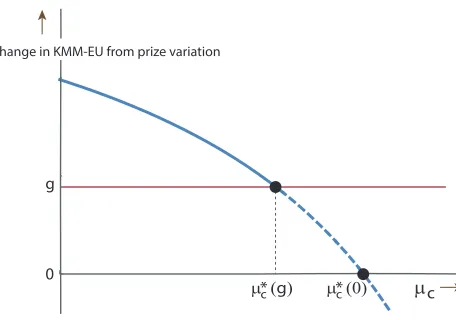
µ (g)c* Change in KMM-EU from prize variation
µc
0 g
[image:13.612.197.425.480.640.2]µ (0)c*
Figure 2: For g = 0, the agent is overall indifferent under Var(x,y) atµc =µ∗c(0). If now
we set g>0, we get a lower cutoffµ∗
How can we generate other cutoffs? If we could introduce a further variation that would improve the agent’s KMM EU at a rategthat is independent of the agent’s beliefs (true or reported), we could find a cutoff – call itµ∗c(g)– such that if we were to changexandyto keep the agent indifferent at beliefµ∗c(g), the agent would be overall indifferent between receiving this (x,y)variation and receiving the belief-independent variation. Sinceµ∗c(g)
depends on g, by varyinggwe could find different values for the cutoff. This is shown in figure2.
The mechanism we set up in section5finds a way to introduce such a belief-independent variation to compare with the (x,y) variation we introduced before, allowing us to gen-erate multiple cutoffs. We ensure it is optimal for the agent to maintain all such cutoff values at their true values. We then show this is only possible if the report is truthful.
4
A mechanism with prize variations
This section introduces a mechanism with prize variations and derives certain properties. We make use of these in later sections to elicit beliefs.
We use the following two acts and prize variations on these acts.
xEy and Var(x,y): Consider a prize vector (x,y)where x >y >0 and the act xEy. Let
Var(x,y) denote the following prize variation: Pick a value µc ∈ (0, 1), then raise x and
reduceyso as to keepµcx+ (1−µc)ythe same. In this case,dy =−1−µcµcdx.
zEz and Var(z): Next, consider a constant actzEz, z>0. Let Var(z) denote the
follow-ing prize variation: raise zat the same rate asxin the other variation, i.e. dz =dx.
Recall that the agent’s second-order belief is given by B ≡ ((µ1, f1), . . . ,(µm, fm)) where
(µ1, . . . ,µm) are the belief-states or second-order states, µi ∈ [0, 1] and µi 6= µj for all
i,j ∈ {1, . . . ,m}. Further, (f1, . . . ,fm) are the second-order beliefs, where fi > 0 is the
belief associated with the stateµi,i∈ {1, . . . ,m}and∑i fi =1.
Letφbdenote the agent’s report onφand let the belief report beBb≡ {(µb1, bf1), . . . ,(µbn, fbn)}
Let µb∗c(p) be given by the solution to
p
n
∑
i=1
b
φ′(µbix+ (1−µbi)y)
b
µi−µb∗c(p)
1−µb∗c(p)
b
fi = (1−p)φb′(z) (4.1)
Let
p ≡ φb
′(z)
b
T1+φb′(z)
(4.2)
where Tb1≡
n
∑
i=1
b
φ′(µbix+ (1−µbi)y)µbibfi. Note that p ∈ (0, 1), so that the interval (p, 1] is
non-empty. It is straightforward to verify that so long as p < p 6 1, there is a unique
solution µb∗c(p) ∈(0, 1).9
It is worth noting at the outset that in all mechanisms specified, any randomization is done before the event Eis realized.
9Let Tb
2 ≡ ∑ni=1φb′(µibx+ (1−µib)y)fbi. Solving from equation (4.1),µb∗c(p) = (Tb1− 1−pp φb′(z))/(Tb2− 1−p
A mechanism with prize variations
The agent is asked to reportBandφ. The agent reports Bb≡ {(µb1, bf1), . . . ,(µbn, bfn)}andφb.
Note that the cardinality of the set of reported belief-states isn. After receiving the report the mechanism designer follows the procedure below, also depicted in Figure3.
1. Announcenprize vectorsxi,yi,i∈ {1, . . . ,n}, and randomly choose one: (xk,yk).10 To simplify notation, we will denote the chosen (xk,yk) as (x,y) in the rest of this section. (Since only one prize vector is chosen there is no scope for confusion if we drop the subscript.)
2. Choose a p ∈ (p, 1] randomly (e.g. using a uniform distribution). (pis defined by (4.2).)
3. Choose the act xEy with probability p and the constant act zEz with probability
(1−p).
4. Calculateµb∗c(p)(using equation (4.1) above).
5. Next, choose a µc randomly from [0, 1] (e.g. using a uniform distribution). Adjust
the act as follows.
• If and only if (a)µc 6µbc∗(p), and (b)xEyis picked in step 3, award the variation
Var(x,y)atµc.
• If and only if (a)µc >µbc∗(p), and (b)zEzis picked in step 3, award the variation
Var(z).
• In any other case, award no variation - i.e. simply award the original act picked in step 3.
§
10Each of the prize vectors are chosen from some subset ofR2 according to some known distribution;
x yE (p)
z z (1-p) p
1
µ∗
c
µc < µ∗ µc <µ∗c c
µc > µc >µ∗c
Var(x,y) Var(z)
p
No Var No Var
Change in KMM EU
^ ^
^ ^
φ (µ + (1−µ ) ) ‘ ix i y (1 − )µ∗c
(µ − )i^µ∗c f i
Σ
i 0
0
p dx (1-p) φ (z)‘ dz
[image:17.612.132.494.77.354.2]E
Figure 3: The mechanism with prize variations. The expressions at the terminal nodes show not the level of KMM EU but the change in KMM EU (of the relevant act) arising from the variations. Note that only the variation received by the agent depends on the agent’s announcement (through determination ofµ∗c(p)).
Let us first calculate the (true) cutoffµ∗c(p)given the mechanism above. For any choice of p, the agent calculates KMM EU as∑mi=1φ(µiw1+ (1−µi)w2)fi, wherew1= px+ (1−p)z
and w2 = py + (1− p)z. Now suppose the agent is awarded variation Var(x,y). The
agent’s utility should then change as:
m
∑
i=1
φ′(·)p
µi+ (1−µi)dy
dx
fidx
which can be written as
p
m
∑
i=1
φ′(·)
µi−µc
1−µc
fidx
using the fact thatdy =− µc
1−µc dx.
w2=y. It follows that the rate of change of KMM EU from Var(x,y)is
p
m
∑
i=1
φ′(µix+ (1−µi)y)
µi−µc
1−µc
fidx. (4.3)
Similarly, if the agent is awarded variation Var(z), utility changes as: ∑mi=1φ′(·)(1−p)fidz
where φ′(·)is evaluated atw1= zand w2 =zsince the agent conditions on the
informa-tion that this variainforma-tion can be awarded only if initially zEz was chosen. Thus the rate of
change of KMM EU from Var(z)is given by∑mi=1φ′(z)(1−p)fidzwhich simplifies to
(1−p)φ′(z)dz. (4.4)
From expressions (4.3) and (4.4), and usingdz =dx, it follows thatµ∗c(p) is given implic-itly by
p
m
∑
i=1
φ′(µix+ (1−µi)y)
µi−µ∗c(p)
1−µ∗
c(p)
fi = (1−p)φ′(z). (4.5)
Note that when calculatingµb∗c from the agent’s report, we have used equation (4.1), which is the same equation but usesφband Bb- the reported values forφand beliefs.
We are now ready to present the first important result. This shows that the agent does not want the cutoffµb∗c(p)calculated from his report to be different from the true cutoff.
Theorem 1. Under the mechanism with prize variations stated above, if the cutoffµb∗c(p) (derived
using the report (φb,Bb))differs from the “true” value µc∗(p) (derived using the true (φ,B)) for
any p∈ (p, 1], the report is suboptimal.
While the formal proof is in the appendix, the discussion in section3.3explains the idea of the proof, which relies on a Vickrey-type dominance argument. Further, note that the act received by the agent does not depend on the agent’s report. The report only influences the calculation of the cutoff µb∗c(p) (and therefore only influences the variation received by the agent). This, combined with the theorem above, shows that any report that preserves the cutoffs at their true value is an optimal report. It follows that truth-telling is an optimal strategy. In other words, the agent cannot do better than truth-telling the truth by lying, and is at best indifferent between reporting truthfully or lying. We note this in the following corollary, which is useful for later arguments.
Corollary 1. Under the mechanism with prize variations, truth-telling is a best response. In
other words, any agent who submits a report(φb,Bb) where eitherφb 6= φand/or Bb 6= B, must be
5
Eliciting Beliefs
Corollary 1above says that truth-telling isanoptimal strategy. We now proceed to show that if we assumeφis known, then under the mechanism with prize variations presented in the previous section augmented by an additional property, reportingBtruthfully is the
uniquely optimal strategy. Later we elicitφ, and then construct a grand mechanism that
elicitsBandφsimultaneously.
Before we state the main result of this section on eliciting B, we need to introduce an assumption about the function φ. In constructing the proof, it is crucial that the n×n matrix Ab (given by (3.1)), can be constructed to be of full rank by choosing the n prize vectors appropriately. We show next that a sufficient condition for Ab to have full rank is that the function φ has non-zero derivatives (almost everywhere) of order at least n. Since the agent can report any number of belief-states, a sufficient condition is that φhas non-zero derivatives of all orders almost everywhere. We assume this:
Assumption 1. The functionφ(·)has non-zero derivatives of all orders almost everywhere on its
domain (set of all possible expected utilities from the set of lottery prize vectors).
We assume that any report φb(·)has the same property.11
Note that this class includes exponential and log functions, power functions such as xt where t < 0 or t is a positive fraction, functions such as xx, trigonometric functions. Essentially the only class excluded is polynomials of positive integer degree. For this latter class, our proof works only so long as the degree exceeds the cardinality of the announced set of belief-states.
Theorem 2. Under assumption 1, it is possible to construct the matrix A to have full rank forb
any finite n.
The proof shows that the question can be translated into one about the rank of a Vander-monde matrix and then using its properties. We relegate this to the appendix. For the matrix Abto have full rank, the set ofnprize vectors(xi,yi)have to be chosen in a certain way (see also footnote10). One procedure is as follows. For anyε>0, small, letXdenote
11Alternatively, if a reportφbdoes not have the property, the seller would withdraw from participation,
the set[ε, 1]×[ε, 1]. The first prize vector(x1,y1)is chosen fromXrandomly (for example
according to the uniform distribution). By definition, the smaller of the two number is called y1 (if the vector happens to be from the 45 degree line, it is discarded and a new
vector is chosen). Let M(k) denote thek×ksquare sub-matrix formed by the firstkrows and first kcolumns ofAb. The vector(x1,y1)determines the first row of Ab. Given(x1,y1)
(and the agent’s belief report) calculate X2 ⊂ X such that if the second row of Abis
con-structed by using any vector fromX2then M(2) has rank 2, implying Abhas rank at least
2. The proof shows this set is non-empty. The prize vector (x2,y2) is chosen randomly (according to conditional uniform) from X2. Similarly, (x3,y3) is chosen to ensure M(3)
has rank 3 and this process is continued till all thenprize vectors are chosen such that the constructed matrix Abhas full rank.
Consider the following mechanism.
Γ
B:
A mechanism to elicit belief states and second-order beliefsBThis is the same as the mechanism with prize variations outlined in the previous section with the following augmentation: in step 1, the mechanism designer chooses thenprize vectors to ensure that the matrix Abhas full rank (we know this is possible from Theorem2 above).
§
We now state the main belief-elicitation result.
Theorem 3. Supposeφ is known, and assumption1holds. Then under the mechanism ΓB, the
agent’s unique best response is to report B truthfully, i.e. to report truthfully the belief states and the second-order belief attached to each state.
The idea of the proof is as follows: suppose we calculate µb∗c(p) using φ (the true func-tion) and Bb(the reported beliefs). Using Theorem1above, we know optimality requires
b
5.1 Proof of Theorem 3
5.1.1 Step 1
We know from Theorem 1 that any optimal report must ensure µb∗c(p) = µ∗c(p) for any p ∈ (p, 1]. Using this, and φb = φ (since we assume φ is known) in equation (4.1) and rewriting (4.5), we get the following:
n
∑
i=1
φ′(µbix+ (1−µbi)y) (µbi−µ∗c(p)) fbi =
1−p
p
(1−µ∗c(p))φ′(z)
m
∑
i=1
φ′(µix+ (1−µi)y) (µi−µ∗c(p)) fi =
1−p
p
(1−µ∗c(p))φ′(z)
Since the right hand sides are equal, we can equate the left hand sides:
n
∑
i=1
φ′(µbix+ (1−µbi)y)µbibfi−µ∗c(p) n
∑
i=1
φ′(µbix+ (1−µbi)y)bfi
=
m
∑
i=1
φ′(µix+ (1−µi)y)µifi−µ∗c(p) m
∑
i=1
φ′(µix+ (1−µi)y)fi
Now, recall that the mechanism designer announces nprize vectors xi,yi, i ∈ {1, . . . ,n}, and randomly chooses one: (xk,yk). The above equation must be satisfied for any choice of(xk,yk), so we getnconditions, which we can write in matrix notation as follows.
Let Abe the followingn×mmatrix.
A ≡
φ′(µ1x1+ (1−µ1)y1) . . . φ′(µmx1+ (1−µm)y1)
... ...
φ′(µ1xn+ (1−µ1)yn) . . . φ′(µmxn+ (1−µm)yn)
b
Ais as defined by (3.1). Next, let Mbe anm×mdiagonal matrix of belief-states:
M≡
µ1 0 . . . 0 0 µ2 . . . 0 ... ... ... 0 0 . . . µm
Let Mb be the similarn×ndiagonal matrix of reported belief-states. Next, let F denote them×1 vector of second-order beliefs
F ≡ f1 ... fm
and similarly define Fbas the n×1 vector of reported second-order beliefs. Finally, let
µ∗c(p)k denote the cutoff value for thek-th prize vector(xk,yk), k=1, . . . ,n. LetCpbe the
following n×ndiagonal matrix of cutoff values:
Cp ≡
µ∗c(p)1 0 . . . 0
0 µ∗c(p)2 . . . 0
... ... ...
0 0 . . . µ∗c(p)n
Thenconditions above can now be written as
b
AMb Fb−CpAbFb= A M F−CpA F
Rewriting,
b
AMb Fb−A M F =Cp
b
AFb−A F.
Note that the only term that involves p is Cp. Further, for any prize vector (x,y), the
corresponding cutoffµ∗c(p)changes withp.12 Thus every diagonal element inCpchanges
with p. It follows that the right hand side varies withp. Therefore the above equality can hold only if
b
AFb= A F. (5.1)
This also implies
b
AMb Fb= A M F.
Solving for Fbfrom each equation and setting them equal we have
b
A−1AF= Mb−1Ab−1AMF.
12This is intuitively obvious: as prises, we are raising the value of variation Var(x,y), soµ∗
c(p)should rise withp. This can be seen formally by solving forµ∗c(p)and taking the derivative. LetT1≡∑mi=1φ′(µix+
(1−µi)y)µifiandT2 ≡ ∑mi=1φ′(µix+ (1−µi)y)fi. Note thatT1 < T2. Then, solving from equation (4.5) and differentiating, ∂µ∗c
∂p =
φ′(z)(T2−T1) (T2p−(1−p)φ′(z))2
which implies that
b
A−1A =Mb−1Ab−1AM. (5.2)
This proves the following result.
Lemma 1. Any report Bb ≡ {(µb1, bf1), . . . ,(µbn, bfn)} that does not satisfy equation(5.2)fails to
satisfyµ∗c(p) = µb∗c(p).
5.1.2 Step 2
Lemma 1 above, combined with theorem1, implies that any report not satisfying equa-tion (5.2) is suboptimal. The proof now proceeds to show that it is not possible to satisfy equation (5.2) unlessFb= Fand Mb = M, implying that truthtelling is uniquely optimal.
Step 2.1 First, let us show that we cannot haven6=m. We consider the two cases,n >m
and n<m, separately.
To clarify the idea behind the proof, here we use two simple examples for the two cases below. The general proof of step 2.1 – which uses the same logic but is perhaps less transparent – is in the appendix (sectionA.4).
Case A: n > m Suppose the agent has a unique prior µ1, but reports 2 priors µb1 with
weight bf1andµb2with weight bf2, where fbi >0 and∑i bfi =1.
Let zijdenote a typical element of the matrix Ab−1A. Since the matrix is n×m, we have i ∈ {1, . . . ,n}andj ∈ {1, . . . ,m}.
Applied to this case, equation (5.2) implies
z11 z21
!
=
µ1
b
µ1z11
µ1
b
µ2z21
(5.3)
Now, recall that Fb= Ab−1AF. Here Fis simply 1, so
b f1 b f2
!
= z11
Since bfi > 0, both z11 and z21 must be positive. But then equation (5.3) cannot possibly
hold, sinceµ1cannot be equal to bothµb1 andµb2.
In the general case ofmvalues andn >mreports, exactly the same problem emerges. All nrows of Ab−1Amust contain positive elements. This then implies that for equation (5.2) to hold, someµvalues would need to be equal to more than oneµbvalue, which is impos-sible.
Case B:n<m
Consider an example where the agent reports two belief states µb1 and µb2 (with positive weights fb1and bf2, respectively), while the agent has 4 belief statesµi,i ∈ {1, . . . , 4} with second-order beliefs fi. In this case, equation (5.2) implies
z11 z12 z13 z14
z21 z22 z23 z24
! = µ1 b µ1
z11 µ2
b
µ1
z12 µ3
b
µ1
z13 µ4
b
µ1
z14
µ1
b
µ2z21
µ2
b
µ2z22
µ3
b
µ2z23
µ4
b
µ2z24
First, note thatµbimust be equal to someµj. Otherwise, it is impossible to havezij = µj
b
µizij
for any choice ofi,jwherei∈ {1, 2}and j∈ {1, . . . , 4}. Suppose, in this case,
b
µ1 =µ2 and µb2 =µ4.
Then Abis the matrix formed by columns 2 and 4 ofA. It follows that the second column of b
A−1Ais the vector(1, 0)′and the fourth column is the vector(0, 1)′(these can be verified by direct calculation, but the idea should be obvious). In other words, the matrix formed by columns 2 and 4 of Ab−1Ais the 2×2 identity matrix.
Thus, equation (5.2) implies
z11 1 z13 0
z21 0 z23 1
! = µ1 b µ1
z11 1 µ3
b
µ1
z13 0
µ1
b
µ2
z21 0 µ3
b
µ2
z23 1
Clearly, this is possible only if allzijterms in columns 1 and 3 ofAb−1Aare 0, so we would have
b
A−1A= Mb−1Ab−1AM = 0 1 0 0
ButFb= Ab−1AF. Therefore,
b f1
b f2
= 0 1 0 0
0 0 0 1 !
f1 ... f4
But that implies bf1 = f2and fb2 = f4. This is impossible since then∑fbi = f2+ f4 <1.
The proof extends immediately to the general case ofn<m.
Step 2.2 From step 2.1 above, it follows that we must haven =m. In this case,zij = µj
b
µi
zij
6
Eliciting
φ
So far we have described the belief elicitation mechanism under the assumption that the function φ is known. However, this would be a fairly unrealistic assumption for most situations and we now discuss the mechanism that elicits φ. This should be of some independent interest as well (for example for policy making purposes where the policy maker may need to know φ.)
We first describe the construction of an ambiguous act and a (random) second-order act, which play crucial roles in the mechanism that elicitsφ.
Ambiguous Act: For prizesx >y, consider a lottery that paysxwith probability p(and
henceywith probability 1−p) and it is announced thatpis chosen from a non-singleton setP. We can assume, without loss of generality, thatP has two elements,p1andp2. No
further information as to howpis chosen from the setPis provided. The lottery therefore constitutes an ambiguous act13 and lettingHdenote the agent’s second-order belief over
P, the agent’s KMM EU isφ◦H. With a slight abuse of notation, we use Hto represent the agent’s (second-order ) belief that p = p1; hence the number 1−H represents the belief that p = p2.
Second-Order Act (SOA): For some prizesw>z, the second-order act payswifpis
cho-sen to be p1andzif the chosenpis equal top2. ARandom SOA (RSOA), chooseswand z independently according to someannounced distribution. For example, two numbers are drawn independently from the uniform distribution over [0, 1]with the larger of the two calledw. Oncewandzhave been chosen, the rest of RSOA is then exactly as in SOA.
Objective Lottery: For q ∈ [0, 1], let ℓ(q;w,z) denote the objective lottery that pays w
with probability qandzwith probability 1−q.
13The actual,physicalconstruction of the ambiguous act can be done following techniques well-known in
Γ
φ:
A mechanism for elicitingφ14The agent is asked to reportφand H. Letφband Hb denote the corresponding reports.
1. The mechanism chooses prizesw,zas in RSOA.
2. With (objective) probability 1/2 each, the mechanism selects either scheme A or
scheme B.
• UnderScheme A, the mechanism chooses a numberq randomly according to the uniform distribution over[0, 1].
– Ifq≥ Hb the agent is given the objective lotteryℓ(q;w,z).
– Ifq< Hb, the agent is awarded the SOA with prizeswandz.
• Under Scheme B, the mechanism chooses a number randomly from the uni-form distribution over[z,w]. Call the randomly chosen numbert. The mecha-nism calculates, according to the reports of the agent, the certainty equivalent (recall this is in terms of vN-M utils, not money) of the ambiguous act with prizes w and z. That is, the mechanism calculates the certainty equivalent of
b
H φb p1w+ (1−p1)z+ 1−Hbφb p2w+ (1−p2)z. LetCE denote this calcu-c
lated certainty equivalent.15 The mechanism allocates as follows.
– Ift≥CE, the agent is awarded the prizec t.
– Ift<CE, the agent is awarded the ambiguous act.c
§
We now show why this mechanism elicits φ. Consider first scheme B. Let CE be the agent’s true certainty equivalent. It is easy to see (using the standard weak-dominance argument) that the agent’s best response is to submit Hb and φb such that the calculated certainty equivalentCE is equal to CE. Clearly, truthful reporting is a best response; how-c ever, it may not be the unique best response. On the other hand if scheme A is chosen
14The usual caveats apply. The mechanism elicits a function that is a representation of the agent’s
pref-erence over second-order acts. If the agent reports an affine transformation of this function then that obvi-ously is also a truthful elicitation (SeeKMM).
15This is given byφb−1Hbφb(p
1w+ (1−p1)z) + (1−Hb)φb(p2w+ (1−p2)z)
(which happens with strictly positive probability), the reportedφbis irrelevant and report-ing Hb to be the same as the true H is the unique best response. (Scheme A is essentially the mechanism in Karni (2009) and its chief advantage is that it elicits beliefs while al-lowing for the mechanism to remain agnostic about φ.) Given that the agent reports H truthfully, reporting φb= φis then the unique best response under scheme B. To see this, note that if, say, φb(·) > φ(·) at any point in the domain of prizes, by continuity there must be an open interval in the domain on which φb(·) > φ(·). But then with positive probability piw+ (1−pi)zbelongs to this interval fori ∈ {1, 2}, implying thatCEc 6=CE. Similarly, we can rule out having φb(·) < φ(·) at any point in the domain of prizes. This proves the following result.
Theorem 4. Under the mechanismΓ
φ, the agent’s unique best response is to reportφtruthfully.
It might be useful to compare Γφ - the mechanism to elicit ambiguity-preference - with procedures that elicit risk-preferenceu(·)(see appendixA.1for one such procedure). Elic-itation of risk-preference involves use of constructed/engineered objective lotteries and of calculated (monetary) certainty equivalent of the lotteries using reports submitted by the agent. As one would expect, a constructed/engineered ambiguous act - and the cal-culated certainty equivalent of this act based on the agent’s report - is used inΓ
φ. There is
however an important and subtle difference. The certainty equivalent of a risky prospect does not depend on whether the prospect is subjective or objective. But φ(·), which re-flects the agent’s ambiguity-preference, comes into play only if the act is subjective. Fur-thermore, the associated second-order belief H – without the knowledge of which the certainty equivalent of the ambiguous act cannot be calculated by the mechanism – is the agent’s private information. This explains the need for scheme A. Its sole purpose is to elicit the second-order belief H which can then be used for calculating the certainty equivalent used in scheme B.
7
A grand mechanism to elicit
B
and
φ
concurrently
We have so far constructed the mechanismΓBin section5to elicitBassumingφis known
and Γφ in section 6 to elicit φ (the latter does not require any knowledge of B). In this
section we use these to construct a grand mechanism to elicitBandφtogether.
so far:
Γ
:
A grand mechanism to elicit BandφconcurrentlyAsk the agent to report B andφ. The agent reports Bband φb. Using these as the relevant reported values, run
• the mechanism
Γ
B with probability 1/2, and• the mechanism
Γ
φwith probability 1/2.§
Corollary1shows that under the mechanism with prize variations introduced in section4 – and therefore also under mechanismΓB– reporting bothφandBtruthfully isanoptimal
strategy. It follows that at worst the agent is indifferent between lying and telling the truth.
Next, under mechanismΓφ, reportingφtruthfully is uniquely optimal (Theorem4). Also
note that this mechanism does not seek reports onB. Since mechanismΓφ is offered with
positive probability, truthful report ofφis uniquely optimal.
It follows that we need to only consider reports of the type(φ,Bb), and then rule outBb6=B. This is accomplished by Theorem 3, which shows that if φis known and assumption 1 holds, reportingBtruthfully is uniquely optimal under mechanismΓB. SinceΓBis offered
with positive probability, reporting Btruthfully is uniquely optimal.
It follows that under the grand mechanismΓ, it is uniquely optimal to report bothφand Btruthfully. This proves the result below.
Theorem 5. Suppose assumption 1 holds. Under the grand mechanism Γ above, the uniquely
optimal response of the agent is to report B andφtruthfully.
8
Conclusion
refers to a different underlying data generating process and the corresponding probabil-ity model. The agent then has a second-order prior on these first-order belief-states. The agent’s preference exhibits non-neutrality to the second-order distribution. As discussed at the outset, such a two-stage decomposition of uncertainty and non-reduction of com-pound lotteries resulting from non-neutrality to the second-order distribution plays an important role in the literature in resolving the Ellsberg Paradox.
The large belief-elicitation literature focuses on eliciting beliefs on events that are observ-able. The entire scoring rule literature fits into this category. Here, on the other hand, we elicit (second-order) beliefs on unobservable belief-states. A few recent papers do also address problems pertaining to belief-elicitation on unobservable states, but these require the agent to be SEU maximizer at some decision making stage. In this paper, in contrast, we consider the more standard problem of eliciting first and second-order be-liefs of agents who are ambiguity-sensitive and do in fact face ambiguity when making a decision. Here we adopt the smooth ambiguity representation ofKMM for specificity. However, as discussed, several other axiomatisations result in a similar representation structure.
The literature on belief elicitation on observable states compareslevelsof utility from acts and lotteries. Here, with unobservable states and ambiguity-sensitive agents, we show that we need to consider how utility changes under report-dependent prize variations. Using such variations, we construct a novel direct revelation mechanism that induces truthful reporting of the first-order belief states as well as the second-order distribution on the belief-states as the unique best response. The mechanism requires knowledge of the sensitivity function to second-order distribution (capturing ambiguity attitude) and the vN-M utility function. We construct variations on established techniques to elicit these aspects of the agent’s preferences.
A
Appendix
A.1 Elicitingu(·)
Forx>y, wherexandyare inmonetaryunits, consider the objective lotteryℓ(p;x,y)that awardsxwith probabilitypandywith probability(1−p). Amechanismthat elicitsu(·)
is as follows. (See footnote7.)
• The agent is asked to reportu. Letubdenote the report.
• The mechanism selects two numbers (call the larger of them xand the smaller one y) randomly from some interval according to independent draws. Without loss of generality let the interval be[0, 1]with the random selections made according to the uniform distribution.
• The mechanism calculates the expected utility of ℓ(p;x,y) using reported function b
u. LetVbdenote the certainty equivalent.
• Next, the mechanism picks a number r randomly - for example using the uniform distribution - from the set [y,x]. Ifr > Vb, the agent is awarded the certain amount r. Ifr 6Vb, the agent receives the lotteryℓ(p;x,y).
Let us show that this mechanism elicits u. Let V denote the true certainty equivalent of ℓ(p;x,y). Suppose Vb > V. The misreporting is irrelevant if r > Vb or r < V. If
b
V > r > V, the report ofubearnsu(V)while the true report earnsu(r), which is higher. Similar arguments show that truthful reporting is weakly dominant ifV >Vb. Therefore reportingusuch thatVb =Vis the weakly dominant strategy under the mechanism. Now, if, say, ub(·) > u(·) at any point in the domain of prizes, by continuity there must be an open interval in the domain on which ub(·) > u(·). But then with positive probability
b
V 6=V. It follows that reportingu(·) truthfully is optimal.
A.2 Proof of Theorem1