Teoh, Kevin and Coyne, I. and Dwayne, D. and Phil, L. and Anthony, Z. (2016)
The interaction between supportive and unsupportive manager behaviors on
employee work attitudes. Personnel Review 45 (6), pp. 1386-1402. ISSN
0048-3486.
Downloaded from:
Usage Guidelines:
Please refer to usage guidelines at or alternatively
Personnel Review
The Interaction between Supportive and Unsupportive Manager Behaviors on Employee Work Attitudes
Journal: Personnel Review
Manuscript ID: PR-05-2015-0136
Manuscript Type: Research Article
Keywords: Social exchange, Managers, Turnover, Engagement, Job satisfaction
Methodologies: Quantitative
Personnel Review
The Interaction between Supportive and Unsupportive Manager Behaviors on
Employee Work Attitudes
Purpose: To use Social Exchange Theory (SET) to examine a model where supportive (SMB) and unsupportive (UMB) manager behaviors interact to predict employees’ engagement, job satisfaction and turnover intention.
Design/Methodology: A cross-sectional online survey collected data from 252 UK based employees of a global data management company.
Findings: Factor analysis confirmed manager behaviors to consist of two constructs: supportive and unsupportive behaviors. Structural equation modelling indicated SMB predicted job satisfaction and turnover intentions, but not engagement. Job satisfaction, but not engagement, mediated the SMB-turnover intention relationship. UMB only predicted job dissatisfaction. Neither job satisfaction nor engagement mediated the UMB-turnover
intention relationship. UMB undermined the positive relationship between SMB and turnover intention.
Implications: The behaviors assessed can be integrated into various stages of a manager’s development process to serve as guidelines of good practice. Crucially, findings suggest managers can exhibit both supportive and unsupportive behaviors, and that consistency in behaviors is important. The study also provides evidence that supportive managers can help reduce turnover intention through job satisfaction.
Originality/value: SET was used as a framework for SMB, UMB and engagement. To our knowledge this is the first study to examine the interaction between SMB and UMB.
Keywords: Supportive manager behaviors; unsupportive manager behaviors; social exchange theory; job satisfaction; engagement; turnover intention
Article Classification: Research paper 3
Personnel Review
The Interaction between Supportive and Unsupportive Manager Behaviors on
Employee Work Attitudes
The quote “People leave managers, not organizations” (Tate and White, 2005, p.2) is often
cited when discussing turnover. As social support is an important source in reducing the risks
of workplace stressors and in protecting worker health, a manager who is seen as supportive
is more likely to have employees who intend to remain in their current employment (Maertz
et al., 2007). The evidence has consistently demonstrated that positive social support is
associated with improved engagement (MacLeod and Clarke, 2009), organizational
citizenship behavior (Chênevert et al., 2015), wellbeing (Luchman and Gonzalez-Morales,
2013), job satisfaction and productivity (Baruch-Feldman et al., 2002). Hence, in trying to
improve the working environment, social support is a crucial buffer towards workplace
stressors, and it is important to understand what impact support from the manager has on the
employee.
Although supportive manager behaviors (SMB; Rooney and Gottlieb, 2007; Yarker et
al., 2007) and perceived supervisor support (Shanock and Eisenberger, 2006) have received
considerable attention, the effects of unsupportive manager behaviors is less commonly
examined (UMB). What is known typically stems from the more extreme side of negative
leadership, such as abusive supervision (Mitchell and Ambrose, 2007) and destructive
leadership (Schyns and Schilling, 2013). Even less attention has been given to the idea that
managers can exhibit different types of leadership behaviors (Kelloway et al., 2006), and
little is known about the possible interactions between SMB and UMB. Consequently, this
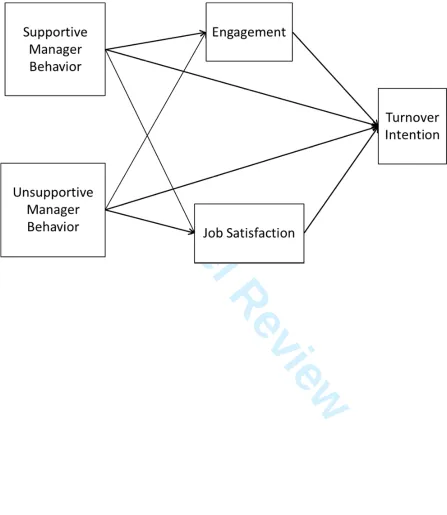
study examines the construct of SMB and UMB using Social Exchange Theory (SET) in
relation to three common employee measures: engagement, job satisfaction and turnover
intention (See Figure 1 for proposed model). The selection of engagement reflects the interest 3
Personnel Review
In addition, another popular SET employee attitude (job satisfaction) is included as a
comparison, and we continue the examination of other researchers (Rooney et al., 2007;
2009) on the impact of SMB on turnover intention.
[Insert Figure 1]
Social Exchange Theory in the Workplace
Social Exchange Theory (SET; Blau, 1964) states that relationships are maintained between
two parties by a state of reciprocal interdependence. It proposes that when one party acts in a
manner which benefits a second party, there is an obligation and expectation that the second
reciprocates the favor (Blau, 1964). Unlike economic or contractual exchanges, SET is
predicated by relationships which are nurtured over time (Aryee et al., 2002), with
reciprocation of the socioemotional benefits having behavioral, cognitive or emotional
implications (Blau, 1964; Cropanzano and Mitchell, 2005). It can be construed that the
employee and the source of support are two actors in the exchange relationship. Within
organizational research, SET typically examines how perceived organizational and supervisor
support is reciprocated by employees (Shanock and Eisenberger, 2006).
In addition to the source, a second aspect of support is the type of support, which
comes in the form of instrumental and emotional support (Haslam et al., 2005). The former
refers to the tangible support an employee receives to complete work duties, whilst the latter
is the care and concern employees might receive that gives them a sense of worth and
belonging. Managers have the ability to influence the work environment by providing job
resources and determining work conditions, thereby providing both emotional and
instrumental support in the workplace (Luchman and Gonzalez-Morales, 2013). Hence,
employees are more likely to reciprocate positively to a conducive environment set by the
manager (Settoon et al., 1996), explaining why the manager-employee relationship has been 3
Personnel Review
found to have a stronger influence on organizational outcomes than relationships with
co-workers (Liaw et al., 2010). This reciprocity is typically initiated by the leader (Graen and
Uhl-Bein, 1995), and if the employee responds favorably an interdependent relationship can
ensue. These employees will then receive additional support, resources and opportunities
(Cropanzano and Mitchell, 2005), leading to the nature of the social exchange relationship
continually altering (Erdogan and Liden, 2002).
Engagement
SET provides a theoretical framework explaining employee engagement (Agarwal,
2014; Ghosh et al., 2014), which is conceptualized by Schaufeli et al., (2006) as being fully
engrossed, deriving enthusiasm and pride, and having high levels of energy and investment in
one’s work. In a report to the UK government, engagement was identified as having a crucial
role in bringing the national economy out of recession (MacLeod and Clarke, 2009; Rayton et
al., 2012). So long as both parties abide by the rules of exchange, the social exchange
relationships will over time, develop into loyal, trusting and mutual commitments
(Cropanzano and Mitchell, 2005). This is congruent with Robinson et al.’s (2004) notion of
engagement as a two-way relationship between the organization and the employee. In
response to the resources received from the other party (i.e., organization, manager),
employees can devote greater cognitive, emotional and physical resources to their
organizations, and adjust the levels with which they engage their work in response to the
resources and support received (Saks, 2006). To our knowledge there have been few attempts
to examine engagement from a SET perspective (Agarwal, 2014: Ghosh et al., 2014), with
the effect of manager support being less conclusive than that from the organization. However,
while engagement is typically examined from a job demands-resources model, the positive 3
Personnel Review
relationship between job resources and engagement has been explained through the reciprocal
nature of SET (e.g., Dollard and Bakker, 2010; Xanthopoulou et al., 2009).
The importance of managers is highlighted by the report to the UK government
identifying effective managers as being one of the four drivers for engaging the workforce
(MacLeod and Clarke, 2009; Rayton et al., 2012), despite the empirical evidence between
manager behaviors or leadership with employee engagement being less clear. Rhoades and
Eisenberger’s (2002) meta-analysis on organizational support theory, which includes
supervisor support as a representative of the organization, did not include engagement. In a
review of 91 studies, Christian et al. (2011) found that job characteristics, leadership and
employees’ personality preceded engagement, with leadership having the weakest
relationship with engagement. Considering that Christian et al.’s coverage of leadership only
encompassed transformational leadership and the leader-member exchange, which are
conceptually different from the assessment of supportive behaviors, a behavior based
examination might yield different results. This study continues the work on Saks’ (2006)
framing of engagement within SET, that when managers meet the professional and personal
needs of their employees, it is plausible that like perceived organizational support, employees
reciprocate with higher engagement levels. As such, it is hypothesized that:
H1: Supportive manager behaviors are positively related with engagement.
Job Satisfaction
The inclusion of job satisfaction in this study allows a comparison with what some have
argued to be conceptually similar to engagement (Macey and Schneider, 2008). According to
SET, when the employee feels supported, their job satisfaction can improve as
socioeomotional needs are met or there is the signaling of the availability of aid to employees
(Rhoades and Eisenberger, 2002). Managers can increase the job satisfaction of their staff by 3
Personnel Review
providing constructive feedback that allow employees to feel valued, or by enhancing work
characteristics like autonomy and group cohesion while reducing ambiguity (Lee and
Cummings, 2008). Furthermore, SET postulates that perception of support can lead to
employees responding affectively, with a lack of support leading to increased job
dissatisfaction (Johnson and O’Leary-Kelly, 2003; Rooney et al., 2007; 2009).
Although the literature surrounding job satisfaction and manager support has focused
on perceptions of support, it would be anticipated according to SET that the provision of
tangible supportive behaviors will demonstrate a similar effect. As a result, it is predicted
that:
H2: Supportive manager behaviors are positively related with job satisfaction.
Turnover Intention
SET would advocate that low support quality could be reciprocated by increased turnover
intention (Cropanzano and Mitchell, 2005; Mossholder et al., 2005). Commitment to an
organization and job can manifest itself as both an affect and/or behavior, and can therefore
be used by an employee to reward or punish their managers. SMB (Rooney et al., 2007;
2009), leader-member exchange (Kang et al., 2011) and perceived supervisor support
(Maertz et al., 2007; Newman et al., 2011) have used SET to explain the support-turnover
intention relationship.
Crede et al. (2007) proposed a model whereby job withdrawal cognitions, along with
organizational citizenship behaviors and counterproductive workplace behaviors, were
identified as groups of ‘behaviors’ which employees can use to reciprocate within the
exchange relationship. Moreover, they argued work attitudes (namely job satisfaction) have a
role in mediating the work environment and behavior relationship. Meta-analytical results 3
Personnel Review
intention. When the situation at work becomes unsatisfactory, one of the coping mechanisms
would be to escape that situation (Moynihan et al., 2003) – manifesting in increased turnover
intention. Extending Crede et al.’s (2007) model to include engagement as a mediator,
engaged employees identify with their work and invest energy in it, and might find difficulty
detaching from or even leaving their work (Halbesleben and Wheeler, 2008). By leaving the
organization they lose the ability to carry on their work, and lose access to resources which
has helped them with their work. This is seen in Halbesleben (2010) and Saks’ (2006) studies
that support a negative relationship between dimensions of engagement and turnover
intention.
Despite the literature so far providing separate evidence that SMB impacts
engagement and job satisfaction, and that these subsequently influence turnover intention,
there have been few models that examine these together. The studies which have are
consistent in their findings. Agarwal et al. (2012) found that engagement mediated the link
between the quality of the employee-manager relationship and turnover intention, whilst three
separate studies revealed job satisfaction to mediate social support from supervisor (van der
Heijden et al., 2010) and leader-member exchange (Han and Jekel, 2011; Wang and Yi,
2011) relationship with turnover intentions. Considering the evidence supporting SMB being
reciprocated with work attitudes, and extending these assumptions into a mediation model, it
is hypothesized that:
H3: Supportive manager behaviors, engagement and job satisfaction have a negative
relationship with turnover intention.
H4: Engagement and job satisfaction mediate the relationship between supportive
manager behaviors and turnover intention.
Unsupportive Manager Behaviors 3
Personnel Review
The negative reciprocal relationship has received little attention within the SET
literature, and it is less clear what the effect unsupportive manager behavior (UMB) has on
the outcome measures described above. The dominance of the research literature examining
supportive managers as opposed to unsupportive or abusive managers has created a myopic
understanding of managers’ influence on employees. The studies that have focused on
negative leadership have looked at abusive, deviant or tyrannical supervision (Mitchell and
Ambrose, 2007), with less attention on the more subtle forms of poor support. Aspects of
work which violate SET would impair the development of a high quality relationship
between the employee and manager (Cropanzano et al., 2003), infringing the implicitly
understood obligations which form the psychological contract between both parties
(Rousseau, 1995). This lack of support could result in employees’ engaging in negative
behaviors in order to strike back at the manager and/or organization (Cropanzano and
Mitchell, 2005; Mitchell and Ambrose, 2007). Saks’ model of engagement postulates that
anything which threatens the social exchange relationship should result in disengagement.
That is, issues with trust, lack of reciprocity, or psychological contract breaches may result in
a weakening of this relationship, resulting in at least a reduction of engagement, if not actual
disengagement (e.g., Agarwal et al., 2012). Some researchers (Uhl-Bien and Carsten, 2007)
have argued that the power imbalance between the manager and the employee can result in
employees being unable to reciprocate negatively due to fears about retaliation from their
managers. Instead, this is displaced towards other parties within the work environment (e.g.,
colleagues, customers, organization). It is equally plausible that employees exposed to UMB
simply withdraw from the relationship, breaking any link between support and outcome. This
fits with Bhogaita’s (2012) findings that UMB did not predict job satisfaction, engagement,
job performance or organizational commitment. 3
Personnel Review
Research in this area has shown SMB and UMB to be different constructs with
different outcomes on employee work attitudes (Bhogaita, 2012; Rooney et al., 2007; 2009)
rather than two separate ends of the same continuum. In addition to the positive influence of
SMB reviewed earlier, the evidence indicates that UMB and poor leader-member exchanges
are reciprocated with lower job satisfaction, organizational citizenship behavior and job
performance, and increased turnover intention (Cropanzano et al., 2003; Rooney and
Gottlieb, 2007; Setton et al., 1996). Employees were also found to respond to abusive
supervisors with feelings of increased stress and helplessness instead of deviant behaviors,
suggesting that they internalize their response and exhibit behavior that benefits them (Organ,
1990). Considering that reciprocity forms the basic tenant of SET, and the previous research
findings involving work-related attitudes in this area, it is hypothesized that:
H5: Unsupportive manager behaviors are negatively related with job satisfaction,
and engagement.
H6: Unsupportive manager behaviors are positively related with turnover intention.
H7: Engagement and job satisfaction mediate the relationship between unsupportive
manager behaviors and turnover intention.
Consistency of support
Even with the growing emphasis of UMB (Bhogaita, 2012; Rooney and Gottlieb, 2007) and
destructive leadership (Schyns and Schilling, 2013) on employee work attitudes, these have
been examined in isolation to the positive dimension of support. How supportive a person is
at work is not necessarily constant, with findings that managers (Rooney and Gottlieb, 2007),
nurses (Krishnasamy, 1996) and spouses of cancer patients (Manne and Schnoll, 2001) can
exhibit both supportive and unsupportive behaviors. In the safety leadership literature,
Kelloway et al. (2006) argued that frequency-based measures of transformational and passive 3
Personnel Review
leadership styles means leaders could alternate between, or exhibit, both styles of leadership.
Building on this, passive-safety leadership has been found to attenuate the positive impact
that transformational-safety leadership has on safety behaviors (Mullen et al., 2011).
However, aside from the work by Kelloway et al. (2006) and Mullen et al. (2011), we are
unaware of any other attempts to examine the interactive relationship between leadership
styles or manager behaviors.
A manager displaying frequent SMB and infrequent UMB can be said to be providing
consistent support to their employees. This consistency reinforces the beneficial behavior
extended to the employee, increasing the trust between both parties and creating the
reciprocal obligation for the employee to respond favorably (Colvin et al., 2002; Cropanzano
and Mitchell, 2005). In contrast, inconsistent support occurs when there is a mismatch
between the frequency of SMB and UMB. Extrapolating from Mullen et al.’s (2011) study,
any positive effect from SMB on employees would be undermined by the presence of
frequent UMB. This clash hinders the development of an exchange relationship between
manager and employee as the incongruent behavior on the part of the manager potentially
violates one of the fundamental principles of SET – trust (Blau, 1964). Finally, managers
displaying infrequent SMB and frequent UMB can be grouped as consistently unsupportive.
As discussed earlier in this paper, this would have a detrimental impact on any relationship
and could result in employees reciprocating with negative work attitudes or withdrawing
from the exchange relationship altogether (Cropanzano et al., 2003; Cropanzano and
Mitchell, 2005; Mitchell and Ambrose, 2007).
It is highly plausible that managers exhibit both supportive and unsupportive
behaviors. As such, this current study seeks to contribute to the recent developments that
examine the interactive role of SMB and UMB on employee outcomes and hypothesizes that: 3
Personnel Review
H8: Employees who experience consistent support (high SMB, low UMB) will report
higher levels of engagement, job satisfaction, and lower turnover intention than those who
experience inconsistent support (high SMB, high UMB or low SMB, low UMB) and
consistent unsupportive (low SMB, high UMB).
Method
Sample and Procedure
Participants were recruited from the UK operations of a global data management and analysis
company. A total of 1,483 employees were emailed and invited to take part via an electronic
survey. Information and contact details were provided on the first page of the online survey.
Participants were also informed that by proceeding with the online survey they were
consenting to take part. However, they were free to exit the browser and withdraw from the
study. The survey window lasted three weeks, with a reminder email sent out after one week.
Overall, 288 employees completed the online questionnaire, although 36 were
removed due to incomplete responses. Managers comprised 29.4% of the sample, and 54% of
the sample was male. The average age was 35.4 years (SD=9.3), and average tenure was 6.17
years (SD=6.59). Participants operated in a wide range of job functions, including
Information Technology (18.3%), Customer Services (11.5%), Analytics (10.7%), Finance
(9.1%), Sales (8.7%), and Product Development (7.5%). The remaining 34% were employed
in other business areas.
Measures
Supportive Manager Behaviors.The Inventory of Supportive and Unsupportive Manager
Behavior is a 14-item measure which contains 9 supportive and 5 unsupportive manager 3
Personnel Review
behaviors (Zarola, 2011). Participants rate their own immediate manager in terms of how
frequently they displayed these behaviors using a 5-point frequency scale where ‘1=never’
and ‘5=always’. An example behavior includes ‘I have to deal with unrealistic expectations
from my manager’. Past researchers (Bhogaita, 2012; Zarola, 2011) have found coefficient
alphas of between .90 and .96 for SMB items and alphas of .75 to .86 for UMB items.
Work Engagement.This study examines the overall measure of engagement, and
therefore, like other researchers (e.g., Agarwal, 2014), summed the subscale scores of the
Utrecht Work Engagement Scale (Schaufeli and Bakker, 2003) to represent engagement.
Comprising nine items, participants rated items such as ‘My job inspires me’ on a seven point
scale with ‘0=never’ and ‘6=everyday’. Internal consistency has previously been reported at
.91 (Schaufeli and Bakker, 2003).
Job Satisfaction.Job satisfaction was assessed using the five items of global job
satisfaction from the Andrew and Withey Job Satisfaction Questionnaire (Rentsch and Steel,
1992). The measure included items such as ‘How do you feel about your job?’ which was
rated on a seven point scale where ‘1=terrible’ and ‘7=delighted’.
Intention to leave.Rosin and Korabik’s (1991) four item scale was used. Three items
were weighted with three answer options (e.g., are you planning to leave your job within the
next six months?; ‘yes=2’, ‘no=0’, and ‘unsure=1’). The fourth item (‘are you actively
searching for another job right now?’), was weighted ‘yes=2’ and ‘no=0’. These were
summed, with a higher score indicating stronger intention to leave. Foley et al. (2002) found
inter-item reliability to be at .83.
Control variables. Age, gender, job tenure, and manager/employee status were
included as control variables in the structural equation and the moderated regression models. 3
Personnel Review
Results
Due to questions arising surrounding the conceptualization of supportive (SMB) and
unsupportive (UMB) manager behaviors as either one (Yarker et al., 2007) or two separate
constructs, a confirmatory factor analysis (CFA) was conducted to confirm that SMB and
UMB composed a better two-factor model than a singular factor model (Rooney et al., 2007;
2009). Analysis showed a two-factor model (CFA=0.95, RMSEA=.08) was a better fit than a
one-factor model (CFA =0.90, RMSEA=0.11).
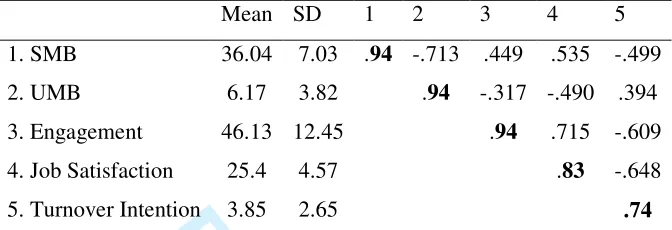
Internal reliabilities, means and standard deviations for all variables are displayed in
Table 1 along with correlational coefficients. SMB was positively correlated with
engagement (r=.45) and job satisfaction (r=.54) while negatively correlated with turnover
intention (r=-.50). The opposite relationships were observed for UMB, which was negatively
related to engagement (r=-.32) and job satisfaction (r=-.49) and positively related to turnover
intention (r=.39). Turnover intention showed negative relationships with engagement (r=-.61)
and job satisfaction (r=-.65). These support all the correlational hypotheses (H1-H3 and
H5-H6) made.
[Insert Table 1]
Latent SEM analyses were used to examine job satisfaction and engagement as
mediators of SMB and UMB on turnover intention. Based on recommendations by Little et
al. (2002) on item parceling in SEM, an empirically-guided approach to parcel construction
via exploratory factor analyses was used to generate empirically robust parcels for SMB,
UMB, engagement, job satisfaction and turnover intentions. All latent variables (i.e., SMB,
UMB, engagement, job satisfaction, and turnover intention) had at least two parceled 3
Personnel Review
indicators and exhibited high internal reliabilities (alphas > .70). Little et al. (2002) argued
that latent models with parceled indicators (compared to item-level indicators) provide more
rigorous and unbiased model estimates in SEM Model fit statistics. Consistent with Anderson
and Gerbing’s (1988) two-step approach, two models were specified and estimated: a
measurement model including all possible correlations among latent variables and a structural
model testing the main study hypotheses including the claim that job satisfaction and
engagement act as mediators in the relationship between SMB/UMB and turnover intentions.
Control variables of age, gender, job tenure, and manager/employee status were included in
the analyses. All exogenous variables including these controls were allowed to covary, and
the two mediators of job satisfaction and engagement were also allowed to covary. In order to
control for common method bias, a single latent factor was included in both measurement and
structural models, with direct paths to all observed variables (indicators) that were measured
in the same survey. The models were run with and without this latent method factor to assess
differences in parameter coefficients, which were deemed marginal.
Confirmatory factor analyses were conducted to assess the overall measurement
model. These results indicated good model fit of the measurement model,
χ
2 (44)=88.0,p<.001; RMSEA=.06 [C.I .04 - .08], CFI=.98, NFI=.97, IFI=.98. Following this model, the
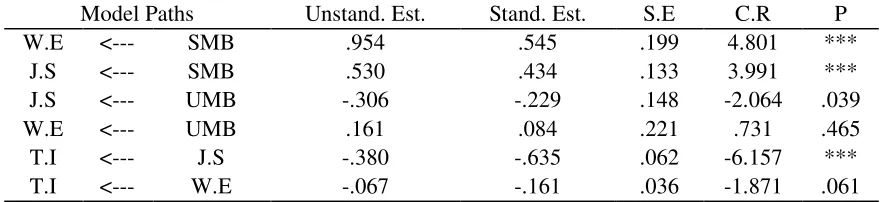
structural model was estimated (see Table 2). This model also reported equally good model
fit,
χ
2 (46)=90.7, p <.001; RMSEA=.06 [C.I .04 -.09], CFI=.98, NFI=.97, IFI=.98. Based onan inspection of individual path coefficients, SMB had significant positive effects on job
satisfaction (b=.53, p<.001) and engagement (b=.95, p<.001). Job satisfaction, in turn, had a
significant negative effect on turnover intentions (b=-.38, p<.001). However, engagement did
not generate a significant effect on turnover intention (b=-.07, p>.05). The bootstrapping
model results revealed that the standardized mediated or indirect effect of SMB on turnover 3
Personnel Review
estimate=-.36, p<.05, 95% C.I: -.51 - -.21). Specific tests of indirect effects of each mediator
revealed that although job satisfaction fully mediated the relationship between SMB and
turnover intention (z=-3.42, p<.001), engagement failed to mediate this relationship (z=-1.60,
p>.05).
UMB had a significant negative effect on job satisfaction (b=-.31, p<.05) but its effect
on engagement was not significant (b=.16, p>.05). The total standardized indirect effect of
UMB on turnover intentions was not statistically significant (b=.13, p>.05, 95% C.I:-.03 to
.28). Specific indirect effect tests revealed that neither job satisfaction (z=1.95, p>.05) nor
engagement (z=.72, p>.05) mediated the relationship between UMB and turnover intentions.
In light of the SEM results, H4 was partially supported as only job satisfaction, and not
engagement, mediated the relationship between SMB and turnover intention. However, as
neither job satisfaction nor engagement mediated the UMB and turnover relationship, H6 was
rejected.
[Insert Table 2]
Moderated regressions were conducted to examine the interactive effect between
SMB and UMB on engagement, job satisfaction and turnover intention. Interactive terms
(SMB x UMB; Block 3) were added to a regression model after control variables (Block 1)
and main effect terms (Block 2). All items were centered before being entered into the
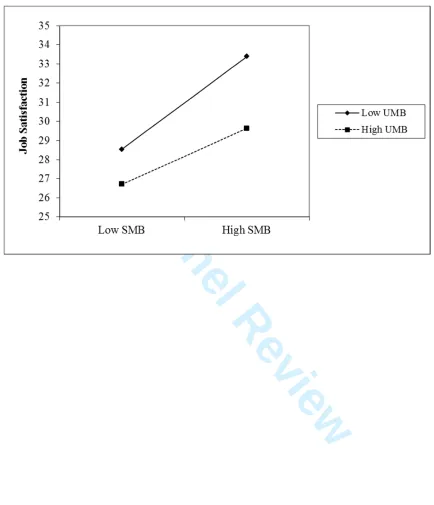
regression. The results, presented in Table 3, show that the SMB x UMB interaction was only
significant for job satisfaction (b=-.37, p>.05). When the interaction for job satisfaction was
plotted (Figure 2), as expected consistent support (high SMB, low UMB) reported higher job
satisfaction than inconsistent support (high SMB, high UMB or low SMB, low UMB) and
consistent unsupportive (low UMB, high SMB). However, H8 is only partially supported as
no interactive effects were found for engagement or turnover intentions. 3
Personnel Review
[Insert Table 3]
[Insert Figure 2]
Discussion
In answering the call for more empirical work to be done on supportive manager behaviors
(Yarker et al., 2008), the current study provides a number of important contributions. Firstly,
the confirmatory factor analysis strengthens the notion that SMB and UMB are two separate
constructs, not two ends of the same continuum. Moreover, that different behaviors predict
different outcomes provides further evidence that UMB is a different construct. What this
means is that a high score on a particular construct represents more frequent demonstration of
such (un)supportive behaviors, with a low score representing less frequent, or absence, of
said behaviors. For example, a low frequency score on any item does not suggest this
behavior is not encouraged, but rather that this behavior does not exist. This is more aligned
with the findings of Rooney et al. (2007; 2009) than with those proposed Yarker et al.
(2008), and is akin to the examination of behaviors in other aspects of organizational research
(i.e., counterproductive versus citizenship behavior; Coyne et al., 2013). As both types of
supportive behaviors are distinct, it is therefore possible for managers to display both
supportive and unsupportive behaviors towards their employees. Secondly, the findings
provide empirical support for the theoretical concept of SET advocating a positive
relationship between SMB and the employee measures of job satisfaction, engagement and
turnover intention. SET postulates that the provision of what the employee desires (more
support) would be reciprocated through improved affect (i.e., job satisfaction and
engagement), or by becoming more committed to their work and organizations, and the
results here correspond with that of past research (Coomber and Barriball, 2007). 3
Personnel Review
Alternatively, as causality cannot be established, it is possible that stronger affect and
commitment might be reciprocated with more supportive behaviors by managers.
As expected, job satisfaction mediated the relationship between SMB and turnover
intention, although this was not the case for engagement. Supportive managers improve the
work environment and make it more satisfying by providing job support, constructive
feedback and encouraging personal development (Coomber and Barriball, 2007; Lee and
Cummings, 2008). This increases employees’ desire to stay in that environment, and reduces
their need to escape from unpleasant situations (Moynihan et al., 2003). The mediation result
helps bridge the gap between past research that shows a link between manager support and
job satisfaction (Baruch-Feldman et al., 2002; van der Heijden et al., 2010), and between job
satisfaction and turnover (Murrells et al., 2008).
Engagement did not mediate the relationship between SMB with turnover intention.
The results indicate that while managers influence how engaged and satisfied employees are
at work; this does not translate to reduced turnover intention. The lack of a mediation effect
by engagement can be attributed to the absence of the engagement-turnover intention
relationship, in contrast to previous findings (Halbesleben, 2010; Saks, 2010). However,
Halbesleben and Wheeler (2008) observed that engagement did not predict turnover
intention, and attributed it to unique sample characteristics, or the attrition rate of their
longitudinal design. Moreover, they found the strength of the correlation between
engagement and turnover intention to weaken considerably when other variables were
accounted for. Considering the debate on whether engagement and job satisfaction are
conceptually different (Macey and Schneider, 2008), it is plausible that the global nature of
job satisfaction might be more salient than engagement, thereby leaving little unique variance
for engagement. In future, the unique contribution of engagement on turnover intention
warrants closer examination. 3
Personnel Review
SET would predict that UMB be reciprocated with negative affect (reduced job
satisfaction), which was observed. The study also provides support for Kelloway et al.’s
(2006) rationale that leaders can exhibit different leadership behaviors, interacting to
influence employee outcomes. Our study echoes that of Mullen et al. (2011) whereby the
positive influence of SMB on job satisfaction is undermined by frequent UMB. This
highlights the importance of consistency in the provision of support to employees when
developing a reciprocal relationship. When managers behave inconsistently employees may
not trust the intention of the manager, in turn perceiving less of a need to respond favorably.
However, UMB was not related negatively to engagement or positively with turnover
intention as postulated by SET. Ultimately, the absence of these relationships means a lack of
mediators between UMB and turnover intention, in contrast to what was predicted. Similarly,
the proposed undermining of SMB on engagement and turnover intention by UMB was not
found. SET theorizes that humans seek to maximize benefits and reduce conflict and costs
within social relationships (Chibucos et al., 2005). Consequently, becoming disengaged or
intending to leave when exposed to unsupportive behaviors might be deemed detrimental to
an employee. Instead, they might choose to ignore these unsupportive behaviors and not
allow it to impact them. On the other hand, job satisfaction is influenced by UMB because as
an affect it is internalized by employees and more difficult to be picked up by managers. The
absence of a UMB-turnover intention relationship could also be attributed to a difference
between desire and intention. Unaccounted variables such as perceived employability and the
current job market might confound this relationship, possibly leading to a lack of intention to
leave even when the desire exists. However, it is worth noting that Bhogaita’s (2012) finding
that UMB did not predict organizational commitment suggests that this explanation might be
less plausible than that proposed by SET perspective. 3
Personnel Review
Practical Implications
These findings suggest that organizations trying to reduce turnover intention should ensure
their employees are satisfied with their work by improving the support they receive from
managers. Managers should provide clear instructions, be able to provide constructive
criticism, and take interest in their employees’ wellbeing and development (Lee and
Cummings, 2008). Crucially, there has to be recognition that managers can exhibit both
supportive and unsupportive behaviors, meaning there likely is scope for improvement
amongst even the most supportive managers. The supportive behaviors contained in the SMB
measures can be integrated into various stages of a manager’s development process,
including selection, training and appraisals, where it can serve as a guideline of good
practice.
Although not examined in this study, it is worth noting that alongside manager
support, having a supportive organization is also crucial in creating a conducive environment
that encourages engagement and satisfaction (Maertz et al., 2007). While managers have a
degree of control, they are often restricted by organizational factors placed upon them, such
as pay and benefit packages, training and developmental opportunities (Shanock and
Eisenberger, 2006). This means that managers could act as a gatekeeper towards these
resources, and organizations themselves have to be supportive of their managers and provide
them with the required resources needed to support employees.
Limitations
Certain limitations need to be considered when evaluating these results and when designing
related studies. Firstly, future studies should consider longitudinal designs to explore possible
causal effects. Secondly, the sole use of self-report measures may lead to common method
bias affecting the results although self-report cannot be avoided in measuring employees’ 3
Personnel Review
affect and intentions (Conway and Lance, 2010). It was initially planned to match employees’
ratings of their managers’ support with managers’ self-rating to allow for matching and
provide an alternate source of measurement, however low matched pairs meant this was not
possible. Additional controls against common method bias include including a common
method variance latent factor to control for it in the SEM, and by using established measures
which showed validity and reliability to reduce measurement error. Also, to reduce social
desirability it was emphasized that this was a study conducted external to the company and
only aggregate data would be shared with the company. Third, although participants stemmed
from a wide range of job functions, they were all from the same company within one UK
industry sector. In addition, the low response rate means respondents might not be
representative of the sample. Consequently, care needs to be taken in generalizing any
findings. 3
Personnel Review
References
Agarwal, U.A., Datta, S., Blake-Beard, S. and Bhargava, S. (2012), “Linking LMX,
innovative work behavior and turnover intentions: The mediating role of work
engagement”, Career Development International, Vol. 17 No. 3, pp. 208-230.
Agarwal, U.A. (2014), "Linking justice, trust and innovative work behavior to work
engagement", Personnel Review, Vol. 43 No. 1, pp. 41-73.
Anderson, J.C. and Gerbing, D.W. (1988), “Structural equation modeling in practice: A
review and recommended two-step approach”, Psychological Bulletin, Vol. 103 No.
3, pp. 411-423.
Aryee, S., Budhwar, P.S. and Chen Z.X. (2002), “Trust as a mediator of the relationship
between organizational justice and work outcomes: Test of a social exchange model”,
Journal of Organizational Behavior, Vol. 23 No. 3, pp. 267-285.
Baruch-Feldman, C., Brondolo, E., Ben-Dayan, D. and Schwartz, J. (2002), “Sources of
social support and burnout, job satisfaction and productivity”, Journal of
Occupational Health Psychology, Vol. 7 No. 1, pp. 84-93.
Blau, P. (1964), Exchange and power in social life, Wiley, New York, NY.
Bhogaita, S. (2012), “Leveraging the role of the manager to improve organisational
performance”, paper presented at the BPS Division of Occupational Psychology
Annual Conference, 9-11 January, 2013, Chester, United Kingdom.
Chênevert, D., Vandenberghe, C. and Tremblay, M. (2015), "Multiple sources of support,
affective commitment, and citizenship behaviors: The moderating role of passive
leadership", Personnel Review, Vol. 44 No. 1, pp. 69-90. 3
Personnel Review
Chibucos, T.R., Leite, R.W. and Weis, D.L. (2005), Readings in Family Theory, Sage
Publications, London.
Christian, M.S., Garza, A.S. and Slaughter, J.E. (2011), “Work engagement: A quantitative
review and test of its relations with task and contextual performance”, Personal
Psychology, Vol. 64 No. 1, pp. 89-136.
Conway, J.M. and Lance, C.E. (2010), “What Reviewers Should Expect from Authors
Regarding Common Method Bias in Organizational Research”, Journal of Business
and Psychology, Vol. 25, pp. 325-334.
Coomber, B. and Barriball, K.L. (2007), “Impact of job satisfaction components on intent to
leave and turnover for hospital-based nurses: A review of the research literature”,
International Journal of Nursing Studies, Vol. 44 No. 2, pp. 297-314.
Colvin, M., Cullen, F.T. and Vander Ven, T. (2002), "Coercion, social support, and crime:
An emerging theoretical consensus", Criminology, Vol. 40, pp. 19-42.
Coyne, I., Gentile, D., Born, M.P., Ersoy, N.C. and Vakola, M. (2013), “The relationship
between productive and counterproductive work behavior across four European
countries”, European Journal of Work and Organizational Psychology, Vol. 22 No. 4,
pp. 377-389.
Crede, M., Chernyshenko, O.S., Stark, S., Dalal, R.S. and Bashshur, M. (2007), “Job
satisfaction as mediator: An assessment of job satisfaction’s position within the
nomological network”, Journal of Occupational and Organizational Psychology, No.
80, pp. 515–538.
Cropanzano, R. and Mitchell, M.S. (2005), “Social exchange theory: An interdisciplinary 3
Personnel Review
Cropanzano, R., Rupp, D.E. and Byrne, Z.S. (2003), “The relationship of emotional
exhaustion to work attitudes, job performance, and organizational citizenship
behaviors”, Journal of Applied Psychology, Vol. 88. No. 1, pp. 160-169.
Dollard, M. and Bakker, A.B. (2010), “Psychosocial safety climate as a precursor to
conducive work environments, psychological health problems, and employee
engagement”, Journal of Occupational and Organizational Psychology, Vol. 83, pp.
579–599.
Erdogan, B. and Liden, R.C. (2002), “Social exchanges in the workplace: A review of recent
developments and future research directions in leader-member exchange theory”, in
Neider, L.L. and Schriesheim, C.A. (Eds.), Leadership, Information Age Press,
Greenwich, CT, pp. 65-114.
Foley, S., Kidder, D.L. and Powell, G.N. (2002), “The perceived glass ceiling and justice
perceptions: An investigation of Hispanic law associates”, Journal of Management,
Vol. 28 No. 4, pp. 471-496.
Ghosh, P., Rai, A., and Sinha, A. (2014), “Organizational justice and employee engagement:
Exploring the linkage in public sector banks in India”, Personnel Review, Vol. 43 No.
4, pp. 628-652.
Graen, G.B. and Uhl-Bien, M. (1995), “Development of Leader-Member Exchange (LMX)
theory of leadership over 25 years: Applying a multi-level multi-domain perspective”,
Leadership Quarterly, Vol. 6, pp. 219-247.
Halbesleben, J.R.B. (2010), “A meta-analysis of work engagement: Relationships with
burnout, demands, resources and consequences”, in Bakker, A. and Leiter, M.P. 3
Personnel Review
(Eds.), Work engagement: Recent developments in theory and research, Routledge,
London, pp. 102-117.
Halbesleben, J.R.B. and Wheeler, A.R. (2008), “The relative roles of engagement and
embeddedness in predicting job performance and intention to leave”, Work and
Stress, Vol. 22 No. 3, pp. 242-256.
Han, G. and Jekel, M. (2011), “The mediating role of job satisfaction between leader-member
exchange and turnover intentions”, Journal of Nursing Management, Vol. 19, pp. 41–
49.
Haslam, S.A., O'Brien, A., Jetten, J., Vormedel, K. and Penna, S. (2005), “Taking the strain:
Social identity, social support and the experience of stress”, British Journal of
Psychology, Vol. 44, pp. 355-370.
Johnson, L.J. and O’Leary-Kelly, A.M. (2003), “The effects of psychological contract breach
and organizational cynicism: Not all social exchange violations are created equal”,
Journal of Organizational Behavior, Vol. 24 No. 5, pp. 627-647.
Kang, D., Stewart, J. and Kim, H. (2011), "The effects of perceived external prestige, ethical
organizational climate, and leader‐member exchange (LMX) quality on employees'
commitments and their subsequent attitudes", Personnel Review, Vol. 40 No. 6, pp.
761-784.
Kelloway, E.K., Mullen, J.E. and Francis, L. (2006), “Injuring your leadership: How passive
leadership affects employee safety”, Journal of Occupational Health Psychology,
Vol. 11 No. 1, pp. 76–86. 3
Personnel Review
Krishnasamy, M. (1996), “What do cancer patients identify as supportive and unsupportive
behavior of nurses? A pilot study”, European Journal of Cancer Care, Vol. 5 No. 2,
pp. 103-110.
Lee, H. and Cummings, G.G. (2008), “Factors influencing job satisfaction of front line nurse
managers: A systematic review”, Journal of Nursing Management, Vol. 16 No. 7, pp.
768-783.
Liaw, Y.J., Chi, N.W. and Chuang, A. (2010), “Examining the mechanisms linking
transformational leadership, employees customer orientation, and service
performance: The mediating roles of perceived supervisor and co-worker support”,
Journal of Business and Psychology, Vol. 25 No. 3, pp. 477-492.
Little, T.D., Cunningham, W.A., Shahar, G. and Widaman, K.F. (2002), “To parcel or not to
parcel: Exploring the question, weighing the merits”, Structural Equation Modeling,
Vol. 9 No. 2, pp. 151–173.
Luchman, J.N. and Gonzalez-Morales, M.G. (2013), “Demands, control, and support: A
meta-analytic review of work characteristics interrelationships”, Journal of
Occupational Health Psychology, Vol. 18 No. 1, pp. 37-52.
Macey, W.H. and Schneider, B. (2008), “The meaning of employee engagement”, Industrial
and Organizational Psychology, Vol. 1 No. 3, pp. 3-30.
MacLeod, D. and Clarke, N. (2009), “Engaging for success: Enhancing performance through
employee engagement. A report to Government”, Office of Public Sector
Information, Surrey. 3
Personnel Review
Manne, S. L. and Schnoll, R. (2001), “Measuring supportive and unsupportive responses
during cancer treatment: A factor analytic assessment of the partner responses to
cancer inventory”, Journal of Behavioral Medicine, Vol. 24, pp. 297–321.
Maertz, C.P., Griffeth, R.W., Campbell, N.S. and Allen, D.G. (2007), “The effects of
perceived organizational support and perceived supervisor support on employee
turnover”, Journal of Organizational Behaviour, Vol. 28, pp. 1059-1075.
Mitchell, M.S. and Ambrose, M.L. (2007), “Abusive supervision and workplace deviance and
the moderating effects of negative reciprocity beliefs”, Journal of Applied
Psychology, Vol. 92, pp. 1159–1168.
Mossholder, K.W., Settoon, R.P. and Henagan, S.C. (2005), “A relational perspective on
turnover: Examining structural, attitudinal, and behavioral predictors”, Academy of
Management Journal, Vol. 48 No. 4, pp. 607-618.
Moynihan, L.M., Boswell, W.R. and Boudreau, J.W. (2003), “The influence of job
satisfaction and organizational commitment on executive withdrawal and
performance”, (CAHRS Working Paper #00-16), Cornell University, School of
Industrial and Labor Relations, Centre for Advanced Human Resource Studies,
Ithaca, New York.
Mullen, J.E., Kelloway, E.K. and Teed, M. (2011), “Inconsistent style of leadership as a
predictor of safety behavior”, Work and Stress, Vol. 25, pp. 41–54.
Murrells, T., Robinson, S. and Griffiths, P. (2008), “Is satisfaction a direct predictor of
nursing turnover? Modeling the relationship between satisfaction, expressed intention
and behavior in a longitudinal cohort study”, Human Resources for Health, Vol. 6 No.
22, pp. 1. 3
Personnel Review
Newman, A., Thanacoody, R. and Hui, W. (2012), “The effects of perceived organizational
support, perceived supervisor support and intra‐organizational network resources on
turnover intentions: A study of Chinese employees in multinational enterprises”,
Personnel Review, Vol. 41 No. 1, pp. 56-72.
Organ, D.W. (1990), “The motivational basis of organizational citizenship behavior”, in
Staw, B.M. and Cummings, L.L. (Eds.), Research in organizational behavior, JAI
Press, Greenwich, CT, Vol. 12, pp. 43-72.
Rayton, B.A. and Yalabik, Z.Y. (2014), “Work engagement, psychological contract breach
and job satisfaction”, The International Journal of Human Resource Management,
Vol. 25 No. 17, pp. 2382-2400.
Rentsch, J.R. and Steel, R.P. (1992), “Construct and concurrent validation of the Andrews
and Withey Job Satisfaction Questionnaire”, Education Psychological Measures, Vol.
52, pp. 357-367.
Rhoades, L. and Eisenberger, R. (2002), “Perceived organizational support: A review of the
literature”, Journal of Applied Psychology, Vol. 87, pp. 698-714.
Robinson, D., Perryman, S. and Hayday, S. (2004), “The drivers of employee engagement”,
Report 408, Institute for Employment Studies, Brighton.
Rosin, H.M. and Karabik, K. (1991), “Workplace variables, affective responses and intention
to leave among woman managers”, Journal of Occupational Psychology, Vol. 64 No.
4, pp. 317-330.
Rooney, J.A. and Gottlieb, B.H. (2007), “Development and initial validation of a measure of
supportive and unsupportive managerial behaviors”, Journal of Vocational Behavior,
Vol. 71, pp. 186-203. 3
Personnel Review
Rooney, J.A., Gottlieb, B.H. and Newby-Clark, I. R. (2008), “How support-related
managerial behaviors influence employees: An integrated model”, Journal of
Managerial Psychology, Vol. 24 No. 5, pp. 410-427.
Rousseau, D. (1995), “Psychological contract in organizations: Understanding written and
unwritten agreements”, Sage, Newbury Park.
Saks, A.M. (2006), “Antecedents and consequences of employee engagement”, Journal of
Managerial Psychology, Vol. 21, pp. 600-619.
Schaufeli, W.B. and Bakker, A.B. (2003), “UWES–Utrecht Work Engagement Scale: Test
manual”, Unpublished manuscript,. Department of Psychology, Utrecht University,
Utrecht, The Netherlands.
Schaufeli, W.B., Bakker, A.B. and Salanova, M. (2006), “The measurement of work
engagement with a short questionnaire: A cross-national study”, Educational &
Psychological Measurement, Vol. 66 No. 4, pp. 701-716.
Schyns, B. and Schilling, J. (2012), “How bad are the effects of bad leaders? A meta-analysis
of destructive leadership and its outcomes”, The Leadership Quarterly, Vol. 24 No. 1,
pp. 138-158.
Settoon, R.P., Bennett, N. and Liden, R.C. (1996), “Social-exchange in organizations:
Perceived organizational support, leader-member exchange, and employee
reciprocity”, Journal of Applied Psychology, Vol. 81, pp. 219-228.
Shanock, L R. and Eisenberger, R. (2006), “When supervisors feel supported: relationships
with employees’ perceived supervisor support, perceived organizational support, and
performance”, Journal of Applied Psychology, Vol. 91 No. 3, pp. 689-695. 3
Personnel Review
Tate, R. and White, J. (2005), “People Leave Managers… Not Organizations! Action Based
Leadership”, iUniverse, London.
Uhl-Bien, M. and Carsten, M.K. (2007), “Being ethical when the boss is not”, Organizational
Dynamics, Vol. 36 No. 2, pp. 187–201.
van der Heijden, B.I.J.M., Kummerling, A., van Dam., K., van der Schoot, E., Estryn-Behar,
M. and Hasselhorn, H.M. (2010), “The impact of social support upon intention to
leave among female nurses in Europe: Secondary analysis of data from the NEXT
survey”, International Journal of Nursing Studies, Vol. 47 No. 4, pp. 434-445.
Wang, S. and Yi, X. (2011), “Its happiness that counts: Full mediating effect of job
satisfaction on the linkage from LMX to turnover intention in Chinese companies”,
International Journal of Leadership Studies, Vol. 6 No. 3, pp. 337-356.
Xanthopoulou, D., Bakker, A.B., Demerouti, E. and Schaufeli, W.B. (2009), “Reciprocal
relationships between job resources, personal resources, and work engagement”,
Journal of Vocational Behavior, Vol. 74 No. 3, pp. 235–244.
Yarker, J., Donaldson-Feilder, E., Lewis, R. and Flaxman, P.E. (2007), Management
competencies for preventing and reducing stress at work: Identifying and developing
the management behaviors necessary to implement the HSE Management Standards,
HSE Books, London.
Yarker, J., Lewis, R. and Donaldson-Feilder, E. (2008), Management competencies for
preventing and reducing stress at work: Identifying and developing the management
behaviors necessary to implement the HSE Management Standards: Phase Two, HSE
Books, London. 3
Personnel Review
Zarola, A. (2011), A health audit report for the Department of Health on specialist teams
across the Ambulance Services within the United Kingdom, Zeal Solutions Ltd,
Nottingham. 3
Personnel Review
Figure 1
Proposed impact of support-related managerial behaviors on employee measures 3
Personnel Review
Figure 2
Interaction between SMB and UMB on job satisfaction 3
Personnel Review
Table 1
Means, Standard Deviations and Correlations for Whole Sample
Mean SD 1 2 3 4 5
1. SMB 36.04 7.03 .94 -.713 .449 .535 -.499
2. UMB 6.17 3.82 .94 -.317 -.490 .394
3. Engagement 46.13 12.45 .94 .715 -.609
4. Job Satisfaction 25.4 4.57 .83 -.648
5. Turnover Intention 3.85 2.65 .74
Note. p<.001. for all correlations (1-tailed hypotheses); n=252; Coefficient alpha reliabilities
are reported along the diagonal.
Personnel Review
Table 2
Structural Model Paths, Estimates and Significance
Model Paths Unstand. Est. Stand. Est. S.E C.R P W.E <--- SMB .954 .545 .199 4.801 ***
J.S <--- SMB .530 .434 .133 3.991 *** J.S <--- UMB -.306 -.229 .148 -2.064 .039 W.E <--- UMB .161 .084 .221 .731 .465 T.I <--- J.S -.380 -.635 .062 -6.157 *** T.I <--- W.E -.067 -.161 .036 -1.871 .061
Model fit statistics:
χ
2(46) = 90.7, p <.001; RMSEA = .06 [C.I .04-.09], CFI = .98, NFI = .97, IFI = .98. SMB = Supportive management behaviors, UMB =; J.S = Job Satisfaction; W.E. = Work engagement; T.I = Turnover intentions. C.R = Critical ratios; S.E = Standard error.
***p< .001. Results of the final model controlling common-method bias.
Personnel Review
Table 3
Summary of hierarchical regression analyses with SMB x UMB interactive terms
Step Predictor Engagement Job Satisfaction
Turnover Intention
Step 1 Gender .050 -.030 -.079
Age -.010 -.106 .118
Tenure -.034 .028 -.035
Manager/employee
status -.211** -.109 .066
∆R2 .046* .022 .019
Step 2 SMB .447** .368** -.437**
UMB -.002 -.230** .083
∆R2 .200** .307** .248**
Step 3 SMB x UMB -.114 -.149* .006
∆R2 .009 .015* .001
*p<.05. **p<.001