© 2016, IRJET | Impact Factor value: 4.45 | ISO 9001:2008 Certified Journal | Page 992
Parameter Optimization by using Grey Relational Analysis of
Photochemical Machining
Amit Bhalchandra Bhasme1, Prof.Dr.M.S.Kadam2
1M.E.(Mfg) Student, Department of Mechanical Engineering E-mail – [email protected]
2Professor and Head of Department of Mechanical Engineering
MGM’s Jawaharlal Nehru Engineering College, Aurangabad, Maharashtra, India.
Abstract:
Photochemical machining (PCM) is one of the least well-known nonconventional machining processes. The measure of performance is undercut (Ud), material removal rate (MRR) and surface roughness. In this paper, Response surface method technique and grey relation method for optimization of the process parameters in SS316L steel etching of PCM process were used for the prediction of Material Removal Rate (MRR), Surface roughness (Ra) and undercut (Ud). The data used for prediction, derived from experiments conducted in etching operation of PCM process according to the principles of Design of Experiment (DoE) method. The input factors considered in the experiments were time, temperature, and concentration of etching process where SS16L steel was used as substrate. The optimum values of input parameter by gray relation analysis are temperature 65°C, time 45 minute and concentration 750 gm/litre. The optimum material removal rate was 0.219 mm3/min, surface roughness was 0.867 µm and undercut0.095 mm in grey relational respectively.
Keyword: PCM, Grey relational analysis, RSM, undercut, MRR, DOE.
1. INTRODUCTION
Photochemical machining (PCM) is non-conventional machining processes which produce burr free and stress free flat complex metal components (D.M. Allen et. al, 2004). It is controlled dissolution of work-piece material by contact of strong chemical solution without changing chemical and mechanical properties of work piece material. It is useful for components with relatively low geometric complexity and high feature size. It employs chemical etching through a photo-resist stencil as method of material removal over selected areas. Therefore, it is very important that the proper selection of PCM process parameter to improve product quality. In this, paper the use of grey-based method to optimize the PCM process parameter with consideration of input parameters etching time, etching temperature and etchant
concentration with multiple output parameters such as MRR, Ra Undercut is reported. The RSM method is a systematic application of design and analysis of experiment for improving of product quality. The grey relational analysis is a multiple performance characteristics the optimization of process parameters. The grey relational theory converts a multiple response process optimization problem into a single response optimization using maximization of overall grey relational grade (J.L. Lin, 2002).
The grey rational theory has been successfully used in various fields, including industry, agriculture, economics and engineering. It can be successfully used to solve problems that are uncertain or which involve systems with incomplete information (Tong et al., 2006). David et al. (2004) has studied Characterization of aqueous ferric chloride etchants used in industrial photochemical machining. Fecl3 most commonly
used as etchants for ferrous material. But there is wide variety in grades of Fecl3.Cucl3is generally
© 2016, IRJET | Impact Factor value: 4.45 | ISO 9001:2008 Certified Journal | Page 993 on experience of operator and optimal set of
parameter required for process is not calculated, it is taken only by experience. The study is necessary to investigate the performance in different ranges, and to find the global optimum parameters. It is necessary to find out single optimum parameters setting to satisfy the requirements of excellent etching quality as per the application. In this paper attempt is made to finalize optimum parameters grey relational analysis.
2 DESIGN OF EXPERIMENTS
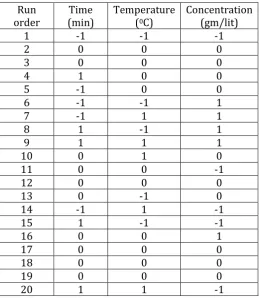
In this study, experiments were designed on the basis of the experimental design technique which refers to the planning of experiments, collection and analysis of data with near-optimum use of available resource (D.C.Montgomery). It is an experimental method designed and developed for evaluating the effects of process parameters on performance characteristics. It determines the process parameter conditions for optimum response variables. During experimentation, a large number of experiments have to be carried out as the number of machining parameters increases. Design of experiments involves proper selection of variables (input factors) and their interactions. The use of statistically derived centre composite design gives the number of experimental runs, to be carried out without affecting the quality of the analysis. Therefore, the centre composite design method was used to determine optimal machining parameters for maximum material removal rate and minimum undercut with less etching time. The centre composite design consists of all combinations of the input parameters taking on three levels. These are high, medium and low levels of factors. Accordingly to centre composite design 20 experiments were planned as per the selected design with one replication. The present investigation studied the results of the effects of Concentration, Time and Temperature on the volumetric metal removal rate, surface roughness and undercut during the PCM process of SS316L material. Input parameters and their levels are shown in Table 1.Table 2 shows experimental design matrix with coded and un-coded values of 20 centre composite design.
Table1. Input parameters and their levels
Factor/coding Notation (-1) (0) (+1)
Time (min) t 30 45 60
Temperature (0C)
T 50 65 80
Concentration
[image:2.595.308.568.302.601.2](gm/lit) C 600 750 900
Table 2 Experimental layout plan for centre
composite design of experiments (CCD)
Run
order (min) Time Temperature (0C)
Concentration (gm/lit)
1 -1 -1 -1
2 0 0 0
3 0 0 0
4 1 0 0
5 -1 0 0
6 -1 -1 1
7 -1 1 1
8 1 -1 1
9 1 1 1
10 0 1 0
11 0 0 -1
12 0 0 0
13 0 -1 0
14 -1 1 -1
15 1 -1 -1
16 0 0 1
17 0 0 0
18 0 0 0
19 0 0 0
20 1 1 -1
3 EXPERIMENTAL PROCEDURE
© 2016, IRJET | Impact Factor value: 4.45 | ISO 9001:2008 Certified Journal | Page 994 photosensitive, etchant-resistant polymer on both
[image:3.595.38.571.345.784.2]side. The coating is done on only on that part opposite to film. Then the specimen is UV exposed. The result of this process is a final component as per image on sheet of metal. The machining is done on that part which is not covered with photo-resist. The sheet is then dip in a heated etching solution. The metal not covered by the photo-resist is dissolved, leaving precisely. Metal with exposed and developed photo resist Metal etched nominal dimensions. The SS316L steel with chemical composition Carbon 0.03 %, Chromium 16.00 - 18.00%,Molybdenum 2.00-3.00 %, Sulphur 0.03 %, Phosphorus 0.045%, Nickel 10.00 - 14.00%, Manganese 2.00%, Silicon 0.75% was selected for experimentation. The thickness of specimen was 2mm and cut at 20mmX20mm dimension. FeCl3 chemical etchant was prepared at 3.76M. The amount of etchant for each experiment was 100ml. Single sided chemical etching was conducted. The measurements of thickness were carried out by mitutoyo micrometer (± 0.001 mm) and for Ra measurement TIME made roughness tester is used .Undercut is determined by using Rapid-I machine. Fig 1 shows schematic representation and photo of experimental setup.
a) Material before b) Square Phototool
machining
c) Photoresist Solution d) UV Exposure Unit
e)Chemical etching d) Finished Part
Fig. 1. Experimental Setup Of Photochemical
Machining
4 RESULTS AND DISCUSSION
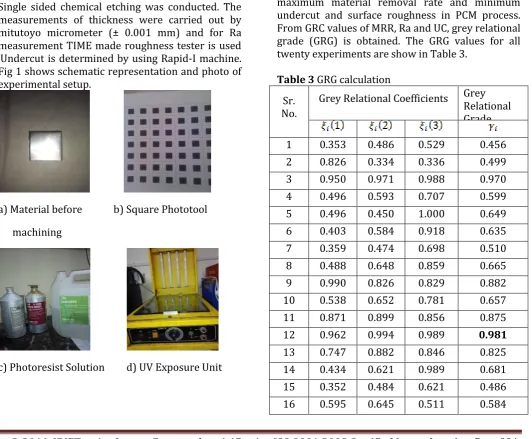
Grey relational analysis ranks the experiments based on the increasing order of their grey relational grade(GRG). The present investigation is focused on the improvement of maximum material removal rate and minimum undercut and surface roughness in PCM process. From GRC values of MRR, Ra and UC, grey relational grade (GRG) is obtained. The GRG values for all twenty experiments are show in Table 3.
Table 3 GRG calculation
Sr. No.
Grey Relational Coefficients Grey Relational Grade
1 0.353 0.486 0.529 0.456
2 0.826 0.334 0.336 0.499
3 0.950 0.971 0.988 0.970
4 0.496 0.593 0.707 0.599
5 0.496 0.450 1.000 0.649
6 0.403 0.584 0.918 0.635
7 0.359 0.474 0.698 0.510
8 0.488 0.648 0.859 0.665
9 0.990 0.826 0.829 0.882
10 0.538 0.652 0.781 0.657
11 0.871 0.899 0.856 0.875
12 0.962 0.994 0.989 0.981
13 0.747 0.882 0.846 0.825
14 0.434 0.621 0.989 0.681
15 0.352 0.484 0.621 0.486
© 2016, IRJET | Impact Factor value: 4.45 | ISO 9001:2008 Certified Journal | Page 995
17 1.000 0.971 0.818 0.930
18 0.877 0.911 0.978 0.922
19 0.984 1.000 0.902 0.962
20 0.530 0.541 0.519 0.530
Condition twelve is optimum at
Temperature =65°C, Concentration=750 gm/litre, and Time=45 minute. According to the experiment design, it is clearly observed from Table 3that the PCM process parameter setting of experiment no.12 has the highest grey relational grade. Therefore, experiment no.12 is the optimal process parameters setting for maximum material removal rate (MRR), minimum roughness and minimum undercut (UC) simultaneously (i.e. the best multi-performance characteristics) among the twenty experiments. In other words, the optimum condition for PCM performance for both material removal rate (MRR) and undercut (UC)) was found
for Temperature =65°C (level-0),
[image:4.595.317.569.348.517.2]Concentration=750 gm/litter (level-0), and Time=45 minute (level-0) combination. As listed in Table 4, the difference between the maximum and the minimum value of the grey relational grade of the photochemical machining parameters is as follow: 0.234 for time, 0.184 for temperature and 0.193 for concentration.
Table 4 Response table for grey relational grade
Level Time Temperature Concentration
1 0.586 0.613 0.606
2 0.82 0.797 0.799
3 0.632 0.652 0.655
Max -
Min 0.234 0.184 0.193
The most significant factors affecting PCM performance characteristics are determined by comparing thesevalues. This comparison will give the level of significance of the input factors over the multi-performancecharacteristics. The most effective controllable factor was the maximum of these values. Here, the maximum value among 0.234, 0.184 and 0.193 is 0.234. The value indicates
that the time has the strongest effect on the multi-performance characteristics among the selected PCM process parameters. On the other hand, the significant role of every input factor can be obtained by examining these values. The order of importance of the controllable factors to the multi-performance characteristics in the PCM process, in sequence can be listed as: factor A (time), C (concentration) and B (temperature), (i.e. 0.234>0.193 > 0.184). The factor time (0.234) was the most effective factor to the performance of the PCM process.
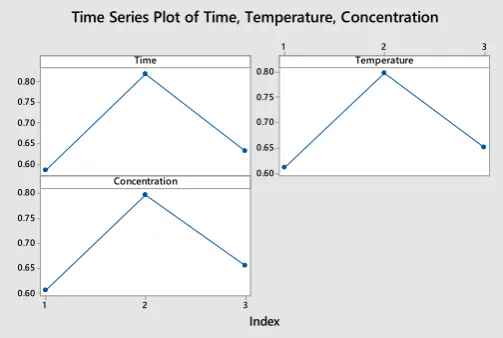
The main effects plots for grey relational grade Fig. 2.. In this study, Taguchi grey relational analysis was employed to optimize the PCM process parameters for multi-performance characteristics that include material removal rate, surface roughness and undercut in copper etching.
0.80 0.75 0.70 0.65 0.60
3 2
1
0.80
0.75
0.70
0.65
0.60
3 2
1 0.80
0.75
0.70
0.65
0.60
Time
Index
Temperature
Concentration
Time Series Plot of Time, Temperature, Concentration
Fig. 2 Main effect plots for grey relational grade
© 2016, IRJET | Impact Factor value: 4.45 | ISO 9001:2008 Certified Journal | Page 996 GRG value from 0.61 to 0.79 and from 65°C to 80°C
there is slight change in GRG value from 0.79 to 0.65. These values are the recommended levels of input machining parameters that gives the
optimum value of multi-performance
characteristics. The most influential factor observed from the graph is time. The order of importance of the input factors to the multi-performance characteristics is time, concentration and temperature. Experimental results have shown that the material removal rate, Ra and undercut in photochemical machining of SS316L can be improved effectively through the proposed approach. This study indicated that the grey relational analysis approach is a robust way to obtain optimal parameters from the multiple quality characteristics.
5 CONCLUSIONS
The gray-based Taguchi method is used to determine the optimal input parameter levels of photo chemical machining of SS316L with the multi-performance characteristics has been given in this paper. A gray relational analysis gives the single performance characteristic for MRR, Ra and UC in terms of grey relational grade.
1 The conditions of experiment number twelve, Temperature at 65°C, Concentration 750gm/litre, and Time 45 minute is optimum for MRR, Ra and UC.
2 The time has the most effecting parameter in photochemical machining of SS316L amongst the selected process parameters.
3 The order of importance of controllable factors effecting multi-performance characteristics in the photochemical machining of SS316L steel are in sequence can be listed as: factor A (time), C (concentration), B (temperature) and, (i.e. 0.234>0.193 > 0.184).
REFERENCES
[1] Tarng Y.S., Juang S.C., Chang C.H., “The use of grey-based Taguchi method to determine submerged arc welding process parameters in hardfacing”, Journal of Materials Processing Technology, 128, 1-6, (2002). [2] D.C. Montgomery, Design and Analysis of
Experiments, Wiley, Singopore, 1991. [3] J.L. Lin, Y. S. Tarng, Optimization of the
multi-response Process by the Taguchi method with grey relation analysis, J. Grey Syst. 4(4) (1998) 355-370.
[4] J.Deng, Control problems of gray systems, Syst. Contr. Lett. 5 (1982) 288-294.
[5] D.M. Allen, H.J.A. Almond, B. Maynard, Testing of a LIGA- Micro spectrometer for monitoring the dissolution of copper and stainless steel in aqueous ferric chloride solution, in: proceedings of the 2004 Design. Test, Integration and packaging of MEMS/MOEMS, accepted for publication. [6] D.M. Allen, L.T. Ler, The potential of oxygen
for regeneration of spent ferric chloride etchant solution, PCMI J, 59(1995) 3-7. [7] D.M. Allen, Heather J.A. Almond,
“Characterization of aqueous ferric chloride etchant used in industrial photochemical machining”, Journal of Materials Processing Technology 149 (2004) pp 238-245.
[8] D.M. Allen, and T.N. Talib, “Manufacturing of stainless steel edge filters: an application of electrolytic photo polishing”, precision engineering 1983, Butterworth & Co (Publisher) Ltd. Pp365-371.
[9] D.M. Allen, “Photochemical Machining: from manufacturing's best kept secret’ to a $6 billion per annum”, rapid manufacturing process CIRP Annals – Manufacturing Technology, Volume 53, Issue 2, 2004, Pages 559-572. 10. D.M. Allen, “Progress
towards Clean Technology for
Photochemical Machining”, CIRP Annals - Manufacturing Technology, Volume 42, Issue 1, 1993, Pages197-200.
[10] D.M. Allen, P. Jefferies An Economic,
Environment-friendly Oxygen-
Hydrochloric Acid Regeneration System for Ferric Chloride Etchants used in Photochemical Machining CIRP Annals - Manufacturing Technology, Volume 55, Issue-1,2006,PP-205-208. International Journal of Innovations in Engineering and Technology (IJIET) Vol.
[11] Rajkumar Roy, David Allen, Oscar Zamora, “Cost of photochemical machining”, Journal of Materials Processing Technology 149 (2004) 460–465
[12] N.S.Payaghan, S.B.Ubale,
Dr.M.S.KadamAnalysis & Optimization of Machining Parameters for Ra in EDM
Process of Cu-W Metal Matrix
© 2016, IRJET | Impact Factor value: 4.45 | ISO 9001:2008 Certified Journal | Page 997 Technology (IJMET), Volume 2, Issue 6, June
2014, pp477-485.
[13] Mr.Anandrao B. Humbe and