Georgia State University Georgia State University
ScholarWorks @ Georgia State University
ScholarWorks @ Georgia State University
Art and Design Theses Ernest G. Welch School of Art and Design
5-10-2014
Axis - A Theoretical Approach to Allegorical Pictorialism,
Axis - A Theoretical Approach to Allegorical Pictorialism,
Minimalist Ideologies, and Expressionism in Contemporary
Minimalist Ideologies, and Expressionism in Contemporary
Photography.
Photography.
David King
Follow this and additional works at: https://scholarworks.gsu.edu/art_design_theses
Recommended Citation Recommended Citation
King, David, "Axis - A Theoretical Approach to Allegorical Pictorialism, Minimalist Ideologies, and Expressionism in Contemporary Photography.." Thesis, Georgia State University, 2014.
https://scholarworks.gsu.edu/art_design_theses/143
This Thesis is brought to you for free and open access by the Ernest G. Welch School of Art and Design at ScholarWorks @ Georgia State University. It has been accepted for inclusion in Art and Design Theses by an authorized administrator of ScholarWorks @ Georgia State University. For more information, please contact
AXIS
A THEORETICAL APPROACH TO ALLEGORICAL PICTORIALISM, MINIMALIST IDEOLOGIES,
AND EXPRESSIONISM IN CONTEMPORARY PHOTOGRAPHY.
by
DAVID CURTIS KING
Under the Direction of Stewart Ziff
ABSTRACT
This Thesis explores the historical foundations and contemporary context of the
photographic series titled Axis. Within Axis are vestiges of traditional Pictorial
photography endowed with theories of minimalism and expressionism, which invites the
audience to expand its insight from what it can see, to what it can understand, both visually
and mentally. I will discuss how these influences have changed traditional pictorialism and
will focus this series’ trajectory. In examining the works of Axis, the theory, its active
practice, and principle of this series become clear. This practice, vested with craft mastery,
allegorical study, and symbolism, calls to question photography’s long-‐standing fine art
status and contemporary photographic trends.
AXIS
THEORETICAL APPROACH TO ALLEGORICAL PICTORIALISM, MINIMALIST IDEOLOGIES,
AND EXPRESSIONISM IN CONTEMPORARY PHOTOGRAPHY.
by
DAVID CURTIS KING
A Thesis Submitted in Partial Fulfillment of the Requirements for the Degree of
Master of Fine Art
In the College of Arts and Sciences
Georgia State University
2014
Copyright by David Curtis King
2014
AXIS
THEORETICAL APPROACH TO ALLEGORICAL PICTORIALISM, MINIMALIST IDEOLOGIES,
AND EXPRESSIONISM IN CONTEMPORARY PHOTOGRAPHY.
by
DAVID CURTIS KING
Committee Chair: Stewart Ziff
Committee: John Decker
Jill Frank
Electronic Version Approved:
Office of Graduate Studies
College of Arts and Sciences
Georgia State University
DEDICATION
In remembrance of my Father,
Curtis William King Jr.
“Sgt. Rock”, H-‐2/7 Vietnam (1966-‐1967)
TABLE OF CONTENTS
DEDICATION ... iv
LIST OF FIGURES ... vi
INTRODUCTION ... 1
PICTORIALISM, MINIMALIST IDEOLOGIES, AND EXPRESSIONISM IN CONTEMPOARY PHOTOGRAPHY ... 2
MASTEREY AND CONCEPTUALISM ... 7
AXIS – THE WORKS OF DAVID KING ... 18
CONCLUSION ... 29
BIBLIOGRAPHY ... 30
LIST OF FIGURES
2.1: LANCELOT SPEED, MERLIN AND VIVIAN 1912 ... 5
2.2: JULIA MARGARET CAMERON, VIVIEN AND MERLIN 1874 ... 6
3.1: EDWARD STEICHEN, LILAS BUDS: MRS.S. 1906 ... 13
3.2: JULIA MARGARET CAMERON, MARIANA SHE SAID I AM AWEARY, AWEARY, I WOULD THAT I WERE DEAD 1875 ... 14
3.3: ANSEL ADAMS, MOON AND HALF DOME 1960 ... 15
3.4: ANGELO MUSCO, XYLEM 2013 ... 16
3.5: ANGELO MUSCO, XYLEM (DETAIL) 2013 ... 16
3.6: CHRIS RAINIER, MENTAWIA, INDONESIA 2014 ... 17
4.1: DAVID KING, AXIS # 4 2013 ... 26
4.2: DAVID KING, AXIS # 8 2013 ... 27
4.3: DAVID KING, AXIS # 2 2013 ... 28
1. Introduction
This Thesis explores the historical foundations and visual details of the
photographic series titled Axis. This thesis will explain broad trends that I have identified
in pictorial photography, in tandem with, the theory of Minimalism and it’s relationship
with the audience, and subjective narrative elements gained from German Expressionism
while focusing on skill sets and craft mastery. This arrangement involves the audience’s
cooperation on a higher plateau than has been needed previously within art photography.
Though it is too early to tell if this is indicative to a broad movement, this thesis will discuss
how these influences have changed traditional pictorialism and will focus the series’
trajectory as a three-‐tier reactionary practice—reactions between the art and the audience,
the creator and the created, and contemporary photographic movements. In examination of
the series titled Axis, the theory, the active practice, and principle of the series become
clear. This practice, vested in craft mastery, allegorical study, and symbolism, calls to
question art-‐photography’s long-‐standing fine art status and contemporary photographic
trends.
2. Pictorialism, minimalist ideologies, and expressionism in contemporary photography
Pictorialism originally emerged from the struggle to establish photography as not only a useful tool for functional description, that is as a vehicle for what we are referring here, today, as truth, and visual documentation. But as a creative medium that was
accessible to the mark of the hand, and the mind, and was a suitable vehicle for what, speaking broadly, we might call the concerns of the poet.1
When looking at the series Axis, it is essential to understand that it combines
elements and influences from a multitude of past art movements: American pictorialism,
minimalism, and German expressionism. The simplest visual cues of Axis give values
regarding pictorialism, id est: the use of romantic lighting, the vignetting, and the use of
figurative study to name a few. Though, upon a more thorough inspection and decoding of
the work, a broader net is cast and understanding of how minimalism and expressionism
play part becomes relevant and necessary, as will be discussed.
The American pictorialist of the late 19th century abandoned notions that
photography was only a tool of documentation and never to become its own form of high
art, as was thought by the museum and gallery culture of that time. While painters of the
time were questioning their reasoning for realistic representation within their own works
on canvas, e.g. photorealism, the pictorialist sought to emulate paintings, not only in
technique and composition, but also their subjecthood-‐-‐ most notably historical and
mythological events and figures (Fig. 2.1, 2.2). Axis borrows from pictorialist the need to
create, or build an image, rather than document actions or events. In the activities of Axis,
the image is mentally constructed and composed well before the camera is considered.
1 A. D. Coleman, “ Return of the Suppressed: Pictorialism’s Revenge”,
Every aspect of the image is mentally rehearsed: angle of view, composition, focal length,
depth of field, et cetera. Also associated with the pictorialist, I value an appreciation for
esthetic beauty within the work itself. While the work of the pictorialist frequently
portrayed mythological scenes or historical context, within Axis I look to interpret
associations of my own understanding, much like the painters in the expressionists’
movement.
German expressionism was a direct retaliation to the French impressionist, and
their philosophy was simple, as Dietmar Elger writes:
What the Expressionists depicted was a simple, organic symbiosis, based on the rhythm of nature alone. They created a utopian counter-‐ world…
…This process of coming to terms with the world was nearly always accompanied by the painter’s personal emancipation.2
This opportunity to create art based solely on the artists view of events permeates the Axis
series, as do the expressionist’s desire to express and facilitate an involvement,
subjectively, between artist and artwork. This emphasis on emotional space was
incorporated again in the evolution of minimalism during the 1960’s.
Critics described minimalist sculpture by its simple modern lines and its
factory-‐made reductive properties. Comparable to expressionism, the idea of relationships
has strong implications when dealing with artwork once that piece becomes public. Where
the expressionist favored the bond between the art and the artist, minimalism dealt with
relationships between the art and viewer. In minimalist sculpture, the relationship is an
ethereal place where emphasis is placed on the physical interaction and movement of the
viewer within the proximity of the piece. This interaction is also characterized by the
2 Dietmar Elger, Expressionism: a Revolution in German Art, Rev. ed. (Italy: Taschen GmbH,
approaching and witnessing of the viewer in direct visual contact to the art.3 What Axis
takes from minimalism is its relationship between the audience and to the art itself, their
interactions and their communications.
This physical presence between viewer and art, and the subjective communication
the viewer has during the time they maintain that relationship, becomes integral. This
bond denotes that the Axis series exists as a reactionary form of art on a multitude of levels.
These levels can be broken down into three distinct types-‐-‐ reactions between the viewer
and art, with the artist and created, as well as against other photographic and art
movements.
3 Franco Bertoni, minimalist Architecture (Berlin, Germany: Birkhäuser Architecture, 2002),
2. 2 Julia Margaret Cameron, Vivien and Merlin 1874
3. Mastery and Conceptualism
For an artist, I feel, there is need to master one’s craft in order to use it to its highest
advantage and to better aid visual communication. Mastery of craft allows for a distinct
read that allows the audience the availability of visual information required to
communicate with the art piece. Though there is no guarantee in how an audience may
read any given art piece, failure to perform to this level is subsequently a failure in the
artist’s communication; hence the story the artist has authored, what ever subject that may
be, is lost completely. Subjectivity becomes the only merit, one that the artist never truly
instilled into the art in the original. As I will discuss momentarily, in the origins of pictorial
photography, certain rules of mastery were neglected or even abandoned altogether.
In order to invoke more theatricality to visual works founded in literature and
history, many photographers of the early 19th century who were to become known as
pictorialist heavily used artifacts such as lens manipulation and soft focus4, among mass
other techniques. Looking at pictorial works such as Edward Steichen’s Lilas Buds: Mrs. S.
(Fig: 3.1), some of these artifacts, and his inherent lax in formal execution, become
apparent. In this artwork, the artist depicts a youthful woman. The corners of the frame
have a soft blur, the depth of field is shallow, and highlight and shadow values loose some
detail. These effects cause the viewer to give attention to what only can be clearly read.
This tunneling effect also seems to constitute a dream-‐like feeling, or an occurrence of a
clouded memory, towards the viewer. Another pictorialist, Julia Margret Cameron, is well
known for her pictorial photographs (Fig 3.2), which incorporate these same fundamentals.
These artifacts, and others like it, were achieved in a variety of techniques. Early on, use of
the view camera allowed for manipulation of the focal plane itself for a variety of results.
By the 1850’s the use of wet-‐plate collodion photography allowed photographers to
manipulate the photographic emulsion due to its inherent attributes. A photographer
achieved an effect by allowing the light-‐sensitive emulsion to move, causing a blur around
the edges of the glass plate. Other photographers attained this by applying thin coats of
petroleum-‐based solvents to the outer areas of their lens’, these photographers were able
to capture an image, which were sharp and in extreme focus in the center, yet softened and
blurred going towards the edges, and vastly soft on the extreme edges (Fig 3.1). In today’s
environment this result can be reproduced with soft-‐focus or tilt-‐shift lenses or with digital
software. Peter Bunnell, in his writings on “Pictorial Photography” states:
The Aim of this photographic style was to make poetic, expressive photographs related to, and, in some cases derived from, the traditional arts in matters of content and meaning. A tenet was that in issues of craft or technique, the act of making a fine photographic print was analogous to the creative and tangible articulation of materials in any medium.5
Selective focus, along with disregard for the highlight and shadow detail in early
pictorial photography, abandoned a mastery of craft which for centuries had been sought
after in all other disciplines of art, and strived for by other photographers of the time; as
seen within in the works of Ansel Adams depicting his legendary landscapes of Yosemite
National Park (Fig 3.6). This may be due in part to many non-‐pictorialist utilizing
photography for a more scientific and or documentary nature in direct opposition to the
pictorialist of the early 19th century. In the Journal Of The University Film Association,
5 Peter C. Bunnell, “Pictorial Photography” Record of the Art Museum, Princeton University,
Jonathan Green stated:
Photography has always been popular art. In spite of many early predictions that the medium would become a high art form, the vast majority of photographers have not used it to explore and resolve the problems of form and expression which we have come to know as sophisticated art.6
Herein lies a vast problem and paradox: even in the contemporary art world photography
is still fighting for stature as a high and sophisticated art. At the same time if we argue
against Green’s assumption and state that photography has explored the problems of form
and expression then we must conclude that it has failed in its pursuit, relegating it back to
only a popular art form and not that of a high art or sophisticated one. If, indeed,
photography had reached the suggested level of high and sophisticated art, then Green’s
statement would need abandonment in its entirety. Many others and I would argue that
photography is still struggling for this accreditation. These matters are in fact due in part
by photography’s stance on mastery being irrelevant to procedure and conceptual
execution; ideals fought against by those like Ansel Adams. In short, pictorial photography
has disregarded art’s basic principles and elements (Form, value, balance, unity, etc.). Yet
this stance of concept over mastery becomes problematic due to its lack of visual
vocabulary and its inability to provide accurate communication; conceptual comprehension
is lost. Though one cannot just state the opposite, which would be that mastery should be
given credence over conceptual, for then concept and meaning are lost. Given this, we can
see that both mastery and conceptual practice must be given equal attention for an order of
alignment, thus allowing for proper communication. This accounting for equilibrium is
6 Jonathan Green, “Photography as Popular Culture” Journal of the University Film
evident in further readings of Green’s:
The term Pictorialism derives from a conception biased on the primacy of making a picture, not merely showing something or stopping an action or event, but taking the information of observable reality and transforming it in a way that is unique to the realm of two-‐dimensional art.7
With proper communication skills the artist photographer becomes able to enter into
discussion on a higher, sophisticated level of fine art. Though as one door closes, another
one opens. With the advent of the digital age, photographers are now pressed with new
queries concerning digital manipulation and reproduction.
The concerns of digital manipulation of the image are complex. Where in
manipulation has always been present in photography, critics argue for the “truth” of an
image8. They state that once a photograph is manipulated it ceases to be a photograph and
becomes an illustration. Though for years photographs were manipulated and still
accepted. Miles Orvell stated in a symposium titled “Truth, Lies, and Photographs”:
Arthur Rothstien’s article on direction in the picture story, written for the complete photographer in 1942, makes clear the degree of manipulation that was accepted practice among social documentary photographers. Rothstien wrote “provided the results are a faithful reproduction of what the photographer believes he sees, what ever takes place in the making of the picture is justified.”
That in mind, even early wet plate collodion negatives have been known to be
stacked atop another to achieve details in a sky, or in the setting up a photograph, such as a
still life, many argue that the act of taking a two-‐dimensional photograph is a manipulation
in and of itself, betraying reality. The photographer manipulates the viewer’s presence to
7 Green, 15-‐20
8 Tom Gunning, “What’s the Point of an Index? Or Faking Photographs’” Nordicom Review,
the situation by limiting your availability of information as well as interaction.
Manipulation now becomes choice-‐-‐ the choice of the photographer of when to stop
manipulating and not the fact that they have manipulated.
The apprehensions with digital photography’s ability to reproduce is evident more
so than in its predecessor, the dark room. In contemporary photography, there is only the
artist who can deem how many identical prints will be made of any given image. In the
recent past, photographers, utilizing traditional darkroom techniques, could make
duplicate prints from the same negative, though each print may differ slightly due to acts of
chemistry or printing strategies. With the advent of archival color printers and digital files,
this is no longer an issue; the photographer only need to tell a computerized system to
reproduce to whatever quantity desired. Artists, such as painters, never acquired this
problem due to the medium’s inherent qualities; one must paint in order to have a single,
one-‐off painting. Photographers have had to endure this problem much as sculptural metal
and ceramic artists have who use mold-‐making techniques in making their art. The lost-‐
wax process can yield infinite, exact reproductions from a single mold, much the same way
a photographer prints from a single digital file. In this tense climate of reproducibility,
some photographers have pushed back against technology, regressing back to more
historical photographic practices, which result in a one of a kind photographic art piece.
Due to conflicting ideologies, a separation between traditional film photography and digital
photography has raised subcultures and elitist mentalities within this medium.
Some contemporary pictorial photographers utilize the dry-‐plate method, and many
other methods, while others have come to embrace technology and merely allow only for
The validly of photography’s acceptance as a sophisticated high art form lay not in the use
of any technique, but in the mastery of that specific technique. This attitude is vastly
apparent in artist photographers such as Angelo Musco (Fig 3.4, 3.5), Chris Rainier (Fig
3. 2 Julia Margaret Cameron, Mariana She said I am aweary, aweary, I would that I were dead 1875
3. 4 Angelo Musco, Xylem 2013
3. 6 Chris Rainier, Mentawia, Indonesia 2014
4. Axis – The Works of David King
The interpretation of dreams and symbols demands intelligence. It cannot be turned into a mechanical system and then crammed into unimaginative brains. It demands both an increasing knowledge of the dreamer’s individuality and an increasing self-‐awareness on the part of the interpreter.9
In the series titled Axis, ideas and influences from many different sources are
brought together to explore, research, and visualize an emotional presence derived from
subconscious thought. With attention to craft mastery, symbolism, and narrative, the focus
of this work showcases allegorical scenes depicting opposing polarities and emotion.
These depicted scenes tell a story, or at least part of one. The camera is utilized here
more than just a tool used for recording visual information, but in the same way a painter
uses oils and brush strokes on a canvas, or a master-‐mason carves a stone-‐-‐ in a careful,
specific, predetermined effort for a specific outcome. The manner in which these artworks
present themselves: their scale, subject matter, and symbolism persuades the viewer to
regard them within the scope of art historical context, as will be discussed in the following
passages. These photographic artworks are premeditated, composed, and rehearsed, just
as a theatrical play is before its opening night. Like a theatrical production, there is an
apparent aim to capture the audience’s attention as well as to try to invite an affective
response from them. Stephanie Cash, Editor of BURNAWAY Magazine, had this to say about
the series:
The dreamlike black-‐and-‐white photographs of David King capture various models, in landscapes, in poses of struggle, surrender, searching, or ascension. King stages cryptic scenes in order to give visual form to emotional states and innermost thoughts…10
This example of the theater also serves well for defining the idea of being a pictorial
photographer. Like the theater, the intent of this approach to imagery is to personify not
only the meaning of the work, but also its inherent esthetic beauty. Driving this is the belief
that art, as a whole, has lost the formal beauty that it held before the modernist movement,
and that which I am drawn to. By formal beauty, I mean the emphasis of mastery, formal
principals, and elements of art (Unity, balance, shape, etc.) that are used for a specific
purpose in which to make an artwork visually appealing as well as conceptually aware.
This ideology, at times, directly conflict against other contemporary photographers who
choose to abandon or neglect any thoughts of learning their craft, becoming solely reliant
on theoretical conception without the ability to visually convey it.
The creation of this work is conceptualized as an experiment in subconscious
thought. C.G. Jung, a psychologist of the mid 20th century, proposed the belief of specific
archetypes and a collective unconscious within the subconscious of all individuals.
Residing in our subconscious, these archetypes are personified by the “Anima/Animus,
Shadow, and the Self”11. Using that idea as inspiration, this body of work started as an
experiment to try and depict the actions of my subconscious. These works use symbolism
recreating events within my own psyche discovered through sensory deprivation,
meditation, and dream interpretation. The images are void of color as well as any specific
narrative to allow their audience insight and subjective reinterpretation. The images
explore an act of contemplation and the realization of instinctive and involuntary thought
and practice while focusing on those inherent within one’s own self. This labor is an effort
to isolate and deeply examine the genuine inner workings of emotional space. The
emotional space, or vagueness, opens the viewer’s own subconscious and allows for
greater interaction with the art itself. While directing the audience’s eye, this body of work
is meant to push the audience to find their own message. Now; the source is not the direct
subject of the work-‐-‐ it was only the Muse, or stimulus, that ignited the inspiration at that
time. Looking at some of these photographs singly, deeper meanings are found in every
aspect of the image.
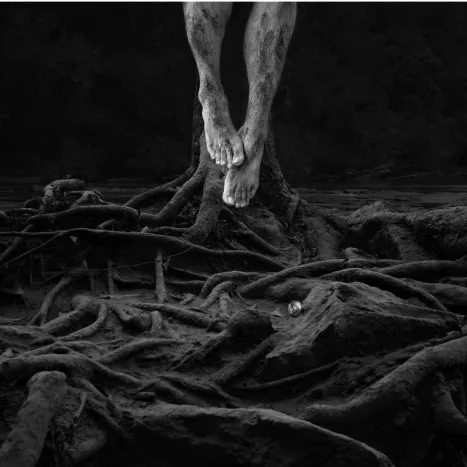
In Axis # 4, the audience is situated at an extreme low vantage point. In this highly
center weighted photograph, a labyrinth of tree roots cradles a small sphere in the
foreground. Just above the centerline, the tree roots give way to a flowing riverbank,
nestled by a shadowed tree line. Breaking these horizons, two human legs are situated
vertically down the centerline. They appear scuffed, muddy, and do not touch the ground.
These components are not randomly placed; each element in this artwork is purposefully
thought-‐out and positioned with care.
The composition of Axis # 4 (Fig 4.1) layers symbolism in an intriguing sonata of
motion and fluidity. The center point to this photograph is the striking pair of legs and feet,
which are stationed above the ground, independent of it. The legs and feet allude to
discord with their filth, but show grace with their relaxed stance. In this visual, it is left to
the audience to interpret whether this figure is suspended somehow from above or
elevating from the earth. Some may argue that this image is a visual representation of the
crucifixion of Christ. In both allegories we are given the visualization of a male who had a
rigorous life infused with struggle; a life, which rose against opposition and the notion of
the motions of them show pathways and interchanges. Yet this turmoil unites into the
single force of growth, represented by the tree. This is meant to symbolize the past and
decisions one has made in a single lifetime. Settled within the roots of the tree sits a single
sphere. The sphere is a direct reference to an idea and belief. This idea comes from the
thought of, and actions taken to, perfecting one’s “Self”. This wholeness of self is well
described by M.-‐L. Franz in, Carl G. Jung’s book, Man and his Symbols while describing one
man’s dream:
The dark oval stone, that she rubs and polishes, symbolizes the dreamer’s innermost being, his true personality. Rubbing and polishing stones is a well-‐known, exceedingly ancient activity of man.
The lioness and her son, which appear on the scene, personify the urge toward individuation, indicated by their work at shaping the round stones. (A round stone is a symbol of the Self.)12
This idea of the “Self” being visualized by a sphere in Axis #4 does not stand alone as
definitive. In this image the stone “Self” is characterized by a great masher. A great
masher, being the largest marble in the game of marbles, is most commonly used to either
start the game or to end it by clearing the board. This duality in interpretation allies with
the action of the legs, as described previously. Past the foremost imagery, we see a river
flanked by a tree line. Here the trees symbolize both growth and observance by non-‐
descript others, while the river and its flowing water reemphasize the flow of life and
constant change. In opposition to this constant change, visually subdued within the
twisted roots of the foreground, we find a single, large, rough, rock. This rock is a direct
homage to Curtis King, my father. Featured here, within the turmoil of the roots, places this
man, whose nickname was Sgt. Rock in the Vietnam War, directly in the pathways and
histories of the one whose life makes up the icon of the tree; in part, helping to direct, or
impede.
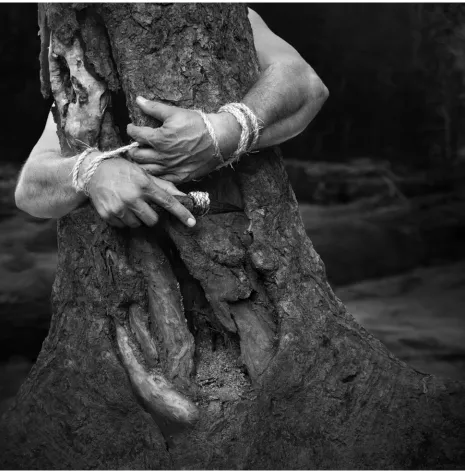
In a second image, titled Axis #8 (Fig 4.2), the audience find themselves, once again,
at a low angle, looking straight at an off-‐centered tree. Two hands wrap around the tree
and are bound at the wrist to each other with thin rope. One hand clenches an opening in
the tree as the other positions a wooden tool that is also bound in rope. In this
transcendental landscape, the viewer is not allowed to see the top of the tree, nor the
ground, but sight of a wild river flows towards the subject, just out of focus.
The photograph is artfully vignetted, bringing emphasis to the imposing tree trunk.
The trunk’s bark is cracked and broken; the tree is split down the center as rot, termites,
and seeds spill from within the tree. The imagery of the tree is a surrogate to the life of the
one who is bound to it and to the tree of life found across multiple religions (Celtic,
Christianity, and Norse). The expulsion from the tree’s center portrays aspects of the three
stages of life, and also alludes to Danu, the triple goddess in traditional Irish Danann-‐-‐
maiden, woman, and hag-‐-‐ as well as in Nordic religion of the Tree and the Three fates:
past, present, and future. This employment of the number three is echoed again in a total
of three times: three items pouring out of the tree, three objects bound, and by three lashes
each.
The figure in this photograph is bound to the tree, but at the same time embracing it.
The manner in which the hands are depicted show both strife and acceptance. One hand
intensely grips the tree’s opening, wanting to break free from the captivity, while the other
lies in a dormant pose holding a tool that could possibly free the binds. This act is
multiple purposes. While this instrument can be used as a freeing device, it is also an
arcane writing utensil. As a writing device, this utensil is an implement of knowledge, but
the fact that it is too bound nullifies its purpose as an artifact of education as well as its role
in freeing of the individual. What we come to find is a being who is repelled by what they
are embracing while having all the power to free themselves and choosing complacency as
the bark digs into their body.
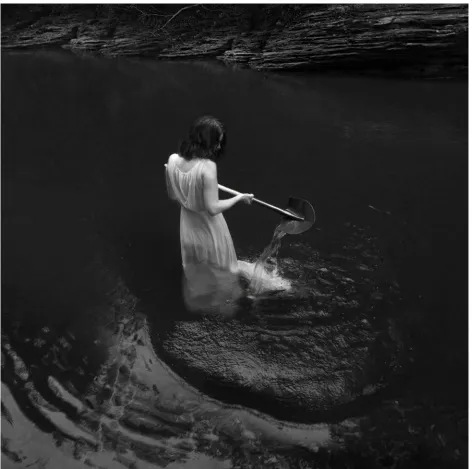
Axis # 2 (Fig 4.3) shows the audience a different perspective than Axis # 4 and # 8.
The viewer is placed well above, looking downward towards the subject. A woman stands
just off center, thigh deep, in a body of water. She is dressed in a white gown and is in the
action of manipulating the water with a spaded shovel. Framing the top of the image
stands a wall of metamorphic stone, the only indication of land in the image.
Within this artwork, symbolism is combined with theories of surrogacy and Jungian
psychology. In this image the shovel serves as a representation for the conscious mind as it
attempts to move and manipulate the surrounding water. The water, thusly, performs as
the opposite, the subconscious. While retaining the icon of the subconscious, the water
also serves to illustrate the flow of life and passage of time, as it does throughout the works
of Axis. Here, water also serves as a point of origin and destination concurrently; it
symbolizes the point from which we are born and must one day return.13 Protruding from
the water, the female form, basked in white, attempts to control the flow of the water. This
physical attempt depicts the action and futility of trying to control both life and
subconscious thought. As can be seen, while this entity carries out her manipulation, she
herself is being manipulated, in return, by the water’s influence on her flowing dress. This
13Marie L. Sjoestedt, Celtic Gods and Heroes (New York: Dover Publications, 2000), 24-‐73
account causes an unending cycle-‐-‐ while enclosed to one’s self, the repercussions of which
flow outward to affect things universally, as depicted by the rippling waters. The rock wall
that frames the top portion of the photograph is a formidable boundary. This boundary
allows the viewer to understand that this process is taking place inside a predetermined
area. The broken reflections of this wall suggest that this area is within the subconscious
itself, the water only being able to reflect the conscious domain that makes up this wall. In
understanding that this artwork is an association to the subconscious, it is needed to also
recognize the icon of the female from within it.
The icon of the female form becomes better understood when identified with
surrogacy and Jungian psychology. C. G. Jung suggested all people have a masculine or a
feminine archetype within their subconscious. In this system M.-‐L. Franz states:
If the dreamer is a man, he will discover a female personification of his unconscious; and it will be a male figure in the case of a woman. Often this second symbolic figure turns up behind the shadow,
bringing up new and different problems.14
The idea of the Anima (feminine) and Animus (masculine)15 allows the artwork to be
viewed as a self-‐portrait, depicting actions between conscious and subconscious reasoning.
This concept carries over to all works within Axis.
Upon approaching the physical artworks which makeup the series titled
Axis, the audience is confronted not only with the scale of the photograph, approximately
three foot square and larger, but also with each piece’s stark contrast in value, their grave
attention to detail, the overarching monochromatic atmosphere, and their inherent
symbolism within allegorical themes.
What is extremely appealing is not just the art itself, but the meeting and
conversation between the art and it’s audience, no matter the subjecthood of the work. The
aspect of these images that becomes apparent is the vast degree of subjective dialogue that
arises, not towards the intended “storyline” but to this invisible “axis.” This emotional
space, or vagueness, opens the viewer’s own subconscious and allows for greater
interaction with the art itself. It is this relationship between the audience and art piece
which allows Axis to surpass the physical boundaries of the art itself and gain further
fruition. What matters most is not only the work itself, but also the relationship between
the viewer and the art.
[image:34.612.73.540.99.566.2]
Fig 4. 3 David King, Axis # 2 2013
[image:36.612.72.544.69.538.2]
5. Conclusion
Looking at these works in concise detail it becomes clear how the series Axis is
influenced by past art movements and theories, and how these influences have changed
traditional pictorialism. This three-‐tier reactionary movement—in reaction between the
art and the audience, between the creator and the created, and other contemporary
photographic movements shows the art-‐author’s push away from contemporary
photography’s desire to document and recontextualize and towards vestiges of traditional
and formal practice in pictorial photography. The amalgamation of this effort and theories
from sculptural minimalism and German expressionism allows for subjectivity while
allowing the author to expressively create. This practice, vested in craft mastery, allegorical
study, and symbolism, answers the questions regarding photography’s long standing status
in the art-‐world, and devotes it to a more sophisticated high-‐art form.
Bibliography
Allen, N. and Snyder, J. “Photography, Vision, and Representation” Critical Inquiry 2:1 (1975) 143-‐169.
Bertoni, Franco. Minimalist Architecture. Berlin, Germany: Birkhäuser Architecture, 2002.
Boeckx, Cedric: Linguistic Minimalism: Origins, Concepts, Methods, and Aims. New York: Oxford University Press, 2006.
Bunnell, P. “Pictorial Photography” Record of the Art Museum, Princeton University, The Art
of Pictorial Photography 1890-‐1925 51:2 (1992) 2+10-‐15.
Byock, J. and Sturluson, S. The Prose Edda: Norse Mythology. New York: Penguin Books, 2006.
Coleman, A. “ Return of the Suppressed: Pictorialism’s Revenge”, http://www.youtube.com/watch?v=_Ig-‐AEe5AMs.
Daum, Prodger P. and Ribemont, F. Impressionist Camera: pictorial Photography in
Europe,1888-‐1918. London, England: Merrell Publishers, 2006.
Dronke, U. The Poetic Edda. New York: Oxford University Press, 1969.
Elger, D. Expressionism. Berlin, Germany: Taschen, 1989.
Gelfand L and Gibson W. “Surrogate Selves: The “Rolin Madonna” and the Late-‐Medieval Devotional Portrait.” Netherlands Quarterly for the History of Art 29:3/4 (2002) 119-‐138.
Green, J. “Photography as Popular Culture” Journal of the University Film Association, Topics
in Film/Video/Photography Theory (1978) 15-‐20.
Gunning, T. “What’s the Point of an Index? Or Faking Photographs’” Nordicom Review, Vol. 1:2 (2004): 39-‐49.
Harbison, C. “Visions and Meditations in Early Flemish Painting” Simiolus: Netherlands
Quarterly for the History of Art 15:2 (1985) 87-‐118.
Jung, Carl G. Psychology and Alchemy. New Jersey: Princeton University Press, 1968.
Jung, Carl G. and Franz, M.-‐L. Man and his Symbols. New York: Doubleday, 1964.
Knowles, Sir James. The Legends of King Author and His Knights 9th Ed. London; New York:
Leja, M. Reframing Abstract Expressionism: Subjectivity and Painting in the 1940’s. Connecticut: Yale University Press, 1993.
Lopes, D. “Pictorial Realism” The Journal of Aesthetics and Art Criticism 53:3 (1995) 277-‐ 285.
MacDermid, S. and Marks, S. “Multiple Roles and the Self: A Theory of Role Balance” Journal
of Marriage and Family 58:2 (1996) 417-‐432.
MacKenzie, A. “Pictorial Photography at Glasgow” Brush and Pencil 8:3 (1901) 169-‐173, 175-‐176.
McGrinn, B. “On Mysticism & Art” Daedalus 132:2 (2003) 133-‐134.
Musco, Angelo. Xylem. www.angelomusco.com/xylem.
Myer, James. Minimalism: art and polemics in the sixties. Connecticut: Yale University Press, 2004.
Orvell, M. “Truth, Lies, and Photohraphs: Social Documentary and Pictorial Manipulation” http://www.youtube.com/watch?v=vNqqXW3_swo.
Phillips, C. “The Judgment Seat of Photography” The MIT Press October 22 (1982) 27-‐63.
Rainier, Chris. Mentawia, Indonesia
http://www.chrisrainier.com/#s=0&mi=2&pt=1&pi=10000&p=10&a=0&at=0.
Sjoestedt, Marie L. Celtic Gods and Heroes. New York: Dover Publications, 2000.
Smith, P. W.B. Yeats and the Tribes of Danu. England: Colin Smythe Ltd., 1986.
Stephanie Cash, e-‐mail message to author, November 12, 2003.
Ward, J. “The Perception of Pictorial Space in Perspective Pictures” Leonardo 9:4 (1976) 279-‐288.
Weaver, M. Whisper of the Muse: The Overstone Album and Other Photographs by Julia
Margaret Cameron. New York: Oxford University Press, 1986.