ScholarWorks @ Georgia State University
ScholarWorks @ Georgia State University
Chemistry Theses Department of Chemistry
4-20-2010
An Analysis of Prominent Water Models by Molecular Dynamics
An Analysis of Prominent Water Models by Molecular Dynamics
Simulations
Simulations
Quentin Ramon Johnson
Georgia State University, [email protected]
Follow this and additional works at: https://scholarworks.gsu.edu/chemistry_theses
Recommended Citation Recommended Citation
Johnson, Quentin Ramon, "An Analysis of Prominent Water Models by Molecular Dynamics Simulations." Thesis, Georgia State University, 2010.
https://scholarworks.gsu.edu/chemistry_theses/30
This Thesis is brought to you for free and open access by the Department of Chemistry at ScholarWorks @ Georgia State University. It has been accepted for inclusion in Chemistry Theses by an authorized administrator of
BY MOLECULAR DYNAIMCS SIMULATIONS
by
QUENTIN JOHNSON
Under the Direction of Dr. Donald Hamelberg
ABSTRACT
Water is the most common solvent for most biological reactions, therefore it is vital that
we fully understand water and all its properties. The complex hydrogen bonding network that
water forms can influence protein-protein and protein-substrate interactions and can slow protein
conformational shifts. Here, I examine an important property of water known as energetic
roughness. The network of interactions between individual water molecules affect the energy
landscape of proteins by altering the underlying energetic roughness. I have attributed this
roughness to the making and breaking of hydrogen bonds as the network of hydrogen bonds
constantly adopts new conformations. Through a novel computational approach I have analyzed
five prominent water models and have determined their inherent roughness to be between 0.43
and 0.62 kcal/mol.
INDEX WORDS: Abstract, Thesis, Energetic Roughness, Department of Chemistry, Quentin
AN ANALYSIS OF THE ENERGETIC ROUGHNESS OF PROMINENT WATER MODELS
BY MOLECULAR DYNAIMCS SIMULATIONS
by
QUENTIN JOHNSON
A Thesis Submitted in Partial Fulfillment of the Requirements for the Degree of
Master of Science
in the College of Arts and Sciences
Georgia State University
Copyright by
Quentin Johnson
AN ANALYSIS OF THE ENERGETIC ROUGHNESS OF PROMINENT WATER MODELS
BY MOLECULAR DYNAIMCS SIMULATIONS
by
QUENTIN JOHNSON
Committee Chair: Donald Hamelberg
Committee: Donald Hamelberg
Stuart Allison
Davon Kennedy
Electronic Version Approved
Office of Graduate Studies
College of Arts and Sciences
Georgia State University
DEDICATION
I would like to take this opportunity to dedicate this manuscript to Dr. Donald
Hamelberg, who introduced me to the field of computational chemistry and has been a constant
inspiration for me. Dr. Hamelberg has not only been my advisor throughout this process but has
ACKNOWLEDGMENTS
I am very appreciative for the boundless friendship, advisement and acceptance that I
have incurred throughout my stay here at Georgia State University. I would like to thank Dr.
Donald Hamelberg for the direction he has given me and all the help he has afforded me over the
years. Also, a thank you goes to Adam Velasquez for his friendship and pressure lifting attitude
that helped me make it through the hard days. Urmi Doshi deserves my thanks for the help she
gave me and also for her stern but constructive criticism. I would also like to thank Jennifer
Kelley for providing assistance and experience in the lab. Thank you Yao Xin for being a soft
spoken leader in the lab giving me an idea of how to roll with the punches. Thank you to Lauren
McGowan for giving me someone to identify with in the lab and providing a few laughs in times
of need.
I would also like to extend my thanks to Dr. Alfons Baumstark for his excellent
advisement, for working hard to help me achieve this goal and for introducing me to Dr.
Hamelberg. Thank you to Will Lovett for his help every semester and for making sure that I
graduated. A special thank you goes to the entire department for helping me get to this point and
for accepting me into the fold.
I would like to thank my mother Sylvia Johnson, sister Monique Johnson, and father
George Johnson for believing in me and providing support throughout my college career. I can
always count on my family to make a vacation a vacation. I appreciate all the holidays I spent
with you all and am only sorry that in my pursuit of education I have not had more time for the
TABLE OF CONTENTS
ACKNOWLEDGEMENTS ... iv
LIST OF TABLES ...viii
LIST OF EQUATIONS...ix
LIST OF FIGURES ...x
LIST OF ABBREVIATIONS……….………xi
1 INTRODUCTION ...1
1.1 Purpose of the Study...1
1.2 Expected Results ...1
1.3 Molecular Dynamics Background...1
1.4 Energetic Roughness Background...3
1.5 Water Roughness...5
1.6 Slaving...5
1.7 Importance of Study...7
2 RESULTS...8
3 DISCUSSION...15
3 CONCLUSION...18
4 EXPERIMENTAL ...20
4.1 TIP3P...20
4.2 TIP4P...27
4.3 SPC/E...28
4.4 TIP5P...29
4.5 Vacuum...31
LIST OF TABLES
LIST OF EQUATIONS
Equation 1.1...2
Equation 1.2...3
Equation 1.3...6
Equation 2.1...9
Equation 2.2...10
Equation 2.3...10
Equation 2.4...10
LIST OF FIGURES
Figure 1.1...6
Figure 1.2...8
Figure 2.1...9
Figure 2.2...11
Figure 2.3...12
Figure 2.4………..13
Figure 3.1...16
LIST OF ABBREVEATIONS
fs femto seconds
ns nano seconds
ps pico second
MD molecular dynamics
CHAPTER 1
INTRODUCTION
Purpose of Study
Water plays a very important role in the dynamics and function of proteins, and the
network of interactions between individual water molecules affects the energy landscape of
proteins by altering the underlying energetic roughness. The purpose of this study is to
mathematically evaluate the amount that water contributes to this “roughness” in hopes to better
understand the functions of proteins and assess the differences of the water models.
Expected Results
I expect that the effect of the interactions of water on the overall energy landscape by
alteration of the energetic roughness will be substantial considering that that hydrogen bond
network of water is intricate and vast. The energetic component of hydrogen bond network
rearrangements has been estimated to be between 0.8 and 1.5 kcal/mol using x-ray absorption
spectroscopy. This value represents the average thermal energy required to distort a hydrogen
bond or to rearrange or change the fully coordinated configuration of water to a configuration
with a broken hydrogen bond to the donor. I expect that the contribution of water's energetic
roughness will fall somewhere in this range, approximately 1 kcal/mol.
Molecular Dynamics Background
Molecular dynamics (MD) is a type of computer simulation that combines chemistry,
math and physics to simulate the motions and interactions of atoms, molecules, and
biomolecules. Atoms and molecules are set up to interact for a period of time by approximations
is frequently utilized in the study of proteins and other biomolecules. It is possible to take
snapshots of crystal structures and probe features of the motion of molecules through nuclear
magnetic resonance NMR, however no conventional experiment allows access to all the time
scales of motion with atomic resolution. Molecular dynamics normally employs crystal structure
from the Protein Data Bank or PDB as the starting structures of a multitude of biomolecules and
adds velocities and coordinates through a combination of complex algorithms, physical
chemistry and physics. Molecular dynamics allows scientists to visualize the motions of
individual atoms in a way that is not possible in laboratory experiments. Molecular dynamics is
based on statistical mechanics and uses a potential energy function with multiple components to
define a system as well as the time-dependent behavior of the system.
E = Ebondstretch + Eangle-bend + Edihedral + Eother + Enonbonded
(Equation 1.2: Amber force field function-Note that despite the term force field, this
equation defines the potential energy of the system; the force is the derivative of this
potential with respect to position.)
The MD method relies on the assumption that statistical ensemble averages are equal to time
averages of the system. This assumption is known as the Ergodic hypothesis. MD simulations
are usually done over short time scales, pico to nano seconds, because longer simulations require
extreme computational power and can be very computationally expensive.
Energetic Roughness Background
While the concept is relatively abstract, it is a physical anomaly and can be defined
through mathematic means. Energetic roughness results in the slowing of bimolecular motion by
restricting the biomolecule through bumps in the energy landscape, during conformational
transitions for example. Somewhat like speed bumps in a road slowing a car from moving from
sub-cellular processes. However, switching between different ensembles of protein
conformations that are important for function can result in complex dynamics due to the
complexity of the energy landscape . The energy landscape of proteins is very rugged and
represents a huge number of conformational states, including the surrounding water molecules
that are an integral part of biomolecular structure . The unevenness of the energy landscape could
lead to kinetic traps if it is comparable or much greater than kBT, where kB is the Boltzmann
constant and T is the temperature. Theories have been developed to highlight the nature of the
inherent roughness of the energy landscape of biomolecules, and experiments have been
proposed and carried out to measure this property . The ruggedness of the energy landscape is
due mainly to intra-protein, protein-water, and water-water interactions that are formed and
broken in different substates or as the protein undergo large conformational changes between
two different substates. Characterizing the nature of the underlying landscape roughness and
calculating the magnitude of the different contributions will provide a better insight into the
dynamics and function of proteins.
Here, we have calculated the effect of water on the energy landscape of proteins using
molecular dynamics simulations and by developing a model based on the position space analog
of the Ornstein-Uhlenbeck process to extract the contribution of the energetic roughness. This
approach has allowed us to study an important property of the widely used atomistic simulation
water models that directly affects the dynamics of biomolecular systems. When the roughness,
which is calculated to be around ~1 kcal/mol, is much greater than kBT, the network of hydrogen
bonds could increase the frustration on the landscape of proteins. Also, this aspect of protein
dynamics could have much broader implications on the function of some classes of enzymes as
Water Roughness
In addition to the ruggedness of energy landscape of protein, water also has a rugged
potential energy landscape, with each point representing a different hydrogen bonding network.
Therefore, water by itself has slow dynamics, since it has to form and break hydrogen bonds as
the network of hydrogen bonds rearranges . The energetic component of hydrogen bond network
rearrangements has been estimated to be between 0.8 and 1.5 kcal/mol using x-ray absorption
spectroscopy. This value represents the average thermal energy required to distort a hydrogen
bond or to rearrange or change the fully coordinated configuration of water to a configuration
with a broken hydrogen bond to the donor. However, the exact structure of liquid water and the
average thermal energy associated with hydrogen bond rearrangements are still unresolved and
controversial. The quality of the data and the interpretation of the results have been questioned.
Nonetheless, forming and breaking of the hydrogen bonds of water molecules around proteins
will undoubtedly have an effect on the dynamics of proteins that will show up as an energetic
component on the overall protein energy landscape. This process can lead to slaving of
biomolecules by the solvent.
Slaving
Protein motions can be slaves to explicit solvent fluctuations. Basically, a surrounding
solvent of a protein controls the rate of motion/folding. Frauenfelder and coworkers postulate
that protein folding has the same temperature dependence as the α-fluctuations in the bulk
solvent but is much slower. Large-scale protein motions follow the solvent fluctuations with
rate coefficient kα but can be slower by a large factor. Slowing occurs because large-scale
(Equation 1.3: Slaving equation. 'Frauenfelder')
(Figure 1.1: A schematic description of protein folding. 'Frauenfelder')
In Figure 1.1 the real space representation of protein folding, the unfolded polypeptide (U) folds
into the working protein (N). In conformational space, the protein makes a random walk through
the high-dimensional energy landscape. (a) A 1D cross-section through the energy landscape
showing the U (blue), TSE (red), and N (green) conformational basins. The long arrow
represents a folding path with an overall rate k f, whereas the short arrow shows a single step,
with a rate k α, in the conformational diffusion during folding. (b) A 2D cross-section through
from a U conformation, proteins make a Brownian walk in the conformational space until they
finally fall into the ensemble of N substates.
Importance of Study
The role of water on protein dynamics has been studies extensively . As proteins undergo
constant thermal motions, they also displace the surrounding water molecules as they change
conformational states. The effect of the viscosity of the aqueous medium on the motions of
proteins is manifested, at the microscopic level, by water molecules that form a dynamic network
of hydrogen bonds. This network of hydrogen bonds constantly rearranges as proteins move
from one conformational state to another. Breaking and reforming of these hydrogen bonds
contribute to the roughness on the overall energy landscape of the protein and could enslave the
motion of proteins, especially at low temperature. The magnitude of the roughness due to
hydration on the energy landscape is not well characterized. A full understanding of this aspect
of protein dynamics has much broader implications, such as the dynamic effects of de-solvated
molecules relative to that of solvated molecules, the low temperature behavior of solvated
biomolecules, and the fundamental nature of water hydrogen bond network.
In order to quantitatively capture the energetic effect of water on the landscape of
proteins, we have developed a model and presented a novel approach to tease out the extent to
which the (energetic) roughness of water influences the energy landscape and the dynamics of
proteins. We carried out a series of molecular dynamics simulations using Ace-Ala-Pro-Nme
(Figure 1) at different temperatures in four widely used explicit simulation water models (TIP3P,
SPC/E, TIP4P-EW, and TIP5P) using the pmemd module in the AMBER 10 suite of programs
and the modified version of the Cornell et al force field. The Langevin thermostat was used to
regulate the temperature, with a collision frequency of 10 ps-1 and the particle mesh Ewald
the set temperature and a constant pressure of 1 bar in a periodic cubic box with the edges of the
box at least 10 Å away from the peptide. The simulation was then carried out for 10 ns at
constant temperature and volume (NVT ensemble) using an integration time step of 2fs and
applying the SHAKE algorithm to all bonds involving hydrogen.
(Figure 1.2: Depicts the Ace-Ala-Pro-Nme, shows the omega angle used in dihedral data. Also gives a plot of ω versus time.)
CHAPTER 2
RESULTS
[image:21.612.77.460.237.370.2]The dynamics of the ω-bond angle (CA-C-N’-CA’) of Ace-Ala-Pro-Nme, shown in
Figure 1.2, were monitored during the course of the simulation. If the velocity autocorrelation
function along the ω-bond angle has a much shorter characteristic timescale compared to that of
the displacement of ω, which is the case for biomolecular dynamics in general, we can use the
diffusive motion of ω on an effective one dimensional energy profile, U(ω), to describe the
actual complicated motion of the peptide along that degree of freedom. The diffusive motion of
the peptide on this effective 1D energy profile is generally described by the Smoluchowski
( )
( )
( ) ( )
⎥ ⎦ ⎤ ⎢ ⎣ ⎡ ∂ ∂ + ∂ ∂ ∂ ∂ = ∂ ∂ ω ω ω ω ω ω ω U T k t p t p D t t p B , , ,(Equation 2.1: Smoluchowki equation)
where p(ω,t) is the time-dependent probability distribution of the peptide ω-bond angle, and the
diffusion coefficient D is assumed to be independent of ω. The probability distribution of the ω
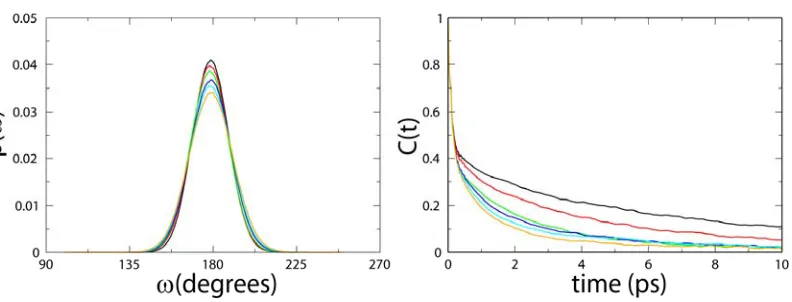
[image:22.612.83.479.312.463.2]-bond angle in the energy basin of the trans configuration is approximately Gaussian, as shown in
Figure 2.1.
(Figure 2.1: The distribution of the peptide ω bond between Ala and Pro in Ace-Ala-Pro-Nme at six different temperatures (275, 300, 325, 350, 375, and 400 K) for SPC/E.)
Therefore, the effective 1D potential landscape, U(ω), of the motion of the peptide along the ω
-bond angle in the trans basin is approximately described by a harmonic potential where C is the
effective spring constant and γ≈ 180o
(
)
22 )
(ω = C ω−γ
U
Furthermore, the Brownian motion in a harmonic potential described as a position space analog
of the Ornstein-Uhlenbeck (OU) process has been studied extensively, and the autocorrelation
function of ω is given by
) exp( ) ( ) 0
( t >=< 2 > −tDC kBT
<ω ω ω
(Equation 2.3: autocorrelation function)
where
C T kB
>= <ω2
(Equation 2.4)
The autocorrelation functions of ω at six different temperatures (275, 300, 325, 350, 375, and
400 K) calculated from the simulation data in the SPC/E water model are also shown in Figure
1.3. Fitting the tail of the autocorrelation functions in Figure 1.3 using Equations 1.6 and 1.7 to a
single exponential, we obtained D, the diffusion coefficient, of the displacement of the ω-bond
angle on the effective 1D harmonic well at different temperatures.
Previously, Zwanzig showed by analytically solving the Smoluchowski equation
(Equation1.4) that the diffusion coefficient, D, on an effective 1D landscape is related to the
underlying energetic roughness, ε, by Equation 2.5.
] ) (
exp[ ε k T θ D
D= 0 − B
(Equation 2.5)
Where D0 is the diffusion coefficient on the smooth potential energy surface. Subsequently, it
was shown that for a protein system in an effective 1D energy profile θ = 2 , and the quadratic
distribution. If the energetic roughness is θ = 1, then the roughness is uniform and evenly
distributed.
From the diffusion coefficients, D, derived from fitting the autocorrelation function to an OU
process at different temperatures, we obtain a plot of equation 2.5, as shown in Figure 2.2 for the
simulations in the different water models, and also in vacuum.
The data fits very well when θ = 2. We further confirmed that θ = 2 is a better fit than θ = 1 by
[image:25.612.90.509.207.626.2]increasing the temperature range and carrying out simulations in TIP4P-EW at 600 K. From
Figure 2.4, we calculated the roughness for the different water models and vacuum (the baseline)
as shown in Figure 2.3.
Water model Roughness,
ε (kcal/mol)
Self-diffusion coefficient (x 10-5 cm2/s)
at ~25oC and 1 atm
Structure of water model (A ball and stick model with partial charges on each charge center)
Vacuum 0.45 -
TIP3P 0.87 5.06 5.65
SPC/E 1.01 2.49 2.76
TIP4P-Ew 1.00 2.4
TIP5P 1.08 2.62
Experimental - 2.23
2.3
(Table 2.1 and Figure 2.3: Table of raw energetic roughness of vacuum, TIP3P, TIP4P. SPC/E,
If one considers the roughness of Ace-Ala-Pro-Nme in vacuum as the baseline, then TIP5P
contribute ~0.63 kcal/mol of additional roughness to the energy landscape. TIP4P-EW and
SPC/E contribute about ~0.56 kcal/mol. The roughness contributed by TIP3P (~0.42 kcal/mol) is
the smallest. Therefore, SPC/E, TIP4P-EW, and TIP5P are slightly “rougher” than TIP3P. It is
also important to note that the self diffusion coefficient of TIP3P is about twice that of SPC/E,
TIP4P-EW, and TIP5P, and the difference in energetic roughness could be partly attributed to
that as well.
While Figure 2.4 is not a completely true to life representation of the energetic landscape of the
peptide used in this experiment, it is useful in illustrating the difference that adding water to a
system causes in the overall energetic landscape. The roughness of water are manifested as the
bumps in the landscape where proteins must scale these hills to reach the next conformational
CHAPTER 3
DISCUSSION
The question still remains, what is the main contributing factor to the energetic roughness
of water? By looking at the partial charges on the water models with three charged centers
(SPC/E, TIP3P, and TIP4P-EW), one could see that the absolute magnitude of the partial charges
is larger in SPC/E and TIP4P-EW than in TIP3P, and the increase correlates with a slight
increase in the energetic roughness. This observation therefore raised the possibility that majority
of the contribution to the energetic roughness is due to hydrogen bonding, which is electrostatic
in nature in the classical definition of the water models. Alternatively, one could argue that the
roughness may have artificial component due to the Langevin thermostat and the random noise
associated with it. However, it is important to note that the roughness is distinctly different for
the different water models under similar conditions and using the same thermostat. Nonetheless,
in order to test the effect of the Langevin thermostat on the energetic roughness, we have
doubled the collision frequency to 20/ps and repeated the simulation for TIP4P-EW water as
shown in Figure 3.1 (magenta). We clearly see that overall the dynamics is slightly slower, as
expected at higher friction, but the slope of the line and hence the roughness is almost identical
to simulations with a smaller collision frequency (Figure 3.1, red line). Changing the collision
(Figure 3.1: Plot of equation 2.5 for TIP4P with collision frequency 10/ps and 20/ps, TIP4P with
no charges, and vacuum)
Consequently, I have hypothesized that the main source of the energetic roughness is due to the
forming and breaking of hydrogen bonding interactions between the water molecules, since the
other non-bonded van der Waals interactions are far weaker. As noted above, the description of
the hydrogen bonding interaction in the current classical model is purely electrostatic.
Therefore, in order to test this hypothesis, we have repeated the simulation of the peptide in a
molecules, thus eliminating the electrostatic interactions between the water molecules. The
simulations were carried out with the same box sizes as those of the simulations with full partial
charges at the different temperatures, in order to only capture the effect of eliminating the
electrostatic interactions. For this model system of TIP4P-EW water with no partial charges, the
energetic roughness is reduced considerably, as shown in Figure 3.1 (orange). We clearly see
that by eliminating the partial charges on the water molecules, the slope of the line and hence the
roughness also decreases considerably and is now comparable to that in vacuum. However, the
data for TIP4P-EW with zero partial charges fits Equation 2.5 better with θ = 1 than with θ = 2,
implying that without the electrostatic interactions the roughness is more uniform and evenly
distributed. This change in the nature of the roughness could be attributed to the fact that van der
Waals interactions are very short ranged and are due only to the oxygen, since the radius of
hydrogen for these water models is zero. On the other hand, electrostatic interactions are
longer-ranged, and a slight change could have implications far away, adding to the randomness of this
interaction.
Using this approach, we have calculated the contribution to the roughness of proteins by
the most widely used water models for atomistic simulations of biomolecules. This approach has
allowed us to study one property of the solvent that directly affects the dynamics of biomolecular
systems. It also presents a very important and an additional property of water that can be taken
into account when optimizing simulation water models, if need be, to reproduce experimental
results and its effects on protein dynamics. The network of hydrogen bonds formed by water
molecules around proteins (as depicted in Figure 3.2) that is constantly rearranging as the protein
changes conformation manifests itself as roughness on the underlying energy surface. The water
molecules immediately around the peptide form transient, cage-like structure that is held together
hydrogen bonds break and re-form to alter the network of hydrogen bonds. Each arrangement of
the network of water molecules is an energetic substate of the water that provides the additional
roughness on the energy landscape of proteins.
(Figure 3.2: Depiction of Pro-Nme with the first shell of hydration enclosing
Conclusion
The energetic roughness could have several implications for protein chemistry and
motions. For example, when θ = 2 in equation 3, the effect of the roughness on the dynamics of
the protein will become very pronounced at low temperature and will enslave the motions of
proteins. At higher temperature, when the roughness is much less than kBT, the effect of water
molecules on the dynamics will be predominately due to the internal frictional drag of the
molecules and less on the roughness of water, since the energetic roughness is ~1 kcal/mol
Additionally, proteins that function as enzymes usually provide an environment in a
cavity or binding site that is usually devoid of any appreciable amount of solvent. Taking away
the specific interactions of the active site of proteins, the effect on the catalytic process of
moving the substrate from the aqueous medium to the active site is still not fully understood.
From the above results, it could be suggested that the change in environment of the substrate
would change the frictional drag and the topological features of the energy landscape of the
protein substrate or other ligand that is not limited to the reduction of the energetic roughness
and thus “paving” the surface along the reactions coordinate for the conformational transition to
occur. This change in the topology of the landscape would most likely manifest itself by altering
the kinetic prefactor, in addition to the dominate effect due to transition state stabilization or
CHAPTER 4
EXPERIMENTAL
TIP3P
We carried out a series of molecular dynamics simulations using Ace-Ala-Pro-Nme at
different temperatures using the pmemd module in the AMBER 10 suite of programs and the
modified version of the Cornell et al force field. The Langevin thermostat was used to regulate
the temperature, with a collision frequency of 10 ps-1 and the particle mesh Ewald method was
used to treat long-ranged electrostatic interactions. The system was equilibrated at the set
temperature and a constant pressure of 1 bar in a periodic cubic box with the edges of the box at
least 10 Å away from the peptide. The simulation was then carried out for 10 ns at constant
temperature and volume (NVT ensemble) using an integration time step of 2fs and applying the
SHAKE algorithm to all bonds involving hydrogen. The system was first created using the xleap
program by first constructing the Ace-Ala-Pro-Nme peptide. Next the peptide was solvated
using the TIP3P water model from the xleap library. Xleap was then utilized to generate a
topology file and an initial coordinate file. The topology and coordinate files were then
combined with a minimization input file in the Amber10 program in the minimization step.
This minimization step is used to bring the system to a global energy minimum while keeping
the system in a periodic box. The minimization was carried out for 0.01 ns. A total of eighteen
minimizations were done in sets of three for six different temperatures ( 275K, 300K, 325K,
350K, 375K, 400K).
-Minimization parameters: The minimization was carried out under the following
imin- set to 1, so that a minimization will be performed
ntx-set to 1, so that X is read formatted with no initial velocity information.
npr- set to 10, so that every 10 steps energy information was printed in the output file.
ntwv- set to 0, so that all velocity output was inhibited.
ibelly- set to 0, so that no subset of atoms was allowed to move.
ntmin- set to 1, so that for NCYC cycles the steepest descent method is used then
conjugate gradient is switched on.
nstlim- set to 10000, so that 10000 steps are performed.
nscm- set to 0, so that the position of the center-of-mass of the molecule is not reset.
dt- set to 0.001, so that each step takes 0.001 fs.
tempi- set to 100K, however this parameter is ignored due to this being a minimization
temp0- set to target temp, so that the minimization is carried out at this average
temperature
ig- set to 71277, 11297, or 61267 depending on the run, this parameter affects the set
of pseudo-random values used for Langevin dynamics. It was set to a different
value for three seperate run in order to produce some variation in data for error
sake.
ntp- set to 1, so that pressure is kept constant
ntb- set to 2, so that pressure is kept constant
comp- set to 44.6, compressibility that is appropriate for water
ntc- set to 1, so that SHAKE algorithm is not performed
pres0- set to 1 to keep the system a 1 bar of pressure
cut- set to 9, so that all non bonded interactions will be cut off at 9 Angstoms
iwrap- set to 1, so that the coordinates written to the restart and trajectory files will be
"wrapped"into a primary box. This means that for each molecule, the image
closest to the middle of the "primary box" [with x coordinates between 0 and a,
y coordinates between 0 and b, and z coordinates between 0 and c] will be the
one written to the output file. This often makes the resulting structures look
better visually, but has no effect on the energy or forces.
At the completion of the minimization step a new coordinate file was created (for each
respective temperature). This coordinate file , deemed the restart file, was used in conjunction
with the original topology file and a new input file (MD input) in the amber program to perform
a molecular dynamics run to bring the system up to the target temperature. The target
temperature varied from 275K to 400K. This MD run was carried out for 0.1 ns.
MD Parameters: The MD run was carried out under the following conditions
imin- set to 0, so that a minimization will not be performed
ntx-set to 5, so initial velocity information is read.
npr- set to 100, so that every 100 steps energy information was printed in the output
file.
ntwv- set to 0, so that all velocity output was inhibited.
ibelly- set to 0, so that no subset of atoms was allowed to move.
ntmin- set to 1, so that for NCYC cycles the steepest descent method is used then
conjugate gradient is switched on.
nstlim- set to 100000, so that 100000 steps are performed.
dt- set to 0.001, so that each step takes 0.001 fs.
tempi- set to 100K, so that the initial temperature is set to 100K
temp0- set to target temp, so that the simulation is carried out at this average
temperature
ig- set to 71277, 11297, or 61267 depending on the run, this parameter affects the set
of pseudo-random values used for Langevin dynamics. It was set to a different
value for three seperate run in order to produce some variation in data for error
sake.
ntp- set to 1, so that pressure is kept constant
ntb- set to 2, so that pressure is kept constant
comp- set to 44.6, compressibility that is appropriate for water
ntc- set to 2, so that SHAKE algorithm is performed
pres0- set to 1 to keep the system a 1 bar of pressure
ntf- set to 1, so that forces between constrained bonds is calculated
cut- set to 9, so that all non bonded interactions will be cut off at 9 Angstoms
iwrap- set to 1, so that the coordinates written to the restart and trajectory files will be
"wrapped"into a primary box. This means that for each molecule, the image
closest to the middle of the "primary box" [with x coordinates between 0 and a,
y coordinates between 0 and b, and z coordinates between 0 and c] will be the
one written to the output file. This often makes the resulting structures look
better visually, but has no effect on the energy or forces.
After this step was completed another restart file was created. This restart file was used
So, the restart file, along with the original topology file and a new input file (equilibration input)
were used to start the equilibration step in the amber program. The equilibration step was done
for each set at the respective temperature. The equilibration step was carried out for 0.5 ns.
Equilibration Parameters: The equilibration step was performed under the following conditions.
imin- set to 0, so that a minimization will not be performed
ntx-set to 5, so initial velocity information is read.
npr- set to 100, so that every 100 steps energy information was printed in the output
file.
ntwv- set to 0, so that all velocity output was inhibited.
ibelly- set to 0, so that no subset of atoms was allowed to move.
ntmin- set to 1, so that for NCYC cycles the steepest descent method is used then
conjugate gradient is switched on.
nstlim- set to 100000, so that 100000 steps are performed.
nscm- set to 10000, so that every 1000 steps translational and rotational motion will
be removed..
dt- set to 0.002, so that each step takes 0.002 fs.
tempi- set to 100K, so that the initial temperature is set to 100K
temp0- set to target temp, so that the simulation is carried out at this average
temperature
ig- set to 71277, 11297, or 61267 depending on the run, this parameter affects the set
of pseudo-random values used for Langevin dynamics. It was set to a different
value for three seperate run in order to produce some variation in data for error
sake.
ntb- set to 2, so that pressure is kept constant
comp- set to 44.6, compressibility that is appropriate for water
ntc- set to 2, so that SHAKE algorithm is performed
pres0- set to 1 to keep the system a 1 bar of pressure
ntf- set to 1, so that forces between constrained bonds is calculated
cut- set to 9, so that all non bonded interactions will be cut off at 9 Angstoms
iwrap- set to 1, so that the coordinates written to the restart and trajectory files will be
"wrapped"into a primary box. This means that for each molecule, the image
closest to the middle of the "primary box" [with x coordinates between 0 and a,
y coordinates between 0 and b, and z coordinates between 0 and c] will be the
one written to the output file. This often makes the resulting structures look
better visually, but has no effect on the energy or forces.
Upon completion of the equilibration step another restart file was created. This restart
file was used in the next step to specify where atoms should be found at the beginning of the next
simulation. Next, the restart file along with the original topology file and a new input file
(production input) were used to start the production step in the amber program. The production
step was done for each set at the respective temperature. The production step was also set to
output dihedral energy information for each step. This production step was done for 10 ns.
Production Step: The production step was performed under the following conditions.
imin- set to 0, so that a minimization will not be performed
npr- set to 100, so that every 100 steps energy information was printed in the output
file.
ntwv- set to 0, so that all velocity output was inhibited.
ibelly- set to 0, so that no subset of atoms was allowed to move.
ntmin- set to 1, so that for NCYC cycles the steepest descent method is used then
conjugate gradient is switched on.
nstlim- set to 5000000, so that 5000000 steps are performed.
nscm- set to 10000, so that every 1000 steps translational and rotational motion will
be removed..
dt- set to 0.002, so that each step takes 0.002 fs.
tempi- set to 100K, so that the initial temperature is set to 100K
temp0- set to target temp, so that the simulation is carried out at this average
temperature
ig- set to 71277, 11297, or 61267 depending on the run, this parameter affects the set
of pseudo-random values used for Langevin dynamics. It was set to a different
value for three seperate run in order to produce some variation in data for error
sake.
ntp- set to 1, so that pressure is kept constant
ntb- set to 2, so that pressure is kept constant
comp- set to 44.6, compressibility that is appropriate for water
ntc- set to 2, so that SHAKE algorithm is performed
pres0- set to 1 to keep the system a 1 bar of pressure
ntf- set to 1, so that forces between constrained bonds is calculated
iwrap- set to 1, so that the coordinates written to the restart and trajectory files will be
"wrapped"into a primary box. This means that for each molecule, the image
closest to the middle of the "primary box" [with x coordinates between 0 and a,
y coordinates between 0 and b, and z coordinates between 0 and c] will be the
one written to the output file. This often makes the resulting structures look
better visually, but has no effect on the energy or forces.
TIP4P
We carried out a series of molecular dynamics simulations using Ace-Ala-Pro-Nme at
different temperatures using the pmemd module in the AMBER 10 suite of programs and the
modified version of the Cornell et al force field. The Langevin thermostat was used to regulate
the temperature, with a collision frequency of 10 ps-1 and the particle mesh Ewald method was
used to treat long-ranged electrostatic interactions. The system was equilibrated at the set
temperature and a constant pressure of 1 bar in a periodic cubic box with the edges of the box at
least 10 Å away from the peptide. The simulation was then carried out for 10 ns at constant
temperature and volume (NVT ensemble) using an integration time step of 2fs and applying the
SHAKE algorithm to all bonds involving hydrogen. The system was first created using the xleap
program by first constructing the Ace-Ala-Pro-Nme peptide. Next the peptide was solvated
using the TIP4P water model from the xleap library. Xleap was then utilized to generate a
topology file and an initial coordinate file. The topology and coordinate files were then
combined with a minimization input file in the Amber10 program in the minimization step.
This minimization step is used to bring the system to a global energy minimum while keeping
minimizations were done in sets of three for six different temperatures ( 275K, 300K, 325K,
350K, 375K, 400K). Then a molecular dynamics run, equilibration and production run to
calculate the dihedral data were all done on the system at the respective temperatures. All
simulations in this sections were carried out under the same conditions as the conditions
specified in the TIP3P section.
SPC/E
We carried out a series of molecular dynamics simulations using Ace-Ala-Pro-Nme at
different temperatures using the pmemd module in the AMBER 10 suite of programs and the
modified version of the Cornell et al force field. The Langevin thermostat was used to regulate
the temperature, with a collision frequency of 10 ps-1 and the particle mesh Ewald method was
used to treat long-ranged electrostatic interactions. The system was equilibrated at the set
temperature and a constant pressure of 1 bar in a periodic cubic box with the edges of the box at
least 10 Å away from the peptide. The simulation was then carried out for 10 ns at constant
temperature and volume (NVT ensemble) using an integration time step of 2fs and applying the
SHAKE algorithm to all bonds involving hydrogen. The system was first created using the xleap
program by first constructing the Ace-Ala-Pro-Nme peptide. Next the peptide was solvated
using the SPC/E water model from the xleap library. Xleap was then utilized to generate a
topology file and an initial coordinate file. The topology and coordinate files were then
combined with a minimization input file in the Amber10 program in the minimization step.
This minimization step is used to bring the system to a global energy minimum while keeping
the system in a periodic box. The minimization was carried out for 0.01 ns. A total of eighteen
350K, 375K, 400K). Then a molecular dynamics run, equilibration and production run to
calculate the dihedral data were all done on the system at the respective temperatures. All
simulations in this sections were carried out under the same conditions as the conditions
specified in the TIP3P section.
TIP5P
We carried out a series of molecular dynamics simulations using Ace-Ala-Pro-Nme at
different temperatures using the pmemd module in the AMBER 10 suite of programs and the
modified version of the Cornell et al force field. The Langevin thermostat was used to regulate
the temperature, with a collision frequency of 10 ps-1 and the particle mesh Ewald method was
used to treat long-ranged electrostatic interactions. The system was equilibrated at the set
temperature and a constant pressure of 1 bar in a periodic cubic box with the edges of the box at
least 10 Å away from the peptide. The simulation was then carried out for 10 ns at constant
temperature and volume (NVT ensemble) using an integration time step of 2fs and applying the
SHAKE algorithm to all bonds involving hydrogen. The system was first created using the xleap
program by first constructing the Ace-Ala-Pro-Nme peptide. Next the peptide was solvated
using the TIP3P water model from the xleap library. Xleap was then utilized to generate a
topology file and an initial coordinate file. The topology and coordinate files were then
combined with a minimization input file in the Amber10 program in the minimization step.
This minimization step is used to bring the system to a global energy minimum while keeping
the system in a periodic box. The minimization was carried out for 0.01 ns. A total of eighteen
minimizations were done in sets of three for six different temperatures ( 275K, 300K, 325K,
350K, 375K, 400K). Then a molecular dynamics run, equilibration and production run to
simulations in this sections were carried out under the same conditions as the conditions
specified in the TIP3P section.
TIP4P With no Charge
We carried out a series of molecular dynamics simulations using Ace-Ala-Pro-Nme at
different temperatures using the pmemd module in the AMBER 10 suite of programs and the
modified version of the Cornell et al force field. The Langevin thermostat was used to regulate
the temperature, with a collision frequency of 10 ps-1 and the particle mesh Ewald method was
used to treat long-ranged electrostatic interactions. The system was equilibrated at the set
temperature and a constant pressure of 1 bar in a periodic cubic box with the edges of the box at
least 10 Å away from the peptide. The simulation was then carried out for 10 ns at constant
temperature and volume (NVT ensemble) using an integration time step of 2fs and applying the
SHAKE algorithm to all bonds involving hydrogen. The system was first created using the xleap
program by first constructing the Ace-Ala-Pro-Nme peptide. Next the peptide was solvated
using the TIP4P water model from the xleap library. The charges on the water molecules were
then set to zero after the system was solvated. Xleap was then utilized to generate a topology file
and an initial coordinate file. The topology and coordinate files were then combined with a
minimization input file in the Amber10 program in the minimization step. This minimization
step is used to bring the system to a global energy minimum while keeping the system in a
periodic box. The minimization was carried out for 0.01 ns. A total of eighteen minimizations
were done in sets of three for six different temperatures ( 275K, 300K, 325K, 350K, 375K,
400K). Then a molecular dynamics run, equilibration and production run to calculate the
sections were carried out under the same conditions as the conditions specified in the TIP3P
section.
Vacuum
We carried out a series of molecular dynamics simulations using Ace-Ala-Pro-Nme at different
temperatures using the pmemd module in the AMBER 10 suite of programs and the modified
version of the Cornell et al force field. The Langevin thermostat was used to regulate the
temperature, with a collision frequency of 10 ps-1 and the particle mesh Ewald method was used
to treat long-ranged electrostatic interactions. The system was equilibrated at the set temperature
and a constant pressure of 1 bar in a periodic cubic box with the edges of the box at least 10 Å
away from the peptide. The simulation was then carried out for 10 ns at constant temperature and
volume (NVT ensemble) using an integration time step of 2fs and applying the SHAKE
algorithm to all bonds involving hydrogen. The system was first created using the xleap program
by first constructing the Ace-Ala-Pro-Nme peptide. Xleap was then utilized to generate a
topology file and an initial coordinate file. The topology and coordinate files were then
combined with a minimization input file in the Amber10 program in the minimization step.
This minimization step is used to bring the system to a global energy minimum while keeping
the system in a periodic box. The minimization was carried out for 0.01 ns. A total of eighteen
minimizations were done in sets of three for six different temperatures ( 275K, 300K, 325K,
350K, 375K, 400K). Then a molecular dynamics run, equilibration and production run to
calculate the dihedral data were all done on the system at the respective temperatures. All
simulations in this section were carried out under the same conditions as the conditions specified
REFERENCES
1. Berendsen, H.J.C., Grigera, J.R. and Straatsma, T.P. (1987) The missing term in effective pair potentials. Journal of Physical Chemistry, 91, 6269-6271.
2. Case, D.A., Darden, T.A., Cheatham III, T.E., Simmerling, C.L., Wang, J., Duke, R.E., Luo, R., Crowley, M., Walker, R.C., Zhang, W. et al. (2008), AMBER 10. University of California, San Francisco.
3. Chaplin, M. (2006) Do we underestimate the importance of water in cell biology? Nature reviews,
7, 861-866.
4. Cornell, W.D., Cieplak, P., Bayly, C.I., Gould, I.R., Merz, K.M., Ferguson, D.M., Spellmeyer, D.C., Fox, T., Caldwell, J.W. and Kollman, P.A. (1995) A 2nd generation force-field for the simulation of proteins, nucleic-acids, and organic-molecules Journal of the American Chemical Society, 117, 5179-5197.
5. Dill, K.A. (1990) Dominant forces in protein folding. Biochemistry, 29, 7133-7155.
6. Eberhardt, E.S., Loh, S.N., Hinck, A.P. and Raines, R.T. (1992) Solvent effects on the energetics of prolyl peptide-bond isomerization. Journal of the American Chemical Society, 114, 5437-5439.
7. Fanghanel, J. and Fischer, G. (2004) Insights into the catalytic mechanism of peptidyl prolyl cis/trans isomerases. Front Biosci, 9, 3453-3478.
8. Fenimore, P.W., Frauenfelder, H., McMahon, B.H. and Parak, F.G. (2002) Slaving: solvent fluctuations dominate protein dynamics and functions. Proceedings of the National Academy of Sciences of the United States of America, 99, 16047-16051.
9. Frauenfelder, H., Parak, F. and Young, R.D. (1988) Conformational substates in proteins. Annual review of biophysics and biophysical chemistry, 17, 451-479.
10. Frauenfelder, H., Sligar, S.G. and Wolynes, P.G. (1991) The energy landscapes and motions of proteins. Science (New York, N.Y, 254, 1598-1603.
11. Frauenfelder, H., Chen, G., Berendzen, J., Fenimore, P.W., Jansson, H., McMahon, B.H., Stroe, I.R., Swenson, J. and Young, R.D. (2009) A unified model of protein dynamics. Proceedings of the National Academy of Sciences of the United States of America, 106, 5129-5134.
13. Halle, B. (2004) Protein hydration dynamics in solution: a critical survey. Philosophical transactions of the Royal Society of London, 359, 1207-1223; discussion 1223-1204, 1323-1208.
14. Hamelberg, D., Shen, T. and Andrew McCammon, J. (2005) Relating kinetic rates and local energetic roughness by accelerated molecular-dynamics simulations. The Journal of chemical physics, 122, 241103.
15. Hamelberg, D. and McCammon, J.A. (2009) Mechanistic insight into the role of transition-state stabilization in cyclophilin A. J Am Chem Soc, 131, 147-152.
16. Hamelberg, D., Shen, T. and McCammon, J.A. (2006) Insight into the role of hydration on protein dynamics. The Journal of chemical physics, 125, 094905.
17. Hornak, V., Abel, R., Okur, A., Strockbine, B., Roitberg, A. and Simmerling, C. (2006) Comparison of multiple Amber force fields and development of improved protein backbone parameters. Proteins, 65, 712-725.
18. Horn, H.W., Swope, W.C., Pitera, J.W., Madura, J.D., Dick, T.J., Hura, G.L. and Head-Gordon, T. (2004) Development of an improved four-site water model for biomolecular simulations: TIP4P-Ew. Journal of Chemical Physics, 120, 9665-9678.
19. Hyeon, C. and Thirumalai, D. (2003) Can energy landscape roughness of proteins and RNA be measured by using mechanical unfolding experiments? Proceedings of the National Academy of Sciences of the United States of America, 100, 10249-10253.
20. Ikura, T., Kinoshita, K. and Ito, N. (2008) A cavity with an appropriate size is the basis of the PPIase activity. Protein Eng Des Sel, 21, 83-89.
21. Jorgensen, W.L., Chandrasekhar, J., Madura, J.D., Impey, R.W. and Klein, M.L. (1983)
Comparison of simple potential functions for simulating liquid water. Journal of Chemical Physics,
79, 926-935.
22. Jorgensen, W.L. and Madura, J.D. (1985) Temperature and size dependence for Monte-Carlo Simulations of TIP4P water. Molecular Physics, 56, 1381-1392.
23. Mahoney, M.W. and Jorgensen, W.L. (2000) A five-site model for liquid water and the reproduction of the density anomaly by rigid, nonpolarizable potential functions. Journal of Chemical Physics, 112, 8910-8922.
24. Nevo, R., Brumfeld, V., Kapon, R., Hinterdorfer, P. and Reich, Z. (2005) Direct measurement of protein energy landscape roughness. EMBO reports, 6, 482-486.
26. Ohmine, I. and Saito, S. (1999) Water dynamics: Fluctuation, relaxation, and chemical reactions in hydrogen bond network rearrangement. Accounts of Chemical Research, 32, 741-749.
27. Smith, J.D., Cappa, C.D., Wilson, K.R., Messer, B.M., Cohen, R.C. and Saykally, R.J. (2004) Energetics of hydrogen bond network rearrangements in liquid water. Science (New York, N.Y, 306,
851-853.
28. Smith, J.D., Cappa, C.D., Messer, B.M., Cohen, R.C. and Saykally, R.J. (2005) Response to Comment on "Energetics of hydrogen bond network: Rearrangements in liquid water". Science (New York, N.Y, 308.
29. Speedy, R.J., Madura, J.D. and Jorgensen, W.L. (1987) Network topology in simulated water.
Journal of Physical Chemistry, 91, 909-913.
30. Wales, D.J. (2003) Energy landscapes. Cambridge University Press, Cambridge, UK ; New York.
31. Wang, M.C. and Uhlenbeck, G.E. (1945) On the theory of the Brownian motion II. Reviews of modern physics, 17, 20.
32. Warshel, A., Aqvist, J. and Creighton, S. (1989) Enzymes work by solvation substitution rather than by desolvation. Proceedings of the National Academy of Sciences of the United States of America, 86, 5820-5824.