Available online www.jocpr.com
Journal of Chemical and Pharmaceutical Research, 2012, 4(7):3651-3658
Research Article
CODEN(USA) : JCPRC5
ISSN : 0975-7384
Terpolymerization of 2-hydroxyacetophenone, catechol and formaldehyde
and its thermal studies
Shailesh K. Mandavgade
1, Jeevan R. Dontulwar
1and Wasudeo B. Gurnule
2*1 Department of Chemistry, Priyadarshini College of Engineering, Nagpur, Maharashtra, India 2 Department of Chemistry, Kamla Nehru Mahavidyalaya, Sakkardara, Nagpur 440010, Maharashtra, India
_____________________________________________________________________________________________
ABSTRACT
The copolymer has been synthesized by the polycondesation technique of 2-hydroxyacetophenone with catechol and formaldehyde in the presence of 2M HCl as a catalyst. The copolymer has been characterized by UV-visible, IR and
1H NMR spectra. The thermal decomposition behavior of new copolymer was studied using thermogravimetric
analysis in air atmosphere. Thermal decomposition curves are discussed with careful attention to minute details. The freeman-Carroll and Sharp-Wentworth methods have been used to calculate activation energy and thermal stability. Thermal activation energy (Ea) calculated with the help of these methods are in agreement with each other. Thermodynamic parameters such as free energy change (∆F), entropy change (∆S), Apparent entropy change(S*) and frequency factor Z are also determined on the basis of TG curves and by using data of the Freeman-Carroll method. Scanning electron microscopy (SEM) was used to establish the surface morphology and nature of the copolymer.
Keywords: Copolymer, Morphology, Thermal degradation, Polycondensation, Resin.
_____________________________________________________________________________________________
INTRODUCTION
In the recent years, we have witnessed a great deal of interest in the synthesis and characterization of transition metal complexes containing copolymers as due to their application as catalysts, semiconductors, drugs, biocides, ion-exchanger and also models for enzymes [1-4]. Non-biodegradable polymer wastes can be reutilized by recycling to useful products rather than by burying them, but only a minor portion of the polymer is recyclable due to economic infeasibility and technical difficulty. Thus, the demand for degradable and biocompatible polymers is rapidly increasing because of the growing recognition worldwide of the need to reduce the global environmental pollution resulting from non-biodegradable polymer waste. For wide-spread acceptance, environmentally degradable polymers must overcome some significant obstacles not recognized earlier. Hence developments in this area require insuring a balance polymer is developed that not only has desirable properties, but also is environmentally acceptance.
The thermal degradation of polymers has been at the centre of thermal analysis studies for many years. Thermogravimetric analysis (TGA) is a common method to study the thermodegradation kinetics of polymers. Similarly differential scanning calorimetry (DSC) is also employed to elucidate the decomposition steps observed in the TGA data. Kinetic analysis may effectively assist in probing degradation mechanisms as well as in predicting the thermal stability of polymers [5].
Wasudeo B. Gurnule
et al
______________________________________________________________________________
has good thermo-oxidative resistance, extensive research has been done to improve
modification of their structure with introduction of some functional group, such as oxadiazolic etc. [1
found that the introduction of nitrogen into the polymeric skeleton can largely improve the flame resistance, adhesion, and also decrease contamination of environment on
However relatively few studies have been reported on the thermostability and thermal degradation kinetics of the thermo tropic copolymers. It is considered that a more detailed stu
must encounter elevated temperatures at almost every step in the manufacturing, compounding and processing steps as well as in service and repair.
The aim of investigation is to synthesize a new kind of high per mechanical property and excellent thermal
data for prolonging life time estimation. Coating of this copolymer may find potential app implantable biomedical device associated infections.
Materials
2-hydroxyacetophenone and catechol were procured from Merck, India and purified by rectified spirit Formaldehyde (37%) were of AR grade, Merck and used as received. Solvents like N,N
dimethylsulphoxide were used after distillation.
Polymerization of 2-HACF copolymer resin
The copolymer was synthesized by the condensation polymerization reaction of
and catechol (0.1mol) with formaldehyde (0.2mol) using hydrochloric acid as the reaction medium at 126±2 oil bath for 5 hrs under refluxed conditi
into crushed ice with constant stirring and left overnight. The dark brown with warm water and extracted with diethyl ether. The dried sample
NaOH and regenerated using 1: 1 (v/v) HCl/water with constant and rapid stirring to avoid lump formation. The process of reprecipitation was repeated twice. The
water, dried in air, powered and kept in vacuum desicator over silica gel. The yield of the polymer was found to be 81% and the reaction route for the synthesis is shown in Fig. 1.
Figure 1: Reaction
Characterization
Electron absorption spectrum of copolymer resin was recorded in DMSO (spectroscopic grade) on shimadzu double beam spectrophotometer in the range of 200 to 850 nm at Sophisticated Analytical
Punjab University, Chandigarh. An infra
Elmer-983 spectrophotometer in KBr pallets in the wave number region of 4000 University, Chandigarh. A Nuclear Magnetic Resonance (
has been scanned on Bruker Advanced 400 NMR spectrometer using DMSO
J. Chem. Pharm. Res., 2012, 4(
______________________________________________________________________________
oxidative resistance, extensive research has been done to improve thermal properties through modification of their structure with introduction of some functional group, such as oxadiazolic etc. [1
found that the introduction of nitrogen into the polymeric skeleton can largely improve the flame resistance, ion, and also decrease contamination of environment on pyrolysis [15,16].
However relatively few studies have been reported on the thermostability and thermal degradation kinetics of the It is considered that a more detailed study would be of value because the copolymers must encounter elevated temperatures at almost every step in the manufacturing, compounding and processing steps
The aim of investigation is to synthesize a new kind of high performance polymer with good processing ability, high mechanical property and excellent thermal properties. The purpose of this study is to provide trustworthy kinetic data for prolonging life time estimation. Coating of this copolymer may find potential app
implantable biomedical device associated infections.
EXPERIMENTAL SECTION
and catechol were procured from Merck, India and purified by rectified spirit Formaldehyde (37%) were of AR grade, Merck and used as received. Solvents like N,N
dimethylsulphoxide were used after distillation.
polymer resin
polymer was synthesized by the condensation polymerization reaction of 2-hydroxyacetophenone and catechol (0.1mol) with formaldehyde (0.2mol) using hydrochloric acid as the reaction medium at 126±2
refluxed condition with occasional shaking. The reaction mixture was then cooled, poured into crushed ice with constant stirring and left overnight. The dark brown colored polymer separated out was washed with warm water and extracted with diethyl ether. The dried sample was then purified by dissolving in 8 % aqueous NaOH and regenerated using 1: 1 (v/v) HCl/water with constant and rapid stirring to avoid lump formation. The process of reprecipitation was repeated twice. The copolymer 2-HACF thus obtained was filtered, was
water, dried in air, powered and kept in vacuum desicator over silica gel. The yield of the polymer was found to be % and the reaction route for the synthesis is shown in Fig. 1.
Figure 1: Reaction and expected structure of 2-HACF copolymer
polymer resin was recorded in DMSO (spectroscopic grade) on shimadzu double beam spectrophotometer in the range of 200 to 850 nm at Sophisticated Analytical
University, Chandigarh. An infra-red spectrum of 2-HACF copolymer resin was recorded on Perkin 983 spectrophotometer in KBr pallets in the wave number region of 4000 - 400 cm
. A Nuclear Magnetic Resonance (1H NMR) spectrum of newly synthesized
has been scanned on Bruker Advanced 400 NMR spectrometer using DMSO-d6 at sophisticated Analytical
J. Chem. Pharm. Res., 2012, 4(7):3651-3658
______________________________________________________________________________
thermal properties through modification of their structure with introduction of some functional group, such as oxadiazolic etc. [14]. It was found that the introduction of nitrogen into the polymeric skeleton can largely improve the flame resistance,
However relatively few studies have been reported on the thermostability and thermal degradation kinetics of the dy would be of value because the copolymers must encounter elevated temperatures at almost every step in the manufacturing, compounding and processing steps
formance polymer with good processing ability, high . The purpose of this study is to provide trustworthy kinetic data for prolonging life time estimation. Coating of this copolymer may find potential applications in inhibiting
and catechol were procured from Merck, India and purified by rectified spirit. Formaldehyde (37%) were of AR grade, Merck and used as received. Solvents like N,N-dimethyl formamide and
hydroxyacetophenone (0.1mol) and catechol (0.1mol) with formaldehyde (0.2mol) using hydrochloric acid as the reaction medium at 126±2oC in an on with occasional shaking. The reaction mixture was then cooled, poured polymer separated out was washed was then purified by dissolving in 8 % aqueous NaOH and regenerated using 1: 1 (v/v) HCl/water with constant and rapid stirring to avoid lump formation. The ACF thus obtained was filtered, washed with hot water, dried in air, powered and kept in vacuum desicator over silica gel. The yield of the polymer was found to be
polymer resin was recorded in DMSO (spectroscopic grade) on shimadzu double beam spectrophotometer in the range of 200 to 850 nm at Sophisticated Analytical Instrumentation Facility, polymer resin was recorded on
Wasudeo B. Gurnule
et al J. Chem. Pharm. Res., 2012, 4(7):3651-3658
______________________________________________________________________________
Instrumentation Facility Punjab University, Chandigarh. TGA of copolymer resin has been carried out by using Perkin–Elmer TGS-II Thermo gravimetric Analyzer at SICART, Vallabh Vidyanagar, Gujrat at heating rate of 10ºC per minute up to 800ºC. With the help of thermo gravimetric data, which is reported in Table 1, the thermal activation energies (Ea) and order of reaction (n) calculated. Also other thermodynamic parameter such as free energy change (∆F), entropy change (∆S), Apparent entropy change(S*) and frequency factor Z are determined and reported in Table 1.
RESULTS AND DISCUSSION
The newly synthesized and purified 2-HACF copolymer sample was found to be dark brown in colour. The copolymer is insoluble in commonly used solvent, but it is soluble in DMF, DMSO, pyridine and conc. H2SO4. The
melting point of the polymer was found to be in the range of 379 to 383 K. The copolymer which has been used in the present investigation was prepared by the reaction given in Fig. 1.
UV-Visible spectra of 2-HACF copolymer
The UV-Visible spectra (Fig. 2) of the 2-HACF copolymer sample in pure DMSO was recorded in the region 200-850 nm at a scanning rate of 100 nm min-1 and a chart speed of 5 cm min-1. The 2-HACF copolymer sample gave two characteristics bands at 360-370nm and 240-260nm. These observed positions for the absorption bands have different intensities. The more intense band is due to π→π* transition and the less intense is due to n→π* transition.
π→π* transition indicates the presence of aromatic nuclei and n→π* transition indicates presence of –OH group. The hyperchromic effect is due to the presence of – OH group, which act as auxochrome [17].
Fig 2: UV-Visible spectra of 2-HACF copolymer
IR spectra of 2-HACF copolymer
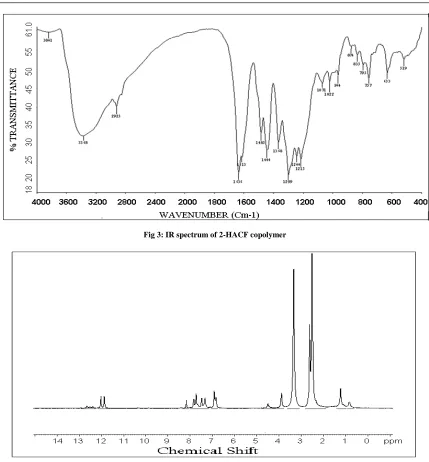
From IR Spectral studies (Fig. 3), it has been revealed that the copolymer show broad absorption band appeared in the region 3368-3370 cm-1 may be assigned to the stretching vibrations of phenolic hydroxyl (-OH) groups exhibiting intramolecular hydrogen bonding [18]. A sharp strong peak at 1613-1614 cm-1 may be ascribed to aromatic skeletal ring. The bands obtained at 1215-1218 cm-1suggest the presence of methylene (-CH2) bridge [19].
The sharp and weak band obtained at 1299- 1305 cm-1 suggest the presence of Ar-CH2-Ar bridge in polymer. The
sharp band displayed at 1636-1640 cm-1 may be due to stretching vibration of carbonyl group attached to acetophenone moity. The 1,2,3,5 substitution of aromatic benzene ring recognized by the sharp, medium / weak
absorption bands appeared at 949-953, 1072-1078, 1199-1208 and 1368-1374 cm-1 respectively. This band seems to
be merged with very broad band of phenolic hydroxyl group.
1H NMR spectra of 2-HACF copolymer
The NMR spectrum (Fig. 4) of 2-HACF copolymer was scanned in DMSO-d6 solvent. The chemical shift (δ) ppm
observed is assigned on the basis of data available in literature [20,21]. The singlet obtained in the region 3.86 -
3.91(δ) ppm may be due to the methylene proton of Ar-CH2-Ar moiety. The weak multiple signals (unsymmetrical
pattern) in the region of 6.83-7.24 (δ) ppm may be attributed to aromatic proton (Ar-H). The signals in the range at
8.2 to 8.4 (δ) ppm may be due to phenolic hydroxyl protons. The much downfield chemical shift for phenolic –OH
indicates clearly the intramolecular hydrogen bonding of -OH group [21,22]. The signal appeared in the region at 2.48- 3.99 (δ) ppm is due to the methylene proton of Ar-CH2 bridge [23]. The signals in the range of 3.2-3.6 (δ) ppm
Wasudeo B. Gurnule
et al J. Chem. Pharm. Res., 2012, 4(7):3651-3658
______________________________________________________________________________
Fig 3: IR spectrum of 2-HACF copolymer
[image:4.595.91.520.59.521.2]
Fig 4: 1H NMR spectral data of 2-HACF copolymer
Scanning Electron Microscopy of 2-HACF copolymer
Wasudeo B. Gurnule
et al
______________________________________________________________________________
Thermo gravimetric Analysis
Thermogravimetry of 2-HACF copolymer sample has been carried out using Perkin analyser in air atmosphere with heating rate of 10
copolymer is given in Fig. 6.
TGA of 2-HACF copolymer resin
Thermogram of TGA of this polymer is shown in Fig.
HACF copolymer resin, the thermo gram has been studied minutely. Thermogram of depicts four step decomposition in the temperature range 50
50 – 180oC corresponds to loss of water molecule ( decomposition start from 180-320
degradation of three hydroxyl group which is attach with aromatic ring. The third step which is in the range 450oC corresponds to 74.30% calculated and
group along with two methylene groups. The fourth step corresponds to loss of 100% found) in the range of 450-520
In the present investigation Sharp-Wentworth and freeman parameters of 2-HACF copolymer sample.
J. Chem. Pharm. Res., 2012, 4(
______________________________________________________________________________
Fig 5: SEM micrographs of 2-HACF copolymer
polymer sample has been carried out using
Perkin-analyser in air atmosphere with heating rate of 10oC/min. A brief account of thermal behavior of
resin
Thermogram of TGA of this polymer is shown in Fig. 6. In order to explore the thermal degradation study of polymer resin, the thermo gram has been studied minutely. Thermogram of
on in the temperature range 50-520oC . The first step is slow decomposition between C corresponds to loss of water molecule (6.23% found and 6.25% calculated). The second step 0oC corresponds to 23.95% calculated and 23.90% found which represent degradation of three hydroxyl group which is attach with aromatic ring. The third step which is in the range
% calculated and 74.34% found which represent the loss of benzene ring, groups. The fourth step corresponds to loss of aromatic ring
520 oC
Fig 6: TGA of 2-HACF copolymer resin
Wentworth and freeman-Carroll methods have been used to determine the kinetic polymer sample.
J. Chem. Pharm. Res., 2012, 4(7):3651-3658
______________________________________________________________________________
-Elmer thermo gravimetric ccount of thermal behavior of 2-HACF
. In order to explore the thermal degradation study of 2-polymer resin, the thermo gram has been studied minutely. Thermogram of 2-HACF co2-polymer resin C . The first step is slow decomposition between % calculated). The second step % found which represent degradation of three hydroxyl group which is attach with aromatic ring. The third step which is in the range
320-% found which represent the loss of benzene ring, one acetyl aromatic ring (100% calculated and
Wasudeo B. Gurnule
et al J. Chem. Pharm. Res., 2012, 4(7):3651-3658
______________________________________________________________________________
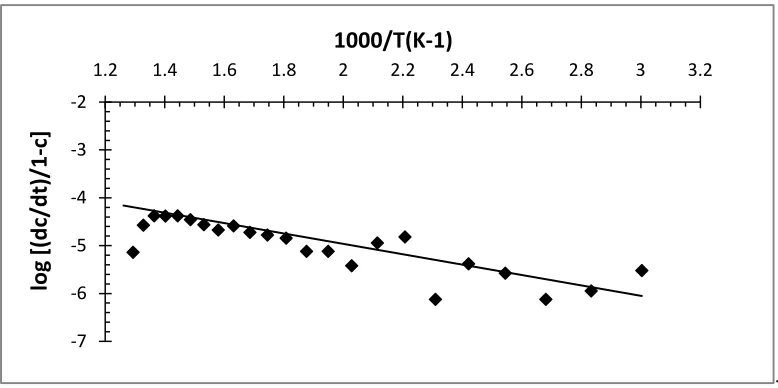
Sharp-Wentworth method :
Using the equation derived by Sharp-Wentworth [1],
Log [( dc/dT ) / (1-c)] = log (A/β) – [Ea/2.303R].1/T……….( 1 )
Where,
dc / dT = rate of change of fraction of weight with change in temperature.
β = linear heating rate dT / dt.
[image:6.595.113.502.173.367.2].
Fig 7: Sharp-Wentworth plot of 2-HACF copolymer resin
By plotting the graph between (dc/dT)/(1-c) vs 1/T we obtained the straight line which gave energy of activation ( Ea) from its slope. Where β is the conversion at time t, R is the gas constant and T is the absolute temperature. The plots Fig. 7 give activation energies at different stages of degradation reaction take place.
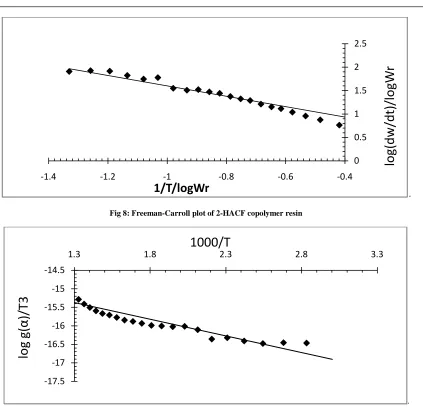
Freeman-Carroll method :
The straight- line equation derived by Freeman and Carroll , which is in the form of n
[ ∆ log (dw / dt) ] / ∆ log Wr = (-E / 2.303R)- ∆(1/T)/ ∆ log Wr + n --- ( 2 )
Where,
dw / dt = rate of change of weight with time. Wr = Wc-W
Wc = weight loss at completion of reaction. W = fraction of weight loss at time t. Ea = energy of activation.
n = order of reaction
A plot of percentage mass loss versus temperature is shown in Fig. 6 for 2-HACF copolymer. From the TG curve, the thermo analytical and the decomposition temperature were determined (Table 1) to obtain the thermal stability of the polymer. The method described by Sharp –Wentworth was adopted. Based on the initial decomposition temperature, the thermal stability of the polymer has been used here to define its thermal stability, neglecting the degree of decomposition (Table 1).
Table 1: Results of Thermo gravimetric Analysis of 2-HACF copolymer resin
Copolymer
Resin Half decomposition
temp. (K)
Activation energy (KJ/mol)
Entropy change
∆S (J)
Free energy change
∆F (KJ)
Frequency factor Z
(sec-1)
Apparent entropy
S* (J)
Order of reaction found
(n) FC SW
2-HACF 533 20.14 20.41 -294.87 177.30 356 -13.75 0.93
-7 -6 -5 -4 -3 -2
1.2 1.4 1.6 1.8 2 2.2 2.4 2.6 2.8 3 3.2
lo
g
[
(d
c/
d
t)
/1
-c
]
Wasudeo B. Gurnule
et al J. Chem. Pharm. Res., 2012, 4(7):3651-3658
______________________________________________________________________________
[image:7.595.100.523.55.467.2].
Fig 8: Freeman-Carroll plot of 2-HACF copolymer resin
.
Fig. 9: Freeman-Carroll plot of 2-HACF copolymer resin
Using thermal decomposition data and then applying the Sharp-Wentworth method Fig. 8, activation energy is calculated which is in agreement with the activation energy calculated by Freeman-Carroll method, Fig. 8 [25]. Thermal activation energy plot of Sharp-Wentworth method (Fig. 7) and Freeman-Carroll method (Fig. 8) for the polymer have been shown. Thermodynamic parameters such as entropy change (∆S), free energy change (∆F), frequency factor (Z) and Apparent entropy (S*) calculated on the basis of thermal activation energy are given in Table 1,
By using the data of the Freeman-Carroll method, various thermodynamics parameters have been calculated (Table 1). From the abnormally low values of frequency factor, it may be concluded that the decomposition reaction of 2-HACF copolymer can be classed as a ‘slow ’reaction. There is no other obvious reason [26, 27]. Fairly good straight line plots are obtained using the two methods. This is expected since the decomposition of polymer is known not to obey first order kinetics perfectly [26, 27].
CONCLUSION
A copolymer containing 2-hydroxyacetophenone, catechol and formaldehyde was synthesized and characterized by
various physicochemical properties like UV-Visible, FTIR, 1H NMR and TGA. Thermal properties were determined
by TGA analysis. The activation energy of thermal decomposition (Ea= 20.41) by Sharp-Wentworth method and
(Ea= 20.14) by Freeman-Carroll method was investigated with thermogravimetric analysis at heating rate 100C/min
from 50-5200C. Isoconversional of analysis of TGA plot indicate variation in activation energy of degradation process. In TGA the kinetic parameters evaluated from the Sharp-Wentworth and Freeman-Carroll methods are found to be similar, indicating the common reaction mode. The resins undergoes degradation at high temperature, indicates that the copolymer resins under study are thermally stable at elevated temperature. Low value of frequency
0 0.5 1 1.5 2 2.5
-1.4 -1.2 -1 -0.8 -0.6 -0.4
lo
g
(d
w
/d
t)
/l
o
g
W
r
1/T/logWr
-17.5 -17 -16.5 -16 -15.5 -15 -14.5
1.3 1.8 2.3 2.8 3.3
lo
g
g
(α
)/
T
3
Wasudeo B. Gurnule
et al J. Chem. Pharm. Res., 2012, 4(7):3651-3658
______________________________________________________________________________
factor may be concluded that the decomposition reaction of 2-hydroxyacetophenone-catechol-formaldehyde copolymer can be classified as ‘slow reaction’.
Acknowledgement
The authors express their sincere thanks to Principal, Priyadarshini college of Engineering, Nagpur, India for cooperation and for providing necessary laboratory facilities.
REFERENCES
[1]JE. Kato; Organic Semiconducting Polymers, Edward Arnold, London, 1968.
[2]JE Sheats; ZE Carraher; CU Pittman, Metal Containing Polymeric Systems, Plenum, New York, 1985.
[3]RN Singru; J. Chem. Pharma. Res, 2012, 4(1), 46-53.
[4]F Arslan; M Odabasoglu; H Olmez; O Buyukgungor; Polyhedron, 2009, 28, 2943.
[5]HF Mark; NM Bikales; CV Overberger; JI Kroschwitz; JH Flynn; Thermal analysis in : Encyclopedia of polymer
science and engineering, Suppl. Vol, Eds.Wiley, NewYork, 1989, 690-699.
[6]XG Li; MR Huang; P Pan; ZL Yang; Synthesis and characterization of a soluble terpolymer from pyridine, aniline and xylidine, Polym Degrad Stab. 2001, 71, 333-41.
[7]CG Bangcuyo; U Evans; ML Myrick; USF Buns, Macromolecules. 2001, 34, 7592-7594.
[8]SK Yang; M Weck, Soft Matter, 2009, 5, 582-85.
[9] B Baradie; MS Shoichet, Macromolecules 2005, 38, 60-68.
[10]F Braun; L Eng; S Trogish; B Voit, Macromol Chem Phys. 2003, 204, 1486-96.
[11]J Hanes; M Chiba; R Langer, Novel polymers for drug delivery. 1996, 29, 5279-87. [12]J Fu; J Fiegel; J Hanes, Macromolecule 2004, 37,7174-80.
[13]RS Bhandari; AK Chauhan; Goswami, J. Chem. Pharma. Res, 2011, 3(2), 34-38.
[14]I Vega; L Senchez; D’Accorso N, React. Funct. Polym. 2008, 68, 233-41.
[15]YL Liu; YJ Chen; WL Wei, Polymer, 2003, 44, 6465-73.
[16]W Xiaodong; Z Qiang, Eur. Polym. J. 2004, 40, 385-96.
[17]RM Silverstein; GC Bassler; TC Morrill, Spectrometric Identification of organic compound, 5th Ed. John Wiley
and Sons. Inc. Priented in Singapor, 1991,
[18]PK Rahangdale; WB Gurnule; LJ Paliwal; RB Kharat, Synth. React. Inorg. Met. Org. chem., 2003, 33(7),
1187-1205.
[19]RK Samal; BK Senapati; TB Behuray, J. Appl. Polym. Sci., 1996, 62, 655-660.
[20]BS Furniss; AJ Hannaford; PWG Smith; AR Tatchell, Vogel’s Text Book of Practical
[21]Organic Chemistry, Addison Westey Longman Ltd. England, First ISE Reprint, 1998.
[22]RT Morrison; RN Boyd, Organic Chemistry, Sixth Edition, Prentice Hall of India Pvt. Ltd. New Delhi, 1996.
[23]G Barth Howard, W Mays Jimmy, Modern Methods of Polymer Characterization, A Wiley Interscience
Publication, John Willey and Sons, New York, 1991, 228.
[24]RM Silverstein; FX Webster, Spectrometric identification of organic compounds, 6th ed. Wiley, New York, 1998.
[25]AR Burkanudeen; MAR Ahamed; RS Azarudeen; MS Begum; WB Gurnule, Arabian J. Chem.(doi
10.1016/j.arabjc.2011.04.007).
[26]WB Gurnule; DB Patle, J. Chem. Pharm. Res., 2012, 4(4), 2118-2121.
[27]NA Nadia Ahmed Mohamed; AO Abeer Obaid Hamad Al Dossary, Polymer Degradation and Stability, 2003,
79(1), 6175.