SUPPORTING LEARNER MODEL EXCHANGE IN
EDUCATIONAL WEB SYSTEMS
Eddie Walsh, Alexander O’Connor,Vincent Wade
Knowledge and Data Engineering Group, School of Computer Science and Statistics, Trinity College Dublin, Dublin 2, Ireland
[email protected], [email protected], [email protected]
Keywords: Interoperability, Mapping, Educational Web Systems, Learner Models, Adaptivity.
Abstract: The heterogeneity of learner models in structure, syntax and semantics makes sharing them a significant challenge for existing educational web systems. Creating mappings between the different types of learner models is one technique that is used when attempting to overcome these issues. This paper presents an overview of research currently being conducted in the area of learner model exchange and defines a categorization, derived from existing educational web systems, of the different mapping types that are required for learner model mapping. Following this, a framework is presented that supports the creation and validation of these different mapping types and the exchange of learner information between multiple heterogeneous educational web systems.
1 INTRODUCTION
Providing advanced levels of learner model interoperability between different educational web systems, learning management systems, learner databases and educational administration systems is a very difficult challenge due to high levels of data heterogeneity at the structural, syntactic and semantic levels (Cena & Furnari 2008). The emergence of adaptive educational web systems that often require rich forms of learner information to support their personalization functionality further complicates these issues.
Many different approaches have attempted to provide learner model interoperability. However, achieving a high level of interoperability between learner models can result in very complex integrations which currently cannot be fully automated (Falconer, Noy & Storey 2007). One method that is commonly used in data integration is the creation of mappings. Mappings are associations between equivalent data from different data model representations. In educational web systems, the mapping approach can be used to perform translations of heterogeneous learner data between independent educational web systems.
This paper presents an overview of the current research in the field of learner exchange and defines a categorization of different mapping types that facilitate sharing between existing learner models. These mappings are derived from the analysis of learner information in a variety of educational web systems including the two main open source learning management systems; Sakai (Sakai 2010) and Moodle (Moodle 2010), and a number of adaptive educational web systems such as AHA! (De Bra et al. 1998), APeLS (Conlan & Wade 2004), CUMULATE (Brusilovsky, Sosnovsky & Shcherbinina 2005).
Subsequently, a framework for the creation and validation of these mappings and the automated, on-demand exchange of learner information between heterogeneous educational web systems is presented. This framework, called FUMES, incorporates web-based, domain-specific tools designed to aid the administrator in carrying out the necessary interoperability tasks, in particular, the creation of mappings between heterogeneous learner data.
2 RELATED RESEARCH
There has been considerable effort put towards the development of a standardized learner model, for example IMS LIP (IMS 2010). However, standardized learner models have failed to gain widespread adoption due to the diversity of educational web systems and their resulting learner representations. This has led to significant research into the field of learner model interoperability.
A variety of approaches to learner model interoperability have been attempted. The most common current implementations are hybrid approaches that take aspects of both the centralized and distributed methods of learner model interoperability (Van Der Sluijs & Houben 2006) (Bielikova & Kuruc 2005).
At the syntactic level, the use of a standard language representation such as XML (De Bra et al. 1998) (Conlan & Wade 2004) is the most common with some approaches now adopting semantic web technologies such as RDF or OWL (Van Der Sluijs & Houben 2006) (Bielikova & Kuruc 2005) (Dolog & Schäfer 2005). A standard transfer protocol, such as web services, is also widely used (Bielikova & Kuruc 2005) (Cena & Furnari 2008).
At the semantic level, some approaches have attempted to adopt compliance with a common canonical learner model or learner model server across all integrated systems (Heckmann et al. 2005) (Dolog & Schäfer 2005). Other approaches have attempted to reconcile heterogeneous learner models by using mapping or mediation techniques (Van Der Sluijs & Houben 2006) (Bielikova & Kuruc 2005).
The mapping approach, which has been used extensively for interoperability in many other related fields such as databases (Sheth & Larson 1990) and more recently ontologies (Kalfoglou & Schorlemmer 2003), provides significant potential for learner model interoperability. However, in many cases mappings are provided manually without tool support or by employing one of the current generic schema or ontology mapping tools available such as COMA++ (Aumueller et al. 2005). These mapping tools cannot provide a systematic approach to learner model mapping and many have been found to be too general, built without domain-specific mechanisms, lacking in visual displays or easy to use components and not allowing for expressive enough mappings (Falconer, Noy & Storey 2007).
To execute an exchange of learner data, some approaches offer a pre-runtime, administrator-initialized process (Dolog & Schäfer 2005) while others can perform the exchange in a runtime,
on-demand process (Heckmann et al. 2005) (Van Der Sluijs & Houben 2006) (Vassileva, McCalla & Greer 2003). Most approaches provide support for multiple learner models interoperability scenarios. However, only a few of the approaches reviewed provided details on how they reconcile conflicting and incomplete learner data (Van Der Sluijs & Houben 2006) (Bielikova & Kuruc 2005).
3 LEARNER MAPPING
CATEGORIZATION
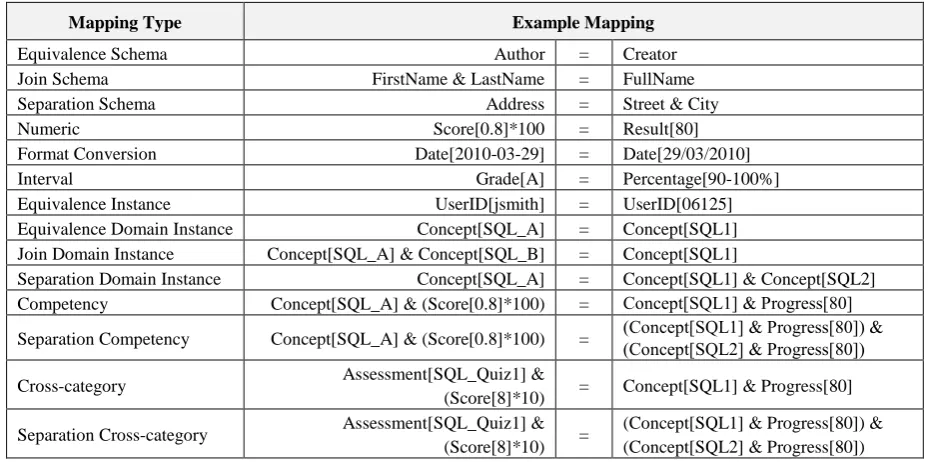
From examining sample learner information from a variety of educational web systems such as Sakai (Sakai 2010), Moodle (Moodle 2010), AHA! (De Bra et al. 1998), CUMULATE (Brusilovsky, Sosnovsky & Shcherbinina 2005) and APeLS (Conlan & Wade 2004) a set of required learner mapping types have been derived and categorized. These learner mappings consist of core generic mapping types that are combined as needed to allow the exchange of heterogeneous learner information. In the following sections, these mapping types are explained and examples of each, in the domain of database and SQL education, are given in table 1.
3.1 Core Generic Mapping Types
Equivalence schema mappings are the most basic form of mapping and are created between the equivalent schema elements of learner models. Two extensions of this type of mapping are the join schema mapping, where multiple schema elements from one learner model are equivalent to one schema element in another learner model, and separation schema mapping, where one schema element is equivalent to multiple schema elements.
Building on the schema mapping, functional mappings allow generic manipulation of instance data in an exchange between learner model schema elements. Types include numeric mappings which allow mathematical manipulation of numerical data, format conversions which allow manipulation of data types such as dates, and interval mappings which allow manipulation of data that requires the use of intervals, for example, learner grades.
Table 1: Examples of Mapping Types.
Mapping Type Example Mapping
Equivalence Schema Author = Creator Join Schema FirstName & LastName = FullName Separation Schema Address = Street & City Numeric Score[0.8]*100 = Result[80] Format Conversion Date[2010-03-29] = Date[29/03/2010] Interval Grade[A] = Percentage[90-100%] Equivalence Instance UserID[jsmith] = UserID[06125] Equivalence Domain Instance Concept[SQL_A] = Concept[SQL1] Join Domain Instance Concept[SQL_A] & Concept[SQL_B] = Concept[SQL1]
Separation Domain Instance Concept[SQL_A] = Concept[SQL1] & Concept[SQL2] Competency Concept[SQL_A] & (Score[0.8]*100) = Concept[SQL1] & Progress[80]
Separation Competency Concept[SQL_A] & (Score[0.8]*100) = (Concept[SQL1] & Progress[80]) & (Concept[SQL2] & Progress[80])
Cross-category Assessment[SQL_Quiz1] &
(Score[8]*10) = Concept[SQL1] & Progress[80]
Separation Cross-category Assessment[SQL_Quiz1] & (Score[8]*10) =
(Concept[SQL1] & Progress[80]) & (Concept[SQL2] & Progress[80])
Instance mappings can also be created using a predefined set of possible instance values, for example, domain concepts retrieved from domain models. Again, extensions of the instance mapping type can include joining and separating.
3.2 Composite Learner Mapping Types
Individually, the generic mapping types are not sufficient to map complex learner model data. However, they can be combined to create mappings between different categories of learner information. The categories of learner information used in this analysis are based on the IMS LIP specification (IMS 2010). They are (i) Identification, (ii) Goals, (iii) Interests, (iv) Assessments, (v) Competencies, (vi) Activities, (vii) Qualifications, (viii) Affiliations, (ix) Accessibility, (x) Security.
An example of a mapping in the competencies category would be the instance mapping of a domain concept in conjunction with the numeric mapping of the learner’s knowledge of that concept. Join and separation extensions also apply at this higher level of learner mapping types, for example, exchanging one competency from a learner model into two competencies in another learner model.
Mappings can also be created between the different categories of learner information. These cross-category mappings allow for very expressive exchange of learner data. An example is equating an assessment in one learner model to a competency in another learner model. In cross-category learner
mappings, join and separation extensions are also possible. For example, separation of an assessment in one learner model into two competencies in another learner model.
In summary, these learner mappings are a core set identified using an evidence-based approach where existing learner representations were analyzed for potentially shareable information. The selected systems are a representative sample of typical educational web systems and use many common user modeling techniques, such as the overlay approach in adaptive systems (Brusilovsky & Millán 2007), that would likely be present in other systems’ learner models. However, there are potentially other mappings to be found in learner data that is more complex and less suitable for sharing such as in event-driven user data or where there is interdependency of data within a learner model.
4 FEDERATED USER MODEL
EXCHANGE SERVICE
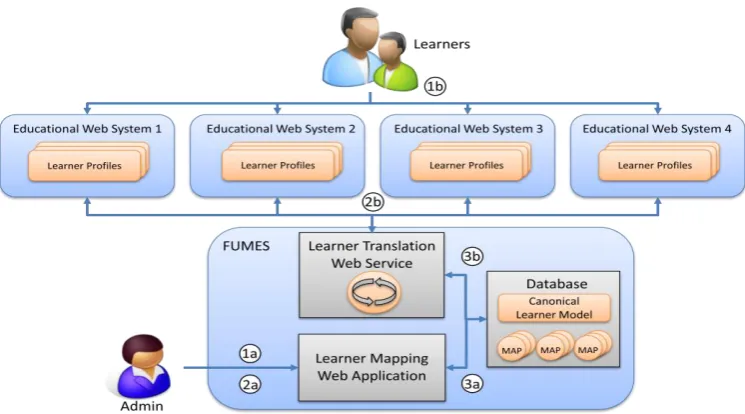
Figure 1: FUMES Architecture.
pre-runtime, administrator-led mapping process and a runtime, automatic exchange process.
The mapping process has led to the development of the Learner Mapping Web Application; a graphical tool for the manual creation of mappings between learner models. After receiving sufficient training, the administrator can used this tool to perform a number of tasks as shown in figure 1.
(1a) The administrator uses the Learner Mapping
Web Application to import learner model schemas from educational web systems.
(2a) The administrator uses the Learner Mapping
Web Application to create mappings between each learner model and the FUMES canonical model, which is based on IMS LIP (IMS 2010). Equivalent selections are made from each model and the mapping type is specified.
(3a) The Learner Mapping Web Application automatically generates XQuery versions of these graphical mappings which can be tested using sample learner model instance data. When the mappings have been verified they are stored in the FUMES database for use at runtime.
When the administrator-led mapping process has been completed for a number of systems, FUMES can perform an automatic exchange of learner information between those systems. FUMES uses web services to allow access to heterogeneous learner models and provides a means to transfer them between different systems using a common standard protocol. Currently, FUMES supports learner models represented in XML; the most commonly used format in existing educational web
systems. In the future, it may be extended to include semantic web technologies such as RDF and OWL.
Within the FUMES framework, the central point for exchange is the Learner Translation Web Service. This service handles the management of the learner model interchange and translates between the various learner model representations. Again, figure 1 shows the stages in the exchange process.
(1b) The end-users access one of potentially many educational web systems that retain learner information about them.
(2b) Each system can request updates of its learner model instances from the Learner Translation Web Service. The Learner Translation Web Service retrieves suitable learner model instances from other educational web systems.
(3b) The retrieved learner models are each translated and merged into the FUMES canonical model form by executing the XQuery mappings in the database. Finally, this canonical learner model representing the various source learner models is translated into the appropriate learner model form and returned to the target educational web system.
5 CASE STUDY
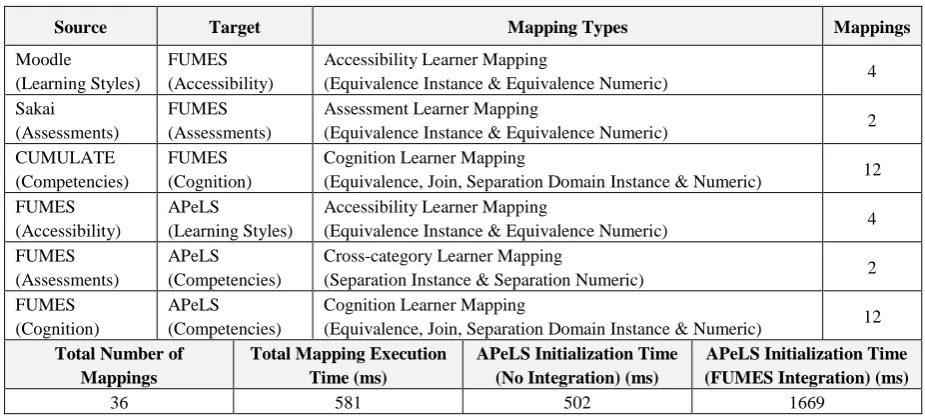
Table 2: Case Study Results.
Source Target Mapping Types Mappings
Moodle
(Learning Styles)
FUMES (Accessibility)
Accessibility Learner Mapping
(Equivalence Instance & Equivalence Numeric) 4 Sakai
(Assessments)
FUMES (Assessments)
Assessment Learner Mapping
(Equivalence Instance & Equivalence Numeric) 2 CUMULATE
(Competencies)
FUMES (Cognition)
Cognition Learner Mapping
(Equivalence, Join, Separation Domain Instance & Numeric) 12 FUMES
(Accessibility)
APeLS
(Learning Styles)
Accessibility Learner Mapping
(Equivalence Instance & Equivalence Numeric) 4 FUMES
(Assessments)
APeLS (Competencies)
Cross-category Learner Mapping
(Separation Instance & Separation Numeric) 2 FUMES
(Cognition)
APeLS (Competencies)
Cognition Learner Mapping
(Equivalence, Join, Separation Domain Instance & Numeric) 12
Total Number of Mappings
Total Mapping Execution Time (ms)
APeLS Initialization Time (No Integration) (ms)
APeLS Initialization Time (FUMES Integration) (ms)
36 581 502 1669
APeLS and the learner modeling system CUMULATE. The learning management systems were chosen as they are often the central point for online learning and are extensively used by many institutions. The adaptive system and learner modeling system were chosen as they retain more complex learner information to provide personalization to learners.
The case study consisted of sample learner information from Sakai, Moodle and CUMULATE being supplied to an APeLS-based adaptive web course used to teach SQL. The adaptivity within the SQL web course is supported by a learner model generated from prior knowledge and learning style questionnaires that new students complete before using the system. The goal of this case study was to identify if FUMES could support the necessary mappings to allow the alternative retrieval of prior knowledge and learning styles from Sakai, Moodle and CUMULATE learner representations.
5.1 Implementation
To achieve the integration, the FUMES Learner Mapping Web Application was used to identify suitable mappings from the source learner representations to the FUMES canonical model. Mappings were then identified from the FUMES canonical model to the APeLS learner model. The mappings allowed the exchange of competencies from CUMULATE, assessments from Sakai and learning style information from Moodle. These mappings were then stored for execution at runtime.
To execute the exchange of learner data, the SQL web course was set up to request new learner models from the FUMES Learner Translation Web Service. When a request was received by FUMES, the mappings were executed and a new learner model was generated based on the competencies found in CUMULATE, the assessments found Sakai and the learning style information found in Moodle. This learner model was translated into an APeLS learner model representation and returned to initialize an adaptive learning session for the learner.
5.2 Performance
An analysis of this case study was carried out to examine the types of mappings required and the performance of those mappings when executed to exchange learner information.
Table 2 shows the results of mapping the individual source learner models to the FUMES canonical model and the FUMES canonical model to the target learner model in the APeLS-based SQL web course. Table 2 also shows the overall performance results for the full integration of Moodle, Sakai, CUMULATE and APeLS using FUMES. The total number of mappings created in this case study using the canonical model approach was 36 and the total execution time for all the mappings was 581ms. The key result of this case
Table 2 shows that the use of FUMES to retrieve updated learner models adds just over one second to the initialization time of the APeLS-based SQL web course. This should not impact greatly on the usability of the system. Another major benefit of using FUMES is the removal of the prior knowledge questionnaires for first-time learners if that prior knowledge can be retrieved from other systems. This could potentially save significant time previously spent completing extensive questionnaires.
In summary, this was an initial case study to test
FUMES in a practical learner exchange scenario. It demonstrates that FUMES can successfully support multiple integrations between heterogeneous educational web systems. It has also shown that the shared learner information can be used successfully by the target system, in this case, to automatically personalize content for new learners. The performance results indicate that, in this case study, the mapping approach is viable and does not significantly decrease the responsiveness and usability of the integrated systems. However, further research will be required into the scalability of this approach for larger numbers of mappings.
6 SUMMARY
This paper has given an overview of current research in the area of learner model interoperability and has defined an evidence-based categorization, based on existing learner models, of mapping types that are required to perform learner model mapping.
To validate these mappings, an interoperability system was implemented to support the sharing of heterogeneous learner information. FUMES allows the creation of complex relationships between multiple learner models, using a visual approach to resolve domain-specific mapping problems.
Finally, a case study demonstrated FUMES supporting the mapping and exchange of learner information between multiple existing educational web systems with minimal impact on usability.
REFERENCES
Aumueller, D, Do, H-H, Massmann, S & Rahm, E 2005, Schema and Ontology Matching with COMA++, In 2005 ACM SIGMOD International Conference on Management of Data. ACM.
Bielikova, M & Kuruc, J 2005, Sharing User Models for Adaptive Hypermedia Applications, In ISDA 05, 5th International Conference on Intelligent Systems Design and Applications. IEEE Computer Society.
Brusilovsky, P & Millán, E 2007, 'User Models for Adaptive Hypermedia and Adaptive Educational Systems', in The Adaptive Web, Springer, pp. 3-53. Brusilovsky, P, Sosnovsky, S & Shcherbinina, O 2005,
User Modeling in a Distributed E-Learning Architecture, In User Modeling 2005. Springer. Cena, F & Furnari, R 2008, A SOA-Based Framework to
Support User Model Interoperability, in 5th International Conference on Adaptive Hypermedia and Adaptive Web-based Systems. Springer.
Conlan, O & Wade, V 2004, Evaluation of APeLS-An Adaptive eLearning Service based on the Multi-model, Metadata-driven Approach, In 3rd International Conference on Adaptive Hypermedia and Adaptive Web-Based Systems. Springer.
De Bra, P, Aerts, A, Berden, B, de Lange, B, Rousseau, B, Santic, T, Smits, D & Stash, N 1998, AHA! The Adaptive Hypermedia Architecture, The New Review of Hypermedia and Multimedia.vol. 4, pp. 115-139. Dolog, P & Schäfer, M 2005, Learner Modeling on the
Semantic Web, In Workshop on Personalisation on the Semantic Web, Edinburgh, Scotland.
Falconer, SM, Noy, NF & Storey, MA 2007, Ontology Mapping - A User Survey, In 2nd International Workshop on Ontology Matching at the International Semantic Web Conference, Busan, Korea.
Heckmann, D, Schwartz, T, Brandherm, B & Kröner, A 2005, Decentralized User Modeling with UserML and GUMO, In Workshop on Decentralized, Agent Based and Social Approaches to User Modelling, Edinburgh, Scotland.
IMS 2010, IMS Learner Information Package,
http://www.imsglobal.org/profiles.
Kalfoglou, Y & Schorlemmer, M 2003, Ontology Mapping: The State of the Art, The Knowledge Engineering Review. vol. 18, no. 01, pp. 1-31. Moodle 2010, http://moodle.org.
Sakai 2010, Sakai Project, http://sakaiproject.org. Sheth, AP & Larson, JA 1990, Federated Database
Systems for Managing Distributed, Heterogeneous, and Autonomous Databases, ACM Computing Surveys, vol. 22, no. 3, pp. 183-236.
Van Der Sluijs, K & Houben, GJ 2006, A generic component for exchanging user models between web-based systems, International Journal of Continuing Engineering Education and Life Long Learning, vol.
16, no. 1, pp. 64-76.