PERPUSTAKAAN UTHM
'I "-: -,
KOLEJ UNIVERSITI TEKNOLOGI TUN HUSSEIN ONN
BORANG PENGESAHAN STATUS TESIS·
JUDUL: A STUDY IN INDUSTRIAL ROBOT PROGRAI\JI\IING
SESI PENGAJIAN _-'2::..:0:....:0'--'4'-"/2:....:0..;:.O~5_
Saya YUSMARNIT A BINTI YUSOP (HURUF BESAR)
mcngaku membenarkan tesis (Smjdiiil P,Juda 'Sarjana lDalcten EdsaLlrl* ini e1isimpan eli Perpustakaan dengan syarat-syarat kegunaan seperti berikut:
I. Tesis aelalah hakl11ilik Kolej Uni\ersiti Teknologi Tun Hussein Onn.
I Perpustakaan e1ibenarkan membuat salinan untuk tujuan pengajian sahaja
3. Perpustakaan e1ibenarkan l11embuat salinan tesis ini sebagai bahan pLTtukaran antara institusi pengajian tinggi.
4. **Sila tandakan (\I"')
II II
SUUTII II
TER.\-IAD(lvIengandungi l11aklul11at yang berdarjah keseiamatan atau kepentingan tvlalaysia scperti yang tcrmaktub eli e1alal11 AKTA RAHSIA RA.SMI 1l)72)
(Menganciungi maklul11at TERHAD yang tebh ditentukan oleh organisasi/baelan eli mana penydielikan c1ijalankan)
TIDAK TERHAD
o
(j)~
\~r~ hkan olehiJi
or-=--"'-VI
(TANDATANGAN PENUUS) (TANDATI\NGAN PENYELlA)
Abmat Tdap:
KI\I 1(, lALAN P ARIT LAlvIPONG. KAI\IPUNG THIEL.
PI\!. DR. ZAINAL ALAI\II-IARON
772(}() I\IELAKA .. Nama Pcnyeiia
Tarikh: 7J NOVEMBER ;()(}4 Tarikh: 22 NOVEI\IBER 2(1)4
CATATAN:
*
**
•
Potong yang tidak bcrkcnaan.
Jika tcsis ini SULIT atau TERHAD. sila lampirkan surat daripada pihak bcrkuasaJorganisasi bcrkcnaan dcngan mcnyatakan sckali tcmpoh tcsis ini perlu dikclaskan scbagai atau TERHAD.
Tcsis dimaksudkan scbagai tcsis bagi 1j'17.1h doktor Falsafah dan Sarjana sccara Pcnyclidikan. atau discrtasi bagi pcngajian sccara kcrja kursus dan
" I hereby declare that I have read this thesis and acknowledge it has achieved the
scope and quality for the award of the Degree of Master of Electrical Engineering."
Signature Supervisor Date
A STUDY IN INDUSTRIAL ROBOT PROGRAMMING
YUSMARNIT A BINTI YUSOP
A thesis submitted in partial fulfillment of the requirements for the award of the Degree of Master of Engineering (Electrical)
Kolej Universiti Teknologi Tun Hussein Onn
11
"No part of the study was covered by copyright. References of information obtained from other source are specially quoted; otherwise the rest of the information presented
through this study is solely worked and experimentally carried out by the author."
Signature Author Date
~
.. l
... ." ... .
\11
I dedicate this to
YOll, mumand dad
IV
ACKNOWLEDGEMENT
I would like to take this opportunity to exiend my deepest gratitude to all these who have assisted me in making this project a success. A special note of thanks goes to my supervisor, PM. Dr. Zainal Alam Haron for his patience and guidance throughout the course of this project.
I would also like to take this opportunity to thank all the technicians who have played a role in accomplishing this project.
ABSTRACT
This project is concerned with learning the tec1mology and programming of servo controlled industrial robots. A Mitsubishi RV-2AJ articulated robot was used in this project. The project work is divided into two parts: In the first part of the project the author familiarized herself with the operation and programming of the robot's manipulator and controller hardware by carrying out some laboratory experiments. A set oflaboratory sheets were produced from this exercise. In the second part, the author studied the mechanics of software control of the robot. A user-defined trajectory planning routine based on the cubic spline fitting function has successfhlly been developed in this project.
VI
CONTENTS
CHAPTER TITLE PAGE
ACKNOWLEDGEMENT IV
ABSTRACT V
CONTENTS vi
LIST OF TABLES IX
LIST OF FIGURES x
LIST OF APPENDICES xii
I INTRODUCTION
1.1 Overview
1.2 Industrial~otivation 3
1.3 Problem Definition 4
1.4 Research Objectives 7
II LITERATURE REVIEW
2.1 Introduction 8
2.2 Historical Development 11
2.3 Robot Pro[,Tfamming 14
2.4 Cubic Spline 17
VlI
III METHODOLOGY 20
IV RESEARCH FINDING & DISCUSSION PART I
4.1 Components of Robot System 23
4.2 Connecting To The Robot 25
4.2.1 Using RS-232-C 26
4.2.2 Using Ethernet 28
4.2.3 Stable Communication Between The Personal Computer Support Software And The Robot
Controller 28
4.3 Mitsubishi RV-2AJ Jog Feed 30
4.4 Personal Computer Support Software (MELFA) 32
4.5 MELFA Robot Programming 34
4.5.1 On-line programming 35
4.5.2 Off-line programming 36
4.5.3 MELFA Robot Programming Language 38
V RESEARCH FINDING & DISCUSSION PART II
5.1 Curve and Interpolation 45
5.2 Methods of Interpolation 47
5.2.1 Piecewise Linear Interpolation 47
5.2.2 Piecewise Polynomial Interpolation 48
5.2.3 Interpolation Using Splines 49
5.3 Cubic Spline User-Defined Trajectory Planning
Routine Using MA TLAB 51
VI FUTURE WORK & CONCLUSION 54
REFERENCES 56
APPENDIX B: MA TLAB RESULTS
APPENDIX C: CUBIC SPLINE INTERPOLATION
THEORY
APPENDIX D: SPECIFICATION OF ROBOT
VIII
84
93
CONTROLLER 97
APPENDIX E: SPECIFICATION OF ROBOT ARM 100
LIST OF TABLES
TABLE NO. TITLE
4.1 On-Line Programming 4.2 Off-Line Programming
4.3 Effective Programming Procedures 5.1 Position Specification
IX
PAGE
35
37
x
LIST OF FIGURES
FIGURE NO. TITLE PAGE
1.1 Joint Interpolation 5
1.2 Linear Interpolation 5
1.3 Circular Interpolation 6
1.4 Continuous Movement 6
2.1 Motion Defining Categories 10
3.1 PART I - Familiarization 21
3.2 PART II - MATLAB Programming 22
4.1 Components Of Robot System 24
4.2 Example ofRS-232 usage and expansion RS-232 usage 25 4.3 Example of connecting multiple robot controllers 26
4.4 Personal Computer's RS-232-C Connector 27
4.5 Controller's RS-232-C Connector 27
4.6 Ethernet Connection Example 28
4.7 Communication Server Setting 29
4.8 JOINT jog 31
4.9 TOOL jog 31
4.10 XYZjog 32
4.11 MELFA PC TOOL 33
Xl
4.13 Off-Line Programming 36
4.14 Operation flow for example I 39
4.15 General Description Of Pick and Place Operation 40
4.16 Operation flow for example 2 42
4.17 General Description Of Palletizing Operation 43
5.1 Polynomial Of Order Four 46
5.2 Comparison Between Different Interpolation Routines 48
5.3 Interpolation Using Spline 50
5.4 Cubic Spline Routine Flowchart 51
APPENDIX NO.
A B C D E F
XII
LIST OF APPENDICES
TITLE PAGE
LAB SHEET 59
MATLAB RESULTS 84
CUBIC SPLINE INTERPOLATION THEORY 93 SPECIFICATION OF ROBOT CONTROLLER 97
SPECIFICATION OF ROBORT ARM 100
CHAPTER I
INTRODUCTION
1. I Overview
Multi-axis machines are used in a variety of applications: pick-and-place operations, welding, machining, etc. Such machines can be divided into two units: the physical mechanism composed oflinks and actuators, and the control system. The number of actuators present in the mechanical system depends on the number of independent machine axes, or degrees of freedom. For example, a typical articulated six degree of freedom manipulator contains six rotating actuators. A five-axis high-speed CNC machining centre would contain three linear actuators and two rotating actuators.
A motion task given to the machine must ultimately be represented as a reference signal, which is sent to the control system. The control system acts to makc
2
design. Computer algorithms are designed to calculate an appropriate reference signal based on the desired task path and time-related limits (such as speed and acceleration). This reference signal is the trajectory, and can be defined as a locus of points in operational or joint space on which a time-law has been specified [1]. The generation of an appropriate trajectory is the problem that is being investigated in this thesis.
The path along which the trajectory is defined can be point-to-point; namely, the machine is required to move between the two points but is not given any fixed intermediate path. This type of path is useful in manipulator pick-and-place operations. A path can also be completely specified through use of geometric functions. This type of path is commonly used in CNC machining applications or in manipulator applications when obstacles are present, or when it is necessary to ensure that the end effector follows a specific path. Herein it is assumed that the path definition is provided, and the problem of path planning is not specifically addressed.
The control of the machine motion can be divided into two parts: motion planning and motion tracking. Motion planning involves generating the path and its time law, providing the controller's reference si!:,llJal. Motion tracking, on the other hand, is concerned with improving the tracking of the reference signal. Motion planning is often done off-line, typically when the trajectory generation algorithms are computationally intensive. However, it is often desirable to generate trajectories
In industrial applications, it is common to use simple PID control laws, which do not take into account the system's nonlinearities, to track a reference signal. To compensate for tracking errors introduced by the system's nonlinearities, a more complicated controller must be used [3,4,5]. Alternatively, it is possible to design a trajectory that takes the system's nonlinearities into account and thus provides a reference signal that can be more easily tracked by common industrial controllers [6,7].
1.2 Industrial Motivation
Increased productivity is an important industrial consideration. When a multi-axis machine limits the task speed, decreasing the machine's overall motion time will increase productivity [6, 3]. In addition, improving the tracking accuracy of the machine is always desirable since it results in more repeatable products or operations.
Tracking a purely time-optimal trajectory with a simple controller will saturate the actuators resulting in poor tracking, vibrations in the machine and increased machine wear [8, 9, 10, 11, 12, 13]. Specialized controllers have been developed in order to provide better tracking of time-optimal trajectories. However, it is unlikely that they will be \videly implemented in industry due to their complicated form. Purely time optimal trajectories have been modified to take into account further limitations of the actuators, for example jerk or torque rate limits, thereby avoiding controller saturation and resulting in improved tracking accuracy [15, 7, 14]. Herein, trajectories that are planned with jerk or torque rate limitations are termed smooth trajectories.
There exists a need for a smooth trajectory generation algorithm that can easily be intel:,rrated into existing industrial systems, that is, be implemented using a typical
4
industrial controller. Such an algorithm should be applicable on-line, provide adequate dynamic timitations, and allow the specification of the speeds at all the way-points.
1.3 Problem DefUlition
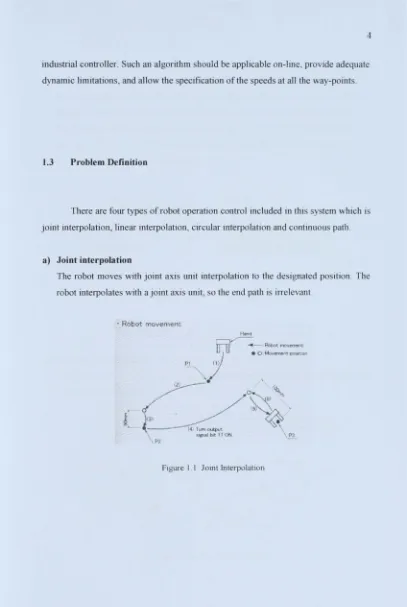
There are four types of robot operation control included in this system which is joint interpolation, linear interpolation, circular interpolation and continuous path.
a) Joint interpolation
The robot moves with joint axis lmit interpolation to the designated position. The
robot interpolates with ajoint axis unit, so the end path is irrelevant.
[image:20.595.95.502.115.722.2]. Robot movement
5
b) Linear interpolation
For the linear interpolation type of control, the end-effector is programmed to
move a sequence of discrete points in the workspace. In between points, no control
required over either speed of the individual axes or the path of the end-effector.
Fig.l.2 shows that the speeds is reduced and almost stop in front of the target
position. After moving to the target position, the speed for moving to the next
target position starts to be accelerated.
Sia.rt paslhon af mOVemen
c) Circular interpolation
II (Speed)
f
f77777A~1
P2 P3rilU4
I (TIm!!).
Figure: 1.2: Linear Interpolation
The robot moves along an arc designated with three points using three-dimensional
circuJar interpolation .
• Robot movement
T\)f'~ outPut
IIlMit.it IB
Oil
Figure. 1.3. Circular Interpolation
~ Robot- mo .... ment • Moyement p05ftion
d) Continuous path
In the continuous operating mode, the speed is reduced in front of the target
position, but it does not stop completely. The speed for moving to the next target
position starts to be accelerated at that point. Therefore, it does not pass through each target position, but it passes through the neighborhood position.
Contlnuau~ movemelJj
PI -0- 1>2
J'~
~
,
jI
l
p3
SIll rt ~ osition of
movEtmet1t
v (Speed;'
PI P2 PJ
I(Tlmel ·The abo~o; g,apll snown an example
OependU19 on ll1e movIng dIstance and/or
$Plled. "cceleratlon and (ieeel"" \Ion may occur dunng Interpotatlon connecllon
Figure: 1.4: Continuous Movement
6
The drawback of the existing operation control methods stated in previous
section are does not preserving continuity in the first and second derivatives at the interpolation point. The first derivative represents continuity in the velocity and the second derivative represents continuity in the acceleration. Several trajectory planning methods can be used in order to provide a method of generating smooth and
continuous path. In practical application, to plan a path for robot's end-effector to
follow, a number of points along the desired path are given by means of a teach-box or a robot language command. The end-effector is then controlled to move through or pass by these points smoothly and continuously.
How to control tile end-effector to move tllrougll tile desired patll smoothly and
To solve the stated problem, this project proposed an approach to constrain smoothness and continuity based on cubic spline trajectory planning algorithm. Cubic splines offer several advantages. First, it is the lowest degree polynomial function that preserving continuity in the first and second derivatives at the interpolation points. Second, low-degree polynomials reduce the effort of computations and the possibility of numerical instabilities. The feasibility of the method is illustrated by experimental results with an articulated robot (Mitsubishi RV-2AJ) located at KUITTHO's Automation Lab.
1.4 Research Objectives
7
This project is divided into two parts. For Part I, the objective of this work is to familiarize with the Mitsubishi RV-2AJ robot operation and control. Instead of to familiarize with the robot operation and control, a further objective is to produce a set oflaboratory sheets as a reference material to the students or lecturers in future work. Furthermore is to learn MELFA robot programming languages, MOVE MASTER Command and MELFA-BASIV IV Command.
CHAPTER II
LITERATURE REVIEW
2.1 Introduction
With a pressing need for increased productivity and the delivery of end products of uniform quality, industry is turning more and more toward computcr-based automation. At the present time, most automated manufacturing tasks are carried out by special-purpose machines designed to perfonn predeterrnined functions in a manufacturing process. The innexibility and generally high cost of these machines, often called hard automation systems, have led to a broad-based jnterest jn the use of robots capable of performing a variety of manufacturing functions in a more nexible working environment and at lower production costs.