Journal of Chemical and Pharmaceutical Research
__________________________________________________
ISSN No: 0975-7384 CODEN(USA): JCPRC5
J. Chem. Pharm. Res., 2011, 3(5):281-289
Optimization of Fermentation Parameters for Maximization of
Actinomycin D production
M Khan1 and C. K. M Tripathi2
Department of Biotechnology, Integral University, Lucknow, India
Division of Fermentation Technology, Central Drug Research Institute (CSIR), Lucknow, India _____________________________________________________________________________
ABSTRACT
Air flow rate (VVM) and stirring rate (RPM) were optimized to maximize the production of an antibiotic, Actinomycin D, from a mutant of Streptomyces sindenensis-M-46. Experiments were conducted using the central composite design (CCD), A Response surface polynomial equation was used to establish a mathematical relationship between the inputs (air flow rate and stirring rate) and targets (Antibiotic concentration after 5 days of incubation, from CCD). Genetic Algorithm (GA) and Nelder-Mead downhill simplex (NMDS) were separately used to optimize the fermentation parameters for maximum antibiotic production. Both GA and NMDS predicted an almost similar optimum combination of fermentation parameters. Antibiotic concentration increased by almost 55% as compared to the maximum obtained at the optimum point in shake flask experiment (1.26 to ~2 gm/L). The polynomial equation was also used to construct a response surface showing the effect of fermentation parameters on antibiotic yield. The response equation successfully predicted the effect of individual fermentation parameters (varying one at a time) on antibiotic yield. Efficient oxygen mass transfer conditions appear to be an important factor governing antibiotic yield.
Keywords: Response surface, Genetic Algorithm, Nelder Mead Downhill Simplex, Actinomycin
D, Optimization.
_____________________________________________________________________________
fermenter parameter on the antibiotic production, the experiment must be designed so that
parameter is uniformly distributed throughout its sample space. The techniques for designing such experiments range from the traditional one-factor-at-a-time (OFAT) method [1-4] to more complex statistical and mathematical techniques involving experimental designs such as full and partial factorials (Plackett–Burman, Hadamard matrix and central composite designs). The central composite design (CCD) was chosen as design of experiment for its orthogonality and rotatability [5-6]. The experimental runs of the CCD serve as inputs in determining the mathematical model that correlates fermenter parameter and antibiotic yield. The mathematical model can be generated by using the statistical technique such as response surface methodology [7]. The most commonly use approximating functions in the model building stage of RSM are quadratic polynomials. The polynomial equation can also be used to construct a response surface showing the effect of Independent Parameters on Dependent Parameters.
GA is a method for solving optimization problems based on natural selection, the process that drives biological evolution [8-9]. The GA repeatedly modifies a population of individual solutions. On the basis of the three rules (selection, crossover, and mutation), GA randomly selects from the current population the individuals who act as parents, and uses them to produce children for the next generation. Over successive generations, the population “evolves” toward an optimal solution.
NMDS [10] is a single-objective optimization approach for searching the space of n-dimensional real vectors. Since it only uses the values of the objective functions without any derivative information (explicit or implicit), it falls into the general class of direct search methods [11-13]. Downhill simplex optimization uses ‘n+1’ point in ‘n’ dimension. In two dimensions, a simplex is a triangle. In three dimensions it is a tetrahedron. Here we are concerned with only non-degenerate simplexes i.e., those that enclose a finite inner N-dimensional volume. If any point of a non-degenerate simplex is taken as the origin, then the N other points define vector directions that span the N-dimensional vector space. Non-degenerate simplex has one important feature that the result of replacing a vertex with its reflection through the opposite face is again, a non-degenerate simplex.
The objective of downhill simplex optimization was to replace the best vertex of the simplex with an even better one or to ascertain that it is a candidate for the global optimum [14-17]. NMDS has been successfully applied for the modeling and optimization of a variety of chemical and biological problems [18-21].
EXPERIMENTAL SECTION
Inoculum preparation
Seed culture was prepared in a 250 ml Erlenmeyer flask containing 50 ml of production medium (Fructose 21.4gm/L; (NH4)2HPO4 0.76gm/L; DL-Threonine 1.53, Soybean Meal 15.34) by
[image:3.595.113.486.238.559.2]inoculating a loop full of spores from the slant and incubating at 28oC on shakers (200 rpm) for 48 h.
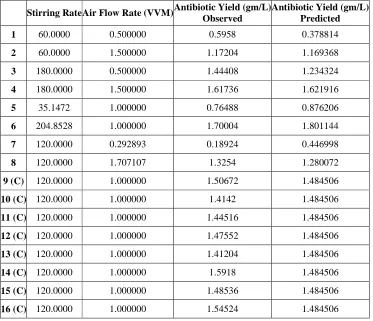
Table 1 Central Composite Design of fermentation parameter (Air flow rate and Stirring rate)
Stirring RateAir Flow Rate (VVM)Antibiotic Yield (gm/L) Observed
Antibiotic Yield (gm/L) Predicted
1 60.0000 0.500000 0.5958 0.378814
2 60.0000 1.500000 1.17204 1.169368
3 180.0000 0.500000 1.44408 1.234324
4 180.0000 1.500000 1.61736 1.621916
5 35.1472 1.000000 0.76488 0.876206
6 204.8528 1.000000 1.70004 1.801144
7 120.0000 0.292893 0.18924 0.446998
8 120.0000 1.707107 1.3254 1.280072
9 (C) 120.0000 1.000000 1.50672 1.484506
10 (C) 120.0000 1.000000 1.4142 1.484506
11 (C) 120.0000 1.000000 1.44516 1.484506
12 (C) 120.0000 1.000000 1.47552 1.484506
13 (C) 120.0000 1.000000 1.41204 1.484506
14 (C) 120.0000 1.000000 1.5918 1.484506
15 (C) 120.0000 1.000000 1.48536 1.484506
16 (C) 120.0000 1.000000 1.54524 1.484506
Design of Experiments (CCD)
Estimation of Actinomycin D
Fermented broth from the fermenter was centrifuged at 11,086 g for 20 min to separate the cells and to obtain the clear supernatant containing antibiotic. The supernatant was extracted with ethyl acetate and concentrated in vacuum. Actinomycin D concentration was estimated by observing UV absorption of crude in methanol with a UV-Vis spectrophotometer (Perkin Elmer Lambda-25) at 443 nm wavelength.
Response Equation
Mathematical packages ‘Statistica and MATLAB®’ were used to perform regression and graphical analysis of the results obtained from CCD. A second order polynomial response eq. (of the form given below) comprising linear, quadratic and interaction terms was obtained.
(1).
Where is Antibiotic concentration in gm/L, is the intercept, is the coefficient for linear direct effect, is the coefficient for quadratic effect and is responsible for curvatures in the model, is the coefficient for interaction effect a positive or negative significant value implies possible interaction between the medium constituents.
GA Optimization
The optimization is done using ‘ga’ function of MATLAB. The input parameters of ‘ga’ function
were as follows: Crossover fraction: 1; Elite count: 4; Population size: 150; Migration Direction: forward; Migration Interval: 20; Migration Fraction: 0.2; Generations: 150; Stall Gen Limit: 50; Creation Fcn: @gacreationuniform; Fitness Scaling Fcn: Rank wise
NMDS Optimization
NMDS was implemented using the “fminsearch” function of MATLAB with the following input parameters: Largescale','off','Simplex','on', 'TolFun', 1.0e-06,'MaxIter', 10000, 'MaxFunEvals', 60000, 'Display', 'Iter'.
RESULTS AND DISCUSSION
Analysis of Response Surface Model (RSM)
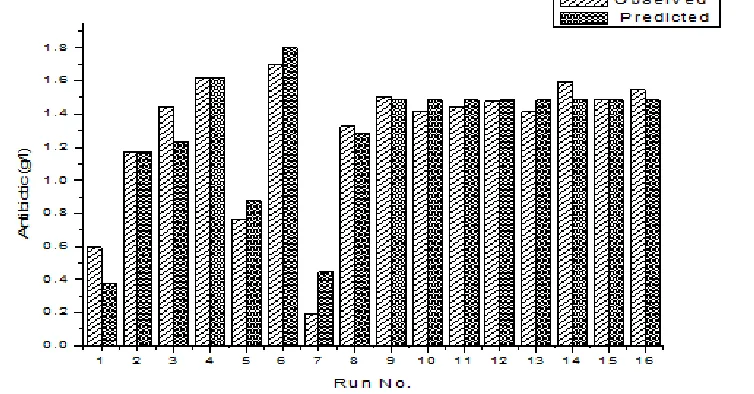
Figure 1 Observed vs. Predicted antibiotic concentration.
Model coefficients and their significance
The significance of each coefficient was determined by P-values (Table 2). The Linear and quadratic main effects of air flow rate and stirring rate are quite significant, as is evident from their respective P-values (Table. 2). The negative values of stirring rate quadratic main effects suggested that stirring rate had a negative effect at higher values which was overcome by higher positive first order main effects. The quadratic main effect of the air flow rate is very low suggesting a weak impact on antibiotic concentration at higher values of air flow rate. Antibiotic concentration appears to be very sensitive to the changes in stirring rate as small change in impeller rotation rate results in large change in the antibiotic concentration obtained in the fermentation broth (Table. 2). A strongly negative quadratic effect of stirring rate on antibiotic concentration in the fermented broth appears to be a result of cell death at higher impeller velocity.
The fact that all the quadratic terms were significant suggested considerable curvature in the model. There exist a non-significant (p = 0.01943 > 0.01) negative interaction between air flow rate and stirring rate.
Table 2 Significance of Regression Coefficients
Regression Coefficients Value p-value
Mean/Interc. ( ) -3.0962 0.002123
Stirring Rate (RPM) ( ) 4.7671 0.009434
Stirring Rate (RPM)( ) - 1.3518 0.018879
Air Flow Rate (VVM)( ) 0.023559 0.000048
Air Flow Rate (VVM)( ) 2.7881e- 005 0.000121
[image:5.595.116.493.117.314.2]Response equation
The application of response surface methodology yielded the following regression equation, which was an empirical relationship between the enzyme yield and test variables i.e Air flow rate ( ) and Stirring rate ( ).
(2).
Where is the response (antibiotic concentration in gm/L)
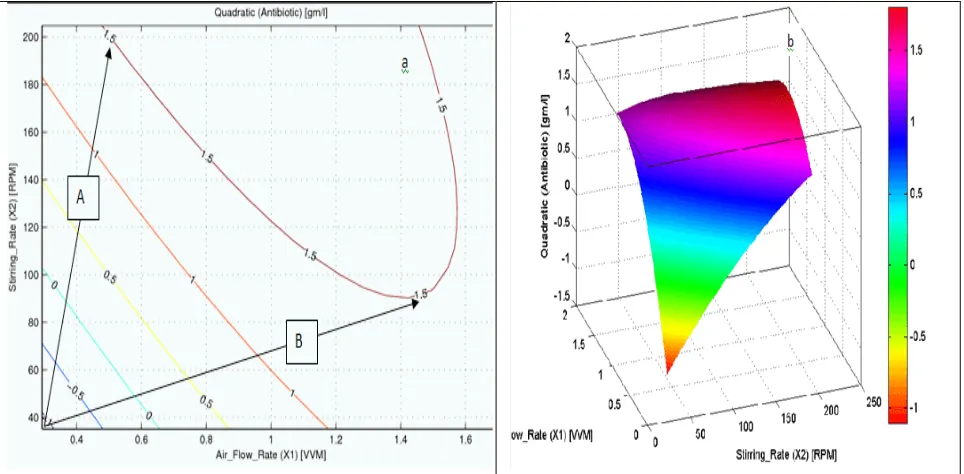
Figure 2a represents the contour plots generated by varying air flow rate ( ) and stirring rate ( ) in the above response equation (Eq. 2). It can be observed that higher antibiotic yields can be obtained at higher stirring rates even at very low air flow rates (Figure 2a, Arrow A). Similar antibiotic yield can only be obtained by increasing air flow rates by three times with only 50% decrease of stirring rate (Figure 2a, Arrow B). The maximization of antibiotic yield also appears to be shifted towards Arrow A i.e higher antibiotic yields can only be obtained in the area confined within the 1.5 gm/L contour. Economical maximization of antibiotic appears to be lying in the area characterized by high stirring rate and low air flow rates. The response surface plot (Figure 2b) generated by varying air flow rate ( ) and stirring rate ( ) in the above response equation (Eq. 2) also suggest a similar picture. It can be observed that high antibiotic yields can be obtained in the area corresponding to high stirring rate and low air flow rate. The antibiotic yield is on an increasing trend near the borders of maximum stirring rate. This suggests that higher antibiotic yields can be obtained on further increasing the stirring rate beyond the maximum (250 RPM) considered in the design.
[image:6.595.63.545.446.683.2]Optimization
GA and NMDS were applied separately to determine the optimum combination of stirring and air flow rates. Eq. 2 was used as fitness function in the optimization performed using genetic algorithm. Since GA implementation of MATLAB® is designed to minimize the given fitness function. The outputs of the eq 2 were made negative (multiplied by -1). Using a population of 200, the responses of the eq. 2 successfully converged to the optimum values after Nine generations only. Maximum antibiotic yield of 1.95gm/L is predicted at the GA (best individual) optimized combination of fermentation conditions (Air flow rate 0.45 VVM and Stirring rate 336 RPM). The GA-optimized best solution, verified experimentally, yielded ~ 2gm/L of antibiotic, which is in close agreement with the GA-predicted antibiotic yield of 1.95gm/L. The experimentally verified antibiotic yield has increased significantly (from 1.26gm/L to ~2gm/L) in comparison to optimized medium in shake flask experiment (previous chapter). NMDS optimization applied via “fminsearch” function of MATLAB also predicted a similar optimum combination of air flow and stirring rates. The function converged to an optimum after 56 iterations.
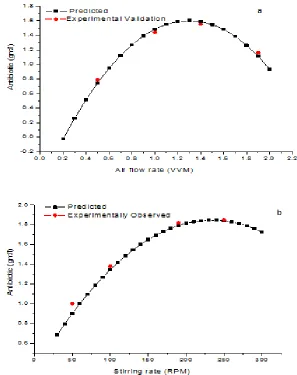
[image:7.595.146.443.320.695.2]Individual effect of fermentation parameters were determined by varying one parameter at a time keeping the other at the central value (Figure 3) of the CCD design (Air flow rate = 1VVM and Stirring rate= 120RPM). It can be observed that higher air flow rates have a negative effect on the antibiotic yield (Figure 3a). This may be due to reduced residence time which results in an inefficient oxygen mass transfer resulting in reduced cell growth and hence decreased antibiotic yield. Increased stirring rates facilitate oxygen mass transfer resulting in higher antibiotic yields at high stirring rates. However, very high stirring rates may lead to cell death with consequent decrease in antibiotic yield. The predictions of the response equation were verified by experimentally validating any 4 randomly selected predictions of the antibiotic yield (Red marker, Figure 3b).
CONCLUSION
The two fermentation parameters (air flow rate and stirring rate) were successfully optimized. Both GA and NMDS proved to be equally efficient in determining the optimum combination of fermentation parameters. The response equation was also successfully used to determine the effect of individual fermentation parameters on antibiotic yield.
REFERENCES
[1] AV Pundle, HS Raman. Biotech Lett, 1994, 16:1041–1046
[2] K Furuhashi, M Takagi, Appl Microbiol Biotechnol, 1984, 20:6–9
[3] PML Castro, PM Hayter, AP Ison, AT Bull, Appl Microbiol Biotechnol, 1992, 38:84–90 [4] RG Silveira, T Kakizono, S Takemoto, N Nishio, S Nagai, J Ferm Bioeng, 1991 72:20–25. [5] T Thiel, J Bramble, S Rogers, FEMS Microbiol Lett, 1989, 61:27–31
[6] GEP Box, WG Hunter, JS Hunter, Statistics for experiments, Wiley, New York, 1978, 291– 334.
[7] TE Fannin, MD Marcus, DA Anderson, HL Bergman, Appl EnvironMicrobiol, 1981, 42:936–943
[8] DR Baughman, YA Liu, Neural Networks in Bioprocessing and Chemical Engineering, Academic Press, San Diego, 1995.
[9] D Goldberg, Genetic algorithms in search, optimization, and machine learning, Addison-Wesley, Reading, 1989.
[10]JA Nelder, R Mead, The Comp J. , 1965, 7: 308–313 [11]MJD Powell. The Comp J., 1964, 7: 155-162.
[12]W Spendley, GR Hext, FR Himsworth, Technometrics, 1962, 4: 441-461. [13]LA Yarbro, SN Deming, Analytica Chimica Acta, 1974, 73: 391–398.
[14]SLS Jacoby, JS Kowalik, JT Pizzo, Iterative methods for nonlinear optimization problems, NJ: Prentice-Hall press, Englewood Cliffs, 1972.
[15]Nadia T. A. Dawood, J. Chem. Pharm. Res., 2011, 3(4):111-121
[16]T. Jayalakshmi, P. Krishnamoorthy, G. Ramesh kumar, P. Sivamani, J. Chem. Pharm. Res.,
2011, 3(4):498-503
[17]F. Sánchez Rojas, C. Bosch Ojeda, J.M. Cano Pavón, J. Chem. Pharm. Res., 2010, 2(4):166-173
[19]K Gerhard, Hoppe, SH Geoffrey, Biotechnology Letters, 1982, 4(1): 39-44.
[20]S Gough, O Flynn, CJ Hack, R Marchant, Applied Microbiology and Biotechnology, 1996, 46(2):187-190.
[21]PRM Reddy, S Mrudula, B Ramesh, G Reddy, G Seenayya, Bioprocess and Biosystems