2017 2nd International Conference on Software, Multimedia and Communication Engineering (SMCE 2017) ISBN: 978-1-60595-458-5
Improved Edge Detection Algorithm and Its Application in Robotic Fish
Jin-zhi REN
1and Yan-song DENG*
Institute of Electrical and Information Engineering, Southwest University for Nationalities of China. Chengdu, Sichuan, 610041, P.R. China
*Corresponding author
Keywords: OpenCV, Canny operator, Edge detection, Self-adaptive thresholds, Robotic fish.
Abstract. To get self-adaptive thresholds, the edge detection algorithm of Canny operator is improved in OpenCV library under Linux platform in this paper. Firstly, the gradient graph of the gray image and the maximum value of the gradient are obtained. Then the histogram is calculated and the pixel points corresponding to the gradient values are obtained via the traversion of histogram. Finally, the high and low thresholds are calculated to determine edge. Consequently, there comes the new self-adaptive thresholds algorithm of Canny operator. In the meantime, by simulating on the robotic fish in the water, the new algorithm is compared with the traditional Canny operator in the effect of the output image and the Peak Signal to Noise Ratio. What’s more, the same picture is tested to compare time in the Matlab platform and OpenCV platform. Such comparisons show that the new algorithm has more flexibility and efficiency.
Introduction
Image is the main medium for people to obtain information, in the visual system, the image carries all the information. Besides, the edge of the image is one of its most basic features, by which you can generally get the image information and greatly reduce the amount of information in the analysis process[1][2]. Since 1960, people have begun to propose a number of edge detection methods for various changes in the image and develop a series of gradient operators and Laplace operator edge algorithm. In early 1980, on the basis of the view of Signal processing point, Jone F. Canny proposed that the edge detection operator must meet three criteria, namely, ratio of optimal signal to noise ratio, optimal positioning accuracy and single edge[3].
In the process of self-adaptive algorithm research, many scholars improved the algorithm for the image noise and the choice of threshold. It was proposed to use the nonlinear smoothing filter (median filter) to substitute the traditional Gaussian filter by Ruo-zhu Chen[4]. The mean curvature motion diffusion equation was proposed by Lions Pierre[5], which could keep the edge of the target and remove the noise. Jie-qing Tan presented the use of anisotropic diffusion equation instead of Gaussian filtering, and made the image be enhanced[6]. Tong-qing Wang proposed a method based on two-dimensional empirical mode decomposition to extract the details of the image during the screening process by multi-scale decomposition of the image[7]. However, passive parameter selection led to these algorithms set parameters mechanically, which was detrimental to the detection of edges when the environment changed.
In this paper, an algorithm about Canny’ self-adaptive thresholds based on the OpenCV platform is put forward by analyzing the algorithm of traditional edge detection operator.
OpenCV on the Linux Platform
The Traditional Edge Detection Algorithm of Canny Operator
The Steps When Use Traditional Canny Operator
Step 1: The image is smoothed by Gaussian filter.
Step 2: The magnitude and direction of the gradient are calculated. Step 3: The magnitude of the gradient adopts non-maximal suppression.
Step 4: Detecting edge by manually determining the threshold and doing edge connection.
The theory of traditional Canny Operator
1) Each image taken by the camera will produce some noise because of the impact of the surrounding environment, so the image should be pretreated. The traditional Canny operator uses the Gaussian filter and makes the image carry on the convolution operation; that is, the convolution kernel and the each pixel of input image are convolved. The final calculating result is as the pixel value of output image, which can restrain noise to a certain extent.
2) Calculate the gradient amplitude and direction of the filtered image. The Canny operator uses the Sobel operator to calculate the gradients of Gx and Gy direction. The Canny function in OpenCV uses the Sobel convolution kernel to calculate the magnitude and direction of the gradient, which will be taken as the original data of the edge of the extracted image. We regard the gradient value as
2 1 2 2
) (Gx Gy
G , and the angle as
y x
G G
actan
.
3) The purpose of the non-maximal suppression is to remove most of the non-edge points, and the principle is through the pixel's eight neighborhoods to determine the edge points. When the gradient value and the maximum value of a pixel are larger than their eight neighborhoods, they are considered as edge points. According to the formula of 2) the gradient value can be obtained at each point, then the maximum gradient value can be obtained in the comparison.
4) Use the double threshold method to get the edge. The minimum threshold and the maximum are set manually, that the pixel gradient amplitude is less than the minimum threshold should be removed, the value greater than the maximum threshold is set the edge point, and the value between the two and only one connected to a pixel above the threshold retained as the edge point.
Improved Edge Detection Algorithm of Canny Operator
Improved the Way of Smoothing
The traditional edge detection algorithm based on Canny operator has some problems. Underwater noise will be different from the land because of the scattering and reflection in the water[10]. The image taken by the camera underwater will reduce the resolution and signal-to-noise ratio due to the absorption effect, scattering effect and convolution effect in the water. So this paper compares four smoothing filter way to find that the median filtering is best suited for underwater.
The improvement of Self-adaptive threshold
For Canny operator, many human factors are added, such as setting the high and low thresholds, which affect the detection of true edges. Therefore, the adaptive threshold method is adopted in this paper, which can automatically adapt to the environment in the water, and automatically set the threshold according to the characteristics of the image.
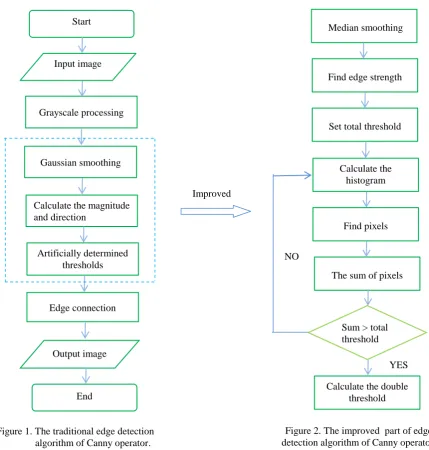
The traditional Canny algorithm and the improved algorithm are compared. The traditional Canny algorithm is shown in figure1, where the marked part is to be improved, and the improved part is shown in figure 2.
As is shown in figure 2, after preprocessing the original image, the gradient of the gray image is obtained and the maximum value of the gradient is taken, too. We regard the maximum value as
v
the width of the image multiplied by the proportion of non-edge. Next, calculate the histogram. Assuming that the gradient histogram hist_sizemaxv, whose range is from 0 to max . We v
traverse histogram to find the each gradient value corresponding to the number of pixels, and add them together. When the sum is more than the total threshold, traversing the histogram terminates. Finally, the high and low threshold can be calculated. The formula for calculating the threshold is
4 . 0 *
_ / max ) 1 (
high low
size hist v i
high
. (1)
(Where i is the number of times the histogram is traversed, maxv is the maximum value of the gradient, hist_size is histogram size.)
According to the different image we can get self-adaptive threshold, and then determine the edge and connect it.
Improved Edge Detection Algorithm for Underwater Machine Fish Simulation
In order to validate the improved Canny operator edge detection algorithm proposed in this paper, we experimented with the robot fish based on the vision system in the laboratory pool according to the rules of the shallow water and oil spill detection race in the International Water Robot Fish Race
[image:3.595.72.502.253.704.2]Figure 1. The traditional edge detection algorithm of Canny operator.
Figure 2. The improved part of edge detection algorithm of Canny operator.
Median smoothing
Find edge strength
Calculate the histogram Set total threshold
Find pixels
The sum of pixels
Sum > total threshold
Calculate the double threshold
YES NO
Improved Start
Input image
Grayscale processing
Gaussian smoothing
Calculate the magnitude and direction
Artificially determined thresholds
Edge connection
Output image
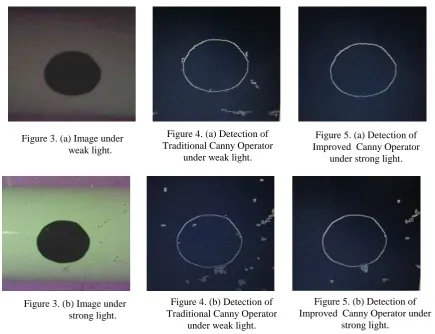
Project Team[11]. We have a PVC white tube with a black circle that the diameter is three centimeters. We use the camera which robot fish comes with, collecting the underwater images in different lighting conditions. figure 3 (a) and figure 3 (b) are two images under different lighting conditions but in the same scene. The target is that circle. For figure 3 (a), the edge of the target is obtained using the traditional artificial determination threshold method and the improved edge detection algorithm, respectively. figure 3 (b) is the same as above.
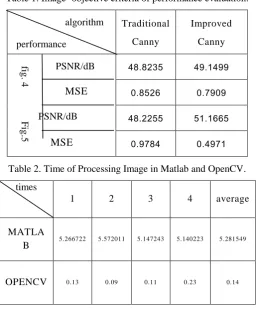
After contrasting the images, it can be seen that the traditional Canny operator can not be well applied to different lighting conditions, and the improved edge algorithm can flexibly adjust the thresholds and adapt well to the environment. In addition, the performance of the four graphs of figure 4 (a) (b) and figure 5 (a)(b) are analyzed, we compare the Peak Signal to Noise Ratio and mean square error respectively, which are shown in table 1. Because the algorithm is based on Matlab’ edge detection principle, and improved on the Open CV platform, this article also test how much time the algorithm runs aiming at one picture on the Matlab platform and Open CV platform. The chart is shown in table 2.
What the image and table indicted is that the improved adaptive threshold algorithm of Canny operator can be better applied to different environments underwater, the segmentation effect has been greatly improved. In the view of the mean square error and Peak Signal to Noise Ratio, the improved Canny algorithm has a rms error less than the traditional algorithm and the signal - to - noise ratio of new algorithm is high, which make the edge more continuous and accurate. What is more, the speed of detection in the OpenCV platform is faster than Matlab.
Figure 3. (a) Image under weak light.
Figure 4. (a) Detection of Traditional Canny Operator
under weak light.
Figure 5. (a) Detection of Improved Canny Operator
under strong light.
Figure 3. (b) Image under strong light.
Figure 4. (b) Detection of Traditional Canny Operator
under weak light.
Figure 5. (b) Detection of Improved Canny Operator under
[image:4.595.86.522.270.604.2]Table 1. Image’ objective criteria of performance evaluation.
Traditional
Canny
Improved
Canny
48.8235 49.1499
MSE 0.8526 0.7909
PSNR/dB 48.2255 51.1665
MSE 0.9784 0.4971
Table 2. Time of Processing Image in Matlab and OpenCV.
times
1 2 3 4 average
MATLA
B 5.266722 5.572011 5.147243 5.140223 5.281549
OPENCV 0.13 0.09 0.11 0.23 0.14
Conclusion
Based on the OpenCV3.2.0 version of Linux, the traditional Canny edge detection algorithm is improved in this paper. Firstly, four methods of smooth filtering are compared to find a more suitable method for the underwater smoothing. This method is median smoothing. In addition, on the basis of adaptive threshold method, we apply it to improve Canny edge detection algorithm. What’s more, the algorithm is applied to the robot fish in the water. For different lighting conditions, the improved edge detection algorithm of Canny operator has obvious effect. However, while improving the algorithm, the proportion of non-edge pixels in one image is set artificially according to a large number of references, which can’t achieve the effect of fully self-adaptive. This question still needs to be studied.
Acknowledgement
This work is partially supported by National Nature Science Foundation (61673016), SWUN Construction Projects for Graduate Degree Programs (2017XWD-S0805), Advance Research Pro-gram of Electronic Science and Technology National Program (2017YYGZS16) and Sichuan Youth Science and technology innovation research team (2017TD0028).
References
[1] Ling-yan Zhang. Study on adaptive edge detection method based on Canny theory, D. Shaanxi: Northwest University, 2009.
[2] Yansong Deng, Kaiyu Qin, et al. Synchronization of complex nonlinear systems at a preset time[J]. Journal of Theoretical and Applied Information Technology, 2013, 48(1): 200-205.
[3] Li-jun Yue, Ren-huang Wang, Hong-jiang Liu. Application and Improvement of edge detection algorithm based on OpenCV in instrument recognition, J. Automation and Instrumentation, 2008,137 (3): 68-71.
fig
. 4 PSNR/dB的、d
Fig
.5
algorithm
[4] Ruo-zhu Chen. Study on image edge detection of improved Canny operator based on Matlab, J. Industrial Instrumentation & Automation Devices, 2014, 4: 113-116.
[5] Varez Luis, Lions Pierre Louis, Morel Jean Michel. Image selective smoothing and edge detection by nonlinear diffusion[J]. SLAM Journal of Numerical Analysis 1992,
29[3]:845-866.
[6] Jie, Jie-qing Tan. Canny edge detection algorithm based on anisotropic diffusion equation, J. Journal of Computer Applications, 2008, 28 (8), 2049-2051.
[7] Yu, Tong-qing Wang. Edge detection algorithm of Canny operator based on BEMD, J. Computer Engineering, 2009,35 (11): 212-213.
[8] Yansong Deng, Kaiyu Qin, et al.Consensus algorithm for formation technology of multiple unmanned aerial vehicles[J]. International Review on Computers and Software, 2012, 7(7):
3764-3769.
[9] Cai Wen, Yansong Deng. Enhancing Visual Targets Image of Robotic Fish by Homomorphic. 2016.
[10] EBMEI International Conference on Education,Information and Management (EBMEI-EIM 2016), São Paulo, Brazil , August 31-September 1, 2016:69-74.
[11] Yansong Deng. Robofish Formation control based on the theory of consensus[C]. Applied Mechanics and Materials. The 2013 2nd International Conference on Chemical, Mechanical and Materials Engineering (CMME 2013), Melbourne, Australia, January 20-21, 2013:572-578.