2016 International Conference on Artificial Intelligence and Computer Science (AICS 2016) ISBN: 978-1-60595-411-0
Research on A New Knowledge Model in Network Teaching
Ming-ming YUAN and Jun SHEN
School of Computer Science & Engineering, Southeast University, Nanjing 211189, China
Keywords: Network teaching, Pattern, Pattern construction, Knowledge model.
Abstract. In view of the problems of the mismatch between the way of knowledge expression and the essential goal of teaching in network-teaching applications, based on the nature of teaching, this thesis analyzes the essential differences between network teaching and traditional teaching and the inelasticity of the existing knowledge representation to the network teaching. Based on this, a new knowledge model for the training of cognitive ability, schema and schema construction methods is proposed. The related concepts are discussed and the visual modeling and implementation are given. The new knowledge model implements a unified description of the basic knowledge and the pattern knowledge and supports the construction and application of these two types of knowledge. Finally, combined with a specific instance, the role of the pattern knowledge in teaching process is expounded and the basic application of this knowledge model is realized.
Introduction
The development of the network brings the change of the times, education has gradually changed from the textbook, the blackboard writing to network teaching. Network teaching breaks the space and time limitation of traditional teaching, gradually becomes a new form of teaching. However, there are many problems behind the rapid development of network teaching. In terms of teaching essence, the original intention of network teaching is that teachers teach students to connect the complicated knowledge into network by multimedia technology, guide and motivate students transform external information to their own knowledge network [1]. However, current network teaching still follows the traditional teaching mode and thinking, it is the re-packaging of the traditional teaching mode under the support of the multimedia technology without any further thinking of the teaching essence. In terms of knowledge organization, the traditional network teaching mostly accumulates teaching resources simply without any further research for the structure of knowledge. The knowledge representation methods proposed in the research field of artificial intelligence mostly suit for black-box reasoning and which are fundamentally different from knowledge representation in network teaching in the application objectives. Therefore, its methods are not applicable to network teaching. In summary, according to the teaching essence, to propose a new knowledge representation model which applies to network teaching is the key to support the development of network teaching.
Based on the modern research results of cognitive science, this paper analyzes the nature of network teaching and current knowledge representation model is inelastic towards it. On the basis of this, it puts forward a new knowledge representation model and gives its detailed description. Finally, it gives analysis combined with a concrete instance based on this model.
Related Work
The Unsuitability of the Existing Knowledge Model to Network Teaching
Since this knowledge organization is considered from the perspective of teachers, lack of cultivation of students' ability to schema construction, is not conducive to independent learning of learners. Scholars in Chongqing University [5] put forward a five-layer knowledge organization structure and four-layer knowledge use structure based on knowledge point ontology. This knowledge expression is still limited to the basic knowledge and its semantic relation level. In the aspect of knowledge application pattern, Shen [6] proposed a related conceptual model and described the relationship between knowledge application pattern and basic knowledge. This model does not give a description of the concrete structure and implementation of the basic knowledge and knowledge application pattern. The division of the knowledge dimension is not clear enough, and the description of the relevant attributes and application scenarios of the knowledge points is not profound. It can be seen that the development of technology has provided the foundation for the interconnected network teaching and brought the enrichment of the teaching form, but the existing knowledge representation model cannot be fully applied in network teaching and still needs further improvement and perfection.
In the field of artificial intelligence, currently most knowledge representation technologies are concerned only with the basic semantics of knowledge points and their semantic relations. Their lack of consideration for the characteristics of the relationship between knowledge points results in that they apply to the black-box model. On the contrary, network teaching is a kind of teaching activity based on the characteristics of a single knowledge point and the connection between knowledge points. The knowledge representation model applied to network teaching not only needs to care about the semantics and characteristics of a single knowledge point, but also a clear mastering of the construction relation of knowledge point cluster. It can be extracted the pattern feature points from similar knowledge points to form the foundation of pattern construction named knowledge application pattern. Due to the different application goals, the knowledge representation methods of artificial intelligence do not apply to network teaching.
The Essence of Network Teaching Application
According to the philosopher Polanyi [7], “There are two types of knowledges. One is called explicit knowledge that is often expressed in writing, diagrams, and mathematical formulas. In addition, the other kind of unexpressed knowledge such as knowledge of what people master in the course of doing something is called implicit knowledge.” Constructivism learning theory refers to implicit knowledge as schema (cognitive structure), which emphasizes the decisive role of implicit knowledge in the process of human cognition [8]. It holds that learning cannot simply be regarded as the transfer of knowledge, but learners in the interaction with the outside world, in certain social and cultural background, construct their own new schemas based on their original schemas [9].
A New Knowledge Model Supporting Pattern Representation
[image:3.612.194.414.118.252.2]According to the inner relation of teaching knowledge, the knowledge level frame is used to describe the knowledge, and the knowledge in teaching is divided into two layers. As shown in Figure 1.
Figure 1. Knowledge level framework diagram.
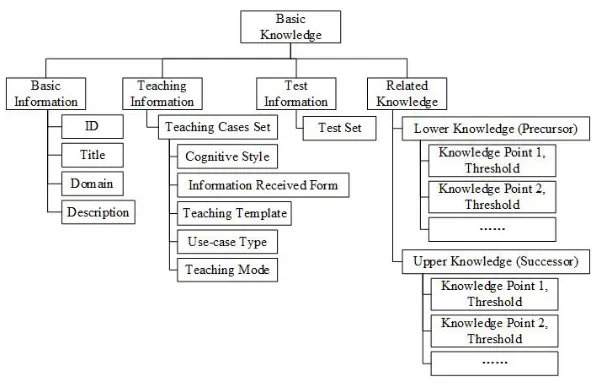
Knowledge is complex, in order to distinguish the discipline level to which the knowledge belongs, we add a domain attribute. Since the network teaching application focuses on the teaching process, the types of teaching cases used in the teaching process are the important basis for assessing the cognitive structure of learning individual, and the test of learning achievement is an important way to test whether the individual pass the current knowledge point. The knowledge in the knowledge base does not exist in isolation, its precursors and successors are the basis for the design of relevant learning paths. In summary, we use four dimensions as follows: basic information, teaching information, test information and related knowledge to describe the knowledge.
Basic Knowledge
The model of basic knowledge is shown in Figure 2.
Figure 2. Basic knowledge construction model diagram.
Basic Information
ID: A unique corresponding identifier for each knowledge point. Basic knowledge begins with K. Title: A high degree of generalization of the knowledge point.
Domain: The category of the field which the current knowledge point belongs to. It uses label to mask the domain, from coarse to fine, the gradual refining benefits the search and query.
[image:3.612.157.456.421.614.2]Teaching Information
[image:4.612.114.501.145.299.2]Teaching information contains the teaching cases used for the teaching of each knowledge point, which are also used to illustrate the usage scenarios and methods of the current knowledge point. The feature description is described by XML and the file identifier specifies the details. The schema definition of the XML document that describes the set of teaching use cases is shown in Figure 3.
Figure 3. The schema definition of the description document of teaching cases.
Test Information
Test information contains a test set, which test the learning individuals’ understanding and mastery based on the content and its importance of the current knowledge point.
Related Knowledge
Related knowledge describes lower knowledges and upper knowledges of the current knowledge point to facilitate the search in the knowledge base and the design of the relevant learning path. Pattern Knowledge
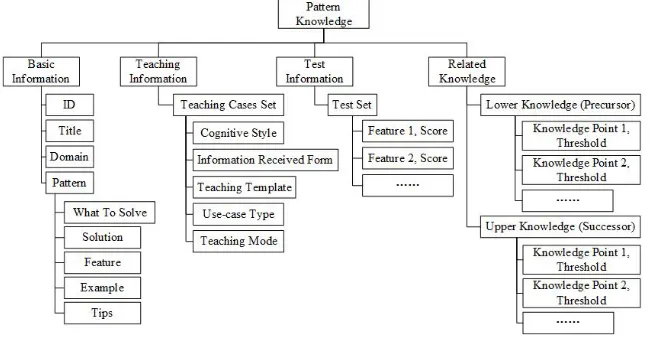
Pattern knowledge is a general and empirical summary of experience in the field of knowledge. And it can also be applied to the solving and processing of similar problems in different fields. According to the constructivist learning theory, the knowledge model must fully embody the schema and the schema construction strategies, therefore, the pattern knowledge formed by the modeling of implicit knowledge is the key of the knowledge model. The construction model is shown in Figure 4.
Figure 4. Pattern knowledge construction model diagram.
[image:4.612.145.470.527.697.2]we add a pattern attribute, referring to the pattern feature framework and the analysis descriptions of the features of the pattern knowledge. We describe a pattern from five aspects: problem definition, solution, feature, example, and tips. When the pattern knowledge is used to solve similar problems in different domains, it is possible to determine whether the pattern is applicable to the current context by referring to the type of problem the corresponding pattern solved and the relevant feature points in the knowledge point. The formal description of the pattern attribute is implemented by XML, and the corresponding schema definition is shown in Figure 5. And teaching information, test information, and related knowledge have the same meaning as the attributions in the basic knowledge.
Figure 5. The schema definition of the pattern attribution.
An Application Example
According to the above knowledge representation and modeling ideas, we present an instance of the teaching application knowledge model in the data representation part of "C++ Program Design" course offered by ordinary institutions of higher learning, as shown in Figure 6. Due to space limitation, herein, this only gives a visual representation and the corresponding analysis.
Figure 6. An instance of the new knowledge model.
[image:5.612.117.494.415.633.2]struct array formed by stacking of structs. These three points are the three elements of the stacking mode, but also the key to understanding the stacking mode.
In addition, the pointer which extends from the variable and the array pointer which extends from the array are the application of the mode 2: pointing model. Referring to the three elements of stacking mode, the pointer can also be stacked to form a pointer array. Similarly, the reference comes from the understanding of the constants and the variables. It can be the reference to the constants or the reference to the variables, and can also be the reference to the structs extends from the struct. Based on this, it can abstract and form pattern 3: binding mode, which means that the newly declared reference is bound to the original object.
Summary
From the above analysis, we can see that the basic knowledge level is the application of the pattern knowledge level. Conversely, the pattern knowledge level is the abstract of the basic knowledge level. Compared with the past knowledge representation structure, this two-level knowledge representation model abstracts the many-to-many relationship between the pattern knowledge points and the basic knowledge points. This kind of knowledge representation model, supporting the teaching of the pattern knowledge, emphasizes the teaching of learning thought and schema construction strategies. Only by mastering the schema construction strategies, can the learner cultivate the metacognitive ability, and improve the learning efficiency authentically.
References
[1] Yu D. Computer Network Environment of Network Teaching[M]// Proceedings of the 2012 International Conference on Communication, Electronics and Automation Engineering. Springer Berlin Heidelberg, 2013: 1299-1304.
[2] Rossi G., Schwabe D, Lucena C.J.P., et al. An Object-Oriented Model for Designing the Human-Computer Interface of Hypermedia Applications [M]// Hypermedia Design. Springer London, 1996: 123-143.
[3] Shen-quan Xie. [J]. Journal of Software, 1998, 9 (10): 785-789.
[4] Roberts E., Engel G., Chang C., et al. Computing curricula 2001: computer science [J]. IEEE Computer Society, Available: http://www.sigcse.org/cc2001, 2001, 34(1): 4–23.
[5] Qin Zhang. [J]. Science and Education Press, 2008 (27): 279-280.
[6] Xiao-yi Shen, Jun Shen. [J]. Journal of Suzhou University (Engineering Science Edition), 2007, 27 (6): 7-11.
[7] Garzotto F., Mainetti L., Paolini P. Hypermedia Application Design: A Structured Approach [M]// Designing User Interfaces for Hypermedia. Springer Berlin Heidelberg, 1995: 5-17.