2016 Joint International Conference on Artificial Intelligence and Computer Engineering (AICE 2016) and International Conference on Network and Communication Security (NCS 2016)
ISBN: 978-1-60595-362-5
(n, n+1) Visual Secret Sharing Scheme Based on
Local Binary Pattern Operator
Wen-Yin ZHANG
1,a*, Rui-Xia XIE
1, Chao-Yang ZHANG
2,b1School of Informatics, Linyi University, Linyi, Shandong, China, 276005
2School of Computing, University of Southern Mississippi, Hattiesburg, MS, USA 39406
a[email protected], b[email protected]
*Corresponding author
Keywords: Visual Cryptography, Visual Secret Sharing, Local Binary Pattern.
Abstract. A novel (n,n+1) Visual Secret Sharing (VSS) Scheme based on Local Binary Pattern
(LBP) operators was presented in this paper. The proposed schemes without adopting Boolean operations make full use of the local contrast features of LBP operators to conceal secret image data into different image shares, which can then be used to recover the secret easily and exactly through the computation of LBP operators. Compared with state-of-the-art algorithms, experiments show that our proposed schemes demonstrate good randomness in shares and exact determination in reconstruction process without much computational cost.
Introduction
A secret sharing scheme is a method to share secret information in a group to avoid potential treats of interruption, modification such as malicious attack and individual inadequate management[1,2]. Visual secret sharing (VSS) or Visual cryptography (VC) scheme belongs to the category of secret sharing scheme, and just with its secret information is an image. Naor and Shamir[3] first presented this concept and a novel detailed scheme is proposed for binary image. The main idea is to split an image into n random shares which separately reveal no information on the original image, and then the original image can be reconstructed by superimposing the two shares. The n shares are n random images printed on transparencies, and the recovered process just need superimpose k or more share images to reveal the secret information by human vision without any computation.
Such convenient recovered property without any computation attracted much attention after the appearance of the first VSS scheme. Many researchers devote to optimizing the pixel expansion (denoted by m) and the contrast (marked by α) problem[4,5]. Also, Multiple secret VSS schemes are the objectives for many researchers[6,7].
In this paper, LBP operators were integrated into Deterministic VSS scheme to realize the image information hiding and sharing. The original LBP operator, which measures the local contrast of pixels, is widely used in the texture classification and face recognition[8,9]. By its inverse construction, we can adjust the secret binary bits into the local contrast of sharing pixels obtained by randomness and secret key control. When recovering the secret image, we can reorganize the shares and get the exact secret binary bits by calculation of LBP operators with secret key. extensive experiments show that the proposed schemes are promising and have produce satisfied results.
The remainder of this paper is organized as follows. In Section 2, we introduce the basic knowledge of LBP operators. In Section 3, the VSS schemes based on the LBP operators was proposed, and the experimental results and analysis are provided accordingly. Section 4 concludes the paper.
Basic Local Binary Pattern Operator
binary gradient directions. A histogram of these micro patterns contains information about the distribution of edges and other local features in an image.
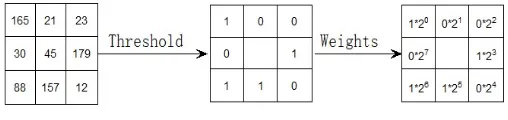
[image:2.612.193.447.190.250.2]The conventional LBP operator[8] is defined in a circular local neighborhood. Using the center pixel as the threshold, its circularly symmetric P neighbors within a certain radii R are individually labeled as 1 when the value is larger than the center, while labeled as 0 when the value is smaller than the center. Fig. 1 shows the computing process of the 3×3 conventional LBP operator, the central pixel is 45, and its LBP code is 108. The entire LBP codes or micro patterns composite a texture spectrum of an image with 256 gray levels, which is often used to extract image features for classification or recognition.
Figure 1. An example of the Conventional LBP Operator.
LBP method is not only relatively simple and of low computation complexity, but also has a rotational invariance, gray scale invariance and other significant advantages. Therefore, LBP has obtained fruitful results and is widely used in image matching, object detection and tracking. Next section we will make use of the reverse computing process of LBP operators to construct the secret image shares.
The Proposed (n,n+1) VSS Scheme based on LBP Operators
For a binary image consisting of black and white pixels, we firstly design a simple (1, 2) scheme (BVSS) based on the improved LBP operator (ILBP)[10] to show the basic sharing principle. ILBP operator adopts a parameter to control the difference between neighboring pixels. If the difference between two pixels does not reach an extent controlled byα, the two pixels were regarded as the same. It is defined as follows:
∑ α 2 (1)
where g is the mean value of pixels in the neighborhood. In our BVSS scheme, we replace g mean with g , and take the control parameter α ∈ 0,1 as the secret key. The algorithm based on ILBP is given as follows.
Algorithm 1a. Encoding
Input: A binary secret image i, j | i, j ∈ 0,1 , 0 i 1,0 j 1. Gray level L.
Algorithm 1b. Decoding
Input: 2 share images S i, j and S i, j ∈ 0,1, ⋯ , L with the size of M N, and control parameterα.
Output: A reconstructed secret image B B i, j |B i, j ∈ 0,1 with the size of M N.
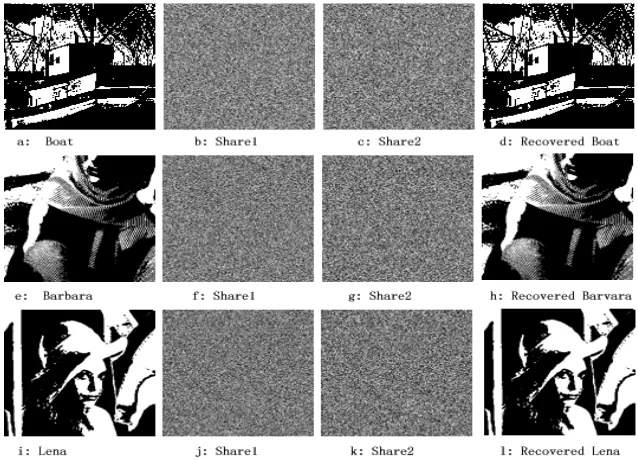
[image:3.612.146.465.231.461.2]We use the Boat, Barbara and Lena binary images to test the performance of the BVSS scheme. Fig.2 shows the experimental results for the three images with gray level L=256. The parameterαfor each secret image is 0.03, 0.10 and 0.15, respectively. These shares display good randomness and visually disclose no information of the secret images, and can exactly recover the secret images.
Figure 2. The Examples for (1, 2) BVSS Scheme.
[image:3.612.153.466.603.690.2]For secret binary images, we can design (n,n+1) scheme to realize these images sharing and exact reconstruction. For n pixels from each of n images, we can give n+1 shadow blocks in circular or line or rectangle forms to contain the sharing data. In fact, section 3.1 is a (1, 2) sharing scheme for one binary secret image. Fig.5 gives some examples of (n, n+1) shadow blocks in different forms. In Fig.5, “•” stands for shadow pixel position, and “ ” represents for center pixel position for threshold. We can randomly determine the position of the central pixel, which is important for us to encode and decode the shares. The method can be easily extended to Visual Cryptography for gray or color images.
Now, we show how to realize the (n, n+1) sharing scheme. Generally, let n shared binary images with size of are marked by , , , , ⋯ , , , and n+1 sharing images are denoted by
, , , , ⋯ , , , 0,1, ⋯ , 1, 0,1, ⋯ , 1. The algorithm for (n, n+1) sharing
scheme is given as follows.
Algorithm 2a. Encoding
Input: n binary images 1, , 2, , ⋯ , , with size of M N. Gray level L.
Output: n+1 sharing images , , , , ⋯ , , , and control factor .
Algorithm 2b. Decoding
Input: n+1 sharing images , , , , ⋯ , , , and control factorα. Output: n binary images , , , , ⋯ , , ..
In the Algorithm 2a, we in fact repeat the Algorithm 1a to generate S , based on S , , with
S , is randomly generated. Similarly, the Algorithm 2b repeats the Algorithm 1b to obtain the
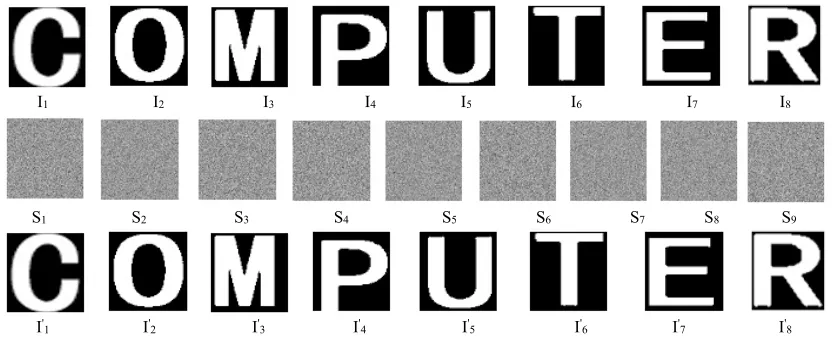
I , , I , , ⋯ I , based on S , , S , , ⋯ , S , and with the control factorα. Taking (8,9) shadow block as an example, Fig 3 shows 8 images , , ⋯ and their 9 shares , , ⋯ generated through the Algorithm 2a, ′, ′, ⋯ ′ are the recovered images obtained by the Algorithm 2b.
I1 I2 I3 I4 I5 I6 I7 I8
S1 S2 S3 S4 S5 S6 S7 S8 S9
[image:4.612.99.515.474.644.2]I'1 I'2 I'3 I'4 I'5 I'6 I'7 I'8
Figure 6. An Example of Multiple Deterministic (8, 9) VSS Scheme.
Conclusions
generalization of image format, easy-to-align problem, and no codebook required. Experimental results demonstrate that the proposed schemes are satisfactory and effective. It is noted that the proposed schemes have the pixel expansion and center threshold pixel location problems. In the future, we will focus on these two problems, at the same time, probabilistic VSS schemes will also be combined with LBP operators in our coming research.
Acknowledgement
This research was financially supported by the National Science Foundation of Shandong Province (ID: ZR2011FL014), National Scholarship Fund of China (ID:201308370009).
References
[1]A. Shamir: How to share a secret. Communications of the. ACM, Vol. 22 (11) (1979), pp. 612-613.
[2]G.R. Blakley: Safeguarding cryptographic keys. Proc. AFIPS, Vol. 48(1979), pp. 313-317. [3]M. Naor, A. Shamir, Visual cryptography, in Proc. Advances in Cryptography (Eurocrypt’94), Springer-Verlag, Lecture Notes in Computer Science, 1995, vol. 950, pp. 1-12.
[4]C.N. Yang and T.S. Chen, “New size-reduced visual secret sharing schemes with half reduction of shadow size,” IEICE Transactions on Fundamentals of Electronics, Communications and Computer, vol. E89-A, pp. 620-625, 2006.
[5]S. Cimato, R. De Prisco, A. De Santis, “Probabilistic visual cryptography schemes,” The Computer Journal, vol. 49, no. 1, pp. 97-107, 2006.
[6]Shyu S.J., Jiang H.W. General constructions for threshold multiple-secret visual cryptographic schemes [J]. IEEE Transactions on Information Forensics and Security, 2013, 8(5): 733-743.
[7]Wu C.C., Chen L.H. A study on visual cryptography [J]. Master's thesis, Institute of Computer and Information Science, National Chiao Tung University, Taiwan, ROC, 1998.
[8]T. Maenpaa, M. Pietikainen, and T. Ojala, “Texture classification by multi-predicate local binary pattern operators,” Proc. 15th International Conference on Pattern Recognition, Barcelona, Spain, 2000, pp. 951–954.
[9]T. Ojala, M. Pietikainen, and T. Maenpaa, “Multiresolution gray scale and rotation invariant texture analysis with local binary pattern,” IEEE Trans. Pattern Analysis and Machine Intelligence, 2002, vol. 24, no. 7, pp. 971–987.