2017 2nd International Conference on Artificial Intelligence and Engineering Applications (AIEA 2017)
ISBN: 978-1-60595-485-1
Buckwheat Detection and Classification Using
Mahalanbis Distance Image and Improved
Morphology Denoising Strategy
ANQI LIU and ZHONGYANG ZHU
ABSTRACT
Real-time automatic assessment of buckwheat appearance quality can improve the estimating efficiency and accuracy when buckwheat was hulled by shelling machine. In this paper, a whole kernel and nibs of buckwheat detection and classification method based on Mahalanbis distance image and improved morphology denoising strategy was proposed. This detection and classification method involves three key steps. Firstly, the whole kernel and nibs of buckwheat image was obtained by CCD camera. And Mahalanbis distance method and OTSU was used to segment the whole kernel and nibs of buckwheat. Secondly, watershed algorithm based on improved morphology denoising strategy and statistics of consecutive fields was used to separate adhesive buckwheat and count the number of buckwheat separately. Finally, color features of buckwheat was extracted and probabilistic neural network was trained to recognize the type of buckwheat. The experimental results show that the detection method based on Mahalanbis distance image and improved morphology denoising strategy can detect the whole kernel and nibs of buckwheat automatically and 98.1% of the buckwheat regions are correctly detected. The recognition rate of the whole kernel and nibs of buckwheat is higher than 92.3% when probabilistic neural network was used. The proposed method can meet the practical need of industry detection and classification.
KEYWORDS
Buckwheat detection classification, Maharanis distance, improved morphology demising strategy, color features.
INTRODUCTION
Buckwheat is an important part in grain which accounts for 38 percent of global food production [1]. It needs to be shelled before deep processing and eating. In order to improve the integrity of shelled buckwheat and reduce the nutrition loss, sheller should be adjusted by integrality degree of buckwheat. The traditional way to detect
_________________________________________
Anqi Liu, Faculty of Information Technology, Beijing University of Technology, Beijing 100124, China; [email protected],
and classify buckwheat has long been done by human visual. However, this method not only has the characteristics of subjectivity but also has the characteristics of lack of reproducibility. Thus, an automatic buckwheat detection and classification system helps improve the efficiency of buckwheat quality evaluation is highly desirable.
During the last decades, many efforts have been made to develop automatic evaluation of grain quality. Zheng et al. [2] implemented rice detection and classification via binary treatment and row-mean gray value of single rice kernel image. Wang et al. [3] presented a wheat grain external quality identification method based on image processing and artificial neural network. It was found that images taken in a black flock paper background by a digital camera were the most preferable. Wu et al. [4] studied the rice outer-quality using gray transformation and automatic threshold segmentation. Shang et al. [5] presented a rice quality evaluation method based on the image recognition technology. Yang et al. [6] presented prickly ash appearance quality detection method using canny detector and second filling method. Liu et al. [7] implemented rice seeds discrimination via multispectral imaging and support vector machine. Analysis revealed that the rice seeds can be easily segment by using multispectral image. Chai et al. [8] studied the soybean appearance quality detection and identification. It was found that morphological characteristics and random forests can identify the soybean appearance quality. Kuang et al. [9] presented an image segmentation of adhering rice based on the improved watershed algorithm.
In this paper, we propose a novel buckwheat detection and classification method. The general framework of our proposed approach for buckwheat detection and classification is illustrated with two major modules. 1).The buckwheat detection method. Purple background and Mahalanbis distance method were used to segment the buckwheat. Then the watershed algorithm based on improved morphology denoising strategy and statistics of consecutive fields was used to separate adhesive buckwheat and count the number of buckwheat separately. 2).The buckwheat classification method. Because of striking difference between the whole kernel and nibs of buckwheat, we extracted the color features of buckwheat and used PNN to recognize the type of buckwheat.
THE BUCKWHEAT DETECTION BASED ON MAHALANBIS DISTANCE METHOD AND IMPROVED MORPHOLOGY DENOISING STRATEGY
The background color.
The color of whole kernel of buckwheat is brown, while the color of nibs of buckwheat is white. As a result, two kinds of color appear in the scene at the same time. If the light color background is selected, the nibs of buckwheat will confuse with background. If the dark color background is selected, the whole kernel of buckwheat will confuse with background. So the background of dark color and light color is not suitable for the task of buckwheat detection. In this paper, we chose purple background by experiment.
The Mahalanbis distance method.
background is selected as background color model. Then, the similarity is measured by using Mahalanbis distance between image pixels with background color model. The Mahalanbis distance between image pixels with background color model is
x back
(x-m) (x-m)D , T
i1 (1)Where x and m represent the pixel of the image and mean vector of the background, respectively. x is three dimensional vectors which its value is the gray
value of RGB channels.
i1 Represents covariance matrix. Background and buckwheat can be separated by using Mahalanbis distance between image pixels with background color model. If the pixels in the identified images are similar to background, the Mahalanbis distance image will become darker. Otherwise the Mahalanbis distance image become lighter. Therefore, the buckwheat and background can be separated. As an additional advantage, the identified image of 24 bits is transformed into the identified image of 8 bits. It can enhance segmentation accuracy and reduce running time. OTSU [11] is used to segment the buckwheat from the background because the Mahalanbis distance image is a grayscale image.Image segmentation of adhering buckwheat based on the improved morphology denoising strategy.
After the buckwheat is segmented by using OTSU, phenomenon of buckwheat speculated margin is serious. Morphology denoising is an appropriate choice to smooth the edge of buckwheat. If disk template with small diameter is selected to smooth the edge of buckwheat, the buckwheat speculated margin will not be removed. This can lead to over-segmentation when watershed algorithm is used to segment the adhered buckwheat. If disk template with big diameter is selected to smooth the edge of buckwheat, the buckwheat speculated margin will be removed. Although the phenomenal of over-segmentation is disappeared, the buckwheat of small size is mistakenly deleted. As a result, the number of buckwheat cannot be calculated accurately. In order to solve this problem, the improved morphology denoising strategy is used to segment the adhered buckwheat. The specific method is as follows.
Step.1 The disk template with 12 pixels diameter is used to smooth the binary image of buckwheat.
Step.2 Watershed algorithm is used to segment the adhered buckwheat.
Step.3 The binary image of disappeared connected component is smooth by using the disk template with 2 pixels diameter.
Step.4 The binary image of step 2 is ANDed with the binary image of step 3 and the final segmentation result is obtained.
THE WHOLE KERNEL AND NIBS OF BUCKWHEAT CLASSIFICATION BASED ON PNN
proper feature. The color of whole kernel of buckwheat is brown, while the color of nibs of buckwheat is white. So we use color feature to describe the type of buckwheat. The mean value, deviation, third central moment, contrasts and entropy of RGB channel was extracted. The detail can see Ref [12].
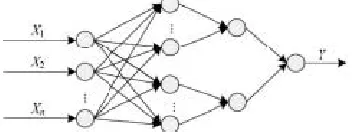
Figure 1. Probabilistic neural network structure.
The PNN was first proposed by DR. Specht in 1988 [13]. It has been significantly applied in supervised classification. The PNN contains input layer, implicit layer, summation layer and output layer. The basic structure of PNN is shown in Fig. 1.
The input layer and output layer of PNN is 15 (color features) and 2 (buckwheat types). One hundred whole kernel and nibs of buckwheat image was trained to construct the PNN.
THE EXPERIMENTAL RESULTS
The result of background segmentation
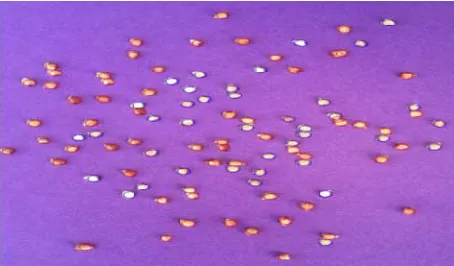
The Mahalanbis distance image (Fig. 3(b)) can be obtained by calculating the Mahalanbis distance between the background image (Fig. 2) and the image of buckwheat (Fig. 3(a)). From Fig. 3(b), it can be seen that the contrast between the region of buckwheat and the region of background had been enhanced. As a result, three types regions (background, whole kernel and nibs of buckwheat) came into two types regions (background and buckwheat). It can benefit the OTSU performance (Fig. 3 (c)).
[image:4.612.212.390.117.183.2]Figure 2. The background image.
[image:4.612.126.467.577.696.2](a) (b) (c)
[image:5.612.90.508.255.306.2]Figure 4. The segmentation results of adhering buckwheat after using (a) disk template with 12 pixels diameter, (b) disk template with 2 pixels diameter and (c) the improved morphology denoising strategy.
Table 1. The number of buckwheat calculation result after using disk template with 12 pixels diameter, disk template with 2 pixels diameter and the improved morphology denoising strategy.
The actual number of buckwheat
disk template with 12 pixels diameter
disk template with 2 pixels diameter
The improved morphology denoising strategy
99 77 112 101
The segmentation results of adhering buckwheat based on the improved morphology denoising strategy
From Fig. 4 and Table 1, it can be seen that the number of buckwheat calculation result after using disk template with 12 pixels diameter is 77 (Fig. 4(a)), which is smaller than the actual number of buckwheat. The reason is that the buckwheat of small size is mistakenly deleted. The number of buckwheat calculation result after using disk template with 2 pixels diameter is 112 (Fig. 4(a)), which is larger than the actual number of buckwheat (Fig. 4(b)). It is because the buckwheat speculated margin cannot be removed and the phenomena of over-segmentation appeared after watershed algorithm was used. The number of buckwheat calculation result after using the improved morphology denoising strategy is 101 (Fig. 4(c)), which is close to the actual number of buckwheat. Fifty buckwheat images was tested, the average detection accuracy of buckwheat is 98.1%.
The whole kernel and nibs of buckwheat classification results
[image:5.612.184.411.548.681.2]From Fig. 5, it can be seen that the whole kernel and nibs of buckwheat was marked by the red circle and the blue circle respectively. Fifty buckwheat images was tested, the average classification accuracy of buckwheat is 92.3%.
CONCLUSION
In this paper, a buckwheat detection and classification is presented. The experimental results show that the buckwheat can be detected and classified by the proposed method. Form above experimental results, some conclusions can be reached:
(1) The contrast between the region of buckwheat and the region of background can be enhanced by using Mahalanbis distance method.
(2) The contradiction between the size of disk template and over-segmentation can be solved by using improved morphology denoising strategy.
(3) The whole kernel and nibs of buckwheat can be classified by using color features.
The proposed method can satisfy the actual requirements.
ACKNOWLEDGMENTS
Corresponding author e-mail: [email protected]
REFERENCES
1. Hou C.Y, Li H.Y, Shang Y.F. et al.: Image Dicerment and Rapid Detection for Rice Quality. Journal of the Chinese Cereals and Oils Association. Vol. 18 (4) (2003), p. 80-83.
2. Zheng H.D., Liu M. H., Wu Y.H. et al.: Rice Fissure Detection Using Computer Vision. Transactions of the CSAE. Vol.22(7) (2006), p. 129-133.
3. Wang Z.J., Cong P.S., Zhou J.L. et al.: Mehtod for Identification of External Quality of Wheat Grain Based on Image Processing and Artificial Neural Network. Transactions of the CSAE.Vol. 23 (1) (2007), p. 158-16.
4. Wu Y.H., Liu M.H., Yang J. et al.: Rice Outer-quality Inspection Based on Computer Vision. Transactions of the Chinese Society for Agricultural Machinery. Vol. 38 (7) (2007), p. 107-111. 5. Shang Y.F., Hou C.Y., Chang G.H.: Automatic Detection of Yellow-colored Rice Using Image
Recognition. Transactions of the CSAE. Vol.20 (4) (2004), p. 146-148.
6. Yang F., Zhu S.P., Qiu Q.M.: Prickly Ash Appearance Quality Detection Based on Computer Vision and Its Implementation in Matlab. Transactions of the CSAE. Vol.24(1) (2008), p. 198-202. 7. Liu W., Liu C. H, Zheng L.: Discrimination in Varieties of Rice Seeds with Multispectral Imaging
Using Support Vector Mechine. Transactions of the Chinese Society of Agricultural Engineering. Vol. 30 (10) (2014), p. 145-150.
8. Chai Y.H., Ding R., Cao X.D.: Soybean Appearance Quality Detection and Identification Based on Random Forests. Journal of Agricultural Mechanization Research. Vol. 12(1) (2016), p. 238-246. 9. Kuang F.J, Xu W.H, Wang Y. H.: Image Segmentation of Adhering Rice Based on the Improved
Watershed Algorithm. Cereal & Feed Industry.Vol. 8 (2010), p. 5-8.
10. Fang J.J., Li Z.B., Jiang Y.: Human Skin Color Region Segmentation Based on Adaptive Model. Journal of Computer-Aided Design & Computer Graphics. Vol. 25 (2) (2013), p. 229-234. 11. Otsu N. A.: Threshold Selection Method from Gray-level Histograms. IEEE Transactions on
System Man and Cybernetic. Vol. 9 (1) (1979), p. 62-66
12. Di P.H., L.V. F.: The Research of the Feature Extraction of Sunflower Leaf Rust Characteristics Based on Color and Texture Feature. The 1st International Conference on Communication Systems and Computing Application Science. (2005)