2017 2nd International Conference on Computer Science and Technology (CST 2017) ISBN: 978-1-60595-461-5
Hybrid Trust Chain Security Model with Cloud
Computing Based on Smart Grid
Wei LI
1, Ting JIANG
1,a*,Yi-dong YUAN
2,3and Zhuo DI
41North China Electric Power University, School of control and Computer engineering,
Beijing, China
2State Grid Key Laboratory of Power Industrial Chip Design and Analysis Technology,
Beijing Smart-Chip Microelectronics Technology Co., Ltd. Beijing, China
3Beijing Engineering Research Center of High-reliability IC with Power Industrial
Grade, Beijing Smart-Chip Microelectronics Technology Co., Ltd. Beijing 100192, China
4State Grid Liaoning Information and Communication Company, Shenyang, China
*Corresponding author
Keywords: Smart Grid, trust chain, cloud model.
Abstract. The paper proposes a hybrid trust chain model with cloud computing based on smart grid, for the purpose of enhancing the ability of smart grid cloud computing system to deal with most malicious attacks and reduce the security risk. The model merges the trust transfer model and the separation model, based on a set of trust chain establishment scheme defined by Trusted Computing Group (TCG), and improves the traditional chain and star trust model, in order to boot and establish a trusted secure computing environment. Proved by examples, the hybrid trust chain security model puts the security of cloud computing on the trusted computing platform, which has significant effects on improving the credibility of the computer system, increasing the security of the cloud foundation and ensuring the integrity of the information.
Introduction
With the continuous development of cloud computing technology, cloud computing applications in the power industry spread gradually. Most power companies and departments have proposed a variety of cloud applications. Usually cloud computing similar to the common computer network access to confirm the users’ identity information, access and audit permissions. However, these methods cannot reliably protect the cloud terminal itself and its access to cloud system security. Therefore, it is urgent to study the new security model to protect the terminal security and realize the security and credibility of the cloud terminal to ensure the security of the power cloud terminal access [1].
without any interference to the complete measurement of the trust chain. The interference-free condition for the integrity of the trusted system is given in literature [6], the criteria for the reliability analysis of the software's dynamic behavior under the control of the delivery and non-delivery security policies are given in the model, but non-intrusive attributes are difficult to verify. Literature [7] proposed the use of parallel operator and the limit operator to achieve the function of the combination operator in the security process algebra, but for the comparison model test method, the trust mechanism based on the theorem proves that the security mechanism analysis is still at the initial stage. There are some practical problems in the practical application of trusted computing technology, there has not been convincing research results.
In this paper, a cloud hybrid trust chain model based on smart grid is established to guide and establish a trusted security computing environment, which can be used as a trusted computing security mechanism as well as the loading and deployment of features based on the feature preset measurement model. The hybrid trust chain model, which combined with the star trust structure and chain trust structure, fusions trust transfer model and pipe separation model, reduce the trust transfer of trust in the link points, thereby reducing the loss of trust caused by node trust transfer process.
Analysis on the Hybrid Trust Chain Model
Cloud Computing of the Smart Grid
With the development of social informatization, the informatization of electric power industry is becoming more and more comprehensive. Therefore, the key application of informationization in power industry has also put forward higher requirements. However, there are a series of problems such as poor reliability, low usability, weak maintainability, long implementation period, high cost, difficult to accumulate and unify information and industry knowledge in power production management system, and these have become a bottleneck restricting the development of the information industry of the power industry. Therefore, the demand for high-confidence software has become increasingly prominent, the construction of high-trusted software has become the important trends and inevitable choice in the field of power production and the entire software industry development.
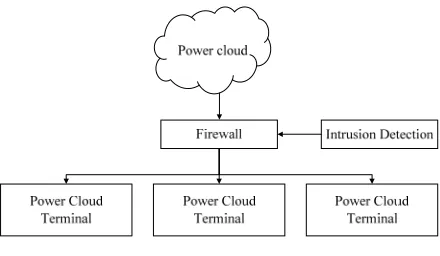
Figure 1. Power private cloud access model.
Users through the power of the cloud terminal access to private cloud system, complete the corresponding work. The cloud terminal should support the establishment of communication links with the cloud through a variety of communication methods, including wired network, wireless network and protected wireless public network.
Trusted Computing Technology
The Trusted Computing Group (TCG) gives a trusted definition of the entity from the point of view of behavior [9]: "TCPA uses a behavioral definition of trust: an entity can be trusted if it always behaves in the expected manner for the intended purpose". Terminal running on the system is an open system; the users can add, delete and modify the system software, which is the root cause of security problems. Although the system uses the relevant security mechanism, but only relies on the software mechanism is difficult to resist attacks from the bottom. Only increasing the closure in the open system to ensure that some special components cannot be tampered, while the security mechanism placed in the hardware and setting a tamper-resistant metric, storing and reporting the core in the hardware. And then use it to check the integrity of the upper components that can better solve the problem.
Compared with ordinary computer, the biggest feature of a trusted computer is embedded in the motherboard a security module-TPM. The TPM encapsulates most of the security services required by a trusted computing platform to provide basic security services for the platform. At the same time, TPM is the trustworthy computing platform of the entire hardware trusted root, and the platform is a credible starting point. As the hardware trusted root of the platform, the TPM is strictly protected. The TPM has physical attack defense, tamper-proof, and anti-detection capability to ensure that the TPM itself and internal data are not attacked illegally. As the hardware trusted root of the platform, the TPM is strictly protected. The TPM has physical attack defense, tamper-proof, and anti-detection capability to ensure that the TPM itself and internal data are not attacked illegally.
The Establishment of Trust Chain in Virtual Environment
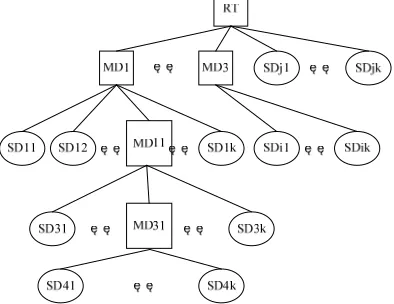
The remote proving mechanism of trusted computing is to prove whether the local environment configuration is trustworthy by sending the integrity metric stored in the PCRs to the remote verifier. In a virtualized environment, VMM not only to prove to the remote verifier virtual machine environment trusted, but also to prove that the virtual machine where the VMM and hardware layer of credibility. Therefore, the trust chain in the TCG specification is no longer applicable to the VMM system, so the trust chain needs to be reconstructed. Fig. 2 is the chain structure of the star trust structure.
Figure 2. The chain structure of the star trust structure.
The star trust chain with chain structure inherits the hierarchical relationship of chain structure, and inherits the central single trust relationship of star trust chain as a whole. Trust in the process of transmission, with the increase in the level of its credibility is decreasing layer by layer, but for each with a star trust chain structure of the trust relationship, the trust is to show the trust to maintain anti-attenuation. From the decay of the trust relationship, there is a slight loss of the single-level star trust chain, but from the efficiency of measurement, the RT node is only responsible for the measurement of the node with trust relationship, while the metrics of other nodes are taken care of by the parent MD node of the node, which can obviously reduce the workload of the center trust node.
The Design of the Hybrid Trust Chain Security Model
The hybrid trust chain security model based on smart grid is based on the information flow interference-free model, which is used to guide and establish a trusted secure computing environment and to deploy the relevant factors based on the smart grid service.
Safety Indicators
Hybrid trust chain security model as a system , consisting of the following elements: . The characteristics of elements under cloud computing model by
three tuples , to represent. Among them:
(1) P denotes the set of the metric being represented as ;
(2) S denotes the set of states of the metric being represented as ;
(3) ST indicates that both of them impose a pause control on the measured;
(4) M denotes the set of measurers, denoted as ;
(5) , When the pause control ST is applied, the current state S is
(6) : Expectations, is the most representative of the qualitative concept of the point in the number of domain space, it represents the center value of P;
(7) : entropy, which represents the measurable granularity of the qualitative
concept, that is the granularity of P;
(8) : Excess-Entropy, the uncertainty measure of , which is the entropy of
entropy;
Hybrid Trust Chain Security Model Structure
The privilege level of mixed trust chain security model is SL, , the
privilege level descends step by step from top to bottom, SL has the highest privilege level, high privilege levels have full operational privileges for low privilege levels and are confidential to low privilege levels.
The trust flow originates from the RT and passes through the metric of different privilege levels to the corresponding metric . This kind of trust transfer is RT-centric star-like trust transfer, and TCG specification iterative transmission are essentially
different: when the trust flow is passed to , the nodes of trust transfer
standard by RTG are reduced to ,
[image:5.612.223.413.325.462.2]this will greatly reduce the trust chain node insecurity caused by the loss of trust. As shown in Fig. 3:
Figure 3. Hybrid trust chain security model transfer structure.
The hybrid trust chain security model separates the set of metric and the set of
measurers from the trust roots, and forms an isolated structure of as
shown in Fig. 4. Where the trust flow between and is passed through the private
Figure 4. Hybrid trust tube model separation structure.
Process of the Hybrid Trust Chain Security Model
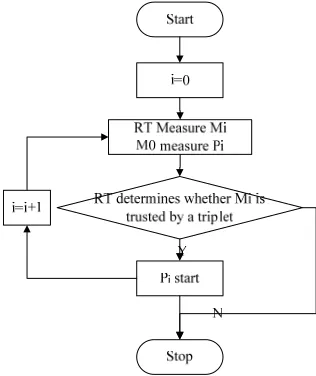
At the time of system startup, it is divided into the following steps. First, RT loads
and measures , and determines whether the metric is passed according to the
triples. If is activated, has the loading condition. Then, when is ready to
load, send a metric request to RT, and measured by the RT, metric and
measured by after loading. After the measured has being load, measure the
metric interface Interface-1 of . Push this step down, so that each measure down to establish a trust chain with the RT, up to establish a measure of relationship with the corresponding measure. The flow chart is shown in Fig. 5.
Figure 5. flow chart of hybrid trust tube model.
An Example of Hybrid Trust Chain Model Analysis
Introduction to the Example
[image:6.612.232.390.395.583.2], , , were evaluated by software reliability evaluation interval, on behalf of the evaluation criteria for {unqualified, qualified, good, excellent} four benchmarks rating benchmark respectively. The result of in the unqualified is not credible, the rest are credible. The summary is shown in Table 1, analysis of the credibility degree of .
Table 1. Evaluation summary table.
Index Weight unqualified qualified Count good excellent
Availability 0.311 0 1 4 5
Reliability 0.445 0 0 6 4
Maintainability 0.244 1 2 3 4
Calculation of Index Weight
(1)
. (2)
. (3)
Scatter plots of large amounts of data is Fig. 6:
Figure 6. Scatter plots of large amounts of data.
Evaluation Results and Analysis
According to the three-element analysis of the measured, the expected value in a good range, entropy and super-entropy value is very small, indicating that the data is very concentrated, it also can be seen from the evaluation data scatter gram of the measured person that most of the points fall within the good range.
So it can be concluded that the credibility of the measured is good, so the next
[image:7.612.106.505.156.222.2]Conclusions
The hybrid trust chain security model combines the star trust structure and the chain trust structure, which reduces the number of trusty nodes in the trust transfer, and reduces the trust loss caused by the insecurity of the trust transfer process. The subject and object of measurement are separated from the traditional trusted computing system, defined as the measure and the measured, and the measure and the measured are separated to ensure the security of the measure.
Acknowledgement
This paper is funded by the project of The State Grid Corporation of China in 2016 “Research on security architecture and protection technology of power business terminal based on security chip”.
References
[1] Zeng Rong. “Design of Power Trusted Cloud Terminal Based on Trusted Computing.” In Chinese.
[2] Anupam, D., Jason, F., Deepak, G., et al. “A logic of secure systems and its application to trusted computing [A],” Proceedings of the 30th IEEE Symposium on Security and Privacy[C]. Washington, DC: IEEE Press, 2009, 221-236.
[3] Tan Liang, Xu Zhi-wei. “Development of the transitive trusted chain based on TPM [J],” Computer Science, 2008, 35(10): .15-18. In Chinese.
[4] Feng Deng-guo. Trusted Computing: Theory and Practice[M]. Beijing: Tsinghua University Press, 2013, 135-138. In Chinese.
[5] Zhang Xing, Chen You-lei, Shen Chang-xiang. “Non-interference trusted model based on processes [J],” Journal on vCommunications, 2009, 30(3): 6-11. In Chinese. [6] Qiu Gang, Wang Yu-lei, Zhou Li-hua. “Noninterferencebased integrity measurement model [J].” Journal of Sichuan University (Engineering Science Edition), 2010, 38(4): 117-120. In Chinese.
[7] Focardi R, Gorrieri R. “Classification of security properties [A],” Proceedings of Foundations of Security Analysis and Design [C]. Berlin: Springer-Verlag Press, 2001, 331-396.
[8] Zhang Ji-sheng. “Application of cloud computing in electric power system[J],” Moder Architecture Electric, 2011, 4(2): 8–11. In Chinese.