R E S E A R C H A R T I C L E
Open Access
Subtypes in clinical burnout patients
enrolled in an employee rehabilitation
program: differences in burnout profiles,
depression, and recovery/resources-stress
balance
Kathrin Bauernhofer
1*, Daniela Bassa
1, Markus Canazei
2, Paulino Jiménez
1, Manuela Paechter
1, Ilona Papousek
1,
Andreas Fink
1and Elisabeth M. Weiss
1Abstract
Background:Burnout is generally perceived a unified disorder with homogeneous symptomatology across people
(exhaustion, cynicism, and reduced professional efficacy). However, increasing evidence points to intra-individual patterns of burnout symptoms in non-clinical samples such as students, athletes, healthy, and burned-out employees. Different burnout subtypes might therefore exist. Yet, burnout subtypes based on burnout profiles have hardly been explored in clinical patients, and the samples investigated in previous studies were rather heterogeneous including patients with various physical, psychological, and social limitations, symptoms, and disabilities. Therefore, the aim of this study is to explore burnout subtypes based on burnout profiles in clinically diagnosed burnout patients enrolled in an employee rehabilitation program, and to investigate whether the subtypes differ in depression, recovery/resources-stress balance, and sociodemographic characteristics.
Methods:One hundred three patients (66 women, 37 men) with a clinical burnout diagnosis, who were enrolled in a 5 week employee rehabilitation program in two specialized psychosomatic clinics in Austria, completed a series of questionnaires including the Maslach Burnout Inventory–General Survey (MBI-GS), the Beck Depression Inventory, and the Recovery-Stress-Questionnaire for Work. Cluster analyses with the three MBI-GS subscales as clustering variables were used to identify the burnout subtypes. Subsequent multivariate/univariate analysis of variance and Pearson chi-square tests were performed to investigate differences in depression, recovery/resources-stress balance, and sociodemographic characteristics.
Results:Three different burnout subtypes were discovered: theexhaustedsubtype, theexhausted/cynicalsubtype, and theburned-outsubtype. Theburned-outsubtype and theexhausted/cynicalsubtype showed both more severe depression symptoms and a worse recovery/resources-stress balance than theexhaustedsubtype. Furthermore, the
burned-outsubtype was more depressed than theexhausted/cynicalsubtype, but no difference was observed between these two subtypes with regard to perceived stress, recovery, and resources. Sociodemographic characteristics were not associated with the subtypes.
(Continued on next page)
* Correspondence:[email protected]
1Department of Psychology, University of Graz, Universitätsplatz 2/DG, 8010
Graz, Austria
Full list of author information is available at the end of the article
(Continued from previous page)
Conclusions:The present study indicates that there are different subtypes in clinical burnout patients (exhausted,
exhausted/cynical, andburned-out), which might represent patients at different developmental stages in the burnout cycle. Future studies need to replicate the current findings, investigate the stability of the symptom patterns, and examine the efficacy of rehabilitation interventions in different subtypes.
Keywords:Burnout, Burnout subtypes, Burnout profiles, Person-oriented approach, Cluster analysis, Depression,
Stress-recovery
Background
During the last decade, burnout has become a public health issue affecting between 4% and 7% of the working population [1]. Nevertheless, the diagnosis is not yet in-cluded in clinical classification systems such as the Diagnostic and Statistical Manual of Mental Disorders (DSM-5) [2] or the International Statistical Classification of Diseases and Related Health Problems (ICD-10) [3]. To date, there is also no consensus on the definition of burnout and its core symptoms [4–7], and the diagnosis overlaps tremendously in symptomatology with other diagnoses, especially chronic fatigue [8] and depression [9–11].
Despite some conceptual controversies [4–7, 12], the most widely accepted definition of burnout is the one by Maslach, Schaufeli, and Leiter [6], who defined it as a work-related stress syndrome characterized by three main symptoms: exhaustion, cynicism, and reduced professional efficacy. Exhaustion refers to feelings of de-pletion caused by various work demands; cynicism re-flects a distant attitude towards work and the people one is working with; and reduced professional efficacy represents the negative self-evaluation that one is in-competent and no longer able to perform work tasks adequately. However, past research has shown that burn-out manifests in different ways. A varying number of burnout profiles [13–15] has been observed across stud-ies, and multifaceted longitudinal trajectories of the burnout symptoms [16–21] indicate different pathways into burnout. Different burnout subtypes might there-fore exist.
The person-oriented approach to burnout [15, 22] is one possibility to investigate burnout subtypes. It identi-fies different groups in a population that are intraindivi-dually homogenous, but interindiviintraindivi-dually heterogeneous in various aspects such as symptomatology, psychopath-ology, and job- and person-related factors. In past research, the person-oriented approach has been used to identify typical burnout profiles [15], which might represent people at different developmental stages in the burnout cycle or truly different burnout subtypes [13, 23–27].
The most frequent burnout profiles that emerged in these studies [13–15], predominantly from the analysis
of the three dimensions of the Maslach Burnout Inventory (MBI) [28], were the burned-out profile and the healthy or engaged profile representing people with severe or low symptomatology in all three burnout di-mensions. Another common symptom profile was the exhausted/cynical profile characterized by high exhaus-tion and cynicism, but simultaneously high professional efficacy. Typical incongruent scoring patterns included theexhausted or overextended, thecynical or disengaged, and thereduced professional efficacyprofile representing people with rather mild symptomatology where only one symptom is pronounced. However, one has to keep in mind that most previous studies have been conducted in non-clinical samples, which consist of people who report symptoms of a burnout but have not been diagnosed by a psychiatrist or clinical psychologist and who are all still working [13–15]. Therefore, the so-called healthy worker effect [29] occurred in these studies, and not all of the prior discussed burnout profiles might genuinely repre-sent clinical burnout subtypes who need or seek treatment in specialized psychosomatic clinics or re-habilitation programs.
subtypes to depression since an intense discussion has been going on during the last years [9–12, 31–54] whether burnout can be seen as a distinct construct or rather a new label of an already known state.
A growing body of literature has examined the overlap between burnout (subtypes) and depression-level, both in the working population [9, 12, 23, 31, 32, 39–48, 50– 52] and in clinical patients [30, 54], but findings are het-erogeneous and inconsistent. Several studies in the working population reported strong correlations between burnout and depression [9–11, 31, 32], espe-cially between exhaustion and depression [10, 31, 32], while in clinically diagnosed burnout patients, the strong exhaustion-depression overlap could not be replicated [55]. Low to moderate correlations between burnout and depression were also found by others in the working population [40, 41, 47], whereas Ahola et al. [45] reported that burnout and depression overlapped par-ticularly in severe burnout. These heterogeneous find-ings may partly result from using different measures of burnout and depression [11, 37] with some measures reflecting a larger concept redundancy between both dis-orders (for a discussion on this topic, see Maslach & Leiter [37]). Furthermore, longitudinal studies have been used to study the complex relationship between burnout and depression, but yielded inconsistent results as well. Some authors reported reciprocal relations between burnout and depression [42–44], while others found a unidirectional relationship from burnout to depression [46–50] or vice versa [51–53] or no predictive relation [36]. Studies applying a person-oriented approach to explore the burnout-depression overlap [9, 31] detected that burnout and depression were not separable from each other. Moreover, both disorders developed longitu-dinally in tandem supporting the hypothesis that burnout and depression may be the same disorder. In clinical burnout patients, longitudinal studies are still sparse [55]. Besides, only a few studies have explored the burnout-depression overlap by applying a person-oriented approach in clinical burnout patients [54] or burnout rehabilitation clients [30, 56], respectively. Yet, the overlap between burnout symptoms and depression might differ between burnout subtypes. Boersma and Lindblom [23] found in the working population that sub-types experiencing high exhaustion were more depressed than other burnout subtypes, and van Dam [54] could dis-tinguish a group with mild symptoms from a group with severe symptoms on several measures (burnout, depres-sion, anxiety, and fatigue) in clinically diagnosed burnout patients. In contrast, Hätinen et al. [30] found in working-aged rehabilitation clients that all subtypes were equally depressed, but in this study, a mixed patient sample suffer-ing from various physiological, psychological, and social limitations, symptoms, and disabilities was explored.
Inconsistencies in organizational risk factors have been found in burnout subtypes as well. According to the job demands-resources (JD-R) model [57], burnout develops when job demands (e.g., workload, time pressure, con-flict) are high, while resources (e.g., autonomy, social support, positive relationship with supervisor) are lim-ited. Resources are therefore no longer able to buffer the negative impact of high demands on stress reactions [58]. Job demands and resources have also been linked to specific burnout symptoms: exhaustion is caused by high workload and emotional demands, whereas cynicism, reduced professional efficacy, and disengage-ment have been associated with a lack of resources [59– 61]. Previous studies on burnout subtypes in the work-ing population [13, 23, 27] likewise found that workload was high in subtypes experiencing high exhaustion (burned-out, exhausted/cynical, and exhausted), but re-sources were only low in subtypes with severe burnout symptoms (burned-out and exhausted/cynical), particu-larly in the burned-out subtype [13]. Yet, in clinical re-habilitation patients, Hätinen et al. [30] did not find any differences in job stressors and resources between three different burnout subtypes (burned-out, exhausted/cyn-ical, and low professional efficacy), although recovery was associated with a decrease in job demands and an increase in job resources [56].
Because most prior research was conducted within the scope of the JD-R model of burnout, recovery has re-ceived comparatively less attention in relevant research. The recovery/resources-stress-balance model [62–64] is similar to the JD-R model but focusses additionally on recovery as crucial aspect to prevent burnout. According to the model, burnout develops after prolonged periods of stress without sufficient recovery and resources. More precisely, the homeostatic balance between stress and re-covery is impaired because resources that were depleted during phases of stress are not adequately restored in the recovery phase [63]. The role of recovery has, how-ever, not been systematically explored in burnout subtypes, particularly not in clinical burnout patients enrolled in an employee rehabilitation program.
Methods
Study design and participants
This study used a person-oriented approach [15] to ex-plore different subtypes based on burnout profiles in clinical burnout patients. A total of 103 patients (64% women) with a clinical burnout diagnosis were recruited from two specialized psychosomatic clinics in Austria. The patients were between 23 and 58 years old (M= 44.82 years, SD= 8.08) and had various educa-tional backgrounds: 31% had a university degree or the A-level (high education), while 69% completed primary education, an apprenticeship or some other type of education or vocational training without the A-level (lower education).
Procedure
Burnout diagnosis was established by a team of psychia-trists and clinical psychologists. Since separate diagnostic codes for burnout are not yet included in clinical classi-fication systems such as DSM-5 or ICD-10 [2, 3], the burnout diagnosis was based on the ICD-10 criteria of work-related neurasthenia, which has been proposed as the psychiatric equivalent of clinical burnout [38]. Simi-lar to previous studies [54, 65], we included only patients that scored ≥2.20 on exhaustion and either ≥2.00 on cynicism or ≤3.67 on professional efficacy in the MBI-GS. Due to their burnout symptoms, all patients were enrolled in a 5 week employee rehabilitation program at the clinics, and they were on sick leave for at least 1 week prior to study admission (M= 106.20 days, SD= 113.46). Data were collected during the first week of the rehabilitation program and informed consent was obtained from all patients prior to participation. The study was in accordance with the 1964 Declaration of Helsinki and was approved by the ethics committee of the University of Graz, Austria.
Psychometric measures Burnout
Burnout symptom severity was assessed with the German version [66] of the MBI-GS [28]. It has 16 items and consists of three subscales: exhaustion, cynicism, and reduced professional efficacy. The exhaustion sub-scale consists of five items (e.g., feeling emotionally drained from work), the cynicism subscale includes also five items (e.g., enthusiasm has decreased since work was started), and the professional efficacy subscale con-sists of six items (e.g., feeling that one gets done things effectively). The items are answered on a frequency rat-ing scale rangrat-ing from 0 (never) to 6 (daily). Since all participants were on sick leave, they were instructed to respond to the items of the MBI-GS according to how they would feel if they were working at the moment.
Depression
The German version of the Beck Depression Inventory (BDI) was used to assess depression severity [67]. The BDI is a 21-item self-rating questionnaire that covers a variety of depressive symptoms along a continuum from 0 (absent or mild) to 3 (severe) symptoms. The BDI is widely used in treatment settings. A cut-off score≥18 indicates a clinically relevant level of depression [68]. Additionally, all patients were screened for a past diag-nosis of major depression using the Structured Clinical Interview for Axis I DSM-IV Disorders (SCID-I) [69].
Recovery/resources-stress balance
The Recovery-Stress-Questionnaire for Work (RESTQ-Work) is based on the recovery/resources-stress balance model [63] and consists overall of 92 items [62]. On a 7-point frequency rating scale ranging from 0 (never) to 6 (always), it measures the degree of stress and the extent of recovery and resources in the past 7 days/ nights. The RESTQ-Work has seven subscales: social-emotional stress (e.g., being mentally stressed, irritated, and frequently in arguments with others), performance (−related) stress (e.g., time pressure, interruptions at work), loss of meaning/burnout (e.g., emotional exhaus-tion, loss of control, meaninglessness), overall recovery (e.g., physical recovery, relaxation, satisfying sleep), leisure/breaks(e.g., undisturbed leisure time without too many high-duty activities such as household chores, effi-cient breaks at work), psychosocial resources (e.g., social support from family, friends, and colleagues), and work-related resources (e.g., autonomy, participation, experi-ence of personal growth). The RESTQ-Work displays good internal reliability and validity, and it has been used in burnout research before [58].
Statistical analyses
burnout profiles, the same approach has been applied by others as well [23, 30].
To describe the burnout subtypes further, one-way analyses of variance (ANOVAs) with the clusters as in-dependent variable and the three MBI-GS subscales as dependent variables were conducted. Differences in depression between the subtypes were evaluated using Pearson’s chi-square tests (for BDI≥18 and depression diagnosis in the past) and a one-way ANOVA. Differ-ences between the subtypes in recovery/resources-stress balance were evaluated using a one-way MANOVA. In the ANOVAs and MANOVA, the clusters served as the independent variable, while the BDI and the seven RESTQ-Work subscales were the dependent variables, respectively. Sociodemographic differences between the subtypes were investigated with one-way ANOVAs (for age and days on sick leave) and Pearson’s chi-square tests (for gender, education, and rehabilitation clinic). In case of homogeneous variances, post-hoc comparisons were made with the Bonferroni test; in case of inhomogeneous vari-ances, the Games-Howell test was used. Effect sizes are reported as partial eta-square (ηp2) indicating small
(0.01≤ηp2< 0.06), medium (0.06≤ηp2< 0.14), and large
(ηp2≥0.14) effects, respectively [72]. All statistical
proce-dures were calculated in SPSS 24 and were performed withα= 0.05 (two-tailed).
Results
Burnout-depression overlap in the entire patient sample
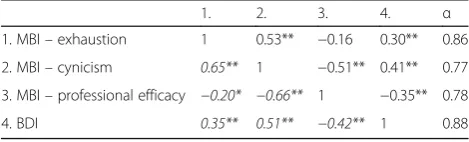
To explore the burnout-depression overlap in the entire patient sample, basic correlations and correlations cor-rected for attenuation [70] between the MBI-GS subscales and the BDI were inspected (see Table 1). The three burnout subscales correlated moderately with de-pression. The highest correlation emerged between cyni-cism and depression (r= 0.41; p< 0.01), the lowest correlation occurred between exhaustion and depression (r= 0.30; p< 0.01). Regarding the correlations between the three MBI-GS subscales, both exhaustion and cyni-cism (r= 0.53; p< 0.01) and cynicism and professional efficacy (r=−0.51;p< 0.01) correlated strongly with each other, whereas a low correlation emerged between exhaustion and professional efficacy (r=−0.16;p= 0.10).
Burnout subtypes in clinically diagnosed burnout patients
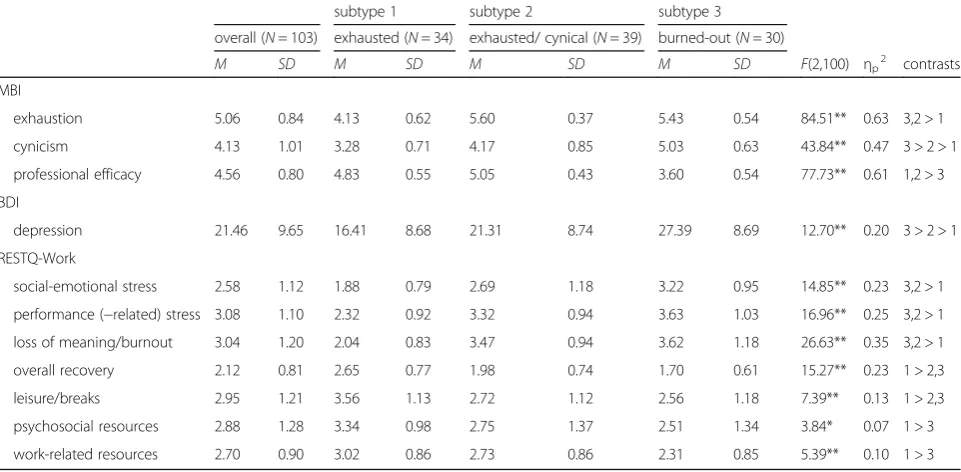
Cluster analysis with the three MBI-GS subscales indi-cated two to four burnout subtypes in the present sample. In the two-cluster solution, cluster 1 and cluster 2 grouped together although the patients of cluster 2 had more severe burnout symptoms than the patients of cluster 1 (see Table 2). In the four-cluster solution, a cluster of patients with elevated burnout symptoms emerged that lay in between cluster 1 and cluster 2. However, since the four-cluster solution did not provide more conceptual clarity than the three-cluster solution, we considered the three-cluster solution representing three different burnout subtypes the best. Subsequent ANOVAs showed how the three subtypes differed in burnout symptomatology (see Table 2).
Figure 1 displays the symptom profile of the burnout subtypes graphically, both in z-scores and in mean scores. Each burnout subtype was described based on its mean score profile and based on which symptoms were most pronounced within the subtype. The three subtypes were labeled as follows:burned-out(subtype 3), exhausted/cynical (subtype 2), and exhausted (subtype 1). Theburned-out subtype (n= 30) had the most severe burnout symptomatology. It displayed high exhaustion, high cynicism, and low professional efficacy. The exhausted/cynical subtype (n= 39) had severe burnout symptoms as well. It was characterized by high exhaustion, elevated levels of cynicism, but simultan-eously high professional efficacy. Finally, the exhausted subtype (n= 34) showed the least severe burnout symp-toms. It displayed elevated levels of exhaustion, the lowest scores on cynicism, and high professional efficacy.
Based on the z-score profile, the three subtypes could have been labeled as burned-out (subtype 3), exhausted (subtype 2), and healthy (subtype 1). However, we de-cided to label the subtypes based on the means score profile because of the general higher symptom severity in clinical burnout patients. Based on the z-score profile, particularly the labelhealthyfor subtype 1 and the label exhaustedfor subtype 2 would have been misleading be-cause both subtypes had elevated levels of exhaustion and subtype 2 had additionally elevated levels of cyni-cism. Hence, subtype 1 did not seem to be healthy and subtype 2 did not seem to be solely exhausted.
Level of depression in the burnout subtypes
[image:5.595.56.291.654.725.2]Depression score was highest in theburned-out subtype, followed by the exhausted/cynical subtype, and the exhausted subtype (see Table 2; Bonferroni-corrected post-hoc tests: burned-outsubtype vs. exhausted/cynical subtype, p= 0.02; burned-out subtype vs. exhausted subtype,p< 0.01;exhausted/cynicalsubtype vs.exhausted subtype,p= 0.05). Moreover, there were significant differ-ences between the subtypes with regard to how many Table 1Cronbach’s alpha (α) and correlations (correlations
corrected for attenuation are in italics) between the MBI-GS subscales and the BDI
1. 2. 3. 4. α
1. MBI–exhaustion 1 0.53** −0.16 0.30** 0.86
2. MBI–cynicism 0.65** 1 −0.51** 0.41** 0.77
3. MBI–professional efficacy −0.20* −0.66** 1 −0.35** 0.78
4. BDI 0.35** 0.51** −0.42** 1 0.88
patients scored above the BDI cut-off score≥18 for clinical depression (burned-out subtype: 27 patients (90%); exhausted/cynical subtype: 27 patients (69%); exhausted subtype: 14 patients (41%); χ2 (2, N= 103) = 17.22,p< 0.01). Concerning previous depression diagno-sis, no significant difference was observed between the subtypes,χ2(2,N= 103) = 0.77,p= 0.68, (see Table 3).
Level of recovery/resources-stress balance in the burnout subtypes
The MANOVA showed significant differences in recov-ery/resources-stress balance between the three subtypes
(using Pillai’s trace,V= 0.48, F(14, 190) = 4.33, p< 0.01, ηp2= 0.24). Subsequent ANOVAs indicated significant
[image:6.595.58.539.100.336.2]differences in all seven RESTQ-Work subscales (see Table 2). Post-hoc analyses further revealed that both the burned-out and the exhausted/cynical subtype experienced significantly more social-emotional stress (p< 0.01), performance(−related) stress (p< 0.01), and loss of meaning/burnout (p< 0.01) as well as significantly less overall recovery (p< 0.01) and less leisure/breaks during work (p< 0.01) than theexhaustedsubtype. Furthermore, the burned-out subtype had significantly less psycho-social resources (p= 0.02) and less work-related Table 2Differences between the burnout subtypes in burnout, depression, and recovery/resources-stress balance
subtype 1 subtype 2 subtype 3
overall (N= 103) exhausted (N= 34) exhausted/ cynical (N= 39) burned-out (N= 30)
M SD M SD M SD M SD F(2,100) ηp2 contrasts
MBI
exhaustion 5.06 0.84 4.13 0.62 5.60 0.37 5.43 0.54 84.51** 0.63 3,2 > 1
cynicism 4.13 1.01 3.28 0.71 4.17 0.85 5.03 0.63 43.84** 0.47 3 > 2 > 1
professional efficacy 4.56 0.80 4.83 0.55 5.05 0.43 3.60 0.54 77.73** 0.61 1,2 > 3
BDI
depression 21.46 9.65 16.41 8.68 21.31 8.74 27.39 8.69 12.70** 0.20 3 > 2 > 1
RESTQ-Work
social-emotional stress 2.58 1.12 1.88 0.79 2.69 1.18 3.22 0.95 14.85** 0.23 3,2 > 1
performance (−related) stress 3.08 1.10 2.32 0.92 3.32 0.94 3.63 1.03 16.96** 0.25 3,2 > 1
loss of meaning/burnout 3.04 1.20 2.04 0.83 3.47 0.94 3.62 1.18 26.63** 0.35 3,2 > 1
overall recovery 2.12 0.81 2.65 0.77 1.98 0.74 1.70 0.61 15.27** 0.23 1 > 2,3
leisure/breaks 2.95 1.21 3.56 1.13 2.72 1.12 2.56 1.18 7.39** 0.13 1 > 2,3
psychosocial resources 2.88 1.28 3.34 0.98 2.75 1.37 2.51 1.34 3.84* 0.07 1 > 3
work-related resources 2.70 0.90 3.02 0.86 2.73 0.86 2.31 0.85 5.39** 0.10 1 > 3
*p< 0.05; **p< 0.01
Fig. 1Burnout profiles based on MBI z-scores and based on MBI mean scores.asubtype 1 =
exhausted; subtype 2 =exhausted/cynical; subtype 3 = burned-out.bpost-hoc tests MBI-GS: exhaustion (
[image:6.595.61.540.522.673.2]resources (p< 0.01) than the exhausted subtype, while the burned-out and the exhausted/cynical subtype did not differ from each other in any of the RESTQ-Work subscales.
Sociodemographic characteristics of the burnout subtypes
Sociodemographic data for the burnout subtypes are pre-sented in Table 3. There were no significant differences between the three subtypes with regard to sociodemo-graphic characteristics. Men and women were equally distributed across the three clusters,χ2(2,N= 103) = 0.65, p= 0.72, and the subtypes did not differ in age,F(2, 100) = 0.71, p= 0.50, and education, χ2 (2, N= 103) = 2.02, p= 0.36, respectively. The rehabilitation clinic was not significantly associated with the burnout subtype, χ2 (2, N= 103) = 0.69, p= 0.71, and there was no signifi-cant difference between the subtypes in how many days the patients had already been on sick leave prior to study admission, F(2, 100) = 2.30, p= 0.10.
Discussion
Burnout subtypes in clinical burnout patients
The present study explored different burnout subtypes based on MBI profiles in clinical burnout patients enrolled in an employee rehabilitation program in a psychosomatic clinic. As increasing evidence points to intra-individual patterns of burnout symptoms in non-clinical samples such as students, athletes, healthy and burned-out employees [13, 15], this study addressed the specific research question of whether different burnout subtypes can also be identified in clinically diagnosed burnout patients and whether these burnout subtypes differ in depression, recovery/resources-stress balance, and sociodemographic characteristics. Previously, van
Dam [54] investigated subgroups in clinically diagnosed burnout patients by means of cluster analysis using fatigue (CIS), depression (SCL-90-D), and anxiety (SCL-90-A) as clustering variables and found two clus-ters that differed from one another in terms of symptom-severity on the three aforementioned mea-sures. To date, only Hätinen et al. [30] have explored MBI burnout profiles in a mixed sample of working-aged rehabilitation clients, in which four different symp-tom patterns occurred: the burned-out profile, the exhausted/cynical profile, the reduced professional efficacy profile, and the healthy profile. However, some of these profiles might have occurred because Hätinen et al. [30] explored a heterogeneous patient sample suffer-ing from various physical, psychological, and social limi-tations, symptoms, and disabilities. A study analyzing burnout subtypes in a group of clinically diagnosed burnout patients with the three MBI-GS dimensions (exhaustion, cynicism, professional efficacy) as clustering variables, is to the very best of our knowledge not avail-able yet. Cluster analysis with the three MBI-GS subscales as clustering variables revealed three distinct burnout subtypes in the present study.
[image:7.595.56.542.100.294.2]In line with Hätinen et al. [30], we found two subtypes with severe burnout symptoms, namely the burned-out and the exhausted/cynical subtype, whereas thereduced professional efficacy subtype and the healthy burnout profile could not be replicated in the present study. Instead, we identified anexhausted subtype representing patients with milder symptomatology. Sociodemographic characteristics were not systematically associated with the subtypes in the present study, but all groups differed in depression severity. The burned-out subtype showed overall the highest level of depression, while the exhausted subtype was the least depressed. Moreover, Table 3Sociodemographic characteristics of the burnout subtypes
subtype 1 subtype 2 subtype 3
overall (N= 103) exhausted (N= 34) exhausted/ cynical (N= 39) burned-out (N= 30)
gender female 66 (64%) 21 (32%) 24 (36%) 21 (32%)
male 37 (36%) 13 (35%) 15 (41%) 09 (24%)
education high 32 (31%) 08 (25%) 12 (38%) 12 (38%)
lower 71 (69%) 26 (37%) 27 (38%) 18 (25%)
BDI≥18 yes 68 (66%) 14 (21%) 27 (40%) 27 (40%)
no 35 (34%) 20 (57%) 12 (34%) 03 (9%)
depression diagnosis in the past yes 70 (68%) 25 (36%) 25 (36%) 20 (29%)
no 33 (32%) 09 (27%) 14 (42%) 10 (30%)
rehabilitation clinica A 51 (49%) 15 (29%) 21 (41%) 15 (29%)
B 52 (51%) 19 (37%) 18 (35%) 15 (29%)
age M(SD) 44.82 (8.08) 44.96 (9.72) 45.76 (6.26) 43.43 (8.22)
days sick leave M(SD) 106.20 (113.46) 73.65 (94.66) 115.56 (104.04) 130.93 (137.13)
a
the burned-outand theexhausted/cynicalsubtype had a worse recovery/resources-stress balance compared to theexhaustedsubtype, but they did not differ from each in perceived stress, recovery, and resources. Since neither the depression scale, nor the RESTQ-Work sub-scales were used for clustering, these differences further support the validity of the cluster solution. Taken together our findings suggest that different burnout sub-types can be identified in clinical patients who were diagnosed with burnout by a professional team of psy-chiatrists and clinical psychologists working in a special-ized psychosomatic clinic.
In line with past research [30, 54], our study indicates that the three subtypes represent patients at different stages in the burnout cycle. The subtypes correspond well with the process model of burnout [18], according to which burnout starts with exhaustion due to pro-longed periods of stress, followed by cynicism as an at-tempt to cope with the intense emotional strain, before finally reduced professional efficacy occurs because a negative attitude towards one’s job precludes achieving work goals. Yet, it cannot be ruled out that the burned-out and the exhausted/cynical subtype might be truly different burnout subtypes, each characterizing the final stage in the burnout cycle. Several researchers have shown that professional efficacy develops rather inde-pendently of the other two burnout symptoms [21, 60], and both burnout profiles seem to be relatively stable over time [23]. Moreover, an alternative longitudinal tra-jectory of the burnout symptoms starting with reduced professional efficacy, followed by cynicism, and ending in emotional exhaustion, has been found as well [21]. The reduced professional efficacy subtype is a common subtype in the general working population [15], and two different pathways into burnout—one starting with exhaustion, the other one starting with reduced profes-sional efficacy—have been addressed [13, 15, 24].
Truly different burnout subtypes might also explain why Hätinen et al. [30] found the reduced professional efficacy subtype, while the present study found the exhausted subtype representing patients with milder symptomatology, although the same methodology was applied in both studies, namely cluster analysis with the three MBI-GS subscales. Nevertheless, one has to keep in mind that our study sample markedly differed from the rehabilitation clients analyzed in the study by Hätinen et al. [30]. The present study solely included clinical burnout patients diagnosed with the ICD-10 cri-teria of work-related neurasthenia, which has been pro-posed as the psychiatric equivalent of clinical burnout [38]. In addition, all patients scored high on exhaustion (≥2.20) and either high on cynicism (≥ 2.00) or low on professional efficacy (≤ 3.67) in the MBI-GS [54, 65]. In contrast, Hätinen et al. [30] explored a mixed patient
sample from an employee rehabilitation clinic suffering from various physical, psychological, and social limita-tions, symptoms, and disabilities. Patients with physical impairments displayed particularly the healthy burnout profile in their study, but physical impairments can lead to the experience of reduced professional efficacy as well, when one is no longer able to conduct one’s job properly.
Regarding the possible antecedents of burnout, we revealed that the three burnout subtypes in our study differed in their recovery/resources-stress balance. The two subtypes with severe burnout symptoms, namely the burned-out subtype and the exhausted/cynical subtype, experienced more social-emotional stress, performan-ce(−related) stress, and loss of meaning in their job than the exhausted subtype. Both subtypes reported also the lowest overall recovery, leisure, and breaks during work. Furthermore, theburned-outsubtype tended to have less psychosocial and work-related resources than the exhausted subtype. According to the JD-R model [57] and the recovery/resources-stress balance model [62– 64], burnout develops due to high job demands and sim-ultaneously low resources and recovery. Both would be necessary to buffer the negative effects of high job de-mands on stress reactions [58]. Our findings are in line with these assumptions, which have also received sup-port in burnout subtypes in the working population [13, 23, 27] and in longitudinal studies in clinical rehabilita-tion clients [56]. Yet, theburned-outand theexhausted/ cynical subtype did not differ in recovery/resources-stress balance from each other in the present study. This is in line with some previous studies [23, 30] but not with others [13] reporting that the burned-out subtype had even less organizational resources than the exhausted/cynical subtype. To clarify, whether the exhausted/cynical subtype and the burned-out subtype represent people at different developmental stages in the burnout cycle or truly different burnout subtypes, future studies should explore longitudinally which characteris-tics differentiate between these two subtypes.
Burnout-depression overlap
subtype and the exhausted subtype, respectively. Similarly, Ahola et al. [45] showed that 90% of people with severe burnout reported a physical or mental dis-ease; more specifically, pain and depression. In contrast, Hätinen et al. [30] could not replicate these findings; the authors found that several burnout subtypes in rehabili-tation clients were equally depressed. Yet, in their study, a mixed sample of rehabilitation clients suffering from various physiological, psychological, and social limita-tions, symptoms, and disorders was explored, while other studies [23, 54] using a person-oriented approach to explore burnout subtypes found that subtypes with severe burnout symptoms had higher depression scores than subtypes with milder burnout symptoms, which is in line with our study.
Interestingly, our results differed also from previous findings with regard to the burnout-depression overlap when the correlations between the three MBI-GS subscales and the BDI score were considered [9, 10, 31, 32]. For example, Bianchi et al. [10] found a high correl-ation between the MBI sum score and the BDI (r= 0.68) in the working population. Importantly, in their study, the correlation between emotional exhaustion and depression was much stronger (r= 0.74) than the corre-lations between the three dimensions of the MBI. Similar to the study of van Dam [54], the present study could not replicate such a strong correlation between exhaustion and depression (r= 0.30) in clinical burnout patients. For more than half a century [73], researchers have debated about the utility of using non-clinical sam-ples such as students as analogues for patients with clin-ical diagnosis. Generalizing findings from non-clinclin-ical burnout samples to clinical burnout patients might therefore be problematic. However, another explanation for the lower correlation between exhaustion and de-pression in the present study and in the study of van Dam [54] might be that the range of exhaustion and de-pression scores is limited in clinical burnout patients, which might have flattened the correlation between both constructs. Furthermore, some of the heterogeneity in study results concerning the burnout-depression overlap may result from using different measures of burnout and depression [11, 12, 31, 32, 37, 40, 41, 47]. Hence, the high correlations between burnout and depression, especially with the burnout dimension emotional exhaustion in some studies, might partly reflect a large level of concept redundancy between specific burnout and depression measures (for a discussion on this topic, please see Maslach & Leiter [37]).
Especially longitudinal studies provide the opportunity to study the complex relationship between burnout and depression. Longitudinal studies focusing on the question whether burnout predicted depression or vice versa, re-vealed inconsistent results. Some authors [42–44] found a
reciprocal relation between burnout and depression, with each predicting subsequent developments in the other, while other authors [46–50] reported a predictive relation from burnout to depression. Furthermore, three longitu-dinal studies showed a unidirectional relationship from depression to burnout [51–53] and one study failed to find any predictive relation [36]. Bianchi, Schonfeld and Laur-ent [31] focused on how burnout and depressive symp-toms clustered at baseline and follow-up by applying a person-oriented approach. In this study, burnout was measured with a global burnout index (the combination of the MBI subscales emotional exhaustion and cynicism); depression was assessed with the Patient Health Question-naire (PHQ-9). A similar person-oriented approach by using cluster analysis to study the relationship between burnout and depressive symptoms at baseline and over 7 years in dentists was applied by Ahola et al. [9]. Again, burnout was measured with a global index (more specifically, a weighted sum score of the MBI dimen-sions was calculated, so that emotional exhaustion, depersonalization, and diminished personal accom-plishment had different weights in the syndrome); de-pressive symptoms were assessed using the short form of the Beck Depression Inventory (BDI-SF). In both studies, similar findings were obtained as both studies could show that the participants formed three clusters with low, intermediate, or high levels of burnout and depressive symptoms at baseline. Add-itionally, in both studies long-term development oc-curred in tandem, either remaining stable or changing in synchrony. Therefore, both studies support the hy-pothesis that burnout and depression overlap or may even be the same disorder.
Up to now, longitudinal studies in clinical burnout patients are still sparse. Oosterholt et al. [55] examined the course of cognitive performance and cortisol level in clinical burnout patients and non-clinical burnout indi-viduals over a time period of 1.5 years. After 1.5 years, clinical burnout patients showed improvement of burn-out symptoms and general physical and psychological complaints, but the patients still reported subjective cognitive impairments that were also evident in a cogni-tive test. In contrast, the non-clinical burnout group expressed the same elevated level of burnout symptoms, general physical and psychological complaints, and cog-nitive problems, but did not show objective cogcog-nitive deficits after 1.5 years.
burnout changes observed 4-month after the interven-tion depended on the burnout profile membership. While exhaustion showed a decreasing trend in the burned-outandexhausted/cynicalprofile, the decreasing trend in cynicism was only evident in the burned-out profile compared to the other profiles. Furthermore, reduced professional efficacy showed an increasing trend in theexhausted/cynical profile, whereas in the reduced professional efficacyprofile the trend was decreasing. In a subsequent study, Hätinen et al. [56] investigated burnout trajectories in a one-year rehabilitation program with a six-month follow-up and found inter-individual changes in how clients reacted to the interventions and how these reactions were manifested in burnout symp-toms during follow-up. The authors found three burnout patterns: two patterns with high levels of burnout and one pattern with low levels of burnout. However, only in one group with high burnout levels, exhaustion and cynicism were decreased at follow-up. This group was labeled as “high burnout-benefited trajectory” by the authors. For the “low burnout trajectory” and the “high burnout-benefited trajectory”, positive changes were detected in job-related antecedents (e.g., time pressure at work, job control, workplace climate) and conse-quences (e.g. depressive symptoms, job satisfaction). Thus, preliminary results suggest that in clinical burnout samples distinct symptom profiles exist and that not all burnout profiles benefit equally from rehabilitation in terms of reduction in burnout symptoms, job-related antecedents, and consequences [30, 56].
Practical implications
Burnout prevention/intervention programs in non-clinical burnout employees are either person-directed (individual level interventions), organization-directed or a combination of both [74]. Person-directed interven-tions usually consist of different kinds of relaxation exercises and/or cognitive behavioral techniques to en-hance social support, job competence, and personal cop-ing skills. Organization-directed interventions target on poor workplace climate, dissatisfaction with supervision, and changes in work procedures such as task restructur-ing. Furthermore, organization-directed interventions aim at decreasing job demand, increasing job control and expanding the level of participation in decision-making. Several reviews in non-clinical populations [74– 77] concluded that burnout intervention programs had a beneficial effect on burnout outcome measures, espe-cially when person-directed and organization-directed interventions were combined. Nonetheless, a recent meta-analysis [78] on the effectiveness of controlled in-terventions to reduce burnout indicated statistically sig-nificant effects of interventions only on general burnout scales (d= 0.224) and exhaustion (d= 0.172); no effect
was observed on cynicism or professional inefficacy. Moreover, the reported effect sizes were overall rather small. Yet, most studies included in this meta-analysis investigated non-clinical burnout employees who do not necessarily possess a high level of burnout, since the interventions were aimed at decreasing the level of stress.
Studies assessing the efficacy of interventions in burn-out patients who are treated in clinical settings are rare [30, 55, 56]. Preliminary results suggest that in clinical burnout samples distinct symptom profiles exist and that not all burnout profiles benefit equally from rehabilita-tion in terms of reducrehabilita-tion in burnout symptoms, job-related antecedents, and consequences [30, 56]. For the burnout subtypes with severe symptomatology such as the exhausted/cynical and the burned-out subtype, the first step in rehabilitation should lie on the alleviation of the burnout and depression symptoms (e.g., psychother-apy and if indicated antidepressants). Additionally, rehabilitation should focus on organization-directed intervention activities in these subtypes, since burnout patients with severe symptomatology reported worse interpersonal relations, poor workplace climate, and dissatisfaction with supervision in previous studies [30]. Similarly, in our own study, the burned-out and the exhausted/cynical subtype experienced high social-emotional stress, performance-related stress and limited (work-related) resources. There is still an ongoing debate about the efficacy of antidepressants and psychother-apies in the treatment of subclinical depression, which is defined as a level of clinically relevant depressive symp-toms in the absence of a major depressive disorder [79, 80]. Therefore, the exhaustedsubtype might profit from a person-directed approach focusing on factors contrib-uting to exhaustion and recovery (e.g., interventions tar-geting workload, relaxation, and work-life balance [27]. In sum, identifying different subtypes of clinical burnout patients and analyzing the relationship of these subtypes to depression will enable psychiatrists and clinical psychologists to focus their intervention activities more effectively.
Study limitations
DSM-5 or ICD-10 [2, 3]. Therefore, in the current study, the burnout diagnosis was based on the ICD-10 criteria of work-related neurasthenia, which has been proposed as the psychiatric equivalent of clinical burnout [38]. Additionally, we included only patients who scored ≥2.20 on exhaustion and either ≥2.00 on cynicism or ≤3.67 on professional efficacy in the MBI-GS. Hence, the findings of our study might not be generalizable to clinical burnout patients who are diagnosed differently. An extensive discussion about the problem of simplifica-tion burnout to ICD-10/DSM-5 codes such as neuras-thenia, somatic symptom disorder or exhaustion, can be found in a current review by Maslach and Leiter [37].
Furthermore, the patients in the present study were on average three and a half months on sick leave, and hence, a recall bias may have occurred; especially in patients who had been longer on sick leave. However, the burnout subtypes did not differ in how many days the patients had been on sick leave; thus, the distortion bias was at least equally distributed between the sub-types. Additionally, data were collected during the first week of the rehabilitation program. Therefore, it cannot be ruled out that the burnout profiles we found occurred because some patients already started benefiting from the positive effects of the rehabilitation program before they filled in the questionnaires. A further limitation of the present study is that the patients were not screened for comorbid psychiatric disorders using the Structured Clinical Interview for Axis I DSM-IV Disorders (SCID-I) [69] or the Mini-International Neuropsychiatric Interview (MINI) [81]. Therefore, we cannot ensure that comorbid disorder are equally divided over the burnout types. Finally, the analyses were based on cross-sectional report questionnaires. Hence, we were not able to inves-tigate whether theexhausted/cynicaland theburned-out subtype represent people at different developmental stages in the burnout cycle or truly different burnout subtypes. Due to the rather small sample size and differ-ent intervdiffer-entions in the two rehabilitation clinics, we were also not able to investigate if the three burnout subtypes responded differently to therapy.
Conclusions
In recent years, different burnout subtypes or profiles, based on cluster/profile analysis with the three MBI subscales, have been proposed by several research groups [13, 15]. However, until now, intra-individual patterns of burnout symptoms have primarily been in-vestigated in non-clinical samples such as students, athletes, healthy, and burned-out employees. Therefore, the current study aimed to investigate whether different burnout subtypes can also be identified in a more homo-geneous group of clinically diagnosed burnout patients enrolled in an employee rehabilitation program in a
psychosomatic clinic. Our results provide evidence that in clinical burnout patients three different burnout subtypes can be revealed: the exhausted subtype, the exhausted/cynical subtype, and the burned-out subtype, which might represent patients at different developmen-tal stages in the burnout cycle. Furthermore, the exhausted subtype displayed the lowest depression level and the best recovery/resources-stress balance, while the burned-outsubtype exhibited the most severe depression symptoms and a worse recovery/resources-stress balance than theexhaustedsubtype. Clearly, the current findings need to be replicated in future studies involving larger, ideally longitudinal data sets to investigate the efficacy of rehabilitation interventions in different burnout subtypes and to track the stability and change patterns between the burnout subtypes over time.
Abbreviations
ANOVA:Analysis of variance; BDI: Beck depression inventory; BDI-SF: Beck depression inventory–short form; CIS: Checklist individual strength; DSM-5: Diagnostic and statistical manual of mental disorders; ICD-10: International statistical classification of diseases and related health problems; JD-R: Job demands-resources; MANOVA: Multivariate analysis of variance; MBI: Maslach burnout inventory; MBI-GS: Maslach burnout inventory–general survey; MINI: Mini-international neuropsychiatric interview; PHQ-9: Patient health questionnaire; RESTQ-Work: Recovery-stress-questionnaire for work; SCID-I: Structured clinical interview for Axis I DSM-IV disorders; SCL-90-A: Symptom checklist–anxiety subscale; SCL-90-D: Symptom checklist–depression subscale
Acknowledgements
We would like to thank two rehabilitation clinics in Austria for support in this research by permitting access to their burnout patients.
Funding
This work was supported by the Austrian Research Promotion Agency (Grant No. 827511/BULT).
Availability of data and materials
The authors confirm that some access restrictions apply to the data underlying the findings. The data set cannot be made publicly available because informed consent from study participants did not cover public deposition of data.
Authors’contributions
KB, EW, MC and DB contributed in the conceptualization of the study. DB participated in collecting the data. KB conducted the statistical analyses, supported by MP and IP. KB drafted the manuscript, and EW, PJ, IP and AF contributed to the interpretation of the data. All authors revised the manuscript and gave final approval of the version to be published.
Ethics approval and consent to participate
The study was in accordance with the 1964 Declaration of Helsinki and was approved by the ethics committee of the University of Graz, Austria. Informed consent was obtained from all patients prior to participation. Data confidentiality was guaranteed and the patients were informed that they had the right to withdraw from the study at any time.
Consent for publication
Not applicable
Competing interests
The authors declare that they have no competing interests.
Publisher’s Note
Author details
1Department of Psychology, University of Graz, Universitätsplatz 2/DG, 8010
Graz, Austria.2Department of Psychology, University of Innsbruck, Bruno-Sander-Haus Innrain 52f, 6020 Innsbruck, Austria.
Received: 2 June 2017 Accepted: 2 January 2018
References
1. Schaufeli W. Past performance and future perspectives of burnout research. SA J Ind Psychol. 2003;29:1–15.
2. American Psychiatric Association. Diagnostic and statistical manual of mental disorders. 5th ed. Arlington, VA: American Psychiatric Publishing; 2013. 3. World Health Organization. The ICD-10 classification of mental and
Behavioural disorders: diagnostic criteria for research. Geneva: World Health Organization; 1993.
4. Demerouti E, Bakker AB. The Oldenburg burnout inventory: a good alternative to measure burnout and engagement. In: Halbesleben JRB, editor. Handbook of stress and burnout in health care. Hauppauge, NY: Nova Science Publishers; 2008. p. 65–78.
5. Kristensen TS, Borritz M, Villadsen E, Christensen KB. The Copenhagen burnout inventory: a new tool for the assessment of burnout. Work Stress. 2005;19:192–207.
6. Maslach C, Schaufeli WB, Leiter MP. Job burnout. Annu Rev Psychol. 2001;52:397–422.
7. Shirom A, Melamed S. A comparison of the construct validity of two burnout measures in two groups of professionals. Int J Stress Manag. 2006; 13:176–200.
8. Huibers MJ, Beurskens AJ, Prins JB, Kant IJ, Bazelmans E, van Schayck CP, Knottnerus JA, Bleijenberg G. Fatigue, burnout, and chronic fatigue syndrome among employees on sick leave: do attributions make the difference? Occup Environ Med. 2003;60:26–31.
9. Ahola K, Hakanen J, Perhoniemi R, Mutanen P. Relationship between burnout and depressive symptoms: a study using the person-centred approach. Burnout Res. 2014;1:29–37.
10. Bianchi R, Boffy C, Hingray C, Truchot D, Laurent E. Comparative
symptomatology of burnout and depression. J Health Psychol. 2013;18:782–7. 11. Bianchi R, Schonfeld IS, Laurent E. Burnout-depression overlap: a review. Clin
Psychol Rev. 2015;36:28–41.
12. Bianchi R, Schonfeld IS, Laurent E. Is burnout a depressive disorder? A reexamination with special focus on atypical depression. Int J Stress Manag. 2014;21:307–24.
13. Leiter MP, Maslach C. Latent burnout profiles: a new approach to understanding the burnout experience. Burnout Res. 2016;3:89–100. 14. Maslach C, Leiter M. Early predictors of job burnout and engagement. J
Appl Psychol. 2008;93:498–512.
15. Mäkikangas A, Kinnunen U. The person-oriented approach to burnout: a systematic review. Burnout Res. 2016;3:11–23.
16. Golembiewski RT, Munzenrider RF, Stevenson JG. Phases of burnout: developments in concepts and applications. New York: Praeger; 1986. 17. Friedman IA. Multiple pathways to burnout: cognitive and emotional
scenarios in teacher burnout. Anxiety Stress Coping. 1996;9:245–59. 18. Leiter MP, Maslach C. The impact of interpersonal environment of burnout
and organizational commitment. J Organ Behav. 1988;9:297–308. 19. Taris TW, Le Blanc PM, Schaufeli WB, Schreurs PJ. Are there causal
relationships between the dimensions of the Maslach burnout inventory? A review and two longitudinal studies. Work Stress. 2005;19:238–55. 20. Te Brake H, Smits N, Wicherts JM, Gorter RC, Hoogstraten J. Burnout development
among dentists: a longitudinal study. Eur J Oral Sci. 2008;116:545–51. 21. van Dierendonck R, Schaufeli WB, Buunk BP. Toward a process model
of burnout: results from a secondary analysis. Eur J Work Organ Psy. 2001;10:41–52.
22. Bergman LR, Trost K. The person-oriented versus the variable-oriented approach: are they complementary, opposites, or exploring different worlds? Merrill Palmer Q. 2006;52:601–32.
23. Boersma K, Lindblom K. Stability and change in burnout profiles over time: a prospective study in the working population. Work Stress. 2009;23:264–83. 24. Demerouti E, Verbeke WJ, Bakker AB. Exploring the relationship between a
multidimensional and multifaceted burnout concept and self-rated performance. J Manage. 2005;31:186–209.
25. Innanen H, Tolvanen A, Salmela-Aro K. Burnout, work engagement and workaholism among highly educated employees: profiles, antecedents and outcomes. Burnout Res. 2014;1:38–49.
26. Lee SM, Cho SH, Kissinger D, Ogle NT. A typology of burnout in professional counselors. J Couns Dev. 2010;88:131–8.
27. Timms C, Brough P, Graham D. Burnt-out but engaged: the co-existence of psychological burnout and engagement. J Educ Adm. 2012;50:327–45. 28. Maslach C, Jackson SE, Leiter M. Maslach burnout inventory. Manual. 3rd ed.
Palo Alto, CA: Consulting Psychologists Press; 1996. 29. Karasek R, Theorell T. Healthy work: stress, productivity and the
reconstruction of working life. New York: Basic Books; 1990. 30. Hätinen M, Kinnunen U, Pekkonen M, Aro A. Burnout patterns in
rehabilitation: short-term changes in job conditions, personal resources, and health. J Occup Health Psychol. 2004;9:220–37.
31. Bianchi R, Schonfeld IS, Laurent E. Is burnout separable from depression in cluster analysis? A longitudinal study. Soc Psychiatry Psychiatr Epidemiol. 2015;50:1005–11.
32. Schonfeld IS, Bianchi R. Burnout and depression: two entities or one? J Clin Psychol. 2016;72:22–37.
33. Bianchi R, Schonfeld IS, Laurent E. Physician burnout is better conceptualised as depression. Lancet. 2017;389:1397–8.
34. Bianchi R, Schonfeld IS, Laurent E. Burnout or depression: both individual and social issue. Lancet. 2017;390:230.
35. Bianchi R, Schonfeld IS, Vandel P, Laurent E. On the depressive nature of the
“burnout syndrome”: a clarification. Eur Psychiatry. 2017;41:109–10. 36. Bianchi R, Schonfeld IS, Laurent E. Burnout does not help predict depression
among French schoolteachers. Scand J Work Environ Health. 2015b;41:565– 8. https://doi.org/10.5271/sjweh.3522.
37. Maslach C, Leiter MP. Understanding the burnout experience: recent research and its implications for psychiatry. World Psychiatry. 2016;15:103–11. 38. Schaufeli WB, Bakker AB, Hoogduin K, Schaap C, Kladler A. On the clinical
validity of the Maslach burnout inventory and the burnout measure. Psychol Health. 2001;16:565–82.
39. Schaufeli WB, Enzmann D. The burnout companion to study and practice: a critical analysis. London: Taylor and Francis; 1998.
40. Leiter MP, Durup J. The discriminant validity of burnout and depression: a confirmatory factor analytic study. Anxiety Stress Coping. 1994;7:357–73. 41. Raedeke TD, Arce C, De Francisco C, Seoane G, Ferraces MJ. The construct
validity of the Spanish version of the ABQ using a multi-trait/multi-method approach. Anales de Psi-cologia. 2012;29:693–700.
42. Ahola K, Hakanen J. Job strain, burnout, and depressive symptoms: a prospective study among dentists. J Affect Disord. 2007;104:103–10. 43. McKnight JD, Glass DC. Perceptions of control, burnout, and depressive
symptomatology: a replication and extension. J Consult Clin Psychol. 1995;63:490–4.
44. Toker S, Biron M. Job burnout and depression: unraveling their temporal relationship and considering the role of physical activity. J Appl Psychol. 2012;97:699–710.
45. Ahola K, Honkonen T, Isometsä E, Kalimo R, Nykyri E, Aromaa A, Lönnqvist J. The relationship between job-related burnout and depressive disorders—results from the Finnish health 2000 study. J Affect Disord. 2005;88:55–62.
46. Armon G, Melamed S, Toker S, Berliner S, Shapira I. Joint effect of chronic medical illness and burnout on depressive symptoms among employed adults. Health Psychol. 2014;33:264–72.
47. Hakanen JJ, Schaufeli WB. Do burnout and work engagement predict depressive symptoms and life satisfaction? A three-wave seven-year prospective study. J Affect Disord. 2012;141:415–24.
48. Hakanen JJ, Schaufeli WB, Ahola K. The job demands–resources model: a three-year cross-lagged study of burnout, depression, commitment, and work engagement. Work Stress. 2008;22:224–41.
49. Salmela-Aro K, Savolainen H, Holopainen L. Depressive symptoms and school burnout during adolescence: evidence from two cross-lagged longitudinal studies. J Youth Adolesc. 2009;38:1316–27.
50. Shin H, Noh H, Jang Y, Park YM, Lee SM. A longitudinal examination of the relationship between teacher burnout and depression. J Employ Couns. 2013;50:124–37.
51. Armon G, Shirom A, Melamed S. The big five personality factors as predictors of changes across time in burnout and its facets. J Pers. 2012;80:403–27. 52. Campbell J, Prochazka AV, Yamashita T, Gopal R. Predictors of persistent
53. Salmela-Aro K, Aunola K, Nurmi JE. Trajectories of depressive symptoms during emerging adulthood: antecedents and consequences. Eur J Dev Psychol. 2008;5:439–65.
54. van Dam A. Subgroup analysis in burnout: relations between fatigue, anxiety, and depression. Front Psychol. 2016; doi: https://doi.org/10.3389/ fpsyg.2016.00090.
55. Oosterholt BG, Maes JH, van der Linden D, Verbraak MJ, Kompier MA. Getting better, but not well: a 1.5 year follow-up of cognitive performance and cortisol levels in clinical and non-clinical burnout. Biol Psychol. 2016;117:89–99.
56. Hätinen M, Kinnunen U, Mäkikangas A, Kalimo R, Tolvanen A, Pekkonen M. Burnout during a long-term rehabilitation: comparing low burnout, high burnout–benefited and high burnout–not benefited trajectories. Anxiety Stress Coping. 2009;22:341–60.
57. Demerouti E, Bakker AB, Nachreiner F, Schaufeli WB. The job demands-resources model of burnout. J Appl Psychol. 2001;86:499–512. 58. Jiménez P, Dunkl A. The buffering effect of workplace resources on the
relationship between the areas of worklife and burnout. Front Psychol. 2017; doi:https://doi.org/10.3389/fpsyg.2017.00012.
59. Bakker AB, Demerouti E, Taris T, Schaufeli WB, Schreurs PJ. A multigroup analysis of the job demands-resources model in four home care organizations. Int J Stress Manag. 2003;10:16–38.
60. Lee RT, Ashforth BE. A meta-analytic examination of the correlates of the three dimensions of job burnout. J Appl Psychol. 1996;2:123–33. 61. Schaufeli WB, Bakker AB. Job demands, job resources, and their
relationship with burnout and engagement: a multi-sample study. J Organ Behav. 2004;25:293–315.
62. Jiménez P, Dunkl A, Kallus KW. Recovery-stress questionnaire for work. In: Kallus KW, Kellmann M, editors. The recovery-stress questionnaire. User manual. Frankfurt/Main: Pearson; 2016. p. 158–87.
63. Kallus KW. Stress and recovery: an overview. In: Kallus KW, Kellmann M, editors. The recovery-stress questionnaire. User manual. Frankfurt/Main: Pearson; 2016. p. 27–48.
64. Kallus KW, Kellmann M. The recovery-stress questionnaire. User manual. Frankfurt/Main: Pearson; 2016.
65. Oosterholt BG, van der Linden D, Maes JH, Verbraak MJ, Kompier MA. Burned out cognition–cognitive functioning of burnout patients before and after a period with psychological treatment. Scand J Work Environ Health. 2012;38:358–69.
66. Büssing A, Glaser J. Managerial stress und burnout. A collaborative international study (CISMS). Die deutsche Untersuchung. [managerial stress and burnout. The German study]. Bericht nr. 44 aus dem Lehrstuhl für Psychologie. München: Technische Universität, Lehrstuhl für Psychologie; 1998. 67. Hautzinger M, Bailer M, Worall H, Keller F. Beck-Depressions-Inventar (BDI).
Bearbeitung der deutschen Ausgabe. Testhandbuch. Bern, Göttingen, Toronto, Seattle: Huber; 1994.
68. Beck AT, Steer RA, Carbin MG. Psychometric properties of the Beck depression inventory: twenty-five years of evaluation. Clin Psychol Rev. 1988;8:77–100.
69. First MB, Spitzer RL, Gibbon M, Williams JB. User’s guide for the structured clinical inter-view for DSM-IV interview for DSM-IV Axis I disorders. Washington, DC: Ameri-can Psychiatric Press; 1997.
70. Cohen J, Cohen P, West SG, Aiken LS. Applied multiple regression/ correlation analysis for the behavioral sciences. 3rd ed. Mahwah, NJ: Earlbaum; 2003.
71. Everitt BS, Landau S, Leese M, Stahl D. Cluster analysis. 5th ed. Chichester, West Sussex: Wiley; 2011.
72. Cohen J. Statistical power analysis for the behavioral sciences. 2nd ed. Hillsdale, NJ: Lawrence Erlbaum; 1988.
73. Endler NS, Deisoff E, Rutherford A. Anxiety and depression: evidence for the differentiation of commonly cooccurring constructs. J Psychopathol Behav Assess. 1998;20:149–71.
74. Awa WL, Plaumann M, Walter U. Burnout prevention: a review of intervention programs. Patient Educ Couns. 2010;78:184–90. 75. Ruotsalainen J, Serra C, Marine A, Verbeek J. Systematic review of
interventions for reducing occupational stress in health care workers. Scand J Work Environ Health. 2008;34:169–78.
76. Walter U, Krugmann CS, Plaumann M. Preventing burnout? A systematic review of effectiveness of individual and comorbid approaches [German]. Bundesgesundheitsblatt Gesundheitsforschung Gesundheitsschutz. 2012;55: 172–82. https://doi.org/10.1007/s00103-011-1412-0.
77. Westermann C, Kozak A, Harling M, Nienhaus A. Burnout intervention studies for inpatient elderly care nursing staff: systematic literature review. Int J Nurs Stud. 2014;51:63–71.
78. Maricutoiu LP, Sava FA, Butta O. The effectiveness of controlled interventions on employees’burnout: a meta-analysis. J Occup Organ Psychol. 2016;89:1–27.
79. Cameron IM, Reid IC, MacGillivray SA. Efficacy and tolerability of
antidepressants for sub-threshold depression and for mild major depressive disorder. J Affect Disord. 2014;166:48–58.
80. Cuijpers P, Koole SL, van Dijke A, Roca M, Li J, Reynolds CF. Psychotherapy for subclinical depression: meta-analysis. Br J Psychiatry. 2014;205:268–74. 81. Sheehan DV, Lecrubier Y, Sheehan KH, Amorim P, Janavs J, Weiller E,
Herqueta T, Baker R, Dunbar GC. The Mini-international neuropsychiatric interview (M.I.N.I.): the development and validation of a structured diagnostic psychiatric interview for DSM-IV and ICD-10. J Clin Psychiatry. 1998;59:22–33.
• We accept pre-submission inquiries
• Our selector tool helps you to find the most relevant journal • We provide round the clock customer support
• Convenient online submission • Thorough peer review
• Inclusion in PubMed and all major indexing services • Maximum visibility for your research
Submit your manuscript at www.biomedcentral.com/submit