Wang, Yan, Scott, Paul J. and Jiang, Xiang
Category model to modeling the surface texture knowledgebase
Original Citation
Wang, Yan, Scott, Paul J. and Jiang, Xiang (2006) Category model to modeling the surface texture
knowledgebase. In: Proceedings of Computing and Engineering Annual Researchers' Conference
2006: CEARC’06. University of Huddersfield, Huddersfield, pp. 17.
This version is available at http://eprints.hud.ac.uk/id/eprint/3794/
The University Repository is a digital collection of the research output of the
University, available on Open Access. Copyright and Moral Rights for the items
on this site are retained by the individual author and/or other copyright owners.
Users may access full items free of charge; copies of full text items generally
can be reproduced, displayed or performed and given to third parties in any
format or medium for personal research or study, educational or notforprofit
purposes without prior permission or charge, provided:
•
The authors, title and full bibliographic details is credited in any copy;
•
A hyperlink and/or URL is included for the original metadata page; and
•
The content is not changed in any way.
For more information, including our policy and submission procedure, please
contact the Repository Team at: [email protected].
CATEGORY MODEL TO MODELING THE SURFACE TEXTURE
KNOWLEDGE-BASE
Yan Wanga, Paul J. Scotta, b and Xiangqian Jianga
a Centre for Precision Technologies, University of Huddersfield, Queensgate, Huddersfield HD1 3DH, United Kingdom
b Taylor Hobson Ltd, 2 New Star Road, Leicester LE4 9JQ, United Kingdom
ABSTRACT
The next generations of Geometrical Product Specification (GPS) standards are considered to be too theoretical, abstract, complex and over-elaborate. And it is not easier for industry to understand and implement them efficiently in a short time. An intelligent knowledge-based system, “VirtualSurf” is being developed to solve the problem, particularly for surface texture knowledge, which is a critical part of GPS. This system will provide expert knowledge of surface texture to link surface function, specification of micro- and nano-geometry through manufacture, and verification. The intelligent knowledge-base should be capable of incorporating knowledge from multiple sources (standards, books, experts, etc), adding new knowledge from these sources and still remain a coherent reliable system. A new data model – category model, based on category theory will be adopted to construct this system.
Keywords GPS, Knowledge-based System, Surface Texture, Category Model, Category Theory
1 INTRODUCTION
In order to optimise resources through the scientific and economic management of the variability of all production processes, the next generation Geometrical Product Specification (GPS) system [1&2] has been shown to be a revolutionary breakthrough. However its wide acceptance and application in industry has been a great problem. The next generations of GPS standards are considered to be too theoretical, abstract, complex and over-elaborate. It is proving to be difficult for industry to understand and operate them effectively in a short time. This point is especially true for small and medium business’, where resources are not available to interpret and implement GPS correctly.
A knowledge-based intelligent system — VirtualSurf is being developed to overcome the problems particularly for the surface texture, which is a critical part of the next generation of GPS. This system will provide expert knowledge of surface texture to link surface function, specification of micro- and nano-geometry through manufacture, and verification [3]. The intelligent knowledge-base should be capable of incorporating knowledge from multiple sources, adding new knowledge from these sources and still remain a coherent reliable system. The system should provide a universal platform for engineers in industry, making it easier for them to understand and use the latest surface texture knowledge.
Surface texture is important across a very wide spectrum of technical activities, from the design function to specification on a drawing, from the manufacturing process to verification.
A complete industry procedure relating to a workpiece surface includes the following steps: Firstly, the requirement for the product performance will be stated, the designers will then choose a suitable function for the surface which satisfies the requirements, and define the product surface that fits the chosen functions, for example fluid friction, dry friction and so on. The designers will define the specifications on the drawing, which indicates the detailed design intent. The manufacturers can then choose the corresponding machinery process and produce the product in accordance with the specification. The final procedure is verification. The metrologists will use a suitable measuring procedure to check whether the real surface of the product conforms to the specifications.
Figure 1 Surface texture framework
The knowledge-base will be very large and distributed, and it will also need fast access. It requires a data model which not only takes flexible structures, but also has a good mathematical foundation, so as to represent the complex knowledge information, and allow easy retrieval.
2 CATEGORY MODEL TO MODELING THE KNOWLEDGE BASE
Because of the abundant information to store and the knowledge taken different structures, the VirtualSurf system adopts a new data model — category model for the knowledge representation. This model not only has the flexible structures for knowledge, but also has a good mathematical foundation [4].
The category data models [5-6] are based on category theory [7-10] and generalise the relational and object orientated data models. Category theory provides a formal basis and abstracts from all types of the representation. It has the ability to combine diagrammatic formalisms as in geometry with symbolic notation as in algebra [5]. This data model, which is a highly abstract model for databases, can bring together different data models and provide a common structure for describing data. It is thought to have both the flexibility of structures for entities and has good mathematical foundations that ensure the database remains a coherent and reliable system as new knowledge is added.
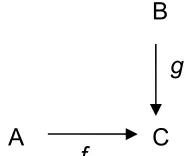
In the category model, the relations in the relational data model can be represented by pullback structures [5]. The pullback, in category theory, is the generalisation of the relational structure. Given a basic structure that connects two entities A and B in figure 2a, the pullback structure identifies the relationships between A and B as defined in the basic structure, see figure 2b, object P represents the relationships between A and B.
[image:3.595.342.492.423.558.2]
Figure 2a Basic structure: connects entities A & B Figure 2b The pullback structure: finds relationships between entities A & B contained within the basic structure
Figure 2 Pullback Structure
Figure 3 gives an example how to generate the table relations into a category model – pullback. P and Q represent different entities, M is a structure used to store all the possible relations and extra information between P and Q, N is the restricted product relationship, i.e. the table relations between entity P and Q. A tick “√”in the table means a relationship between the two objects in P and Q, which is generated into a pullback structure in the category model. For example, there is a tick between “A” and “1” in the table, thus, in the category model, there is a pullback structure connecting them together, “A1” is the product of “A” and “1”, as indicated by the dotted arrows in figure 3. If there is no tick between two objects in the table, then there is no pullback structure in the category model between them and vice versa.
P
f’
g’
g
f
A
O
B
f
g
B
A
C
Surface texture
[image:3.595.117.210.446.524.2]Figure 3 A simple Table Relationship put into an equivalent Pullback Structure
The fundamental constructs in category theory are objects and arrows between objects, which is similar to the entities and functions in the functional data model [11]. It is intended that the structure and manipulation language of category model can be developed based on DAPLEX [11], which provides the most natural query language, thereby providing a conceptually natural query language for the category data models.
3 MODELING OF SPECIFICATION
3.1 Knowledge Acquisition
The specification knowledge-base contains surface texture specifications. The main component is the symbol callout, see figure 4, including:
a. Indication of upper (U) or lower (L) specification limit. b. Filter type “X”.
c. The transmission band is indicated as short-wave or long-wave filter.
d. Profile (R, W or P), indicates the profile type: roughness profile, waviness profile and primary profile.
e. Characteristic/parameter.
f. Evaluation length as the number of sampling lengths.
g. Comparison rule (“16 %-rule” or “max-rule”). The “16 %-rule” is defined as the default rule for all indications of surface texture requirements.
h. Limit value in micrometres. i. Type of manufacturing process. j. Surface texture lay.
Figure 4 Surface texture callout symbol and brief explanation of symbols
Many of the symbols in the callout have default values. These are values to be used when the symbol does not define a particular value to use. For example, “Ra 3.3”, has the complete representation “0.008-2.5 / Ra516% 3.3”, where the missing values are given by the default values [12]. Users, who are not familiar with the definitions, have to waste much time on looking up references in order to obtain the complete data information. The callout knowledge-base will allow users to easily retrieve the necessary data information.
The detail information including in the callout structure are as follows:
A callout includes several simple callout symbols, for example, a callout , includes three simple callouts
-0,8 / Ra 3,1 U -2,5 / Rz 18 L – 2,5 / Rz 6,5
A simple callout symbol comprises the feature of the surface, the tolerance and the comparison rules, the details are given below:
Feature: the portion of the surface to which the tolerance applies.
There are two ways to describe a surface feature, a profile and over an area (the standards on areal surface texture are currently being developed). A profile consists of the direction of surface lay, the filter and the evaluation length. The filter comprises the filter type and the bandwidth: lower limit and upper limit.
Tolerance: gives the limits in value of the specified characteristic for the feature.
The tolerance includes the parameter, an indication of upper or lower specification limits and the limit value. The parameter has a parameter name and a type.
Comparison rules: gives the method to compare the measured value with the specified value.
The comparison rule contains the evaluation length and the type of comparison rule: “16%-rule” and “max-rule”.
The parameter type and the limit value determine the bandwidth of the filter. The evaluation length can be obtained from the number of sampling length and the value of upper limit (sampling length).
3.2 Functional Model by P/FDM
Figure 5 Functional Model of Callout
3.3 Category Model of Callout
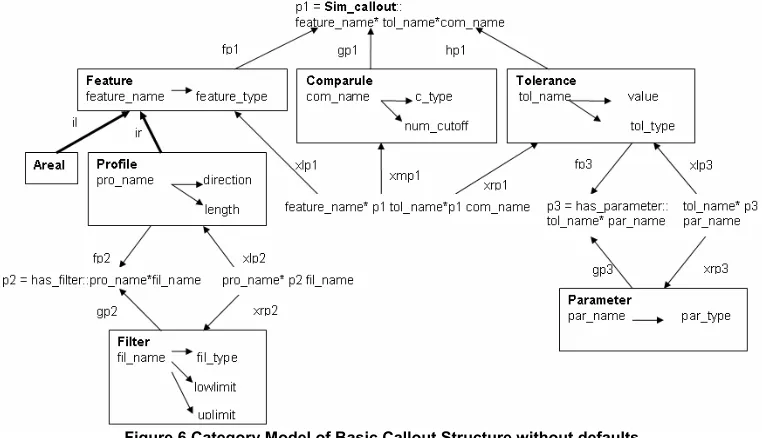
Based on the functional data model, the structure of a simple callout can be transferred to a category model, as shown in figure 6. Figure 6 is just the basic structure of a callout, without the default relations. In this model, relations among callout structures are represented by the category terms “pullback” and “product” which generalises the table structure in a relational data model.
Figure 6 Category Model of Basic Callout Structure without defaults
[image:6.595.121.502.404.623.2]Figure 7 An example of pullback – relationship p2
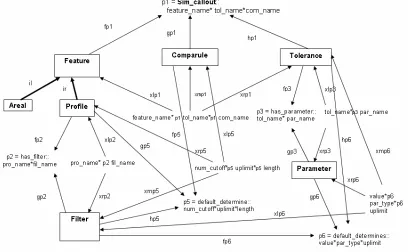
Figure 8 shows the complete category model of callout structure, with all the default values, p5 = default_determine :: num_cutoff * uplimit * length and p6 = default_determines :: value * par_type *
uplimit. This category model represents a clear, apparent object-related hierarchical model, with
objects at several levels.
Figure 8 Complete Category Model of Callout Structure
The knowledge-base is like an electronic library, which covers the useful information contained in ISO 1302 and other references about surface specification. It should be easy to use as an intelligent “handbook” for engineers. The main operations it can supply are listed below:
1. Review the definitions and contents of all the symbols in a callout.
2. Retrieve the complete callout, including the default values, after entering a callout on a drawing. 3. Help to understand the meaning of the symbols of a callout.
4. Further refer to the function, the manufacture and the verification knowledge-base.
4 CONCLUSIONS AND FUTURE WORK
[image:7.595.81.490.300.552.2]the functional model. The paper also provides an example, the surface texture callout, showing how to transfer a functional model to a category model. Surface texture knowledge is divided into four parts: function, specification (callout), manufacture and verification. This paper is focused on surface texture callout, which is contained in specification. Further work will be concentrated on modeling function, manufacture and verification knowledge-base and also developing a complete relational structure that integrates them together. More work has to be done to realize the integrated intelligent surface texture knowledge-based system.
REFERENCES
[1] ISO/TR 14638: (1995), Geometrical Product Specifications (GPS) –Masterplan, International Organisation for Standardisation, Geneva.
[2] ISO TC/213: (2001), Vision Statement, http://isotc213.ds.dk
[3] X. Jiang (Project Leader) (2003), ISO/TC213 WG16N084: Masterplan for the uniform of surface texture for profile and areal standards.
[4] Wang Yan, Paul Scott, Xiangqian Jiang (2005) The structure of surface texture knowledge, Journal of Physics: Conf. Series. (13) 1-4
[5] Rossiter, N.N; & Nelson, D.A (1994) The Categorical Product Data Model as Formalism for
Object-Relational Databases, Technical Report 505, Department of Computing Science, University of
Newcastle, 1995 (http://computing.unn.ac.uk/staff/CGNR1/index.htm).
[6] Nelson, D A, & Rossiter, B N (1996), Prototyping a Categorical Database in P/FDM. Proceedings of the Second International Workshop on Advances in Databases and Information Systems (ADBIS'95), Moscow, 27-30 June 1995, Springer-Verlag Workshops in Computing, ISBN 3-540-76014-8, 432-456. [7] Lawvere, F.William; & Schanual, Stephen H; (1997) Conceptual Mathematics, A first introduction to
categories, Cambridge University Press, ISBN 0-521-47817-0
[8] Pierce, Benjamin C. (1991) Basic Category Theory for Computer Scientists, MIT press, ISBN 0-262-66071-7
[9] Barr, Michael; & Wells, Charles; (1995) Category Theory for Computing Science 2nd ed, Prentice Hall, ISBN 0-13-323809-1
[10] J.Lambek and P.J.Scott (1986) Introduction to higher order categorical logic, Cambridge University Press, ISBN 0-521-24665-2
[11] Shipman (1981), The Functional Data Model and the Data language DAPLEX, Computer Corporation of America, ACM Transactions on Database Systems, 6(1981) 140-173
[12] ISO 1302 (2002), Geometrical Product Specifications (GPS) — Indication of surface texture in
technical product documentation, International Organisation for Standardisation, Geneva.