Application of the morphological alpha shape method to the
extraction of topographical features from engineering surfaces
Shan Lou, Xiangqian Jiang*, Paul J. Scott
EPSRC Centre for Innovative Manufacturing in Advanced Metrology, University of Huddersfield, Huddersfield, HD1 3DH, UK
*Corresponding author: Tel: +44 1484 473634; Fax: +44 1484 472161; E-mail: [email protected]
Abstract
In contrast to the mean-line based filters, morphological filters are function oriented and more
suitable for the functional prediction of component performance. This paper presents a novel morphological method based on the alpha shape for the extraction of topographical features from
engineering surfaces. Compared to the traditional implementation of morphological filters, the alpha shape method is more efficient in performance for large structuring element. The resulting envelope follows the form of the surface all over such that the distortions caused the end effects
are avoided. A series of measured surfaces from the automotive cylinder liner and the bioengineering femoral heads are analyzed using the morphological alpha shape method. The
topographical features are successfully extracted, enabling further analysis to the components.
Keywords: morphological filters; alpha shape; surface topography; topographical features
1. Introduction
In industry, surface topography is one of critical factors and important indicators in performance of high precision components. The characterization of surface topography has profound influences on manufacturing quality as it plays two important roles. On one hand, it
helps to control the manufacturing process: monitor changes in the surface texture and indicate changes in the manufacturing process such as machine tool vibration and tool wear [1]. On the
other hand, it helps to interpret functional properties of macro, micro and nano geometry, which directly impact on tribological and physical properties of the whole system [2, 3].
Surface topography are comprised of different surface components, i.e. roughness, waviness
and form, and multi-scales of topographical features, such as random peaks/pits and ridges/valleys. Topographical features are functionally critical for component performance. For example, during
the functional operation of interacting surfaces, peaks and ridges will act as sites of high contact stresses and abrasion. Consequently wear particles and debris will be generated by such kind of surface topographical features, whereas pits and valleys will affect lubrication and fluid retention
properties [4]. Thus the functional assessment of surface topography must not only appropriately separate roughness, waviness and form error, but also extract the topographical features from
surfaces.
as well as the average statistical parameters are widely used techniques to detect the
manufacturing process [5, 6, 7]. However the significant events on the surface, such as peaks and pits are usually smoothed during the filtration process. It is these topographical features that play
more important roles in functional performance. In contrast, morphological filters evolved from the early envelope filter are relevant to geometrical features of surfaces, thus more suitable for the functional prediction of components, such as optical quality, reliability, safety, service life, etc [8].
As a result, morphological filters are valid candidates for the extraction of topographical features. The traditional implementation of morphological filters has some limitations that are not
suited to the extraction of topographical features. This paper seeks to apply a novel morphological method based on the alpha shape to extract topographical feature. The paper is structured in the following fashion. Section 2 gives a brief introduction to morphological filters. Section 3 presents
the limitations of the traditional implementation of morphological filters. A novel morphological alpha shape method is illustrated in Section 4. In Section 5, the morphological alpha shape method
is employed to extract topographical features from the surfaces measured from the cylinder liner and femoral heads. Finally Section 6 gives the conclusion.
2. Morphological filters
The early envelope filter is obtained by rolling a ball/disk over the surface/profile [9], see Fig.
[image:2.595.190.407.394.510.2]1. The envelope is the locus of the centre of the rolling ball, usually compensated by the ball/disk radius.
Fig. 1. Profile and surface envelope [10].
By introducing four basic morphological operations, namely dilation, erosion, opening and
closing, morphological filters emerged as the evolution of the traditional envelope method [11]. Morphological filters are essentially the superset of the early envelope filter, offering more tools
and capabilities. They are carried out by performing morphological operations on the input surface with circular or flat structuring elements [12].
The dilation of the surface profile is the locus of the centre of the disk as it rolls over the
profile from the above. Dual to the dilation, the erosion is obtained by rolling the disk over the profile from the below. Closing is the combination of two operations, first a dilation followed by
an erosion. Opening is morphological dual to closing, given by applying a dilation followed by an erosion.
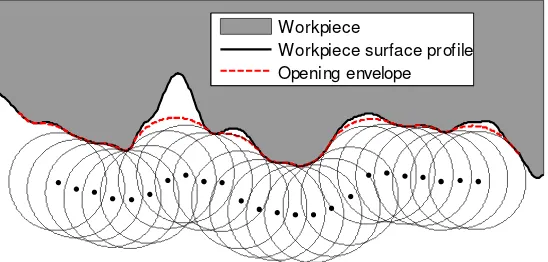
Fig. 2 and Fig. 3 illustrate two examples of applying the closing operation and the opening
operation on an open profile with the disk structuring element respectively. The closing envelope is obtained by placing an infinite number of identical disks in contact with the profile from above
filter is archived by placing an infinite number of identical disks in contact with the profile from
below along all the profile and taking the upper boundary of the disks.
Workpiece
[image:3.595.152.444.109.249.2]Workpiece surface profile Closing envelope
Fig 2. The closing envelope of an open profile by a disk.
Workpiece
Workpiece surface profile Opening envelope
Fig 3. The opening envelope of an open profile by a disk.
Alternating sequential filters are the combination of openings and closings with various structuring element sizes. The opening filter will suppress those peaks of which widths are less
than the given size of the structuring element and the closing filter will suppress those valleys whose widths are less than the size of the structuring element. If the structuring element size of the closing filter is equivalent to that of the opening filter and the structuring element in use is
symmetrical about its origin, then the alternating sequential filter is called as the alternating symmetrical filter [14].
3. Problems of the traditional morphological method
The traditional implementation of morphological filters was original developed for the early
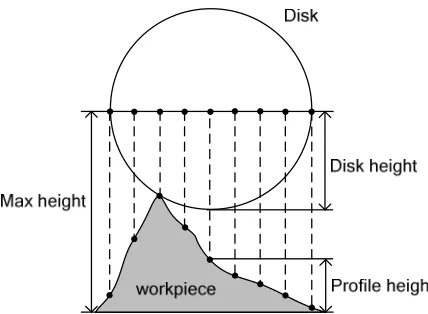
covering envelope filter, which in essence is a dilation envelope offset by the ball/disk radius. Fig. 4 presents a basic method to compute the dilation operation with the disk structuring element for
profile data [15]. The disk ordinates are computed from the disk centre to the two ends with the same sampling interval to the measured profile. These ordinates are placed to overlap the profile ordinates with the disk centre locating at the target profile point. The ordinate where the mapping
pair of the profile ordinate and the disk ordinate gives the maximum value determines the height of the disk centre. This procedure is repeated for all the profile ordinates to obtain the whole
[image:3.595.161.435.303.434.2]followed by flipped its dilation envelope. Combining the dilation and erosion in sequence will
[image:4.595.189.403.140.297.2]lead to the closing and opening envelopes. In the case of areal data, the disk is extended to the ball, on which the ball ordinates are calculated on the hemisphere.
Fig. 4. Computation of the dilation operation with the disk structuring element.
The traditional algorithm for morphological filters however has two limitations. For one thing,
it is time consuming for large structuring element because the calculation of each envelope ordinate may involve all of the surface data. The maximum size of the structuring element is limited due to the huge computation requirement, whereas for many real applications they may
desire the structuring element size much larger than the size of the surface in evaluation. For another, the traditional algorithm in its implementation has the end effects corrected. The end
effects, as a common phenomenon in the filtration of open surfaces, are unintentional changes in the filtration response in the boundary regions of an open surface [16]. With the conventional algorithm, in order to calculate the morphological envelope of boundary regions, the original
surface is assumed to drop down to the negative/positive infinity outside the surface for dilation/erosion respectively such that they could be calculated with the ball/disk ordinates to
generate the corresponding envelope [12].
The end effect correction by infinity padding, although necessary for open surface filtering, will cause distortion to the extraction of topographical features. Refer to Fig. 5 as an example. The
profile in evaluation is a simulated data in form of the parabola curve superimposed by the intentionally made pits, see Fig. 5(a). To extract the pit features, using the traditional method, the
simulated profile is applied by the morphological closing filter with disk radius 5 mm to yield a closing envelope which is graphed in the figure as the dash line. The closing envelope is then subtracted from the original profile to generate a residual profile. It is obvious in Fig. 5(b) that this
end effect corrected profile has distortions at the two end of the profile on which the pit features are not properly extracted. It will definitely influence the precise evaluation of topographic
0 2 4 6 8 10 1
2 3 4 5
X / mm
Z
/
m
m
Simulated profile Traditional algorithm Alpha shape algorithm
(a)
0 2 4 6 8 10
-2.5 -2 -1.5 -1 -0.5 0 0.5
X / mm
Z
/
m
m
Traditional algorithm Alpha shape algorithm
[image:5.595.165.421.76.408.2](b)
Fig. 5. Morphological closing envelope generated by the traditional method and the alpha shape
method: (a) raw profile and closing envelopes; (b) Residual profiles obtained by subtracting the closing envelopes from the raw profile.
4. Alpha shape method for morphological filters
Recently we [17, 18] proposed a novel method for morphological filters based on the link
between the alpha hull and morphological operations. The alpha shape was introduced by Edelsbrunner [19] aiming to describe the specific “shape” of a finite point set with a real parameter
α
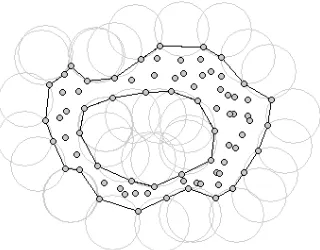
controlling the desired level of details. As Fig. 6 illustrates, the alpha hull is theboundary formed by rolling a ball (disk) with the given radius over the point set. Straightening the round faces of the alpha hull by line segments for arcs and triangles for caps yields the alpha
shape.
[image:5.595.218.378.611.736.2]There exists a theoretical link between the alpha hull and morphological operations: the alpha
hull is equivalent to the closing of the point set
X
with a generalized ball of radius−
1
α
andthat from the duality of closing and opening the alpha hull is the complement of the opening of
c
X
(complement ofX
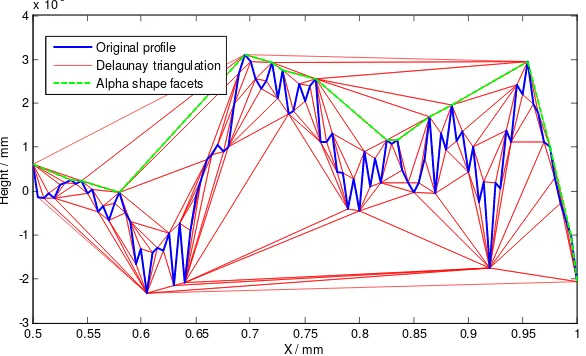
) with the same ball as the structuring element [20]. This relationship provides the theoretical basis of using the alpha shape to compute morphological filters.The alpha shape algorithm is based on the Delaunay triangulation from which the boundary facets of the alpha shape are extracted. Fig. 7 illustrates an example of the boundary alpha shape
facets extracted from the Delaunay triangulation of the profile data. The boundary of the alpha shape is equivalent to the boundary of the alpha complex, which is the collection of the simplices in the Delaunay triangulation satisfying two properties:
(1) The radius of the smallest circumsphere of the simplex is smaller than the radius and the circumsphere is empty.
(2) The simplex is a face of super simplex in the alpha complex.
0.5 0.55 0.6 0.65 0.7 0.75 0.8 0.85 0.9 0.95 1
-3 -2 -1 0 1 2 3 4x 10
-3
X / mm
[image:6.595.151.444.319.497.2]H e ig h t / m m Original profile Delaunay triangulation Alpha shape facets
Fig. 7. Alpha shape facets extracted from the Delaunay triangulation of the profile data.
For open surfaces, the envelope ordinates are achieved by interpolating points on the caps
determined by the boundary facets (upper facets for the morphological closing envelope and lower facets for the morphological opening envelope).
In comparison to the traditional algorithm for morphological filters, the alpha shape method is more efficient, especially for large structuring element. Another merit is the obtained morphological envelope follows the form of the surface all over including boundary regions, thus
there are no distortion to the extraction of topographical features. As presented in the example of Fig. 5, the closing envelope obtained by the alpha shape method which is graphed by the dot line
in the figure follows the profile with no distortions at the profile end. As a result, the pit features on the profile are perfectly extracted.
5. Extraction of morphological features from engineering surfaces
Aiming to verify the capability of the morphological alpha shape method, a series of typical
the objectives for the extraction of topographical features.
Fig. 8(a) presents an internal surface of the cylinder liner from an automotive engine. The cylinder line surface is a multi-process surface produced by two steps, first a rough honing
procedure to generate large peaks and valleys followed by a plateauing process to remove peaks and leave a layer of roughness texture imposed on the valleys [21]. These topographical features are intentionally made to serve functional operations. The valleys serve as the reservoir for
lubrication retention, whereas the roughness textures support bearing functions. It is known that the valleys are more functionally important features to cylinder liners in that their distribution and
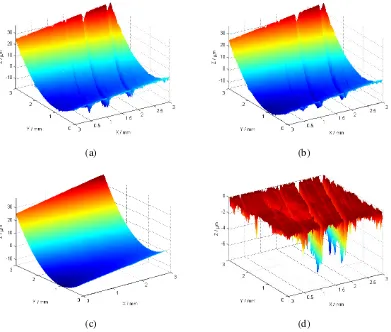
amplitude will considerably affect the flow of air or fluid in a pressure balance of an engine. Using the morphological alpha shape method, the raw measured surface presented in Fig. 8(a) is firstly applied by the morphological alternating symmetrical filter with ball radius 50 µm to smooth the
fine texture, see Fig. 8(b). Subsequently the smoothed surface is filtered by the morphological closing filter with ball radius 50 mm to generate a closing envelope, see Fig. 8(c). The residual
surface obtained by subtracting the closing envelope from the smoothed measured surface is illustrated in Fig. 8(d). It is evident on the residual surface that the deep valleys are successfully extracted.
(a) (b)
[image:7.595.100.491.349.681.2](c) (d)
Fig. 8. Cylinder liner surface analysis using the morphological alpha shape method: (a) Raw measured surface; (b) Smoothed surface; (c) Closing envelope; (d) Residual surface.
The following examples in Fig. 9(a)-11(a) are a group of bioengineering surfaces measured
system because it not only supports most of the body weight, but also to resist long term wear in
service. The wear property of the femoral head surface is crucial for the lifetime of the whole hip joint system.
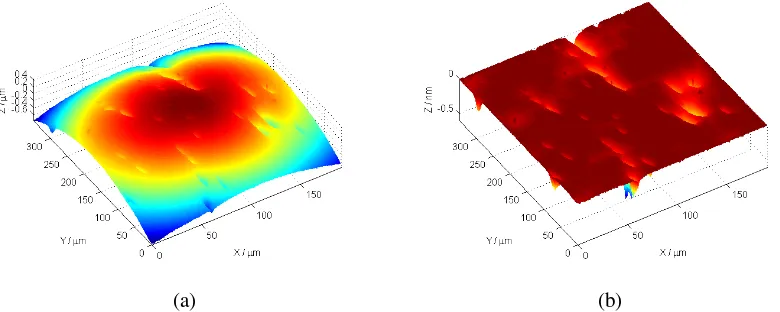
Fig. 9(a) presents a lapped surface measured from a worn metallic femoral head, which has two kinds of scratches: the random deep scratches, generated by the functional service and the regular shallow scratches, produced by the manufacturing process. Fig. 10(a) shows a surface
topography from a new ceramic femoral head, which looks smooth but consists of some deep and short scratches. To extract the topographical features from these surfaces, the morphological
closing filter with ball radius 50 mm is applied to generate the closing envelopes and thereafter two residual surfaces are obtained by subtracting the closing envelopes from the raw measured surfaces. Their topographical features could be clearly seen from the residual surfaces, as
presented in Fig. 9(b) and Fig. 10(b) respectively.
[image:8.595.99.486.284.445.2](a) (b)
Fig. 9. Worn metallic surface analysis using the morphological alpha shape method: (a) Raw measured surface; (b) Residual surface.
(a) (b)
Fig. 10. New ceramic surface analysis using the morphological alpha shape method: (a) Raw measured surface; (b) Residual surface.
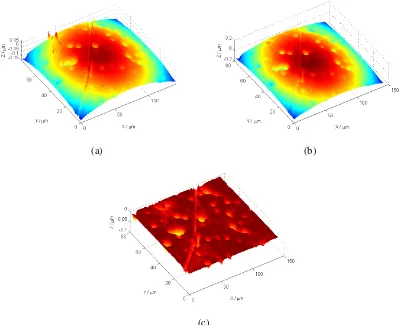
Fig. 11(a) illustrates a diamond-like-carbon femoral head surface, consisting of large pits, deep scratches as well as some burrs. The burrs are not desired in the extraction of the
[image:8.595.99.489.507.663.2]these burrs, the surface is first filtered by the morphological opening filter with radius 0.1 mm, see
Fig. 11(b). Afterwards this surface is applied by the morphological closing filter with ball radius 50 mm to generate a closing envelope. By comparing the closing envelope and the burrs removed
surface, the residual surface is obtained on which the pits and scratches are clearly presented, see Fig. 11(c).
(a) (b)
(c)
Fig. 11. Worn Diamond-like-carbon surface analysis using the morphological alpha shape method: (a) Raw measured surface; (b) Burrs removed surface; (c) Extracted topographical feature surface.
It is reported that in comparison to roughness and waviness components, the wear rates of surfaces in the operational service is more affected by topographical features like pits, valleys,
scratches [22]. From the functional evaluation point of view, these topographical features will impact directly on wear mechanics and physical properties of the component, such as the cylinder liner of the engine system and the femoral head of the hip joint replacement system. Using the
morphological method based on the alpha shape, topographical features on the surfaces presented in Fig. 8(a) – Fig. 11(a) are properly extracted with no distortions.
6. Conclusion
Topographical features on the component surface are functionally important for physical and
tribological properties of the component. The mean-line based filtering techniques, e.g. the Gaussian filter, is not suitable for the extraction of topographical features. This paper presented a
[image:9.595.94.496.179.504.2]from engineering surfaces. The alpha shape method overcomes the limitations of the traditional
morphological algorithm which is time consuming for large structuring element and causes distortions to the extraction of topographical features. A series of automobile engineering and
bioengineering surfaces were analyzed using the novel alpha shape method. The experimental results show that topographical features are successfully extracted using the alpha shape method from these engineering surfaces, enabling further physical and tribological analysis to the
components.
Acknowledgements
The author X. Jiang gratefully acknowledges the Royal Society under a Wolfson-Royal Society Research Merit Award. The authors gratefully acknowledge the European Research
Council for its “Ideal Specific programme” ERC-2008-AdG 228117-Surfund and the UK research council for its “manufacturing the future” program on the EPSRC centre in advanced metrology.
References
[1] X. Jiang, P.J. Scott, D.J. Whitehouse, L.Blunt, Paradigm shifts in surface metrology Part II. The current shift, Proc. R. Soc. A. 463(2007) 2071-2099.
[2] B. Bhushan, Tribology and mechanics of magnetic storage devices, 2nd edn, Springer-Verlag, New York, 1996.
[3] A. Unswoth, Recent developments in the tribology of artificial joints, Tribol. Int. 28(1995) 485-495.
[4] X. Jiang, W. Zeng, P.J. Scott, Wavelet Analysis for the Extraction of Morphological Features
for Orthopaedic Bearing Surfaces, In: Bioengineering, InTech - Open Access Publisher, London, 2011, .
[5] D.J. Whitehouse, Surface Metrology, Institute of physics publishing, Bristol and Philadelphia, 1994.
[6] J. Raja, B. Muralikrishnan, S. Fu, Recent advances in separation of roughness, waviness and
form, Precis. Eng. 26(2002): 222-235.
[7] X. Jiang, P.J. Scott, D.J. Whitehouse, L. Blunt, Paradigm shifts in surface metrology, Part I.
Historical philosophy. Proc Royal Society A. 463(2007): 2071-2099.
[8] M. Dietzsch, M. Gerlach, S. Groger, Back to the envelope system with morphological operations for the evaluation of surfaces. Wear 264 (2008): 411-415.
[9] H. Von Weingraber, U¨ ber die Eignung des Hu¨llprofils als Bezugslinie f¨ur die Messung der Rauheit, Ann. CIRP 5 (1956) 116-128.
[10] J. Haesing, Bestimmung der Glaettungstiefe rauher Flaechen, PTB-Mittelungen 4(1964) 339-340.
[11] V. Srinivasan, Discrete morphological filters for metrology, Proceedings 6th ISMQC
Symposium on Metrology for Quality Control in Production, 1998.
[12] International Standards Organization, ISO 16610-41 Geometrical Product Specification
(GPS) — Filtration Part 41: Morphological profile filters Disk and horizontal line-segment filters, Switzerland, 2010.
[13] Scott, P. J. 2000 Scale-space techniques. Proceedings of the X International Colloquium on
Surfaces, Chemnitz University of Technology. 153-161.
(GPS)-Filtration Part 49: Scale space techniques, Switzerland, 2010.
[15] M.S. Shunmugam, V. Radhakrishnan, Two-and three dimensional analyses of surfaces according to the E-system, Proc Instn. Mech. Eng. 188(1974) 691–699.
[16] International Standards Organization, ISO 16610-28 Geometrical Product Specification (GPS)-Filtration Part 28: Profile filters: end effect, Switzerland, 2010.
[17] S. Lou, X. Jiang, P.J. Scott, Fast algorithm to morphological filters, Phys. Conf. Ser. 311(2011)
1-5.
[18] X. Jiang, S. Lou, P.J. Scott, Morphological method for surface metrology and dimensional
metrology based on the alpha shape, Meas. Sci. Technol. 23(2012) (In press, doi:10.1088/0957-0233/23/1/015003).
[19] H. Edelsbrunner, E.P. Mucke, Three-dimensional alpha shapes, ACM. Trans. Graph.
13(1994) 43-72.
[20] M. Worring, W.M. Smelders, Shape of arbitrary finite point set in R2, J. Math. Imaging. Vis.
4(1994) 151-170.
[21] B. Muralikrishnan, J. Raja, Functional filtering and performance correlation of plateau honed surface profiles, Trans. ASME 127(2005) 193-197.
![Fig. 1. Profile and surface envelope [10].](https://thumb-us.123doks.com/thumbv2/123dok_us/344033.1035427/2.595.190.407.394.510/fig-profile-and-surface-envelope.webp)