2017 International Conference on Mathematics, Modelling and Simulation Technologies and Applications (MMSTA 2017) ISBN: 978-1-60595-530-8
Real-time Detecting System of High Knee Movement Based on Kinect
Xiao-hui ZHENG
1, Meng GAO
1, Xu MENG
2, Li GAO
1, Ming-ying LAN
1and Liang ZHENG
31School of Digital Media & Design Arts, Beijing University of Posts and Telecommunications,
Beijing 100876, China
2School of Art & Media, Century College, Beijing University of Posts and Telecommunications,
Beijing 102101, China
3Air Traffic Control Bureau, China Air Staff, Beijing 100843, China
Keywords: Kinect motion recognition, high knee movement, counting.
Abstract. High knee movement in place is a common exercise of physical education in school. However, in traditional testing of high knee motion, manual counting consumes a lot of manpower and time, and it entails the high professionalism of referees. The present paper presents a strategy to reduce the error of counting and save manpower by using somatosensory technology and Kinect equipment. In this study, the researchers designed and developed a real-time detecting system that can track the skeleton information of objects, and then perform action recognition and counting. In repeated experiments, the system accurately obtained the skeleton information of the human body, and made valid count in high knee movement. It is envisioned that this real-time detecting system of high knee movement will open new possibilities for the way of counting in sports testing.
Introduction
High knee movement is an important aerobic exercise to improve respiratory and cardiopulmonary function. It enhances the leg strength, improves the joint flexibility, and exercises the whole body. In the high knee movement examination, the high professionalism of referees required, and the accuracy of traditional way of counting is difficult to guarantee. Besides, it consumes a lot of manpower and resources. On this account, using the computer technology in physical education has become increasingly important. The computer programs used in the physical education of students will greatly enhance the efficiency and arouse the curiosity of children, which will benefit their physical and mental growth. The real-time detection system of high knee movement presented in the present paper is widely applicable. The system can be used to adjust the normative action of high knee in children’s physical education. It can be used to test whether the children can do it or not after the essentials of high knee movement are introduced to them. The system will not count unless the children meet the standard of the movement. The present paper probes into how the Kinect equipment is to be used to track the testers’ actions, detect their high-knee movement and do counting in set time.
Standard of Action Recognition Based on Kinect SDK in High Knee Movement
recorded. A total of 20 persons of different ages and genders were tested in this experiment, including 11 females and 9 males. The age composition is shown in Table 1.
Table 1. The age of the experimenters.
The age of the tested person <18 18-28 29-38 >38
Number of people 2 13 2 3
Each experimenter was required to do continuous high knee movements within 10 seconds. Ten times of the movements which are in the middle of the experiment are selected during the testing. We took the average of 10 times as the final data which is regarded as the experimental data.
Combined with the data and common sense, it was found that object's height of high knee movement is often related to his height. In our research, we used Kinect to record the vertical distance from the knee to the ground (a represents this distance), and the vertical distance between the hipbone and the tester's head (b represents this distance). And then we computed the difference between a and b. The result is c (c represents the difference between a and b). We used this distance (c) divided by tester’s height, then we got a ratio. The algorithm for the ratio is shown in Figure 1.
[image:2.612.123.480.295.428.2]
Figure 1. The algorithm for the ratio. Figure 2. Important joints of human body.
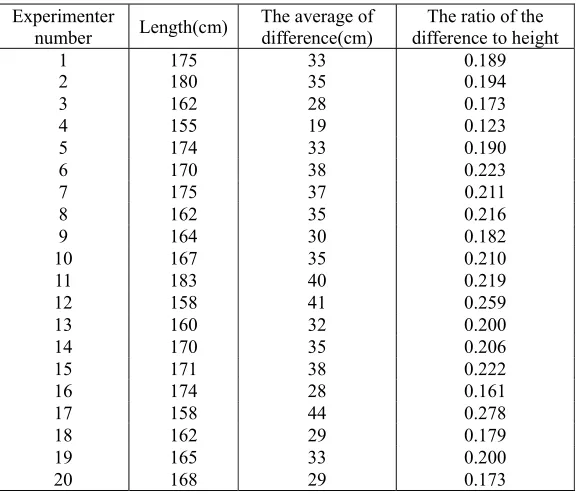
[image:2.612.163.452.497.744.2]This data is used as the criterion to determine whether high knee movement is acceptable. The data obtained is shown in Table 2.
Table 2. The test of qualified standards of high knee movement.
Experimenter
number Length(cm) The average of difference(cm) difference to height The ratio of the
1 175 33 0.189
2 180 35 0.194
3 162 28 0.173
4 155 19 0.123
5 174 33 0.190
6 170 38 0.223
7 175 37 0.211
8 162 35 0.216
9 164 30 0.182
10 167 35 0.210
11 183 40 0.219
12 158 41 0.259
13 160 32 0.200
14 170 35 0.206
15 171 38 0.222
16 174 28 0.161
17 158 44 0.278
18 162 29 0.179
19 165 33 0.200
According to Table2, among the 20 participants in the measurement of high knee movement,the ratio of the minimum number is 0.123, the maximum value is 0.278. In our research, we designed that 80% of the testers can meet the requirement. The required and the most suitable ratio is 0.200. When the ratio is 0.200 or below 0.200, the action of high knee is qualified. When the ratio is more than 0.200, the action of high knee is not qualified. In the experiments of high knee movement, choosing the ratio of 0.200 as the action criterion is in line with the actual needs. It can motivate objects’ enthusiasm to participate the high knee movement. It can also keep them interested in the movement.
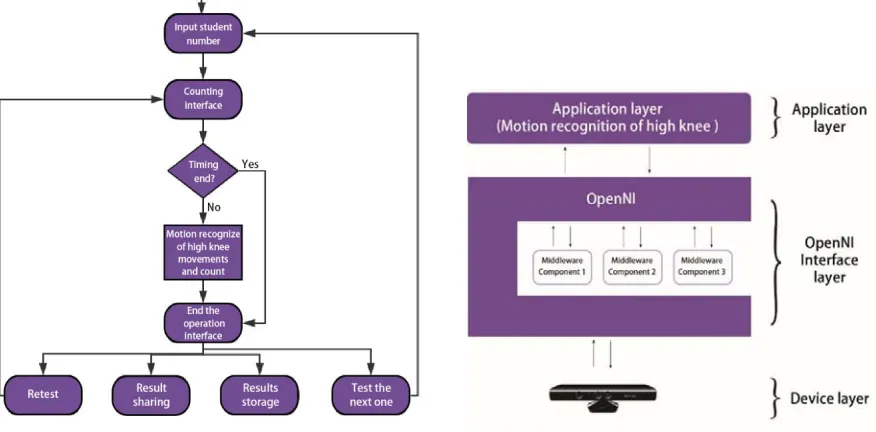
The Function Implementation of Motion Recognition & Count Based on Kinect in the System Based on the system development environment of Microsoft Visual Studio 2010, we used the Kinect SDK for Windows, and c # language to develop this system. Firstly, we selected Dispatcher Timer as the timer module in the system. Secondly, the timer module is bound to the action identification module. Finally, test results were stored and shared with others. The main workflow of the system is shown in Figure 3.
[image:3.612.89.527.271.487.2]
Figure 3. The main workflow of the system. Figure 4. OpenNI system framework.
In this study, the real-time detection system of high knee movement included two main interfaces: recognition & counting interface and operation interface of the test result. The two interfaces connect with the timing link. Objects could independently control the start and end of timing. According to eligibility criteria of the high knee, the testers' skeleton information was identified by Kinect, and the identification module calculated and analyzed the obtained data to identify high knee movement and count it.
According to the eligibility criteria based on above experimental results, the identification module obtained the human skeleton information. Relying on them, the system calculated and analyzed the obtained data in high knee movement. Then the object's high knee movements were identified and counted within the set time. The test results were displayed after the timer was finished. If the objects are satisfied with the test results, they can choose to share or store the results. If the objects are not satisfied with the result, the test can be retested. And the object does not need to re-enter the student ID. The system operators may choose to test the next one or close the system after a test is completed.
Data Acquisition and Processing Based on Kinect in High Knee Movement
human joints 3d information, which can be used by developers. The collection of these data needs to be carried out under the framework of the program OpenNI, which is a standardized development platform. OpenNI is compatible with a variety of somatosensory devices, including Kinect. In this study, we used the function of skeletal analysis in OpenNI to develop and design the experimental system of motion recognition in high knee movement based on Kinect. Figure 4 is an application framework based on OpenNI.
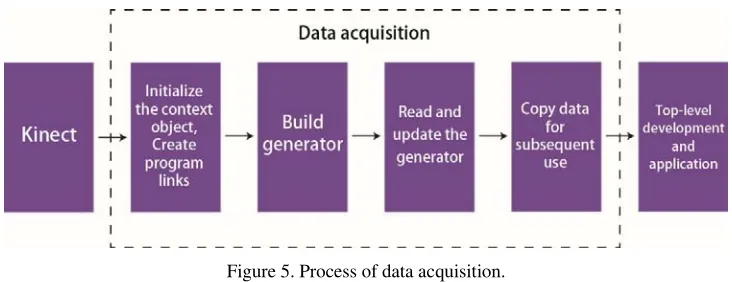
[image:4.612.123.489.244.385.2]In order to use the data interface provided by OpenNI itself, we developed the application layer of the system. The OpenNI interface layer is the main framework part of OpenNI,which can be both downward compatible devices and supported by middleware components for specific devices .Device layer is mainly connected with the system hardware devices, such as Kinect and so on. Researchers can use OpenNI to capture color images, depth information and three-dimensional information of human joints. The specific process shown in Figure 5.
Figure 5. Process of data acquisition.
Motion Recognition of High Knee Based on Kinect
The latest version of Kinect SDK provided a skeleton tracking tool, which can collect joint information in the form of points. And this information was collected in key frames. In each frame, the tool estimated and collected the location of 20 points. When the skeleton was tracked by the Kinect, the first feature that can be magnified is the position of the joint. Because each joint has three coordinate values, each of which consists of 20 joints. Therefore, the eigenvector has 60 dimensions. When dealing with pre-defined gestures, we can choose important joints to represent these gestures. As shown in Figure 2, we observe that 10 joints (A, B, C, D, E, F, G, H, S and Q) are the most important joints that representing high knee movements. By collecting the information of these joints, different angles can be calculated, which can be used as a basis for determining the action of raising the knees.
In this paper, HMM model was used to track and identify high knee movements. According to the human body skeleton information and depth information, the system can calculate object’s posture characteristics and movement characteristics. The system then incorporated the information as a whole feature of action. This is used as a criterion to determine whether high knee movements are eligible.
Timer Module of High Knee Recognition Based on Kinect
of the position data. In real-time gesture recognition, the Kinect collects 60 frames of coordinate data and is sent to the classification model to identify the skeletal posture of each frame. The Boolean variable action gate is used as the control door to prevent a repeat count in a qualified high-lift leg. Action gate was opened, and as soon as one of the high legs was qualified, Action gate was shut down and counted. Action gate will only reopen after this high leg lift.
Storage and Sharing of Test Results
Since the test results of this system are only used to store the number and test scores of the tested objects, the data should not be sorted and inquired. The system has a smaller data store, so select the most time-saving and space-saving way of storing it: write directly to the file using c # file stream. After storing the test results, the experiment also designed and established the sharing interface. On this interface, the tester can see the number and test scores entered before. This system can save the interface of the display score as the image format for sharing test results with others.
Conclusion
Our research presents a novel way to perform real-time detection and counting of high knee movement. The real-time detection system can not only recognize the correct action, but also do counting it. Moreover, the system can greatly stimulate object's enthusiasm for the movement through sharing the test results. Therefore, the newly designed system is application a wonderful choice in the field of physical education.
References
[1] J.L. Raheja, A. Chaudhary, K. Singal. Tracking of fingertips and centers of palm using Kinect [C]. Proc of 2011 IEEE Third International Conference on Computational Intelligence, Modelling, and Simulation, 2011: 248-252.
[2] T.T. Thanh, F. Chen, K. Kotani, et al. Extraction of Discriminative Patterns from Skeleton Sequences for Human Action Recognition [C]. Proc of IEEE International Conference on Computing and Communication Technologies, Research, Innovation, and Vision for the Future, 2012: 1-6.
[3] Diego-Mas J.A., Alcaide-Marzal J. Using Kinect sensor in observational methods for assessing postures at work [J]. Applied Ergonomics, 2014, 45(4): 976-985.