University of Huddersfield Repository
Nikki, CarthyDeconstructing Offenders' Narratives Original Citation
Nikki, Carthy (2013) Deconstructing Offenders' Narratives. Doctoral thesis, University of Huddersfield.
This version is available at http://eprints.hud.ac.uk/id/eprint/20354/
The University Repository is a digital collection of the research output of the University, available on Open Access. Copyright and Moral Rights for the items on this site are retained by the individual author and/or other copyright owners. Users may access full items free of charge; copies of full text items generally can be reproduced, displayed or performed and given to third parties in any format or medium for personal research or study, educational or notforprofit purposes without prior permission or charge, provided:
• The authors, title and full bibliographic details is credited in any copy; • A hyperlink and/or URL is included for the original metadata page; and
• The content is not changed in any way.
For more information, including our policy and submission procedure, please contact the Repository Team at: [email protected].
DECONSTRUCTING OFFENDERS’ NARRATIVES
by
NIKKI L. CARTHY
A thesis submitted to the University of Huddersfield
in partial fulfilment of the requirements for
the degree of Doctor of Philosophy
UNIVERSITY OF HUDDERSFIELD
Copyright statement
i. The author of this thesis (including any appendices and/or schedules to this thesis) owns any copyright in it (the “copyright”) and s/he has given The University of Huddersfield the right to use such Copyright for any administrative, promotional, educational and/or teaching purposes.
ii. Copies of this thesis, either in full or in extracts, may be made only in accordance with the regulations of the University Library. Details of these regulations may be obtained from the Librarian. This page must form part of any such copies.
“...[Atticus Finch] you never really understand a person until you consider things
from his point of view...until you climb into his skin and walk around in it...”
i Abstract
The view of making sense of a person’s reality through the stories they tell about their lives, developed by Bruner (1991) and McAdams (1993) is the theoretical perspective used to reveal what offenders’ life-stories uncover about their offending action. Interviews with 63 incarcerated offenders and 90 non-incarcerated males’ explored three life-episodes: a Significant Event (SE), crime or deviant act, and life as a film. Narrative Roles Questionnaire (NRQ) and demographic information was also collected. The LAAF framework for eliciting and interpreting life-story narratives was implemented. The LAAF is developed from psychological literature from different aspects of narrative focusing on three primary areas: McAdams (e.g. 1993) life-stories, Bamberg’s (2009) identity in narrative, and Sykes and Matza’s (1957) neutralisation theory.
The first section of analysis focuses on SE and film narratives. Firstly, incarcerated and non-incarcerated descriptions of SE and film, for each of the LAAF content variables, were compared employing Chi Square analysis. Findings show the incarcerated group having more negative items identified in their life-episodes. This difference was consistent in SE and film narratives. Secondly, SSA-I explored the thematic structure of the LAAF variables for the incarcerated and non-incarcerated individuals. A thematic region within the incarcerated SSA-I plot termed ‘contamination script’ was found in all of the incarcerated offenders narratives, for SE and film, but in only a small proportion of the non-incarcerated narratives. Thirdly, archetypal themes were identified in the SSA-I configuration showing distinct regions of themes relating to Youngs and Canter’s (2011; 2012) classifications of hero, victim, revenger and professional for the SE and film narrative. Findings demonstrated psychological consistency with dominant narrative roles across the two life-episodes.
The second section focuses on crime and deviant life-episodes. Youngs and Canter (2012) identified narrative themes in offenders’ NRQ responses. First, SSA-I configuration confirmed narrative themes in the incarcerated and non-incarcerated responses to NRQ items. Principal Component Analysis revealed psychological components of emotion, identity, and cognitive interpretations in NRQ items. Secondly, crimes and deviant acts were differentiated using: property, person, and sensory categories; a psychological classification system, based on Bandura’s (1986, 1999) theory of incentives. Multivariate analyses of the NRQ responses provided loose support for different narrative themes underpinning different crime types. Qualitative thematic analysis revealed a number of psychological themes of emotion, preparedness, and blame present in both incarcerated and non-incarcerated narratives; differences were exhibited by Feshbach’s (1964) instrumental and expressive dichotomy.
ii Dedication
I dedicate this thesis to my late father, Nicholas Carthy. Dad, if you had not taken the
time from work to take me to the PhD interview and prepare me for what was ahead; the
journey may have never begun! You have been an inspiration in my life in many ways –
iii
Acknowledgements
First of all, I would like to extend my deepest gratitude to all of the narrators that
took the time to take part in the research; without such detailed and interesting life-stories
the study would not be possible. Thank you to the research team for collecting the data and
HMP Liverpool for providing the means to do so.
I would like to thank my supervisors Professor David Canter and Dr Donna Youngs for
giving me the opportunity to work with such an exciting and intriguing dataset. I would also
like to thank them for all of their support, mentorship and continued guidance. David, I am
eternally grateful for your thorough and constructive feedback on my writing; it has
certainly helped me improve and provided me with a strong foundation for continued
development. Donna, I would like to thank you for your patience and helping me to develop
both academically and professionally. It has been a pleasure to work with you both and I
look forward to many future collaborations.
Thank you to the University of Huddersfield for funding my studies and for the
technical and administrative support.
A big thank you Sophia Tkazky, Valerie Savoie, Kathy Hughes, Olivia Simpson, Emek
Yuce Zeyrek and Agnes Wozna for all the great work and help with inter-rating – I know it
was not easy but I am eternally grateful. It has been a pleasure to work with the team at
IRCIP; the peer support has provided an enjoyable experience even during difficult times. I
have made some life-long colleagues and some life-long friends. In particular, I would like to
thank (in no particular order) Dr Maria Ioannou, Dr Laura Hammond, John Synnott, Jemma
Hollinshead, Val Savoie and Kathy Hughes for all the proof reading and comments you have
provided over the years, which has helped develop the thesis into what it is today.
Thank you to my colleagues at Teesside University for all of their success (and
horror) stories which helped me prepare for the PhD rollercoaster ride. To, Natalie Wilson, a
colleague and dear friend, for the time she spent reading drafts and the many weekly stats
iv
I would like to extend a personal thanks to my family, especially my mother, Beverly
Carthy, for supporting me through the years emotionally (and financially!) to reach my goals
and teaching me to never give up; and to my brothers Brogan, Tysen and Kalem and to
Karen for your love and support. To my friends who have barely seen me. My oldest and
dearest friend Natalie Crow for supplying plenty of coffee breaks and conversations about
the life that exists beyond being a PhD student; to my treasured friend, Stacey Tonkin, for all
the friendship and kindness she has given over the years; to my dear friend Dr Matthew
Haigh for the guidance he has provided; and to my old and dear friend Phil Wood for always
reminding me: “the force is with you”.
Finally, I would like to give a special thanks to my partner, Michael Sreenan, whose
support, patience, compassion and friendship (and culinary skills!) was the backbone of the
v Contents
Abstract...i
Acknowledgments...ii
Table of Contents...v
List of Tables...xi
List of Figures...xii
List of abbreviations...xiii
Chapter 1. A Crime, A Criminal, A Narrative, Does this Exhibit An Agenda...1
1.1. Using Criminals As A First-hand Data Source...2
1.2. Storylines of Criminal Action...4
1.3. Researching the Offenders’ Perspective...7
1.4. Linguistic Examination of Crime Narratives...8
1.5. Limitations in the research...9
Chapter 2. A Psychological Framework for Criminal Narrative Deconstruction...11
2.1. Defining Narratives...11
2.2. Autobiographical Narratives ...12
2.3. Agentic Benefits of Narrative ...15
2.4. The Role of Narrative in Understanding Criminality: A summary of ideas...17
2.4.1. Exploring deviancy...18
2.4.1.1. Definitional issues and limitations for offender – non-offender comparisons...19
2.4.2. The role of time and place accounting for change in narrative...21
2.4.3. Narrative identity...22
2.4.3.1. Dominant narratives ...24
2.4.3.2. Portrayal of a character role ...25
2.4.3.3. Creating meaning...27
2.4.3.4. Idealised persons: Imagoes of the self and others ...29
vi
2.4.5. Polarising aspects of interpersonal behaviour...31
2.4.6. Life-story themes: a redemption script and a contamination script ...33
2.4.6.1. A move towards the light: the redemption script...33
2.4.6.2. Descending from the light: A contamination script...35
2.4.7. Justifying behaviour: Cognitive interpretations expressed in narrative...36
2.4.8. Emotions ...38
2.5. A Psychological Framework for Narrative...39
2.5.1. Development of a Narrative Action System (NAS)...40
Chapter 3. Rationale for Research...42
3.1. Themes of the Analysis ...44
3.2. Research Aims and Questions...44
Chapter 4. Thesis methodology ...47
4.1.Thesis statement ...47
4.1.1.Epistemological and theoretical position ...47
4.2.Data ...49
4.2.1. CY-NEOv1 narrative protocol ...49
4.2.1.1.Life-episodes ...51
4.2.1.2. NRQ ...51
4.2.1.3. Demographic questions ...52
4.2.1.4. LTQ, Emotions and D45 ...53
4.2.1.5. CY-NEOv1 in action ...53
4.1.2. LAAF framework ...54
4.3. Sample ...55
4.3.1. Incarcerated offenders’ ...55
4.2.2. Non-incarcerated respondents ...57
vii
4.4.1. Ethics ...60
Section introduction (1): Life outside of crime ...62
Chapter 5. Life narrative comparisons of incarcerated and non-incarcerated males ...63
5.1. Introduction ...63
5.2. Method ...64
5.2.1. Data analysis strategy...65
5.3. Results ...66
5.3.1. Film narrative ...75
5.3.1.1. Story content ...75
5.3.1.2. Psychological content ...80
5.3.1.3. Psychological complexity ...83
5.3.1.4. Psychological components ...84
5.3.2. Significant event ...89
5.3.2.1. Story genre ...97
5.3.2.2. Psychological content ...99
5.3.2.3. Psychological complexity ...104
5.3.2.4. Psychological components ...104
5.4. Chapter summary and conclusion: uncovering the criminal narrative ...110
Chapter 6. Offenders’ contaminated script ...114
6.1. Introduction ...114
6.2. Method ...115
6.2.1. Data analysis strategy...117
6.3. Results ...117
6.3.1. Thematic structure and frequency analysis of LAAF variables …...118
6.3.1.1. Frequency analysis ………...118
6.3.1.2. Thematic structure ………...…...129
viii
6.3.2. Case studies: level of contamination within the life narratives
...138
6.3.3. Background characteristics and level of contamination ………...141
6.4. Chapter summary and conclusion: the contaminated script ……...142
Chapter 7. Archetypal themes in life-episodes ………...145
7.1. Introduction ………...145
7.2. Method ………...147
7.2.1. Data analysis strategy...147
7.3. Results ………...147
7.3.1. Archetypal structure of LAAF items ...147
7.3.2.1. Archetypal themes and dominant narrative roles in the LAAF items ...152
7.3.3. Correlating dominant narrative roles with narrative contexts ...163
7.4. Chapter summary and conclusion: Archetypal themes and life trajectories ...163
Section introduction: Life inside of crime ...166
Chapter 8. Uncovering narrative roles of criminal and deviant action using the Narrative Roles Questionnaire (NRQ): Comparisons with published research ...167
8.1. Introduction ...167
8.1.1. Summary of Youngs and Canter (2012) findings...167
8.1.2. Broader themes of criminal and socially unacceptable behaviour....168
8.2. Method...169
8.2.1. Data analysis strategy...169
8.3. Results...172
8.3.1. Comparing NRQ findings to Youngs and Canter (2012)...172
8.3.1.1. SSA configuration and dominant narrative structure...172
8.3.1.2. Psychological component interpretations of SSA...177
ix
8.3.2. Substructures and regionality of broader themes of criminal and
socially unacceptable behaviour...180
8.3.2.1. Principal Component Analysis...182
8.3.2.2. PCA and SSA-I...184
8.3.2.3. Component differences in participant groups ...185
8.4. Chapter summary and conclusion ...186
Chapter 9. Differentiating narratives of criminal and deviant acts: What narratives underpin criminality? ...189
9.1. Introduction ...189
9.2. Method ...191
9.2.1. Data ...191
9.2.2. Data analysis strategy...191
9.3. Results section ...192
9.3.1. NRQ themes and action classifications ...192
9.3.2. Deconstructing narratives of crime types in comparison to deviant acts ...198
9.3.2.1. Property acts ...199
9.3.2.2. Person acts ...209
9.3.2.3. Sensory acts ...215
9.4. Chapter summary and conclusions ...222
Chapter 10. Thesis discussion and conclusions ...226
10.1. The contaminated script ...226
10.1.1. Contaminated script: victim of circumstance ...227
10.1.2. Contaminated script: quest for honour ...228
10.2. The life of crime ...230
10.2.1. Negative life projection ...231
10.3. The instrumental aims of crime ...231
10.4. Archetypal themes ...232
x
10.5.1. An aetiological approach to criminality ...234
10.6. Methodological contributions ...236
10.6.1. Narrative paradigm as a method for exploring criminal action ...236
10.6.2. Life As A Film (LAAF) ...237
10.6.3. Narrative Roles Questionnaire (NRQ) ...238
10.7. Practical contributions ...238
10.7.1. Treatment and rehabilitation ...238
10.7.2. Offender reintegration and crime reduction ...239
10.7.3. Conversation management tools ...240
10.7.4. Police investigation and Criminal Justice System ...241
10.8. Future directions ...241
References...244
xi List of Tables
Table 5.1. LAAF variables for life as a film narrative interview...67
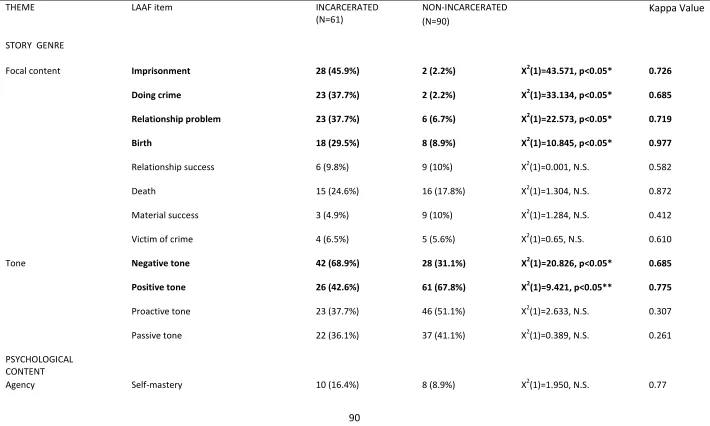
Table 5.2. LAAF variables for significant event narrative interview...90
Table 6.1. Frequency of LAAF items for the film and significant event narrative interviews for both incarcerated and non-incarcerated individuals...120
Table 7.1. Chronbach’s alpha for thematic regions of LAAF variables...151
Table 8.1. Internal consistency of NRQ items for each narrative role from the incarcerated offenders...174
Table 8.2. Internal consistency of NRQ items for each narrative role from the non-incarcerated sample...176
Table 8.3. Internal consistency of NRQ items for each narrative role from the combined incarcerated offenders and non-incarcerated individuals...182
Table 8.4. NRQ item loadings from PCA analysis using varimax rotation...183
Table 8.5. PCA component themes and central tendency comparisons of participant groups ...186
Table 9.1. Summary of PPS classifications in criminal and deviant actions discussed by participants...193
Table 9.2. Crime classifications and NRQ items...194
Table 9.3. Deviant acts and NRQ items...196
xii
List of Figures
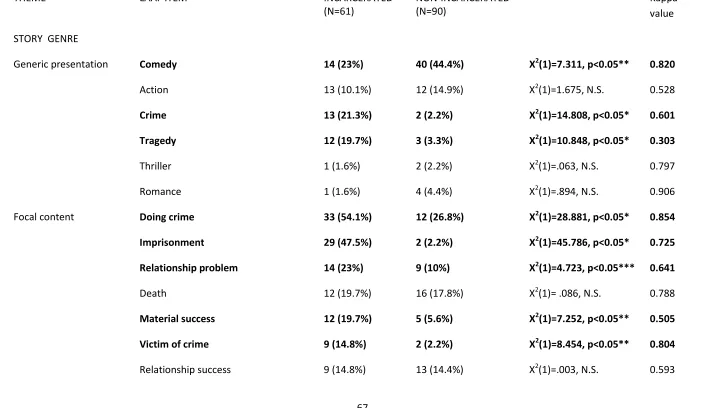
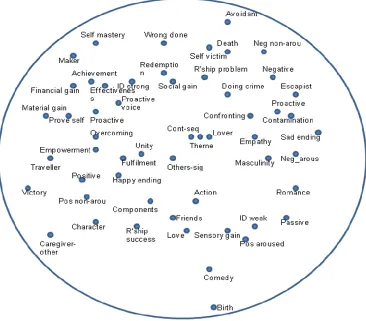
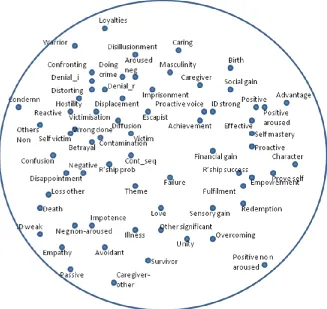
Figure 6.1. Thematic structure of LAAF variables for film narrative for incarcerated
offenders...130
Figure 6.2. Thematic structure of LAAF variables for film narrative for non-incarcerated ...131
Figure 6.3. Thematic structure of LAAF variables for significant event narrative for
incarcerated offenders...132
Figure 6.4. Thematic structure of LAAF variables for the significant narrative for
non-incarcerated ...133
Figure 6.5. Thematic structure of LAAF items for Film narrative for incarcerated offenders with non-incarcerated LAAF items mapped on...136
Figure 6.6. Thematic structure of LAAF items for significant event for incarcerated offenders with non-incarcerated LAAF items mapped on...137
Figure 7.1. Thematic regions of LAAF variables for film narrative for incarcerated
offenders...149
Figure 7.2. Thematic regions of LAAF variables for significant event narrative for
incarcerated offenders...150
Figure 7.3. Summary of narrative themes in the configuration of the LAAF items from figure 7.1 and 7.2...152
Figure 8.1. SSA configuration of NRQ responses for the crime behaviours disclosed by the incarcerated sample...174
Figure 8.2. SSA configuration of NRQ responses for the socially unacceptable behaviours disclosed in the non-incarcerated sample...176
Figure 8.3. Psychological component SSA-I divisions for socially unacceptable
behaviours...178
Figure 8.4. SSA of NRQ items for incarcerated and non-incarcerated individuals...181
xiii
List of abbreviations
CJS...Criminal Justice System
COA...Coefficient Of Alienation
ICON...International Comparison of Offenders Narratives project
IP...Investigative Psychology
IRCIP...International Research Centre for Investigative Psychology
LAAF...Life As A Film, framework for eliciting and analysing offenders narratives
LIC...Life Inside of Crime
LOOC...Life Outside Of Crime
MDS...Multidimensional Scaling
NAS...Canter and Youngs (2009) Narrative Action System
NRQ...Narrative Roles Questionnaire
PCA...Principal Component Analysis
PPS...Person, Property and Sensory classifications used to differentiate crime types
SE...Significant Event, a section of the narrative interview
SLT...Social Learning Theory
SSA-I...Smallest Space Analysis, a multidimensional scaling method
SUBs...Socially Unacceptable Behaviours
1
Chapter 1
A Crime, A Criminal, A Narrative, Does this Exhibit An Agenda of Study?
Asking the criminal, as the expert of their life, behaviours, and choices, to describe
their offending action provides an avenue to explore antecedent factors and a diverse range
of direct psychological processes that are involved in the commissioning and execution of
the action. Through narratives, crime action can be uncovered the way it makes sense to
those who commit the crimes and how the action exists within their reality. The idea of
getting closer to the crime, from the perspective of the offender, is a concept that has been
commonly noted within criminological and psychological literature (e.g. Canter, 1994;
Maruna, 1999; Matza, 1970; Nee, 2004; Presser, 2009; Toch, 1987). The development of a
narrative paradigm for researching criminal action has started to emerge more frequently
within academic literature over recent decades. Uncovering a criminal’s narrative as a
research tool sheds light on, what Polkinghorne (1988) describes as, lived experience;
providing a psychologically rich source of data.
Practitioners within the Criminal Justice System (CJS) spend a large proportion of
their time working with criminals’ narrative experience of the crimes they have committed;
still, researchers tend to overlook the usefulness of narrative experience as raw data in
favour of analysing datasets and statistical models (Nee, 2004, pg.3). Much knowledge
about crime and criminals has emphasis on background and environmental features and has
supported a lot of developments in theoretical explanations of criminality. Agnew (2006)
raises an important point that when criminals’ discuss their crimes they narrate storied
accounts of their actions rather than describing background and environmental features.
However, the potential use of storied narratives as explanatory methods to the aetiology of
crime is lacking as a substantial contribution to the existing literature (Presser, 2009).
The use of criminals’ narratives as research data opens up a debate to how such
information can be used in a systematic way which extends existing knowledge of
criminality. Presser (2010) highlights the lack of a knowledge base for methodological
approaches to elicit, interpret and analyse criminals’ narratives. To establish the
2
method of collecting the data and the type of data to be collected. Each theme is explored
in the following sections.
1.1. Using Criminals As A First-hand Data Source
Within Investigative Psychology (IP), collecting data from the offenders’ crime scene
actions offers a way of viewing crimes from the perspective of the offenders. This approach
has been successful in the study of a number of crimes, such as rape (Canter & Heritage,
1990), stalking (Canter & Ioannou, 2004), homicide (Salfati, 2000), burglary (Merry &
Harsent, 2000) and terrorism (Wilson, 2000), case linkage of sex offenders (Woodhams &
Labuschange, 2012), case linkage of homicide (Labuschange, 2006), case linkage of burglary
(Markson, Woodhams, & Bond, 2010), and criminals spatial movements (Lundringan,
Czarnomski & Wilson, 2010). However, such methods are limited to police data files, crime
scene information, and witness statements; each holds a number of biases due to the data
not being collected for academic research purposes and requires a strong element of
interpretation by the researcher. One way to overcome this is to develop direct data
sources from interviewing offenders.
Nee (2004) reviews the usefulness of interviewing offenders about their crimes; this
approach is particularly valuable in gaining the offenders perspective of the crimes they
commit. Taylor and Nee (1988), for example, examined simulations of offenders’ reactions
to viewing properties as targets for burglaries. Thought patterns were narrated aloud by the
offenders uncovering information to what the offenders considered as ‘attractive’ features
of the properties as potential targets for crimes. Canter (2003) implemented a similar
narrative simulation method by asking offenders to draw maps of their ‘crime space’ and
provide a narrative of the map discussing how it relates to geographical distribution of the
crimes they have committed. The simulation method allows researchers the opportunity to
explore the psycho-geography of the offenders’ spatial awareness, mental boundaries, and
opportunities for crime (Canter & Youngs, 2009). Simulation methods demonstrate the
value of information that can be obtained by examining offenders’ narratives of their crime
commissioning. Such approaches provide a way of reviewing target selection of the crimes
using a method of inspecting cognitive scripts that are evolved around the offender’s
3
eliciting narrative data that is rich in the lived experience of the offenders exploring the why
elements of the crimes. However, such methods tend to focus on one aspect of the crime
such as geographical features or target selection rather than encompassing the full range of
psychological components that occur during the crime commissioning. Nonetheless, the
simulation methods demonstrate the usefulness of criminals narrated accounts of their
crime action.
Criminality is a complex set of processes and quite often extends beyond the crime
actions. By only focusing on the crimes scene actions or methods of target selection, other
important details from the offenders broader concept of criminality i.e. motivations for
action, environmental influences, interactions, emotions, identity, and goals, are
overlooked. The use of criminals’ narratives, as a research tool, has a lot to offer in relation
to the amount of information that can be obtained about their criminal action. Canter
(1994) posits narratives provide a tool for uncovering the processes driving the action; an
idea that has been more recently echoed by Presser (2009). One approach, as Cornish
(1994) argues, is the adaption of cognitive script theory to criminal action. Here, Cornish
states that criminal action is considered as a schematic process which the offender follows
for each crime; creating a script. Through analysis of the script the offenders decision
making process for the commissioning of crimes can be obtained.
Cognitive script theories, suggest that each type of behaviour has a script that is
followed. Script theory has been regularly implemented in to researching criminal action
(e.g. Beauregard, Proulx, Rossmo, Leclerc & Allaire, 2007; Gavin & Hockey, 2010; Rumgay,
2004; Yun & Roth, 2008); however, the theory is limited by focusing on the commissioning
of the crime and the situation in which it occurred. Although script theory has been useful in
crime prevention strategies; it is limited by its assumption that the commission of a crime is
a stable feature; overlooking other processes that may influence criminal action which are a
product of the broader life-story. Agnew (2006) argues that a crime accounts for only one
moment in time, whereas the situation which the crime occurred may be part of a broader
storyline where the build-up to the crime and consequences of the action have a much
longer influence on the criminal. One interpretation of a cognitive script is the role of a
4 1.2. Storylines of Criminal Action
Agnew (2006) defines a storyline as “...an interrelated set of events and conditions
that increase the likelihood that individuals will engage in a crime or series of related
crimes...”(pg. 121). Agnew states that within storylines the conditions in which the crime
occurred, the offender’s perception, reaction, emotional states, and interactions with others
are available; which extends beyond traditional methods of script theory. Canter (2010)
extends this idea stating that the story of the crime is not a fictional account but rather it is
the offenders’ account which has been developed from interactions and events. Both
Agnew and Canter point toward an underlying plot for which the sequence of events are
uncovered and the protagonist (the offender) takes the central role in acting out the
sequence. Presser (2009) argues that that plot of the storyline leads to explanations of why
the action occurs. The plot or storyline encompasses a number of factors that lead to the
explanation of the action such as the conditions of how the crime occurred and the
offender’s interactions with other, rather than solely focusing on one element.
Agnew (2006) proposes five storylines for criminal action: ‘a desperate need for
money’, ‘an unresolved dispute’, ‘a brief, but close involvement with criminal others’, ‘a
brief, tempting opportunity for crime’, and ‘a temporary break with conventional
others/institutions’. Each storyline provides motivations and situational information about
the crimes. One point to note is the storylines are not mutually exclusive. Agnew argues, like
background features, storylines can contribute to other storylines and each storyline is not
relevant to one type of crime. An advantage of exploring crime in this way is that
background features of criminals can be explored in relation to how they vary for each of
the storylines (Agnew, 2006). This approach provides a method for offending to be viewed
from the intentions of the offender but also drawing on the broader components and
situational factors in which the crime occurs. How the offenders’ identify themselves within
the crime and the circumstances in which it occurred is an important aspect of the use of
storylines within criminal research.
In a similar vein, Katz (1988) describes different seductions of criminal acts as a
series of storylines which he uses to explore criminal action such as, ‘righteous slaughter’,
self-5
understanding is an important aspect of how an offence appears to the individual. For
example, the ways in which an individual perceives themselves and their perceptions of
others; are used to interpret how the crime is portrayed. One of the main points that Katz
makes is the view that criminal action is best understood by exploring how it is experienced
by the criminals who commit the crimes. The role of background features such as age,
gender, economic status provides broad spectrums of people who commit crimes; such
features are often referenced by psychologists and criminologists in explanations of criminal
behaviour. However, Katz argues that such features are too vague to provide clear
explanations of criminal action. For example, background features associated with offenders
are also background features of many people who do not commit crimes. He further adds
that for clear explanations to be made crime should be understood from the foreground of
the people who commit the offences.
Both Agnew (2006) and Katz (1988) express the potential explanatory power of
storylines as a method of classifying different styles of criminal action. However, neither
study draws directly on offenders’ accounts of their crimes as data to developing such
storylines. For example, Agnew draws on thematic analysis of theoretical criminology to
provide background examples to the storylines he proposes. Katz, on the other hand, draws
primarily on descriptions provided by a set of university students and pre-published reports.
Although, both studies recognize the importance of the storied-action in exploring the
offenders’ experience, neither author draws their conclusions from systematically analysing
the narrative of the offenders’ experiences of the crimes they commit.
In a more direct approach Alison, Rockett, Deprez and Watts (2000), uncovered
narrative themes through thematic analysis of the crime scene actions exhibited in a set of
armed robberies. Three dominant roles offenders portrayed during their crime action were
based on the level of planning and impulsive behaviours displayed during the robberies they
found three dominant roles that the offenders portrayed during their crime action; namely:
‘Robin’s men’, ‘Bandits’ and ‘Cowboys’. Like the storylines suggested by Agnew and Katz,
each of the dominant roles discussed by Alison, et al. show variations in the psychological
features of the offenders such as motive, commissioning of the offence, emotions and
6
regularly used within investigative psychology; this method allows themes of behaviours to
be established.
One important study by Canter and Heritage (1990) demonstrated how different
modes of interactions between the offenders and victims were presented from thematic
review of crime scene actions in stranger rape cases. The study demonstrates how offenders
assign roles to their victims based on themes of vehicle, object and person; each projecting
a different level of violation Each theme presents an altered set of actions and interactions
which the offender uses with the victim during the crimes; suggesting the offender is
following some form of plot depending on the character role assigned to the victim. In a
more recent study of youth violence, McMurran, Hoyte and Jinks (2012) reviewed a set of
narrated accounts of alcohol related violence from the youths involved. They found the
violence was able to be classified into various themes based on the youths accounts of their
interaction with others; presenting different modalities in the levels of violence and
motivation for the action.
A further approach to exploring storylines was offered by Luckenbill (1977). He
reviewed a number of murder cases exploring the transactions between the victims and the
offenders obtained through case files, offender statements and court transcripts. He
proposed, in the case of murder, the offender conformed to a ‘character contest’ where the
offenders and victims acted out a plot of interactions. Luckenbill’s study indicates that
murder offences follow similar storylines. He concluded that acts of murder are not
one-sided to the offenders but they are a set of transactions between the victim and offender;
the offenders and the victims both play a character role, acting out the script that assumes
the storyline.
The research on storylines has shown success in developing knowledge of criminal
action by focusing on the people that commit the crimes; getting to the forefront of the
action like Katz (1988) suggests. Storylines readily demonstrate a method of how the
offenders might experience the crime from the actions that precede the crime to the
consequences following the crime and at each stage indicating the offenders experience
throughout. The role of the storyline is to portray the action of the inner narrative the
7
the source of the different storied formations discussed. The inner narrative provides a tool
for the offender to assign himself as the main character in his life story; others can then be
assigned subsequent character roles within the narrative plot. The inner narrative provides a
tool in which self-identity is developed through interactions with others and the
environment. The storyline provides a way of reviewing the internal narrative; the internal
narrative is a tool to which complex psychological issues such as identity can be explored.
However, the research presented here is lacking in data obtained regarding the criminals’
actual narrative experience of the crime.
1.3. Researching the Offenders’ Perspective
Messerschmidt (2000) highlights the importance of understanding the crime as it
makes sense to the criminal. He used a method of interviewing adolescent males about
their life-history in an attempt to uncover information about their violent action. By looking
at the stories the adolescents told about different episodes of their life he was able to
explore the factors that lead some adolescent males to violence. Through this mode of
analysis Messerschmidt demonstrates the importance of uncovering life-story accounts, as a
source of information gathering, that allows for the personal experiences and
transformations that the narrators encounter during their life-process. Such information is
important to reveal how the crimes make sense to the individuals and uncovers important
information relating to pathways into criminality.
In a later study, Canter, Kaouri and Ioannou (2003) examined dominant story plots
presented by criminals’. In this research offenders were asked to complete an experience of
offending questionnaire for a crime they had committed. The responses were classified into
four themes: adventure, revenger, victim, and professional. Each theme is underpinned by
Frye’s (1957) fictional mythoi and demonstrates a different set of psychological processes
exhibited by the offenders. This research explains that storylines are also present within
criminals’ own accounts of their offending action rather than storylines being a product of
themed analysis of criminological literature as presented by the researcher.
More recently, a series of research by Youngs and Canter (2011; 2012) interviewed
8
(2011) presented a case-study review of offenders’ narrated accounts which revealed
different forms of dominant narrative roles. Each role presents a set of psychological
precursors to the criminal actions disclosed by the offenders. In the second study, Youngs
and Canter (2012) further explored the narrative roles by reviewing a quantitative
self-report measure which the criminals completed in relation to their offending action. The
results demonstrate that the dominant narrative roles can be differentiated by variations in
psychological underpinning; highlighting the importance of using the offenders’ perspective
of the crimes they commit to develop a more enriched knowledge of criminality.
In a qualitative analysis of child sex offenders Farmer, Beech and Ward (2012) found
two distinct narrative patterns when comparing those who were seen to be desisting from
offending and those child sex offenders who were considered as still active. The narrative
patterns mirrored earlier findings of Maruna (2001) who explored life-story narratives of
offenders who had desisted from crime and persisting offenders. In both studies the
desisting offenders had more positive narrative patterns whereas as the persisting offenders
showed a more contaminated narrative pattern through negatively discussing events and
attributing blame of their behaviour to others.
1.4. Linguistic Examination of Crime Narratives
Linguistic examinations of criminals narrated versions of their crime accounts are
primarily derived from interpersonal interactions within the broad literature of investigative
interviewing. Narrative research, in this area, tends to reside in linguistic complexity of the
questions asked by interviewers (e.g. Carter, Bottoms & Levine, 1996; Lamb, Sternberg &
Esplin, 1994) and detecting deception (e.g. Burgoon, Blair, Qin & Nunamaker, 2003). This
research is dominated by the narratives of crimes from witness and victim accounts. The
investigative interview, in particular, provides police with a first-hand account of the events
that unfolded as the crimes were carried out. Language based analysis of police interviews
can offer a more detailed analysis of the interviews for a wider range of interviewees, even
those that are uncooperative (Heydon, 2012). One strand of research, known as forensic
linguistics, seeks to obtain a degree of identification of a person or characteristics that are
9
method has been demonstrated in rapists’ linguistic patterns by differentiating different
forms of rape encounters (Grant & Woodhams, 2007).
Speaker identification, within the narrative, is extended by O’Connor (2000) who
explored linguistic patterns of men in maximum security prisons through the analysis of
their speaking styles when providing information about their crimes and imprisonment. In
particular, O’Connor draws attention to the level of (or lack of) agency within the narratives
that the incarcerated men tell about their lives. From her interviews with incarcerated
males she was able to formulate a framework of linguistic devices that offenders use in the
stories about their lives. The study of linguistic patterns demonstrates how particular
wording and phrasing can be categorised to provide themes of verbal behaviours. The
linguistic method of analysing the narrative is particularly useful for providing a basis for
linguistic structures that offenders employ when discussing their crimes (e.g. O’Connor,
2000) or during their crimes (e.g. Grant and Woodhams, 2007).
1.5. Limitations in the research
Offered in the research outlined above is the vast scope that methodologies
encompassing criminals as sources of data have to offer in the area of understanding
criminality. The research also highlights the fruitfulness of narratives as a method for
uncovering motivations for action. Story plots suggest a limited number of stories that exist
in relation to criminal action; this is a topic that is regularly debated within narrative
psychology in the form of a dominant narrative or habitual stories that people use to
describe events in their life. Motivational trends of the precursors to the events that are
described can be uncovered through the personal agency that narrative allows. However,
research examining narratives, in a criminal arena, is limited by a lack of methodological
approaches for eliciting, analysing, and exploring criminals’ narratives. Researchers drawing
on interviews with offenders have tended to focus on their criminal action and fail to
encompass life-story accounts as a general theme for uncovering psychological aspects that
can be useful in understanding crime actions. Presser (2010) highlights the issue of a lack of
knowledge base for collecting and analysing criminals’ stories; stating that a number of
10
of social reward for explaining ones behaviour, may add to the lack of research drawing on
criminals’ narratives.
The impact of social reward and the level of truthfulness were also touched on by
Stevens (1994). In Stevens’ research, incarcerated offenders interviewed each other about
their target selection in rape attacks. Although this method provided knowledge on the
opportunity for crime, it was biased due to offenders interviewing offenders. Stevens
commented that such a methodology has the potential to create a situation for offenders’
to sensationalise their actions to increase social status among their peers. Still, the issue of
veracity and social reward is a problem for any form of self-report method. How the
narrative is conceptualised by the researcher can also be problematic to the research;
however, the issue of biased conceptualisations is an issue for all qualitative methods
(Presser, 2009). That aside, narrative offers a data source that encompasses realism to the
behaviours and events discussed and can offer psychologically rich data for empirical
analysis. A psychological framework for uncovering criminals narratives is reviewed in the
11
Chapter 2
A Psychological Framework for Criminal Narrative Deconstruction
The stories people tell about their lives is an important aspect to understanding their
reality and sense of self. The plot of a narrative, Polkinghorne (1988; 1991) argues, incurs
meaning. Canter (1994) extends this point suggesting that, within a criminal context, the
plot of the narrative can imply intention to the action. Therefore uncovering the narratives
that criminals use to tell stories about their lives can provide fruitful information of
instigators to criminal actions. The narrative approach has the potential of developing
accepted explanations of criminality through exploring key psychological aspects of
narrative – identity, emotion, and cognition - and how they interact with each other within
the narrative context (Presser, 2009). However, concerns around the lack of definition,
conceptualisations, and methodical input have readily been discussed (Presser, 2009; Ward,
2012). The previous chapter focused on research that has implemented criminals’ as data
sources, incorporating studies focused on narrative aspects and the role of story-plots;
highlighting how such research can exploit the offenders’ version of events, interactions
with environment and others and also how dominant roles (or story plots) are formed. From
the research it is apparent that no clear methodology for eliciting and interpreting criminals’
narratives is available. Outlined in the following sections is a summary of ideas
demonstrating the potential of a narrative perspective in researching criminality.
2.1. Defining Narratives
One criticism of the narrative approach, particularly in the use of narratives in
criminal research, is the definitional vagueness of what narrative is and what narrative
identity is (Presser, 2009; Ward, 2012). A number of different, interchangeable
terminologies such as, narrative-identity, self-narratives, and autobiographical narratives
are used by narrative researchers; therefore it is important to provide definitional clarity for
the use of narratives in the present study.
The underlying concept of a narrative is “...coherent, follow-able accounts of
perceived past experience. When preformed, they present selected, interpreted, and
12
6). Based on Braids definition, the following definitions are presented. Personal narratives
are narrated constructions of an event that is personal to the narrator; the narrator was
part of the event, and not a reconstruction of an event narrated by another person.
Life-narratives are reconstructions of different episodes and events that have occurred
throughout the narrator’s life and described by the narrator. Narrative-identity refers to the
person’s identity within the narrated context. Personal-stories and life-stories are the
constructions of a storied form of events which contain similar features in literacy-storied
fashion e.g. character roles and plots. In the present discussion, narrative is used to
represent the storied formation that people use to describe different events and
experiences.
Agency in narrative identity refers to the conscious awareness of the person
committing the action. For example, Bandura (2001) explains that being an agent of action
requires the person to intentionally commit the action through his or her cognitive and
motivational processes. The term ‘the agentic nature of the narrative’ refers to Bandura’s
idea of a person as an agent of their own actions and the narrative as a tool for external
expression. However, agency is also incorporated as a psychological theme within the
context of a narrative. In this case, McAdams (1993) describes agency as a person’s
motivation for power and achievement. The key distinction is that agency in the former
refers to a person being an agent of their action and relates mainly to what can be achieved
through narrative research. Agency in the latter refers to agency as a psychological
motivation that is a fundamental to personality.
2.2. Autobiographical Narratives
The stories people tell about their lives offers a form of self-reflection allowing them
to create meaning from the experiences they have encountered. The narrative paradigm, in
criminal research, provides an opportunity for the listener to gain perspective of the
narrator’s interpretations of the experiences they are disclosing. This form of
autobiographical event reconstruction is regularly used within forensic and investigative
arenas’, from investigative interviews and court appearances to therapeutic and
13
Autobiographical memory is an important part of the memory system; it allows a
person to understand the self, emotions, and experiences in a temporal formation (Conway
& Pleydell-Pearce, 2000). Like all memory systems, it is limited to cue-retrieval sensitivity,
distortion, and decay; making the memories subjective to the person describing them.
Nonetheless, autobiographical memories are derived from social-cognitive factors such as
social interactions and language, making them an important part of self-awareness through
insight from past events (Reese, Jack & White, 2010). Due to the real-life nature of
autobiographical memory, the memories disclosed can include emotional content in
addition to temporal and spatial information (Rubin, 2005). Memories can be distorted by
subjective aspects to the person disclosing them due to the multi-modal elements involved
in the autobiographical memory system being person relevant. Knowledge of how a person
experiences an event, their interactions, emotions, and temporal and spatial elements all
provide psychologically rich material. Uncovering a series of autobiographical events,
through the exploration of life episodes; can unearth a lot of information about a person or
their perception of an event.
Exploration of autobiographical memories (or life-episodes) is regularly used in
forensic and investigative settings. For example, the investigative interview is based on
uncovering knowledge of an autobiographical memory of an event; and within therapeutic
settings, previous life episodes are explored to uncover details of the present state of the
individual. Uncovering knowledge of the stories people tell about their lives has direct
implications for forensic and investigative psychology. The autobiographical nature of
narrative construction is important in providing interpretation and meaning to the events
that are disclosed. It allows each individual to portray their version of events, as it makes
sense to them. Recognition of such knowledge allows for a greater understanding of the
offenders experience of their actions during the commissioning and execution of criminal
proceedings. In turn, providing a basis for distinguishing the suspect’s interview behaviour
with the potential application of a framework for an interviewing strategy based on the
psychological profile within the narrative theme (Youngs & Canter, 2009).
The construction of the narrative creates a role for both the narrator and the
14
discussed (McAdams, 1993; Murray, 2000) and the listener is able to follow, make sense,
and make interpretations from the presentation of the narrative (Braid, 1996). Bruner
(1991) puts forward the role of the underlying context of the narrative and its influence in
the interpretations from both the narrator and listener. Bruner highlights the role of
background knowledge the narrators and listeners may have of the event under discussion;
stating that the level of background knowledge could influence how the narrative is
interpreted. For the narrator, their perception of the event may influence how they
interpret it and, as a result, how they disclose it. For the listener, their knowledge of the
event or the knowledge they wish to obtain about the event may also bias their
interpretations. Presser (2004; 2010) also notes that the setting in which the narrative is
disclosed and the reasons for the disclosure can also influence the stories being told.
Autobiographical accounts of crimes are a key feature of criminal investigations and
proceedings. Exploring the narrative from both the narrator’s and listener’s perspective has
direct implications for investigative procedures. During investigations the narrative
formation of the autobiographical event, for example the crime, is constructed by the
narrator and interpreted by the listener. The investigation and prosecution of crimes is a
process of narrations and interpretations of autobiographical events. For example, a suspect
(the narrator) provides their version of events to the investigating officers and the legal
team during the investigation, and the judge and the jury during trial (all are listeners).
Therefore developing a greater knowledge of criminals narratives has strong implications for
informing forensic settings (the listeners) resulting in more depth of knowledge to
inferences being made by the listeners as they interpret the narrative and other crime
actions that are disclosed.
Recently, autobiographical episodes of crime actions have shown success in
detecting distinct narrative themes among adult child-sex offenders (Farmer, Beech & Ward,
2012), adult offenders from a range of crimes (Youngs & Canter, 2011) and in violent youths
(McMurran, Hoyte & Jinks, 2012). The mounting research that has focused on offenders’
narrated accounts of their offending action or broader life-stories show the potential of
further development of narrative methodologies and their potential usage in the criminal
15
populations is the life-stories model (see McAdams, 1993; 1996; 2001; 2012). Adaptations of
the life-story model have been successfully implemented with adult persistent and desisting
offenders (Maruna, 2001) and violent actions of adolescents (Messerschmidt, 2000).
The life-story model explores a series of life-episodes offered by the individual.
McAdams (1993) terms such snap-shots of events as nuclear episodes describing them as
“...prominent positions in our understanding of who we were, and indeed who we are...”
(pg. 296). The episodes resemble meaning to the individual whether it is positive or negative
or a statement of continuity or change. In life-episodes elements of identity are based
around themes of agency and communion; where the narrator can express themselves as a
source of power or as part of a community (McAdams, 1993). Such interpersonal elements
uncover intention to the action, such as to assert power over others or to be intimate with
others. Canter (1994) argues that such themes are static components of a criminals
life-story; suggesting that each component describes narrator at a particular point in time.
Life-episodes provide an autobiographical representation of events and experiences of the
narrator; so, much like reading a person’s autobiography, exploring a series of life-episodes
provides a way of exploring the person from their self-perception; where themes of
continuity (static narrative features) and change (turning points) can be uncovered through
their unfolding life events. This is an important feature when establishing a narrative
framework and methodological framework; exploring different life episodes allows an
opportunity for the research to establish validity and reliability of narrative themes that are
uncovered.
2.3. Agentic Benefits of Narrative
“...There is a landscape of action in which an event unfolds... there is a second
landscape, a landscape of consciousness, the inner worlds of the protagonist involved in the
action...” (Bruner, 2004, pg. 698).
In his interviews with incarcerated offenders, McKendy (2006) found that the
narrative interviews provided a form of relief to the prisoners; supplying them with a form
of externalisation - a way to express themselves beyond the cognitive boundaries imposed
16
to talk freely about their lives due to the pressure to take responsibility for their actions.
McKendy discusses the benefits of narrative in allowing offenders’ to take the time to think
about their actions and claim responsibility; still, he noted that there was a forced discourse
among the men he interviewed which had the reverse effect. In contrast, Presser (2010)
writes that the prison system provides an environment where telling stories about their
crimes is a normalised aspect of an offenders’ discourse.
Exploring narratives of life-episodes creates a situation in which offenders can
provide their account without judgment or forced discourse that McKendy (2006) discusses.
Exploring behaviours through narrated descriptions provides a basis for the narrator to
show their intentions, forethought, self-reaction, and self-reflection – or lack of, as Bandura
(2001) recommends. For the listeners interpreting the account, the narrative offers a form
of agency in terms of the narrator’s interpretation of the event rather than the prospect of
the narrator taking full responsibility for their actions. Canter (1994) proposes the idea that
criminal acts are committed with internal logic rather than the irrational thought that is
commonly assumed. The narrative disclosure provides a tool for the internal logic to be
uncovered; such internal logic is what drives the action and is presented in the plot of the
narrative. Uncovering such logic will expose the intention of the action (Canter, 1994).
White and Epston (1990) put forward a model for externalising dominant narratives
based on the notion of externalising oneself from the problem and the ability to see oneself
in relation to the problem rather than as the problem. This method produces the
opportunity for the individual to imagine oneself in a different relationship to the problem
(Weingarten, 1998). The concept of externalisation is important in understanding criminal
action. Psychological understanding of the person tends to be described by focusing on
specific traits derived from scale scores (Baumeister & Newman, 1994). Agnew (2006)
argues when people talk about crimes they do not talk about the events in terms of specific
traits but as stories. By allowing those involved in crime to externalise their problem
behaviours - the crimes they have committed - in a storied format, would provide an
17
2.4. The Role of Narrative in Understanding Criminality: A summary of ideas
Bamberg (2009) highlights three problematic areas for identity within narratives. The
first is continuity of self in changes over time, the second is distinctiveness of the self, and
the third is the agency of the self. He states that all activities require an aspect of
identity and therefore the narrative is a method of refection; this element of
self-reflection and need of continuity is what White and Epston (1995) propose as the
processors for formulating the dominant narrative. For example, externalising problematic
behaviour is a form of self-reflection and there is continuity in how the language is used to
express the problematic behaviours and other associated aspects. In criminal action,
continuity in self-reflection can be extrapolated to draw themes of action in behaviour
creating a dominant narrative. Characteristics that underpin the dominant narrative can
then be used as methods of differentiating modes of action. This has particular benefits to a
criminal context when little might be known about the offender; the narrative theme can
help differentiate between types of offenders through their crime actions.
Canter and Youngs (2009) have demonstrated how crime action, from a variety of
offences, can be differentiated using a Narrative Action System (NAS). However, this
research is heavily focused on themes of crime scene actions; little research has explored
how narrated accounts of crimes can be differentiated by narrative themes. Presser (2009)
points out the possibility of different narrative themes underpinning certain crimes.
However, to do so would require a careful research design focusing on what is consistent
and what varies within offenders narratives. For example, the consistency of the narrative
may change with the different audiences and settings in which it is disclosed; therefore it is
important to explore underlying psychological concepts that are encompassed within in the
narrative which uncover stable features of narrative identity, such as the themes of agency
and communion (McAdams, 1993; Canter, 1994).
Labov (2006) advises that narrative accounts are formulated from a process of
cognitive construction of events. How offenders construct their crimes should uncover
psychological aspects like the cognitive constructing of life—stories. In a criminal context,
the self-identity and cognitive interpretations presented in the narrative provides
18
following sections will evaluate psychological themes that have been presented in narrative
research from both criminal and non-criminal samples. First, a case is put forward for
exploring broader themes of criminal and deviant episodes, alongside life-outside-of-crime
episodes.
2.4.1. Exploring deviancy
A narrative approach to understanding deviancy allows the accountability of the act
to be explored through the interpretation of the protagonist (DeGregorio, 2009). Youngs
and Canter (in press) point out a need to explore where the boundary is for general public
offending and activities that are considered criminal. One thought is that lower levels of
crime are precursors of more serious offences; however, not everyone who commits low
levels of crime will go on to commit more serious offences. The distinction between what
makes one person not a criminal and the other person a criminal is a legal, rather than a
psychological, distinction.
Due to the wide variety of actions involved in criminal behaviours, within and across
crimes, it is important for distinctions to be made that help classify offence types. Drawing
distinctions between those who are and those who are not criminals has many limitations.
One way of approaching this is to consider antisocial behaviour as a continuum where
people show lesser or greater degree of the acts (Rutter, Giller & Hagel, 1998). A method of
measuring such a continuum is through self-reports of offending (Rutter, Giller & Hagel,
1998; Youngs & Canter, in press). Still, one problem is that only some behaviour is
recognised by the general public as criminal (Rutter, Giller & Hagel, 1998). With this in mind,
one person may carry out an act not realising it as a potential criminal act, whereas another
person may carry out the same act with the intention of it being criminal. An example of this
can often be seen in victimless crimes. For example, the victim of some crimes i.e. driving
and drugs offences is sometimes considered as a ‘red herring’, until there are serious
consequences, such as death. Legally, dangerous driving is a crime but because a direct
victim is not always present; it may be psychologically difficult to classify it as a crime. An
19
Person A is late leaving for work and as a result drives over the speed limit to get to work on time, whereas person B goes for a ‘joy ride’ with the intention to drive over the speed limit for the full journey.
Person A has a batch of cannabis and shares it with friends, whereas person B has a batch of cannabis which is then sold to friends.
In both scenarios the individual is breaking the law and committing a crime however the
psychological difference is the level of intent; even though, from a legal stance, both A and
B, are committing the same offence. The point here is that criminal and deviant acts can be
differentiated psychologically by exploring the circumstances and the intentions that
precede the actions.
2.4.1.1. Definitional issues and limitations for offender – non-offender comparisons
One problem with offender – non-offender comparative research is the premise that
for an individual to be a non-offender they have not committed a crime. For such research
to have validity the assumption is that offenders are always going to be offenders and
non-offenders are always going to be non-non-offenders. This is not always the case. For example,
Harris (2011) explored first-time adult-onset offending, demonstrating that offending at this
age was mostly due to changes in stability factors such as employment and relationship
problems. Sampson and Laub (1995) also found adult offending to be due to the lack of
similar stability factors. Harris (2011) suggests differences between adult-onset offending
and persistent offending is due to the lack of deviant lifestyle in adult on-set offenders. This
research supports the notion that offending is due to circumstantial features. In addition to
adult-on-set offending, some offenders are one-time only offenders. Such offenders do not
fit in to general theories of offending. Theories of offending tend to be limited to research
exploring life-course persistent offenders or adolescent offending (Harris, 2011). The
literature exploring criminality suggests that salient life events influence behaviour and
modify life-trajectories (Farrington, 1996; Palmer, 2003b; Sampson & Laub, 1995).
Examining how a person perceives their life and the influence of this self-identity on their
behaviour, in a way that the narrative paradigm allows; offers an additional way of exploring