ISSN Online: 2162-576X ISSN Print: 2162-5751
No Quantum Process Can Explain the Existence of
the Preferred Basis: Decoherence Is Not Universal
Hitoshi Inamori
Société Générale, Boulevard Franck Kupka, Puteaux, France
Abstract
Environment induced decoherence, and other quantum processes, have been pro-posed in the literature to explain the apparent spontaneous selection—out of the many mathematically eligible bases—of a privileged measurement basis that corres-ponds to what we actually observe. This paper describes such processes, and demon-strates that—contrary to common belief—no such process can actually lead to a pre-ferred basis in general. The key observation is that environment induced decohe-rence implicitly assumes a prior independence of the observed system, the observer and the environment. However, such independence cannot be guaranteed, and we show that environment induced decoherence does not succeed in establishing a pre-ferred measurement basis in general. We conclude that the existence of the prepre-ferred basis must be postulated in quantum mechanics, and that changing the basis for a measurement is, and must be, described as an actual physical process.
Keywords
Quantum Mechanics, Measurement, Preferred Basis, Entanglement
1. Introduction
Assume that an observer O is performing a measurement on a quantum system S. For simplicity, suppose that O and S can both be described by Hilbert spaces of dimension two, and let
{
0 , 1}
O O and
{
0 S, 1S}
be some orthonormal bases for these spaces.Assume that the respective initial states of O and S are 0
O and
(
)
10 1
2 S + S . The measurement is initiated with an interaction between the observer and the quantum system. Following [1]-[3], let’s suppose that the state of the system comprised of O and S, denoted bythe product space O⊗S, is transformed as below following
How to cite this paper: Inamori, H. (2016) No Quantum Process Can Explain the Exis-tence of the Preferred Basis: Decoherence Is Not Universal. Journal of Quantum Infor-mation Science, 6, 214-222.
http://dx.doi.org/10.4236/jqis.2016.63014
Received: July 16, 2016 Accepted: August 23, 2016 Published: August 26, 2016
Copyright © 2016 by author and Scientific Research Publishing Inc. This work is licensed under the Creative Commons Attribution International License (CC BY 4.0).
this interaction:
0 1
1 1 1 1
0 0 1 0 0 1 1
2 2 2 2
O S S O S O S
ϕ = ⊗ + → ϕ = ⊗ + ⊗
(1)
One is tempted to interpret the state on the right hand side as describing a situation in which O measures S in the basis
{
0 , 1}
S S : with probability 1/2, O sees S in the
state 0 S and with probability 1/2, O sees S in the state 1
S.
The trouble is that the same resulting state can be written as well as [1]-[3]:
1
1 1
2 O S 2 O S
ϕ = + ⊗ + + − ⊗ − (2)
where 1
(
0 1)
2O O O
± = ± and 1
(
0 1)
2
S S S
± = ± constitute the conjugate
bases for O and S respectively. Therefore the state ϕ1 could also be interpreted as a
situation in which O measures S in the conjugate basis
{
,}
S S
+ − . So in which basis
does O observe S?
In practice, the actual observation is believed to be made in one basis and not in any other. If the experiment described is the Schrödinger cat experiment in which O is the experimenter and S is the cat, the cat is actually observed in the basis
{
live , dead}
, never in the conjugate basis 1(
live dead ,)
1(
live dead)
2 2
+ −
.
However the laws of quantum mechanics do not explicitly tell us which basis is the preferred one in which actual observations are performed. This ambiguity is referred to as the preferred basis problem in quantum mechanics.
The preferred basis problem has been at the centre of many studies and much debate
[4]. In particular, theories such as environment induced decoherence [1][2][5], have been put forward in an effort to explain the spontaneous apparition of such preferred bases. The goal of these theories is to explain the emergence of the preferred bases using only the laws of quantum mechanics, usually through an interaction with a third aux-iliary physical system [1][2][6] such as the environment. More precisely, these theories assert that the state of the observer and the measured system, like ϕ1 for O⊗S in
the example above, evolves in a short frame of time into a classical mixture of states as defined below:
Definition 1 The combined system O⊗S is said to be in a classical mixture of
states if and only if there exist an orthonormal basis
{ }
i O i=1,2, for O and an ortho-nomal basis
{ }
1,2, S j j
= for S, such that the density matrix describing O⊗S can be
written as:
,
, i j
i jp i O iO j S jS
ρ=
∑
⊗ (3)for some nonnegative set of numbers 0≤pi j, ≤1, ,i j=1, 2,, such that
∑
i j, pi j, =1.Prop-erty 2 in the Appendix shows an example of a family of density matrices that are not classical mixture of states.
The aim of this paper is to describe the theories such as environment induced deco-herence, starting with a simple case of the environment induced decoherence proposed in [1]-[3], then generalizing to any theories that are supposed to lead to a classical mix-ture of states, using only processes allowed by the laws of quantum mechanics.
We observe that all these theories make an implicit assumption on the initial state of the combined system, comprised of the observed system, the observer, and any third auxiliary system introduced by such theories. However, such assumption cannot be guaranteed to hold, as we have no prior knowledge of what the quantum state of any physical system is. And indeed it can be proved that these processes do not lead to the emergence of any preferred basis for many initial states that are possible for the com-bined system. This is at odds with the belief commonly shared so far, as for instance in
[1], in which it is claimed that environment induced decoherence systematically leads to a classical mixture of states for the observer and the quantum system [7].
We conclude that the existence of the preferred basis in quantum mechanics cannot be explained by quantum mechanics itself. The existence of the preferred basis must be a postulate, added to the existing laws of quantum mechanics.
The consequence of such a postulate is that any selection of the measurement basis—
other than the preferred one—must be considered as an explicit, actual physical process.
As any actual physical processes, the selection of this basis cannot be independent of the rest of the universe, depending on the initial state of the universe, state which is not known. The choice of the measurement basis cannot be proven to be independent of the system being observed, and this fact is made explicit by postulating the existence of the preferred basis in the laws of quantum mechanics.
2. Case Study: Environment Induced Decoherence Does Not Lead
to a Classical Mixture of States in General
Environment induced decoherence [2][3] proposes to explain the apparition of a pre-ferred basis as a consequence of an unavoidable interaction of the observer O with a third physical system, called environment, denoted by E.
It is argued that such interaction reduces in a short frame of time any quantum state describing O⊗S into a classical mixture of states: the latter describes a situation in
which O observes S in a state chosen from a unique basis, with a certain classical prob-ability distribution. This unique basis is deduced from the nature of the interaction with the environment, and corresponds to the preferred basis.
Coming back to our first example, following [2][3], let’s introduce the environment and assume that the initial state for the combined system O⊗ ⊗S E is
0
1 1
0 0 1 0 ,
2 2
O S S E
ϕ = ⊗ + ⊗
(4)
where 0
As in the previous example, there is a first interaction between O and S leading to the state
1
1 1
0 0 1 1 0 .
2 O S 2 O S E
ϕ = ⊗ + ⊗ ⊗
(5)
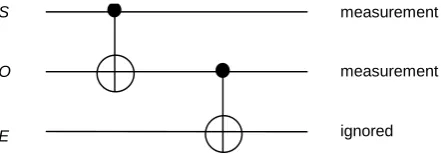
At this point, the environment induced decoherence states that there is an unavoida-ble interaction between O and its environment E. Suppose that such an interaction can be written as
0
O E O E
i ⊗ → i ⊗ i (6)
1 not
O E O E
i ⊗ → i ⊗ i (7)
For i = 0, 1, where
{
0 , 1}
E E is an orthonormal basis which is associated with this
interaction between O and E. The state ϕ1 evolves into
2
1 1
0 0 0 1 1 1 .
2 O S E 2 O S E
ϕ = ⊗ ⊗ + ⊗ ⊗ (8)
In environment induced decoherence, one claims that any information in the envi-ronment is lost or ignored. The density matrix for the subsystem O⊗S, ρOS, is
ob-tained by tracing over the degree of freedom associated with E, namely:
2 2
1 1
0 0 0 0 1 1 1 1
2 2
OS TrE O O S S O O S S
ρ = ϕ ϕ = ⊗ + ⊗ . (9)
Mathematically, the density matrix ρOS above is a classical mixture of states and can
be interpreted as describing a classical situation in which O observes 0 S with
proba-bility 1/2 and 1S with probability 1/2.
The proponents of the decoherence theory assert that this is indeed what actually happens physically—the form of the interaction with the environment has selected a
preferred basis, in which the density matrix of the composite system O⊗S adopts a
format that corresponds to a classical mixture of events, and that S is actually observed in that preferred basis. The physical setup describing the process is described in Figure 1.
Our first remark is that even if the state of O⊗S is in a classical mixture of state in
a given basis, nothing in the laws of quantum mechanics formally obliges the measure-ment to be done in such a basis. Rigorously speaking, quantum mechanics does not forbid observing the state ρOS in a basis different from the basis in which ρOS is diagonal.
[image:4.595.264.485.610.687.2]This remark being set aside (although in the author’s opinion, this is sufficient to call for the need to postulate the existence of the preferred basis), another fundamental issue
Figure 1. Setup describing the environment induced decoherence.
measurement
measurement
ignored
O S
with the decoherence theory is that the mechanism above ignores the possibility that the environment could have been entangled with the system or the observer previous to the experiment. The initial state of the whole setup O⊗ ⊗S E is unknown, and in
particular, the degree of the initial entanglement between the three systems is not known, and cannot be assumed.
As an example, suppose that the observed system and the environment were entan-gled, such that the initial state of O⊗ ⊗S E is
0
1 1
0 0 0 0 1 1 .
2 O S E 2 O S E
ϕ′ = ⊗ ⊗ + ⊗ ⊗ (10)
Indeed, we cannot rule out an interaction between S and E prior to the experiment. For instance, starting with the state ϕ0 , if we had a controlled-not interaction
be-tween S and E as in Equation (6), (7), that would lead to the above state ϕ0′ .
Applying the same interactions above to this initial state ϕ0′ will lead to the final
state
2
1 1
0 0 0 0 1 0
2 2
1 1
0 0 1 1 0
2 2
O S E O S E
O S O S E
ϕ
=
′ = ⊗ ⊗ + ⊗ ⊗
⊗ + ⊗ ⊗
(11)
and tracing over E leads now to
2 2
OS TrE
ρ′ = ϕ ϕ′ ′ = χ χ (12)
where 1 0 0 1 1 1
2 O S 2 O S
χ = ⊗ + ⊗
. Such density matrix is not a classical
mixture of states, as proved in Property 2 in the Appendix.
This example shows that the environment induced decoherence does not in general lead to a classical mixture state in a preferred basis: the initial state of the system is un-known and we cannot rule out entanglement between the observed system, the observ-er and the environment, which can lead to a final state in which we do not obtain a classical mixture of states.
3. General Case: No Quantum Process Can Lead to a Classical
Mixture of States in General
We have shown in the previous section that the environment induced decoherence as described in [2][3] does not always lead to a classical mixture of states, if one takes into account that the initial state of an experimental setup is ultimately unknown.
Is any other process, under the constraints of quantum mechanical laws, capable of producing classical mixture of states for the observed system and the observer, regard-less of the initial state for the overall setup comprising the observed system, the observ-er, and any auxiliary third physical system?
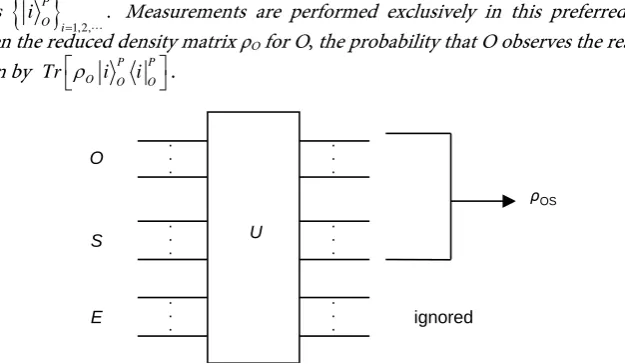
possi-bly in a most complex manner. After this interaction, represented by an unitary opera-tor U, we interest ourselves with the state describing O⊗S, the state of the auxiliary
system E being ignored (Figure 2).
Let eE be some state in the Hilbert space describing E. For any density matrix
de-scribing O⊗S, ρOS, the initial state described by the density matrix:
(
)
†
O U OS eE eE U
ρ = ρ ⊗ (14)
lead to the final state †
0 OS E E
UρU =ρ ⊗e e . By tracing over E, we obtain naturally
ρOS for the final state of O⊗S.
This in particular holds for any density matrix ρOS that is not a classical mixture of
states for O⊗S. We have actually proven in Property 2 that many such density
ma-trices exist. Therefore there exist initial states for the overall system O⊗ ⊗S E that
do not lead to a mixture state for O⊗S.
We have therefore shown:
Property 1 In any measurement process involving an observer, an observed system and any auxiliary system, no physical setup which is obeying quantum mechanical laws can guarantee to produce a classical mixture of states for the observer and the observed system.
4. Consequences
4.1. The Preferred Basis Must Be Postulated
The result in the previous section shows that quantum mechanical processes cannot by themselves explain the existence of preferred bases in quantum mechanics. Current formulation of the quantum mechanical laws is not sufficient to imply the existence of a preferred basis. To be rigorously complete, quantum mechanical laws must be supple-mented by an explicit assumption on what the preferred basis is, at least for the space describing the observer.
Postulate 1 The Hilbert space describing the observer is endowed with a preferred basis
{ }
1,2, . P O i i
= Measurements are performed exclusively in this preferred basis.
Given the reduced density matrix ρO for O, the probability that O observes the result i is
given by P P
O O O
Trρ i i .
Figure 2.Setup describing a general quantum process supposed to lead to classical mixture of states for O⊗S.
U .
. .
S O
E ignored
ρOS .
. .
. . .
. . .
. . .
[image:6.595.212.525.496.678.2]Note that we need to assume the preferred basis for the observer only, as the exis-tence of the preferred basis is experienced only at the observer’s level. Changing the ba-sis used for S or E in the calculation above has no impact on the outcomes and the as-sociated probabilities experienced at the observer O’s level.
4.2. Change of Measurement Basis Is a Physical Process
As quantum mechanics cannot explain the existence of preferred basis, we need to ac-cept it as a postulate. There exists a privileged basis for the Hilbert space describing the observer, and as a consequence there is no theoretical freedom in the selection of the basis in which measurements are performed. Observation of quantum states can be done in different bases, but there must be an actual physical process corresponding to this basis change: for instance, in a photon polarisation measurement, the measurement basis is changed by actually acting on a phase shifter. In the Stern-Gerlach experiment the measurement basis is changed by rotating the magnets creating the magnetic field. Our point is that one does not change the measurement basis only by thought, and that an actual physical change must occur to act on a measurement basis.
The fact that a measurement basis change is not a theoretical concept but is an actual physical process has a fundamental consequence. So far, it has been common to assume (for instance, in the thought experiment leading to the Bell inequality [8] in which two remote experimenters A and B choose freely and independently the measurement bases locally), that the choice of “how” a physical system is measured is independent of the state of the measured physical system itself. This assumption seemed natural if one as-sumed a conceptual freedom in choosing the measurement basis.
By making the measurement basis selection an explicit physical process that also ob-eys to the laws of quantum mechanics, we have no longer the theoretical independence between an observed system and the measurement basis in which the system is ob-served. Indeed, the observed system and the setup selecting the measurement basis are both quantum systems and are described jointly by a composite quantum system, for which the initial state is unknown. As proved in [9], this implies that no mechanism can guarantee that the choice of the measurement basis is independent of the state of the system being measured.
As such, Postulate 1 of this paper is not a mere mathematical axiom that is only re-quired for a formal completeness of the laws of quantum mechanics. It implies a theo-retical dependence between the choice of the measurement basis and the observed physical system, i.e. a potential à-priori dependence between the observer and the ob-served.
References
[1] Zurek, W.H. (1981) Pointer Basis of Quantum Apparatus: Into What Mixture Does the Wave Packet Collapse? Physical Review D, 24, 1516-1525.
http://dx.doi.org/10.1103/PhysRevD.24.1516
[3] Zurek, W.H. (2002) Decoherence and the Transition from Quantum to Classical—Revi- sited. Los Alamos Science, 27, 2-25.
[4] Schlosshauer, M. (2005) Decoherence, the Measurement Problem, and Interpretations of Quantum Mechanics. Reviews of Modern Physics, 76, 1267-1305.
http://dx.doi.org/10.1103/RevModPhys.76.1267
[5] Zeh, H.D. (1970) On the Interpretation of Measurement in Quantum Theory. Foundations of Physics, 1, 69.http://dx.doi.org/10.1007/BF00708656
[6] Wang, T. and Hobill, D. (2014) Is the Preferred Basis Selected by the Environment? arXiv:quant-ph/1412.2852
[7] Zurek, W.H. (1981) Pointer Basis of Quantum Apparatus: Into What Mixture Does the Wave Packet Collapse? Physical Review D, 24, 1519, Section III.
http://dx.doi.org/10.1103/PhysRevD.24.1516
[8] Bell, J.S. (1964) On the Einstein Podolsky Rosen Paradox. Physics, 1, Article ID: 195200. [9] Inamori, H. (2016) Is Independent Choice Possible? Journal of Quantum Information
Science, 6, 39-43. http://dx.doi.org/10.4236/jqis.2016.61005
[10]Mintert, F., Vinviescas, C. and Buchleitner, A. (2009) Basic Concepts of Entangled States.
Appendix
The following property gives an example of a family of density matrices that are not classical mixture of states, for the Hilbert spaces for O and S:
Property 2 Let
{ }
i O i=1,2, and{ }
j S i=1,2, be any orthonormal bases for theHil-bert spaces O and S respectively. Consider any state χ ∈ ⊗O S such that
,
, i j
i j i O j S
χ =
∑
α ⊗ (15)with αi j, being non-zero for at least for two couples (i1, j1) and (i2, j2), with i1 ≠ i2 and
j1 ≠ j2. Then the density matrix ρ= χ χ is not a classical mixture of states.
Proof 1 The proof uses standard mathematical techniques as described for instance in [10].
Let’s consider 2
Trρ . On one hand, we have ρ2= χ χ χ χ = χ χ ,
there-fore we have Tr =ρ2 χ χ =1
.
On the other hand, if we assume that ρ is a classical mixture of states, then by defini-tion, there exists an orthonormal basis
{
}
, i O j S i j
µ ⊗ν for O⊗S, not necessarily
equal to the basis
{
i O⊗ j S}
i j, such that,
, i j i i j j
i jp O O S S
ρ=
∑
µ µ ⊗ν ν (16)with 0≤ pi j, ≤1 and
∑
i j, pi j, =1.Taking the trace of its square, we get 2 2 ,
, i j
i j
Tr = ρ
∑
p which can be equal to oneonly if there is an unique couple (i0, j0) such that pi0,j0 =1, the remaining pi j, being
zero.
Take now the trace over S. We have, on one hand,
[ ]
(
2)
,
S j S S i j i j O O
Tr ρ =
∑
j χ χ j =∑ ∑
α i i .This density matrix has a rank strictly greater than 1as αi,j is non-zero at least for two
couples (i1, j1) and (i2, j2), with i1 ≠ i2 and j1 ≠ j2.
On the other hand, if we assume that ρ is a classical mixture of states, then using Equa-tion (16), we get TrS
[ ]
ρ TrS pi0,j0 µi0 O µi0 O νj0 S νj0 S µi0 O µi0 O
= ⊗ = which
Submit or recommend next manuscript to SCIRP and we will provide best service for you:
Accepting pre-submission inquiries through Email, Facebook, LinkedIn, Twitter, etc. A wide selection of journals (inclusive of 9 subjects, more than 200 journals)
Providing 24-hour high-quality service User-friendly online submission system Fair and swift peer-review system
Efficient typesetting and proofreading procedure
Display of the result of downloads and visits, as well as the number of cited articles Maximum dissemination of your research work