A Highly Luminous LiCaPO
4
:Eu
2+
Phosphor
Synthesized by a Solution Method Employing a
Water-Soluble Phosphate Ester
Minsung Kim, Makoto Kobayashi, Hideki Kato, Masato Kakihana* Institute of Multidisciplinary Research for Advanced Materials, Tohoku University, Sendai, Japan
Email: *[email protected]
Received June 19,2013; revised July 23, 2013; accepted August 26, 2013
Copyright © 2013 Minsung Kim et al. This is an open access article distributed under the Creative Commons Attribution License, which permits unrestricted use, distribution, and reproduction in any medium, provided the original work is properly cited.
ABSTRACT
A LiCaPO4:Eu2+ phosphor with high photoluminescence was synthesized using a polymerizable complex (PC) method
employing a water-soluble polyethylene glycol-conjugated phosphate ester (PEG-P). PEG-P could be obtained from a reaction among polyethylene glycol 300, phosphorus pentoxide, and pyrophosphoric acid. The PEG-P prepared was stable in an aqueous condition. A transparent solution and gel were obtained when the PEG-P was used as a source of P during the PC method, whereas the use of H3PO4 caused an undesirable precipitate. The LiCaPO4:Eu2+ obtained via the
PC method employing the PEG-P showed higher emission intensity than those synthesized by a solid state reaction method and the PC method employing H3PO4. The high luminescence properties of the sample synthesized using the
PEG-P may be attributed to high homogeneity of constituents in the sample.
Keywords: Solution Method; Stable Phosphate Ester; Homogeneity; LiCaPO4:Eu2+
1. Introduction
Phosphate phosphors have been well-known as one of the most important luminescence materials because of their excellent thermal stability and high emission inten- sity as well as lower temperature synthesis [1,2]. Among them, Eu2+-activated ABPO4 phosphors (A and B are
mono- and divalent cations, respectively) have been re-ported as blue-emitting phosphors excited by near UV- LEDs. For instance, KSrPO4:Eu2+, KBaPO4:Eu2+, and
LiCaPO4:Eu2+ have excellent luminescence properties
including quantum efficiency and thermal quenching behavior. Therefore, they are considered to be potential application as phosphors for the white light emitting di- odes [3-5].
Several kinds of methods were applied to synthesis of inorganic powders, such as solid state reaction (SSR), solution-based method, and combustion process. In the synthesis of phosphors, the SSR method is the most ex- tensively used. However, the SSR method includes some drawbacks such as low homogeneity, and non-uniform particles morphology and size. Generally, solution-based synthesis is considered to be a desirable approach be-
cause it can produce highly homogeneous compounds in the atomic level [6,7]. Homogeneity of constituents and control of morphology and size of particles are requisites for highly efficient phosphors. One of limitations in a synthesis of phosphate phosphors using solution methods is requirement of appropriate P source, which is soluble and stable in an aqueous condition. The use of conven- tional phosphate reagents such as phosphoric acid or am- monium phosphate produce precipitates with metal ions in an aqueous condition [8]. Precipitates would lead to samples with inhomogeneous composition accompa- nying by secondary phases. In ion-activated type phos- phors, distribution of an activator is closely connected to luminescence intensity in the view of concentration quenching. It indicates that inhomogeneity results in low performance of phosphor. Additionally, in a highly ho- mogeneous sample, high amount of rare-earth can be doped, and as a result, high luminescence intensity would be achieved.
Solution-based synthesis highly requires the use of appropriate raw materials, which do not produce precipi- tate with any metals present in a given aqueous solution. Therefore, development of a new water-soluble P source that does not form precipitates with other metal ions is
precipitates between phosphorus and metals could be prevented by introduction of condensed chain-structured phosphates [9,10]. Recently, we have succeeded in a syn- thesis of a phosphate phosphor with high luminescence by a solution method using such a phosphate oligomer [11]. The prepared oligomer had good solubility and sta-bility in an aqueous condition, though approximately 50% H3PO4 unreacted remained. Therefore, it can be
expected that if a phosphorus source with further less H3PO4 can be prepared, the range of synthesis of phos-
phate phosphors with even better photoluminescence properties can be greatly expanded. The condensed chain-structured phosphates are commercially available and are synthesized from a rather simple reaction among alcohol, phosphorus pentoxide, and polyphosphoric acid [12]. Especially, polyethylene glycol (PEG) is considered to be a good candidate for its condensation with the phosphate moiety because PEG is widely used as a cross-linking agent for promoting formation of “gel” in a variety of “sol-gel”-based solution methods. Polyethyl-ene glycol-conjugated phosphate ester (PEG-P) is con-sidered to be soluble and stable in an aqueous solution, and also PEG-P may have a role as a cross-linking agent. In this study, we report the synthesis of PEG-P whose chemical structures are deduced from 1H and 31P{1H} NMR measurements, and then we stress the great advan-tage of the use of PEG-P as a P source for the synthesis of Eu2+-doped LiCaPO4, chosen as a model among
phos-phate-based phosphors, by demonstrating the superior photoluminescence properties of the target phosphor synthesized by the polymerizable complex (PC) method employing the PEG-P instead of the conventional P source, that is H3PO4.
2. Experimental Section
2.1. Synthesis of PEG-P
Pyrophosphoric acid (10 mmol phosphorus, Kanto Che- mical) and polyethylene glycol 300 (PEG300, 10 mmol Kanto Chemical) were mixed at 323 K and kept for 2 h. Phosphorus pentoxide P4O10 (10 mmol phosphorus,
Wako Chemical) was weighed in an inert atmosphere to prevent its hydrolysis, and then slowly added into the mixture. After P4O10 was dispersed homogeneously,
temperature of the mixture increased to 358 K and kept for 5 h. Finally, 10 mmol of PEG300 was added, and the reaction was continued for 12 h at 358 K. The entire re- action was conducted in N2 atmosphere. Gel with high
viscosity was formed and it was dissolved in distilled water. The gel was dissolved in D2O, and pH was
ad-justed to 13 using 10 M NaOH to prepare a solution
the chemical structure of PEG-P. The phosphorus con- centration of diluted PEG-P was determined using an inductively-coupled plasma (ICP) method (Perkin Elmer; Optima 3300XL) prior to its use for the synthesis of Eu2+-doped LiCaPO4 by the PC method described in the
following section.
2.2. Preparation of Eu2+-Doped LiCaPO4
A Eu2+-doped LiCaPO4 phosphor was synthesized via the
PC method employing the PEG-P as a P source. LiNO3
(99%, Kanto Chemical), Ca(NO3)2·4H2O (99.5%, Kanto
Chemical), and Eu(NO3)3, which was prepared by disso-
lution of Eu2O3 in HNO3, were dissolved in a citric acid
(CA) solution at a ratio of Li:Ca:Eu:CA = 1:0.97:0.03:8. The mixture was firstly heated at 353 K to allow chela- tion for 2 h, and then, the PEG-P and propylene glycol (PG) were added into the solution at a molar ratio of 1:8. The temperature was subsequently increased to 423 K to promote gel formation. The formed gel was heated at 1123 K in air to remove the organic content, and then it was reduced at 1373 K under a flow of Ar containing 4% H2 for 3 h. To enhance the phase purity, post-heat treat-
ment was conducted at 1073 K for 18 h in an Ar/4%H2
atmosphere. A Eu2+-doped LiCaPO4 phosphor was also
synthesized by the PC method using H3PO4 as the P
source. In addition, synthesis using the SSR method was carried out for comparison by stoichiometric mixing raw materials including Eu2O3 (Furuuchi Chemical), and
Li2CO3 (Wako Chemical), CaCO3, and (NH4)H2PO4
(both from Kanto Chemical). X-ray diffraction analysis (XRD, Bruker AXS; D2 Phaser) was conducted. Excita- tion and emission spectra of phosphors were recorded using a fluorescence spectrometer (Hitachi; F-4500) at room temperature. Quantum efficiencies of the samples were evaluated using fluorescence spectrometer (Jasco; FP-6500).
3. Results and Discussion
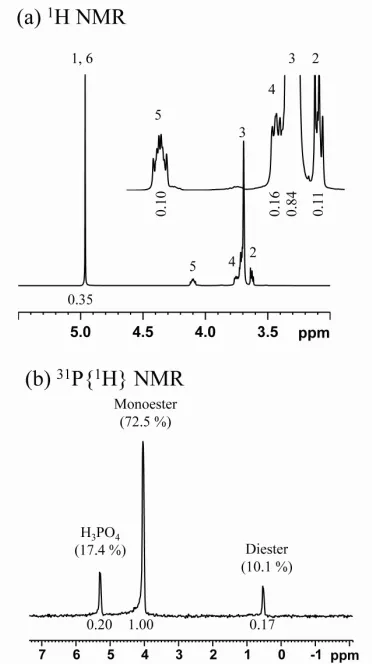
Scheme 1 shows estimated chemical structures of the synthesized PEG-P; (a) mono- and (b) di-esters, and Fig- ure 1 shows 1H (a) and 31P{1H} (b) NMR spectra of the obtained PEG-P. In the 1H NMR spectra (Figure 1(a)), each peak was assigned to each hydrogen marked with “1 - 6” in Scheme 1(a). No peaks of “4” and “5” were ob- served in 1H NMR spectra of PEG and H3PO4 (not shown
Scheme 1. Estimated chemical structures of synthesized PEG-P: (a) monoester, (b) diester.
area corresponding to the peak “2” was greatly decreased after the reaction, and finally, it could be estimated that more than 90% of PEG 300 was bonded with phosphate. From the 31P{1H} NMR spectrum, it could be confirmed that the PEG-P contained H3PO4, monoester, and diester
with ratio of 17.4:72.5:10.1 (Figure 1(b)). Previously, we reported preparation of a phosphate oligomer starting from ethylene glycol and phosphoric acid by promoting their esterification reaction under reflux [11]. The yield of the phosphate oligomer was about 55.4% with 44.6% of unreacted H3PO4. This indicates that the present
method can produce the condensed chain-structured pho- sphate with less H3PO4 than the reported method. The
use of such a P source having a large proportion of esters containing a small amount of H3PO4 is considered to be
suitable for solution-based synthesis of phosphate-based phosphors because of less opportunity that precipitates form resulting from interaction between H3PO4 and metal
ions present in a given solution. Another important char- acteristic of PEG-P is its stability in H2O, which was
confirmed by the fact that the initial small proportion of H3PO4 remained unchanged over 2 months.
To demonstrate the advantages of the use of PEG-P in a solution-based method, a LiCaPO4 doped with Eu2+
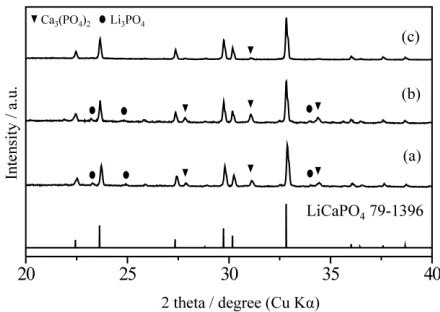
phosphor was synthesized by the PC method employing the PEG-P. Figure 2 shows XRD patterns of LiCaPO4:
Eu0.03 synthesized by the PC method employing the
PEG-P under various conditions; (a) 1123 K for 3 h in air, (b) 1373 K for 3 h in Ar/4%H2 atmosphere, and (c) post-
heating of (b) at 1073 K for 18 h. No precipitate was formed when the PEG-P was added into an aqueous so- lution containing LiNO3, Ca(NO3)2·4H2O, and Eu(NO3)3.
When the sample obtained after the heat-treatment at 1123 K in air, a single phase LiCaPO4 was formed
with-out any impurity phases as shown in Figure 2(a). Syn-thesis of a single phase LiCaPO4:Eu2+ phosphor was
rarely achieved in previous studies, and they suffered from significant contamination by impurities, such as Li3PO4 and Ca3(PO4)2 [13-15]. It should therefore be
stressed here that it was possible to obtain a single phase of LiCaPO4 resulting from the achievement of highly
[image:3.595.330.516.84.416.2]homogeneous distribution of constituents. Reduction at 1373 K for 3 h gave the sample exhibiting the highest emission intensity among various reduction temperatures (1073 - 1473 K). However, at this relatively higher tem- perature, strong reflections due to impurity phases such as Li3PO4 and Ca3(PO4)2 showed up (Figure 2(b)).
Figure 1. 1H and 31P{1H} NMR spectra of PEG-P in D2O at pH 13.
This is due to decomposition of LiCaPO4 at such a high
temperature. Reaction between Li3PO4 and Ca3(PO4)2
appears to be possible when the corresponding phase diagram for these two compounds is taken into account [15,16]. The post-heat treatment of the above-mentioned sample at 1073 K for 18 h (Figure 2(c)) resulted in al-most complete elimination of Li3PO4 and Ca3(PO4)2,
which accompanied formation of LiCaPO4 resulting from
a back reaction between the two impurities, and conse-quently an almost single phase of LiCaPO4 was formed
[image:3.595.60.289.87.133.2]with a very tiny amount of Ca3(PO4)2.
Figure 3 shows XRD patterns of LiCaPO4:
synthesized by the PC method employing PEG-P or H3PO4 and the SSR method after post-heat treatment at
1073 K for 18 h. All the samples mainly consisted of LiCaPO4 as assigned to the JCPDS Card (LiCaPO4, No.
79-1396). The sample synthesized by the PC method employing PEG-P was the almost single phase LiCaPO4
with negligible extent of impurity phase, whereas the samples synthesized by the PC method using phosphoric acid and SSR method contained a large amount of impu-rities, which were Li3PO4 and Ca3(PO4)2. During the PC
method employing H3PO4, precipitate was observed in 2+ 0.03
Figure 2. XRD patterns of LiCaPO4:Eu0.03 phosphors syn-thesized by the PC method; (a) calcination at 1123 K for 3 h, (b) reduction at 1373 K for 3 h, and (c) post-heating at 1073 K for 18 h.
the mixture solution while PEG-P didn’t make any pre- cipitate. It can be expected that low homogeneity led to formation of a large amount of Li3PO4 and Ca3(PO4)2 and
these phases remained even after post-heat treatment. As mentioned above, phase purity is closely related to pho- toluminescence properties. The use of a novel PEG-P as a P source in the PC method could improve phase purity of LiCaPO4, and it is one of advantages of the PEG-P in
the PC method.
Figure 4 shows the SEM and the corresponding EDS maps of Eu in LiCaPO4:Eu20.07
phosphors prepared by the SSR method (a, b) and the PC method employing PEG-P (c, d) after the post-heat treatment. The state of Eu distribution is closely related to the photolumines- cence properties of given phosphors [7]. 7 mol% Eu- doped samples were analyzed to obtain clearer images of Eu distribution. As to the sample synthesized using the SSR method, inhomogeneity, especially, deficient Eu area as marked with the white arrow in Figure 4(b) cor- responding to the black arrow in Figure 4(a) could be observed. On the other hand, as to the sample prepared using the PC method, the EDS mapping image showed uniform distribution of Eu without observation of defi- cient and localization of Eu ions. These results suggest that the PC method allowed highly homogeneous distri- bution of each element throughout the Eu2+-doped Li- CaPO4 phosphor, which may result in improvement of
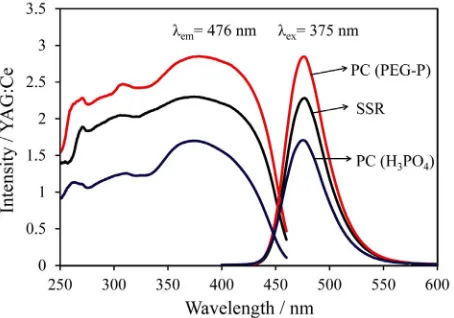
the corresponding photoluminescence properties. Figure 5 shows excitation and emission spectra of the LiCaPO4: phosphors synthesized using the SSR
method and the PC method employing the PEG-P or H3PO4 after post-heat treatment at 1073 K for 18 h. The
sample synthesized by the PC method using H3PO4
showed the lowest emission intensity. As stated above, the emission intensity of materials is closely related to the homogeneity of each element. The formation of pre-
2 0.03
[image:4.595.313.533.86.242.2]Eu
Figure 3. XRD profiles of LiCaPO4: phosphors after post-heating synthesized by the SSR method (a) and PC method employing H3PO4 (b) and PEG-P(c).
2+ 0.03
Eu
cipitate between H3PO4 and metals during the mixing
step in the PC method implies poor homogeneity despite of a solution-based method. The SSR method could pro-duce better condition of sample compared to that of the PC method employing H3PO4, because it exhibited
higher emission intensity. Formation of undesirable pre-cipitate in the PC method is thought to be a critical factor for homogeneity. The strongest emission intensity was observed from the sample synthesized via the PC method using the PEG-P as a P source. The internal quantum efficiencies of LiCaPO4: prepared using the SSR
method and the PC method employing PEG-P under ex-citation at 375 nm were 53.7% and 67.6%, respectively, although the corresponding absorption rate (81.3%) of the sample prepared by the PC method using PEG-P was slightly smaller than that of the one prepared by the SSR method (82.7%). The PEG-P was stable in the aqueous condition and the use of PEG-P didn’t produce any pre- cipitates with coexisting metal ions, and it allowed us to obtaining a highly homogeneous phosphor sample. As a result, despite of a lower absorption rate, the sample ob- tained from the PC method using PEG-P showed the high emission intensity and enhanced quantum efficiency.
2 0.03
Eu
4. Conclusion
A stable and water soluble phosphate ester was prepared by the reaction using pyrophosphoric acid, phosphorus pentoxide, and PEG300. The method could produce P source with less H3PO4. It was confirmed that the syn-
thesized PEG-P didn’t make any precipitate in a mix- ture of metal salts while the use of H3PO4 resulted in
formation of a precipitate. An almost single phase of Li- CaPO4 was obtained using the PEG-P, while SSR and PC
method using H3PO4 led to formation of impurity phases,
which were Li3PO4 and Ca3(PO4)2. As a result, the phos-
Figure 4. SEM micrographs and corresponding EDS mapping images of Eu ion in LiCaPO4: phosphors prepared by (a), (b) SSR method, and (c), (d) PC method using PEG-P.
2+ 0.07
Eu
Figure 5. Excitation and Emission spectra of LiCaPO4: phosphors synthesized by SSR and PC method em-ploying H3PO4 or PEG-P.
2+ 0.03
Eu
PEG-P exhibited enhanced photoluminescence properties, such as the highest emission intensity and quantum effi- ciency compared to other methods. Enhanced photolu- minescence properties seemed to be attributed to homo- geneous distribution of constituents in the atomic level. Therefore, the PEG-P is expected to be applicable in the solution-based synthesis of various kinds of phospha- te-based ceramic compositions with enhanced material properties.
5. Acknowledgements
This work was partially supported by a Grant-in-Aid for Scientific Research on Innovative Areas of “Fusion Ma-terials: Creative Development of Materials and Explora-tion of Their FuncExplora-tion through Molecular Control” (no. 2206) from the Ministry of Education, Culture, Sports, Science and Technology (MEXT), Japan and a Grant- in-Aid for JSPS Fellows (24·9285) from Japan Society for the Promotion of Science (JSPS).
REFERENCES
[1] S. H. M. Poort, W. Janssen and G. Blasse, “Optical Pro- perties of Eu2+-Activated Orthosilicates and Orthophos- phates,” Journal of Alloys and Compound, Vol. 260, No.
1-2, 1997, pp. 93-97.
http://dx.doi.org/10.1016/S0925-8388(97)00140-0
[2] Y. S. Tang, S. F. Hu, C. C. Lin, N. C. Bagkar and R. S. Liu, “Thermally Stable Luminescence of KSrPO4:Eu2+
Phosphor for White Light UV Light-Emitting Diodes,”
Applied Physics Letter, Vol. 90, No. 15, 2007, Article ID. 151108. http://dx.doi.org/ 10.1063/1.2721846
[3] M. E. Hannah, A. P. Piquette, M. Anc, J. McKittrick, J. Talbot, J. Han and K. C. Mishra, “A Study of Blue Emit-ting Phosphors, ABPO4,” ECS Transaction, Vol. 41, No.
37, 2012, pp. 19-25. http://dx.doi.org/10.1149/1.3697441
[4] S. Zhang, Y. Huang and H. J. Seo, “The Spectroscopy and Structural Sites of Eu2+ Ions Doped KCaPO4
Phos-phor,” Journal of Electrochemical Society, Vol. 157, No. 7, 2010, pp. J261-J266.
http://dx.doi.org/10.1149/1.3429887
[5] S. D. More, M. N. Meshram, S. P. Wankhede, P. L. Muthal, S. M. Dhopte and S. V. Moharil, “Luminescence in LiCaPO4,” Physica B: Condensed Matter, Vol. 406, No.
5, 2011, pp. 1178-1181.
http://dx.doi.org/10.1016/j.physb.2010.12.077
[6] M. Kakihana, “‘sol-gel’ Preparation of High Temperature Superconducting Oxides,” Journal of Sol-Gel Science and Technology, Vol. 6, No. 1, 1996, pp. 7-55.
http://dx.doi.org/10.1007/BF00402588
[7] M. Kakihana, “Synthesis of High-Performance Ceramics Based on Polymerizable Complex Method,” Journal of Ceramic Society of Japan, Vol. 117, No. 1368, 2009, pp. 857-862. http://dx.doi.org/10.2109/jcersj2.117.857
[8] W. Weng, L. Huang and G. Han, “The Alkoxide Sol-Gel Process in the Calcium Phosphate System and Its Appli-cations,” Applied Organometallic Chemistry, Vol. 13, No. 8, 1999, pp. 555-564.
http://dx.doi.org/10.1002/(SICI)1099-0739(199908)13:8< 555::AID-AOC913>3.0.CO;2-C
[9] J. R. Van Wazer and C. F. Callis, “Metal Complexing By Phosphates,” Chemical Reviews, Vol. 58, No. 6, 1958, pp. 1011-1046. http://dx.doi.org/10.1021/cr50024a001
[10] F. Rashchi and J. A. Finch, “Polyphosphates: A review Their Chemistry and Application with Particular Refer-ence to Mineral Processing,” Minerals Engineering, Vol. 13, No. 10-11, 2000, pp. 1019-1035.
http://dx.doi.org/0.1016/S0892-6875(00)00087-X
[11] M. Kim, M. Kobayashi, H. Kato and M. Kakihana, “En-hancement of Luminescence Properties of a KSrPO4:Eu2+
[image:5.595.59.286.217.376.2]tergents, Vol. 5, No. 2, 2002, pp. 169-172. http://dx.doi.org/10.1007/s11743-002-0218-9
[13] P. Lightfoot, M. C. Pienkowski, P. G. Brucea, I. Abra-hamd and E. Eh, “Synthesis and Structure of LiCaPO4, by
Combined X-Ray and Neutron Powder Diffraction,”
Journal of Materials Chemistry, Vol. 1, No. 6, 1991, pp. 1061-1063. http://dx.doi.org/10.1039/jm9910101061
[14] C. Wan, J. Meng, F. Zhang, X. Deng and C. Yang, “An Efficient Blue-Emitting Phosphor LiCaPO4:Eu2+ for
White LEDs,” Solid State Communications, Vol. 150, No. 31-32, 2010, pp. 1493-1495.
phors,” ECS Journal of Solid State Science and Technol-ogy, Vol. 1, No. 1, 2012, pp. R37-R40.
http://dx.doi.org/10.1149/2.026201jss