Time Use and Time Budgets –
Improvements, Future Challenges and
Recommendations
Merz, Joachim
Forschungsinstitut Freie Berufe (FFB)
March 2009
Online at
https://mpra.ub.uni-muenchen.de/16304/
FFB
Freie Berufe
Fakultät II - Wirtschafts-, Verhaltens- und Rechtswissenschaften
Postanschrift:
Forschungsinstitut Freie Berufe Postfach 2440
21314 Lüneburg
[email protected] http://ffb.uni-lueneburg.de Tel: +49 4131 677-2051 Fax:+49 4131 677-2059
Time Use and Time Budgets –
Improvements, Future Challenges and
Recommendations
Joachim Merz
Time Use and Time Budgets –
Improvements, Future Challenges and Recommendations
Joachim Merz
1FFB-Discussionpaper No. 78
May 2009
ISSN 0942-2595
1 Univ.-Prof. Dr. Joachim Merz, Institute on Professions (Forschungsinstitut Freie Berufe, FFB), Chair ‘Statistics and Professions’, Faculty II – Economic, Behavioural and Law Sciences, Leuphana University of Lüneburg, Campus: Scharnhorststr. 1, Geb. 5, 21332 Lüneburg, Germany, phone.: +49 4131 / 677 2051, fax: +49 4131 / 677 2059, e-mail: [email protected], url: http://ffb.uni-lueneburg.de
Improvements, Future Challenges and Recommendations
Joachim Merz
FFB-Discussionpaper No. 78, May 2009, ISSN 0942-2595
Abstract
“Time-use statistics offer a unique tool for exploring a wide range of policy concerns including social change; division of labour; allocation of time for household work; the estimation of the value of household production; transportation; leisure and recreation; pension plans; and health-care programmes, among others” (United Nations). This expertise will discuss recent developments, improvements and future challenges of time use and time budgets for policy and research with focus on international and in particular German national developments. It is written in the sequel of the last German KVI commission report on the improvement of the information infrastructure between sciences and statistics.
Topics are: recent :international time use institutions, data archives and surveys; German time use data bases and their access, actual time use research fields and studies; time use and economic and social policy; new methods in time use survey sampling, future developments and European and international challenges. The conclusions recommend first of all a new German Time Use Survey GTUS 2011/12 and urgently calls for its financing and start of organisation. Specific GTUS improvements, SOEP time use issues, a brand new time use panel and a permanent establishment of the German research data centres (RDCs) are recommended in addition.
JEL:
C81, J2, D1, I3, O15, O17
Keywords:
Time use, time budgets and time use surveys, time use data
Zusammenfassung
“Statistiken über Zeitverwendung bieten ein einzigartiges Werkzeug um ein weites Spektrum von Politikanliegen zu erforschen einschließlich sozialem Wandel, Arbeitsteilung, Zeitallokation der Hausarbeit, Schätzung des Wertes der Haushaltsproduktion, Transport, Freizeit und Erholung, Rentenpläne, Gesundheitsprogramme u.a.“ (Vereinte Nationen). Diese Expertise diskutiert neuere Entwicklungen, Verbesserungen und zukünftige Herausforderungen der Zeitverwendung und Zeitbudgets für die Politik und die Forschung mit Fokus auf internationale und deutsche Entwicklungen. Es ist in der Folge des letzten KVI Kommissionsreports über die Verbesserung der informationellen Infrastruktur zischen Wissenschaft und Statistik geschrieben.
Schwerpunkte sind: neue internationale Zeitverwendungsinstitutionen, Datenarchive und Umfragen, deutsche Zeitverwendungsdaten und ihr Zugriff, aktuelle Forschungsfelder und Studien der Zeitverwendung, Zeitverwendung und Wirtschafts- und Sozialpolitik, neue Methoden und Zeitverwendungserhebungen, zukünftige Entwicklungen und europäische und internationale Herausforderungen. Die abschließenden Bemerkungen empfehlen vor allem eine neue deutsche Zeitverwendungsumfrage GTUS 2011/12 und fordert dringend jetzt den finanziellen und organisatorischen Start. Spezifische GTUS Verbesserungen, SOEP Zeitverwendungsitems, ein ganz neues Zeitverwendungspanel und eine permanente Etablierung der deutschen Forschungsdatenzentren (FDZ) werden zusätzlich empfohlen.
JEL:
C81, J2, D1, I3, O15, O17
1
Time Use and Time Budgets – General Concern
Time
is the encompassing and compound dimension and resource of individual activities and
living arrangements. Very generally speaking, any characteristic or information is only
complete, when time is considered additional to the factual/socio-economic and geographic
attributes. Quantitative/statistical based knowledge about the use of time for all conceivable
activities from the labour market to the leisure world, thus, is of central importance not only
for the individual but also for the economy, for governmental economic and social policy, and
the society at large:
„Time-use statistics offer a unique tool for exploring a wide range of
policy concerns including social change; division of labour; allocation of time for household
work; the estimation of the value of household production; transportation; leisure and
recreation; pension plans; and health-care programmes, among others“.
(United Nations Statistics Division, http://unstats.un.org/unsd/demo graphic/sconcerns/tuse/).
Time use surveys
collect information about activity sequences in time spells over a period
from one day to a week. The core of a time use survey is the time use diary, which registers
an individual’s activity sequence. For each main activity in such a spell additional
information are asked like a secondary activity, and information about “where” and “with
whom” this activity was done. Additional to the diary information, a time use survey typically
includes a questionnaire about socio-economic individual and household background
variables. Sometimes specific information are included in the questionnaire about less
frequent activities for a period longer than a day and/or item-specific questions like a
seven-day work schedule proposed by the Harmonised European Time Use Study (HETUS, see
EUROSTAT 2009).
Time budgets
in a strong sense refer to activity specific aggregated time used over the entire
day, say, like a money budget (Harms and Gershuny 2009, 1). However, the terminus time
budget or time budget survey is often a synonymous for the diary information itself or for the
diary based complete time use survey (diaries plus socio-economic background); this is the
interpretation we will follow. The overall advantage of a time budget is its more accurate time
use measurement than by stylised data and the temporal location of an activity within a day.
So the possibility to analyse the timing of activities (like working hours) and the sequence of
activity pattern is the extraordinary surplus compared to all other surveys asking for
daily/weekly individual activities being in the labour market or in any field of daily live.
Time use research
analyses the individual’s use of time. As Andrew Harvey, longstanding
mentor of time use research states „Time use research is the study of how people use their
time. Minimally, time use studies show what activities people do week to week or day to day.
Maximally, they show what people are doing, where they are, who they are with, and how
they feel from minute to minute“ (www. stmarys.ca/partners/turp/pages/whatistimeuse.htm).
Time use general background/general literature
Since the beginning of the 20th century time use research has developed with respect to
methodological as well as to substantive issues. Meanwhile there are a number of
comprehensive studies about the concern and the international development of time use
research: Kramer 2005 has recently provided an historic overview, Harms and Gershuny 2009
focus on time budgets and time use issues, Gershuny 2001 covers time use methods, Harvey
2007, 2004, 1999, Harvey et al. 1984, Gershuny 1995, Andorka 1987 or the volume on “Time
Use – Research, Data and Policy (Merz and Ehling 1999) give a general and recent overview
about the field.
Though within a time use diary the respondent is characterizing his/her activity in a time spell
in his/her own words, only coded activities are available for a user. Thus, an appropriate
coding for all thinkable research interests is a challenging task. However, there are
international harmonising approaches, like the HETUS project (EUROSTAT 2009), the
United Nations (Bediako and Vanek 1999) or alternative approaches (Hoffmann and Mata
1999). Actual scientific articles of in-depth time use analyses, books and projects can be
found in particular in the new electronic International Journal of Time Use Research
(www.eIJTUR.org). Andrew Harvey with his TURP project at the St. Mary’s University of
Halifax, Canada, provides a substantial bibliography of time use studies. The Centre for Time
Use Research (CTUR) informs since 2007 about actual time use publications
(www.timeuse.orgh c/information).
Our expertise will discuss improvements and future challenges of time use and time budgets
with focus on recent international and in particular national developments 2000+ in the sequel
of the last German KVI commission report on the improvement of the information
infrastructure between sciences and statistics.
1The expertise is organized as follows: Chapter
2 sketches international important time use institutions, data archives and surveys followed by
time use data bases and their access in Germany (chapter 3). Time use research fields with
international and national improvements, developments and studies are assembled in chapter
4. Time use in and for economic and social policy is the topic in chapter 5. New methods in
time use survey sampling are presented in chapter 6. Chapter 7 examines future developments
with European and international challenges. Chapter 8 provides the conclusions and
recommendations.
2
Time Use International - Institutions, Data Archives and Surveys
The following recent main time use institutions, data archives and international surveys build
the improved international background in which the German time use activities are
embedded.
International Time Use Institutions:
Important international time use institutions are
assembled in Table 1.
Table 1: International Time Use Institutions
The International Association for Time Use Research www.iatur.org TURP: Time Use Research Program at St. Mary's University, Halifax,
Ca.
www.stmarys.ca/partners/turp
UNSTATS, United Nations Statistics: Allocation of Time and Time Use http://unstats.un.org/unsd/demogra
phic/sconcerns/tuse/ RNTU: Research Network on Time Use at Lüneburg University,
Germany http://ffb.uni-lueneburg.de/rntu eIJTUR: electronic International Journal of Time Use Research www.eIJTUR.org
CTUR: Centre for Time Use Research at Oxford University, UK www.timeuse.org
Major developments:
The time use community is associated since 1970 (www.iatur.org) and
is of increasing growth within the last decade. Its annual conference 2009 – after (USA) and
Sydney (Australia) – will be at the Leuphana University of Lüneburg, Germany
(www.leuphana.de/ffb/iatur 2009) and hosted by our Research Institute on Professions
(Forschungsinstitut Freie Berufe (FFB) and the German Federal Statistical Office). TURP at
St. Mary’s University in Halifax (Ca.) provides since 1985 a worldwide time use bibliography
and is a recent pioneer in spatial time use research with its 2007/2009
Halifax Regional
Space-Time Activity Research (STAR)
Project
, a GPS-assisted household time use survey.
Besides the recent UNSTATS activities and the time use research network RNTU activities at
Lüneburg, a new peer reviewed scientific time use journalm the electronic International
Journal of Time Use Research (www.eIJTUR.org, hosted by FFB, University of Lüneburg)
was founded 2003. Worldwide time use data sets are archived and harmonised by
CTUR/MTUS at Oxford University, an enormous progress for international comparisons.
International Time Use Data Archives:
The first international time budget study was the
[image:7.595.75.528.532.620.2]Multinational Time Budget Study coordinated in the 1960s by Alexander Szalai (1972). This
project developed standardized diaries and survey methods implemented by 12 countries
2in
1965. Since then increasingly new time use/time budget surveys have been created. Recent
main studies and archives 2000+ are compiled in Table 2.
Table 2: International Time Use Data Archives
MTUS: Multinational Time Use Study www.timeuse.org/mtus MHES: Multinational Household Expenditures
Study www.economics.unimelb.edu.au/SITE/household/MTUS1.shtml HETUS: Harmonised European Time Use Study
HETUS table generating tool
http://ec.europa.eu/eurostat/ https://www.testh2.scb.se/tus CHAD: Consolidated Human Activity Database www.epa.gov/chadnet1/index.html
Major developments:
The most comprehensive and enduring data archives of international
time use studies since is the Multinational Time Use Study (MTUS) at CTUR now at the
Oxford University (Prof. Jonathan Gershuny, see Gershuny, Jones und Gauthier 2000).
MTUS is harmonising time use studies based on diaries from many countries with now about
60 studies from about 26 countries worldwide. MHES, the Multinational Household
Expenditure Study (MHES) (Prof. Duncan Ironmonger, University of Melbourne, Australia).
provides individual and household information about time use
and
expenditures.
The European Union begun to support the harmonisation of time use surveys and statistics in
Europe in the early 1990s (HETUS, EUROSTAT 2009, Rydenstam 1999). Now, major
European time use survey are harmonised by HETUS, an enormous advantage for
international comparisons developments. The actual HETUS guidelines are of 2009. Based on
the HETUS, Statistics Finland and Statistics Sweden have developed the
HETUS table
generating tool,
an interactive, internet based, user friendly tool for producing user defined
statistical tables.
3The Consolidated Human Activity Database (CHAD) will serve as an
example for a specific individual time use data base dedicated to a certain substantive aim,
here environmental protection.
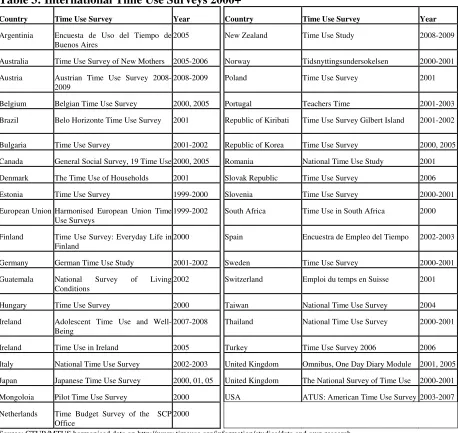
4International Time Use Surveys 2000+:
At the turn of the millennium around 20 European
countries conducted time use surveys according to the harmonised HETUS guidelines. More
than 40 international time use surveys worldwide have been conducted since 2000+
(see Table 3).
5Major developments
- besides new country single cross sectional time use surveys – since
2000+:
First:
the Harmonised European Time Use Surveys (HETUS) were a milestone in a
multinational concerted sampling and activity coding of time use diary data.
Second:
The new
US time use engagement with the annual American Time Use Study (ATUS,
www.bls.gov/tus/) includes work on the ATUS ancestor: The American Heritage Time Use
Study (AHTUS, 1965, 1975, 1989, 1992-94 and 1998/99) which is harmonised by the Centre
for Time Use Research (CTUR) at Oxford University (www.timeuse.org/ahtus). The
American Heritage Time Use Data (AHTUD) is the respective five studies time use data base
which was assessed by a multinational expert group
6providing a calibration (Merz and
Stolze 2008), evaluation and recommendation for further time use surveys (Harvey 2006,
http://pna.yale.edu).
Third:some countries are following a quinquennial period of collecting
new time use surveys (Canada, Japan, Korea). Altogether, the almost exponential increase of
new time use studies since 2000+ worldwide emphasizes the international recognized
importance of time use data for research and policy.
3 Credentials are necessary to access the tool, Klas Rydenstam, Statistics Sweden
(https://www.testh2.scb.se/tus/tus/ and [email protected]) has to be contacted (Rydenstam 2007, 118). 4 CHAD is developed by the US Environmental Protection Agency (EPA) CHAD harmonizes about 10
databases with frequency and duration information of an activity (e.g. under pollution) with further daily and spatial information.
5 Detailled information about earlier harmonised international time use studies are made available by MTUS of the Centre of Time Use Research at Oxford University (http://www.timeuse.org/ information/studies/data). A list of the MTUS harmonised time use activities is given by www.timeuse.org/mtus/documentation/appendix. 6 Multinational project “Assessing American Heritage Time Use Studies” by Prof. Dr. Andrew Harvey, St.
Table 3: International Time Use Surveys 2000+
Country Time Use Survey Year Country Time Use Survey Year
Argentinia Encuesta de Uso del Tiempo de
Buenos Aires 2005 New Zealand Time Use Study 2008-2009 Australia Time Use Survey of New Mothers 2005-2006 Norway Tidsnyttingsundersokelsen 2000-2001 Austria Austrian Time Use Survey
2008-2009 2008-2009 Poland Time Use Survey 2001 Belgium Belgian Time Use Survey 2000, 2005 Portugal Teachers Time 2001-2003 Brazil Belo Horizonte Time Use Survey 2001 Republic of Kiribati Time Use Survey Gilbert Island 2001-2002
Bulgaria Time Use Survey 2001-2002 Republic of Korea Time Use Survey 2000, 2005 Canada General Social Survey, 19 Time Use 2000, 2005 Romania National Time Use Study 2001 Denmark The Time Use of Households 2001 Slovak Republic Time Use Survey 2006 Estonia Time Use Survey 1999-2000 Slovenia Time Use Survey 2000-2001 European Union Harmonised European Union Time
Use Surveys 1999-2002 South Africa Time Use in South Africa 2000 Finland Time Use Survey: Everyday Life in
Finland 2000 Spain Encuestra de Empleo del Tiempo 2002-2003 Germany German Time Use Study 2001-2002 Sweden Time Use Survey 2000-2001 Guatemala National Survey of Living
Conditions 2002 Switzerland Emploi du temps en Suisse 2001 Hungary Time Use Survey 2000 Taiwan National Time Use Survey 2004 Ireland Adolescent Time Use and
Well-Being 2007-2008 Thailand National Time Use Survey 2000-2001 Ireland Time Use in Ireland 2005 Turkey Time Use Survey 2006 2006 Italy National Time Use Survey 2002-2003 United Kingdom Omnibus, One Day Diary Module 2001, 2005 Japan Japanese Time Use Survey 2000, 01, 05 United Kingdom The National Survey of Time Use 2000-2001 Mongoloia Pilot Time Use Survey 2000 USA ATUS: American Time Use Survey 2003-2007 Netherlands Time Budget Survey of the SCP
Office 2000
Source: CTUR/MTUS harmonised data on http://www.timeuse.org/information/studies/data and own research.
3
Time Use Data in Germany - Data Bases and Data Access
The approved most important development in providing time use diary data is the nationwide
official German Time Use Survey GTUS 2001/02 (predecessor GTUS 1991/92). Summarized
working hour information is provided by the German Micro Census. Average time use data
stylised by a “normal day”
7are part of the German Socio-Economic Panel. Some more topic
specific, less sized surveys and firm side time use data were collected since 2000+ in
Germany, too.
Time Use Data Bases in Germany
German Time Use Survey 2001/02:
The 2001/02 German Time Use Survey consists of
about 5.400 households, about 37.700 diary days and about 270 activity codes classified by:
household work and do-it-yourself, paid job/job seeking, voluntary and community work,
qualification/education, physiological recreation, social life/contacts, use of media/leisure
time activities, child care, taking care and attending people, times of getting ready and travel
times including the means of transport. The GTUS design follows EUROSTAT’s Guidelines
on Harmonised European Time Use Surveys (HETUS). All household members aged 10 years
and older were asked to fill out diaries based on 10-minute intervals on three days – two days
during the week from Monday to Friday, one day on the weekend. Data were collected on
primary and secondary activities, persons involved or present, the location and mode of
transport. A wide range of household and individual data (socio-demographic/economic
variables and other background variables) were collected in additional questionnaires.
The GTUS microdata themselves and information about the survey are available from the
Research Data Centres of the Federal Statistical Office and the Statistical Offices of the
Länder (RDC, www.forschungsdatenzentrum.de). In addition, the IZA in Bonn offers
metadata about this and other surveys (http://idsc.iza.org/metadata/). A comprehensive
GTUS-Compass
about the broad range of GTUS 2001/02 information and its usage is
provided by Statistisches Bundesamt 2006a.
8German Socio-Economic Panel Study
(1984 – ongoing): The German Socio-Economic
Panel Study (GSOEP) about living in Germany annually collects a broad set of individual
subjective and objective information of each household member 16 years and older since
1984 (http://www.diw.de/soep. GSOEP, hosted by the German Institute for Economic
Research, (DIW Berlin http://www.diw.de/english), offers only “typical/normal” work and
non work day time use information for each of the following activities: paid work (including
commuting and secondary occupational activities), housework and shopping, child care, do it
yourself, education/learning, watching television, videos as well as hobbies and other leisure
activities. In addition, GSOEP asks for less frequent activities how often they were done
within different longer time periods.
The GSOEP advantage (among others) is its truly longitudinal character and a broad range of
socio-economic variables for testing behavioural hypotheses. The disadvantage (besides the
stylised information only) is to allow only full hours (no further minutes) information when
collecting the data. A simple extension by minutes is strongly recommended for further
GSOEP waves and international comparisons.
German Micro Census:
The large scale German Micro Census (1% sample of the
population) is focused around the labour market and asks for a variety of “typical/normal”
working hours in-depth since 2005 (www.destatis.de) for actual as well as for a desired
working hour arrangement.
Further Studies with time use information:
Time use information by private firms, like
Nielsen Marketing or the Gesellschaft für Konsumforschung (GfK) will be activated in our
Time Use Research Fields chapter below. Television and broadcast services (like ARD or
ZDF) and other media firms developed an own large scale survey system about media use
with many process based time use information. The situation and the suitability of diary based
time use research for media use are recently analysed by Merz 2009. Less sized or topic
specific studies e.g. are the “Berliner Längsschnitt Medien”, a project to analyse media use
and school performance by the Kriminologisches Forschungsinstitut Niedersachsen (KFN,
http://www.kfn.de) or e.g. a particular time use study on intra-family relations
(www.ifb.bayern.de/ forschung /inapf-deu.html). Altogether, though there are important
private firms’ and other institutions’ time use data in Germany, however, they are not
available for other institutions or researchers, in general.
Time Use Microdata Access in Germany
While the GSOEP and its time use data were available for scientists from its very beginning
on (1984) via the DIW in Berlin, official microdata are provided since some years by new
research data centres for the public and the scientific community
(www.ratswd.de/engl/dat/RDC.html). The official German time use surveys GTUS 2001/02
and GTUS 1991/92 are provided and served by the Research Data Centres of the Federal
Statistical Office and the Statistical Offices of the Länder (RDC,
www.forschungsdatenzentrum.de). The RDC provides four different forms of access to
selected microdata of official statistics: public-use-files, scientific-use-files, safe scientific
workstations – data laboratories and controlled remote data processing. They differ with
regard to both the anonymity of the microdata which can be used and the form of data
provision (http://www. forschungsdatenzentrum de/en/anonymisierung.asp). There are
possibilities for foreign institutions and scientists not subject to German law to access
German official microdata.
New microdata access developments 2000+ and the future:
the entire microdata access via
the Research Data Centres is a new and proved to be a very successful possibility to work
with official microdata like the scientific use files (SUF). However, scientific use files still are
anonymized; a “final” run with the original data within the Federal Statistical Office is
striking for many final results and publications. The new
onsite secured possibilities
(like at
the DIW in Berlin for geo-coded SOEP data) is a promising road for an advanced access.
Important for the future will be a
remote access
to micro- and meta data
like to the
Luxembourg Income Study (LIS). The most important future issue: the Federal Statistical
Office’s RDC has to be established permanently for a continuing accredited necessary
service!
4
Time Use Research Fields –International and National
Improvements, Developments and Studies 2000+
With this perspective new and recent 2000+ international and national time use research
fields are summarized in the following. They encompass substantive contributions from
economic, sociology and other sciences as well methodological issues also on a multinational
level. Though there are a multitude of studies behind each time use research field from 2000+,
and certainly before
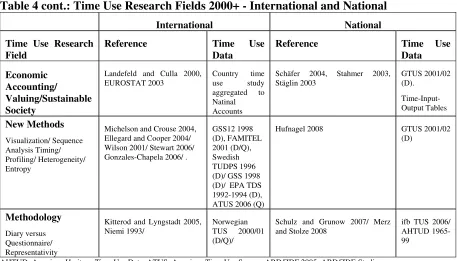
9, in the assembling Table 4 only one international and one national
reference will characterize the issue. My taxonomy of time use research fields tries to catch
the recent international and national research activities and could use different sources.
10Table 4: Time Use Research Fields 2000+ - International and National
International National
Time Use Research Field
Reference Time Use Data
Reference Time Use
Data Labour Market/
Paid Work
Timing, Fragmentation of Work/ Work-life balance/ Sequencing
Hamermesh 2002/Fisher and
Layte 2004/ Lesnard 2004 MTUS Version 5.0.1 (D), British TUS 2000-01 (D), HETUS 2003 (D)/ French TUS 1985-86, 1998-99 (D)/.
Merz and Böhm 2005; Merz and Burgert 2004; Merz, Böhm, Burgert 2004 GTUS 2001/02 (D) Unpaid work/ Nonmarket Activities/Househol d Production
Deding and Lausten 2006, Harvey 2006, Ironmonger 2001 Danish TUS 2001 (D), American (Heritage) TUS (D), Australian TUS (D)
Schäfer 2004 GTUS 2001/02 (D)
Gender Perspectives World´s Women Report
UNIFEM 2009 Multiple time use data worldwide
(D/Q)
Cornelißen 2005, Sellach et al.
2004 GTUS 2001/02 (D)
Division of Housework
Anxo and Carlin 2004, Bonke
and McIntosh 2005 French TUD 1999 (D) Gille and Marbach 2004 (D) GTUS 2001/02
Child Care/ Day Care/ Care
Joesch and Spiess 2006, Chalasani 2006
ECHP 1996 (Q) Kahle 2004, Fendrich and Schillig 2005
GTUS 2001/02 (D)
Family Interactions/ Parental Time and Leisure
Anxo and Carlin 2004/ Guryan, J., Hurst, E. and M.S. Kearney 2008
French TUS 1999/ American TUS 2006
Bundesministerium für Familie,
Senioren, Frauen und Jugend 2006 GTUS 2001/02 (D)
9 See e.g. Merz and Ehling 1999.
Table 4 cont.: Time Use Research Fields 2000+ - International and National
International National
Time Use Research Field
Reference Time Use Data
Reference Time Use
Data Nutrition/Househol
d Economics
US Department of
Agriculture American TUS 2005, 2006 Gwodz et al. 2006 (D) GTUS 2001/02
Consumption/ Shopping
Jacobson and Kooreman 2004 Netherland SCP Survey 2000 (D/Q)
Merz, Hanglberger and Rucha 2009 GTUS 2001/02 (D)
Education Guryan et al. 2007 ATUS 2005 Wilhelm and Wingerter 2004 GTUS 2001/02 (D)
Leisure/ Culture/ Quality of Life
Torres et al. 2007 European Quality of Life Survey (25 countries)
Statistisches Bundesamt 2008,
Weick 2004 GTUS 2001/02 (D)
Media use/ Play/ IT Deal 2008 Digital Games Survey 2006 (D/Q)
Merz 2009, Jäckel and Wollscheid 2004, Fritz and Klingler 2006, Kleinmann and Mößle 2008
GTUS 2000/01 (D),
ARD/ZDF-Studie 2005 (Q), BL 2005-2010 (D/Q)
Space/ Geography/ Environment
Harvey 2009 STAR: GPS Time Use Survey 2008
Kramer 2005 GTUS 2001/02 (D)
Mobility/
Transport/ Travel
Keall and Baker 2008 Travel Survey New Zealand 2001 (D)
Kramer 2004 GTUS 2001/02 (D)
Social Contacts/ Networks / Volunteering
Bittman et al. 2005 Australian TUS 1997 (D), Australian
SDAC 1998 (Q)
Merz and Osberg 2009, Gabriel et
al. 2004 GTUS 2001/02 (D)
Time Crunch/ Time Stress/ Harriedness
Sullivan 2007, Bonke and
Gerstoft 2007 Danish TUS 2001 (Q), Home OnLine 1998 (Q/D)
Gille and Marbach 2004 GTUS 2001/02 (D)
Poverty/ Extended
well-being/Inequality
Akarro 2008, Folbre 2009 Time Use Study and Advanced Census
Analysis in Tanzania 2002 (D)
Holz 2004, Kettschau et al. 2004,
Merz and Rathjen 2009 ISG 2004 GTUS 2001/02 (D)
Special Populations Children/
Adolescent,Youth/ Elderly,Retirement
Pääkkönen 2008/ Mulligan, Schneider and Wolfe 2005/ Piekkola and Leijola 2006
Finnish TUS 1999/00 (Q)/ CPS 1992 (Q), NELS 1992, SDAC 1992/93 (ESM)/ MTUS: 1987, 1991, 1995, 1999 2000 (D)
Cornelißen and Blanke 2004,
Table 4 cont.: Time Use Research Fields 2000+ - International and National
International National
Time Use Research Field
Reference Time Use Data
Reference Time Use
Data Economic
Accounting/
Valuing/Sustainable Society
Landefeld and Culla 2000,
EUROSTAT 2003 Country time use study aggregated to Natinal
Accounts
Schäfer 2004, Stahmer 2003,
Stäglin 2003 GTUS 2001/02 (D). Time-Input-Output Tables New Methods Visualization/ Sequence Analysis Timing/ Profiling/ Heterogeneity/ Entropy
Michelson and Crouse 2004, Ellegard and Cooper 2004/ Wilson 2001/ Stewart 2006/ Gonzales-Chapela 2006/ .
GSS12 1998 (D), FAMITEL 2001 (D/Q), Swedish TUDPS 1996 (D)/ GSS 1998 (D)/ EPA TDS 1992-1994 (D), ATUS 2006 (Q)
Hufnagel 2008 GTUS 2001/02 (D)
Methodology Diary versus Questionnaire/ Representativity
Kitterod and Lyngstadt 2005,
Niemi 1993/ Norwegian TUS 2000/01 (D/Q)/
Schulz and Grunow 2007/ Merz
and Stolze 2008 ifb TUS 2006/ AHTUD 1965-99
AHTUD: American Heritage Time Use Data, ATUS: American Time Use Survey, ARD/ZDF 2005: ARD/ZDF-Studie
Massenkommunikation 2005 (Q), BL: Berliner Längsschnitt Medien, CPS: Current population survey, ECHP: European Community Household Panel, GSS: General Social Survey, HETUS: Harmonised European Time Use Studies, MTUS: Multinational Time Use Study, NELS: National Education Longitudinal Study, TUS: Time Use Survey, SDAC: Survey of Disability, Ageing and Carers, Sloan Study: Study of Youth and Social Development Wave 1, GTUS: German Time Use Survey
Source: Own taxonomy based on various national and international information (see Footnote 10).
Major improvements and developments:
Altogether, the Table 4 overview shows a wide
range of research fields with important economic and social concern. For instance, specific
time use information provided by diaries allows particular
labour market analyses
which are
not available by other labour market surveys: the sequencing, timing and fragmentation of
daily working hour arrangements, multiple jobs a day, which are important for new forms of
labour contracts within labour market flexibility developments.
Unpaid work and nonmarket
activities
count for the importance of the informal economy and emphasize women’s
economic importance and gender approaches in particular.
The
entire leisure activities
with social networking and volunteer work, family interaction,
media use, culture, sports and genuine leisure (to mention only a few) are important in many
aspects for the understanding of economic, social individual and societal living conditions.
Recently, in psychology time use studies (via experience sampling) are used, for example, for
the study of affect regulation (Riedinger et al. 2009).
For Germany
, the overview also shows: the recent German Time Use Study GTUS 2001/02
In addition to the discussed spectrum of time use based scientific research activities there are
many further fields in private firms and administrative/governmental activities which ask for
or gain from time use information.
Private firms and time use information:
Besides all the working hour time use data within
any private firm, private firms in the field of consumer surveying do collect item and time
specific information. To mention only two important private firms: The Nielsen Consumer
Panel survey with now of 300.000 households in 28 countries e.g. asks for consumption
activities scanned by the respondents via bar-codes
(http://www.acnielsen._de/products/cps_homescan.shtml). The GfK (Gesellschaft für
Konsumforschung) runs its ConsumerScope with explicit time use information; specific
studies on gardening, media-use etc. deepen the activity specific time use information
(http://www. gfkps.com/scope/infopool/chartofthe week/index.de.html)
Time use and downsizing bureaucracy by reducing administrative burdens:
The
Standard Cost Model (SCM) of the Federal Statistical Office, a tool for downsizing
bureaucracy, measures the administrative costs imposed on businesses and individuals by
central government regulation. Specific SCM time use surveys and interviews provide the
data;. GTUS 2001/02 is used for a further inspection. The German efforts are integrated in an
international SCM network (http://www.administrative-burdens.com/).
Time Use, National Accounts and Nonmarket Production:
Though the main focus of time
use research is on individual behaviour, there are substantial longstanding international and
national efforts to count for the contribution of the nonmarket production to the national
product and national accounts. Emphasis there is laid on valuing individual time use by
various methods (market replacement costs with global or specialized substitutes, opportunity
costs, self-evaluation (Chadeau 1985, Goldschmidt-Clermont 1993). Recent international
nonmarket national accounts efforts are described by Landefeld and Culla 2000 and
EUROSTAT 2003. An interesting new way to describe the macro situation of a society is the
“Great Day”, an aggregated time use picture proposed by Gershuny 1999.
Recent German
national accounts by nonmarket satellite systems
focus on time pattern in a Social
Accounting Framework; see e.g. Stahmer 2003, Stahmer and Schaffer 2004, Stäglin and
Schindtke 2003 for time input-output tables. Schäfer 2004 provides an estimate of a
nonmarket production contribution for the German national accounts based on the GTUS
2001/02.
5
Economic and Social Policy and Time Use
Targeted economic and social policy needs sound individual information of the population.
Because of the encompassing range of individual activities time use data is a genuine
information provider for almost any sound economic and social policy to support and flank
the daily temporal coordination of life. With the substantive background of our time use
research field overview (Table 4), only some main policy aspects and new activities – of
international importance but with German references – which gain in particular from
individual time use information should be sketched:
•
Family and Time Use Policy:
for almost all activities considered in the recent Seventh
2006 with time policy for child care, child raising allowances, balancing family and
work, education and other aspects of individual living conditions (www.bmfsfj.de).
•
Public transport, Traffic, Mobility and Time Use Policy:
Increasing interest in
individual transport and traffic time aspects of working and leisure activities (see
Kramer 2005)
•
Bureaucracy Downsizing and time use:
reducing administrative costs and time burden
imposed on businesses and individuals (see the discussed SCM project
(www.administrative-burdens. com).
•
Poverty and Time Use Policy:
see the expertises for the three German Federal
Richness and Poverty Reports (Armuts- und Reichtumsberichte der Bundesregierung,
Bundesministerium für Arbeit und Soziales 2008, in particular: ISG 2004, Kettschau et
al. 2004)
•
Working Hours/Labour Market Flexibility and Time Use Policy:
Setting
administrative general regulations on working hours and working conditions with
particular daily working time regulations.
•
Time Policy in urban and rural areas:
To support the temporal coordination of public
services and the private and firm sector.
The mentioned Time Use Compass by the Federal Statistical Office 2006a provides a further
range of time use information used by the German administration for economic and social
policy.
New and future time use policy developments:
The temporal aspect regarding family affairs
and working hour arrangements is a longstanding policy focus. Time use policy interests are
new with regard to urban and rural temporal coordination of daily life (see the time policy
project for the metropolitan area Hamburg (Mückenberger 2008) and the new time policy of
European wide activities (Garhammer 2008). See also the activities of the „Deutsche
Gesellschaft für Zeitpolitik e.V. (DGfZP)“ (www.zeitpolitik.de).
6
New methods in Time Use Survey Sampling
All the substantive time use approaches and research fields are based on the following
instruments and methods:
•
Direct time use questions (stylised approach) about number of times to participate
,
or the amount of time denoted for a certain activity in a typical day; either time
constrained (must cover a defined time period) or time unconstrained.
•
Activity lists,
typically selective rather than exhaustive mostly time-unconstrained,
activity matrix: time-constrained.
•
Beeper,
call for information randomly and/or experienced sampled over a period (day)
for actual subjective, context sensitive information.
•
Time use diary,
exhaustive, all activities and patterns of associations between people,
location, allows sequence analyses; highly recommended.
disregard the randomness of a certain day situation, to mention only the main issues (see
Harvey 1999 for more). There are some beeper data based results, like those of the
ISR-Michigan group, but beeper data is not the dominantly used sampling instrument. However,
experience sampling, by a beeper or another instrument, which is collecting context sensitive
data by a self-reported momentary experience, by random or by some scheme over a day, say,
is of growing use at least in psychological investigations (Riedinger 2009).
Within this methodological frame, since 2000+ (roughly speaking) many new sampling tools
connected with the growth of handheld devices and mobile phones have been developed (see
the conference volume about new sampling technologies with focus on time use surveying
Ehling and Merz 2002).
Many new sampling instruments, mainly developed to collect individual working hour
information, may be classified – according to the taxonomy of Merz 2009 – by three
principles: Come and Go, Project Precise and Task Precise. Come and Go measures the total
daily working time (when, and how long). Project Precise measures the time information for a
certain project (when, and how long). Task Precise might measure a certain (sub) task of a
project. Table 5 provides examples of new time use sampling devices for each of these
principles.
Table 5: New time use sampling technologies by surveying principles
Come and Go
PZE-Master [Working hour per terminal] www.zeit-reporter.de/article_info.php?articles_id=154
NovaCHRON [Workers time per web client] http://www.novachron-zeiterfassung.de/personalzeiterfassung.php diTime [Working hours per web-client] http://www.disoft.de/index.html (Link muss im Dok. Geändert werden) timeCard [Working hours per chipcard/token] www.easy-technology.de/software/timecard/
Micades [Mobile per barcodescanner and GPRS/GSM]www.mobile-zeiterfassung.info/Fahrzeug.html MOBILDAT [Mobile per software] www.mobile-zeiterfassung.info/Fahrzeug.html
Webalizer [Media/IT use per software]www.tobias-schwarz.net/webalizer_gui.html
Web-Zählpixel [Internet use per plugin/software]www.ivw.de User tracking [Internet use per cookies/software]www.agof.de/
Project Precise
MobilZeit SERVICE [Working hours per terminal] http://www.mobile-zeiterfassung.info/Fahrzeug.html
TimeLog Project [Working hours per software] http://www.timelog.de/produkte/zeiterfassung.html
TIM / TIM Mobile [Mobile per cell phone (GPRS/GSM ) and software] www.pressebox.de/pressemeldungen/echtzeit-
zeitmanagement/boxid-108393.html
Task Precise
Zeittagebücher [per diary]
Time-Soft [Working Hours per web-client] www.lewald.com
Micro-Kiosk-System [Working Hours per terminal / PDA] www.softguide.de/prog_g/pg_2252.htm diTime [per Barcodescanner] http://www.disoft.de/index.htm
SMS-Methode [per cell phone and software]
Mobile Zeiterfassung [per cell phone and software]http://www.virtic.com/?u=mobile_zeiterfassung Halifax Regional Space-Time Activity Research (Star) Project [activity per cell phone (GPS) and diary] http://www.stmarys.ca/partners/turp/pages/projects/STAR/STAR_Main.htm
TimeCorder [activity per hardware] http://www.paceproductivity.com/timecorder.html Timeboy [per Hardware]www.datafox.de
mQuest [per PC, PDA or smartphone] www.mquest.info
For a discussion of the benefits and challenges of these new time use data sampling
instruments see Merz 2009. They certainly have to be considered and tested before used for a
next German Time Use Survey.
7
Future Developments: European and International Challenges
The worldwide financial and economic crisis accentuates the importance of an effective use
of scarce resources. Since time use surveys encompass many (or all) individual activities
incorporating temporal information, they are a very efficient “in one hand” tool with scarce
resources to provide a broad scope of detailed individual data in a household context for a
multitude of substantive interests. So, it could be expected that this crisis is even in favour of
new time use surveys, however after convincing the policy makers of its evident usability.
In
Europe
, great efforts have been invested and still have to be invested to get a full HETUS
every 10 years (as in Norway among other countries for decades). After about 20 new time
use surveys at the beginning of the millennium 2000/2002 the next European Harmonised
Time Use Study (HETUS) 2010-12 will be a cornerstone not only in national surveying and
research but also for the European community development as a whole.
In the UK, light diaries in multiple intervening years between the ten years full scale surveys
(Japan and Korea have 5 years) are discussed. As to the IATUR secretary Dr. Kimberly
Fisher, there are a growing number of diary surveys on specific topics like on children linked
to longitudinal data, notably the Child Development Supplement of the PSID
(http://psidonline.isr.umich.edu/CDS/) and the “Growing Up Longitudinal Study of
Australian Children” (www.aifs.gov.au/growingup/); another way to achieve individual time
use data.
International
, new countries and new time use surveys are worldwide on the agenda. A new
UN-sponsored series of studies in developing countries is discussed. Based on the
experiences and the efforts of the annual American Time Use Studies the international time
use community will succeed in more frequent cross-sectional time use surveys. A
comprehensive survey by the Federal Statistical Office about
Time Use Survey – National
Plans for the next wave of surveys 2008-2010 for 32 countries
is given in the Appendix 2.
Periodical cross sectional time use surveys with intervals of 5 or 10 years will be very
important. The invention of an annual time use panel of repeatedly asked
individuals/households with all its longitudinal information is on the international agenda.
The panel option will be an enormous step forward in time use research providing among
others specific event driven micro information for actual and targeted policy and research.
New electronic devices allow more precise and at the same time less expensive time use data
sampling. Future developments and challenges for the German time use survey situation will
be outlined in our conclusions and recommendations.
8
Conclusions and Recommendations
respondents to walk through the sequence of events in a given day, and has significant
advantages in ensuring the completeness and consistency of responses. Time use diaries thus
support the understanding of causality and the interdependence of all the market and
nonmarket activities and their individual synchronization. The disadvantage is a high cost of
administration, which mandates relatively few days observed per respondent and the
possibility that a survey will miss low frequency events. Therefore, additional summary
questions about the “work week” (HETUS) were already added in GTUS 2001/02 and in
some other time use surveys.
With the background of the growing international experience in the field of successful time
use survey methodology, the following recommendations are expressed in particular for
Germany. They will support research and targeted policy with more advanced substantive as
well as methodological investigations on modelling individual and household behaviour at the
micro level and on developing new sound national accounts data at the macro level:
Recommendation 1a:
A next official German Time Use Survey GTUS in the years 2011/12
should unconditionally be conducted nationwide by the Federal Statistical Office. The
financing for GTUS 2011/12 is not yet assured and has to be organized as soon as possible.
The next German TUS has to be embedded again in the European Harmonised Time Use
Surveys (HETUS, EUROSTAT 2009). Then Germany, at least concerted within the European
time use efforts, can follow a ten years interval (with GTUS 1991/92, GTUS 2001/02) of
precious time use information with socio-economic background for targeted policy and
research.
Recommendation 1b:
GTUS 2011/12: New methods in sampling time diaries based on
mobile devices, including beeper/experience sampling methods for even more context
sensitive questions should be incorporated in the next GTUS after a proper pilot study. This
allows to follow three objectives: first, to achieve more context sensitive data; second: reduce
the burden of filling out a traditional diary booklet; third, will reduce overall expenses. The
sampling procedure should use mixed mode data collection (internet, (cell) phone, mail,
pre-coded diaries …) and the advantages of the Access Panel (Körner et al. 2008) with voluntary
information of the Federal Statistical Office.
Recommendation 1c:
GTUS 2011/12: The single activity spell with its “where” and “with
whom” attributes should be extended by expenditure information. This would provide new
data about activity money efforts and intensity for all concerned activity fields (transport,
shopping, etc.)
11A suitable way has to be found to characterize a second or third job in a
day’s activity spell.
Recommendation 1d:
GTUS 2011/12: The time use diary information should be extended by
questions concerning less frequent activities. First, by information about the “work week”
following the recent HETUS recommendation (EUROSTAT 2009, Guidelines Annex VI).
Second, by information about a longer period than a day (different week diaries,
frequencies …). Third, by information about a “typical/normal” period (day, week, month).
Recommendation 1e:
GTUS 2011/12: The time use diary supplementary information should
be extended by more objective background individual and household questions and questions
about the living environment. The supplementary data should encompass information about
the income situation from labour market activities (occupational status, wage and detailed
income (including unemployment benefits …) or from other income sources (capital income,
further third party payments etc.). The environment information should encompass external
child care possibilities and external living conditions (residence environment, exposure to
environmental risks, and social life participation (social networks, social “inclusion”)).
Recommendation 1f:
GTUS 2011/12: The time use diary supplementary information should
be extended by subjective information about satisfaction (of life in general and other items in
addition to time type and stress information) and health (subjective and objective). In addition
the “Big Five” personal characteristics’ items
12should be added to approximately measure
unobserved heterogeneity (for instance). All this subjective data will allow to value and to
qualify the time use information.
Recommendation 1g:
GTUS 2011/12: The time use diary supplementary information should
be closely adjusted and harmonised with the respective socio-economic questions of the
German Socio-economic Panel (SOEP) to allow high quality merged new data sets.
Recommendation 2:
A brand new annual Time Use Survey Panel should be started to
answer the important longitudinal questions. A TUS-Panel – e.g. in the sequel of the next
GTUS 2011/12 – will allow inspections of individual changing time uses and time use
profiles in changing environments with extended causality and sequential event analyses. The
TUS Panel thus has a different focus than the GSOEP.
Recommendation 3:
The German Socio-Economic Panel (SOEP) should continue to ask for
“typical day” and less frequent time use information to allow first, continuing existing
longitudinal analyses, and second, to use the enormous socio-economic background labour
market and further information of the GSOEP. GSOEP should not only ask for full hours but
should allow minutes’ information as well.
Recommendation 4:
The Research Data Centre (RCD) of the Federal Statistical Office
should be put forward to a permanent basis in general and in particular for the time use data
service and new time use data developing. The new onsite secured data access possibilities
should be further developed. In particular, the remote access to micro- and meta data for a fast
and secured access should be expanded.
Recommendation 5:
In general, the Council for Social and Research Data should actively
support and strengthen all activities to have a new GTUS 2011/12 be financed and organized.
Because a time use survey provides such a multitude of substantive answers for policy and
research “in one hand”, is harmonised now within Europe, and offers an efficient use of
scarce resources, the next GTUS 2011/12 should be promoted eminently and without fail.
Appendix A1: Current Registered RDC GTUS 2001/02 Research Projects
No. Research Project - RDC Registered and Based on GTUS 2001/02 (March 2009)
1 Arbeitstitel: Haushalt: Haushalt: Kleine Fabrik oder gender factory
2 Zeitverwendung von Arbeitslosen und Vollzeiterwerbstätigen. Eine vergleichende Analyse mit den Zeitbudgetdaten des Statistischen Bundesamtes von 2002.
3 Inklusionsprofile
4 Zeitverwendung in Haushalten
5 FrauenDatenReport 2005
6 Feiertage, freizeit und Soziales Kapital
7 Soziale Netzwerke und Hilfebeziehungen im unteren Einkommensbereich
8 Consumption and Time Allocation
9 Female labor market supply and home work in Germany
10 Bayerischer Familienreport 2006 - Schwerpunkt "Väter in Deutschland" 11 Kooperative Demokratie - Kritik der Arbeit und der Arbeitslosigkeit 12 1. Erwerbsverhalten und Home Production / 2. Zeitverwendung im Alter
13 Der soziale Dienstleistungsbereich als Chance für eine höhere Arbeitsmarktintegration und Professionalisierung weiblicher Erwerbskaeeieren.
14 Zeitverwendung und Work-Life-Balance in Großbritannien und Deutschland 15 Das Arbeitsangebotsverhalten von Frauen in Deutschland
16 A. Mobilitäts- und Freizeitverhalten von Kindern und Jugendlichen B. Verbesserung der Methoden zur Prognose der KFZ-Bemessungsverkehrsstärken
17 Zeitverwendung und soziale Schichten
18 Klartext reden oder Farbe bekennen: Der Einfluss von Sprachkenntnissen und Aussehen auf gesellschaftliche Integration von Migranten in Deutschland
19 Der Einflussvon Kindern auf Zeitallokation von Haushalten
20 Effekt von Zeitverwendung auf die Ausbildung von nicht-kognitiven Fähigkeiten
21 Arbeitszeit & Zeitbudgetanalysen - Analyse täglicher Arbeitszeiten und Nachfragearrangements 22 Soziale Ungleichheit und Prävention
23 Das Konzept der Europäischen Sozioökonomischen Klassifikation und seine Anwendung auf die in der Zeitbudgeterhebung 2001/02 befragten Haushalte
24 Renewhility
25 Substitutability of Partner's Productive Activities
26 Einkommensabhängiges Freizeitverhalten unter älteren Menschen
27 Zeit und soziale Ungleichheit. Die schichtspezifische Strukturierung sozialer Zeit - unter besonderer Beobachtung von Geschlecht und Generation
28 Schulz-Borck/Hofmann: Schadenersatz bei Ausfall von Hausfrauen und Müttern im Haushalt - mit Berechnungstabellen, 6. Aufl.-Karlsruhe: VVW 2000, ISBN 3-58487-89487-894-8
29 "Integration of Rebound Effects into Life-Cycle Assessment" (finanziert durch BFE und Nationalfonds) 30 Ruhestandsmigration in Deutschland
31 Assisted Living - Technisch unterstüztes Wohnen im Alter, Teilprojekt: Sozialwissenschaftliche Begleitforschung
32 Sozioökonomische Berichterstattung (soeb.de)
33 "Einkommen und Freizeit - Eine empirische Analyse des Freizeitverhaltens älterer Menschen mit Daten der Zeitbudgeterhebung des Statistischen Bundesamtes"
34 "Einkommen und Freizeit - Eine empirische Analyse des Freizeitverhaltens älterer Menschen mit Daten der Zeitbudgeterhebung des Statistischen Bundesamtes"
Appendix A1 cont.: Current Registered RDC GTUS 2001/02 Research Projects
36 Integrierter Survey
37 International Evidence on housework and market work by husbands and wives
38 Entwicklungstendenzen im Online-Printmedienbereich in Deutschland - Arbeitsmarktstatistische und Arbeitsorganisatorische Analyse der Srukturveränderungen durch das Internet für Journalisten, 1990 - Gegenwart
39 Erstellung von Tabellen für das Seminar zur Wirtschaftslehre des Haushalts, in dem Studierende den zeitaufwand für Kinder in den unterschiedlichen Haushaltstypen vergleichen sollen
40 Stochaistische Modellierung von Nutzerverhalten in Wohngebäuden 41 A cross-cultural analysis of overreporting of socially desirable behavior
42 Bezogenes Verkehrsverhalten von Beschäftigten im sekundären und tertiären Sektor
43 Potentiale der Zeitbudgeterhebung 2001/02 Eine Bestandsaufnahne anhand der Zeitverwendung "Junger Allter"
44 Berichtete und tatsächliche Kirchgangshäufigkeit in Ost- und Westdeutschland
45 Comparative Study on the Double Burden of Working Parents; Gender Differences in Time Poverty 46 Zeitverwendung von Arbeitslosen für Arbeitssuche
47 Soziale Netzwerke und Hilfebeziehungen im unteren Einkommensbereich 48 Zeitbudgeterhebungen - Methodik und Anwendungen
49 Analyse der Verschiebungen zwischen Wegezeiten und Zeiten für andere Aktivitäten in Abhängigkeit von der Raumstruktur
50 PACT (Pathways for carbon transitions) 51 Der zweite demographische Übergang
Appendix A2: Time Use Survey National Plans for the next wave of surveys 2008-2010.
Country Foreseen schedule Comment
Belgium (BE) 2010 Statistics Belgium collects TUS data and Vrije Universiteit Brussel analysis
them. Next data collection will take place in 2010, analysis in 2011.
Bulgaria (BG) 2009/2010 Survey will be included into the National Programme for Statistical Surveys
2009/2010
Czech Republic (CZ) Not before 2010 The implementation of TUS has not been assumed yet (no plan exists). There
is lack of financial resources and of human capacity, the respondents’ burden is still increasing and nor TUS, neither related activities is the priority of Czech Statistical Office in the area of social statistics.
Denmark (DK) 2008/2009 DTUC-Danish Time Use and Consumption Survey by Rockwool Foundation
(Pilot ongoing)
Germany (DE) No schedule The next wave of the TUS survey is not yet organized and financed. Estonia (EE) 2009/2010 EE is planning a TUS by 2009/2010
Ireland (IE) Not before 2010 The National Development Plan Gender Equality Unit which was based in
the Department of Justice, Equality and Law Reform engaged the ESRI to carry out a pilot light diary survey in 2005. The report is available to download at:
http://www.justice.ie/en/JELR/Pages/Time_use_survey_report
Anonymised microdata is available through the Irish Social Science Data Archive (ISSDA) see http://www.ucd.ie/issda/ dataset-info/timeuse.htm However, with the exception of this 2005 light diary pilot and a small CSO HETUS pilot carried out in 1998 in one region of Ireland (Munster), to date no national time-use study has been carried out in Ireland. There are no definite plans to carry out a HETUS based or light diary survey at present.
Greece (EL) No schedule Lack of "economic and human resources"
Spain (ES) 2009/2010 ES plans a TUS in 2009/2010. Fieldwork between 10/2009 and 9/2010 France (FR) September
2009-August 2010
Italy (IT) 2008/2009 Fieldwork between February 2008 and January 2009.
Cyprus (CY) Not before 2013 It is likely that TUS will not be launched before 2013
Latvia (LV) Not before 2011 Difficult to have precise plan at this moment. Depends on financial
resources.
Lithuania (LT) Not before 2010 Difficult to have precise plan at this moment. Depends on financial resources Luxembourg (LU) Not before 2010/2011 We first have to integrate the Time Use Survey in our national plan. So it is
difficult to have a precise plan for the moment (financing and human resources must be confirmed). It is likely that the survey will not be launched before 2010/2011.
Hungary (HU) 2009 or 2010 We are planning to organize a TUS during the next year (2009) or 2010. We
are making only a pilot (on a 100 sample) during the summer of this year. Hopefully it will be successful, and we can use the results of this pilot to support the necessity of such a survey. It is not easy to find financial sources for a survey, which is not compulsory, in Hungary.
Malta (MT) No updated information
The previous TUS survey was carried out in 2002
1. 2005 applying national methodology 2. 2006 according to HETUS guidelines
In 2010 we will either apply our national methodology or the Hetus
methodology. We have to weight out pros and cons of both methodologies before we will reach a decision on that.
Austria (AT) 2008/2009 Fieldwork from March 2008 until February 2009. The sample for TUS will
be a subsample of the Austrian Microcensus. In addition to the Microcensus questionnaire persons in the selected households will be asked to fill in a diary for one day (aim: net sample of 8.000 persons being 10 years and older). There will be no special TUS questionnaire.
Poland (PL) (2012) 2014 It is impossible for Poland to carry out TUS in 2010 because of Agricultural
Census in 2010 and National Census in 2011. The most likely and convenient time for the Polish CSO is 2013/2014 but it will be considering 2012. Depends on financial resources.
Portugal (PT) No schedule Not planned. Depending on financial resources.
Romania (RO) 2009/2010? Romanian National Institute of Statistics could not carry out TUS in
2008/2009 due to lack of financial and human resources. We provisional plan that the survey to be launched in 2009/2010 and that depends by financial and human resources
Slovenia (SI) No schedule Slovenia did not plan incorporate in the medium term plan financial
resources and employees for the TUS. A TUS will not be conducted in the near future
Slovakia (SK) Not before 2010 Previous TUS surveys:
2006 was carried out the Pilot project on TUS in accord with HETUS guidelines, edition 2004.
A plan for regular TUS (not earlier than 2010) depends on obtaining of financial resources
Finland (FI) 2009/2010 Fieldwork between April 2009 and March 2010. Sweden (SE) 2010 if resources
available
Regarding the next round of the Time Use Surveys we have an ongoing discussion with the Ministry for Integration and Gender concerning financing. There is a great interest in taking part in the next round so we are optimistic about the outcome of the discussions.
United Kingdom (UK) Full survey: not before 2013. Exploring lower cost options (eg collecting basic data via an existing survey)
The UK carried out a light diary survey in 4 months of 2005. With regard to a HETUS survey there appears to be no prospect of funding a full survey in the current planning period (2008-2012), given other priorities and budgetary pressures. ONS is still exploring lower cost options (eg collecting basic data via an existing survey), but this will also depend on financial resources being found across government and ESRC.
Croatia (HR) No schedule National plan to be confirmed
FYROM (MK) 2009 According to the working plan 2008-2012, TUS will be carried out in 2009.
Fieldwork will start on 1 January 2009.
Turkey (TR) 2011 The previous TUS survey was carried out in 2006 and the results published
in July 2007. Turkish Statistical Institution, TURKSTAT, has planned to carry out TUS for 5-year-period in line with HETUS guidelines.
Norway (NO) 2010
Switzerland (CH) Not before 2011 No TUS is planned at the Swiss Federal Statistical Office (FSO). In the
context of the new Statistical System on Households and Persons the possibility of a mini-TUS added to the omnibus survey is examined (light diary, CATI-interviews with precoded activities. It would be realised in 2011 at the earliest. The decision is still open.
References
Akarro, R. (2008), The Impact of Time Use Differentials on Poverty levels in the Eastern and Northern Zones of Tanzania, in: European Journal of Economics, Finance and Administrative Sciences, Issue 13, 108-120
Andorka, R. (1987). Time budgets and their uses. Annual Review of Sociology, 13, 149–164.
Anxo, D. and P. Carlin (2004), Intra-family time allocation to housework: French evidence, in: electronic International Journal of Time Use Research (www.eIJTUR.org), Vol. 1, 14-36 Ås, D. (1978), Studies of time-use: Problems and prospects, in: Acta Sociologica, 21 (2), 125–141. Bediako, G. and J. Vanek (1999), Trial International Classification of Activities for Time Use
Statistics, in: Merz, J. and M. Ehling (Eds.), Time Use – Research, Data and Policy, FFB-Book Series, Vol. 10, NOMOS publisher, 151-164
Bevans, G.E. (1913), How Working Men Spend Their Spare Time, New York: Columbia University Press
Bundesministerium für Arbeit und Soziales (2008), Der 3. Armuts- und Reichtumsbericht der Bundesregierung,Berlin
(http://www.bmas.de/coremedia/generator/26896/lebenslagen__in__deutschland__der__3__ar muts__und__reichtums bericht__der__bundesregierung.html)
Bundesministerium für Familie, Senioren, Frauen und Jugend (2006), Familie zwischen Flexibilität und Verlässlichkeit - Perspektiven für eine lebenslaufbezogene Familienpolitik, Siebter Familienbericht, Deutscher Bundestag, Drucksache 16/1360
Chadeau, A. (1985), Measuring Household Activities – Some International Comparisons, in: Review on Income and Wealth , 31, 237-254
Cornelißen, W. (Hrsg., 2005): Gender-Datenreport, 1. Datenreport zur Gleichstellung von Frauen und Männern in der Bundesrepublik Deutschland. Im Auftrag des Bundesministeriums für Familie, Senioren, Frauen und Jugend. 2. Fassung, München.
Cornelißen, W. and K.Blanke (2004), Zeitverwendung von Mädchen und Jungen, in: Statistisches Bundesamt (Hrsg.) (2004), Alltag in Deutschland - Analysen zur Zeitverwendung., Wiesbaden, 160-174
Dressel, Chr., Cornelißen, W. and K. Wol (2005), Vereinbarkeit von Familie und Beruf, in: Cornelißen, Waltraud (Hrsg., 2005): Gender-Datenreport, 1. Datenreport zur Gleichstellung von Frauen und Männern in der Bundesrepublik Deutschland. Im Auftrag des Bundesministeriums für Familie, enioren, Frauen und Jugend. 2. Fassung, München. Kapitel 5, S.278-356, http://www.bmfsfj.de/Publikationen/genderreport/root.html
Ehling, M. and J. Merz (Eds.) (2002), Neue Technologien in der Umfrageforschung – Anwendungen bei der Erhebung von Zeitverwendung (New Technologies in Survey Research – Applications for Time Use Studies), FFB-Schriftenreihe Band 14, Nomos Verlagsgesellschaft, Baden-Baden, 2002
Ehling, M., Merz, J. et al. (2001), Zeitbudget in Deurtschland – Erfahrungsberichte der Wissenschaft, Spektrum der Bundesstatistik, Bd. 17, hrsg. Vom Statistischen Bundesamt, Wiesbaden