http://dx.doi.org/10.4236/ojfd.2013.34032
Study on the Wake Shape behind a Wing in Ground Effect
Using an Unsteady Discrete Vortex Panel Method
Cheolheui Han1*, Spyros A. Kinnas2
1Department of Aeronautical and Mechanical Design, Korea National University of Transportation, Chungju, Republic of Korea 2Department of Civil, Architectural and Environmental Engineering, University of Texas at Austin, Austin, USA
Email: *[email protected]
Received August 13, 2013; revised September 13, 2013; accepted September 20,2013
Copyright © 2013 Cheolheui Han, Spyros A. Kinnas. This is an open access article distributed under the Creative Commons Attribu-tion License, which permits unrestricted use, distribuAttribu-tion, and reproducAttribu-tion in any medium, provided the original work is properly cited.
ABSTRACT
The unsteady evolution of trailing vortex sheets behind a wing in ground effect is simulated using an unsteady discrete vortex panel method. The ground effect is included by image method. The present method is validated by comparing the simulated wake roll-up shapes to published numerical results. When a wing is flying in a very close proximity to the ground, the optimal wing loading is parabolic rather than elliptic. Thus, a theoretical model of wing load distributions is suggested, and unsteady vortex evolutions behind lifting lines with both elliptic and parabolic load distributions are simulated for several ground heights. For a lifting line with elliptic and parabolic loading, the ground has the effect of moving the wingtip vortices laterally outward and suppressing the development of the vortex. When the wing is in a very close proximity to the ground, the types of wing load distributions does not affect much on the overall wake shapes, but parabolic load distributions make the wingtip vortices move more laterally outward than the elliptic load distribu- tions.
Keywords: Wake Shape; Wing in Ground Effect; Unsteady Discrete Vortex Method
1. Introduction
When a wing is flying near the ground, the aerodynamic characteristics of the wing is changed due to the interac- tion of the wing and the ground. This phenomenon is called as wing-in-ground (WIG) effect. New conceptual vehicles utilizing the WIG effect has been suggested fo- cusing on fuel efficiency and stability [1].
Panel methods have been frequently applied to the conceptual design of wing-in-ground effect vehicles [2]. Many free-wake analysis techniques have been devel- oped in order to represent the complicated wake vortex behavior behind a wing (Hoeijmakers and Vaatstra [3], Ribeiro and Kroo [4], Zhu and Takami [5], for example). Lamarre and Paraschivoiu [6] showed that the large-scale behavior of the roll-up of the aircraft trailing vortices can be simulated using the shape of 2-dimensional vortex sheet at any pseudo time because it resembles the shape of the cross section of the 3-dimensional sheet at a dis- tance behind the wing (see [7] for a comprehensive re- view). Pullin [8], Krasny [9,10] investigated the roll-up
of an initially plane semi-infinite vortex sheet. Morky [11] developed a 2-dimensional algorithm (based on the con- stant vortex sheet method) for modeling the evolution and propagation of aircraft trailing vortices in a sheared environment near the ground. Han and Cho [12] investi- gated the unsteady evolution of trailing vortex sheets behind a wing in ground effect using a discrete vortex method.
Han and Cho [12] assumed that the wings in close formation flight near the ground have the elliptic load distributions. Windall and Barrow [13] showed, based on a linear approach, that semi-elliptic wing planform with parabolic wing loading is optimal for a wing in ground effect for all aspect ratios. When a large aspect ratio wing is flying very close to the ground (extreme ground ef- fect: EGE), based on a nonlinear inviscid theory, the op- timal spanwise distribution of loading is parabolic rather than elliptic [2].
tion is suggested in order to match the change of the load distributions due to the change of the ground height. A lifting line with an initial load distribution is discretized with discrete vortex elements. The trailing wake vortices from each vortex element are represented by free vortices that deform freely by the assumption of a force-free posi- tion during the simulation.
2. Numerical Method
2.1. Wing Loading
For a lifting line solution of a symmetrical thin rectangu- lar wing in ground effect, Tan and Plotkin [14] con- firmed that the lifting line solution agrees well with vor- tex-lattice numerical method. Formal mathematical de- velopment of Lifting Line Theory is well described in many text books on aerodynamics [15,16]. Following the notations in [17], solving an integro-differential equa- tion for spanwise circulation distribution in terms of geo- metrical characteristics of the wing with boundary condi- tions at both wingtips provides the aerodynamic charac- teristics of the wing.
0 0 0
0 2
0 0 0 2 0
d 2 1 d d
4π
b y
b y
y y
y
y y y
m y Uc y U y y
(1)
where m y0
0 is the local lift curve slope, c y
0 is the local wing chord, and
y0 and 0
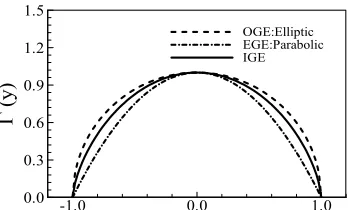
y0 are re- spectively geometric and zero-lift angles of attack at the spanwise location y0. It can be easily verified that thesolution of Equation (1) for an elliptic planform, un- twisted wing out of ground effect (OGE) has an elliptic spanwise distribution of bound circulation and the elliptic wing loading is the optimal value for minimum induced drag within the limitation of flat rigid wake assumption. When a wing is flying in close proximity to the ground, the optimal spanwise distribution of bound circulation is parabolic [13]. Equation (2) shows the equations for bound circulation distributions (for a wing in and out of ground effect) along the spanwise direction, where bound circulations are divided by their maximum values for each case. Thus, it can be said that the nondimensional bound circulation distribution of a wing in ground effect is confined in the envelope with its upper one as an ellip- tic distribution Equation (2a), and its lower one as a para- bolic distribution Equation (2c) (See Figure 1).
Out of Ground Effect: Elliptic Loading,
y
1 y2 2
1, y 1,t 0 (2a)
In Ground Effect:
1 2
, 1,1 1 02
p
y y y p t
(2b)
(y
)
-1.0 0.0 1.0
0.0 0.3 0.6 0.9 1.2 1.5
[image:2.595.338.513.84.189.2]OGE:Elliptic EGE:Parabolic IGE
Figure 1. Comparison of spanwise circulation distributions.
Extreme Ground Effect: Parabolic Loading:
y
1 y2
,y 1,t 0 (2c)
When applying Equation 2 to the calculation of bound circulation distributions, it is also required to understand the relationship between bound circulation and wing height.
Shigemi et al. [18] performed a wind tunnel test in or- der to investigate the ground effect on an 8.9% model of HOPE ALFLEX (Automatic Landing Flight Experi- ment) vehicle. They found an equation for the change of lift coefficient due to the change of the wing height as follows. After modifying the equation in order to match with Equation (2),
exp ,
L L LE L
C CB Ch B C C (3) where CL is the lift coefficient of a wing in free flight (OGE), CLE is the lift coefficient of a wing in extreme ground effect (EGE) and C is the coefficient that makes Equation (3) matching with the experimental data and should have a positive value. h represents the distance between the mid chord to the ground.
As shown in Equation (3), the lift coefficient is a nonlinear function of wing height, which also results in the change of circulation distribution. Thus, in the pre- sent paper, it is assumed that p in Equation (2b) changes as follows.
0 10
1 18
p p h (4)
where p0 is set to 1/2. p has the values of 0 and 1 re- spectively for h = 1.0 and 0.1.
2.2. Unsteady Discrete Vortex Panel Method
b/2 Y
O 3
4l Z
Γ0
l: panel element length
Point Vortex
2 0
2
1 b
y
[image:3.595.62.283.85.202.2]
Figure 2. Representation of a lifting line with elliptic load- ing with discrete vortex panel elements.
the same vorticity. On each line segment, the point vor- tex is located at the 3/4 point. The trailing wake vortices from each vortex panel element are represented by free point vortices that can deform freely with an assumption of a force-free position.
The distributions of the dimensionless tangential ve- locities induced by a point vortex are represented using the Lamb (Oseen) model [19]. The Lamb model has a Gaussian distribution of vorticity. Ling et al. [20] pro- posed a model that is based on the solution for the actual velocity in a viscous fluid. The core radius, rc, is ap-
proximately equal to the radial distance of the point where the maximum velocity is induced. This is ex- pressed
0 3.17
j cj cj
e
t
r r
R
(5)
The second term on the right-hand side of Equation (5) provides an estimate for the growth in the core radius of the vortex. The vortex Reynolds number is related to the time scale over which the laminar diffusion processes in the vortex core region become turbulent [21]. In the pre- sent work, an infinite Reynolds number is assumed. The tangential velocity induced by a point vortex with its circulation, Γj, is as follows.
2
1 exp 1.25643 2
j j
cj r v
r r
(6)
Several smoothing schemes are used in order to obtain accurate solutions by circumventing the singularity be- havior when the distance is very small. Krasny [10] avoids the singularity in the induced velocity of a point vortex through a smoothing factor, δ. The induced ve- locities because of other vortices can then be written as follows
2 2 2 2
1
( ) ( ) 2
N
j i j i
i j
i ji ji
z z y y
G
w i j
r r
(7)
where G y
is represented as follows depending on thewing distance to the ground.
2
12OG :E y 1y dy h1.0 (8a)
2
1
0
1
2 1 exp ,
2 0.1 1 0
E ,
.
IG : py y p dy p p Kh
h
(8b)
2
GE : 0.
E ydy h 1 (8c) In order to enforce the no penetration condition at the ground, an image method is used. Since the wake is force-free, the evolution of each vortex is investigated by moving the positions of point vortices using an Euler convection scheme.
y z,
j u v dt, j (9)3. Results and Discussion
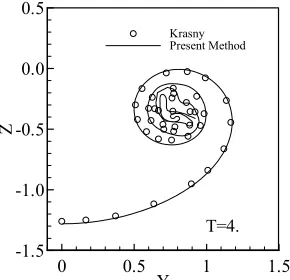
[image:3.595.326.538.87.190.2]Figure 3 shows the validation of the present method by comparing the wake shapes behind a lifting line having an elliptic loading with the published result of Krasny [10]. It is assumed that the wing is placed at h = 0 and is out of ground effect. In both calculations, the in-flow velocity and the maximum circulation at the midspan are assumed to be unity. The smoothing factor for the pre- sent calculation is set to 0.05 [the same as Krasny’s]. As shown in Figure 4, an unrealistic vortex sheet crossing is not observed in the present results. A time step size of 0.04 sec is used in the present calculation whereas Kras- ny [10] used a time step size of 0.01 sec. Thus, it can be said that the present results are in agreement with Krasny’s.
Figure 4 shows the comparison of wake shapes behind wings in and out of ground effect. Both wings are placed at the same ground height of h = 1.0. As shown in the figure, wake vortices behind a wing in ground effect cannot fully develop due to the insufficient distance be- tween the wing and the ground. The positions of wingtip vortices of a wing in ground effect are moved laterally
Y
Z
0 0.5 1 1.5
-1.5 -1.0 -0.5 0.0 0.5
Krasny Present Method
T=4.
[image:3.595.351.496.562.702.2]Y
Z
0.0 0.5 1.0 1.5
0.0 0.5 1.0 1.5
OGE IGE
T=4.0 sec. h=1.0 Lifting Line
at h=1.0
[image:4.595.112.232.79.225.2]Ground
Figure 4. Wake shapes behind a wing in and out of ground effect.
more outward and vertically more upward than those of a wing out of ground effect. When the wing is in ground effect, the desingularized point vortices become confined to a small region and coalesce. Present method does not include the viscous diffusion model of interacting point vortices, but it can be said that the interaction of point vortices while merging will decrease further the viscous diffusion. The total circulation of wingtip vortices behind a wing in ground effect will be decreased.
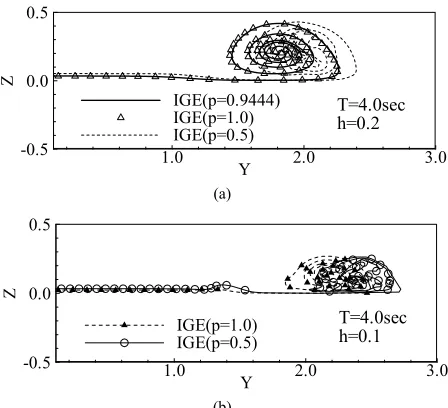
Figure 5 shows the wake shapes behind a wing in close proximity to the ground. When the wing is placed at h = 0.2, from Equation (4), p17 18. As shown in Equation (2), p = 0.5 means the elliptic circulation distri- bution whereas p = 1.0 represents the parabolic circula- tion distribution. When h = 0.2, the value of exponent p approaches to p = 1.0. Figure 5(a) shows the wake shapes behind a wing at h = 0.2 with three cases of cir- culation distributions. Figure 5(b) shows the wake shapes behind a wing at h = 0.1 for elliptic and parabolic circulation distributions. As shown in both Figures 5(a) and (b), overall wingtip vortex shapes are similar to each other and does not dependent on the circulation dis- tributions, however, the position of the wingtip vortices for elliptic loading is moved laterally more outward than the other cases. Thus, it can be said that, for a single wing in ground effect, the assumption of elliptic load distributions does not affect much the wake shapes but negligibly changes the position of wingtip vortices.
Figure 6 shows the changes of wake shapes behind a wing in ground effect. As the wing is placed close to the ground, the wingtip vortices departed from the wing is moving vertically downward and laterally outward. As shown in Figure 6(b), when the wing is in close prox- imity to the ground (h = 0.1), the area of confined vortic- ity is decreased compared to the case of the wing at h = 0.5.
4. Conclusions
In the present paper, a new formula that matches elliptic
Y
Z
1.0 2.0 3.0
-0.5 0.0 0.5
IGE(p=0.9444) IGE(p=1.0) IGE(p=0.5)
T=4.0sec h=0.2
(a)
Y
Z
1.0 2.0 3.0
-0.5 0.0 0.5
IGE(p=1.0) IGE(p=0.5)
T=4.0sec h=0.1
[image:4.595.312.536.84.288.2](b)
Figure 5. Wake shapes behind a wing in close proximity to the ground with various wing loadings.
Y
Z
0.0 1.0 2.0 3.0 -0.5
0.0 0.5 1.0 1.5
h=0.2 h=1.0
h=1.0 h=0.5
h=0.1
(a)
h=0.1 h=0.5
[image:4.595.312.535.329.565.2](b)
Figure 6.Wake shapes for different wing heights. (a) Wake shape in the Trefftz plane, T = 4.0; (b) Three dimensional view of unsteady wake evolutions.
loading for OGE and parabolic loading for EGE is sug- gested.
In future, the present model will be applied to the un- steady wake evolution behind wings in formation where the significant interaction between wingtip vortices is expected.
5. Acknowledgements
The research was supported by a grant from the 2011 program for visiting professors overseas in Korea Na- tional University of Transportation.
REFERENCES
[1] K. V. Rozhdestvensky, “Wing-in-Ground Effect Vehi- cles,” Progress in Aerospace Sciences, Vol. 42, No. 3, 2006, pp. 183-211.
[2] K. V. Rozhdestvensky, “Aerodynamics of a Lifting Sys- tem in Extreme Ground Effect,” Springer, Heidelberg,
[3] H. W. M. Hoeijmakers and W. Vaatstra, “A Higher Order Panel Method Applied to Vortex Sheet Roll-up,” AIAA Journal, Vol. 21, No. 4, 1983, pp. 516-523.
[4] R. S. Ribeiro and I. Kroo, “Vortex-in-Cell Analysis of Wing Wake Roll-Up,” Journal of Aircraft, Vol. 32, No. 5, 1995, pp. 962-9 [5] K. Zhu and H. Takami, “Effect of Ground on Wake Roll-
Up behind a Lifting Surface,” Proceedings of the 37th Japan National Congress for Applied Mechanics, Tokyo, 1987, pp. 115-123.
[6] F. Lamarre and I. Paraschivoiu, “Efficient Panel Method for Vortex Sheet Roll-Up,” Journal of Aircraft, Vol. 29, No. 1, 1992, pp. 28-33. [7] T. Sarpkaya, “Computational Methods with Vortices—
The 1988 Freeman Scholar Lecture,” Journal of Fluids Engineering, Vol. 111, No. 1, 1989, pp. 5-52.
[8] D. I. Pullin, “The Large-scale Structure of Unsteady Self-Similar Rolled-Up Vortex Sheets,” Journal of Fluid Mechanics, Vol. 88, No. 3, 1978, pp. 401-430.
[9] R. Krasny, “A Study of Singularity Formation in a Vortex Sheet by the Point-Vortex Approximation,” Journal of Fluid Mechanics, Vol. 167, 1986, pp. 65-93.
[10] R. Krasny, “Computation of Vortex Sheet Roll-Up in the Trefftz Plane,” Journal of Fluid Mechanics, Vol. 184, 1987, pp. 123-155.
[11] M. Morky, “Numerical Simulation of Aircraft Trailing Vortices Interacting with Ambient Shear or Ground,”
Journal of Aircraft, Vol. 38, No. 4, 2001, pp. 636-643.
[12] C. Han and J. Cho, “Unsteady Trailing Vortex Evolution Behind a Wing in Ground Effect,” Journal of Aircraft, Vol. 42, No. 2, 2005, pp. 429-434.
[13] S. E. Windall, and T. M. Barrows, “An Analytic Solution for Two- and Three-Dimensional Wings in Ground Ef- fect,” Journal of Fluid Mechanics, Vol. 41, No. 4, 1970, pp. 769-792.
[14] A. Plotkin and C. H. Tan, “Lifting-Line Solution for a Symmetrical Thin Wing in Ground Effect,” AIAA Journal, Vol. 24, No. 7, 1986, pp. 1193-1194.
[15] J. Anderson, “Fundamentals of Aerodynamics,” 5th Edi- tion, McGraw Hill, New York, 2010.
[16] J. Katz and A. Plotkin, “Low Speed Aerodynamics,” 2nd Edition, Cambridge University Press, Cambridge, 2001.
[17] I. G. Sheldon, “Wing Tip Vortices,” In: I. G. Sheldon, Ed.,
Fluid Vortices, Kluwer Academic Publishers, Berlin, 1995, Chapter X.
[18] M. Shigemi, T. Fujita, A. Iwasaki, T. Ohnuki, K. Rinoie, H. Nakayasu and M. Sagisaka, “Experimental Investiga- tion of Static and Dynamic Ground Effect on HOPE ALFLEX Vehicle,” Technical Report of National Aero- space Laboratory TR-1236, National Aerospace Labora- tory, Tokyo, 1994.
[19] A. Ogawa, “Vortex Flow-CRC Series on Fine Particle Science and Technology,” CRC Press, Boca Raton, 1940. [20] G. C. Ling, P. W. Bearman and J. M. R. Graham, “A Fur-
ther Simulation of Starting Flow around a Flat Plate by a Discrete Vortex Model,” Internal Seminar on Engineer- ing Applications of the Surface and Cloud Vorticity Me- thods, Vol. 51, No. 14, 1986, pp. 118-138.