Technology (IJRASET)
©IJRASET 2013: All Rights are Reserved
41
Performance Analysis of Filters on Complex Images for Text
Extraction through Binarization
Dixcha Gusain1, Binay Kumar Pandey2, Hardwari Lal Mandoria3 Research Scholar, Assistant Professor, Professor and Head
Department of Information Technology, G.B. Pant University of Agriculture & Technology, Pant Nagar, UK, India
Abstract- Text data present in image contain useful information and extraction of text from complex images is an extremely difficult task and challenging job due to variation in style, font,alignment,background intensity, illumination and various other factors. Image binarization is a technique in which text is extracted from image in dual color i.e. black and white. The extracted text will be in black color and background will be in white color. A suitable threshold value is calculated from the pixels of the input image. Existing research has been shown that different image require different method for detection or extraction of text. Filters are used for removing the noise from images and preserving the edges of text in images.. In this paper, we are doing the performance analysis of image filters on complex images for text extraction through binarization using analytical simulation in MATLAB.
Keywords: Text detection, Filters, Binarization, Thresholding, binary images.
I. INTRODUCTION
Text extraction from image is concerned with extracting the proper and suitable text data from the collection of images. Image binarization is the process of converting a image into a binary image. A binary image is the digital image which has two colors i.e. 0 and 1.The pixel value 0 represent the black color for foreground and 1 represent the white color for background. Thresholding is a technique which is used for image binarization. The pixels of an image are distinguishes as a background and foreground by comparing them to threshold value. Thresholding is further classified as global and local. Global threshold method is suitable for images with contrast foreground and background. There are certain images which contain large amount of noise, illumination and uneven lightning. In such cases, local threshold is suitable. The binary images [3] frequently occur in image processing as masks or as the outcome of segment and threshold.
Figure1: Original Image [1]
Figure2: Binarized Image
Technology (IJRASET)
©IJRASET 2013: All Rights are Reserved
42
binarization algorithm on images for text extraction is still an area of study. This dissertation has focused on effects of different filtering techniques like wiener, wavelet denoising, average, median and trimmed on image binarization. This paper is organized as follows, Section II discuss about related work with binarization. Section III includes proposed binarization technique. Section IV includes the results which simulated using MATLAB. In Section V there is a brief conclusion.
II. RELATED WORK
Jagroop Kaur et al.(2014)[13] has proposed a new method to improve degraded document binarization using guided filter. Image filters are used to remove the noise from the images. A combination of a global and a local adaptive binarization method at connected component level is proposed that aims in an improved overall performance is proposed by K. Ntirogiannis et al.(2014)[14].
Ioannis Pratikakis et al.(2013)[9] has discussed about the DIBCO(Document Image Binarization Contest). The general objective of the contest is to identify current advances in document image binarization for both machine-printed and handwritten document images using evaluation performance measures that conform to document image analysis and recognition..Konstantinos Nitrogiannis et al.(2013)[14] has addressed a pixel-based binarization evaluation methodology for historical handwritten/machine-printed document images. The recall and precision evaluation measure are properly modified using a weighting scheme that diminishes any potential evaluation bias.
Abedenour Sehad et al.(2013)[10] has proposed a scheme for binarization of ancient and degraded document images, grounded on texture qualities. Hossein Ziaei Nafchi et al.(2013) [11] has concluded that the pre-processing and post processing phases meaningfully advance the performance of binarization approaches, particularly in the situation of harshly degraded ancient documents. An unverified post processing technique is presented founded on the phase-preserved denoised image and also phase congruency features extracted from the input image. The central part of the technique comprises of two robust mask images that can be used to cross the false positive pixels on the production of the binarization technique. Djamel et al.(2013)[15] has proposed a method in which nature of every pixel is approximate using a hierarchal local thresholding in order to classify it as foreground ,background or ambiguous pixel. Marian Wagdy et al(2013)[16] has implemented a quick and proficient document image clean up and binarization technique depend on retinex hypothesis and global thresholding.
Satish Kumar et al(2012)[1] has developed a system which takes the advantage of the distinctive characteristic of text that makes it stand out from other images material i.e. text possesses certain frequency and orientation information.; text shows spatial cohesion-characters of the same text strings are of same heights, orientation and spacing. Vassilis Papavassiliou et al. (2012) [5] has discussed an capable technique dependent upon mathematical morphology for extracting text regions from degraded document images. Bolan Su et al. (2012) [6] has studied a document image binarization structure that makes utilization of the Markov Random Field model. Structure isolates the document image pixels into three classes i.e. document background text, document foreground text, and uncertain pixels established binarization method. C. Patvardhan et al. (2012) [7] has studied that images may contain difficult background i.e. shading or a denoising. Binarization method of document images creates them suitable for OCR using discrete curvelet transform.
III. PROPOSED ALGORITHM
This section contains the proposed binarization technique. The proposed technique consists of three parts: .In first part the filtering techniques are applied to the input image for removing the noise and restore it .It will improve the visibility of the input image.. In second part the local image contrast and local image gradient techniques are applied to the restored image for balancing the image variation within the images. In last part true binarization is done. The contrast map are going to binarized through using global thresholding method it will be integrated with canny edge detection to recognize the text stroke edge pixels. The proposed method is easy, robust and creates significant result over existing technique.
Step1. First of all images will be taken for experimental purpose.
Step2. If the input image is a color image then it will be converted into gray scale one.
Step3. Apply the different filtering techniques for removing the noise, making it smooth and restoring the image Step4. Now apply the local image contrast.
Step5 Now apply the local image gradient.
Technology (IJRASET)
©IJRASET 2013: All Rights are Reserved
43
Step7. The simulation parameters are calculated.
IV. EXPERIMENTAL RESULTS
[image:4.612.204.408.156.241.2]This section contain the experimental result of the proposed and the existing techniques.Through experimental results is has been shown that proposed technique are quite effective and significant over existing one .Figure 3 has shown the input image to be binarized using proposed and the existing techniques.
Figure 3: Input image
Figure 4 has shown the result of existing algorithm. It is clearly shown that results are not much clear.
Figure 4:Existing Output
Figure 5 has shown the result of proposed algorithm. It is clearly shown that results are quite clear than the result of existing algorithm.
[image:4.612.153.453.538.700.2]Figure 5: Proposed output
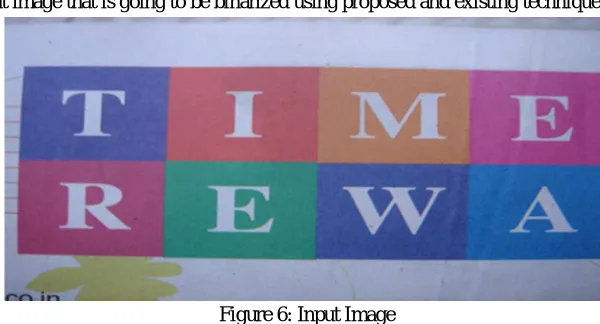
Figure 6 has shown the input image that is going to be binarized using proposed and existing technique.
Figure 6: Input Image
Technology (IJRASET)
[image:5.612.170.444.109.233.2]©IJRASET 2013: All Rights are Reserved
44
Figure 7: Existing Output
Figure 8 has shown the result of proposed algorithm. It is clearly shown that results are quite clear than the result of existing algorithm
[image:5.612.119.497.405.529.2]Figure 8: Proposed output
Figure 9 has shown the input image that is going to be binarized using proposed and existing technique.
Figure 9: Input Image
Figure 10 has shown the result of existing algorithm. It is clearly shown that results are not much clear.
Figure 10: Existing Output
Technology (IJRASET)
©IJRASET 2013: All Rights are Reserved
45
algorithm
Figure11: Proposed Output
V. PERFORMANCE ANALYSIS A. MSE (Mean Square Error)
The MSE is the average of the square of the difference between the desired response and the actual system output (the error). The mean square error (MSE) is one way to evaluate the difference between an estimator and the true value of the quantity being estimated.
MSE = ∑ ∑ ( ( , )− ( , )) B. PSNR (Peak Signal to Noise Ratio)
The term peak signal-to-noise ratio (PSNR) is an expression for the ratio between the maximum possible value (power) of a signal and the power of distorting noise that affects the quality of its representation.
PSNR =10 log ( )
√
C. NCC (Normalized Cross-Correlation)
For image-processing applications in which the brightness of the image and template can vary due to lighting and exposure conditions, the images can be first normalized.
NCC =∑∑ ∑∑ ( , )( ( , ))∗ ( , )
D. NAE (Normalized Absolute Error)
The large the value of NAE means that image is poor quality.
NAE = ∑ ∑∑ ∑| ( , ) )( , )| | ( , )|
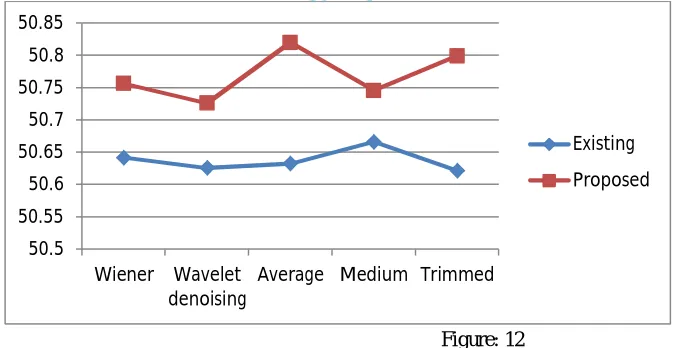
Table 1 and Figure 12 are showing the comparative analysis between proposed and the existing one in terms of PSNR for input image figure 3.
Filters Wiener Wavelet denoising
Average Medium Trimmed
Existing 50.6416 50.6256 50.6324 50.664 50.6276
Proposed 50.7586 50.7263 50.8201 50.7458 50.7993
Technology (IJRASET)
©IJRASET 2013: All Rights are Reserved
46
Figure: 12
Table 2 and Figure 13 are showing the comparative analysis between proposed and the existing one in terms of MSE for input image figure 3.
Filters Wiener Wavelet denoising
Average Medium Trimmed
Existing 0.5644 0.563 0.5621 0.5577 0.5639
[image:7.612.137.477.76.250.2]Proposed 0.546 0.5501 0.5384 0.5476 0.5409
Table:2
Figure:13
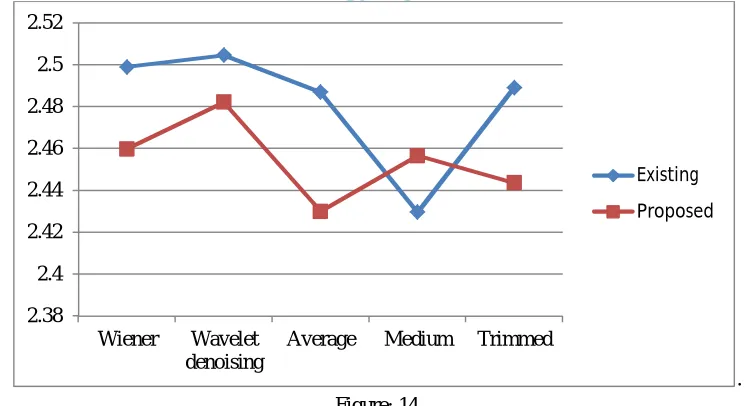
Table 3 and Figure 14 are showing the comparative analysis between proposed and the existing one in terms of NCC for input image figure 3.
Filters Wiener Wavelet denoising
Average Medium Trimmed
Existing 2.499 2.5046 2.487 2.4297 2.4892
Proposed 2.4598 2.4822 2.43 2.4566 2.4436
Table: 3
50.5 50.55 50.6 50.65 50.7 50.75 50.8 50.85
Wiener Wavelet denoising
Average Medium Trimmed
Existing
Proposed
0.52 0.53 0.54 0.55 0.56 0.57
Wiener Wavelet denoising
Average Medium Trimmed
Existing
[image:7.612.140.473.298.559.2]Technology (IJRASET)
©IJRASET 2013: All Rights are Reserved
47
[image:8.612.118.492.76.279.2]. Figure: 14
Table 4 and Figure 15 are showing the comparative analysis between proposed and the existing one in terms of NAE for input image figure 3.
Filters Wiener Wavelet denoising
Average Medium Trimmed Existing 2.7976 2.7922 2.7885 2.7711 2.7944 Proposed 2.7291 2.7451 2.7003 2.7336 2.7099
Table: 4
Figure: 15
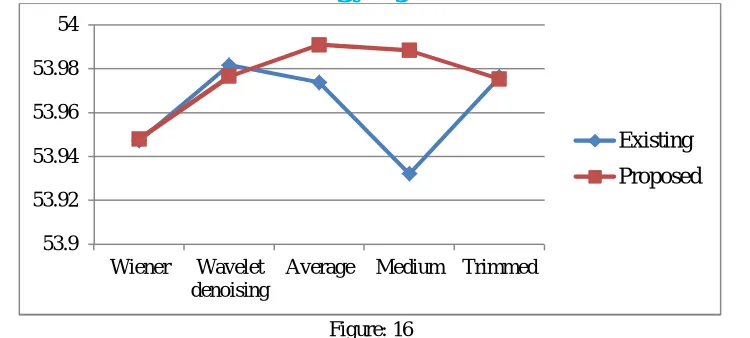
Table 5and Figure 16 are showing the comparative analysis between proposed and the existing one in terms of PSNR for input image figure 6.
Filters Wiener Wavelet denoising
[image:8.612.146.465.605.666.2]Average Medium Trimmed Existing 53.9473 53.9818 53.9739 53.9322 53.9764 Proposed 53.9481 53.9766 53.9909 53.9884 53.9754
Table: 5 2.38 2.4 2.42 2.44 2.46 2.48 2.5 2.52 Wiener Wavelet denoising
Average Medium Trimmed
Existing Proposed 2.64 2.66 2.68 2.7 2.72 2.74 2.76 2.78 2.8 2.82 Wiener Wavelet denoising
Average Medium Trimmed
Existing
Technology (IJRASET)
©IJRASET 2013: All Rights are Reserved
48
Figure: 16
[image:9.612.121.496.75.244.2]Table 6 and Figure 17 are showing the comparative analysis between proposed and the existing one in terms of MSE for input image figure 6.
Table: 6
Figure: 17
Table 7 and Figure 18 are showing the comparative analysis between proposed and the existing one in terms of NCC for input image figure 6.
Filters Wiener Wavelet denoising
[image:9.612.128.489.283.577.2]Average Medium Trimmed Existing 1.7553 17524 1.7456 1.7641 1.7502 Proposed 1.7319 1.744 1.7226 1.7321 1.7288
Table: 7 53.9
53.92 53.94 53.96 53.98 54
Wiener Wavelet denoising
Average Medium Trimmed
Existing
Proposed
0.257 0.258 0.259 0.26 0.261 0.262 0.263 0.264
Wiener Wavelet denoising
Average Medium Trimmed
Existing
Proposed
Filters Wiener Wavelet denoising
[image:9.612.145.462.613.674.2]Technology (IJRASET)
[image:10.612.144.470.78.252.2]©IJRASET 2013: All Rights are Reserved
49
Figure: 18
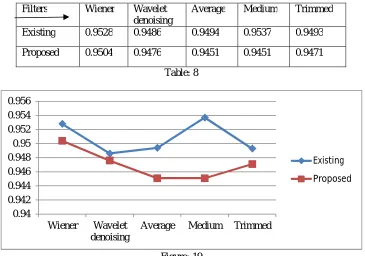
Table 8 and Figure 19 are showing the comparative analysis between proposed and the existing one in terms of NAE for input image figure 6.
Filters Wiener Wavelet denoising
[image:10.612.125.490.296.552.2]Average Medium Trimmed Existing 0.9528 0.9486 0.9494 0.9537 0.9493 Proposed 0.9504 0.9476 0.9451 0.9451 0.9471
Table: 8
Figure: 19
Table 9 and Figure 20 are showing the comparative analysis between proposed and the existing one in terms of PSNR for input image figure 9.
Filters Wiener Wavelet denoising
Average Medium Trimmed
Existing 56.5778 56.4238 56.5942 56.5998 56.5651
[image:10.612.129.484.587.689.2]Proposed 56.4339 56.3978 56.3622 56.4654 56.4708
Table: 9 1.7
1.71 1.72 1.73 1.74 1.75 1.76 1.77
Wiener Wavelet denoising
Average Medium Trimmed
Existing
Proposed
0.94 0.942 0.944 0.946 0.948 0.95 0.952 0.954 0.956
Wiener Wavelet denoising
Average Medium Trimmed
Existing
Technology (IJRASET)
©IJRASET 2013: All Rights are Reserved
50
Figure: 20
Table 10 and Figure 21are showing the comparative analysis between proposed and the existing one in terms of MSE for input image figure 9.
Filters Wiener Wavelet denoising
Average Medium Trimmed
[image:11.612.125.498.73.281.2]Existing 0.143 0.1481 0.1424 0.1423 0.1434 Proposed 0.1478 0.149 0.1503 0.1467 0.1466
Table: 10
[image:11.612.135.478.321.573.2]Figure: 21
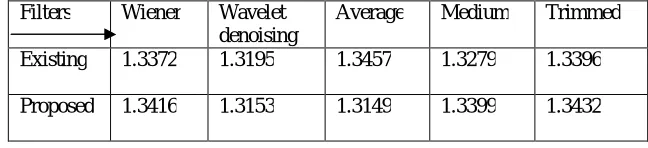
Table 11 and Figure 22 are showing the comparative analysis between proposed and the existing one in terms of NCC for input image figure 9.
Table: 11 56.2
56.25 56.3 56.35 56.4 56.45 56.5 56.55 56.6 56.65
Wiener Wavelet denoising
Average Medium Trimmed
Existing Proposed
0.138 0.14 0.142 0.144 0.146 0.148 0.15 0.152
Wiener Wavelet denoising
Average Medium Trimmed
Existing
Proposed
Filters Wiener Wavelet denoising
[image:11.612.142.466.613.687.2]Technology (IJRASET)
[image:12.612.138.473.69.252.2]©IJRASET 2013: All Rights are Reserved
51
Figure: 22
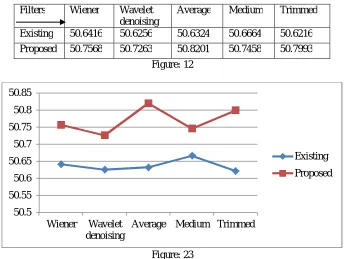
Table 12 and Figure 23 are showing the comparative analysis between proposed and the existing one in terms of NAE for input image figure 9.
Filters Wiener Wavelet denoising
[image:12.612.134.481.292.551.2]Average Medium Trimmed Existing 50.6416 50.6256 50.6324 50.6664 50.6216 Proposed 50.7568 50.7263 50.8201 50.7458 50.7993
Figure: 12
Figure: 23 VI. CONCLUSION
It has been found that every technique has its own advantages and disadvantages. Each case requires its own method of binarization for text extraction form images. The main limitation of existing technique is found that images are noisy and low intensity. The different filtering has been applied to the existing and proposed algorithms. The comparative analysis has shown that the proposed algorithm outperform over the existing method.
REFERENCES
[1] Satish Kumar, Sunil Kumar, Dr. S.Gopinath,“ Text Extraction From Images” Image Processing, International Journal of Advance Research in Computer Engineering and Technology Volume 1 ,Issue 4,June 2012.
[2] T Kasar , J Kumar , A G Ramakrishnan,” Font and background color independent text binarization ” In Proceedings of 2nd International Workshop on Camera Based Document Analysis and Recognition,2007
[3] Stathis, Pavlos, Ergina Kavallieratos, and Nikos Papamarkos. "An evaluation survey of binarization algorithms on historical documents." Pattern Recognition, 2008. ICPR 2008. 19th International Conference on. IEEE, 2008.
[4] Su, Bolan, Shijian Lu, and Chew Lim Tan. "Combination of document image binarization techniques." Document Analysis and Recognition (ICDAR), 2011 International Conference on. IEEE, 2011.
1.295 1.3 1.305 1.31 1.315 1.32 1.325 1.33 1.335 1.34 1.345 1.35 Wiener Wavelet denoising
Average Medium Trimmed
Existing Proposed 50.5 50.55 50.6 50.65 50.7 50.75 50.8 50.85 Wiener Wavelet denoising
Average Medium Trimmed
Technology (IJRASET)
©IJRASET 2013: All Rights are Reserved
52
[5] Papavassiliou, Vassilis, et al. "A Morphology Based Approach for Binarization of Handwritten Documents." Frontiers in Handwriting Recognition (ICFHR), 2012 International Conference on. IEEE, 2012.
[6] Su, Bolan, Shijian Lu, and Chew Lim Tan. "A learning framework for degraded document image binarization using Markov random field." Pattern Recognition (ICPR), 2012 21st International Conference on. IEEE, 2012.
[7] Patvardhan, C., A. K. Verma, and C. Vasantha Lakshmi. "Document image denoising and binarization using Curvelet transform for OCR applications."Engineering (NUiCONE), 2012 Nirma University International Conference on. IEEE, 2012.
[8] Su, Bolan, Shijian Lu, and Chew Lim Tan. "Robust document image binarization technique for degraded document images." Image Processing, IEEE Transactions on 22.4 (2013): 1408-1417.
[9] Pratikakis, Ioannis, Basilis Gatos, and Konstantinos Ntirogiannis. "ICDAR 2013 Document Image Binarization Contest (DIBCO 2013)." Document Analysis and Recognition (ICDAR), 2013 12th International Conference on. IEEE, 2013.
[10] Sehad, Abdenour, et al. "Ancient degraded document image binarization based on texture features." Image and Signal Processing and Analysis (ISPA), 2013 8th International Symposium on. IEEE, 2013.
[11] Nafchi, Hossein Ziaei, Reza Farrahi Moghaddam, and Mohamed Cheriet. "Application of Phase-Based Features and Denoising in Postprocessing and Binarization of Historical Document Images." Document Analysis and Recognition (ICDAR), 2013 12th International Conference on. IEEE, 2013.
[12] Parker, Jon, Ophir Frieder, and Gideon Frieder. "Automatic Enhancement and Binarization of Degraded Document Images." Document Analysis and Recognition (ICDAR), 2013 12th International Conference on. IEEE, 2013.
[13] Jagroop Kaur, Dr.Rajiv Mahajan “Improve Degraded Document Image Binarization using Guided Image Filter” ,International Journal of Advanced Research in Computer and Communication Engineering Volume 3, Issue 5, May 2014.
[14] K.Ntirogiannis,B.Gatos,I.Pratikaki,“A combined approach for the binarization of handwritten document images”, Pattern recognition letters, Volume 35,pp 3-15,January 2014.
[15] Gaceb, Djamel, Frank Lebourgeois, and Jean Duong. "Adaptative Smart-Binarization Method: For Images of Business Documents." Document Analysis and Recognition (ICDAR), 2013 12th International Conference on. IEEE, 2013.