5
VIII
August 2017
854
©IJRASET (UGC Approved Journal): All Rights are Reserved
Intelligent Driver Assistance System
Aadavan K
Electronics and Communication Engineering, Rajalakshmi Institute of Technology
Abstract: In present world, where accidents have become more a day to day happening . It is high time that we come up with a plan to suppress it down. Our paper concentrates on how these daunting accidents which has great toll on valuable lives can be curtailed. In India; we don’t have a complicated system which could facilitate to control the accidents. So we have a taken an initiative to control the dreadful accidents, which is at soaring rates at present by means of this paper. Our paper is about the prevention of accidents in case of bent roads where most accidents is suspected to happen as in this case vehicle on one side ignorant about the vehicle coming on the other side. In this paper, we instill awareness in the driver of vehicle coming on one side of the road about the speed and type of other side vehicle of a bent road and make him cautious about the dangers befall him. In this paper we have used wireless sensors to demonstrate our idea. Wireless Sensors being a novel concept we really suppose this will help us to transform our idea. We really presume that this paper will really help in reducing the atrocious accidents which has a dreadful effect on lives.
Keywords: accidents, prevention, wireless sensors, awareness
I. INTRODUCTION
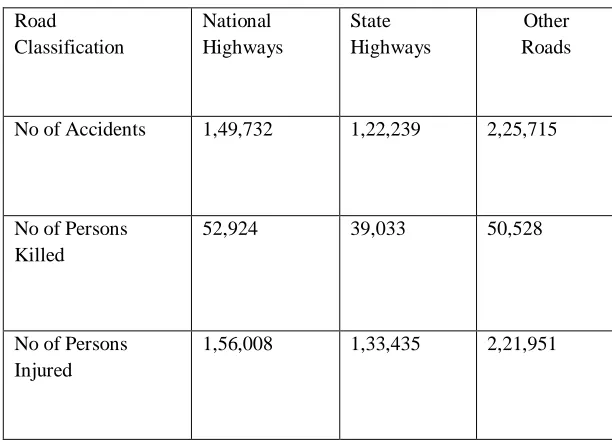
[image:2.612.151.457.490.711.2]Road accidents are an outcome of the interplay of various factors, some of which are the length of road network, vehicle population, human population and enforcement of road safety regulations etc. Road accident causes injuries, fatalities, disabilities and hospitalization with severe social economic costs across the country. Consequently, road safety has become an issue of concern both at national and international level. The total number of road accidents increased by 2.5 percent from 4,89,400 in 2014 to 5.01,423 in 2015. The total number of persons killed increased by 4.6 per cent from 1,39,671 in 2014 to 1,46,133 in 2015. Road accident injuries have also increased by 1.4 per cent from 4,93,474 in 2014 to 5,00,279 in 2015. Accident severity ( number of persons killed per 100 accidents) has gone up from28.5 in 2014 to 29.1 in 2015.It further reveals that 57 accidents take place and 17 lives are lost every hour on an average in road accidents in our country. There is one death every four minutes due to a road accident in India.One serious road accident in the country occurs every minute and 16 die on Indian roads every hour.1214 road crashes occur every day in India. Tamil Nadu is the state with the maximum number of road crash injuries.
Table 1: Accidents, persons killed and injured
. Road Classification National Highways State Highways Other Roads
No of Accidents 1,49,732 1,22,239 2,25,715
No of Persons Killed
52,924 39,033 50,528
No of Persons Injured
855
©IJRASET (UGC Approved Journal): All Rights are Reserved
[image:3.612.158.415.97.279.2]
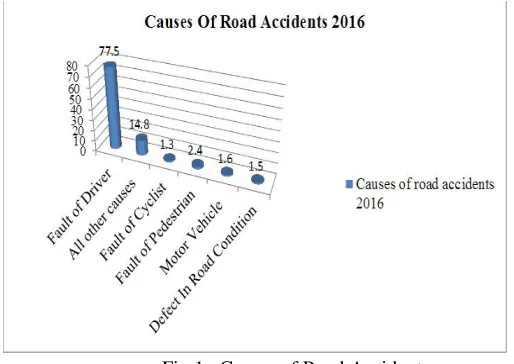
Fig 1 : Causes of Road Accidents
II. RELATED WORK
Susmit Nanda et al,[13] in 2015 worked on Infrared Sensor to Control Speed of an Arduino Based Car, which integrates new technologies, offering ease of maintenance and energy
savings and advantages is surface material is identified in this system and infrared sensor is used and limitations is distance cannot be measured and accuracy Pasy Pyykonen et al,[9] in 2015, in their work on developing blind Spot Mirrors and advanced Blind Spot Detection systems assist in avoiding collisions.One of the targets of the project was to introduce driver monitoring in training vehicles of professional truck drivers.For the training supervisor, it is challenging to recognise all situations when the candidate is not paying sufficient attention to traffic during the driving session. Thus, the driving monitoring system helps to gather the data during the education period.More advanced ITS solutions are Blind Spot Detection systems, which detect objects in blind spots and warn drivers.
Joan Albesa et al,[6] in 2012, in their work on seat belt sensor application to occupancy and belt detection in removable vehicle seats.This system used Occupancy sensor to detection of person in the driver seat.Safety systems in vehicles aim to reduce injuries of the occupants in an accident. The use of seat belt reminder systems is effective in reminding the vehicle occupants to buckle up and is reported as one of the most effective ways in avoiding deaths and injuries in traffic accidents. Advantages are occupancy sensor is used in this system and safety is increased in the system.Disadvantages sensor is costly,limit switch is not used.
E.Dagan et al,[5] in 2014, in their work on collision avoidance using single camera.It uses a single forward facing camera located typically near the rear view mirror, the camera detects and tracks vehicles on the road ahead providing range,relative speed and lane position data. The system detects
also the lane markings and road edges and measures the distance of the host vehicle to road boundaries. Thus it combines together on the same platform Forward Collision Warning, Lane Departure Warning and Headway Monitoring.It can also be connected to active safety systems. Advantages are slow avoidance and sudden brake avoidance.
III. EXISTING METHOD
In the current scenario, Anti braking system is used to stop the vehicle.ABS increases the efficiency of braking and accidents are reduced if brakes are applied perfectly. Manual head light beam adjustment are used to change the beam from high beam to low beam .Infrared sensor is used in determining vehicle detection for parking and lane change support. Occupancy sensor is used in seat belt detection system .Eye tracking is sensor is used in high end cars.
A. Limitations
856
©IJRASET (UGC Approved Journal): All Rights are Reserved
IV. PROPOSED MODEL
[image:4.612.185.425.152.276.2]Designed and made especially for Indian roads.Speed control using ultrasonic sensors.Blind spot detection using display and speakers.Smart head light beam technology.Speed limiter using seat belt. (40km/hr.).Speed control and blind spot detection will work on speed greater than 60km/hr. (Specially made for highway)
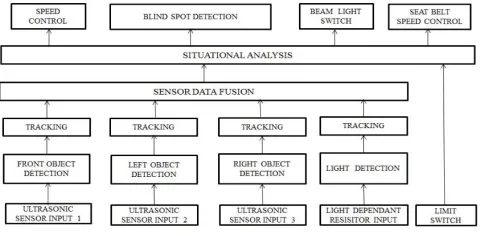
Fig 2 : block diagram of proposed model
Fig 3: explanation of the block diagram
This project is based on intelligent driver assistance system to control the vehicle to avoid the accidents. To design and implement a system that helps the driver of the automobile like car, heavy vehicles, etc. to drive smartly in the road and to prevent accidents. This is achieved by using various sensors like ultra-sonic sensor, LDR Sensor etc., that detects the objects on the road, blind spot detection, seat belt speed limiter and smart head light beam to make decisions whether to warn or act on behalf of a driver.Arduino Mega is the brain of the small computer based system and it is used to control all the devices into the single unit.
A. Smart Beam Light Switch
In this block diagram, light is the input given to the LDR sensor and from there it is provided to the Arduino Microcontroller. It is conditioned by using the signal conditioned unit to glow the LED either High or Low beam. LDR Sensor is used to sense the light depends on the resistance value. During night, we face difficult to drive in roads due to high beam in opposite vehicle. In this module we sense the light from the opposite vehicle using LDR and change the beam to low beam accordingly. After the vehicle passes by automatically the car light changes to its original state.
B. Speed Control
[image:4.612.188.430.319.437.2]857
©IJRASET (UGC Approved Journal): All Rights are Reserved C. Blind Spot Detection
This driver assistance technology senses cars coming up in your blind spot behind or alongside you. You’re warned by a display in front of you and then with buzzer sound on side of the vehicle If you’re not planning to change lanes (there is no turn signal on), the warning light glows steadily but doesn’t flash and there’s no audible alert.
D. Seat Belt Speed Limiter
A system for detecting proper usage of a seatbelt in a vehicle by an operator of the vehicle is provided. Limit switch is fixed in the seat belt. If seat belt is not used by the driver and co-driver the car will not go speeds greater than 40km/hr.If seat belt is used the car will achieve is its maximum speed. If seat belt is removed after moving vehicle the car automatically gradually reduces speed with a buzzer intimating the driver.
V.RESULT
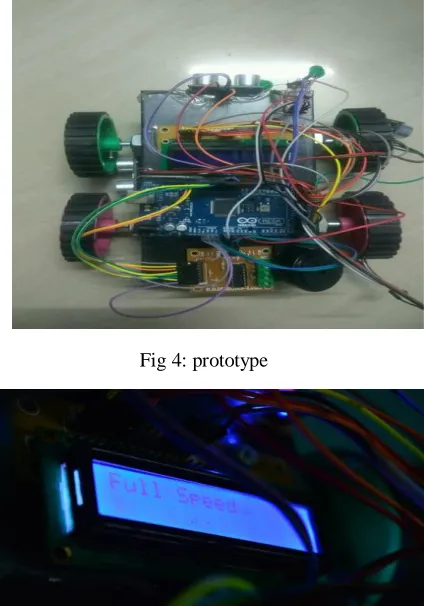
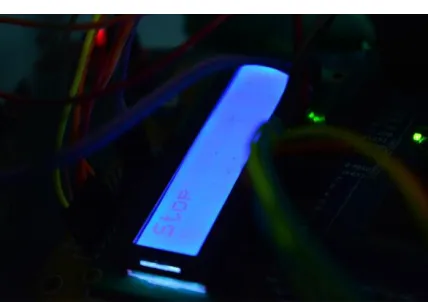
Here, various weather parameters like speed control, smart beam light, blind spot detection and limit switch are continuously monitored and the output attained is displayed in lcd , motor, led and buzzer. displayed in lcd , motor, led and buzzer. .Once the hardware is assembled coding and testing process is done. Then the coding will run via Arduino IDE. The information displayed in the LCD.We sense the light from the opposite vehicle using LDR and change the beam to low beam accordingly. After the vehicle passes by automatically the car light changes to its original state.Speed control is done using ultrasonic sensors. A ultrasonic sensor is placed in front of the vehicle and that sense the obstacle within the range of 20cm. If it senses the data it sends the data to the micro controller and controller stops the vehicle by reducing the speed of the motor to 80 rpm and another 2 ultrasonic sensors which are kept aside will sense whether there is way or not and send the data to controller .When there is a way is any of the side, it will notify us in lcd display and buzzer and we can
drive through it, when no way is detected and vehicle is about less than 10cm, the vehicle stops and displaying no way.
[image:5.612.204.416.392.695.2]
Fig 4: prototype
858
[image:6.612.196.406.89.197.2]©IJRASET (UGC Approved Journal): All Rights are Reserved
[image:6.612.198.409.224.365.2]Fig 6: when the vehicle is detected at 20 cm, Left clear
Fig 7: when the vehicle is detected at 20 cm,Right clear
Fig 8: when there is no way
[image:6.612.196.411.393.544.2] [image:6.612.198.412.554.705.2]
859
©IJRASET (UGC Approved Journal): All Rights are Reserved
VI. CONCLUSION AND FUTURE WORK
Safety features are designed to avoid collisions and accidents by offering technologies that alert the driver to potential problems, or to avoid collisions by implementing safeguards and taking over control of the vehicle. Future features will be fully automated driving system. Future plans are to develop the system further and to bring the concept in use in .professional truck driver training. It shall bring different means to adapt e-learning solutions, serious games, practical exercises with real vehicles and simulator (high-end and low-(high-end) based training together. The individual development of learned skills is followed during the training period. This enables personalized learning methods and duration. An important part of the concept is to pre-test the drivers and to plan training accordingly
A. Less-Experienced Driver
Electronic stability control (also known as cornering break control), adaptive cruise control and forward collision avoidance technology.
B. Frequent Night Driver
Drowsiness alert and adaptive headlights.
REFERENCES
[1] J. de Boeij, E. Lomonova, and J. Duarte, “Contactless planar actuator with manipulator: A motion system without cables and physical contact between the
mover and the fixed world,” IEEE Trans. Ind. Appl., vol. 45, no. 6, pp. 1930–1938, Nov./Dec. 2009.
[2] M. Budhia, G. A. Covic, and J. T. Boys, “Design and optimization of circular magnetic structures for lumped inductive power transfer systems,” IEEE Trans.
Power Electron., vol. 26, no. 11, pp. 3096–3108, Nov. 2011.
[3] J. Casselgren. “Road surface classification using near infrared Spectroscopy”. Licentiate thesis. Dept. Appl. Physics and Mech.Eng.,
[4] Luleå Univ. of Tech, Luleå, Sweden, 2015
[5] J.Casselgren, M. Sjödahl, M. Sanfridsson, and S. Woxneryd, "Classification of road conditions - to improve safety," in Advanced Microsystems for automotive
Applications 2007, J. Valldorf and W.Gessner, eds. (Springer,Berlin, Germany 2007), pp. 47-59
[6] E.Dagan, O. Mano, G.P. Stein“Forward Collision Warning with a Single Camera” to improve safety and avoid collision,mobile eye vision Technologies Ltd.
Technologies Ltd. Jerusalem, Israel, 2014.
[7] Joan Albesa and Manel Gasulla “Monitoring Switch-Type Sensors via Inductive Coupling: application to Occupancy and Belt Detection in Removable Vehicle
Seats” (2012)
[8] H. L. Li, A. P. Hu, and G. A. Covic, “A direct AC–AC converter for inductive power-transfer systems,” IEEE Trans. Power Electron., vol. 27,no. 2, pp. 661–
668, Feb. 2012.
[9] Matti Kutila, Pasi Pyykönen, Aarno Lybeck, Pirita Niemi, Erik Nordin. Towards Autonomous Vehicles with Advanced Sensor Solutions. IEEE 11th
International Conference on Intelligent Computer Communication and Processing (2015 IEEE ICCP). Cluj-Napoca, Romania. 3-5 Sep 2015.
[10] Pasy Pyykonen, Ari Virtanen, Arto Kyytinen “Developing intelligent blind spot detection system for Heavy Goods Vehicles” 2015.
[11] V. Pavlov, H. Ruser and M. Horn, “Feature extraction from an infrared sensor array for localization and surface recognition of moving cylindrical objects,”
Proc. IEEE Conference on Instrumentation and Measurement Technology, pp. 1-6, 2007.
[12] J. Scholliers, D. Bell, A. Morris, A.B. Garcia, “Improving safety and mobility of Vulnerable Road Users through ITS applications,” Transport Research Arena