Technology (IJRASET)
New Method for Solar Tracker Using Spiral
Spring in Simulink
Pankaj Deshmukh1, Prof. Anil Thosar2
Electronics Department, Mumbai University
Abstract—On an average the sunshine hour in India is about 6hrs annually also the sun shine shines in India for about 9 months in a year. Electricity from the sun can be generated through the solar photovoltaic modules (SPV). The SPV comes in various power output to meet the load requirement. Maximization of power from a solar photo voltaic module (SPV) is of special interest as the efficiency of the SPV module is very low. Power estimation is associated with careful investigation and calculation as aspect of system design. Various methods are employed to enhance or achieved maximum power from Solar Panel which include different solar Trackers. This paper will compare two solar Tracking models in which operating power consumption is analyzed. The main system design is based on gear and spring driver. The initial costs may be high but power consumed in design system is zero and total power is utilized by load. Maximum energy save from proposed tracking system is 30%.In tropical countries, which have sunshine almost throughout the year in most parts will generate electricity throughout the year. This form of renewable energy occupies less space compared to the space occupied by other power projects. Developing countries can cover all their demands for energy by solar systems with 0.1% of the land area.
Keywords— Spring, Solar photovoltaic modules, Maximum power, Solar Tracker, Electricity, Solar system
I. INTRODUCTION
Renewable energy sources play an important role in electricity generation. Various renewable energy sources like wind, solar, geothermal, ocean thermal, and biomass can be used for generation of electricity and for meeting our daily energy needs [1] [2]. Energy from the sun is the best option for electricity generation as it is available everywhere and is free to harness. On an average the sunshine hour in India is about 6hrs annually also the sun shine shines in India for about 9 months in a year [3].
Electricity from the sun can be generated through the solar photovoltaic modules (SPV) [4] [6]. The SPV comes in various power output to meet the load requirement. Maximization of power from a solar photo voltaic module (SPV) is of special interest as the efficiency of the SPV module is very low [7]. Power estimation is associated with careful investigation and calculation as aspect of system design [5] [6].
The most important concern is to know how power is saved and system is more efficient. The present work describes that replace existing tracker without motor. The entire system design is based on gear and spring driver. The initial costs may be high but power consumed in designed system is zero and total power from SPV can be utilized by load. Maximum power saved from proposed tracking system is about 30%. In tropical countries, which have sunshine almost throughout the year in most parts, solar energy is one of the most viable options. Energy from the sun has been used to provide electricity for many years.
II. LITERATUREREVIEW
Technology (IJRASET)
output power by 44% as compared to PV flat-plate system for passively cooled modules. Design models with lower trough angles gave higher output power because of higher glass transitivity. PV modules with lower series resistance gave higher gain in output power [9].
III. SOLARENERGYANDRADIATION
Before talking about the solar tracking systems, we will review some basic concepts concerning solar radiation and mention some important values to better understand the results of this work. The sun, at an estimated temperature of 5800 K, emits high amounts of energy in the form of radiation, which reaches the planets of the solar system. Sunlight has two components, the direct beam and diffuse beam. Direct radiation (also called beam radiation) is the solar radiation of the sun that has not been scattered (causes shadow). Direct beam carries about 90% of the solar energy, and the "diffuse sunlight" that carries the remainder.
A. Solar Altitude (θz)
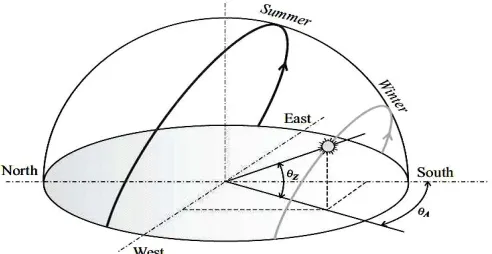
The solar altitude is the vertical angle between the horizontal and the line connecting to the sun. At sunset/sunrise altitude is 0 and is 90 degrees when the sun is at the zenith as shown in Fig 1. The altitude relates to the latitude of the site, the declination angle and the hour angle.
B. Solar Azimuth (θA)
[image:3.612.198.444.342.469.2]The azimuth angle is the angle within the horizontal plane measured from true South or North. The azimuth angle is measured clockwise from the zero azimuths. For example, if you're in the Northern Hemisphere and the zero azimuths are set to South, the azimuth angle value will be negative before solar noon and positive after solar noon.
Fig. 1 Solar altitudes and azimuths typical behavior of sun path
IV. SOLARCELLANDPVARRAY
The solar cell is composed of the semiconductors of the P-N junctions, convert light into electric energy. The open circuit voltage of a single solar cell is approx 0.5V.Much higher voltage is required for practical application. Solar cells are connected in series to increase its open circuit output voltage and they are connected in parallel to increase current capacity. Such series & parallel connections form module of PV cells.
[image:3.612.194.430.578.699.2]Technology (IJRASET)
V. SOLARTRACKER
Solar Tracker is a device which follows the movement of the sun as it rotates from the east to the west every day. The main function of all tracking systems is to provide one or two degrees of freedom in movement. Trackers are used to keep solar collectors/solar panels oriented directly towards the sun as it moves through the sky every day. Using solar trackers increases the amount of solar energy which is received by the solar energy collector and improves the energy output of the heat/electricity which is generated. Solar trackers can increase the output of solar panels by 20-30% which improves the economics of the solar panel project.
A. Drive Types
Passive Trackers:-The term "passive tracker" is also used for photovoltaic modules that include a hologram behind stripes of photovoltaic cells. Sunlight passes through the transparent part of the module and reflects from the hologram. This allows sunlight to hit the cell from behind, thereby increasing the module's efficiency. The module does not have to move since the hologram always reflects sunlight from the correct angle towards the cells.
Active Trackers: - Active Trackers use motors and gear trains to direct the tracker as commanded by controller responding to the solar direction.
[image:4.612.115.493.302.468.2]VI. PROPOSEDWORKMETHODOLOGY:SPIRALSPRINGBASEDTRACKER
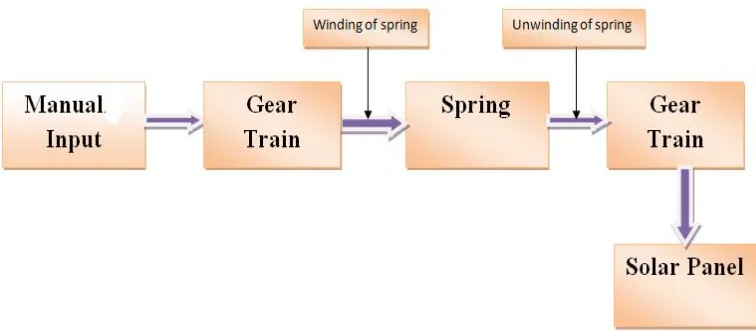
Fig. 3 Block diagram of proposed single axis active tracker
The proposed project is simulation of spiral spring controlled solar tracker by using Mat lab Simulink. As the sun rotates throughout the day, fixed solar panels are not in a position to receive the maximum amount of sunlight. It is necessary to make sure that the collector position is optimized so that it can collect the maximum amount of solar energy. In order to collect the most amount of sunlight, the solar energy systems must be able to track the sun’s movement throughout the day.
The system tracks the sun east-to-west along one axis (azimuth). The other thing is tracking system must be very accurate on the longitude and latitude; otherwise it will significantly reduce the efficiency of the system.
In this section, the main aim is to simulate the single axis solar tracking system during the day time using MATLAB / Simulink. The simulation of the solar system is developed for testing and implementation. Our model is independence of all the parameters with respect to solar radiation and temperature. The simulation results show that the output characteristics of the simulator have a good agreement with those of the actual photovoltaic panel in various loads conditions i.e. for different value of panel additionally the simulator has a good dynamic response.
The SPV panel mounted on the shaft with bearings at both ends will be rotated with the help of released energy from spring, like an hour hand of watch. It is rotated in 180o within 12 hours. If we give more strength spring the panel will come back to its original position after 24 hours. It is necessary to wind spring at regular intervals. Thus human intervention is required at regular intervals, however conventional motorized systems also rotate the panel only during day time with motor and panel need to be brought to original position manually at night.
Technology (IJRASET)
Efficiency of system.
[image:5.612.102.520.140.356.2]VII.SIMULINKMODELOFSPRINGTRACKER
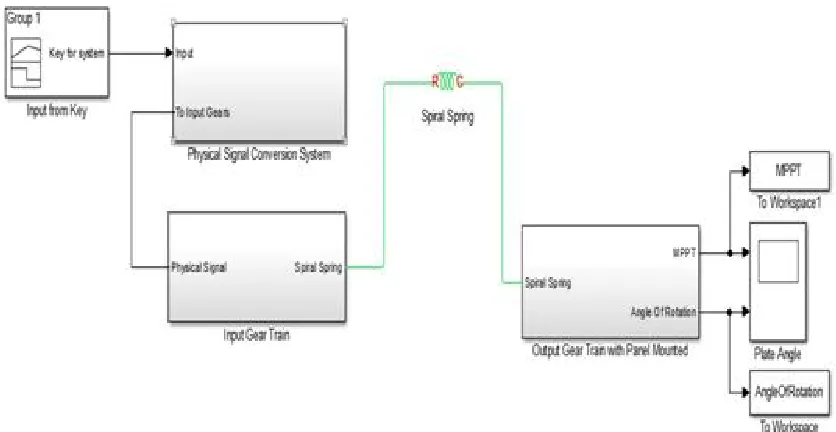
Fig. 4 Simulink model of spring tracker
The Physical signal gives to ideal angular velocity source which converted it into Rotational Velocity & Angular Displacement. The winding of spring is now done with help of gear train i.e. input gear train which is connected to spring. In this process the Energy is stored in the spring through key and gear train. The gear box is characterised by the gear ratio. Connection S and O are Mechanical rotational conserving ports associated with the box input and output shaft respectively. The gear ratio is determined as the ratio of the input shaft angular velocity to the output shaft angular velocity. Unwinding of the spring generates mechanical movement of rotation in terms of angle.
VIII. RESULTOFTHESYSTEM
[image:5.612.84.539.503.700.2]Technology (IJRASET)
IX. CONCLUSIONS
Initial cost of spring based system even if it is little higher than conventional system. This cost will be recovered early by saving energy which is otherwise required to drive the motor. More power is available to drive the load. Maintenance cost is also less as compared to motorized system. Maintenance can be done by semiskilled person. So such system can be installed in rural areas. This is a simple and robust system. The simulation results demonstrate the effectiveness and robustness of the proposed method.
X. ACKNOWLEDGMENT
I would like to express our gratitude towards all the people who have imparted their valued time and efforts to help us in completing this project, without whom it would not been possible for us to understand and examine the project. I would like to thank Prof. Anil Thosar, Prof.Milind Marathe, Professors Head, Department of Electronics Engineering, K.J College of Engineering, Vidya vihar Mumbai our Project Supervisor, for his guidance, support, and motivation and encouragement throughout the period this work was carried out. His readiness and eagerness for consultation at all times, his educative inputs, his concern and assistance have been invaluable. Finally, we wish to express our sincere appreciation and thanks to our college library and all those who have guided and helped us directly or indirectly for accomplishing our goal.
REFERENCES
[1] I. Dincer, “Renewable Energy and Sustainable Development: A Crucial Review,” Renewable and Sustainable Energy Reviews, vol. 4, no. 2, pp. 157–175, 2000, issn: 1364-0321.
[2] M. Adnan, D. Ibrahim, and A. Murat, “Green Energy Strategies for Sustainable Development,” Energy Policy, vol. 34, no. 18, pp. 3623 –3633,2006, issn: 0301-4215 .
[3] C. S. Sangani and C. S. Solanki, “Experimental Evaluation of V-Trough (2 Suns) PV Concentrator System Using Commercial PV Modules”, Solar Energy Materials & Solar Cells, 91(2007), pp. 453–459.
[4] S. Abdallaha and O. O Badranb, “Sun Tracking System for Productivity Enhancement of Solar Still”, Desalination,220(2008), pp. 669–676. [5] S. A. Kalogirou, “Design and Construction of a One-Axis Sun-Tracking System”, Solar Energy, 57(1996), pp.465–469.
[6] Effect of manual tilt adjustments on incident irradiance on fixed and Tracking solar panels. Applied Energy. Nahidul Hoque Samrat, 1 Norhafizan Bin Ahmad, 1 ,* Imtiaz Ahmed Choudhury, 1 and Zahari Bin Taha 2ScientificWorldJournal. 2014; 2014: 436376. 2014 Apr 30: 10.1155/2014/436376
[7] Chang, T.P. 2009. The gain of single-axis tracked panel according to extraterrestrial Radiation. Applied Energy. 86: 1074–1079. 2009 .
[8] C. Sungur, “Multi-Axes Sun-Tracking System With PLC Control for Photovoltaic Panels in Turkey”, RenewableEnergy, 34(2009), pp. 1119–1125.